
Oversized Cargo Transportation Market Size and Share
Market Overview
| Study Period | 2020 - 2031 |
|---|---|
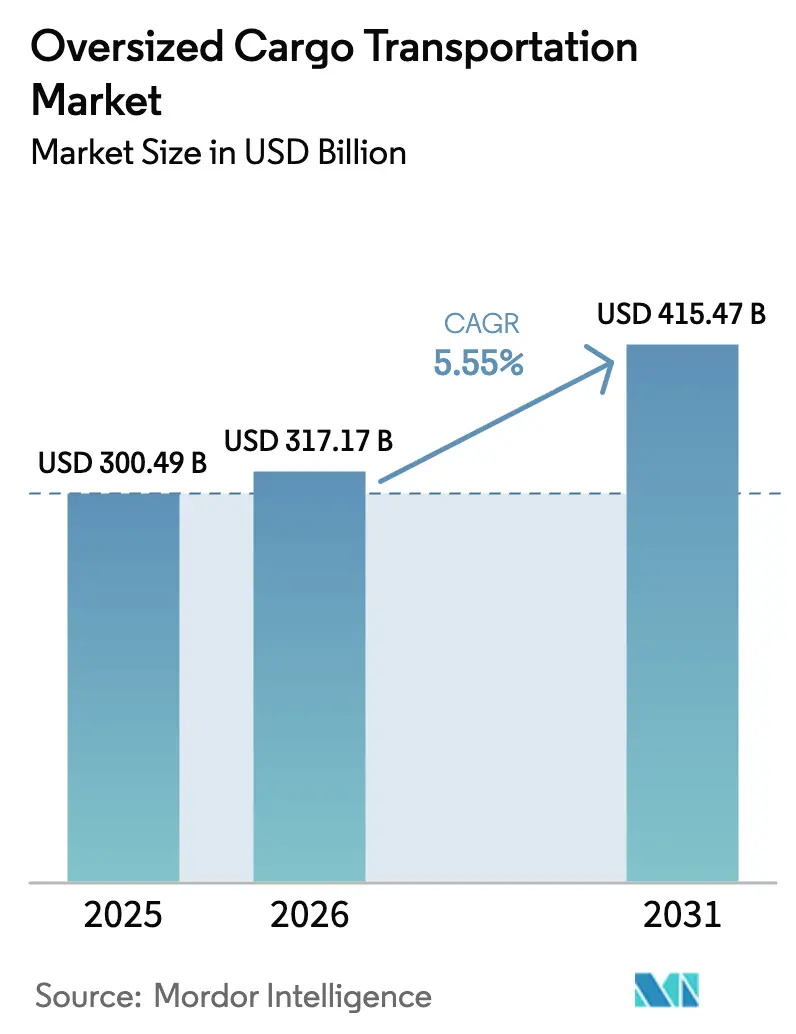
| Market Size (2026) | USD 317.17 Billion |
| Market Size (2031) | USD 415.47 Billion |
| Growth Rate (2026 - 2031) | 5.55 % |
| Fastest Growing Market | Asia Pacific |
| Largest Market | North America |
| Market Concentration | Medium |
Major Players *Disclaimer: Major Players sorted in no particular order Image © Mordor Intelligence. Reuse requires attribution under CC BY 4.0. | |
Oversized Cargo Transportation Market Analysis by Mordor Intelligence
The Oversized Cargo Transportation Market size is expected to grow from USD 300.49 billion in 2025 to USD 317.17 billion in 2026 and is forecast to reach USD 415.47 billion by 2031 at 5.55% CAGR over 2026-2031. This durable growth reflects the rising scale of energy, manufacturing, and construction assets that exceed standard shipping envelopes. Persistent investment in renewable-energy installations, deep-water oil platforms, and modular industrial plants keeps demand steady even during economic slowdowns. Operators that combine specialized heavy-lift vessels with road-rail trans-shipment hubs improve schedule reliability and lower per-ton costs, creating competitive differentiation. Technology adoption, particularly digital twin-enabled route modeling, optimizes axle loads, bridge clearances, and vessel drafts, trimming empty repositioning mileage. Meanwhile, charter-rate volatility and multi-jurisdictional permit rules introduce operating risk, propelling larger providers to acquire niche specialists and lock in multimodal capacity for the next project cycle.
Key Report Takeaways
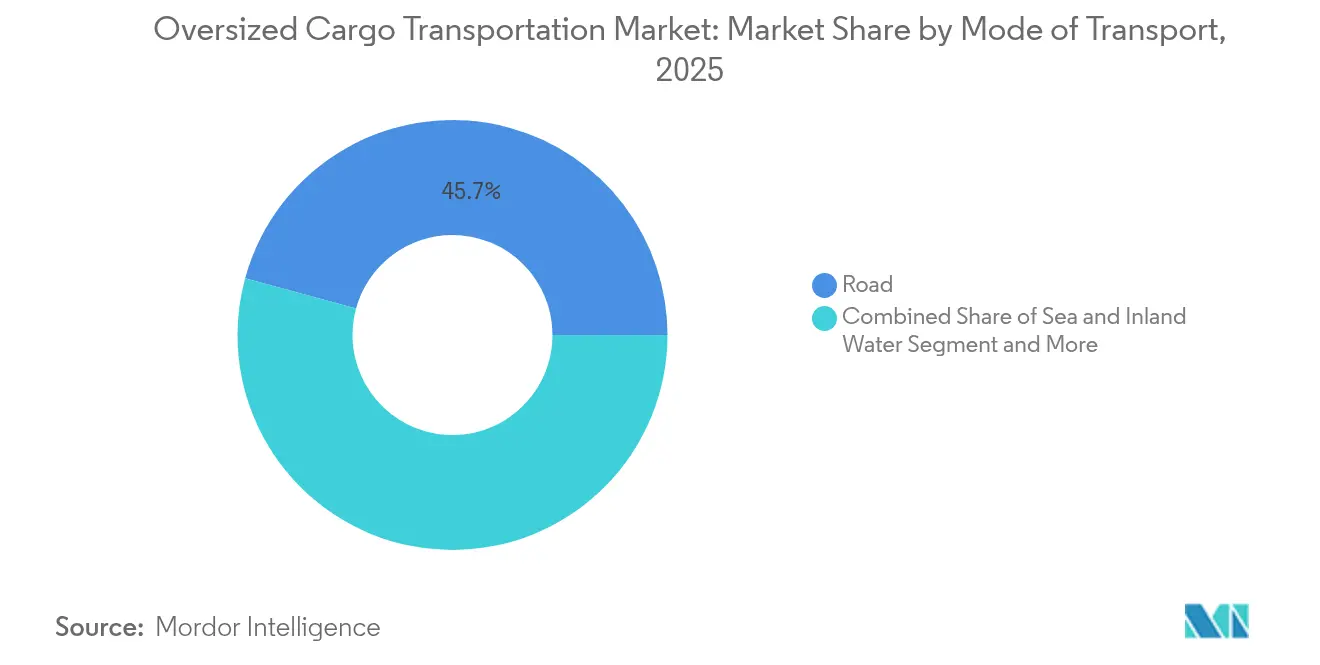
- By mode of transport, roads held 45.74% of the oversized cargo transportation market share in 2025, whereas sea freight is projected to grow at an 8.39% CAGR through 2031.
- By end-use industry, construction & infrastructure commanded 26.12% of the oversized cargo transportation market size in 2025, while renewable energy is advancing at an 11.25% CAGR over 2026-2031.
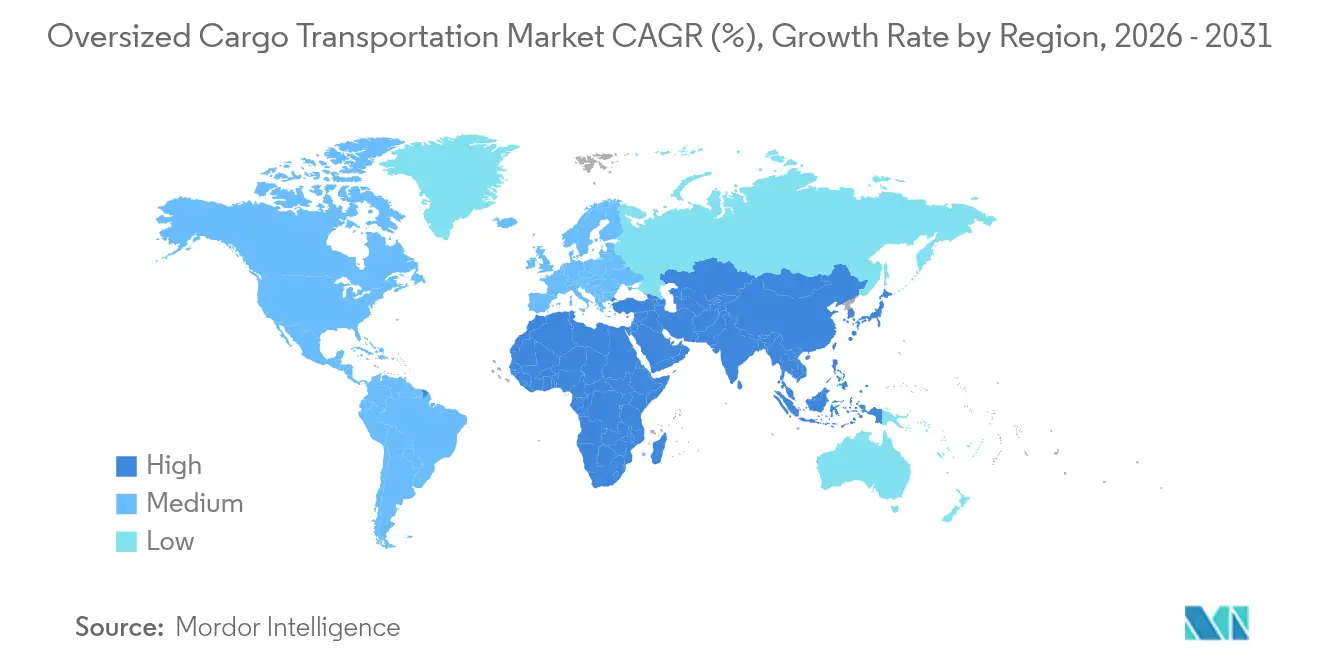
- By geography, North America led with 32.20% of the oversized cargo transportation market share in 2025; Asia-Pacific registers the highest projected CAGR at 9.02% to 2031.
Note: Market size and forecast figures in this report are generated using Mordor Intelligence’s proprietary estimation framework, updated with the latest available data and insights as of 2026.
Market Trends and Insights
Drivers Impact Analysis of Oversized Cargo Transportation Market*
| Driver | (~) % Impact on CAGR Forecast | Geographic Relevance | Impact Timeline |
|---|---|---|---|
| Expansion of renewable-energy project components | +1.8% | Global, strong in North America, Europe, Asia-Pacific | Long term (≥ 4 years) |
| Growth in mega infrastructure & construction projects | +1.5% | Asia-Pacific core; spill-over to Middle East, North America | Medium term (2-4 years) |
| Rising offshore oil & gas exploration in deepwater | +1.2% | North America (Gulf of Mexico), South America (Brazil), Europe (North Sea) | Long term (≥ 4 years) |
| Increasing the average size of industrial equipment & plant modules | +0.9% | Global; emphasis on Asia-Pacific, North America | Medium term (2-4 years) |
| Emergence of extra-large cargo aircraft enabling new inland routes | +0.6% | Global, early adoption in North America, Europe | Short term (≤ 2 years) |
| Digital-twin route optimization for heavy haulage | +0.4% | Global, advanced in Europe, North America | Short term (≤ 2 years) |
| Source: Mordor Intelligence | |||
Expansion of Renewable-Energy Project Components
Wind-turbine blades now span beyond 100 meters while nacelles exceed 400 tons, pushing road-escort clearances and crane capacities. The United States Department of Energy’s Big Adaptive Rotor program explores segmented or foldable blades to navigate tight highway radii without sacrificing energy capture[1]U.S. Department of Energy, “Big Adaptive Rotor: Flexible Blade Concepts for Land-Based Turbines,” U.S. Department of Energy, energy.gov. Offshore foundations intensify complexity: Boskalis’ 45,500-ton-capacity Windpiper moves complete jacket structures, shortening installation windows and cutting vessel days. Projects such as New Mexico’s 916-turbine SunZia require synchronized convoys that temporarily dominate rural road networks, highlighting the interplay between logistics planning and construction sequencing.
Growth in Mega Infrastructure & Construction Projects
Asia-Pacific’s big-ticket projects redefine regional freight corridors. Thailand’s Landbridge (USD 28 billion) will link the Gulf of Thailand with the Andaman Sea, trimming three sailing days from Asia-Europe routes. Cambodia’s USD 1.7 billion Funan Techo Canal plans a 180-kilometer inland waterway able to move prefabricated modules directly to project sites. China’s pan-Asia rail spine carried 4.18 million tons of freight in its first 30 months, validating rail-assisted heavy-haul strategies for bulk construction equipment. Japan is piloting a 500-kilometer automated conveyor system to reposition aggregates and precast segments with minimal driver input, signaling new paradigms for inland oversized moves.
Rising Offshore Oil & Gas Exploration in Deepwater
Shell’s 55,000-ton Perdido spar traveled 13,200 kilometers via heavy-lift barge, illustrating the global reach of project supply chains. As field economics drive integrated topside-plus-hull fabrication, modules routinely exceed 20,000 tons, necessitating semi-submersible carriers with deeper drafts and wider beam clearances. Drydocks World’s order for a 5,000-ton floating sheerleg crane underlines the escalating lift envelope industry expects by 2026.
Increasing Average Size of Industrial Equipment & Plant Modules
Semiconductor and data-center builders favor off-site mega modules to shrink commissioning schedules, raising single-lift weights beyond 1,000 tons. Enerpac’s 2024 buyout of DTA added self-propelled transporter lines engineered for millimeter-level stability during factory moves. Tadano’s purchase of IHI Transport Machinery expands unified jacking-skidding offerings, responding to demand for synchronized lift-and-slide in restricted urban sites.
Restraints Impact Analysis of Oversized Cargo Transportation Market*
| Restraint | (~) % Impact on CAGR Forecast | Geographic Relevance | Impact Timeline |
|---|---|---|---|
| High transportation-cost volatility (fuel & charters) | -0.8% | Global; most acute on long-haul sea routes | Short term (≤ 2 years) |
| Stringent road & port permit regulations | -1.2% | North America, Europe; rising in Asia-Pacific | Medium term (2-4 years) |
| Acute shortage of skilled heavy-haul drivers & pilots | -0.9% | Global; severe in North America, Europe | Medium term (2-4 years) |
| Congestion at renewable-project sites | -0.6% | Key renewable hubs such as Texas, California, Northern Europe | Short term (≤ 2 years) |
| Source: Mordor Intelligence | |||
High Transportation-Cost Volatility (Fuel & Charter Rates)
Daily rates for semi-submersible carriers swing 40-60% as offshore-wind campaigns peak, causing contract buffers that inflate bid prices. Vessel positioning absorbs up to 20% of total spend when assets must steam empty to remote loading ports. Fuel hedges curb risk yet raise financing thresholds, extending payback periods for new-build vessels.
Stringent Road & Port Permit Regulations
The European Union’s revised Weights & Dimensions Directive lifts zero-emission truck limits to 44 tons by 2034, indicating gradual allowance increases but also tighter enforcement[2]European Parliament, “Revision of the Weights and Dimensions Directive,” Official Journal of the European Union, europarl.europa.eu. United States haulers crossing state lines juggle dozens of escort-car requirements and curfews, with a single Midwest wind-blade run requiring 24 separate approvals. The United States Coast Guard’s safety zones for Los Angeles–Long Beach underscore maritime scrutiny as ports densify[3]Federal Highway Administration, “Compilation of Existing State Truck Size and Weight Limit Laws,” U.S. Department of Transportation, fhwa.dot.gov.
*Our forecasts treat driver/restraint impacts as directional, not additive. The impact forecasts reflect baseline growth, mix effects, and variable interactions.
Oversized Cargo Transportation Market Segment Analysis
By Mode of Transport:
Sea Freight Narrowing the Gap with RoadSea freight generated the steepest growth path with an 8.39% CAGR, reflecting shipping lines’ investment in semi-submersible decks and roll-on heavy dock vessels. Boskalis’ Windpiper demonstrates integrated subsea-rock installation alongside module transport, a dual-service model that broadens revenue per voyage. Road transport still anchors last-mile moves; however, rising bridge-load scrutiny and pavement-wear fees escalate routing detours. The Federal Highway Administration catalogues weight exemptions state by state, guiding fleet dispatchers through a patchwork of nighttime windows and holiday moratoria. Rail retains a niche on captive lines linking Canadian oil sands with Gulf Coast upgraders, while air remains a cost-justified recourse for turbines or satellite assemblies on critical path schedules.



By End-Use Industry:
Renewable Energy Sets the PaceConstruction and infrastructure consumed 26.12% of the 2025 oversized cargo transportation market size as urban mega-projects adopted modular towers and “bridge-in-a-box” spans. Renewable energy, advancing at an 11.25% CAGR, overtakes traditional power segments as blade, tower, and transformer masses escalate beyond rail clearances. Oil and gas stay material through deepwater hull traffic, whereas mining and metals order large crushers and draglines for greenfield pits. Aerospace and defense, although small in tonnage terms, require stringent humidity, vibration, and secrecy controls, spawning specialized air-side transfer corridors.

Geography Analysis
North America Oversized Cargo Transportation Market
North America retained 32.20% market share in 2025, leveraging Gulf Coast fabrication yards, Midwest wind corridors, and Alberta oil-sands modules. The region upgrades terminals such as Louisiana’s USD 1.8 billion International Terminal, awarded USD 226.2 million in federal grants, to maintain draft depth for next-generation semi-subs. Canada’s Contrecoeur expansion (USD 120 million federal support) will add 1.15 million TEU capacity by 2029, feeding Great Lakes steel and auto plants. Mexico’s Interoceanic Corridor, with 231,000 tons moved on Line Z since 2024, bolsters bidirectional heavy-haul flows between Gulf and Pacific yards.
EMEA, South America and APAC Oversized Cargo Transportation Market
Asia-Pacific’s 9.02% CAGR through 2031 mirrors multibillion-dollar infrastructure schemes. Thailand’s Landbridge cuts distance around the Strait of Malacca, opening a new 90-kilometer road-rail pipeline for modules. Malaysia’s Perlis Inland Port (USD 118 million) will anchor a Europe-to-Asia rail corridor aimed at fertilizer, rubber, and oversized machine traffic. Japan’s expressway lanes for autonomous trucks, scheduled by fiscal 2027, directly address driver scarcity while preserving axle-load flexibility. China’s Laos rail spur continues to serve hydropower dam expansions needing turbine and penstock sections beyond 300 tons. Europe approaches parity growth due to offshore wind clusters in the North Sea. The TEN-T regulation sets 2030 deadlines for 160 km/h passenger and 100 km/h freight corridors, indirectly freeing conventional lines for heavy-haul slots. Middle East & Africa hinges on Djibouti’s Doraleh port, processing 1.2 million TEUs in 2024 and feeding Ethiopia’s inland projects via a 753-kilometer electric rail that cuts transit time to 12 hours. South America adds volume through Brazilian pre-salt platforms and Andean copper mines, requiring 300-ton truck assemblies sent by roll-on barge up the Paraná River.

Competitive Landscape
Specialized heavy-lift experts such as Mammoet, Sarens, and Fagioli focus on engineering scope—strand-jacking, SK-cranes, and self-propelled modular transporters—to tackle one-off challenges. Integrated logistics majors like Maersk, DSV, and Kuehne + Nagel embed these capabilities into global networks, bundling customs brokerage and project finance. DSV’s USD 16.0 billion purchase of Schenker almost doubles its project-cargo reach to 160,000 employees across 90 countries, with USD 1.3 billion targeted in annual synergy savings by 2028.
Technology now shapes tender scores: United Heavy Lift rolled out Syroco’s weather-routing across 11 ships, claiming 10% bunker savings on North Atlantic loops. Regional alliances multiply; BigLift and Chung Yang share deck carriers to balance Asia-Europe roundtrips. Barriers to entry remain high due to capital-intensive fleets and the long training curve for rigging engineers, sustaining moderate fragmentation with room for consolidation as project pipelines cluster around renewable hubs.
Oversized Cargo Transportation Industry Leaders
A.P. Moller–Maersk
DHL Group
Kuehne + Nagel
C.H. Robinson
DSV
- *Disclaimer: Major Players sorted in no particular order

Oversized Cargo Transportation Market Companies Covered in this Report
- A.P. Moller–Maersk
- DHL Group
- Kuehne + Nagel
- C.H. Robinson
- DSV
- CEVA Logistics
- Nippon Express
- Mammoet
- BigLift Shipping
- United Heavy Lift
- Sarens
- Fagioli
- COSCO Shipping
- Roll Group
- Sinotrans
- Hellmann Worldwide Logistics
- GEODIS
- Yusen Logistics
- SAL Heavy Lift
- Deugro
- Fracht Group

Recent Industry Developments in Oversized Cargo Transportation Market
- April 2025: DSV finalized its USD 16.0 billion takeover of Schenker, creating a top-three global forwarder with integrated oversized-cargo engineering expertise.
- April 2025: Infrastructure investor Stonepeak acquired Air Transport Services Group for USD 3.1 billion, expanding access to B767, A321, and A330 wide-body freighters suited to time-critical oversized moves.
- March 2025: Dockwise vessel Boka Vanguard completed a capacity refit, enabling heavier offshore wind foundations on trans-Atlantic voyages.
- January 2025: ZIM committed USD 2.3 billion to fleet expansion, adding newbuilds with reinforced cell guides that accommodate breakbulk on deck for hybrid project loads.


Global Oversized Cargo Transportation Market Report Scope
| Road |
| Rail |
| Sea and Inland Water |
| Air |
| Construction and Infrastructure |
| Oil and Gas |
| Renewable Energy (Wind, Solar) |
| Mining and Metals |
| Manufacturing and Industrial Equipment |
| Aerospace and Defense |
| Others |
| North America | United States |
| Canada | |
| Mexico | |
| South America | Brazil |
| Peru | |
| Chile | |
| Argentina | |
| Rest of South America | |
| Asia-Pacific | India |
| China | |
| Japan | |
| Australia | |
| South Korea | |
| Southeast Asia (Singapore, Malaysia, Thailand, Indonesia, Vietnam, and Philippines) | |
| Rest of Asia-Pacific | |
| Europe | United Kingdom |
| Germany | |
| France | |
| Spain | |
| Italy | |
| BENELUX (Belgium, Netherlands, and Luxembourg) | |
| NORDICS (Denmark, Finland, Iceland, Norway, and Sweden) | |
| Rest of Europe | |
| Middle East And Africa | United Arab Emirates |
| Saudi Arabia | |
| South Africa | |
| Nigeria | |
| Rest of Middle East And Africa |
| By Mode of Transport | Road | |
| Rail | ||
| Sea and Inland Water | ||
| Air | ||
| By End-Use Industry | Construction and Infrastructure | |
| Oil and Gas | ||
| Renewable Energy (Wind, Solar) | ||
| Mining and Metals | ||
| Manufacturing and Industrial Equipment | ||
| Aerospace and Defense | ||
| Others | ||
| By Geography | North America | United States |
| Canada | ||
| Mexico | ||
| South America | Brazil | |
| Peru | ||
| Chile | ||
| Argentina | ||
| Rest of South America | ||
| Asia-Pacific | India | |
| China | ||
| Japan | ||
| Australia | ||
| South Korea | ||
| Southeast Asia (Singapore, Malaysia, Thailand, Indonesia, Vietnam, and Philippines) | ||
| Rest of Asia-Pacific | ||
| Europe | United Kingdom | |
| Germany | ||
| France | ||
| Spain | ||
| Italy | ||
| BENELUX (Belgium, Netherlands, and Luxembourg) | ||
| NORDICS (Denmark, Finland, Iceland, Norway, and Sweden) | ||
| Rest of Europe | ||
| Middle East And Africa | United Arab Emirates | |
| Saudi Arabia | ||
| South Africa | ||
| Nigeria | ||
| Rest of Middle East And Africa | ||


Key Questions Answered in the Report
What is the current global value of the oversized cargo transportation market?
The oversized cargo transportation market size reached USD 317.17 billion in 2026 and is forecast to rise to USD 415.47 billion by 2031.
Which mode of transport is expanding fastest?
Sea freight is the fastest-growing mode with an 8.39% CAGR, supported by new semi-submersible vessels and project-specific deck carriers.
Why is renewable energy influencing demand so strongly?
Larger wind-turbine components and offshore foundations push weight and dimension envelopes, driving an 11.25% CAGR for renewable-related shipments.
Which region is projected to grow the quickest by 2031?
Asia-Pacific leads growth at a 9.02% CAGR due to multibillion-dollar infrastructure schemes and Belt and Road corridor expansion.
How are companies addressing fuel-cost volatility?
Operators adopt digital twin route planning, fuel hedging, and longer-term charter agreements to manage swings that can move day rates by 40-60%.
What major consolidation has reshaped the sector recently?
DSV’s USD 16.0 billion acquisition of Schenker in 2025 created one of the world’s largest end-to-end providers with integrated heavy-lift engineering.
Page last updated on:





