
Nail Polish Market Size and Share
Market Overview
| Study Period | 2021 - 2031 |
|---|---|
| Market Size (2026) | USD 5.59 Billion |
| Market Size (2031) | USD 7.43 Billion |
| Growth Rate (2026 - 2031) | 5.86 % |
| Fastest Growing Market | Asia Pacific |
| Largest Market | North America |
| Market Concentration | Medium |
Major Players
*Disclaimer: Major Players sorted in no particular order Image © Mordor Intelligence. Reuse requires attribution under CC BY 4.0. |
|
Nail Polish Market Analysis by Mordor Intelligence
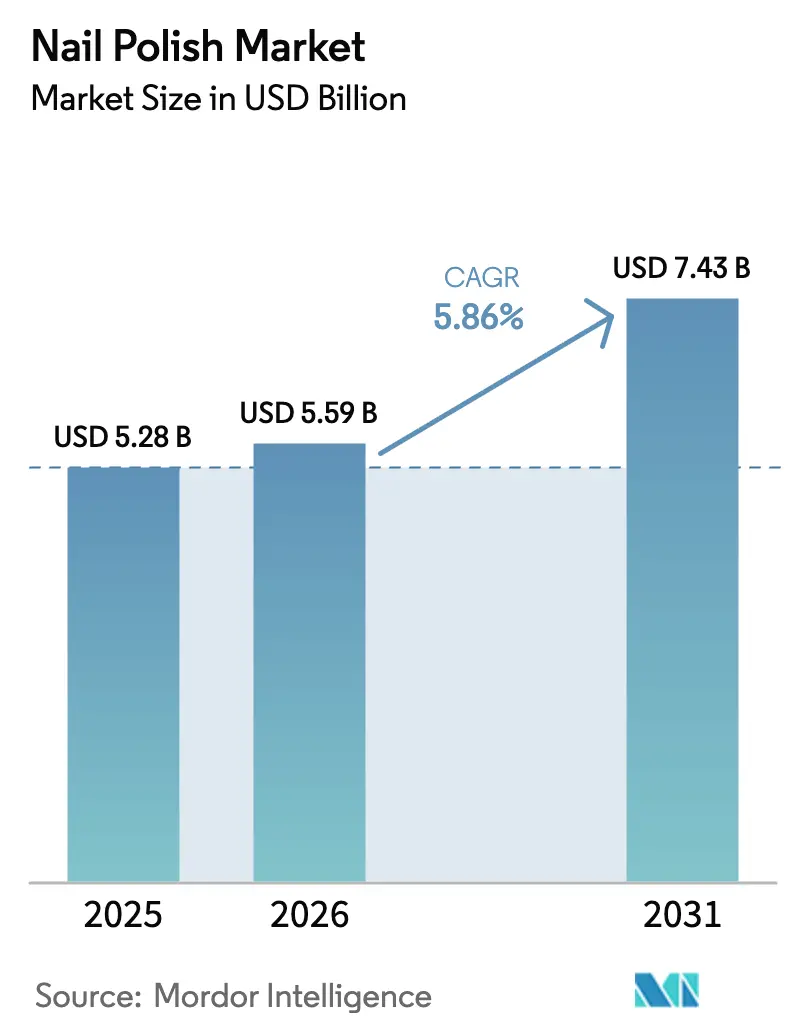
The nail polish market is expected to grow significantly, increasing from USD 5.28 billion in 2025 and USD 5.59 billion in 2026 to USD 7.43 billion by 2031. This represents a compound annual growth rate (CAGR) of 5.86% during the forecast period from 2026 to 2031. Several factors are driving this growth. Regulatory bans on harmful photoinitiators in regions such as the European Union and California have pushed companies to invest in research and development to develop safer, cleaner nail polish formulas. By product type, gel nail polishes are gaining popularity and are outpacing traditional lacquer formats due to their durability and finish. In terms of coat type, base coats currently dominate the market, while top coats are also experiencing accelerated growth. When categorized by formula, conventional nail polishes continue to lead the market, but demand for natural or organic options is rising as consumers become more environmentally conscious. The market remains moderately consolidated, with established players and emerging brands competing to meet evolving consumer preferences.
Key Report Takeaways
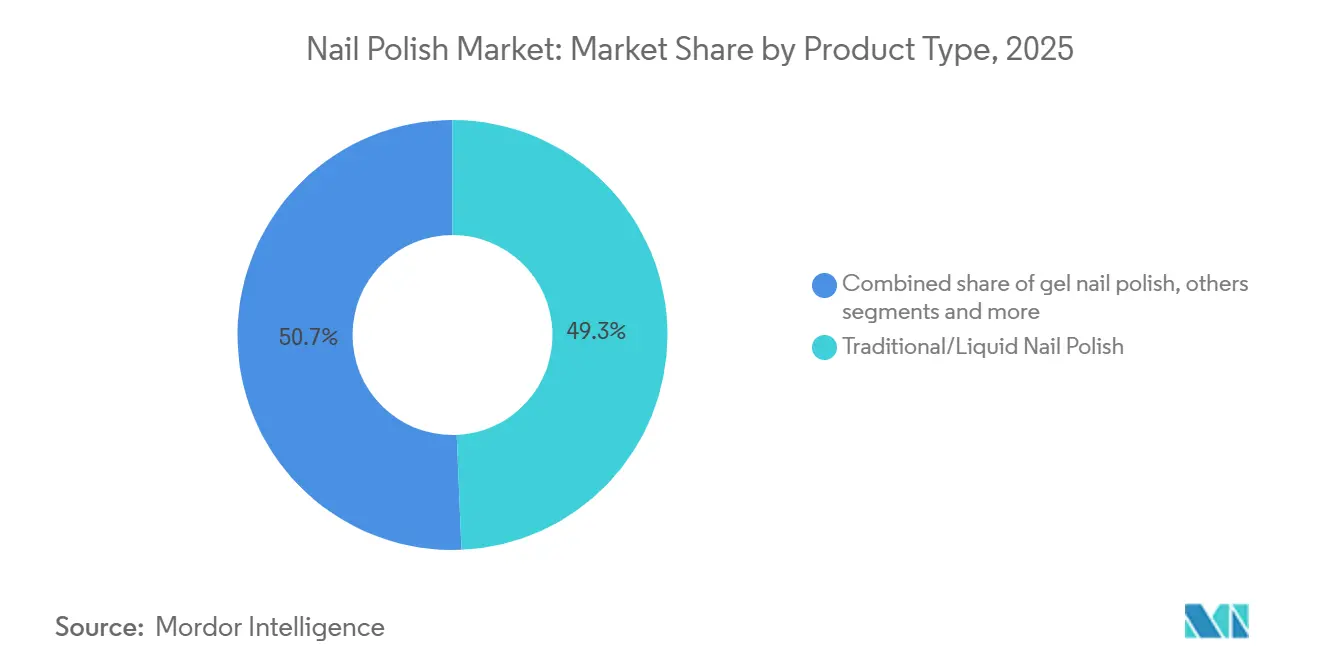
- By product type, traditional lacquers retained 49.34% revenue share in 2025, while gel formats led with 7.23% CAGR through 2031.
- By coat type, base coats held 67.03% of the nail polish market share in 2025, and top coats are set to grow at a 6.54% CAGR through 2031.
- By category, conventional formulas commanded 85.31% of the nail polish market in 2025, while natural and organic lines will grow at a 6.15% CAGR.
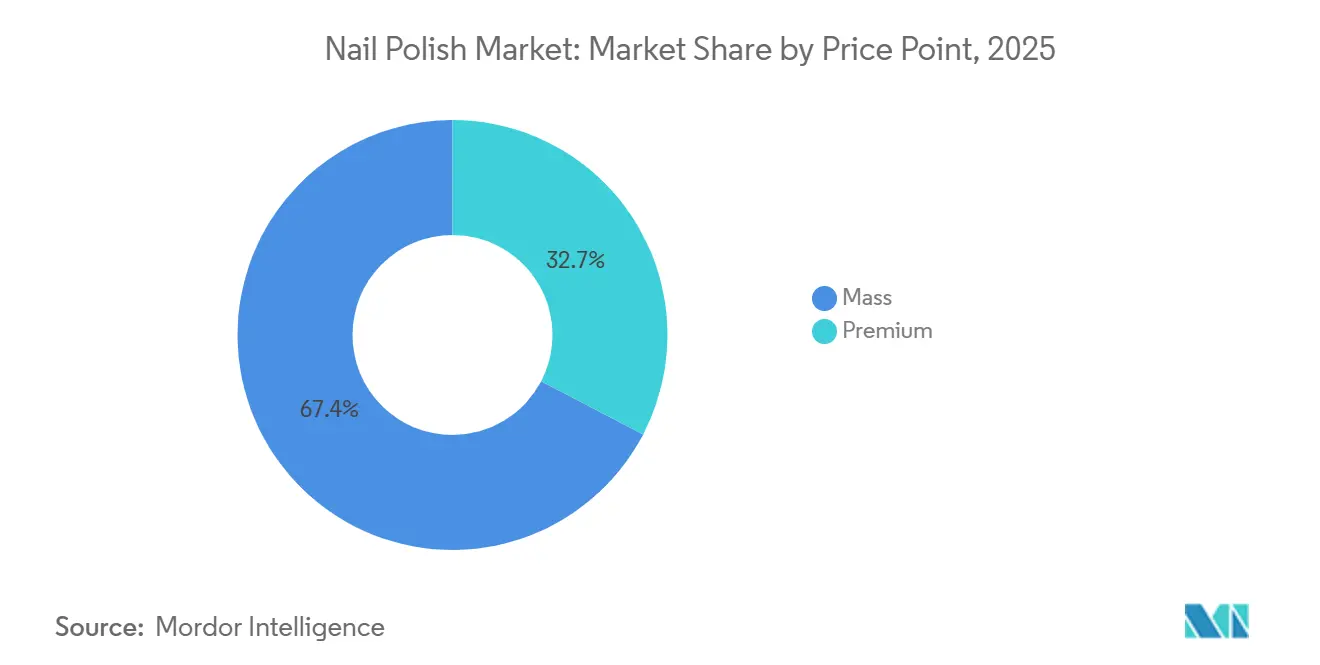
- By price range, the mass segment accounted for 67.35% of revenue in 2025, whereas premium offerings posted the fastest expansion at a 6.63% CAGR through 2031.
- By distribution channel, specialty stores accounted for 43.18% of 2025 turnover, and online retail is projected to grow at a 7.04% CAGR through 2031.
- By geography, North America accounted for 33.58% of 2025 sales, but Asia-Pacific is forecast to have the highest regional CAGR at 7.36% through 2031.
Note: Market size and forecast figures in this report are generated using Mordor Intelligence’s proprietary estimation framework, updated with the latest available data and insights as of January 2026.
Market Trends and Insights
Drivers Impact Analysis of Nail Polish Market*
| Driver | (~) % Impact on CAGR Forecast | Geographic Relevance | Impact Timeline |
|---|---|---|---|
| Increasing focus on personal grooming and appearance | +0.8% | Global, with stronger momentum in Asia-Pacific (China, India, South Korea) and North America | Medium term (2-4 years) |
| Demand for long-lasting and chip-resistant formulations | +1.0% | Global, particularly North America and Europe where gel and dip-powder adoption is accelerating | Short term (≤ 2 years) |
| Demand for everyday, office-friendly nail styles such as "soap nails" | +0.5% | North America, Europe, and urban centers in Asia-Pacific (Japan, Singapore) | Short term (≤ 2 years) |
| Influence of celebrity endorsements and brand collaborations | +0.6% | Global, with heightened impact in North America and select Asia-Pacific markets (South Korea, China) | Short term (≤ 2 years) |
| Advancements in nail polish application technologies | +0.7% | Global, led by North America and Europe; spillover to Asia-Pacific as brands localize innovations | Medium term (2-4 years) |
| Growing demand for clean, non-toxic, halal and vegan formulations | +1.2% | Global, with peak demand in Middle East and Africa (Saudi Arabia, United Arab Emirates), Asia-Pacific (Indonesia, Malaysia), and North America | Long term (≥ 4 years) |
| Source: Mordor Intelligence | |||
Growing demand for clean, non-toxic, halal and vegan formulations
The demand for clean, non-toxic, halal, and vegan nail polish is growing as consumers increasingly prioritize safety, ethical practices, and transparency in product ingredients. According to the World Animal Foundation, the global vegan population is expected to reach approximately 88 million out of over 8.3 billion people by February 2026[1]Source: World Animal Foundation, "How Many Vegans Are in the World in 2026? Latest Vegan Stats", worldanimalfoundation.org. Similarly, data from the Islamic City indicates that Muslims, who make up about 24.1% of the global population, total nearly 2 billion people as of 2025[2]Source: Islamic City, "Muslim Population By Country 2025", islamicity.org. This significant demographic is driving the demand for halal-certified beauty products. At the same time, regulatory restrictions on certain ingredients, such as TPO and HEMA, are prompting manufacturers to develop safer alternatives, including HEMA-free, long-lasting nail polish systems. Despite their higher price points, premium clean products are gaining popularity among consumers who value quality and safety. For instance, Iba Cosmetics offers halal-certified, breathable nail polishes that allow water vapor to permeate while adhering to ethical standards.
Demand for long-lasting and chip-resistant formulations
The growing preference for nail polishes that last longer and resist chipping is fueling the expansion of gel and dip powder segments. Consumers are seeking products that deliver salon-quality results at home. Brands are introducing innovations like one-step gel polishes that work with affordable, portable lamps, making the application process easier and more accessible for beginners. Companies are improving their formulations by incorporating features such as high-pigment colors, flexible polymers, and self-leveling properties. Many of these products promise extended wear, often lasting up to ten days without chipping, which appeals to consumers even at higher price points due to the value they provide. Retailers are also focusing on stocking high-performance products, favoring brands that back their durability claims with testing and customer feedback. For example, Sally Hansen’s Miracle Gel line, OPI GelColor, and Kiara Sky Dip Powder are well-known for delivering long-lasting, chip-resistant results, making them popular choices in the market.
Influence of celebrity endorsements and brand collaborations
The increasing popularity of celebrity endorsements and brand collaborations is driving significant growth in the nail polish market. Consumers now see nail color as a way to express their individuality, and partnerships with music artists, influencers, and entertainment franchises are creating a strong appeal. Limited-edition collections tied to these celebrities often generate excitement and sell out quickly, even at higher price points. These collaborations not only attract younger audiences but also help brands stay culturally relevant. Social-commerce platforms and livestream shopping events are playing a key role in boosting customer engagement and driving sales. To keep up with this momentum, brands are adopting strategies that involve frequent launches of new collections while continuing to offer their most popular shades. This approach allows them to stay fresh and relevant without losing focus on their core products. For example, trends like “soap nails,” popularized by celebrities such as Selena Gomez and Kylie Jenner in early 2024, have gained widespread attention.
Advancements in nail polish application technologies
Recent advancements in nail polish application technologies are making products easier to use and more effective, thereby improving product quality and the overall user experience. Brands are focusing on better formulations, such as controlling polish thickness (viscosity), improving pigment mixing for even color, and using advanced systems that help the polish spread smoothly and automatically correct mistakes. These innovations make applying nail polish simpler and more efficient for users. In addition to better formulations, packaging is also evolving. Features like frosted bottles and matte caps are being introduced to reduce glare, making the product more visually appealing and helping users create better photos and videos for social media. This, in turn, increases the brand's online engagement. Another key development is the use of advanced LED curing systems. These systems are designed to cure gel nail polish more safely by using optimized wavelengths and producing less heat, addressing safety concerns, and encouraging more people to try gel nails at home.
Restraints Impact Analysis of Nail Polish Market*
| Restraint | (~) % Impact on CAGR Forecast | Geographic Relevance | Impact Timeline |
|---|---|---|---|
| Availability of low-cost counterfeit and unbranded products | -0.6% | Global, with acute impact in Asia-Pacific (China, India) and Latin America (Brazil, Argentina) | Short term (≤ 2 years) |
| Skin sensitivity and allergic reactions among users | -0.4% | Global, particularly Europe and North America where dermatological awareness is higher | Medium term (2-4 years) |
| Growing concerns over harmful chemicals in formulations | -0.5% | Europe, North America, and emerging awareness in Asia-Pacific urban centers | Medium term (2-4 years) |
| Stringent regulatory requirements on cosmetic ingredients | -0.7% | Europe (EU Cosmetics Regulation 1223/2009), North America (Food and Drug Administration, California Proposition 65), spillover to Asia-Pacific | Long term (≥ 4 years) |
| Source: Mordor Intelligence | |||
Availability of low-cost counterfeit and unbranded products
The presence of cheap counterfeit and unbranded nail polish products is a major challenge for the global market. These low-cost alternatives raise serious health and safety risks. Counterfeit products often contain poor-quality or harmful ingredients, such as industrial dyes or heavy metals, which can harm users and damage the reputation of trusted brands. Since these products are priced much lower, they attract budget-conscious consumers, resulting in revenue losses for legitimate manufacturers. To address this issue, leading brands are taking steps to combat counterfeiting. They are implementing measures like QR-code verification to help customers identify genuine products, selling directly to consumers through official channels, and tightening control over their distribution networks. While these efforts increase operational costs, they are essential for protecting brand integrity. Companies are working to educate consumers about the risks of counterfeit products and the benefits of choosing authentic, high-quality options.
Stringent regulatory requirements on cosmetic ingredients
Strict regulations on cosmetic ingredients are a significant challenge for the global nail polish market, as brands must frequently adjust their formulations to comply with different regional standards. For example, the European Commission's EU Cosmetics Regulation restricts the use of certain ingredients, such as HEMA and TPO, in consumer products[3]Source: European Commission, "TPO in Nail Products – Questions & Answers", ec.europa.eu/sectors/cosmetics/tpo-nail-products-questions-answers_en. Similarly, in the United States, the California Office of Environmental Health Hazard Assessment imposes strict limits on substances such as toluene and requires alternative analysis for safer options. These regulations make compliance more complex and often force companies to create multiple product variations to meet the requirements of different regions. Larger companies, with more resources, can manage these costs more effectively, but smaller brands often struggle with funding and may find it difficult to expand into new markets. For instance, well-known brands like OPI and Essie have had to reformulate their product lines to meet these evolving regulatory standards.
*Our forecasts treat driver/restraint impacts as directional, not additive. The impact forecasts reflect baseline growth, mix effects, and variable interactions.
Nail Polish Market Segment Analysis
By Product Type:
Gel Formats Gain GroundIn 2025, traditional liquid nail polish held the largest share of the nail polish market, accounting for 49.34% of total sales. This dominance was due to its affordability, ease of use, and widespread availability in retail stores. It remained a popular choice, especially in markets with high price sensitivity. The segment also benefited from a wide variety of shades, frequent product updates, and strong brand visibility across both physical and online retail platforms. Additionally, advancements in quick-dry formulas and improved product quality further reinforced its appeal among consumers.
On the other hand, gel nail polish emerged as the fastest-growing segment and is expected to grow at a CAGR of 7.23% through 2031. Its rising popularity is driven by consumer demand for long-lasting, salon-like finishes that are durable and chip-resistant. The increasing availability of at-home manicure kits and UV/LED curing devices has made gel polish more accessible to a broader audience. Furthermore, ongoing innovations in gel formulations and the growing trend of DIY beauty have significantly contributed to its rapid adoption. This segment is poised for continued growth as consumers prioritize convenience and professional-quality results.



By Coat Type:
Top Coats AccelerateBase coats accounted for a significant 67.03% share of the global nail polish market in 2025, primarily because they are a crucial step in achieving long-lasting manicures. These products help nail polish adhere better, prevent nail discoloration, and ensure the polish stays intact for longer. Their consistent use by both professionals and individuals at home has made them a staple in the nail care routine. Additionally, the introduction of base coats with added benefits, such as nail strengthening and nourishment, has further boosted their popularity and demand among consumers.
Top coats, meanwhile, are expected to grow at a steady CAGR of 6.54% through 2031, driven by rising consumer preference for a polished, durable finish. These products are gaining popularity for their ability to deliver a gel-like shine and extend nail polish's lifespan without UV light. Quick-drying, chip-resistant formulations have made top coats more convenient for users, especially those seeking efficient at-home manicure solutions. Moreover, the rising trend of DIY nail care and the desire for salon-quality results at home are key drivers of this segment's growth.
By Category:
Natural and Organic ClimbIn 2025, conventional synthetic nail polish formulations led the global market, accounting for 85.31% of the total share. These products are popular because they provide vibrant colors, long-lasting wear, and affordability. Consumers prefer them for their wide variety of shades, quick-drying features, and reliable performance at a lower cost. Additionally, their easy availability in retail stores and professional salons has strengthened their dominance. Ongoing improvements in formulas have also helped brands retain customer loyalty and encourage repeat purchases.
On the other hand, natural and organic nail polish options are expected to grow steadily, with a projected CAGR of 6.15% through 2031. This growth is driven by increasing consumer awareness about health, safety, and environmental sustainability. Many customers are now looking for non-toxic, eco-friendly products made with “free-from” formulations that avoid harmful chemicals. Regulatory changes and shifting preferences toward safer personal care items are also pushing brands to innovate. As a result, plant-based and breathable nail polish formulas are gaining traction, appealing to consumers who prioritize clean beauty and sustainability.
By Price Range:
Premium OutperformsMass-market nail polishes held 67.35% of the global market share in 2025, primarily due to their affordability and easy availability. These products are widely available in supermarkets, drugstores, and online platforms catering to budget-conscious consumers. Their popularity is further boosted by frequent product launches, seasonal collections, and competitive pricing, which encourage repeat purchases. Additionally, the strong presence of retail distribution networks ensures these products are accessible to a broad audience, solidifying their dominance in the market.
On the other hand, premium nail polishes are expected to grow at a CAGR of 6.63% between 2026 and 2031, driven by rising demand for high-quality, long-lasting products. Consumers are increasingly preferring salon-grade formulations, clean beauty options, and innovative finishes. This segment is also benefiting from effective brand positioning, influencer endorsements, and unique in-store experiences that attract customers. As more consumers prioritize performance and aesthetics, the premium nail polish market is likely to see steady, consistent growth over the forecast period.
By Distribution Channel:
Online Retail SurgesSpecialty beauty chains held 43.18% of the nail polish market share in 2025, primarily due to their ability to offer a wide range of curated products and engaging in-store experiences. These stores allowed customers to test different shades, textures, and finishes before purchase, boosting consumer confidence. Additionally, loyalty programs and exclusive product launches attracted more customers, while partnerships with premium and trending brands further strengthened their market position. The personalized shopping experience provided by these chains played a key role in maintaining their popularity among consumers.
On the other hand, online channels are expected to grow at the fastest CAGR of 7.04% through 2031, driven by the rapid growth of e-commerce and the rise of digital-first beauty brands. Features like virtual try-on tools, user-friendly navigation, and quick checkout options have made online shopping more convenient and appealing. Both brand-owned websites and third-party platforms have expanded product accessibility, allowing consumers to discover and purchase products more easily. As digital engagement and the demand for convenience continue to increase, online channels are likely to see sustained growth in the coming years.
Geography Analysis
North America, Europe, APAC and LATAM Nail Polish Market
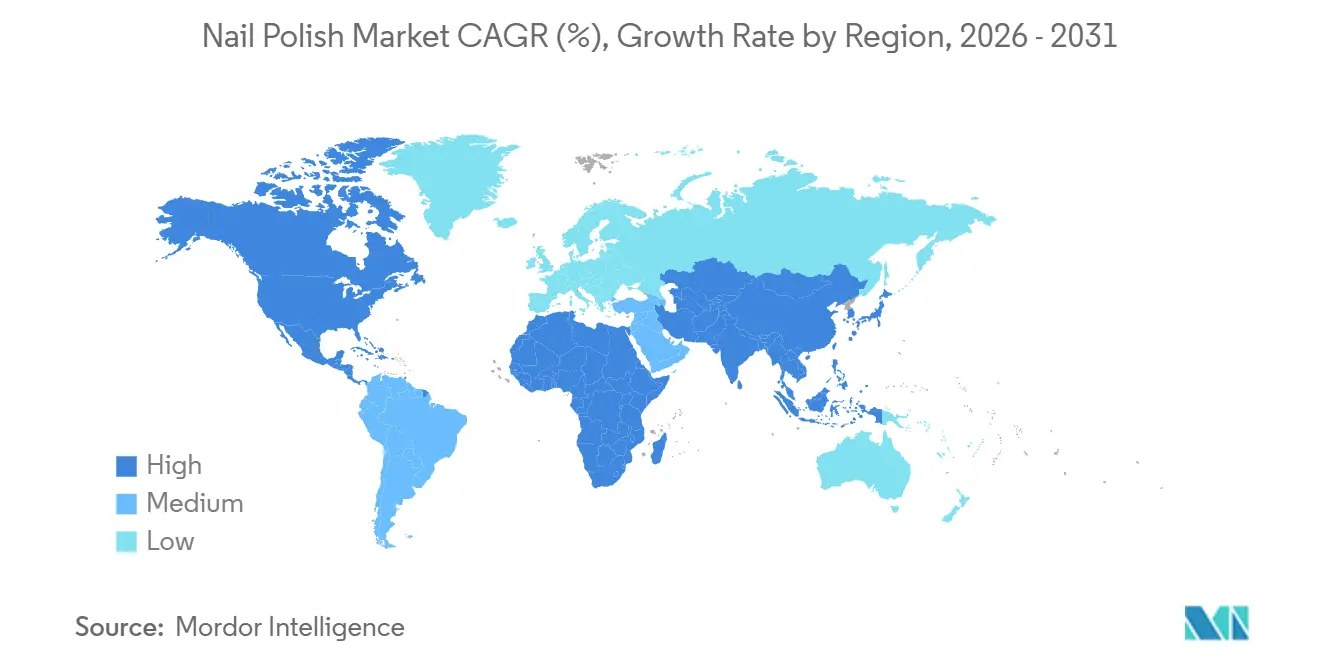
North America accounted for 33.58% of nail polish market revenue in 2025, driven by high consumer spending on beauty products and the popularity of premium nail polish formulations. The region’s well-established retail networks and strong brand presence played a key role in maintaining its dominance. Europe also showed steady performance, supported by consistent demand for nail care products. Meanwhile, regions like Asia-Pacific and Latin America, though starting from a smaller base, showed promising growth as they expanded their market presence. Developed regions continued to lead due to their advanced distribution systems and high product awareness.
APAC, MEA and South America Nail Polish Market
Asia-Pacific is expected to grow at the fastest rate, with a CAGR of 7.36% projected through 2031. This growth is fueled by increasing disposable incomes and greater access to beauty products in the region. The rapid expansion of e-commerce platforms and digital tools has made nail polish products more accessible to consumers, boosting engagement and sales. Additionally, the Middle East and Africa and South America are also anticipated to grow steadily, supported by improving retail infrastructure and changing consumer preferences. These emerging markets are becoming significant contributors to the global nail polish industry.
Global Nail Polish Market
Globally, the nail polish market reflects a combination of mature and growing regions. Developed markets are focusing on innovation and premium products to retain their consumer base, while emerging markets are emphasizing affordability and accessibility to attract new customers. The rise of online shopping and direct-to-consumer models is transforming how brands connect with buyers worldwide. At the same time, localization strategies and evolving regulations are shaping product offerings and distribution methods. These trends are expected to influence the competitive landscape across all regions in the coming years.

Competitive Landscape
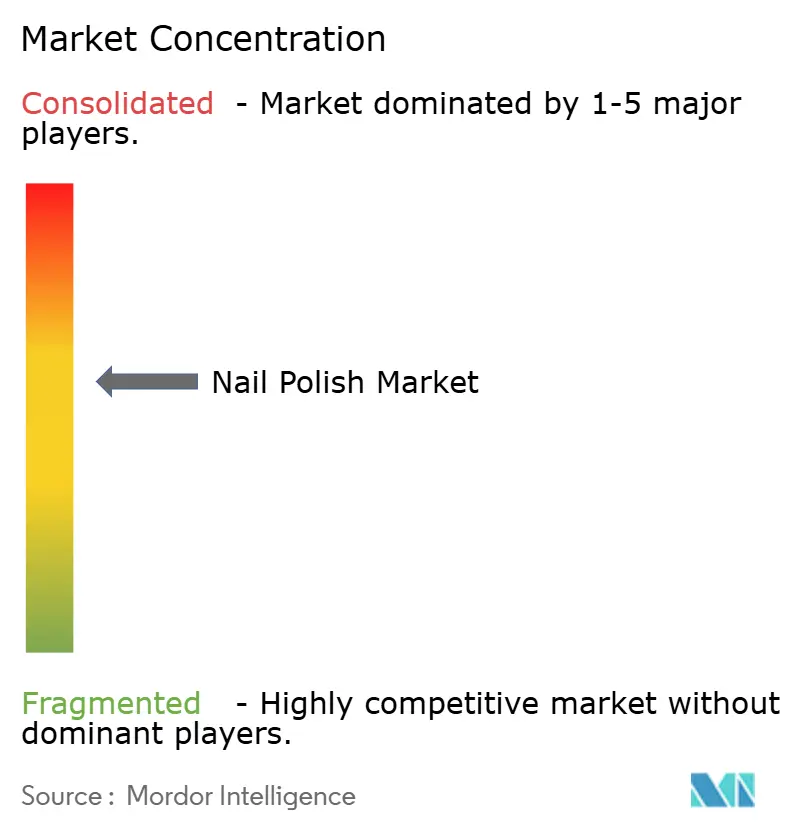
The nail polish market is moderately consolidated, with a few major players like L’Oréal S.A., The Estée Lauder Companies Inc., Coty Inc., Revlon, Inc., and Shiseido Company, Limited holding a significant share of the market revenue. These companies dominate the market, but smaller regional and niche brands are also competing by offering unique products. Many of these smaller brands focus on clean ingredients, cultural relevance, and certifications to attract specific consumer groups. This mix of large corporations and smaller competitors creates a moderately competitive market environment.
Big companies are increasingly acquiring smaller, fast-growing brands to expand their product offerings and appeal to younger consumers. These acquisitions help larger players tap into the loyal customer base and authenticity of these smaller brands. At the same time, many digitally native brands are growing rapidly through direct-to-consumer channels, e-commerce platforms, and specialty retail stores. These brands are attractive acquisition targets, driving continuous growth and change in the market. This trend highlights the importance of strategic expansion in staying competitive.
Innovation plays a key role in differentiating brands in the nail polish market. Companies are investing in advanced formulations, better product performance, and improved packaging to justify higher prices. Vertical integration is also becoming more common, as it allows companies to control their supply chains and ensure transparency in sourcing and production. Additionally, the rise in counterfeit products has pushed brands to adopt technologies for product authentication and traceability. Overall, the market is evolving through a combination of innovation, strategic acquisitions, and meeting changing consumer demands.
Nail Polish Industry Leaders
-
L'Oréal S.A.
-
The Estée Lauder Companies
-
Revlon Inc.
-
Shiseido Co., Ltd.
-
Coty Inc.
- *Disclaimer: Major Players sorted in no particular order
Nail Polish Market Companies Covered in this Report
- LVMH Moët Hennessy Louis Vuitton SE
- L'Oréal S.A.
- Revlon Inc.
- The Estée Lauder Companies
- Chanel Ltd.
- Shiseido Co., Ltd.
- Coty Inc.
- Orly International, Inc.
- Avon Products Inc.
- Wella Company
- Art of Beauty, Inc.
- FACES Cosmetics India Pvt. Ltd.
- Nails Inc. Ltd.
- Deborah Lippmann LLC
- Colorbar Cosmetics
- The Good Glamm Group
- Unilever plc
- Ecotrail Personal Care Pvt. Ltd. (Iba)
- LoveChild by Masaba
- Kering SA

Recent Industry Developments in Nail Polish Market
- January 2026: Sally Hansen introduced a new range of nail products, including improved Miracle Gel polishes, shorter and more practical press-on nails, and better nail and cuticle care solutions for everyday use. The brand upgraded its Miracle Gel line with a new formula and Color Grip technology, offering longer-lasting wear and a shiny finish without needing UV light.
- October 2025: OPI launched its “Good Enough to Treat” Holiday 2025 collection, offering a variety of festive nail colors inspired by holiday celebrations. The collection features bold reds, soft pinks, icy whites, and deep blues in sparkly, metallic, and shimmery finishes, perfect for different holiday events.
- August 2025: Sally Beauty Holdings focused on nails as a key growth area, expanding its product range to over 1,400 items, including polish, gel, dip powders, and press-on nails, to meet growing customer demand. The company highlighted nails as an important way to attract new customers and prioritized innovation, accessibility, and trendy products.
- May 2025: Color Street launched its Attract FX collection, a unique nail product featuring magnetic-effect polish strips produced through a special process. This technology creates a 3D-like finish by aligning magnetic pigments in the strips, offering a distinctive look without needing an external magnet during application.


Global Nail Polish Market Report Scope
Nail polish is a cosmetic lacquer applied to fingernails or toenails to add color, shine, and protection. The global nail polish market is segmented into product type, coat type, category, price range, distribution channel, and geography. Based on product type, the market is segmented into traditional/liquid nail polish, gel nail polish, dip powder nail polish, and others. Based on coat type, the market is segmented into base coat and top coat. Based on category, the market is segmented into natural/organic and conventional/synthetic. Based on price range, the market is divided into mass and premium segments. Based on distribution channel, the market is segmented into supermarkets/hypermarkets, specialty stores, online retail stores, and other distribution channels. Based on geography, the market is segmented into North America, Europe, Asia-Pacific, South America, and Middle East and Africa. The market forecasts are provided in terms of value (USD).
| Traditional/Liquid Nail Polish |
| Gel Nail Polish |
| Dip Powder Nail Polish |
| Others |
| Base Coat |
| Top Coat |
| Natural/Organic |
| Conventional/Synthetic |
| Mass |
| Premium |
| Supermarkets/Hypermarkets |
| Specialty Stores |
| Online Retail Stores |
| Other Distribution Channels |
| North America | United States |
| Canada | |
| Mexico | |
| Rest of North America | |
| South America | Brazil |
| Argentina | |
| Colombia | |
| Chile | |
| Peru | |
| Rest of South America | |
| Europe | Germany |
| United Kingdom | |
| Italy | |
| France | |
| Spain | |
| Poland | |
| Belgium | |
| Sweden | |
| Rest of Europe | |
| Asia-Pacific | China |
| Japan | |
| India | |
| Australia | |
| Indonesia | |
| South Korea | |
| Thailand | |
| Singapore | |
| Rest of Asia-Pacific | |
| Middle East and Africa | South Africa |
| Saudi Arabia | |
| United Arab Emirates | |
| Nigeria | |
| Egypt | |
| Morocco | |
| Turkey | |
| Rest of Middle East and Africa |
| By Product Type | Traditional/Liquid Nail Polish | |
| Gel Nail Polish | ||
| Dip Powder Nail Polish | ||
| Others | ||
| By Coat Type | Base Coat | |
| Top Coat | ||
| By Category | Natural/Organic | |
| Conventional/Synthetic | ||
| By Price Range | Mass | |
| Premium | ||
| By Distribution Channel | Supermarkets/Hypermarkets | |
| Specialty Stores | ||
| Online Retail Stores | ||
| Other Distribution Channels | ||
| By Geography | North America | United States |
| Canada | ||
| Mexico | ||
| Rest of North America | ||
| South America | Brazil | |
| Argentina | ||
| Colombia | ||
| Chile | ||
| Peru | ||
| Rest of South America | ||
| Europe | Germany | |
| United Kingdom | ||
| Italy | ||
| France | ||
| Spain | ||
| Poland | ||
| Belgium | ||
| Sweden | ||
| Rest of Europe | ||
| Asia-Pacific | China | |
| Japan | ||
| India | ||
| Australia | ||
| Indonesia | ||
| South Korea | ||
| Thailand | ||
| Singapore | ||
| Rest of Asia-Pacific | ||
| Middle East and Africa | South Africa | |
| Saudi Arabia | ||
| United Arab Emirates | ||
| Nigeria | ||
| Egypt | ||
| Morocco | ||
| Turkey | ||
| Rest of Middle East and Africa | ||


Key Questions Answered in the Report
How large is the global nail polish market in 2026?
The nail polish market size is estimated at USD 5.59 billion in 2026 and is set to reach USD 7.43 billion by 2031.
Which product type is expanding the fastest worldwide?
Gel formats are forecast to grow at 7.23% CAGR through 2031, the quickest among all product types.
Which region is projected to record the highest growth?
Asia-Pacific is expected to post a 7.36% CAGR due to rising incomes, e-commerce adoption, and strong demand for halal-certified products.
How are brands addressing counterfeit products?
Many brands now embed QR-code authentication, tighten distributor contracts, and expand direct-to-consumer channels to ensure product legitimacy.
Page last updated on:





