
Music Royalty Market Size and Share
Market Overview
| Study Period | 2020 - 2031 |
|---|---|
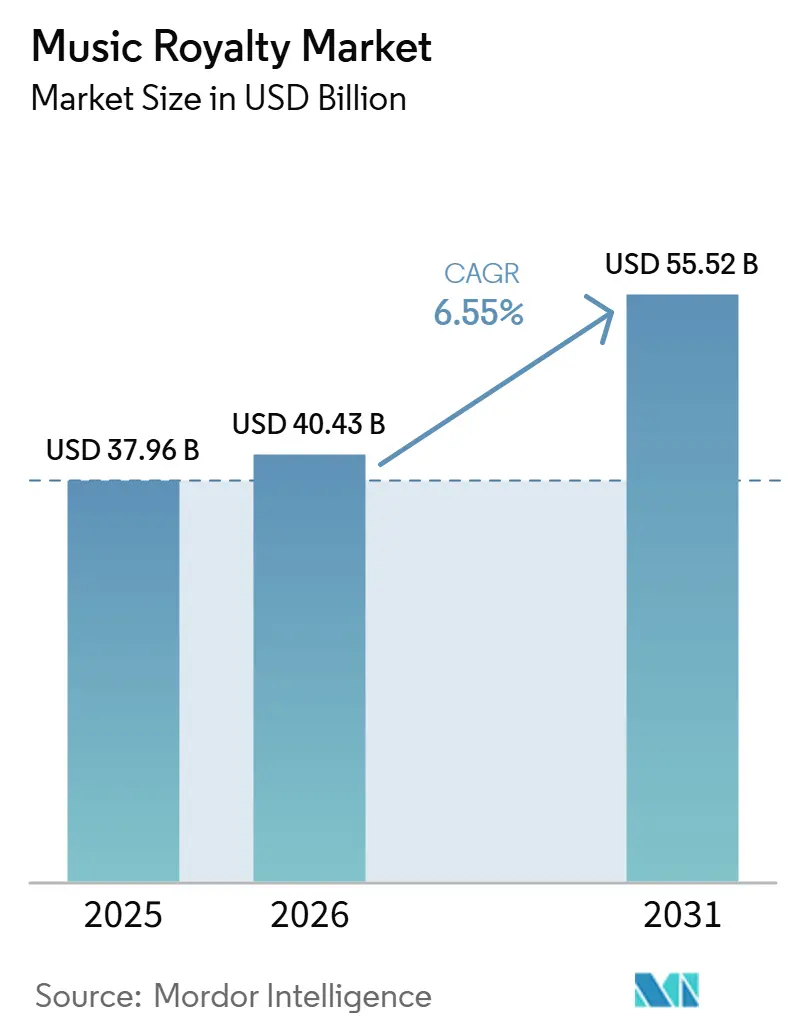
| Market Size (2026) | USD 40.43 Billion |
| Market Size (2031) | USD 55.52 Billion |
| Growth Rate (2026 - 2031) | 6.55 % |
| Fastest Growing Market | Asia-Pacific |
| Largest Market | North America |
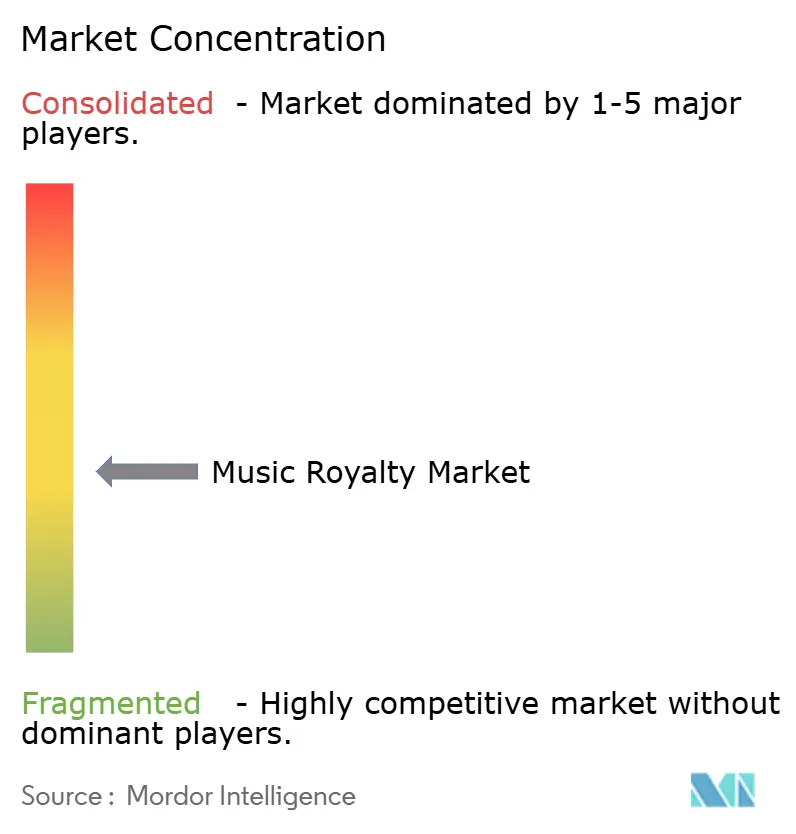
| Market Concentration | Medium |
Major Players *Disclaimer: Major Players sorted in no particular order Image © Mordor Intelligence. Reuse requires attribution under CC BY 4.0. | |
Music Royalty Market Analysis by Mordor Intelligence
The Music Royalty Market size is projected to expand from USD 37.96 billion in 2025 and USD 40.43 billion in 2026 to USD 55.52 billion by 2031, registering a CAGR of 6.55% between 2026 to 2031. The market is being supported by the steady shift of music consumption toward licensed digital channels, with paid streaming now carrying most of the revenue base for recorded music and giving rights holders a broader global collection pool. Publishing income is also gaining weight within the music royalty market, which points to a stronger earnings profile for song rights and a wider base for long-term cash flows. Collection societies reported strong 2025 results, which shows that royalty administration systems are still scaling in line with demand rather than falling behind it. Regional growth remains uneven, with North America still leading current revenue while Asia-Pacific is expanding faster on the back of rising digital usage and improving collection systems. Competition in the music royalty market is also shifting toward attribution tools, metadata quality, and administrative scale, while bundle reclassification in streaming remains the clearest pressure point for near-term royalty leakage.
Key Report Takeaways
- By Type, Sound Recording and Master Royalties led with 41.57% share in 2025, while Synchronization Royalties are projected to expand at a 10.82% CAGR through 2031.
- By Channel, Streaming Platforms held 52.22% of the music royalty market share in 2025, while Gaming and Interactive Media is expected to grow at an 11.67% CAGR through 2031.
- By End-user, Record Labels accounted for 38.52% of market revenue in 2025, while Independent Artists are projected to advance at a 13.11% CAGR through 2031.
- By Geography, North America captured 39.42% of revenue in 2025, while Asia-Pacific is projected to grow at an 11.83% CAGR through 2031.
Note: Market size and forecast figures in this report are generated using Mordor Intelligence’s proprietary estimation framework, updated with the latest available data and insights as of January 2026.
Market Trends and Insights
Drivers Impact Analysis of Music Royalty Market*
| Driver | (~) % Impact on CAGR Forecast | Geographic Relevance | Impact Timeline |
|---|---|---|---|
| Accelerating Digital Streaming Monetization | +2.1% | Global, peak impact in North America and Europe | Short term (≤ 2 years) |
| Expanding Public Performance Licensing Coverage | +1.2% | Global, with early gains in Asia-Pacific and Africa | Medium term (2-4 years) |
| Growth in Short-Form Video and Social Commerce | +1.0% | Global, concentrated in North America and Asia-Pacific | Short term (≤ 2 years) |
| Rising Synchronization Demand from OTT, Gaming, and Advertising | +0.9% | North America, Europe, Asia-Pacific | Medium term (2-4 years) |
| Cross-Border Royalty Collection Standardization | +0.5% | Global, spill-over to Middle East and South America | Long term (≥ 4 years) |
| Improved Data Matching, Fingerprinting, and Metadata Quality | +0.4% | Global | Medium term (2-4 years) |
| Source: Mordor Intelligence | |||
Accelerating Digital Streaming Monetization
Digital streaming remains the main engine of expansion for the music royalty market because it keeps converting listening activity into recurring licensed revenue across many territories at once. IFPI reported that streaming revenues continued to expand and represented the majority of global recorded music income, confirming how central platform monetization has become to the market’s current structure. ASCAP also indicated that licensed performances in the United States continued to grow, supported by rising domestic revenues and stronger foreign revenue collections. Spotify stated that 2025 delivered its largest annual music publishing payout and that more than 13,800 artists generated at least USD 100,000 from Spotify alone during the year.[1] That pattern matters for the music royalty market because it shows that growth is not limited to the very top of the catalog stack and is reaching a wider earnings base. It also suggests that rights owners with stronger licensing terms, deeper catalogs, and better administrative control should continue to capture disproportionate gains as digital usage keeps rising.
Expanding Public Performance Licensing Coverage
Public performance licensing is widening the addressable base of the music royalty market, especially in regions where collection systems are becoming more formal and digital revenue is taking a larger role.CISAC reported that India’s IPRS recorded strong growth in creator revenues, supported by the rising contribution of digital streaming to overall collections. The same report also showed that Africa continued to improve creator royalty collections, indicating that collection coverage is strengthening even in markets where monetization systems are still developing. WIPO’s Good Practice Toolkit for Collective Management Organizations adds a practical framework for governance, transparency, and cross-border handling, which supports more consistent society operations over time.[2] For the music royalty market, that combination of higher collections and stronger operating standards reduces leakage in markets that previously contributed less than their usage levels implied. It also improves the position of rights holders that depend on society efficiency rather than direct platform bargaining.
Growth In Short-Form Video And Social Commerce
Short-form video is becoming a more organized earnings channel for the music royalty market because platforms now need systems that can handle large volumes of small, fast-moving music uses. Harry Fox Agency announced in June 2025 that ByteDance engaged Rumblefish to provide full-suite rights management services for TikTok and CapCut, including direct publisher licensing, sound recording-to-composition data linking, royalty calculation, and distribution.[3] That scope shows that short-form music use is no longer being treated as an informal discovery layer and is instead being processed as a licensable commercial activity. It also helps the music royalty market by tightening the link between usage data and payment flows, which is essential when a large share of activity comes from creator-driven uploads and edits. Better data linking should reduce underpayment risk for rights owners whose works travel quickly across many clips, formats, and engagement cycles. As social commerce expands and music remains central to creator content, rights administrators with stronger metadata systems should be better placed to convert usage into actual collections.
Rising Synchronization Demand From OTT, Gaming, and Advertising
Synchronization demand is adding a faster-growing revenue lane to the music royalty market, with usage spreading across film, television, OTT releases, advertising, and interactive formats. Within the market’s type structure, synchronization royalties are expected to record stronger growth compared with more mature royalty categories. Demand is being supported by the rising need for pre-cleared music, faster licensing workflows, and reliable rights administration across films, streaming content, advertisements, gaming, and short-form digital media, where content moves quickly from launch to monetization. CISAC’s June 2026 launch of AVR+, a machine-readable JSON schema built on the Global Cue Sheet Standard 2.0, directly addresses metadata consistency and settlement delays in screen-based uses. That matters for the music royalty market because cue sheet quality and format consistency often determine how fast usage can be translated into paid royalties. The same shift also favors rights owners and administrators that can combine catalog depth with cleaner cue data, faster matching, and more predictable licensing workflows.
Restraints Impact Analysis of Music Royalty Market*
| Restraint | (~) % Impact on CAGR Forecast | Geographic Relevance | Impact Timeline |
|---|---|---|---|
| Faster Value Leakage in Bundled and Discounted Subscriptions | -0.9% | North America and Europe | Short term (≤ 2 years) |
| High Royalty Dispute, Matching, and Reproduction Error Rates | -0.8% | Global, most acute in North America | Short term (≤ 2 years) |
| Fragmented Territorial Licensing and Administration | -0.7% | Global, concentrated in Asia-Pacific, Middle East, South America | Long term (≥ 4 years) |
| Unmatched Works and Metadata Gaps | -0.5% | Global | Medium term (2-4 years) |
| Source: Mordor Intelligence | |||
Value Leakage in Bundled and Discounted Subscriptions
Bundled and discounted subscriptions remain the clearest near-term drag on the music royalty market because they change how platform revenue is allocated before it reaches rights holders. The source draft shows that bundle reclassification has already altered the balance between performance and mechanical royalty pools in the United States, which creates direct pressure for publishers whose collections depend heavily on mechanical income. The same draft also notes Spotify’s disclosed potential liability tied to the bundle question, which shows that the issue is material enough to sit at the center of active legal and commercial dispute. This problem matters beyond one platform because any market that bases statutory or negotiated royalty flows on service revenue can face similar pressure when a music subscription is folded into a wider bundle. For the music royalty market, the consequence is not weaker listening demand but weaker value capture per paid user. Unless courts, regulators, or contract revisions change the treatment of bundled tiers, royalty leakage is likely to remain a persistent check on publishing-side upside.
High Royalty Dispute, Matching, and Reproduction Error Rates
Matching failures continue to reduce the efficiency of the music royalty market because revenues can only be distributed correctly when works, recordings, and ownership data are aligned across systems. CISAC’s 2025 Annual Report highlighted the rollout of the ISWC IPI Context Search tool and the soft launch of ISWC-ISRC linking with selected record labels in 2025, both of which are aimed at reducing registration and attribution errors. Those projects matter because they connect composition and recording identifiers earlier in the process, which lowers the risk of unmatched uses and delayed payments across territories. Warner Music Group’s acquisition of Sureel AI in June 2026 shows that major rights owners now view attribution technology as a core operating tool rather than a side feature.[4] In the music royalty market, that shift should strengthen firms with the capital to automate provenance tracking and challenge misallocations at scale. Smaller rights holders and less advanced administrators, by contrast, remain more exposed to lost income when errors move across several collection systems before they are detected.
*Our forecasts treat driver/restraint impacts as directional, not additive. The impact forecasts reflect baseline growth, mix effects, and variable interactions.
Music Royalty Market Segment Analysis
By Type:
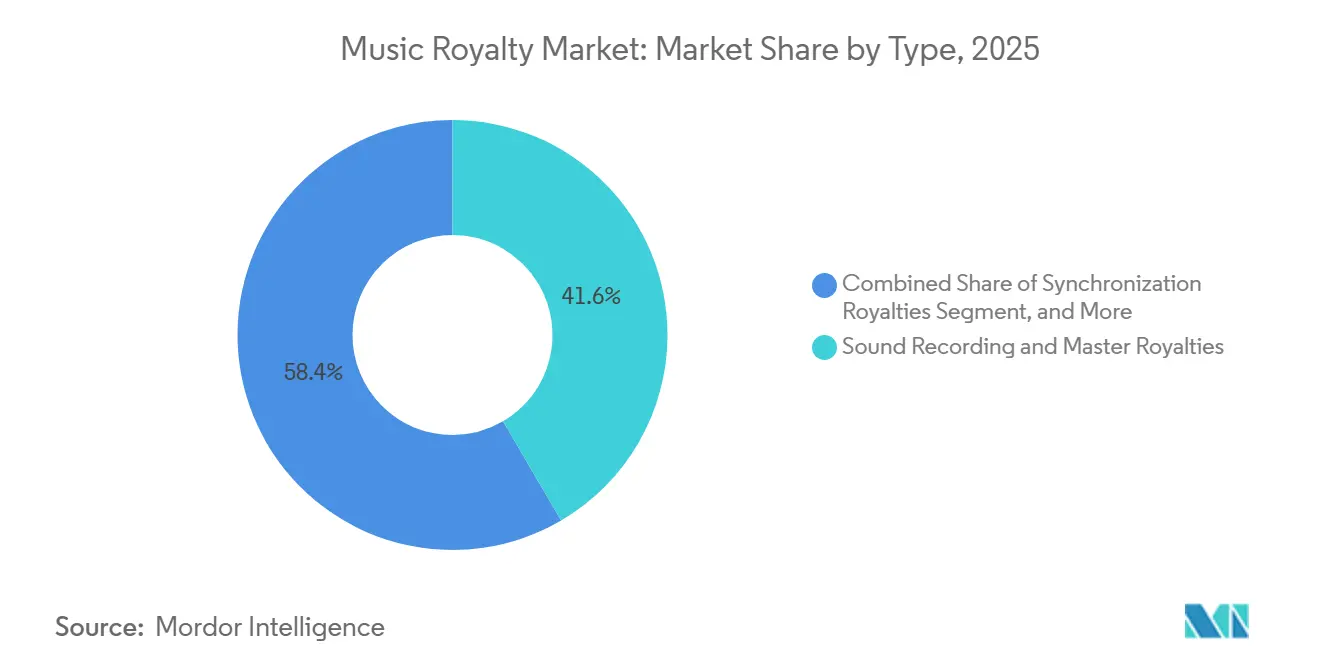
Master Rights Hold The Largest Base While Synchronization Gains SpeedSound Recording and Master Royalties held a 41.57% share of the music royalty market in 2025, which made them the largest royalty type in the current revenue mix. That position reflects the persistent weight of master ownership, especially where large catalogs can be licensed repeatedly across streaming, sync, broadcast, and neighboring rights channels. Performance Royalties also remain central to the music royalty market because the NMPA reported that they accounted for 52% of U.S. music publishing revenue in 2025. The same NMPA breakdown showed Synchronization Royalties at 24% and Mechanical Royalties at 19%, which underlines how streaming has changed the balance of publishing income without removing the role of screen-based licensing. Digital collections across CISAC’s network reached EUR 5 billion (USD 5.7 billion) in 2024 for the first time, which confirms that the music royalty industry is moving deeper into digitally administered performance and mechanical flows.
The music royalty market size for Synchronization Royalties is projected to expand at a 10.82% CAGR through 2031, which makes this the fastest-growing type in the current forecast. That growth fits with a wider licensing environment where music is now embedded across OTT releases, creator content, advertising formats, and interactive entertainment. It also raises the relative value of works and recordings that can be cleared quickly, tracked accurately, and reused across several media settings without ownership ambiguity. CISAC’s ISWC-ISRC linking program supports that direction because faster linking of compositions and recordings should shorten attribution delays once a work is released. The Others category still has a role in the music royalty market through neighboring rights, private copying, and library-related income, but its growth path remains more dependent on territory-specific rules and collection practices than the leading types.

By Channel:
Streaming Leads The Revenue Pool While Gaming Lifts The Growth ProfileStreaming Platforms accounted for 52.22% of the music royalty market share in 2025, which confirms that this remains the dominant channel for monetized listening. IFPI reported that paid streaming subscription revenues continued to grow and represented more than half of global recorded music revenues, reinforcing the channel’s leadership within the recorded music market. This highlights the sustained importance of subscription-led streaming as a core revenue driver for labels, artists, and rights holders. The channel’s strength comes from scale, recurring user payments, and the ability to license the same catalog across many territories at once. At the same time, the source draft shows that bundle reclassification is changing the split between royalty pools inside digital subscriptions, which means revenue growth does not always translate into the same payout mix for every rightsholder group. For the music royalty market, that makes streaming both the largest opportunity and the clearest zone of commercial tension.
Broadcasting and Digital Radio continue to support the music royalty market because they feed established public performance and non-interactive digital royalty systems. SoundExchange reported USD 991.5 million in full-year 2025 distributions and crossed USD 13 billion in cumulative distributions in March 2026, which shows the continuing scale of licensed non-interactive digital use. Gaming and Interactive Media is projected to grow at an 11.67% CAGR through 2031, which makes it the fastest-growing channel in the current market framework. That growth reflects the deeper role of music inside live-service environments, interactive storytelling, and game-based audience engagement. Film, Television, and OTT Media also remain important for the music royalty market, and CISAC’s AVR+ standard should help this channel by improving cue sheet ingestion and reducing metadata gaps in royalty processing.
By End-User:
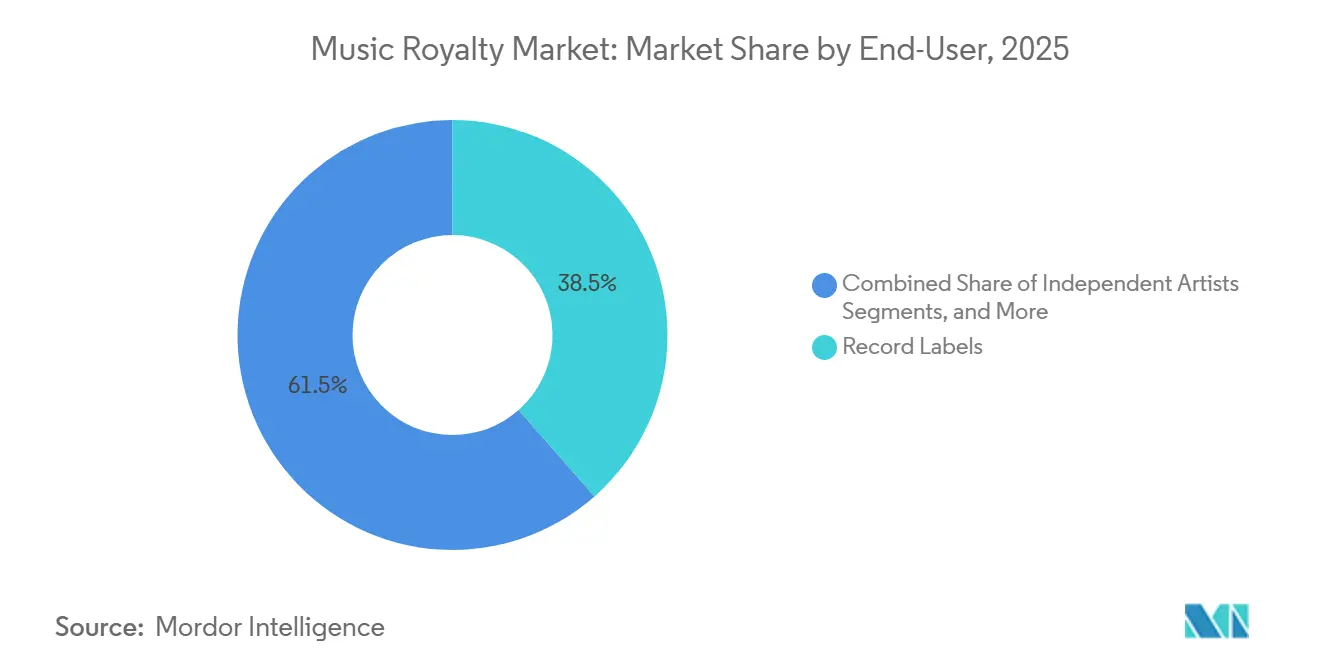
Record Labels Hold The Largest Share While Independent Artists Gain MomentumRecord Labels held 38.52% of the music royalty market in 2025, which reflects their exposure to master royalties, performance income, synchronization fees, and neighboring rights. Their position is also reinforced by their ability to negotiate platform agreements at scale and to monetize catalog across several channels at the same time. Music publishers remain a major value center in the music royalty market, supported by the continued expansion of publishing revenues and the growing importance of rights management. Songwriters and composers continue to depend heavily on collection systems, as performing rights organizations play a critical role in collecting, administering, and distributing royalties across domestic and international markets. These figures show that the music royalty market still rests on a layered end-user structure rather than a single beneficiary class.
Independent Artists are projected to grow at a 13.11% CAGR through 2031, which gives them the strongest expansion profile among end-users. Spotify stated that nearly half of its USD 11 billion royalty payouts in 2025 went to independent artists and labels, which supports the view that independents now capture a much larger portion of digital value than they once did. Spotify also reported that more than 13,800 artists generated at least USD 100,000 from the platform in 2025, which points to a broader middle layer of viable earners. That change does not remove the importance of labels and publishers, but it does raise the weight of distribution access, data visibility, and royalty administration for self-directed creators. CISAC’s 2025 Annual Report also treated AI-related integrity and anti-fraud measures as an operational priority, which matters for the music royalty market because independent creators can be more exposed when inaccurate registrations or synthetic content compete for payout pools.
Geography Analysis
North America Music Royalty Market
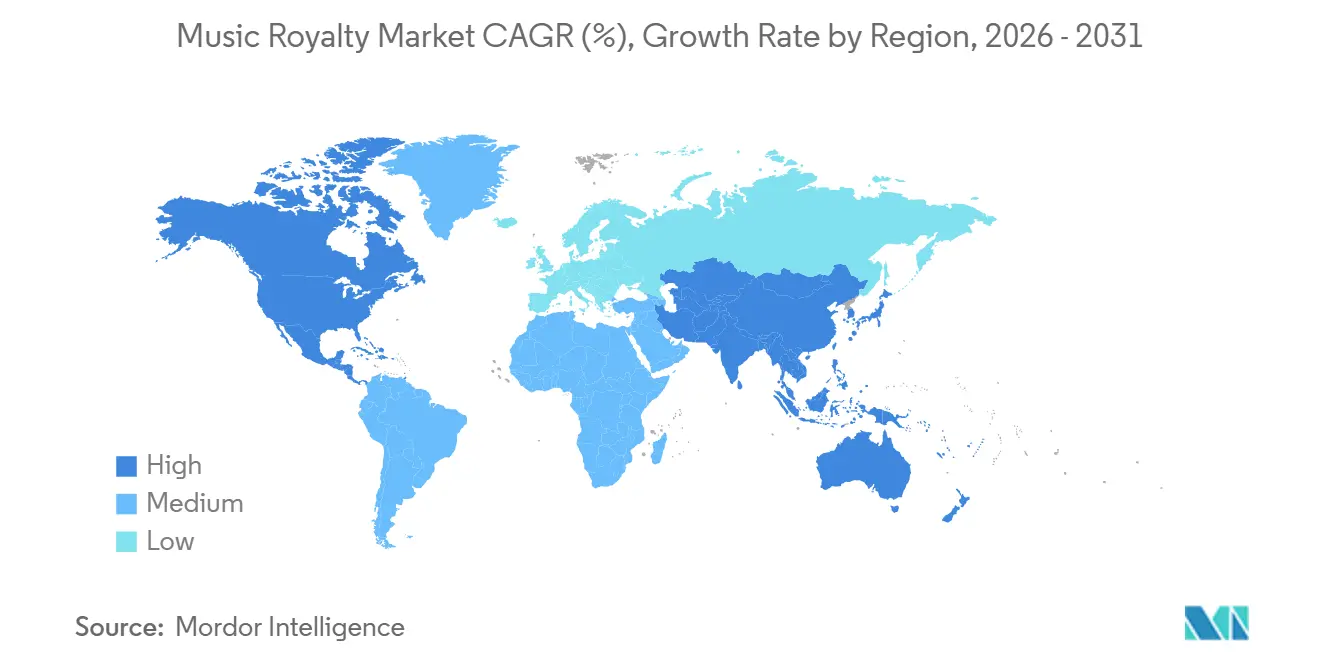
North America accounted for 39.42% of the music royalty market in 2025, which kept it as the largest regional revenue base in the current structure. ASCAP reported record 2025 revenue of USD 1.945 billion and royalty distributions of USD 1.759 billion, supported by streaming audio, radio, and general licensing collections. SoundExchange also distributed USD 991.5 million in 2025 and crossed USD 13 billion in cumulative distributions in March 2026, which highlights the maturity of North America’s digital performance system. CISAC placed North American creator royalty collections at EUR 3.5 billion (USD 3.9 billion) in 2024, up 10% year over year, which shows that the regional base was still expanding before the current bundle dispute intensified. The main constraint for the music royalty market in North America is not weak demand but the risk that subscription bundling and royalty allocation disputes slow the conversion of platform income into publisher and songwriter payments.
Europe Music Royalty Market
Europe remains the second-largest collection base in the music royalty market, with CISAC-affiliated societies collecting EUR 7.6 billion (USD 8.6 billion) in 2024, up 6.7% from the prior year. SACEM reported 2025 revenue of EUR 1.804 billion, or USD 2.04 billion, and said its direct collection infrastructure now extends to nearly 180 countries, which gives Europe a strong cross-border administrative position. PRS for Music collected GBP 1.24 billion, or USD 1.63 billion, in 2025 and paid out GBP 1.07 billion, or USD 1.41 billion, which confirms continued strength in one of the region’s largest rights markets. Europe’s role in the music royalty market is also supported by improving cost efficiency in administration and by a regulatory setting that keeps platform transparency and reporting obligations under close review.
APAC, South America and MEA Music Royalty Market
Asia-Pacific is projected to grow at an 11.83% CAGR through 2031, which gives it the fastest regional growth path in the music royalty market. IFPI reported that China’s recorded music revenues grew 20.1% in 2025, which made it the fastest-growing market in the global top 20 and lifted it to the world’s fourth-largest recorded music market. CISAC reported that India’s IPRS increased creator revenues by 40.5% in 2024 to EUR 80.5 million (USD 91.77 million), with digital streaming making up 82.7% of collections, which points to strong monetization progress from a still-developing base. South America, the Middle East, and Africa also showed strong recorded music growth in 2025, but the music royalty market still has a larger monetization gap there because collection infrastructure trails underlying consumption. That leaves these regions as longer-term upside areas where better compliance, stronger society operations, and cleaner rights data could translate usage growth into higher royalty capture.
Competitive Landscape
The music royalty market remains moderately fragmented overall, but bargaining power is concentrated in a small group of large publishers, major labels, and scaled administrators that control valuable catalog and established collection relationships. Sony Music Publishing, Universal Music Publishing Group, and Warner Chappell Music continue to shape the top tier through catalog depth, licensing reach, and the ability to negotiate with major streaming and media buyers. A second group that includes BMG, Kobalt, Concord, Downtown, and Reservoir competes by combining rights administration, service models, and technology capability within the music royalty market. This structure means scale matters, but scale alone is no longer enough when rights attribution, metadata cleanliness, and payment speed are becoming key differentiators. In practice, the firms that can pair catalog with better data systems are gaining a stronger position than firms that rely only on legacy ownership advantages.
Strategic consolidation is now reshaping the independent side of the music royalty market. Primary Wave announced a definitive agreement in March 2026 to acquire Kobalt Music Group for approximately USD 1.5 billion, bringing Kobalt’s publishing operations, catalog interests, and amra’s digital royalty collection platform under one wider platform. That move is significant because it combines catalog marketing capability with a proven digital administration engine, which should improve leverage with platforms and rightsholders. The source draft also shows that BMG and Concord agreed to merge in April 2026, which reinforces the same theme of scale-building across the independent tier. Together, these deals suggest that the music royalty market is rewarding operators that can offer both repertoire strength and infrastructure depth.
Technology investment is becoming just as important as M&A in the music royalty market. Warner Music Group’s acquisition of Sureel AI in June 2026 shows that rights owners now view creative provenance tracking and AI-use detection as operating priorities with commercial value. Collecting societies are making the same adjustment through process efficiency, with SACEM and PRS for Music highlighting stronger collection and payout systems in their latest disclosures. CISAC’s standards work, including AVR+ and broader identifier upgrades, adds a shared operating baseline that can influence how rights owners choose administrator partners. Over the next few years, the firms best placed in the music royalty market are likely to be those that can improve attribution accuracy, shorten payment cycles, and defend rights quality across streaming, social video, and AI-linked use cases.
Music Royalty Industry Leaders
-
Sony Music Publishing
-
Universal Music Publishing Group
-
Warner Chappell Music
-
Kobalt Music Group
-
BMG Rights Management
- *Disclaimer: Major Players sorted in no particular order
Music Royalty Market Companies Covered in this Report
- Sony Music Publishing
- Universal Music Publishing Group
- Warner Chappell Music
- Kobalt Music Group
- BMG Rights Management
- Concord Music Publishing
- Downtown Music Holdings
- Reservoir Media
- Peermusic
- ASCAP
- BMI
- SESAC Music Group
- PRS for Music
- SACEM
- GEMA
- SoundExchange
- The Mechanical Licensing Collective
- PPL
- Merlin Network Limited
- Universal Music Group
Recent Industry Developments in Music Royalty Market
- June 2026: Warner Music Group acquired AI attribution startup Sureel AI, whose patented "AI DNA" technology tracks creative provenance at the component level to detect when artist works are used in AI-generated content or model training. The acquisition advances WMG's strategy of positioning attribution as a monetization and enforcement layer for rights holders, per the WMG official press release.
- June 2026: CISAC published AVR+, a machine-readable JSON schema built on the Global Cue Sheet Standard 2.0, enabling automated cue sheet ingestion, reduction of metadata gaps, and consistent validation across production partners and royalty processing systems, per CISAC's June 18, 2026 press release.
- June 2026: Sony Music Publishing plans to acquire Recognition Music’s entire catalog of works from funds managed by Blackstone, securing rights to more than 45,000 songs, including works by Beyoncé, Fleetwood Mac, and Rihanna.
- March 2026: Primary Wave Music announced a definitive agreement to acquire Kobalt Music Group from Francisco Partners for approximately USD 1.5 billion, with a strategic investment from Brookfield, creating an entity with over USD 7 billion in combined assets. The deal encompasses Kobalt's worldwide catalog, publishing operations, and amra's global digital royalty collection platform, with closing expected in Q3 2026, per Primary Wave's official press release.
Global Music Royalty Market Report Scope
The Music Royalty Market Report is Segmented by Type (Performance Royalties, Mechanical Royalties, Synchronization Royalties, Sound Recording and Master Royalties, and Other Types), Channel (Streaming Platforms, Broadcasting and Digital Radio, Film, Television, and OTT Media, Gaming and Interactive Media, and Other Channels), End-Users (Independent Artists, Songwriters and Composers, Music Publishers, Record Labels, and Other End-Users), and Geography ( North America, South America, Europe, Asia-Pacific, Middle East, and Africa). The Market Forecasts are Provided in Terms of Value (USD).
Segmentation Overview
| Performance Royalties |
| Mechanical Royalties |
| Synchronization Royalties |
| Sound Recording and Master Royalties |
| Other Types |
| Streaming Platforms |
| Broadcasting and Digital Radio |
| Film, Television, and OTT Media |
| Gaming and Interactive Media |
| Other Channels |
| Independent Artists |
| Songwriters and Composers |
| Music Publishers |
| Record Labels |
| Other End-Users |
| North America | United States |
| Canada | |
| Mexico | |
| South America | Brazil |
| Argentina | |
| Chile | |
| Rest of South America | |
| Europe | Germany |
| United Kingdom | |
| France | |
| Italy | |
| Spain | |
| Rest of Europe | |
| Asia-Pacific | China |
| Japan | |
| India | |
| South Korea | |
| Australia | |
| Rest of Asia-Pacific | |
| Middle East | Saudi Arabia |
| United Arab Emirates | |
| Qatar | |
| Rest of Middle East | |
| Africa | South Africa |
| Egypt | |
| Nigeria | |
| Rest of Africa |
| By Type | Performance Royalties | |
| Mechanical Royalties | ||
| Synchronization Royalties | ||
| Sound Recording and Master Royalties | ||
| Other Types | ||
| By Channel | Streaming Platforms | |
| Broadcasting and Digital Radio | ||
| Film, Television, and OTT Media | ||
| Gaming and Interactive Media | ||
| Other Channels | ||
| By End-users | Independent Artists | |
| Songwriters and Composers | ||
| Music Publishers | ||
| Record Labels | ||
| Other End-Users | ||
| By Geography | North America | United States |
| Canada | ||
| Mexico | ||
| South America | Brazil | |
| Argentina | ||
| Chile | ||
| Rest of South America | ||
| Europe | Germany | |
| United Kingdom | ||
| France | ||
| Italy | ||
| Spain | ||
| Rest of Europe | ||
| Asia-Pacific | China | |
| Japan | ||
| India | ||
| South Korea | ||
| Australia | ||
| Rest of Asia-Pacific | ||
| Middle East | Saudi Arabia | |
| United Arab Emirates | ||
| Qatar | ||
| Rest of Middle East | ||
| Africa | South Africa | |
| Egypt | ||
| Nigeria | ||
| Rest of Africa | ||
Key Questions Answered in the Report
What is the current size of the music royalty market?
The music royalty market size is projected at USD 40.43 billion in 2026 and is forecast to reach USD 55.52 billion by 2031 at a 6.55% CAGR.
Which royalty type leads global revenue generation?
Sound Recording and Master Royalties led the revenue mix in 2025 with a 41.57% share, reflecting the strength of master ownership and catalog leverage.
Which distribution channel is growing fastest for royalty monetization?
Gaming and Interactive Media is projected to grow at an 11.67% CAGR through 2031, ahead of other channels in the current forecast.
Why are independent artists gaining ground in royalty earnings?
Independent Artists are projected to grow at a 13.11% CAGR, and Spotify said nearly half of its USD 11 billion 2025 payouts went to independent artists and labels.
Which region has the strongest growth outlook through 2031?
Asia-Pacific is expected to post the fastest regional CAGR at 11.83%, supported by strong growth in China and improving collections in India.