
Music Licensing Market Size and Share
Market Overview
| Study Period | 2020 - 2031 |
|---|---|
| Market Size (2026) | USD 9.73 Billion |
| Market Size (2031) | USD 14.84 Billion |
| Growth Rate (2026 - 2031) | 8.81 % |
| Fastest Growing Market | Asia-Pacific |
| Largest Market | North America |
| Market Concentration | High |
Major Players *Disclaimer: Major Players sorted in no particular order Image © Mordor Intelligence. Reuse requires attribution under CC BY 4.0. | |
Music Licensing Market Analysis by Mordor Intelligence
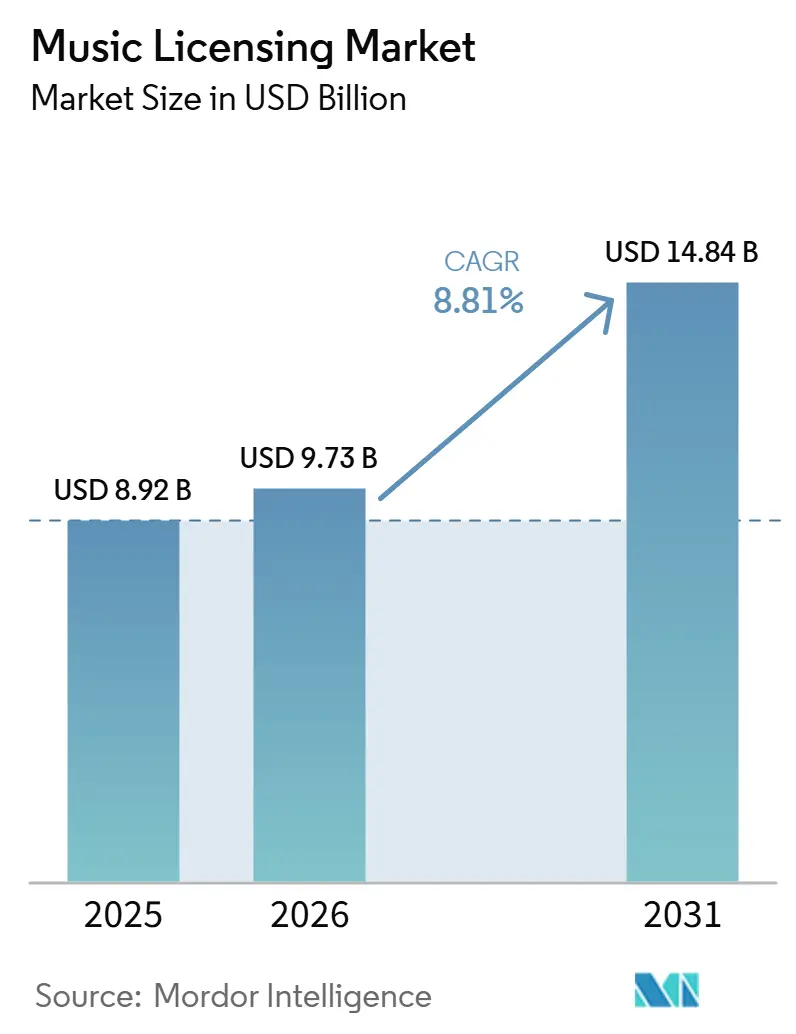
The Music Licensing Market size is projected to expand from USD 8.92 billion in 2025 and USD 9.73 billion in 2026 to USD 14.84 billion by 2031, registering a CAGR of 8.81% between 2026 to 2031. The music licensing market is growing because streaming has turned licensing into a steady revenue system rather than a back-end clearance task. The music licensing market is also benefiting from broader use of music across social platforms, branded content, games, and creator-led media, where rights owners now expect formal commercial use terms. Real-time metadata tools and stronger rights matching are improving collection efficiency, which makes the music licensing market more attractive to publishers, administrators, and collection societies. Direct platform deals, catalog ownership, and faster royalty administration are shaping competitive strategy across the music licensing market. AI attribution, platform royalty policy changes, and cross-border rights complexity are also pushing the music licensing market toward more specialized infrastructure and more active rights enforcement.
Key Report Takeaways
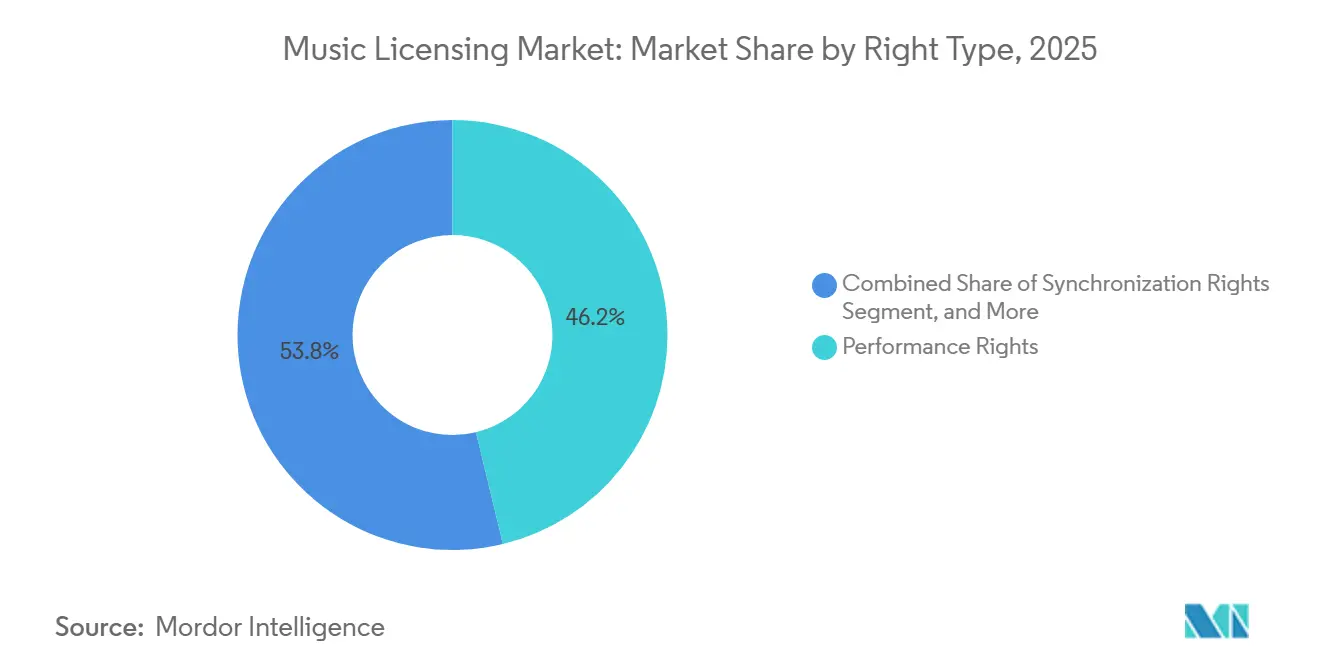
- By Rights Type, Performance Rights led with 46.23% revenue share of the music licensing market in 2025, while Synchronization Rights are projected to expand at an 10.12% CAGR through 2031.
- By Usage Platform, Streaming Audio held 43.21% share in 2025, while Social Media Platforms are projected to expand at a 9.87% CAGR through 2031.
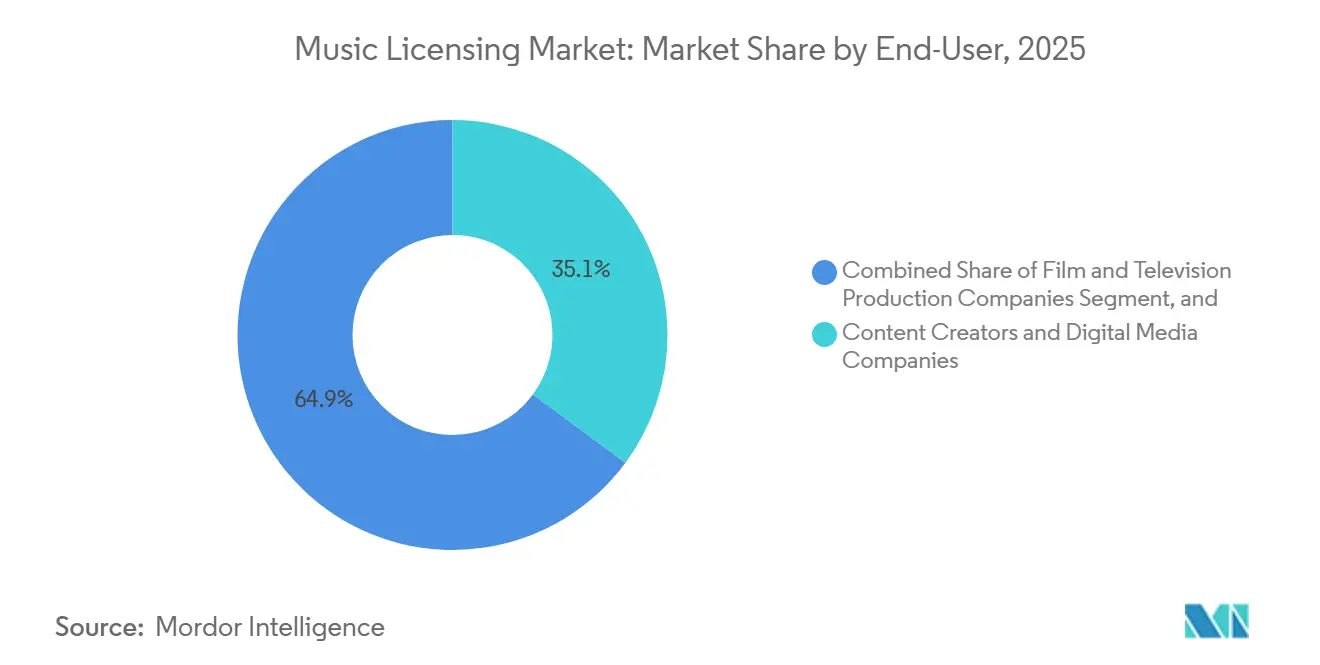
- By End-User, Content Creators and Digital Platforms accounted for 35.12% share in 2025 and also recorded the highest projected CAGR at 9.11% through 2031.
- By Geography, North America held 41.61% share of the music licensing market in 2025, while Asia-Pacific is projected to expand at an 9.91% CAGR through 2031.
Note: Market size and forecast figures in this report are generated using Mordor Intelligence’s proprietary estimation framework, updated with the latest available data and insights as of January 2026.
Global Music Licensing Market Trends and Insights
Drivers Impact Analysis*
| Driver | (~) % Impact on CAGR Forecast | Geographic Relevance | Impact Timeline |
|---|---|---|---|
| Expansion Of Streaming Platforms | +2.5% | Global | Short term (≤ 2 years) |
| Rising Synchronization Demand | +2.0% | North America and EU, with early APAC gains | Medium term (2-4 years) |
| Greater Use Of Real-Time Licensing Data | +1.5% | North America and EU | Medium term (2-4 years) |
| Growth Of Direct Licensing | +1.2% | North America, early gains in EU | Short term (≤ 2 years) |
| Cross-Border Catalog Management | +0.8% | APAC core, spill-over to Middle East and Africa and South America | Long term (≥ 4 years) |
| Higher Enforcement Of IP Rights | +0.6% | North America, EU, and APAC core | Long term (≥ 4 years) |
| Source: Mordor Intelligence | |||
Expansion Of Streaming Platforms: Licensing Volume Scales with Subscriber Growth
Streaming has made licensing volume move more directly with subscriber growth, which gives the music licensing market a wider and more repeatable royalty base. Paid streaming subscribers reached 837 million globally in 2025, which shows how much licensed music use now depends on platform scale rather than one-off transactions.[1]IFPI, “Global Music Report 2026, Global Recorded Music Revenues Grow 6.4% as Record Companies Drive Innovation,” IFPI, ifpi.org Spotify paid more than USD 11 billion to the music industry in 2025, which highlights how large digital services now sit at the center of the music licensing market.[2]Spotify, “From USD 11B in 2025 Payouts to What We're Building for Artists in 2026,” Spotify Newsroom, spotify.com Streaming revenues passed USD 22 billion in 2025 and represented 69.6% of recorded music income, which means each rise in listening activity feeds a larger pool of performance, mechanical, and sometimes synchronization claims. MENA and South America already derive more than 88% of recorded music revenue from streaming, so the music licensing market has clear room to deepen monetization in regions where digital use is already dominant. Paid subscription streaming grew 8.8% in 2025, which shows the music licensing market is still adding monetized listeners rather than only shifting free users across plan tiers.
Rising Synchronization Demand: New Channels Broaden Sync Revenue Beyond Traditional Media
Synchronization demand is expanding beyond film and television, which is widening the commercial reach of the music licensing market across short-form video, branded campaigns, and platform-native content. In the United States, synchronization revenue represented 24% of total music publishing income in 2025, which shows that sync already sits well beyond a niche role in the music licensing market.[3]National Music Publishers' Association, “US Music Publishing Revenues Hit USD 7.3B in 2025,” NMPA, nmpa.org The shift matters because creator-led advertising and commercial social content need pre-cleared music, and that raises licensing demand even when content is produced outside traditional studio systems. The music licensing market is therefore seeing sync move closer to an always-on workflow that supports daily brand publishing and platform circulation rather than only campaign-based uses. This broadening demand profile should keep synchronization one of the more responsive growth areas within the music licensing market through the forecast period.
Greater Use Of Real-Time Licensing Data: Uncollected Royalties Drive Matching Infrastructure Investment
Real-time rights matching is becoming more important because data errors still prevent a large share of royalties from reaching rights holders on time. Kobalt estimated that more than USD 1 billion in publishing royalties goes uncollected each year, which shows how strongly the music licensing market still depends on better matching infrastructure. The UK Intellectual Property Office reported that collection management organizations often receive recording information after release from digital service providers rather than directly from rights holders, which creates delays that affect payment timing and tracking quality. SoundExchange expanded its international agreements to more than 90 CMOs by February 2026 and said that its network now covers more than 91% of the available global neighboring rights market, which shows how data infrastructure is widening collectible revenue pools in the music licensing market. The music licensing market should benefit as more platforms connect recording and composition identifiers earlier in the content workflow, because that reduces leakage before royalties move into collection and distribution systems. Better data quality also gives the music licensing market a clearer path to monetizing independent and cross-border catalog that previously sat in unresolved accounts.
Growth Of Direct Licensing: Publishers Seek Better Economics and Faster Collection
Direct licensing is becoming more appealing because rights holders want stronger economics and more control over how music is monetized on large platforms. The NMPA estimated that Spotify's subscription bundle reclassification has cost songwriters and publishers USD 480 million since 2024, which has pushed direct negotiation higher on the strategic agenda across the music licensing market. Spotify's scale also matters here because a service that paid more than USD 11 billion in 2025 offers enough financial weight to make direct commercial terms meaningful for large and mid-sized rights owners. Kobalt said its KOSIGN platform can help independent songwriters collect royalties in around 3 months instead of the 12 or more months often seen through conventional routing, which shows how faster administration supports the logic of direct licensing in the music licensing market. The music licensing market is likely to see more rights owners balance collective systems with direct arrangements when scale, leverage, and speed justify that mix.
Restraints Impact Analysis*
| Restraint | (~) % Impact on CAGR Forecast | Geographic Relevance | Impact Timeline |
|---|---|---|---|
| Royalty Fragmentation Across Rights Holders and Territories | -1.8% | Global | Medium term (2-4 years) |
| Metadata Inaccuracy and Usage-Tracking Gaps | -1.5% | Global | Short term (≤ 2 years) |
| Slow Reconciliation Cycles and Payout Delays | -1.0% | Global, with severity in emerging markets | Medium term (2-4 years) |
| Rising Legal Complexity Around AI-Generated and Derivative Music | -0.8% | North America and EU | Long term (≥ 4 years) |
| Source: Mordor Intelligence | |||
Royalty Fragmentation Across Rights Holders and Territories: Multi-Framework Complexity Constrains Collection Efficiency
Royalty fragmentation remains a real drag on the music licensing market because one song can generate performance, mechanical, synchronization, and neighboring rights income through different systems. ASCAP paid out a record USD 1.76 billion in 2025, but that scale still sits inside a broader environment where multiple organizations and legal frameworks handle different parts of the same asset. SoundExchange's expansion to more than 90 international agreements shows that cross-border recovery often depends on many separate counterparties before royalties can move back to the original rights holder.[4]SoundExchange, “SoundExchange Expands International CMO Agreements,” SoundExchange, soundexchange.com The UK Intellectual Property Office also pointed to delays between release and metadata submission, which means fragmentation is not only legal and institutional, it is also operational. The music licensing market will continue to lose efficiency until rights ownership, usage reporting, and collection pathways align more closely across territories and rights classes. This issue weighs most heavily on independent creators and smaller catalogs because they usually lack the internal teams needed to manage fragmented claims at scale.
Metadata Inaccuracy and Usage-Tracking Gaps: Data Gaps Channel Royalties Into Unallocated Accounts
Metadata inaccuracy is one of the most persistent restraints in the music licensing market because royalty systems depend on clean links between recordings and compositions. The UK Intellectual Property Office found that collection organizations often receive recording information after release rather than before release, which creates a built-in delay in payment matching. Kobalt said more than USD 1 billion in publishing royalties goes uncollected each year, and it linked much of that gap to rights-matching failures. When ISRC and ISWC information fails to line up across services, publishers, and collection societies, royalties can move into unallocated or disputed pools that are hard to recover later. The music licensing market needs better ingestion standards, earlier metadata validation, and stronger identifier matching if it is going to reduce payment leakage in a measurable way. Progress in this area would improve creator trust and raise the collectible base across the music licensing market without requiring a comparable rise in listening volume.
*Our forecasts treat driver/restraint impacts as directional, not additive. The impact forecasts reflect baseline growth, mix effects, and variable interactions.
Segment Analysis
By Rights Type: Performance Rights Lead As Synchronization Accelerates
Performance rights held 46.23% of the music licensing market share in 2025, which made them the largest rights type in the category. This position reflects the broad reach of performing rights organizations across radio, broadcast, live performance, and streaming environments where public performance claims remain central. ASCAP paid out a record USD 1.76 billion to songwriters and publishers in 2025, which shows how large-scale collection networks still underpin a major part of the music licensing market. Mechanical rights remained an important part of the category, but publisher economics came under pressure as large digital platforms adjusted how subscription bundles affect royalty allocation. Print music rights and other smaller rights streams stayed niche, though physical music momentum gave them a firmer base than in prior years.
Synchronization rights are projected to expand at an 10.12% CAGR through 2031, which makes them the fastest-growing rights type in the music licensing market size mix over the forecast period. In the United States, sync represented 24% of total music publishing revenue in 2025, which shows that the segment already carries material weight before its faster growth is fully reflected. The mix is shifting because commercial creator content, social advertising, and branded digital media use more music that needs active rights clearance. That makes synchronization one of the clearest expressions of how the music licensing industry is moving toward faster, more repeatable clearance workflows across digital content formats. As platforms, agencies, and rights owners standardize these workflows, synchronization should continue gaining strategic importance inside the music licensing market.



By Usage Platform: Streaming Audio Anchors The Market As Social Media Scales
Streaming audio accounted for 43.21% of the music licensing market size in 2025, which made it the leading usage platform by revenue contribution. The segment's lead reflects the near-complete shift of on-demand listening to subscription and ad-supported audio services. Spotify paid more than USD 11 billion to the music industry in 2025, which shows how heavily the music licensing market depends on licensed streaming flows for current revenue generation. Video streaming also remains important because long-form digital content continues to use licensed music across subscription, ad-supported, and original programming models. Live events and venues recovered further in fiscal 2025, with JASRAC's live concert royalty collections reaching 6.79 billion JPY, which was equivalent to USD 45.3 million using the reported conversion basis in the source material.
Social media platforms are projected to expand at a 9.87% CAGR through 2031, which makes them the fastest-growing usage platform in the music licensing market. This growth reflects the formalization of commercial creator activity, where brands and professional creators need rights-cleared music for monetized distribution. Universal Music Group and TikTok announced a new multi-year global licensing agreement in May 2026, which shows that major platforms now treat music access, publishing rights, and AI safeguards as core operating issues rather than side agreements. Video games remain a smaller platform by share, but they create distinct synchronization demands because music use in interactive formats often differs from linear media. The others category, which includes fitness apps, podcasts, and AI audio tools, also points to how the music licensing market is widening into high-volume digital uses that need simpler but more continuous licensing models.
By End-User: Content Creators and Digital Platforms Define the Growth Frontier
Content creators and digital platforms held 35.12% share in 2025, which placed them at the center of the music licensing market as the largest end-user group. The same segment is projected to expand at a 9.11% CAGR through 2031, which means it is also the fastest-growing end-user block in the music licensing market size profile. Spotify reported that more than 1,500 artists generated over USD 1 million in royalties from the platform in 2025, which shows how creator monetization is now tied closely to scalable licensing systems. Artists from 75 countries generated at least USD 500,000 from Spotify in 2025, up from 66 countries in 2024, which shows the music licensing market is broadening geographically at the same time it expands digitally. This end-user pattern is important because licensing demand is no longer concentrated only in broadcasters, labels, and studios, it now runs through a much larger base of platform-native commercial activity.
Film and television production remained important because sync income still draws heavily from long-form content and streaming originals. Advertising and marketing are becoming more active because agencies, brands, and creator partnerships increasingly need licensed music for social-led campaigns and AI-assisted content workflows. Broadcasters remain meaningful but their relative position has eased as audience attention and monetized listening continue moving toward streaming and social platforms. JASRAC reported that interactive transmissions reached 59.4 billion JPY in fiscal 2025, which was equivalent to USD 396 million using the reported conversion basis in the source material, and that supports the case for digital end-users taking a larger role in the music licensing market. The others category also points to new demand from immersive media, spatial audio, and extended reality uses, which shows how the music licensing industry is adapting to more varied digital consumption settings.
Geography Analysis
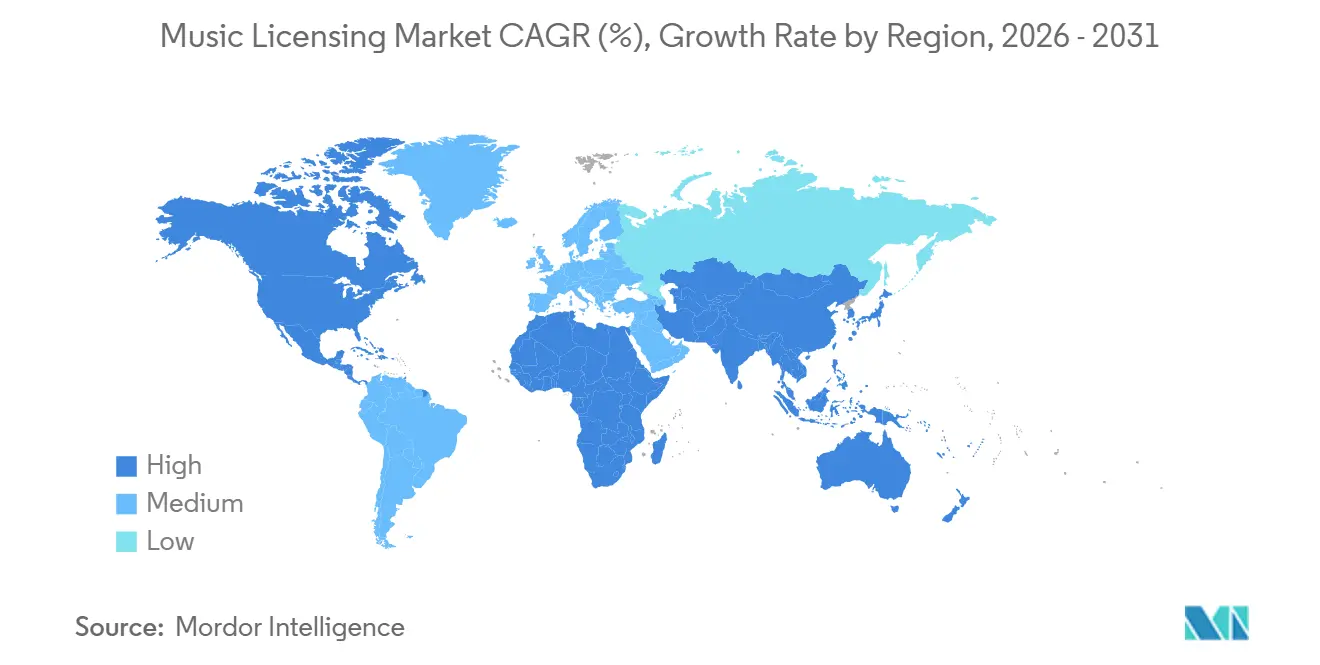
North America held 41.61% of the music licensing market share in 2025, which made it the largest regional contributor. The United States publishing ecosystem generated USD 7.3 billion in 2025, with performance royalties contributing 52%, synchronization 24%, and mechanical 19%, which shows the scale and balance of revenue streams supporting the region. North America also remains the main testing ground for direct platform arrangements and faster royalty administration, which gives the music licensing market a commercial model that other regions may increasingly follow. Europe remained the second-largest region because it combines mature collecting societies, strong online usage, and established publishing infrastructure, even as the music licensing market continues shifting toward digital-first channels. South America, while smaller by absolute revenue, stands out for strong digital monetization because streaming represented 88.1% of recorded music revenue in the region in 2025.
Asia-Pacific is projected to expand at an 9.91% CAGR through 2031, which makes it the fastest-growing regional segment in the music licensing market. JASRAC reported a record fiscal 2025 distribution of JPY 151.86 billion, which was equivalent to USD 1.01 billion using the reported conversion basis in the source material. Japan returned to growth at 8.9% in 2025, which supports the region's importance as both a mature market and a base for rights administration scale. China became the world's fourth-largest recorded music market in 2025 after 20.1% year-on-year growth, which signals rising cross-border licensing demand in the region. India remained the world's second-largest streaming market by volume, which suggests a large future licensing base as paid models and formal rights systems deepen over time.
The Middle East and Africa are the highest-growth emerging geographies in the music licensing market, with MENA and Sub-Saharan Africa each recording 15.2% revenue growth in 2025. Streaming accounted for 97.5% of MENA music revenue, which shows how fully digital use now shapes the region's licensing opportunity. South Africa represented 78.1% of Sub-Saharan African music revenue, but neighboring rights infrastructure is widening as international collection agreements extend into more territories. SoundExchange added new agreements in markets including Kenya in February 2026, which shows the music licensing market is building stronger collection pathways in regions that were once harder to monetize at scale.

Competitive Landscape
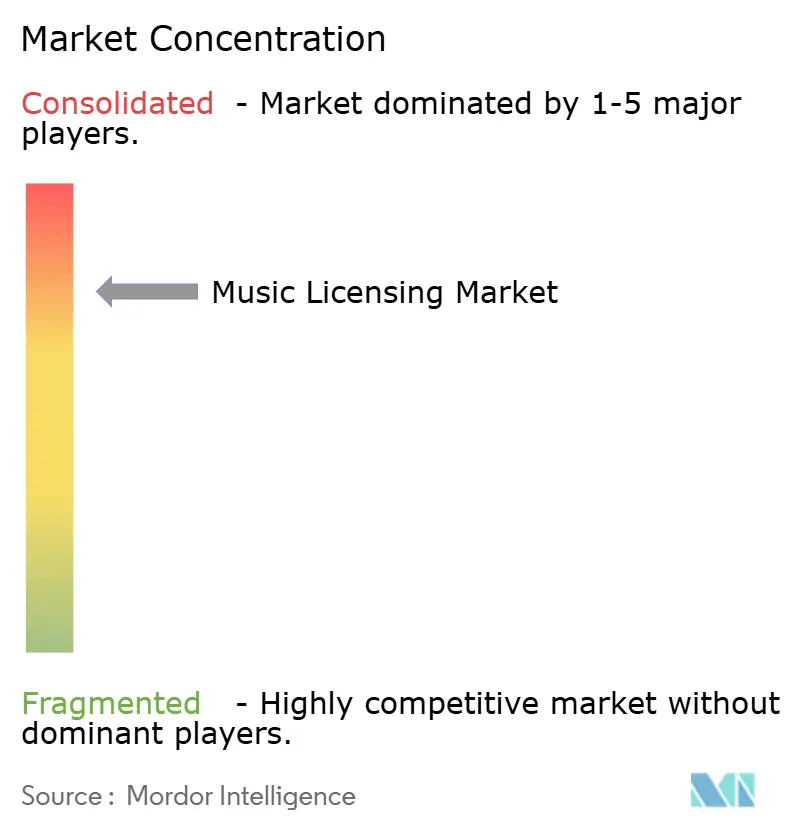
The music licensing market is moderately concentrated at the top of global catalog ownership, with Sony Music Publishing, Universal Music Publishing Group, and Warner Chappell Music setting the pace on scale and negotiating leverage. At the same time, the broader music licensing market remains fragmented across publishers, performing rights organizations, collective management organizations, and rights administrators that handle different parts of the value chain. That split explains why catalog scale matters so much in direct negotiations, while operational reach and data quality matter just as much in collection and royalty administration. The result is a music licensing market where ownership concentration and service fragmentation exist at the same time.
Strategic moves in 2026 show that companies are using acquisitions to deepen catalog control and widen licensing reach across the music licensing market. Primary Wave announced its acquisition of Kobalt Music Group in March 2026, which adds worldwide operations, owned copyrights, and the Amra digital collection platform to its portfolio. Sony Music Publishing agreed in May 2026 to acquire the complete catalog of Recognition Music Group, which reflects continued demand for scaled, high-value song catalogs. Concord also acquired the assets of Mothership Music Publishing in April 2026, which strengthens its reach across pop, indie pop, rock, alternative, and singer-songwriter copyrights. These moves show that the music licensing market rewards companies that can combine catalog breadth with global administration capability.
Technology and platform relationships are becoming just as important as catalog ownership in the music licensing market. Kobalt said KOSIGN can cut royalty collection timelines to around 3 months from the 12 or more months often seen through standard routes, which shows how speed itself has become a competitive advantage. Universal Music Group and TikTok signed a new global licensing agreement in May 2026, which highlights how major rightsholders are using direct platform relationships to protect access, monetization, and AI safeguards at the same time. SoundExchange's growing network of international agreements also shows that the music licensing market increasingly rewards organizations that can recover neighboring rights across more territories without raising friction for artists and labels. Smaller publishers and creator-focused administrators still have room to grow, but they will need sharper data tools, faster settlement cycles, and more focused niche coverage to stand out in the music licensing market.
Music Licensing Industry Leaders
Sony Music Publishing LLC
Universal Music Publishing Group Inc.
Warner Chappell Music Inc.
Kobalt Music Group Ltd.
BMG Rights Management GmbH
- *Disclaimer: Major Players sorted in no particular order

Recent Industry Developments
- June 2026: Japan's National Diet passed a copyright reform granting performers and record companies royalties when their recordings play in public spaces, including overseas uses. Mitsubishi UFJ Research and Consulting estimated that, had the rights been in effect in 2024, Japanese artists would have generated 2.4 billion JPY (approximately USD 15.1 million) in overseas revenue, with the government targeting a tenfold increase in overseas music sales to 1 trillion JPY by 2033 per The Asahi Shimbun.
- June 2026: Warner Music Group acquired Sureel AI, an AI attribution startup whose patented technology creates "AI DNA" for songs to trace how AI models incorporate musical elements from existing works. The acquisition positions WMG to enforce AI attribution rights and detect unauthorized use of its catalog in generative AI training data, following WMG's earlier licensing deals with Suno and Udio per WMG's announcement.
- May 2026: Universal Music Group and TikTok announced a new multi-year global licensing agreement covering UMG's recorded music and publishing catalogs. The deal builds on the 2024 partnership that resolved UMG's catalog withdrawal and commits both parties to jointly remove unauthorized AI-generated music from the platform while expanding AI protection measures per the joint UMG-TikTok announcement.
- May 2026: Sony Music Publishing agreed to acquire the complete catalog of Recognition Music Group, comprising more than 45,000 songs. Bloomberg reported the transaction could be valued at up to USD 4 billion, positioning it as one of the largest single catalog acquisitions in music publishing history and continuing Sony Music Publishing's aggressive Nordic and global catalog expansion strategy.


Global Music Licensing Market Report Scope
The Music Licensing Market Report is Segmented by Rights Type (Performance Rights, Mechanical Rights, Synchronization Rights, Print Music Rights, and Other Rights Type), Usage Platform (Streaming Audio, Video Streaming, Social Media Platforms, Live Events and Venues, Video Games, and Other Usage Platform), End-User (Content Creators and Digital Media Companies, Film and Television Production Companies, Advertising and Marketing Agencies, Broadcasters, and Other End-User), and Geography(North America, South America, Europe, Asia-Pacific, Middle East, and Africa). The Market Forecasts are Provided in Terms of Value (USD).
| Performance Rights |
| Mechanical Rights |
| Synchronization Rights |
| Print Music Rights |
| Other Rights Type |
| Streaming Audio |
| Video Streaming |
| Social Media Platforms |
| Live Events and Venues |
| Video Games |
| Other Usage Platforms |
| Content Creators and Digital Media Companies |
| Film and Television Production Companies |
| Advertising and Marketing Agencies |
| Broadcasters |
| Other End-Users |
| North America | United States |
| Canada | |
| Mexico | |
| South America | Brazil |
| Argentina | |
| Chile | |
| Rest of South America | |
| Europe | Germany |
| United Kingdom | |
| France | |
| Italy | |
| Spain | |
| Rest of Europe | |
| Asia-Pacific | China |
| Japan | |
| India | |
| South Korea | |
| Australia | |
| Rest of Asia-Pacific | |
| Middle East | Saudi Arabia |
| United Arab Emirates | |
| Qatar | |
| Rest of Middle East | |
| Africa | South Africa |
| Egypt | |
| Nigeria | |
| Rest of Africa |
| By Rights Type | Performance Rights | |
| Mechanical Rights | ||
| Synchronization Rights | ||
| Print Music Rights | ||
| Other Rights Type | ||
| By Usage Platform | Streaming Audio | |
| Video Streaming | ||
| Social Media Platforms | ||
| Live Events and Venues | ||
| Video Games | ||
| Other Usage Platforms | ||
| By End-User | Content Creators and Digital Media Companies | |
| Film and Television Production Companies | ||
| Advertising and Marketing Agencies | ||
| Broadcasters | ||
| Other End-Users | ||
| By Geography | North America | United States |
| Canada | ||
| Mexico | ||
| South America | Brazil | |
| Argentina | ||
| Chile | ||
| Rest of South America | ||
| Europe | Germany | |
| United Kingdom | ||
| France | ||
| Italy | ||
| Spain | ||
| Rest of Europe | ||
| Asia-Pacific | China | |
| Japan | ||
| India | ||
| South Korea | ||
| Australia | ||
| Rest of Asia-Pacific | ||
| Middle East | Saudi Arabia | |
| United Arab Emirates | ||
| Qatar | ||
| Rest of Middle East | ||
| Africa | South Africa | |
| Egypt | ||
| Nigeria | ||
| Rest of Africa | ||


Key Questions Answered in the Report
What is the current and forecast value of the music licensing sector?
The Music Licensing Market size stood at USD 9.73 billion in 2026 and is projected to reach USD 14.84 billion by 2031 at an 8.81% CAGR.
Which rights type contributes the most revenue?
Performance rights led with 46.23% share in 2025, supported by large public performance collection networks and strong streaming-related usage.
Which platform is expanding the fastest for licensed music use?
Social media platforms are projected to grow at a 9.87% CAGR through 2031 because monetized creator activity is moving into formal commercial licensing.
Why is metadata accuracy so important for royalty collection?
Metadata quality determines whether recordings and compositions match correctly in payment systems. Kobalt said more than USD 1 billion in publishing royalties goes uncollected each year, and the UK Intellectual Property Office also highlighted delayed and incomplete metadata flows.
Which region is growing the fastest?
Asia-Pacific is the fastest-growing region with an 9.91% projected CAGR, helped by strong momentum in Japan, China, and India.
What are the main competitive moves shaping this space in 2026?
Large catalog acquisitions and direct platform relationships are shaping the field, including Primary Wave's move for Kobalt, Sony Music Publishing's Recognition Music Group deal, Concord's Mothership acquisition, and the new UMG-TikTok licensing agreement.
Page last updated on:


 Your data is secure and never sold or shared.


