
Moldova Telecom MNO Market Size and Share
Market Overview
| Study Period | 2019 - 2030 |
|---|---|
| Forecast Data Period | 2025 - 2030 |
| Historical Data Period | 2019 - 2023 |
| Market Size (2025) | USD 0.42 Billion |
| Market Size (2030) | USD 0.51 Billion |
| Growth Rate (2025 - 2030) | 3.79 % |
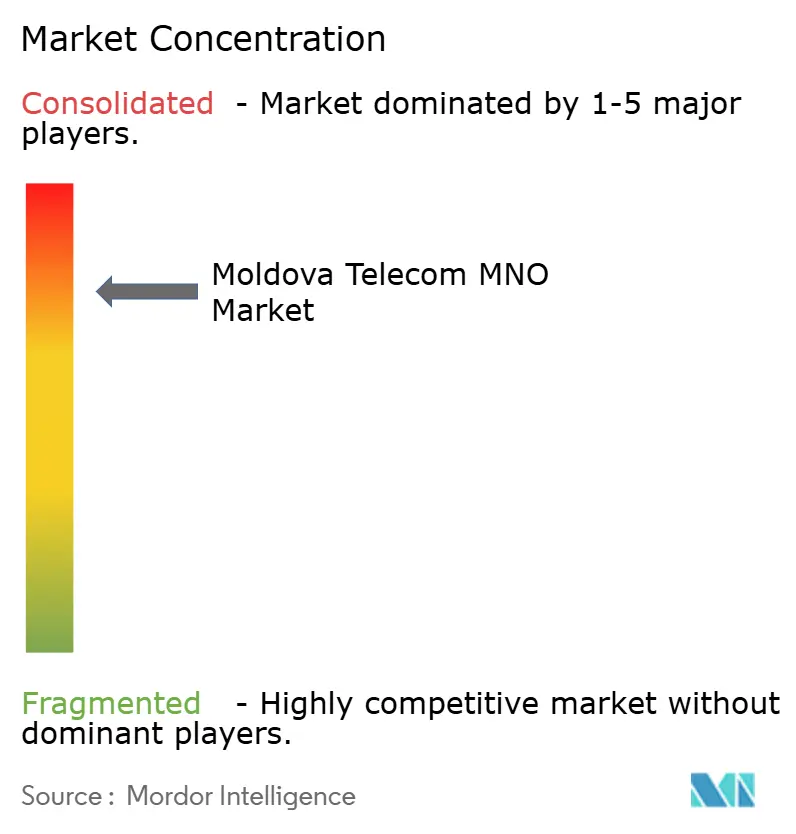
| Market Concentration | High |
Major Players *Disclaimer: Major Players sorted in no particular order Image © Mordor Intelligence. Reuse requires attribution under CC BY 4.0. | |
Moldova Telecom MNO Market Analysis by Mordor Intelligence
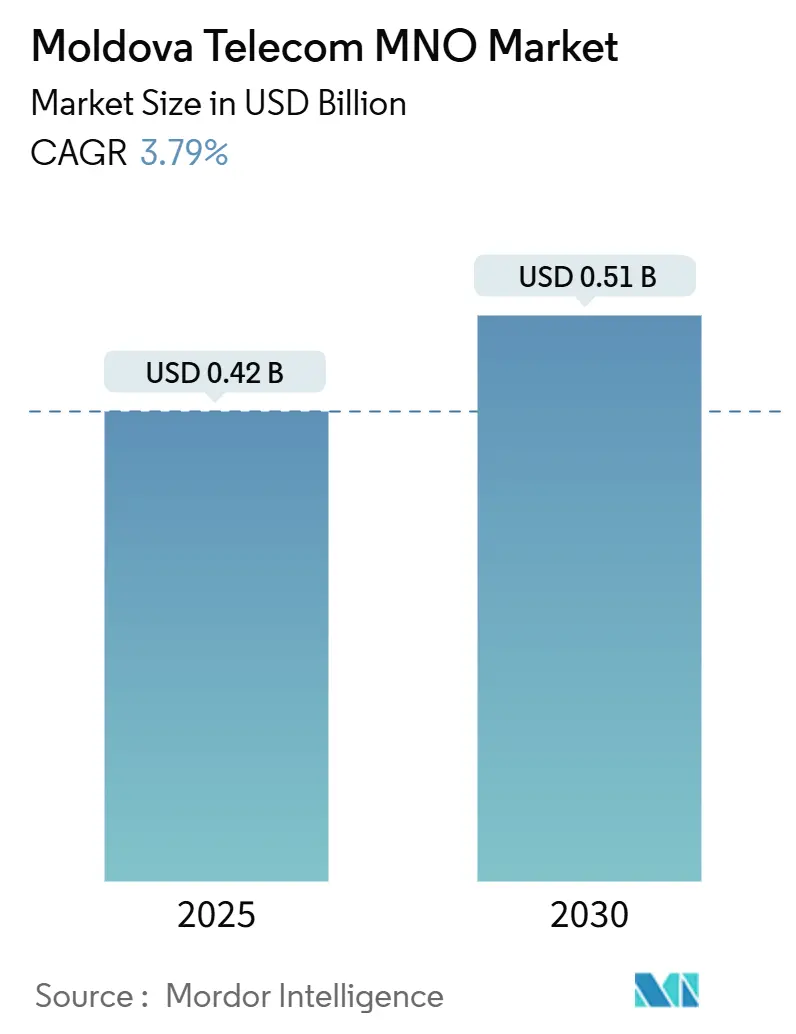
The Moldova Telecom MNO Market size is estimated at USD 0.42 billion in 2025, and is expected to reach USD 0.51 billion by 2030, at a CAGR of 3.79% during the forecast period (2025-2030). In terms of subscriber volume, the market is expected to grow from 5.11 million Subscribers in 2025 to 6.05 million Subscribers by 2030, at a CAGR of 3.40% during the forecast period (2025-2030). The growth is driven by the sector’s ability to navigate demographic decline, leverage European integration, and monetize the accelerating growth of data traffic. Robust fiber-to-the-home (FTTH) roll-outs, 2100 MHz spectrum awards, and the scheduled “Roam-Like-At-Home” launch in January 2026 underpin rising mobile data usage. Enterprise demand for NB-IoT and LTE-M connectivity augments revenue diversification, while convergent service bundles sustain average revenue per user (ARPU) in a price-sensitive environment. Competitive intensity among Orange Moldova, Moldcell, and Moldtelecom drives continuous network investments that enhance service quality, positioning the Moldova telecom MNO market as a regional bridge between EU standards and Eastern Europe. [1]European Commission, “EU-Moldova Association Agreement – Digital Economy Chapter,” ec.europa.eu
Key Report Takeaways
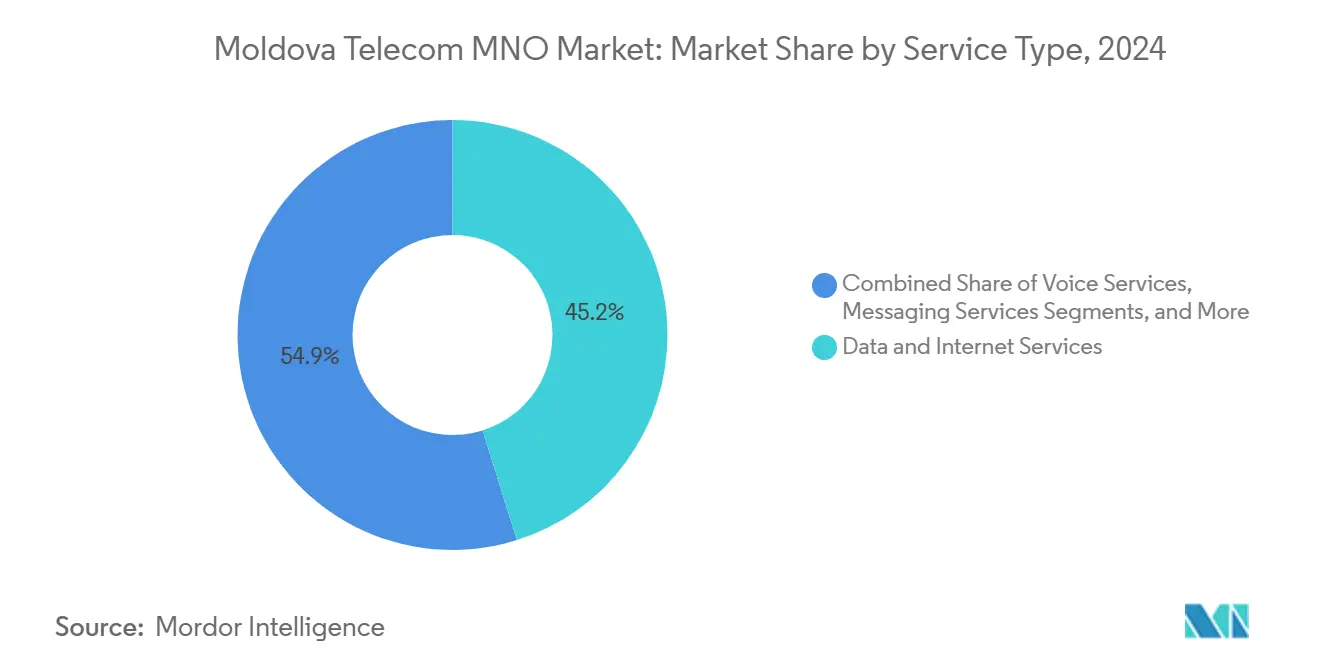
- By service type, data and internet services led with 45.15% revenue share in 2024; OTT and PayTV services are projected to expand at a 4.77% CAGR through 2030.
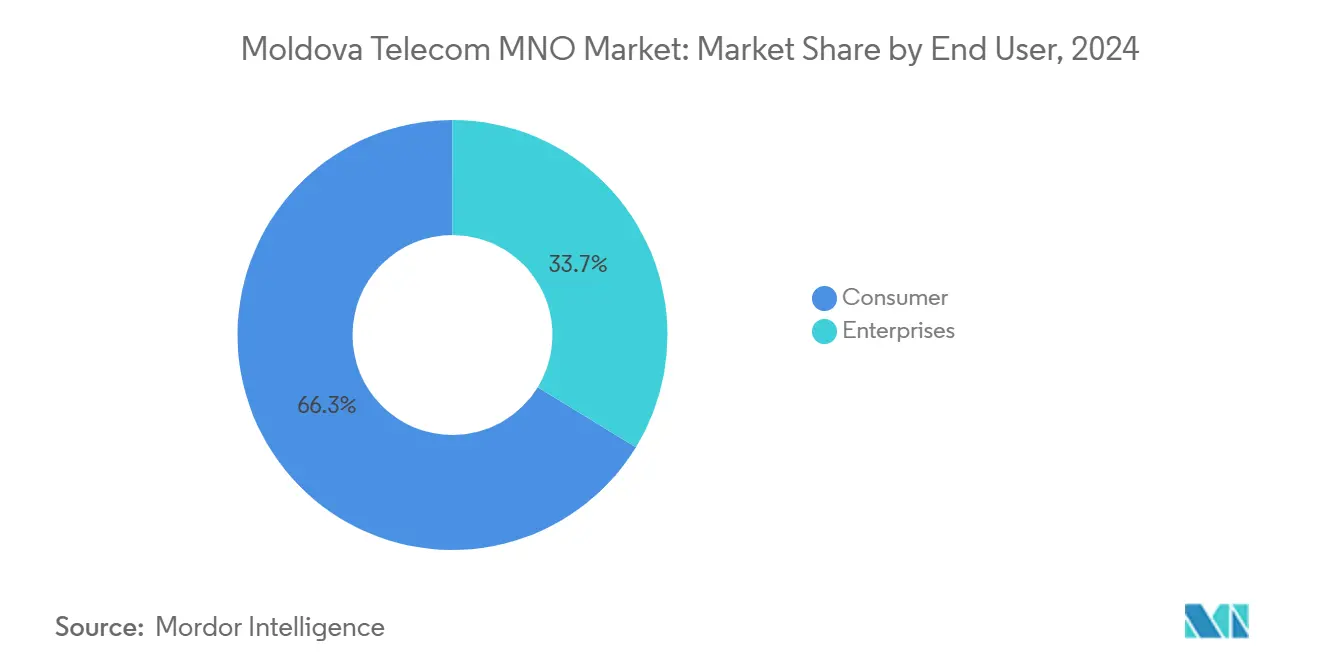
- By end-user, consumers held 66.26% revenue share in 2024, whereas the enterprise segment is forecast to post the fastest 3.88% CAGR to 2030.
Moldova Telecom MNO Market Trends and Insights
Drivers Impact Analysis*
| Driver | (~) % Impact on CAGR Forecast | Geographic Relevance | Impact Timeline |
|---|---|---|---|
| Accelerating Mobile-data Traffic and Smartphone Adoption | +1.2% | National, concentrated in Chisinau and Balti | Short term (≤ 2 years) |
| Nationwide FTTH Roll-out Backed by State Broadband Program | +0.8% | National, prioritizing rural areas | Medium term (2-4 years) |
| 5G License Issuance and Pilot Deployments by MNOs | +0.6% | Urban centers, extending to secondary cities | Medium term (2-4 years) |
| Enterprise Push for NB-IoT / LTE-M Solutions | +0.4% | Business districts and industrial zones | Long term (≥ 4 years) |
| EU “Roam-Like-At-Home” Integration (Jan-2026) Boosts Usage | +0.7% | National, diaspora connectivity benefits | Short term (≤ 2 years) |
| Diaspora-centric OTT/PayTV Bundles Raising ARPU | +0.3% | National, targeting diaspora families | Medium term (2-4 years) |
| Source: Mordor Intelligence | |||
Accelerating Mobile-Data Traffic and Smartphone Adoption
Mobile internet users climbed to 5.3 million, generating revenue of RON 816.5 million (USD 170.7 million) in Q3 2024, while ARPU grew 7.2% year on year to RON 65.8 (USD 13.76). [2]Quarterly Statistical Report Q3 2024,” anrceti.md Smartphone uptake now spans seniors, as 18.2% of residents are aged 65 and over, unlocking a fresh user cohort. Fixed subscribers favor high-speed lines, with 90.6% on FTTx and 48.8% choosing speeds above 100 Mbps, confirming appetite for bandwidth-heavy applications. These usage patterns enable mobile operators to introduce tiered plans that raise spending without compromising affordability in the Moldova telecom MNO market.
Nationwide FTTH Roll-out Backed by State Broadband Program
Fixed internet subscriptions reached 825,200, pushing penetration to 32.8 per 100 inhabitants. Moldtelecom’s 22,629 km fiber backbone supplies up to 2.1 Gbps to 400,000 customers, supporting IPTV bundles that feature 200 channels and 74 HD streams. [3]Moldtelecom, “Annual Sustainability Statement 2024,” moldtelecom.md Government subsidies accelerate rural builds, forcing rivals to match speeds while enabling smaller providers to enter through wholesale access. Convergent packages that pair high-speed internet, voice, and TV strengthen stickiness across the Moldova telecom MNO market.
5G License Issuance and Pilot Deployments by MNOs
Orange Moldova, Moldcell, and Moldtelecom secured 2100 MHz licenses in December 2024 and have begun 5G pilots in Chisinau. [4]TelecomTalk, “Moldova MNOs Secure 2100 MHz Spectrum for 5G,” telecomtalk.info Orange claims the quickest 4G network, giving it a head start as 5G coverage scales. Spectrum refarming from 2G releases additional capacity, yet a gradual sunset delays full efficiency. Early roll-outs focus on enhanced mobile broadband, with industrial IoT use cases forecast once coverage and devices mature.
Enterprise Push for NB-IoT / LTE-M Solutions
Enterprises in the banking, agriculture, logistics, and public utilities sectors are adopting connected sensors, transforming Moldova's telecom market. Wineries use narrow-band IoT trackers for real-time temperature monitoring, while exporters tag pallets with LTE-M devices to streamline border paperwork and ensure cold-chain compliance. Telecom operators now offer bundled services, including connectivity, SIM management portals, and data dashboards, which simplify compliance with ANRCETI's requirements. With over 100,000 active IoT lines, pilots in street lighting and smart irrigation indicate potential fivefold growth as spectrum refarming unlocks 2.1 GHz capacity for machine-type traffic. Affordable NB-IoT modules, priced under USD 3 and powered by a single AA battery, enable smaller factories along the Prut River to adopt sensor networks, making IoT an operational necessity in Moldova's telecom MNO market.
Restraints Impact Analysis*
| Restraint | (~) % Impact on CAGR Forecast | Geographic Relevance | Impact Timeline |
|---|---|---|---|
| Shrinking Population and Out-migration | −0.9% | National, especially rural areas | Long term (≥ 4 years) |
| Intense Price Competition Keeps ARPU Among the Lowest in Europe | −0.6% | National | Short term (≤ 2 years) |
| High Cyber-security and Energy-backup Costs Near Transnistria | −0.3% | Eastern border regions | Medium term (2-4 years) |
| Slow 2G Sunset Delays Spectrum Refarming for 5G | −0.2% | National | Medium term (2-4 years) |
| Source: Mordor Intelligence | |||
Shrinking Population and Out-Migration
Moldova's telecom MNO sector faces a shrinking consumer base. Census data shows a 13.9% population decline from 2014 to 2024, leaving 2.4 million residents, while 1.2 million Moldovans work abroad. With one in five citizens over 65, early-morning voice traffic has risen as retirees schedule medical appointments, while working-age users rely on international OTT calls after 7 PM. Operators have launched "Family Abroad" bundles, which combine high-speed FTTH at home with affordable roaming for families abroad. However, these packages only partially offset the decline in SIM card sales. To sustain profitability, network planners are consolidating base-station sites and decommissioning underutilized DSL ports.
Intense Price Competition Keeps ARPU Among the Lowest in Europe
Three full-service operators compete for the same user base, driving tariffs to some of the lowest levels on the continent. Prepaid customers can purchase a 10 GB 4G data pack for under USD 2, which barely covers costs such as energy, spectrum fees, and universal-service levies. The price war, which began with handset subsidies, has now expanded to include flash promotions such as unlimited TikTok access or six months of free IPTV. ANRCETI’s latest bulletin reports a 7.2% year-on-year increase in mobile ARPU to MDL 65.8, though this remains below Romania and Ukraine despite Moldova's smaller scale. Moldtelecom offers cloud storage, Moldcell provides device insurance, and Orange includes cybersecurity apps, to retain customers. However, intense competition continues to limit pricing power in Moldova's telecom MNO market.
*Our forecasts treat driver/restraint impacts as directional, not additive. The impact forecasts reflect baseline growth, mix effects, and variable interactions.
Segment Analysis
By Service Type: Data and Internet Services Drive Evolution
Data and Internet services accounted for 45.15% of 2024 revenue, underscoring a behavioral shift from voice to internet-based communication. OTT and PayTV retain the highest growth outlook at 4.77% CAGR, underpinned by video-on-demand services, including Netflix, Megogo, and YouTube, which are now penetrating more households in Moldova than ever before.
Convergent bundles merge high-speed broadband, IPTV, and wireless voice to sustain ARPU. Diaspora-oriented OTT and pay-TV packages broaden content appeal, while value-added services, such as mobile payments, provide incremental earnings. The drive toward digital-only engagement positions data as the long-term engine of the Moldova telecom MNO market.



By End-User: Consumer Dominance with Enterprise Upside
Consumers generated 66.26% of 2024 revenue, reflecting the residential orientation of the Moldova telecom MNO market. Aging demographics open opportunities for simplified interfaces and assisted-living connectivity. Operators are segmenting the mass market into micro-targets, such as youth who enjoy discounted nighttime data, seniors who benefit from enlarged fonts and dedicated hotline support, and families who can pool their allowances across multiple devices. Such strategies enhance the perception of fairness, ensuring customer loyalty even in the face of constant promotions.
Enterprises, though smaller, are expanding at a 3.88% CAGR as digital transformation accelerates. Higher enterprise ARPU stems from managed networks, cloud links, and IoT platforms that include support agreements. Operators develop vertical offerings for agriculture, manufacturing, and logistics, broadening the Moldova telecom MNO industry’s service mix and reducing reliance on residential demand.
Geography Analysis
Chișinău is the hub of Moldova's telecom market. With 800,000 residents within a 20-minute drive and a median household income 35% above the national average, the city boasts full 4G coverage and a 98% FTTH penetration rate. Operators are piloting 5G small cells in the Botanica district, where business parks rely on low-latency links for cloud CRM. Weekend data peaks align with diaspora return flights, as jets arrive full on Fridays, load streaming apps with roaming-free data, and leave half-empty by Monday.
Balti, Cahul, and Comrat form the next revenue tier. Despite a combined population equal to Chișinău’s, lower disposable incomes and higher migration rates drive operators to optimize capex, with macro-sites supporting both broadband and NB-IoT traffic from greenhouse clusters. Refarming the 2100 MHz band accelerates LTE upgrades, though winter frost delays trenching near the Prut floodplain. Median downlink rates in Balti have doubled since 2022, aided by Moldtelecom leasing dark fiber to smaller ISPs, highlighting the value of wholesale partnerships.
Rural northern districts face connectivity challenges, with villages of 500 residents spaced six kilometers apart. Subsidies from the state broadband fund cover 70% of civil works costs, requiring operators to deliver 100 Mbps service and maintain urban-equivalent tariffs. FTTH subscriptions in Glodeni increased by 18% last year, with improved school attendance attributed to better access to homework portals. High operating costs persist, prompting providers to combine microwave backhaul with satellite backups during spring floods. In Transnistria, InterDnestrcom’s parallel infrastructure necessitates interconnection agreements and enhanced cybersecurity protocols for cross-border traffic.
Competitive Landscape
Three vertically integrated operators, such as Orange Moldova, Moldcell, and Moldtelecom, drive a competitive market where legacy advantages hold little weight. Orange, with a significant share of mobile subscribers and awards for 4G speed, transitioned to eSIMs in 2024 to streamline distribution and cut costs. Moldcell’s “Year of the Customer” campaign upgraded 80 retail points with self-service kiosks and extended call-center hours, raising its Net Promoter Score by eight points in six months. Moldtelecom, leveraging the largest fixed footprint, offers bundled gigabit internet, IPTV, and a mobile virtual network.
Technology investment is a key focus. The operators collectively spent USD 35 million on 2100 MHz licenses, enabling 5G pilot clusters near universities and tech parks. Initial tests achieved 800 Mbps on non-stand-alone equipment, attracting gaming cafés and streaming studios to early adoption programs. Operators share passive tower infrastructure to reduce rural operational costs, while active-sharing negotiations could cut 5G roll-out expenses by 25%, a significant advantage in Moldova’s slow-growth telecom MNO market.
Service innovation is another competitive front. Orange launched the “Smart Home Line” with Zigbee hubs, Moldcell rents cloud storage for CCTV feeds, and Moldtelecom provides APIs for fintechs to integrate SMS-based two-factor authentication. These efforts aim to boost ARPU without triggering price wars. Regulatory oversight by ANRCETI ensures speed-test transparency, one-day number portability, and fair interconnect fees, protecting smaller ISPs.
Moldova Telecom MNO Industry Leaders
Orange Moldova
Moldcell
Moldtelecom (Unité)
- *Disclaimer: Major Players sorted in no particular order

Recent Industry Developments
- April 2024: DRUID has partnered with Moldtelecom to launch Chat Moldtelecom, an advanced virtual assistant available on Moldtelecom's website, Telegram, Viber, and soon on Facebook Messenger. This collaboration highlights their commitment to enhancing customer service through innovation.
- April 2024: Orange Moldova announced the nation’s first 5G trials, reinforcing its technology leadership.


Moldova Telecom MNO Market Report Scope
| Voice Services |
| Data and Internet Services |
| Messaging Services |
| IoT and M2M Services |
| OTT and PayTV Services |
| Other Services (VAS, Roaming and International Services, Enterprise and Wholesale Services, etc.) |
| Enterprises |
| Consumer |
| Service Type | Voice Services |
| Data and Internet Services | |
| Messaging Services | |
| IoT and M2M Services | |
| OTT and PayTV Services | |
| Other Services (VAS, Roaming and International Services, Enterprise and Wholesale Services, etc.) | |
| End-user | Enterprises |
| Consumer |


Key Questions Answered in the Report
What is the current size of the Moldova telecom MNO market?
The market is valued at USD 0.42 billion in 2025 and is forecast to reach USD 0.51 billion by 2030.
Which service type leads the Moldova telecom MNO market?
Data and Internet services hold the top position with 45.15% revenue share in 2024, driven by rising mobile and fixed broadband usage.
How fast is the enterprise segment growing?
Enterprise telecom revenue is projected to expand at a 3.88% CAGR between 2025 and 2030 as IoT and cloud connectivity gain traction.
When will roaming charges be eliminated between Moldova and the EU?
The “Roam-Like-At-Home” regime takes effect in January 2026, with phased tariff reductions starting in 2025.
Which operators are testing 5G in Moldova?
Orange Moldova, Moldcell, and Moldtelecom began 5G pilot deployments after receiving 2100 MHz licenses in December 2024.
What challenges could slow market growth?
Continued population decline, intense price competition, and additional security costs near Transnistria could trim the market’s CAGR outlook.
Page last updated on:


 Your data is secure and never sold or shared.


