
Slovakia Telecom MNO Market Size and Share
Market Overview
| Study Period | 2019 - 2030 |
|---|---|
| Forecast Data Period | 2025 - 2030 |
| Historical Data Period | 2019 - 2023 |
| Market Size (2025) | USD 2.11 Billion |
| Market Size (2030) | USD 2.53 Billion |
| Growth Rate (2025 - 2030) | 3.68 % |
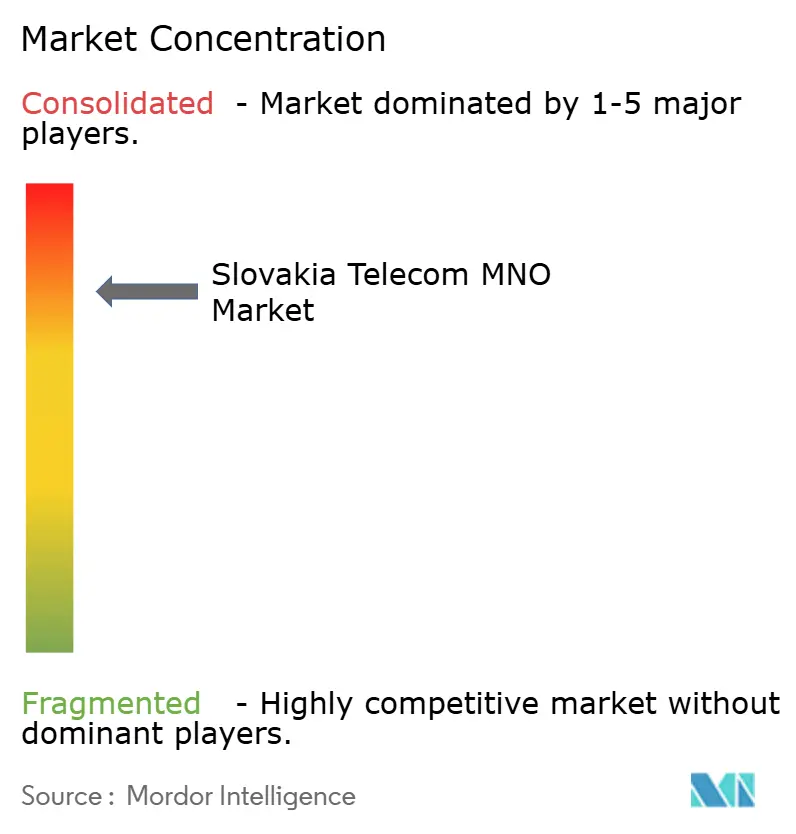
| Market Concentration | High |
Major Players *Disclaimer: Major Players sorted in no particular order Image © Mordor Intelligence. Reuse requires attribution under CC BY 4.0. | |
Slovakia Telecom MNO Market Analysis by Mordor Intelligence
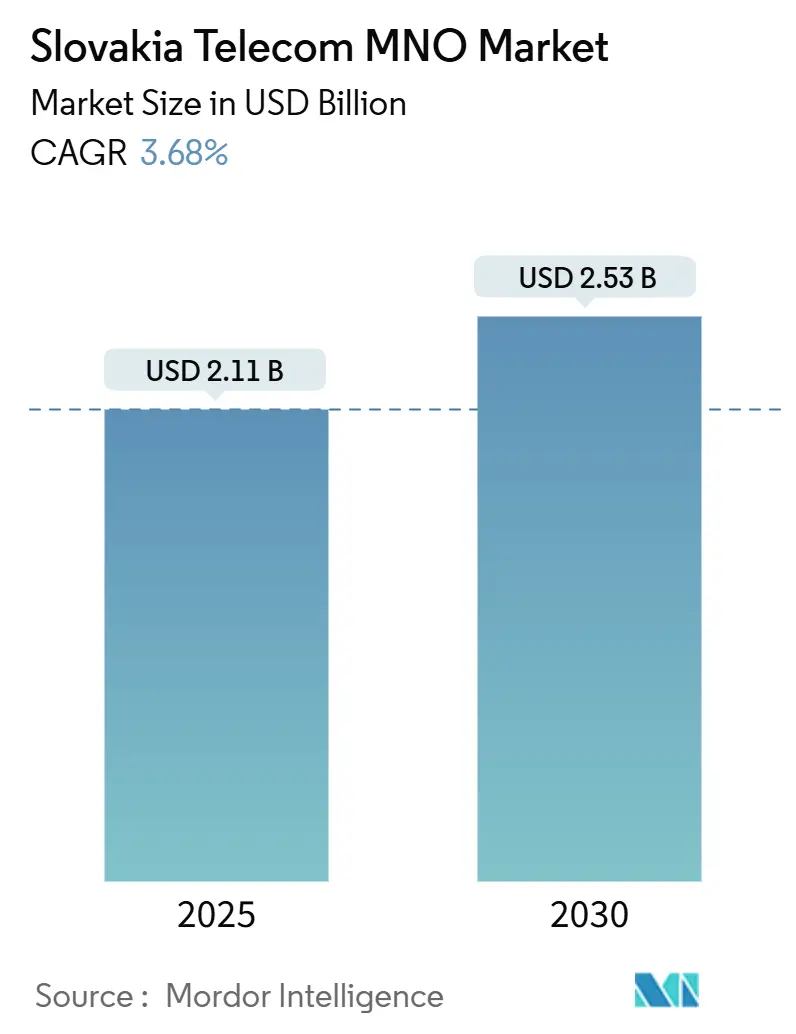
The Slovakia Telecom MNO Market size is estimated at USD 2.11 billion in 2025, and is expected to reach USD 2.53 billion by 2030, at a CAGR of 3.68% during the forecast period (2025-2030). In terms of subscriber volume, the market is expected to grow from 7.72 million Subscribers in 2025 to 9.06 million Subscribers by 2030, at a CAGR of 3.26% during the forecast period (2025-2030).
Rising 5G adoption, nationwide fiber builds, and enterprise digitalization give the Slovakia telecom MNO market a resilient baseline for revenue expansion. Operators focus on data-centric offerings as voice revenue erodes, while government funding offsets rural deployment costs and anchors long-term infrastructure plans. Consolidation such as e&’s purchase of PPF Telecom Group reshapes competitive dynamics and unlocks fresh capital for network upgrades. Energy-price swings, spectrum renewal costs, and OTT substitution temper margins but do not derail the structural pivot toward high-bandwidth and IoT services.
Key Report Takeaways
- By service type, voice services held 47.25% of Slovakia telecom MNO market share in 2024; IoT and M2M services are set to grow at a 4.35% CAGR to 2030.
- By end user, the consumer segment generated 70.26% of 2024 revenue; the enterprise segment is projected to rise at a 3.78% CAGR to 2030.
Slovakia Telecom MNO Market Trends and Insights
Drivers Impact Analysis*
| Driver | (~) % Impact on CAGR Forecast | Geographic Relevance | Impact Timeline |
|---|---|---|---|
| Accelerated 5G rollout and adoption | +1.2% | Urban centers nationwide | Medium term (2-4 years) |
| Government-backed nationwide fiber plan | +0.8% | Rural and urban areas | Long term (≥ 4 years) |
| Enterprise demand for IoT vertical solutions | +0.7% | Industrial corridors | Medium term (2-4 years) |
| Convergent OTT/Pay-TV bundles raising ARPU | +0.5% | Major cities | Short term (≤ 2 years) |
| EU 5G transport-corridor projects | +0.3% | Border regions | Long term (≥ 4 years) |
| Neutral-host rural tower sharing economics | +0.2% | Mountainous zones | Medium term (2-4 years) |
| Source: Mordor Intelligence | |||
Accelerated 5G rollout and adoption
Operators pushed 5G population coverage past 60% in 2024, with O2 Slovakia leading at 70% and looking to monetize low-latency enterprise applications. [1]Red Hat, “O2 Slovakia Cloud-Native 5G Case Study,” redhat.com Competition among four national MNOs shortens deployment cycles, pulls forward capex commitments, and feeds a virtuous circle of device upgrades and data package upselling. Early enterprise pilots in automotive and logistics embed 5G as a production input, locking in long-run bandwidth demand. The race for coverage leadership also raises switching costs for subscribers, improving retention metrics in the Slovakia telecom MNO market.
Government-backed nationwide fiber plan
Under the Recovery and Resilience Plan, EUR 945 million is earmarked for digital projects, including last-mile fiber that targets 85% gigabit coverage. [2]European Commission, “Digital Decade Policy Programme,” ec.europa.eu Subsidy structures encourage public-private partnerships rather than state-owned builds, compressing deployment costs by up to 30% versus solo builds. Fiber reach transforms underserved municipalities into viable markets for cloud and OTT services, supporting future traffic offload from mobile networks and undergirding the Slovakia telecom MNO market’s long-term demand curve.
Enterprise demand for IoT vertical solutions
Manufacturing, energy, and transport firms deploy sensor networks for predictive maintenance and supply-chain visibility. Telecom operators move up the stack, bundling connectivity with analytics and managed security, creating higher-margin service lines. O2 Slovakia’s business arm positions itself as an end-to-end partner, capturing wallet share that once flowed to specialist integrators. Industrial clients gain single-SLA accountability, while operators gain sticky revenue streams that justify 5G slicing investments in the Slovakia telecom MNO market.
Convergent OTT/Pay-TV bundles raising ARPU
Slovak Telekom’s Magio triple-play and Orange’s Love packages fuse fixed internet, mobile, and video into a single invoice, boosting household ARPU by double-digit percentages. Bundles build emotional switching costs as subscribers perceive a penalty in losing content libraries. The tactic slows churn amid price aggression from MVNOs and aligns with operators’ fiber upgrade cycles, sustaining price discipline in the Slovakia telecom MNO market.
Restraints Impact Analysis*
| Restraint | (~) % Impact on CAGR Forecast | Geographic Relevance | Impact Timeline |
|---|---|---|---|
| High spectrum renewal and license fees | -0.6% | Nationwide | Short term (≤ 2 years) |
| Rapid voice/SMS substitution by OTT apps | -0.4% | Urban clusters | Short term (≤ 2 years) |
| Shortage of skilled fiber-deployment labor | -0.3% | Rural builds | Medium term (2-4 years) |
| Energy-price volatility is inflating OPEX | -0.2% | Network-wide | Short term (≤ 2 years) |
| Source: Mordor Intelligence | |||
High spectrum renewal and licence fees
The 5G auction in Slovakia raised capital outlays beyond internal forecasts, obliging operators to amortise license costs over extended horizons. [3]CMS, “Telecoms: Spectrum Auctions in Slovakia,” cms.law Cash diverted toward spectrum limits discretionary capex for rural macro-cell densification. Smaller players such as 4ka/SWAN face tighter debt covenants, which may slow their 5G expansion and tamp competitive pricing freedom in the Slovakia telecom MNO market.
Rapid voice/SMS substitution by OTT apps
WhatsApp, Telegram, and Viber soak up traditional voice and messaging volumes. Blended voice-data ARPU subsides as unlimited data plans effectively subsidise the challenger platforms. Operators must re-architect networks for asymmetric, bursty data traffic while extracting monetisation from lower-yield OTT usage patterns. The resulting revenue drag weighs on the near-term topline trajectory of the Slovakia telecom MNO market.
*Our forecasts treat driver/restraint impacts as directional, not additive. The impact forecasts reflect baseline growth, mix effects, and variable interactions.
Segment Analysis
By Service Type: Voice Services Drive Market Evolution
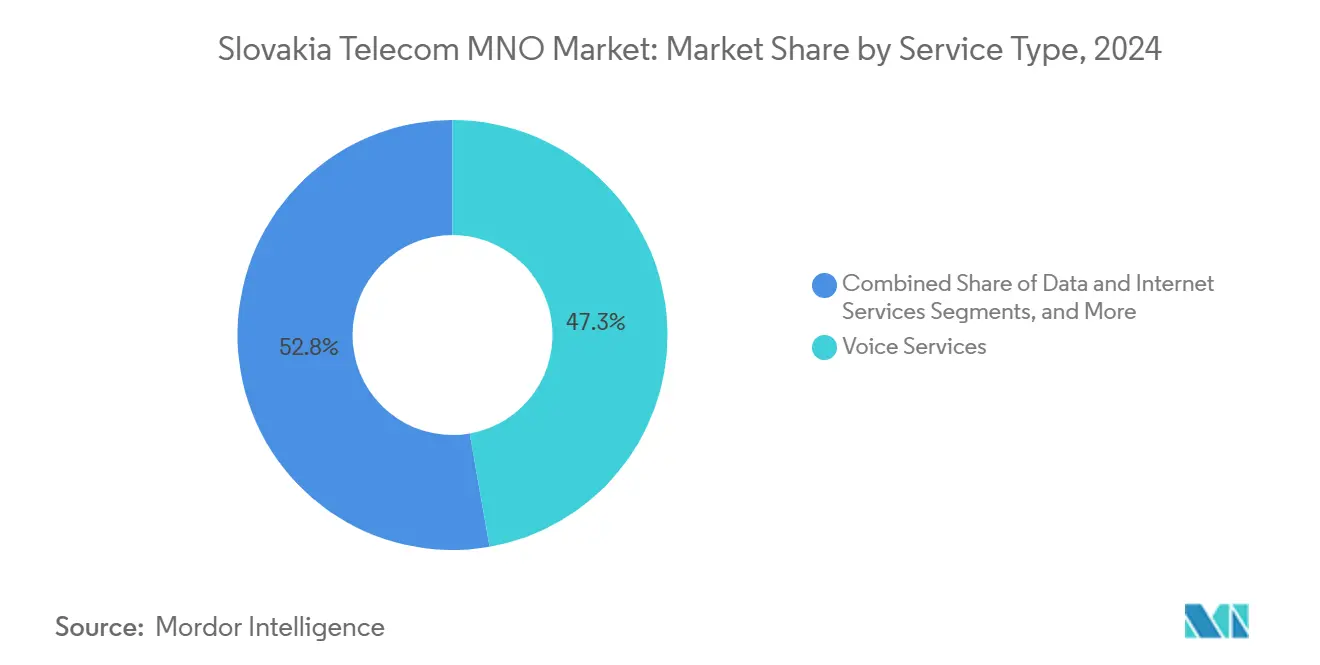
Voice services generated 47.25% of 2024 revenue, underlining their position as the growth engine within the Slovakia telecom MNO market. IoT and M2M services post the fastest outlook at a 4.35% CAGR to 2030. Younger cohorts migrate to data-based messaging, forcing operators to freeze or cut per-minute tariffs to slow churn. Fixed-line voice fades faster as PSTN circuits shutter and enterprises switch to VoIP.
Operators, therefore, treat voice as an enticement within broader bundles rather than a standalone profit driver. Slovak Telekom’s Magenta 1 illustrates the pivot, wrapping voice minutes inside a triple-play that maintains ARPU without explicit voice price inflation. Regulators mandate universal service so that voice will persist, but its strategic weight in the Slovakia telecom MNO market shifts toward retention rather than growth.



By End User: Consumer Base with Enterprise Growth Momentum
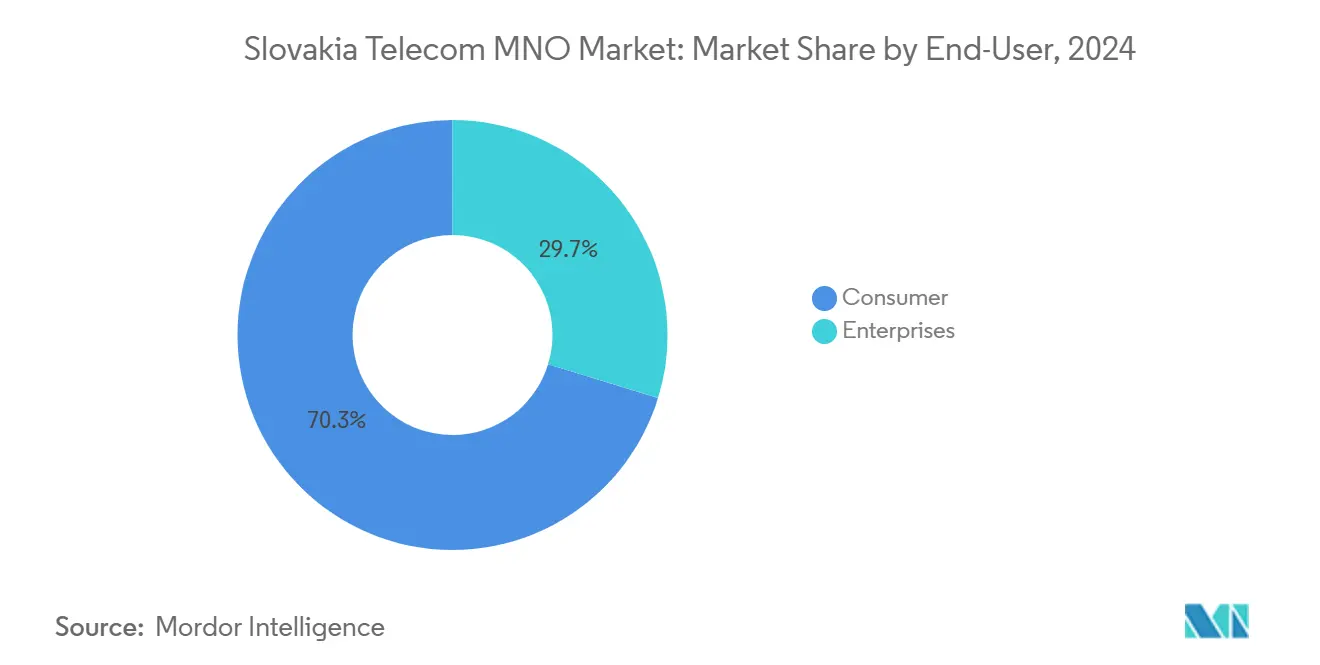
Consumers produced 70.26% of the 2024 turnover, but enterprises are moving faster at a 3.78% CAGR to 2030, broadening the Slovakia telecom MNO market. Business clients pursue predictive maintenance, connected logistics, and zero-trust security strategies that require high-reliability links and managed services. Operators respond with dedicated enterprise units, cloud marketplaces, and joint offers with hyperscale providers.
The consumer segment remains vital for scale and cash-flow stability. Bundled OTT and smart-home offers help defend pricing power as VAT rose to 23% in January 2025. Nonetheless, strategic focus continues to tilt toward enterprise solutions, which lift blended margins and diversify revenue risk for the Slovakia telecom MNO industry.
Geography Analysis
The Bratislava region generates the highest ARPU due to dense business activity and early 5G densification. Košice, Žilina, and other urban hubs follow, each benefiting from near-ubiquitous LTE and fast-growing 5G overlays. Rural districts lag on fiber build-out yet stand to gain from the EUR 945 million digital fund, aligning universal service goals with incremental traffic growth in the Slovakia telecom MNO market.
Cross-border corridors with the Czech Republic, Poland, and Hungary gain strategic relevance as the EU 5G transport initiative calls for seamless roaming and corridor handovers. [4]European Commission, “5G Cross-Border Corridors,” ec.europa.eu Operators' position to monetise transit traffic and enterprise SD-WAN overlays that connect factories on opposite sides of borders. Neutral-host tower models ease capex burdens in the mountainous northwest, where terrain complicates macro-cell placement.
The fixed wireless access (FWA) niche closes speed gaps in sparsely populated valleys. While fiber remains the priority, FWA uses mid-band 5G spectrum to supply 200 Mbps downlink where trenching costs are prohibitive. Geography thus shapes technology selection, deployment sequencing, and competitive positioning within the Slovakia telecom MNO market.
Competitive Landscape
Four nationwide mobile network operators control a major share of the industry revenue, indicating a consolidated Slovakia telecom MNO market. Slovak Telekom leverages Deutsche Telekom Group innovations such as cloud RAN and AI-driven customer care, sustaining quality-of-service leadership. e&’s EUR 2.15 billion acquisition of PPF Telecom Group introduces new capital and scale advantages for O2 Slovakia, spurring fresh pricing and service experimentation.
Orange Slovensko maintains momentum via aggressive 5G coverage, hitting 78% of the population by September 2024. 4ka/SWAN pursues a value-pricing strategy that resonates with cost-sensitive youth but now pairs that stance with accelerated 5G rollout, supplied by neutral-host towers to shrink per-site costs. The competitive narrative turns on integrated fixed-mobile propositions, as convergent services deliver stickier ARPU and lever fiber capex across broader revenue pools in the Slovakia telecom MNO market.
Strategic moves include network sharing deals, edge computing trials with automotive OEMs, and AI contact-center deployments that trim opex. Each operator courts enterprise deals by guaranteeing latency and cybersecurity compliance, moving beyond pure connectivity. Overall rivalry keeps tariffs disciplined but channels competitive energy into coverage, cloud partnerships, and vertical solutions rather than price wars.
Slovakia Telecom MNO Industry Leaders
Slovak Telekom (Deutsche Telekom)
Orange Slovensko AS
O2 Slovakia
SWAN, a.s. (4ka brand)
- *Disclaimer: Major Players sorted in no particular order

Recent Industry Developments
- October 2024: e& completed its EUR 2.15 billion acquisition of PPF Telecom Group’s Slovak, Bulgarian, Hungarian, and Serbian units, forming e& PPF Telecom Group.
- September 2024: Orange Slovensko lifted 5G reach to 78% of residents.
- May 2024: 4ka broadened nationwide 5G availability as part of SWAN’s investment drive.
- April 2024: O2 Slovakia expanded 5G coverage beyond 89% of the population.


Slovakia Telecom MNO Market Report Scope
| Voice Services |
| Data and Internet Services |
| Messaging Services |
| IoT and M2M Services |
| OTT and PayTV Services |
| Other Services (VAS, Roaming and International Services, Enterprise and Wholesale Services, etc.) |
| Enterprises |
| Consumer |
| Service Type | Voice Services |
| Data and Internet Services | |
| Messaging Services | |
| IoT and M2M Services | |
| OTT and PayTV Services | |
| Other Services (VAS, Roaming and International Services, Enterprise and Wholesale Services, etc.) | |
| End-user | Enterprises |
| Consumer |


Key Questions Answered in the Report
What is the current size of the Slovakia telecom MNO market?
The market is valued at USD 2.11 billion in 2025.
What CAGR is forecast for the Slovakia telecom MNO market through 2030?
Market revenue is projected to expand at a 3.68% CAGR between 2025 and 2030.
Which service segment is expected to grow the fastest?
IoT and M2M services lead with a projected 4.35% CAGR through 2030.
How extensive is 5G coverage in Slovakia today?
Operators collectively surpassed 60% population coverage in 2024, with O2 Slovakia reaching 89%.
What impact will Slovakia’s government-backed fiber plan have on rural areas?
The EUR 945 million digital fund targets 85% gigabit coverage, lowering deployment costs and improving rural broadband availability.
Who are the main competitors in the market?
Slovak Telekom, Orange Slovensko, O2 Slovakia (under e&), and 4ka/SWAN together control roughly 80% of industry revenue.
Page last updated on:





