
Mineral Cosmetics Market Size and Share
Market Overview
| Study Period | 2021 - 2031 |
|---|---|
| Market Size (2026) | USD 4.16 Billion |
| Market Size (2031) | USD 5.48 Billion |
| Growth Rate (2026 - 2031) | 4.85 % |
| Fastest Growing Market | Asia-Pacific |
| Largest Market | North America |
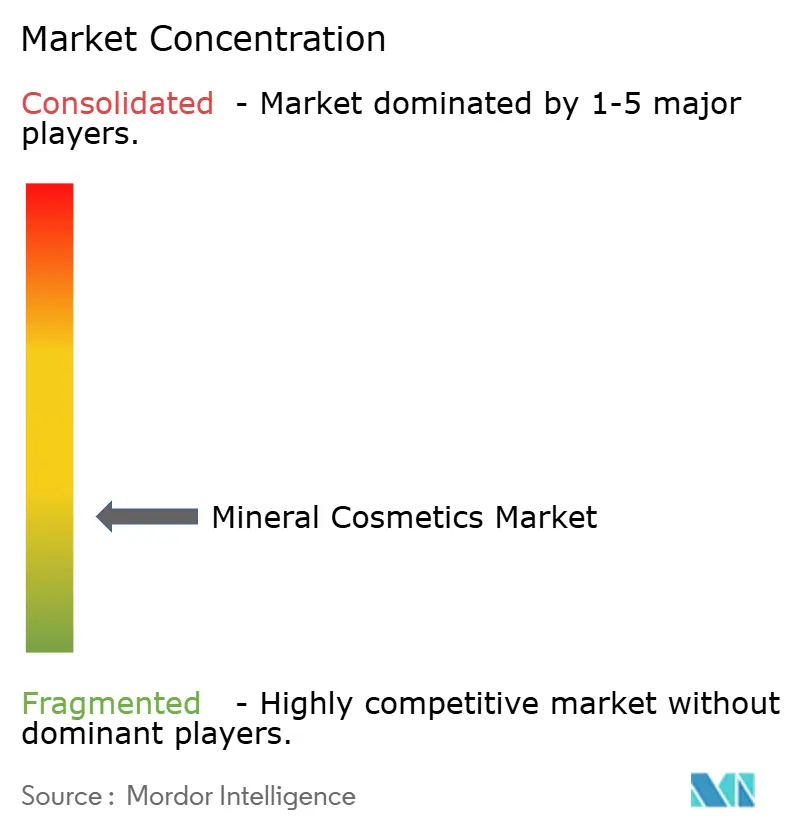
| Market Concentration | Low |
Major Players
*Disclaimer: Major Players sorted in no particular order Image © Mordor Intelligence. Reuse requires attribution under CC BY 4.0. |
|
Mineral Cosmetics Market Analysis by Mordor Intelligence
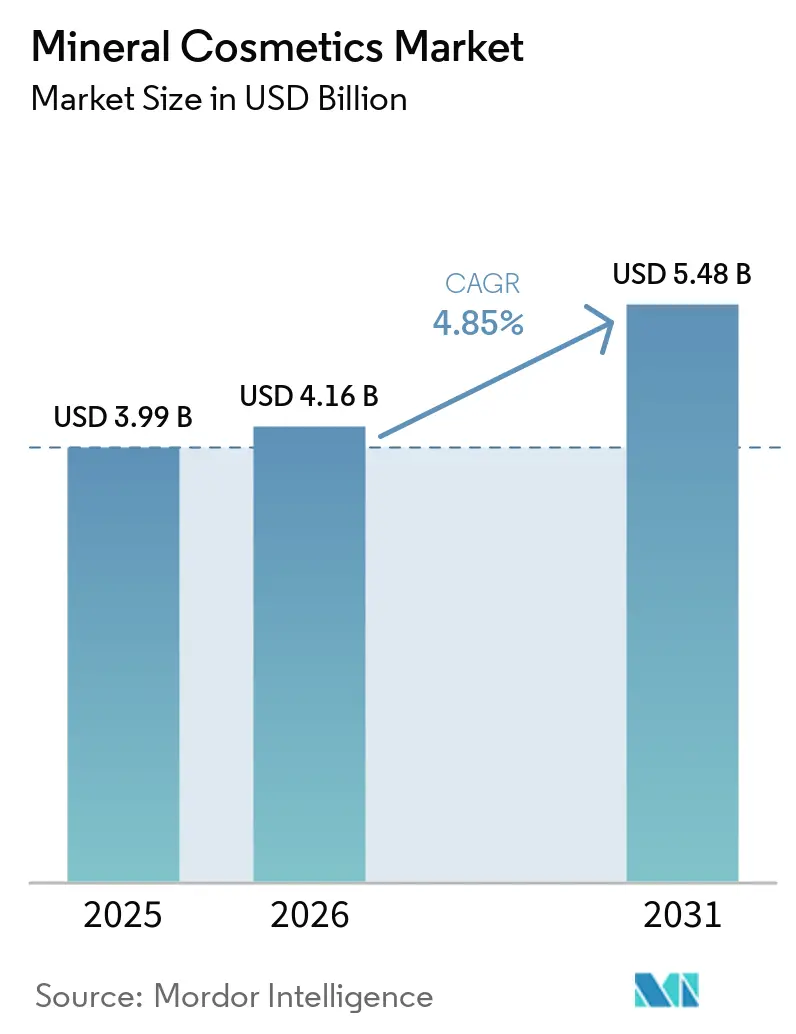
The Mineral Cosmetics Market size is projected to expand from USD 3.99 billion in 2025 and USD 4.16 billion in 2026 to USD 5.48 billion by 2031, registering a CAGR of 4.85% between 2026 to 2031. The mineral cosmetics market is growing because buyers increasingly want products that reduce irritation, support daily wear comfort, and provide a cleaner ingredient profile than many conventional formulas. Zinc oxide, titanium dioxide, iron oxides, and mica give these products a clear functional role in complexion coverage, light UV support, and skin-friendly positioning. Dermatologist recommendation is also becoming more important for acne-prone, sensitive, and reactive skin users, which gives the mineral cosmetics market stronger credibility in pharmacies, clinics, and premium beauty counters. Vegan and cruelty-free preferences are widening the customer base beyond the traditional sensitive-skin user, while new launches show that skin care, sun care, and makeup claims are increasingly being combined in one format. Premium pricing and lingering questions around coverage performance still limit conversion in some price-sensitive markets, so companies are relying on reformulation, clinical support, and selective retail expansion to build the mineral cosmetics market.
Key Report Takeaways
- By product type, skincare products held 44.22% of revenue in 2025, while makeup products are projected to grow at a 5.68% CAGR through 2031.
- By end user, women held 68.72% share in 2025, while men recorded the highest projected CAGR at 6.02% through 2031.
- By distribution channel, specialty and drug stores accounted for 38.75% share in 2025, while online retail is advancing at a 6.25% CAGR through 2031.
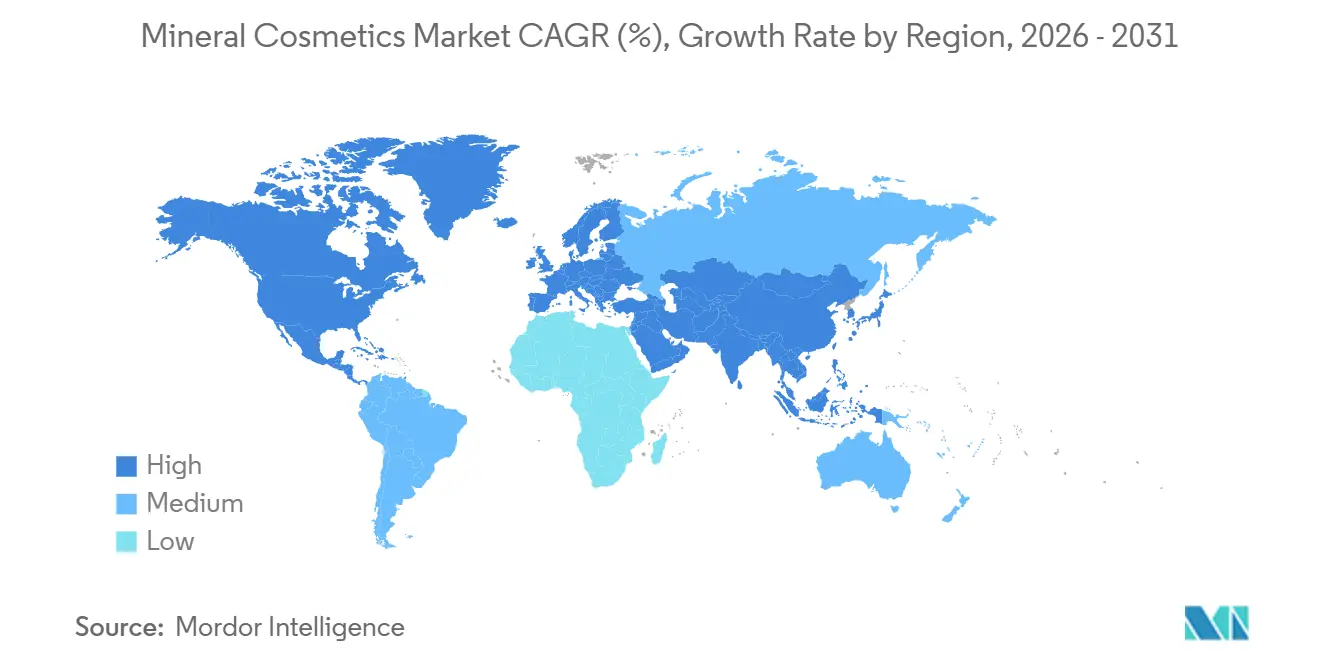
- By geography, North America held 35.84% share in 2025, while Asia-Pacific is forecast to expand at a 6.52% CAGR through 2031.
Note: Market size and forecast figures in this report are generated using Mordor Intelligence’s proprietary estimation framework, updated with the latest available data and insights as of January 2026.
Market Trends and Insights
Drivers Impact Analysis of Mineral Cosmetics Market*
| Drivers | (~) % Impact on CAGR Forecasts | Geographic Relevance | Impact Timeline |
|---|---|---|---|
| Growing Demand for Clean-Label Beauty Products | +1.5% | Global, most pronounced in North America and Europe | Short term (≤ 2 years) |
| Rising Prevalence of Sensitive Skin and Dermatological Conditions | +1.2% | Global, with highest intensity in urban Asia-Pacific and North America | Medium term (2-4 years) |
| Growing Demand for Multi-Functional Cosmetics | +0.9% | North America, Europe, and urban Asia-Pacific centers | Medium term (2-4 years) |
| Innovation in Mineral Cosmetic Formulations | +0.7% | Global | Long term (≥ 4 years) |
| Expansion of Vegan and Cruelty-Free Beauty Products | +0.6% | North America and Europe, with spillover to Asia-Pacific | Short term (≤ 2 years) |
| Increasing Disposable Income and Premium Beauty Spending | +0.5% | Asia-Pacific core, with spillover to South America and the Middle East and Africa | Medium term (2-4 years) |
| Source: Mordor Intelligence | |||
Growing Demand for Clean-Label Beauty Products
The clean-label shift is supporting the mineral cosmetics market through both consumer demand and regulation. EU Regulation (EU) 2025/877 took effect on September 1, 2025, and added further limits on substances classified as carcinogenic, mutagenic, or toxic for reproduction in cosmetic products. This matters because many mineral-led formulas already rely on simpler ingredient systems, so they face less reformulation pressure than synthetic-heavy alternatives. In the United States, MoCRA has also raised the level of ingredient scrutiny through expanded product listing and compliance requirements, which is pushing brands toward greater traceability and clearer label language[1]Source: U.S. Food and Drug Administration, “Modernization of Cosmetics Regulation Act of 2022 (MoCRA),” FDA, fda.gov. As a result, the mineral cosmetics market benefits from a demand pattern that is being reinforced by both end users and regulatory conditions.
Rising Prevalence of Sensitive Skin and Dermatological Conditions
Sensitive skin is becoming a more important commercial driver for the mineral cosmetics market because it shapes both product choice and channel choice. Galderma reported in September 2025 that up to 70% of people globally say they have sensitive skin, and the study linked this rise to urban living, oxidative stress, and sleep disruption. This pattern lifts demand for formulations that are non-comedogenic, anti-inflammatory, and lower in potential irritants. It also makes pharmacy counters, dermatology clinics, and medi-spa settings more important because shoppers often want validation before moving away from conventional products. Brands that can show clinical tolerability are therefore in a better position to build trust and repeat buying in the mineral cosmetics market.
Growing Demand for Multi-Functional Cosmetics
The move toward products that combine several benefits in one step is expanding the mineral cosmetics market into everyday-use routines. Mineral pigments already support coverage and UV-related positioning, which makes them well suited to products that sit between skin care, makeup, and daily sun care. Brands are adding ingredients such as peptides and hyaluronic acid so that one product can address appearance, hydration, and comfort at the same time. This is especially relevant for men and busy urban consumers who prefer fewer steps but still want visible performance. The result is a broader use case for the mineral cosmetics market than the category had when it was seen mainly as a sensitive-skin option.
Innovation in Mineral Cosmetic Formulations
Innovation is helping the mineral cosmetics market solve the product feel and coverage issues that once held it back. Advances in pigment treatment and formulation design are improving texture, wear, and finish without moving away from a mineral-led ingredient base. Colorescience introduced Barrier Pro Serum Spray in September 2025, which showed how mineral players are extending into barrier care and more clinically framed formats. ILIA Beauty followed in April 2026 with Sun Serum Mineral Sunscreen SPF 50, a serum format designed to reduce the chalky finish that many consumers still associate with mineral SPF products. These launches show that the mineral cosmetics market is now competing more directly on performance, finish, and format as well as on ingredient positioning.
Restraints Impact Analysis of Mineral Cosmetics Market*
| Restraints | (~) % Impact on CAGR Forecasts | Geographic Relevance | Impact Timeline |
|---|---|---|---|
| Premium Pricing Compared to Conventional Cosmetics | -0.8% | Emerging markets, most acute in South America and the Middle East and Africa | Short term (≤ 2 years) |
| Limited Consumer Awareness in Emerging Markets | -0.5% | South America, the Middle East and Africa, and Southeast Asia | Medium term (2-4 years) |
| Regulatory and Labeling Challenges | -0.4% | Global, most complex in Europe and North America | Medium term (2-4 years) |
| Performance Perception Challenges | -0.3% | Global, strongest in markets with high conventional cosmetics penetration | Short term (≤ 2 years) |
| Source: Mordor Intelligence | |||
Premium Pricing Compared to Conventional Cosmetics
Premium pricing remains one of the clearest limits on faster mineral cosmetics market adoption. Higher-purity sourcing, smaller production scale, and certification-related costs make many mineral products more expensive than comparable conventional alternatives. This matters most in Southeast Asia, sub-Saharan Africa, and parts of South America, where premium beauty spending is still narrow outside major urban areas. Cost pressure also rises when brands try to maintain responsible mica sourcing, because tighter sourcing standards can limit procurement flexibility and keep raw material costs elevated. Even when interest is strong, the mineral cosmetics market can lose conversion if the price gap is too wide at the shelf.
Limited Consumer Awareness in Emerging Markets
The mineral cosmetics market also faces an education gap in many emerging economies. In several Asian markets, brightening and fairness-led categories still shape buying behavior, so the skin-comfort and ingredient-transparency message does not always trigger the first purchase. Brazil shows that premium urban consumers understand the proposition, but wider adoption outside those groups is still limited by awareness and affordability. In India, the long-run opportunity is notable because more than 80% of internet users in the country reported sensitive facial skin in the study cited in the draft, yet habit and price still slow conversion. Brands that invest in dermatologist education, pharmacy sampling, and focused digital explanation are likely to build stronger positions than brands that attempt broad launches without proof points.
*Our forecasts treat driver/restraint impacts as directional, not additive. The impact forecasts reflect baseline growth, mix effects, and variable interactions.
Mineral Cosmetics Market Segment Analysis
By Product Type:
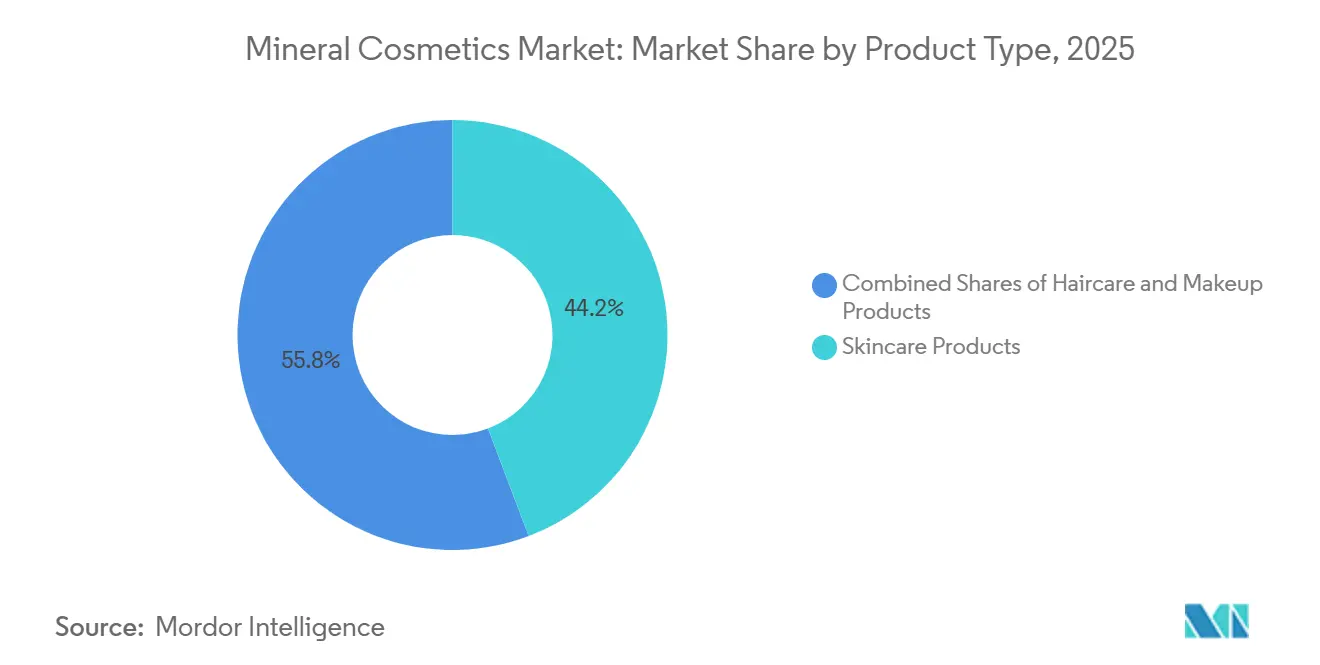
Skincare Leads While Makeup Expands FasterSkincare products held 44.23% of the mineral cosmetics market share in 2025, which made them the largest product category. According to the Tricoci University data from 2026, United States accounts for about 16% of global skincare spending[2]Source: Tricoci University, "Skincare Industry Statistics", tricociuniversity.org. Moisturizers, cleansers, and toners led this segment because mineral actives fit naturally into products used for barrier support, daily comfort, and lower irritation risk. This part of the mineral cosmetics market also benefits from simpler clinical communication, since tolerability and non-comedogenic positioning are easier to explain than color payoff or wear time. Pharmacy and dermo-cosmetics counters support repeat purchases because the consumer often enters through a skin concern rather than a beauty trend.
Within product type, the mineral cosmetics market size for makeup products is projected to grow at a 5.68% CAGR through 2031, which makes it the fastest-rising category. Face makeup leads this group because foundations, tinted moisturizers, and SPF-infused complexion products offer an easy entry point for buyers who want fewer products in their routine. Jane Iredale's Spring Edit 2026, led by the Skintuition SPF 30 Radiance-Boosting Liquid Foundation in 26 shades, shows how brands are moving deeper into liquid complexion formats rather than staying focused on powders alone. Haircare remains a smaller part of the mineral cosmetics market, but it adds a broader personal care use case for consumers who want fewer synthetic ingredients across the full routine.



By End User:
Women Anchor Sales While Men Add GrowthWomen held 68.72% share in 2025, which kept them as the main revenue base for the mineral cosmetics market. This reflects stronger purchasing frequency, broader product engagement, and deeper loyalty in premium beauty categories. The women’s segment is also changing because ingredient scrutiny is no longer limited to a small clean-beauty audience and is now affecting mainstream makeup and skin care buying behavior. Brands that combine transparency, tolerability, and shade relevance are therefore better placed to defend the largest part of the mineral cosmetics market.
Men are projected to grow at a 6.02% CAGR through 2031, which makes them the fastest-expanding end-user group in the mineral cosmetics market. Entry products such as tinted SPF and BB cream are helping because they fit established grooming habits and reduce the social barrier linked with the word makeup. The category also benefits from the fact that mineral formulas suit oily, acne-prone, and irritation-prone skin concerns that are common in male grooming. The Estée Lauder Companies and Shiseido have responded with gender-neutral and dermatology-linked approaches, which suggests that future growth in the mineral cosmetics market will depend as much on language and positioning as on formula performance.
By Distribution Channel:
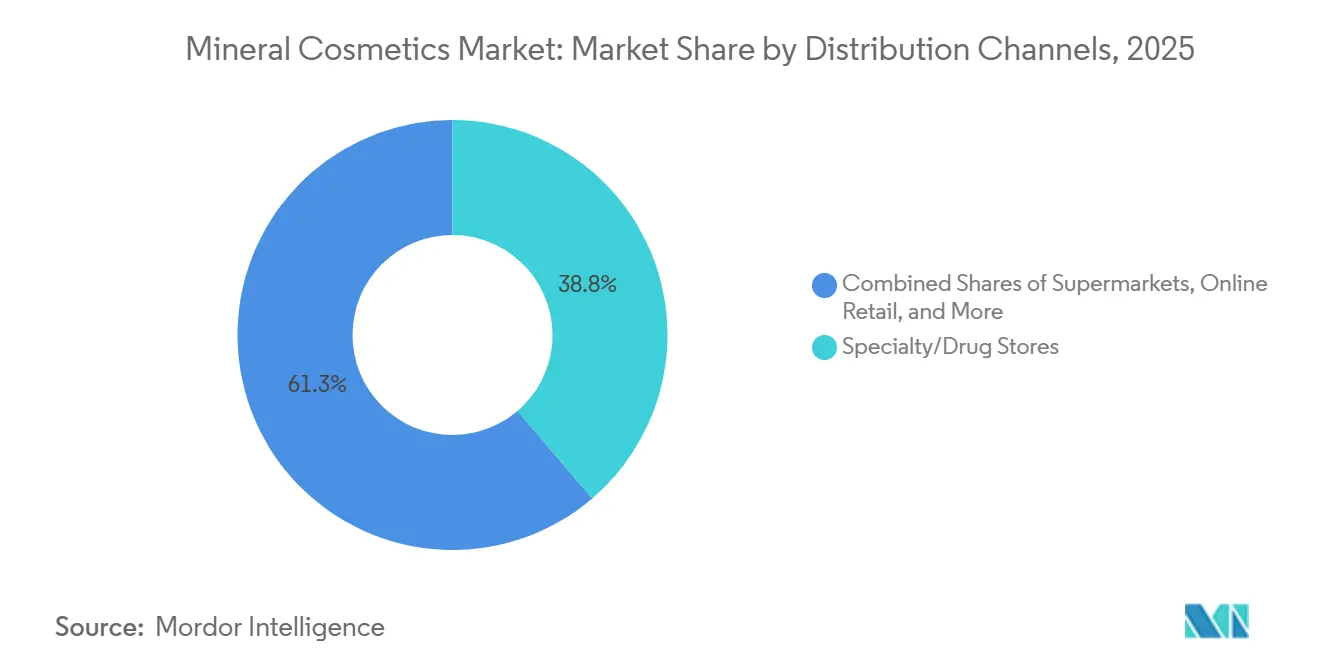
Specialty Retail Leads While Online Gains SpeedSpecialty and drug stores held 38.75% share in 2025, giving them the leading channel position in the mineral cosmetics market. These outlets matter because trained beauty advisors can explain texture, shade match, and coverage in person, which is still important for first-time users. The in-store trial moment is especially relevant for older consumers and men, who often want reassurance before paying a premium for a new format. bareMinerals' expansion into 19 Marks & Spencer beauty halls in the UK and Ireland in September 2025 showed that physical shelf visibility remains a practical growth tool for the mineral cosmetics market.
Online retail is projected to expand at a 6.25% CAGR through 2031, which makes it the fastest-growing distribution channel in the mineral cosmetics market. Digital buying works well for this category because shoppers often search ingredients, compare skin claims, and read user feedback before purchase. Social platforms and brand-owned education also reduce the trial barrier for products that need more explanation than conventional makeup. As online assortments improve and repeat buyers become more confident with shade and formula selection, the mineral cosmetics market is likely to see stronger retention through digital channels.
Geography Analysis
North America and Europe Mineral Cosmetics Market
North America held 35.84% of the mineral cosmetics market share in 2025, which made it the largest regional cluster. The United States set the pace because specialty retail is mature and ingredient scrutiny is high. Canada shows similar demand for clean-label and sensitive-skin products, while Mexico is becoming a premium beauty pocket in major urban centers. Europe followed with Germany and France as anchor markets, supported by stronger ingredient oversight and consistent consumer demand for minimally processed beauty products. The UK also remains relevant for the mineral cosmetics market because premium shelf expansion continued through bareMinerals' rollout into 19 Marks & Spencer beauty halls in 2025.
APAC Mineral Cosmetics Market
Asia-Pacific is projected to grow at a 6.52% CAGR through 2031, which gives it the fastest regional mineral cosmetics market size expansion in the forecast period. China leads volume in the region because a larger middle class and stronger attention to product safety are lifting interest in ingredient-validated formulas. South Korea supports category education through its hybrid beauty and skin care culture, where consumers are already familiar with BB creams and cushion formats. India offers large long-run potential because sensitive facial skin is widely reported among internet users, but price sensitivity and strong conventional preferences still slow faster conversion. Vietnam, Indonesia, Thailand, and Singapore are adding incremental demand as e-commerce widens access to imported and premium mineral brands.
MEA and South America Mineral Cosmetics Market
South America remains led by Brazil, where spending is concentrated among premium urban consumers and where regulatory documentation is familiar to brands already aligned with European standards[3]Source: European Commission, “Commission Regulation (EU) 2025/877 of 12 May 2025 Amending Regulation (EC) No 1223/2009 as Regards the Use in Cosmetic Products of Certain Substances Classified as Carcinogenic, Mutagenic or Toxic for Reproduction,” EUR-Lex, eur-lex.europa.eu. Argentina, Colombia, Chile, and Peru show opportunity, but economic volatility makes distribution planning less predictable. In the Middle East and Africa, the UAE and Saudi Arabia stand out for high beauty spending, while halal alignment can strengthen trust in clean, non-animal-derived mineral formulas. Nigeria, South Africa, Morocco, and Turkey add longer-term potential, especially where high UV exposure, humidity, urbanization, and e-commerce make mineral SPF and complexion products more relevant.

Competitive Landscape
The mineral cosmetics market remains fragmented, and no company holds majority share across product types and regions. L'Oréal S.A. has the widest global reach, using its scale and portfolio breadth to place mineral products beside mainstream cosmetics. The Estée Lauder Companies Inc. and Shiseido also compete through premium positioning, dermatology-linked credibility, and strong distribution in high-value channels. Specialist brands such as bareMinerals, Colorescience, Jane Iredale, Youngblood Mineral Cosmetics, and Inika Organic keep an advantage in formula identity and category authenticity.
Competition in the mineral cosmetics market is centered on clinical proof, product texture improvement, and retail visibility. Colorescience expanded its clinical positioning in September 2025 with Barrier Pro Serum Spray, which moved the brand further into skin barrier care and showed how mineral brands are broadening beyond color cosmetics. ILIA Beauty strengthened the premium SPF-led path in April 2026 with Sun Serum Mineral Sunscreen SPF 50, a launch that directly addressed residue concerns and supported the convergence of sun care and complexion products. bareMinerals also widened physical reach in September 2025 through its Marks & Spencer rollout in the UK and Ireland, showing that store placement still matters for trial and conversion in the mineral cosmetics market. These moves show that success in the mineral cosmetics market depends not only on clean positioning, but also on better wear, easier shade adoption, and stronger proof at the point of sale.
Open areas remain in gender-neutral offers for men, deeper skin tone development, and halal-aligned assortments for GCC markets. The mineral cosmetics market also has a meaningful barrier to entry because pigment performance, comfort, and clinical tolerability must be delivered together in the same formula. That requirement favors companies with sustained research and development budgets, established supplier networks, and the ability to test across both beauty and dermo-cosmetics channels. As a result, the market is fragmented at the brand level, but shelf access and product credibility are still concentrated among companies that can invest steadily in reformulation and launch support.
Mineral Cosmetics Industry Leaders
-
L'Oréal S.A.
-
The Estée Lauder Companies Inc.
-
Shiseido Company, Limited
-
Revlon, Inc.
-
Inika Organic Pty Ltd
- *Disclaimer: Major Players sorted in no particular order
Mineral Cosmetics Market Companies Covered in this Report
- L'Oréal S.A.
- The Estée Lauder Companies Inc.
- Shiseido Company, Limited
- Revlon, Inc.
- Glo Skin Beauty
- Jane Iredale
- Cover FX Skincare Inc.
- Mineralissima Cosmetics BV
- Ahava Dead Sea Laboratories Ltd.
- Bare Escentuals Beauty, LLC
- Colorescience, Inc.
- Youngblood Mineral Cosmetics LLC
- RMS Beauty LLC
- W3LL People, Inc.
- Au Naturale Cosmetics, LLC
- Inika Organic Pty Ltd
- Alima Pure, LLC
- Lily Lolo Ltd.
- Bellápierre Cosmetics, Inc.
- Everyday Minerals, LLC
- Pur Minerals, LLC

Recent Industry Developments in Mineral Cosmetics Market
- April 2026: ILIA Beauty launched Sun Serum Mineral Sunscreen SPF 50 exclusively at Sephora.com and Sephora stores, in-store from April 30, priced at USD 40. The serum-format mineral sunscreen combines seven molecular weights of hyaluronic acid with zinc oxide and titanium dioxide UV filters, directly targeting the chalky residue objection that had limited consumer adoption of mineral SPF formats and positioning the brand as a clinical-grade clean beauty competitor in the premium sun care segment.
- April 2026: Obagi Medical expanded its sun care portfolio with the launch of Sun Shield™ Mineral UV Barrier Protect Broad Spectrum SPF 40, a clinically proven mineral sunscreen formulated with 100% mineral UV filters, antioxidants, ceramides, and squalane. Designed specifically for sensitive, acne-prone, and post-procedure skin, the product provides broad-spectrum UVA/UVB protection while supporting skin barrier health and hydration.
- October 2025: SONNI launched its SunDay / SunDown prestige skincare system, introducing a range of mineral SPF products designed to promote daily sun protection as an essential skincare routine. The product line includes mineral SPF serums, moisturizers, body care formulations, and post-sun recovery treatments formulated with advanced zinc technology, niacinamide, hyaluronic acid, and squalane.


Global Mineral Cosmetics Market Report Scope
| Skincare Products | Moisturizers |
| Cleansers | |
| Toners | |
| Others | |
| Makeup Products | Face Makeup |
| Eye Makeup | |
| Lip Makeup | |
| Haircare Products | Shampoo |
| Conditioners | |
| Others |
| Women |
| Men |
| Supermarkets/Hypermarkets |
| Specialty/Drug Stores |
| Online Retail Channels |
| Other Distribution Channels |
| North America | United States |
| Canada | |
| Mexico | |
| Rest of North America | |
| Europe | Germany |
| United Kingdom | |
| France | |
| Italy | |
| Spain | |
| Netherlands | |
| Sweden | |
| Poland | |
| Belgium | |
| Rest of Europe | |
| Asia-Pacific | China |
| India | |
| Japan | |
| Australia | |
| South Korea | |
| Vietnam | |
| Indonesia | |
| Thailand | |
| Singapore | |
| Rest of Asia-Pacific | |
| South America | Brazil |
| Argentina | |
| Chile | |
| Peru | |
| Colombia | |
| Rest of South America | |
| Middle East and Africa | United Arab Emirates |
| Saudi Arabia | |
| South Africa | |
| Nigeria | |
| Egypt | |
| Morocco | |
| Turkey | |
| Rest of Middle East and Africa |
| Product Type | Skincare Products | Moisturizers |
| Cleansers | ||
| Toners | ||
| Others | ||
| Makeup Products | Face Makeup | |
| Eye Makeup | ||
| Lip Makeup | ||
| Haircare Products | Shampoo | |
| Conditioners | ||
| Others | ||
| End User | Women | |
| Men | ||
| Distribution Channels | Supermarkets/Hypermarkets | |
| Specialty/Drug Stores | ||
| Online Retail Channels | ||
| Other Distribution Channels | ||
| By Geography | North America | United States |
| Canada | ||
| Mexico | ||
| Rest of North America | ||
| Europe | Germany | |
| United Kingdom | ||
| France | ||
| Italy | ||
| Spain | ||
| Netherlands | ||
| Sweden | ||
| Poland | ||
| Belgium | ||
| Rest of Europe | ||
| Asia-Pacific | China | |
| India | ||
| Japan | ||
| Australia | ||
| South Korea | ||
| Vietnam | ||
| Indonesia | ||
| Thailand | ||
| Singapore | ||
| Rest of Asia-Pacific | ||
| South America | Brazil | |
| Argentina | ||
| Chile | ||
| Peru | ||
| Colombia | ||
| Rest of South America | ||
| Middle East and Africa | United Arab Emirates | |
| Saudi Arabia | ||
| South Africa | ||
| Nigeria | ||
| Egypt | ||
| Morocco | ||
| Turkey | ||
| Rest of Middle East and Africa | ||


Key Questions Answered in the Report
How large will mineral cosmetics be by 2031?
The category is forecast to reach USD 5.48 billion by 2031, rising from USD 4.16 billion in 2026 at a 4.85% CAGR.
Which product type leads sales today?
Skincare products led with 44.23% share in 2025 because they align well with barrier support, low-irritation use, and pharmacy-led recommendation.
Which end-user group is growing the fastest?
Men are projected to grow at a 6.02% CAGR through 2031, helped by tinted SPF, BB cream, and gender-neutral positioning.
Which region offers the fastest growth outlook?
Asia-Pacific is set to grow at a 6.52% CAGR through 2031, supported by middle-class expansion, safety-focused buying, and wider digital access.
Page last updated on:


 Your data is secure and never sold or shared.


