
LLM Infrastructure GPU Market Size and Share
Market Overview
| Study Period | 2020 - 2031 |
|---|---|
| Market Size (2026) | USD 73.41 Billion |
| Market Size (2031) | USD 161.88 Billion |
| Growth Rate (2026 - 2031) | 17.14 % |
| Fastest Growing Market | Asia-Pacific |
| Largest Market | North America |
| Market Concentration | High |
Major Players *Disclaimer: Major Players sorted in no particular order Image © Mordor Intelligence. Reuse requires attribution under CC BY 4.0. | |
LLM Infrastructure GPU Market Analysis by Mordor Intelligence
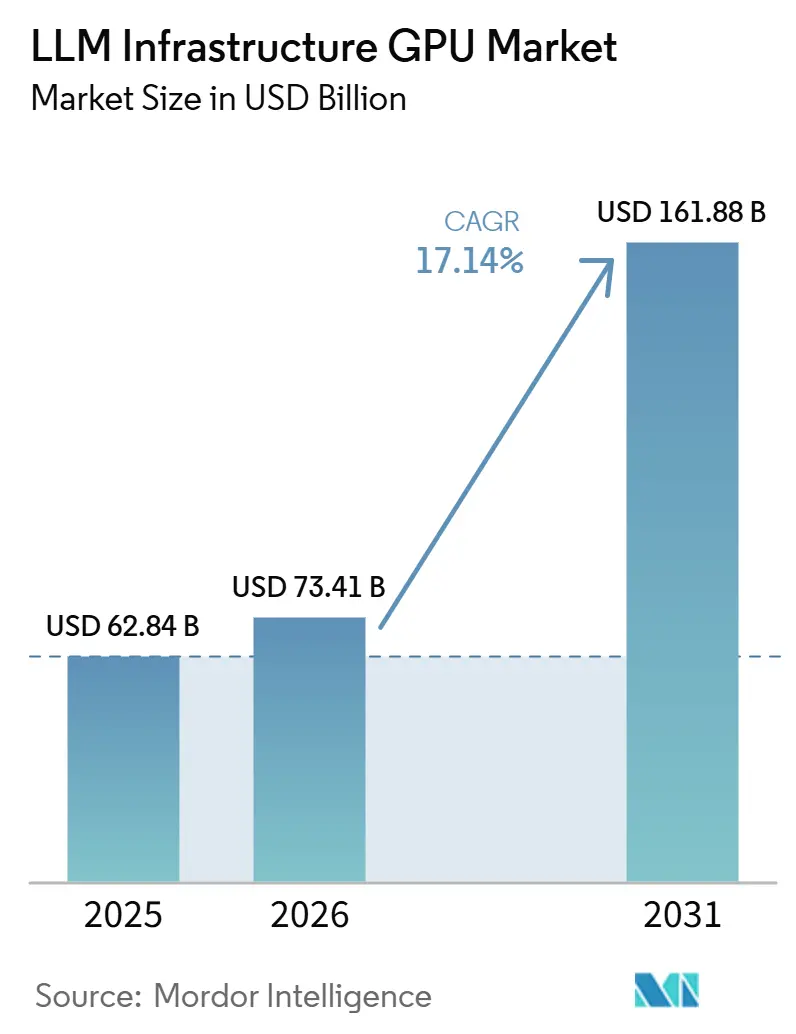
The LLM infrastructure GPU market size is expected to increase from USD 62.84 billion in 2025 to USD 73.41 billion in 2026 and reach USD 161.88 billion by 2031, growing at a CAGR of 17.14% over 2026-2031. The main growth engine is sustained capital spending on foundation model training and production AI serving, which continues to push buyers toward larger and denser compute clusters. The LLM infrastructure GPU market is also expanding because multi-year supply agreements now shape competition more than spot purchases, which gives large buyers better hardware access and longer planning visibility. Domestic hosting requirements, private inference deployments, and sovereign compute priorities are widening the number of locations where advanced GPU capacity must be installed, which adds to overall demand. New capacity in the LLM infrastructure GPU market is increasingly being built around liquid cooling, high-bandwidth interconnects, and rack-scale architectures, because these features now support mainstream production environments rather than niche deployments. The main risks remain tied to memory supply, advanced packaging, and cross-border hardware restrictions, but those same pressures are also encouraging second-source vendors, regional system builders, and domestic accelerator programs to expand their role in the market.
Key Report Takeaways
- By deployment model, cloud data centers held 71.22% of the LLM infrastructure GPU market in 2025, while enterprise and private data centers are projected to expand at a 17.57% CAGR through 2031.
- By workload type, training GPUs accounted for 66.59% share of the LLM infrastructure GPU market in 2025, while inference GPUs are projected to grow at a 17.88% CAGR through 2031.
- By end user, hyperscalers and cloud service providers held 68.17% share in 2025, while enterprises are projected to expand at a 17.64% CAGR through 2031.
- By GPU integration and interconnect, high-bandwidth interconnect GPUs accounted for 63.21% share in 2025 and are also projected to record the fastest growth at an 18.14% CAGR through 2031.
- By cooling technology, air-cooled GPU infrastructure held 61.47% share in 2025, while liquid-cooled GPUs are projected to advance at a 17.99% CAGR through 2031.
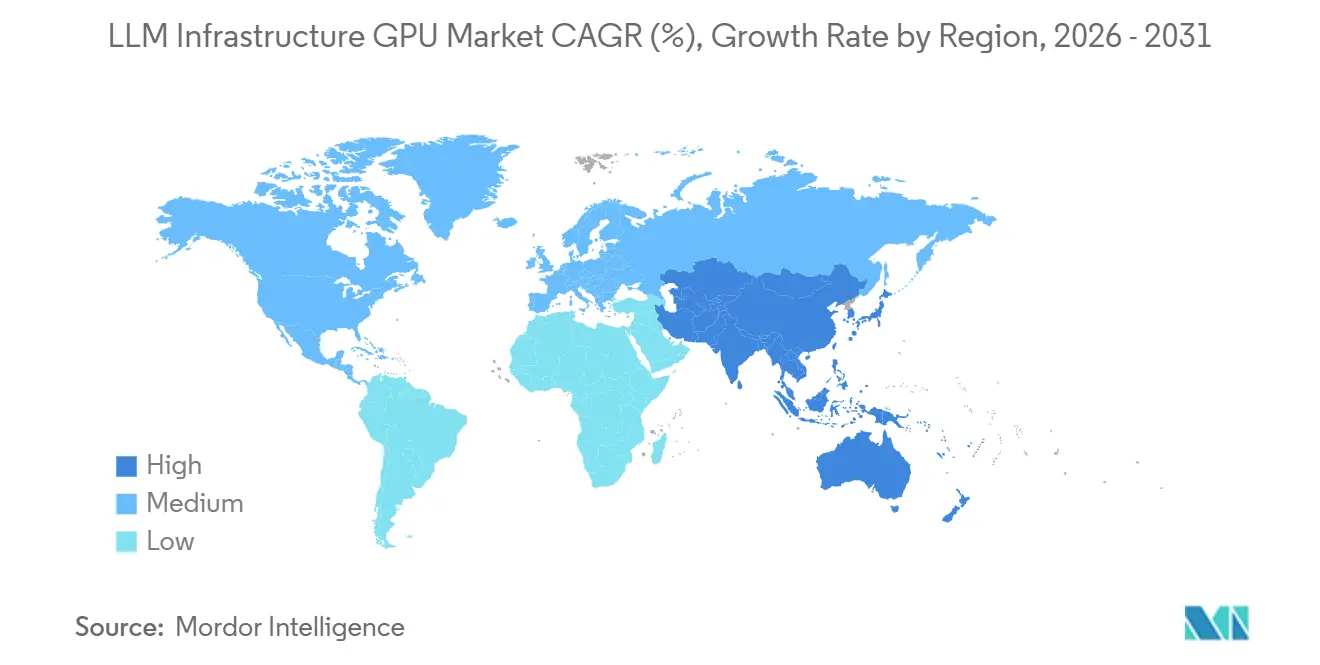
- By geography, North America held 47.12% share of the LLM infrastructure GPU market in 2025, while Asia-Pacific is projected to expand at an 18.22% CAGR through 2031.
Note: Market size and forecast figures in this report are generated using Mordor Intelligence’s proprietary estimation framework, updated with the latest available data and insights as of January 2026.
Market Trends and Insights
Drivers Impact Analysis of LLM Infrastructure GPU Market*
| Driver | (~) % Impact on CAGR Forecast | Geographic Relevance | Impact Timeline |
|---|---|---|---|
| Growing Demand for High-Density GPU Clusters for Foundation Model Training | +5.0% | Global | Short term (≤ 2 years) |
| Rising Adoption of GPU-Accelerated Cloud Services for LLM Development and Serving | +4.2% | Global | Short term (≤ 2 years) |
| Expansion of Sovereign AI and In-Country Model Hosting Programs | +2.8% | Middle East and Africa, APAC, Europe | Medium term (2-4 years) |
| Increasing Shift Toward Inference Optimization and Low-Latency Serving | +2.1% | Global | Medium term (2-4 years) |
| Power-Efficient Liquid-Cooled Rack Designs Improving Deployable Compute Density | +1.2% | North America and Europe (early adopters), Global (spill-over) | Short term (≤ 2 years) |
| Standardization of LLM Benchmarking and Cluster Procurement Frameworks | +0.8% | Global | Medium term (2-4 years) |
| Source: Mordor Intelligence | |||
Growing Demand for High-Density GPU Clusters for Foundation Model Training
The LLM infrastructure GPU market is being pushed upward by the rapid scaling of foundation model training from clusters measured in thousands of accelerators to fleets measured in tens of thousands. NVIDIA stated that Vera Rubin NVL72 ramped into full production in May 2026 and that one rack integrates 72 GPUs as a unified compute domain, which shows how quickly rack density expectations have shifted in the LLM infrastructure GPU market.[1]NVIDIA Corporation, “NVIDIA Vera Rubin Ramps Into Full Production to Power Agentic AI Factories Worldwide,” NVIDIA, nvidia.com NVIDIA also reported that CoreWeave, IBM, and NVIDIA scaled MLPerf Training v6.0 submissions to 8,192 Blackwell GPUs, which marked the largest validated cluster under the MLCommons peer-reviewed framework NVIDIA.COM. In parallel, NVIDIA disclosed through an SEC filing in January 2026 that it invested USD 2 billion in CoreWeave to help accelerate more than 5 gigawatts of AI factory buildout by 2030, which shows that capacity planning is now being contracted years ahead.[2]NVIDIA Corporation and CoreWeave, Inc., “NVIDIA Invests USD 2 Billion in CoreWeave,” U.S. Securities and Exchange Commission, sec.gov This shift is changing the LLM infrastructure GPU market from a hardware procurement cycle into a long-horizon infrastructure market where forward capital commitments determine access. It also increases the gap between hyperscale buyers and smaller operators, because the organizations that secure early capacity are better positioned to scale training, launch services faster, and reuse infrastructure across model generations.
Rising Adoption of GPU-Accelerated Cloud Services for LLM Development and Serving
The LLM infrastructure GPU market is also benefiting from a sharp rise in GPU cloud consumption, because many buyers need fast access to current-generation hardware without building a full private data center first. AMD and OpenAI announced a 6-gigawatt strategic partnership in October 2025, with the first 1-gigawatt AMD Instinct MI450 deployment scheduled for the second half of 2026, which shows how cloud capacity is now being contracted at infrastructure scale.[3]Advanced Micro Devices, Inc., “AMD and OpenAI Announce Strategic Partnership to Deploy 6 Gigawatts of AMD GPUs,” AMD, amd.com IBM and NVIDIA expanded their collaboration in March 2026, and IBM Cloud said it would offer NVIDIA Blackwell Ultra GPUs for large-scale training and inferencing in the second quarter of 2026, which reflects rising demand for managed and compliant GPU access. CoreWeave then expanded a USD 21 billion long-term AI cloud agreement with Meta in April 2026 and signed a separate USD 6 billion AI cloud agreement with Jane Street, which highlights how committed-capacity contracts are shaping cloud economics in the LLM infrastructure GPU market. These moves show that buyers increasingly value hardware access, workload tuning, and operational support over simple hourly pricing. They also widen the role of neocloud providers, because dedicated GPU clouds can target LLM workloads with less platform overhead than general-purpose cloud environments.
Expansion of Sovereign AI and In-Country Model Hosting Programs
Government-led compute programs are becoming a meaningful support factor for the LLM infrastructure GPU market, because more countries want domestic training and inference capacity for strategic and regulatory reasons. The UK government released its AI Hardware Plan in June 2026, committing GBP 750 million, which equals USD 952 million, to national AI hardware expansion and opening a GBP 400 million procurement path for next-generation systems. In Japan, RIKEN announced in June 2026 that it had deployed the “Riku” AI for Science supercomputer, built with 1,600 NVIDIA GB200 NVL4 Blackwell GPUs, which shows how national research bodies are moving into high-end accelerator ownership. These programs expand the LLM infrastructure GPU market beyond hyperscalers, because they bring ministries, public labs, universities, and state-backed operators into long-cycle infrastructure buying. They also favor regionally hosted clusters, sovereign cloud models, and local systems integration instead of a purely centralized model. Over time, this will widen geographic demand and create more mixed procurement patterns across public, research, and enterprise buyers.
Increasing Shift Toward Inference Optimization and Low-Latency Serving
A growing share of the LLM infrastructure GPU market is now being shaped by inference needs rather than only by model training, because production AI applications create constant token demand and tighter latency targets. NVIDIA reported that DFlash speculative decoding can improve inference performance by up to 15x on Blackwell GPUs, which shows how software and architecture changes are directly affecting hardware productivity. PyTorch reported in June 2026 that DeepSeek-V4 served on NVIDIA GB300 via SGLang and delivered 5x higher throughput at the same interactivity, which supports the move toward inference-focused serving stacks. Broadcom also said in June 2026 that 56% of surveyed senior IT leaders were running or planning to run production AI inference on private cloud, which signals stronger demand for distributed and controlled inference capacity. The LLM infrastructure GPU market is therefore splitting into more distinct infrastructure paths, with some fleets built for dense training and others designed for memory bandwidth, lower latency, and regional serving. That separation matters because it changes how buyers evaluate GPUs, networking, facility design, and software orchestration when they plan long-term infrastructure.
Restraints Impact Analysis of LLM Infrastructure GPU Market*
| Restraint | (~) % Impact on CAGR Forecast | Geographic Relevance | Impact Timeline |
|---|---|---|---|
| HBM and Advanced Packaging Supply Constraints | -1.8% | Global (supply concentrated in APAC; demand global) | Short term (≤ 2 years) |
| High Total Cost of Ownership for Large GPU Fleets | -1.2% | Emerging markets, mid-market enterprises globally | Medium term (2-4 years) |
| Export Controls and Cross-Border Availability Restrictions | -0.9% | China, select APAC markets, MENA | Medium term (2-4 years) |
| Vendor Lock-In Across Software, Interconnect, and Cluster Stacks | -0.5% | Global | Medium term (2-4 years) |
| Source: Mordor Intelligence | |||
*Our forecasts treat driver/restraint impacts as directional, not additive. The impact forecasts reflect baseline growth, mix effects, and variable interactions.
LLM Infrastructure GPU Market Segment Analysis
By Deployment Model:
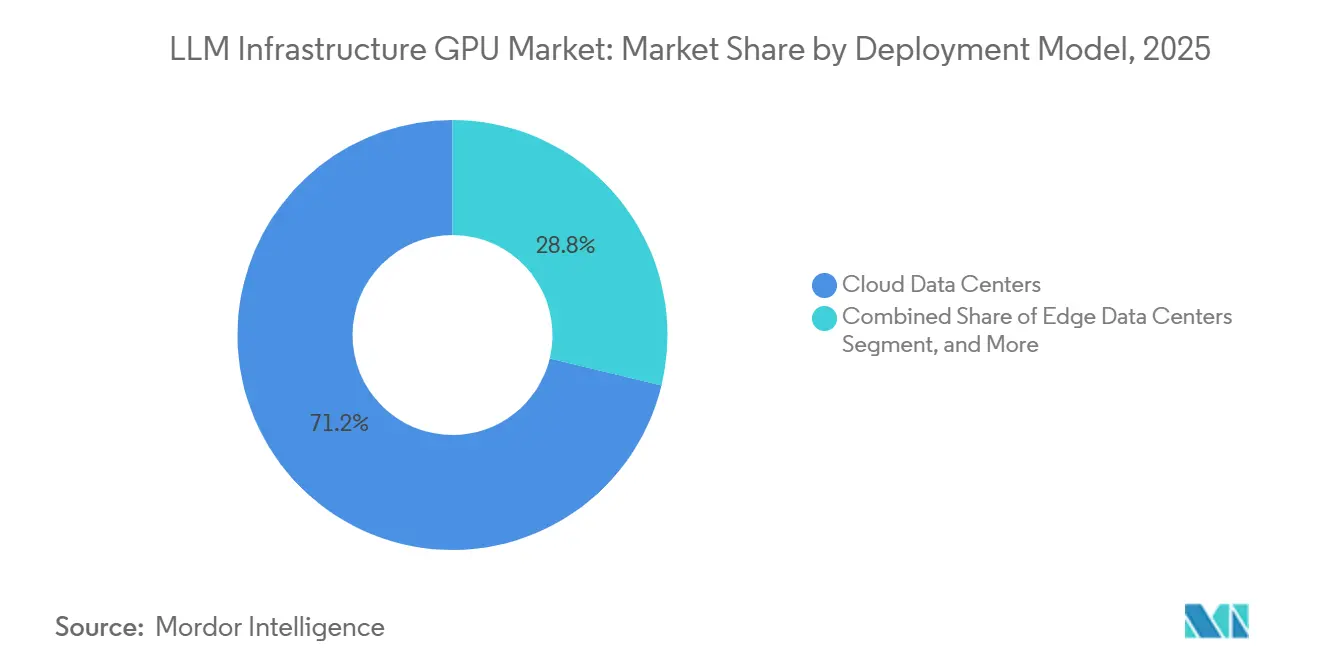
Enterprise Buildouts Accelerate Amid Cloud ConsolidationCloud data centers held 71.22% share in 2025, which made them the largest deployment base in the LLM infrastructure GPU market. That leadership reflects the role of hyperscaler campuses and neocloud facilities that can support dense liquid-cooled racks, large training jobs, and broad developer access. In the current structure of the LLM infrastructure GPU market, cloud deployment still offers the fastest route to large-scale training because it concentrates GPUs, networking, and orchestration in one location. It also lets buyers use short-term and committed-capacity models without carrying the full cost of land, power, and cooling on their own balance sheets. Even so, centralized cloud capacity is no longer the only default, because data control, latency requirements, and inference economics are pushing more organizations to look at hybrid and private footprints.
Edge data centers remain the smallest deployment path in the LLM infrastructure GPU market, but they are gaining relevance where sub-10-millisecond response times or local processing requirements matter. Enterprise and private data centers are projected to grow at a 17.57% CAGR through 2031, and the LLM infrastructure GPU market size for this segment is expanding faster as organizations move from pilot projects into sustained AI operations. Cloudian’s March 2026 survey said that 73% of respondents planned to shift AI workloads toward on-premises or hybrid infrastructure over the next 24 months. That shift does not mean enterprises are abandoning cloud, but it does mean they are reserving public capacity for burst training while placing inference, compliance-sensitive workloads, and internal tooling on infrastructure they control. In practical terms, the LLM infrastructure GPU market is moving toward a mixed deployment model where cloud remains the scale engine, while private environments become more important for steady-state serving and regulated data workloads.



By Workload Type:
Inference Emerges as the Primary Growth EngineTraining GPUs held a 66.59% share in 2025, which shows that model development still accounted for the largest portion of spending in the LLM infrastructure GPU market. Large training runs remain expensive because they require extended access to dense clusters, high-bandwidth fabrics, and coordinated software environments across thousands of accelerators. That is why the LLM infrastructure GPU market continued to direct significant capital toward platforms optimized for large-scale pretraining and model refresh cycles. At the same time, the mix is beginning to shift because more enterprises now fine-tune existing checkpoints and deploy domain-specific applications instead of building foundation models from scratch. As a result, the share of compute dedicated only to training is gradually giving way to a broader balance between training and deployment workloads.
Inference GPUs are projected to grow at a 17.88% CAGR through 2031, making them the fastest-growing workload segment in the LLM infrastructure GPU market. NVIDIA reported that DFlash speculative decoding can improve inference performance by up to 15x on Blackwell GPUs, which shows why software efficiency is becoming part of hardware buying decisions. PyTorch said in June 2026 that DeepSeek-V4 on NVIDIA GB300 with SGLang delivered 5x higher throughput at the same interactivity, which reinforces the demand for serving stacks tailored to inference rather than training. This is important because the LLM infrastructure GPU industry is no longer relying on one cluster design for every workload, and buyers are separating dense training systems from geographically distributed inference systems. That change is creating a more segmented LLM infrastructure GPU market where memory bandwidth, latency behavior, software scheduling, and regional placement matter just as much as raw compute scale.
By End User:
Enterprises Join Hyperscalers in Scaling GPU InfrastructureHyperscalers and cloud service providers held 68.17% share in 2025, which made them the dominant end-user group in the LLM infrastructure GPU market. Their lead reflects sustained spending on training clusters, global inference serving, and platform ecosystems that package compute together with storage, networking, and software services. In the current LLM infrastructure GPU market, these operators still shape the first wave of hardware adoption because they buy in the largest volumes and can absorb longer contract horizons. Government and research institutions are smaller, but they are becoming more visible as policy-led compute programs gain funding and public research centers take ownership of advanced accelerator systems. That demand is important because it broadens the customer base beyond commercial cloud operators and makes the LLM infrastructure GPU market less dependent on a single buyer class.
Enterprises are projected to record the fastest growth at a 17.64% CAGR through 2031, which shows that private AI infrastructure is becoming a core operational priority rather than a limited experiment. IBM and NVIDIA said in March 2026 that IBM Cloud would offer NVIDIA Blackwell Ultra GPUs for large-scale training, high-throughput inferencing, and AI reasoning, which shows that enterprise access is moving toward full-stack services rather than simple compute rental. Public research deployment is also expanding, as RIKEN announced its “Riku” supercomputer in June 2026 with 1,600 NVIDIA GB200 NVL4 Blackwell GPUs. The challenge for enterprise buyers is that hardware purchase alone does not guarantee strong utilization, because orchestration, model management, and workload scheduling all need to mature alongside the fleet. The LLM infrastructure GPU market therefore favors providers that can combine silicon access, managed operations, and compliance controls, since those capabilities help enterprises turn purchased capacity into sustained production output.
By GPU Integration and Interconnect:
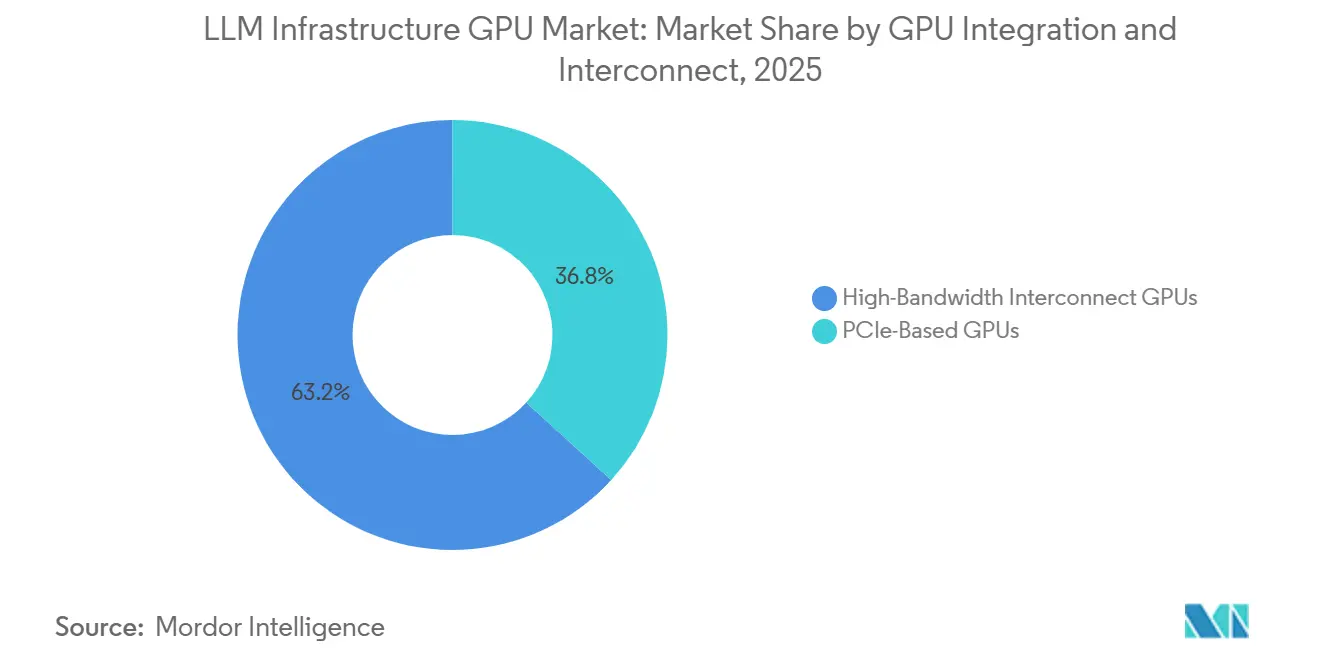
High-Bandwidth Architectures Redefine Cluster ScaleHigh-bandwidth interconnect GPUs held 63.21% share in 2025 and were also projected to grow at an 18.14% CAGR through 2031, which means this segment was both the largest and the fastest-growing in the LLM infrastructure GPU market. That combination reflects a structural shift, because large LLM clusters now depend on high-speed fabrics as a baseline requirement rather than as an optional performance upgrade. Training environments at the top end of the LLM infrastructure GPU market need tight coordination across thousands of GPUs, and that makes PCIe-only architectures insufficient for the biggest workloads. PCIe-based systems still matter in smaller enterprise deployments, edge inference, and use cases where parallelism stays within a single server or a limited cluster. Even so, the center of gravity is moving toward integrated platforms where interconnect choice shapes performance, cost, rack design, and long-term upgrade options.
NVIDIA said in May 2026 that Vera Rubin doubles NVLink bandwidth and per-GPU networking capacity compared with Blackwell, while also introducing Spectrum-X Ethernet Photonics with 200Gbps SerDes and improved power efficiency. These features matter because buyers in the LLM infrastructure GPU market are increasingly purchasing a full platform that includes switches, cables, firmware, and cluster management software. In effect, the decision is starting to resemble platform adoption more than component selection. High-bandwidth interconnect GPUs accounted for 63.21% of the LLM infrastructure GPU market size in 2025, and that share shows how quickly scale-out design became the default choice for production deployments. The result is a tighter link between silicon vendors and infrastructure design, which raises performance ceilings but also increases the importance of ecosystem fit, switching cost, and vendor dependency over the life of the cluster.
By Cooling Technology:
Liquid Cooling Becomes Infrastructure Standard for AI FactoriesAir-cooled GPU infrastructure held 61.47% share in 2025, which means it still represented the dominant installed base in the LLM infrastructure GPU market. That base largely reflects existing data centers and retrofit environments that were not originally built for the thermal profile of newer accelerator systems. Air cooling, therefore, remains important in the LLM infrastructure GPU market where buyers extend existing facilities, phase upgrades gradually, or serve smaller workloads that do not require rack densities at the highest end. Even so, the balance is changing because newly commissioned AI factories are increasingly designed around liquid cooling from the start. This creates a split where legacy capacity stays air-cooled while most future large-scale installations move toward closed-loop liquid systems.
Liquid-cooled GPUs are projected to grow at a 17.99% CAGR through 2031, making them the fastest-growing cooling segment in the LLM infrastructure GPU market. NVIDIA said DSX MaxLPS can help operators run up to 40% more GPUs within a fixed power budget, and it also said GB200 NVL72 can deliver 25x more energy efficiency and 300x more water efficiency than traditional air-cooled architectures. LiquidStack launched its GigaModular CDU platform commercially in May 2026 with scaling up to 14 MW, while Supermicro introduced DCBBS blueprints for Vera Rubin NVL72 and HGX Rubin NVL8 in June 2026. Those moves show that the supporting ecosystem for liquid cooling is maturing alongside the hardware itself. In the next phase of the LLM infrastructure GPU market, cooling will no longer be treated as an auxiliary facility choice, because it already shapes deployable density, usable power budgets, rack design, and the economics of future AI factory buildout.
Geography Analysis
The Americas LLM Infrastructure GPU Market
North America held 47.12% share in 2025, giving it the leading regional position in the LLM infrastructure GPU market. The region remains the main center for hyperscaler procurement, neocloud expansion, and vendor-led AI factory partnerships. NVIDIA disclosed in January 2026 that it invested USD 2 billion in CoreWeave to support more than 5 gigawatts of AI factory buildout by 2030, and NVIDIA and IREN announced another strategic partnership in May 2026 targeting up to 5 gigawatts of AI infrastructure deployment, which shows how capital and supply commitments are clustering around North American expansion. This keeps the LLM infrastructure GPU market in North America closely tied to large-scale cloud buildouts, long-term hardware commitments, and rapid adoption of liquid-cooled capacity. South America remains at an earlier stage, with deployments still centered on major cloud regions and a smaller base of sovereign or enterprise-owned AI infrastructure.
Europe LLM Infrastructure GPU Market
Europe is becoming more important to the LLM infrastructure GPU market as public policy and enterprise data control requirements support local deployment choices. The UK government’s AI Hardware Plan committed GBP 750 million, equal to USD 952 million, and included a GBP 400 million procurement opportunity for next-generation hardware, which gives the region a clearer public investment path. European demand is also shaped by stronger requirements around regional hosting, model governance, and operational accountability, which make private data centers and sovereign-style cloud environments more relevant. That means the LLM infrastructure GPU market in Europe is not only a hardware story, because hosting location and governance structure increasingly influence procurement choices alongside raw performance.
APAC and MEA LLM Infrastructure GPU Market
Asia-Pacific is projected to expand at an 18.22% CAGR through 2031, making it the fastest-growing geography in the LLM infrastructure GPU market. Japan and South Korea already show visible momentum, as RIKEN announced its “Riku” deployment in June 2026 and NAVER and NVIDIA announced a gigawatt-scale global AI factory agreement beginning at 55 MW at NAVER’s GAK Sejong facility. The regional LLM infrastructure GPU market is also being shaped by domestic accelerator programs, rising enterprise buildout, and a stronger focus on national compute capacity. China’s access restrictions on top-end imported hardware are encouraging domestic substitution, which changes the supplier mix even when frontier GPU availability remains constrained. The Middle East and Africa are also moving more actively into sovereign compute buildout, and that broadens the future geographic footprint of the LLM infrastructure GPU market beyond the long-established North American core.

Competitive Landscape
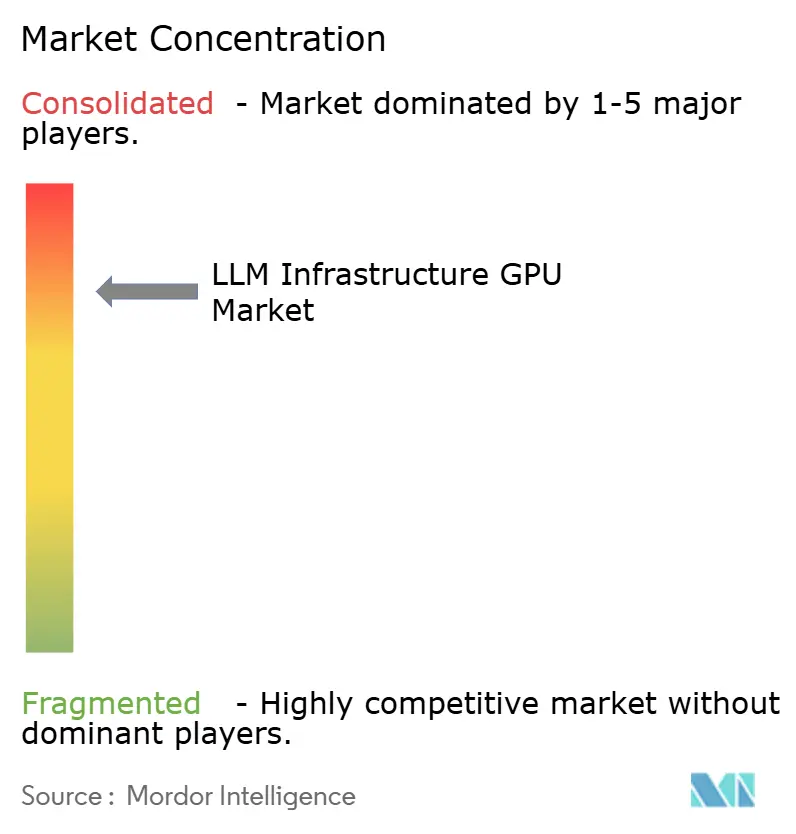
The LLM infrastructure GPU market remains highly concentrated at the chip layer, even though competition is broader across cloud delivery, systems integration, and software services. NVIDIA continues to hold the strongest position because CUDA links hardware adoption with developer tools, libraries, inference frameworks, and operational know-how. That gives the company a structural advantage in the LLM infrastructure GPU market, because customers often evaluate the software ecosystem and deployment path together with silicon performance. At the same time, AMD has strengthened its position as the clearest large-scale alternative, first through its October 2025 OpenAI partnership and then through its February 2026 expanded strategic partnership with Meta, both structured at a gigawatt scale. These agreements matter because they show that competition in the LLM infrastructure GPU market is no longer limited to individual accelerator launches, but now depends on whether vendors can secure long-term infrastructure commitments from the largest AI buyers.
NVIDIA’s January 2026 USD 2 billion investment in CoreWeave was one of the clearest signs that value in the LLM infrastructure GPU market is shifting toward full-stack AI factory capacity with guaranteed access to current-generation hardware. CoreWeave reinforced that direction in April 2026 by expanding its USD 21 billion agreement with Meta and signing a separate USD 6 billion AI cloud agreement with Jane Street, which shows that assured capacity is now a strategic product in its own right. IBM and NVIDIA also expanded their collaboration in March 2026, which added another example of how enterprise buyers increasingly want packaged access to GPUs, software, and operational controls rather than hardware alone. System integrators such as Dell, HPE, Lenovo, and Supermicro therefore compete less on chip differentiation and more on rack delivery, liquid cooling integration, deployment speed, and lifecycle support. This creates a layered competitive structure where the silicon tier remains concentrated, but the service and deployment tiers of the LLM infrastructure GPU market are widening.
The next contest in the LLM infrastructure GPU market is likely to center on inference infrastructure, sovereign deployments, and enterprise private clusters, where buyers care as much about fit and operating model as they do about benchmark leadership. Vendors that can package networking, cooling, firmware, cluster management, and compliance controls together will have an advantage because procurement decisions now reach well beyond the GPU itself. The market is also seeing more room for specialized and regional players, especially where domestic policy, local hosting requirements, or workload-specific tuning create openings that standard hyperscaler models do not fully address. Even so, the LLM infrastructure GPU market is unlikely to become loose or fully fragmented in the near term, because access to advanced silicon, interconnect ecosystems, and production-grade software still gives the largest platform vendors a durable lead.
LLM Infrastructure GPU Industry Leaders
NVIDIA Corporation
Advanced Micro Devices, Inc.
Intel Corporation
Microsoft Corporation
Amazon Web Services, Inc.
- *Disclaimer: Major Players sorted in no particular order
LLM Infrastructure GPU Market Companies Covered in this Report
- NVIDIA Corporation
- Advanced Micro Devices, Inc.
- Intel Corporation
- Microsoft Corporation
- Amazon Web Services, Inc.
- Google LLC
- Meta Platforms, Inc.
- Oracle Corporation
- Tencent Holdings Limited
- Alibaba Group Holding Limited
- Huawei Technologies Co., Ltd.
- Super Micro Computer, Inc.
- Dell Technologies Inc.
- Hewlett Packard Enterprise Company
- Lenovo Group Limited
- Cisco Systems, Inc.
- IBM Corporation
- CoreWeave, Inc.
- Cerebras Systems, Inc.
- SambaNova Systems, Inc.
- Lambda Labs
- Tenstorrent Inc.
- Marvell Technology Group
- Giga Computing Technology Co., Ltd.
- ASUSTeK Computer Inc.

Recent Industry Developments in LLM Infrastructure GPU Market
- June 2026: AMD and Rackspace Technology signed a definitive agreement for phased deployment of an initial 30 MW of AMD AI compute across Rackspace's global data centers from late 2026 through 2028, operationalizing a May 2026 memorandum of understanding and establishing AMD as Rackspace's strategic silicon-layer partner AMD GlobeNewswire, June 16, 2026.
- June 2026: NAVER and NVIDIA announced a gigawatt-scale global AI factory agreement beginning at 55 MW at NAVER's GAK Sejong facility, with a roadmap spanning Asia, the Middle East, and Europe, structured as an integrated capital-sharing partnership rather than a conventional technology supply arrangement NVIDIA Investor Relations, June 7, 2026.
- June 2026: NVIDIA Blackwell achieved a clean sweep in the MLPerf Training v6.0 benchmark, submitting on all benchmarks with the fastest results at scale and validating cluster performance across 8,192 Blackwell GPUs in production hyperscale environments, the largest GPU cluster submitted under the MLCommons peer-reviewed framework NVIDIA Developer Blog, June 2026.
- May 2026: NVIDIA Vera Rubin ramped into full production, delivering 10x agent throughput over the prior Blackwell generation and introducing Spectrum-X Ethernet Photonics, the first co-packaged-optics switch in production, with early cloud adopters including CoreWeave, Microsoft Azure, Oracle Cloud Infrastructure, and IBM Cloud NVIDIA Investor Relations, May 31, 2026.


Global LLM Infrastructure GPU Market Report Scope
The LLM Infrastructure GPU Market refers to the market for GPU-based hardware and supporting systems used to train, fine-tune, host, and run large language models at scale. It includes high-performance accelerators, memory, networking, storage, cooling, and cluster orchestration layers needed for LLM workloads.
The LLM Infrastructure GPU Market Report is Segmented by Deployment Model (Cloud Data Centers, Enterprise and Private Data Centers, and Edge Data Centers), Workload Type (Training GPUs, and Inference GPUs), End User (Hyperscalers and Cloud Service Providers, Enterprises, Government and Research Institutions), GPU Integration (PCIe-Based GPUs, and High-Bandwidth GPUs), Cooling (Air-Cooled GPUs, and Liquid-Cooled GPUs), and Geography (North America, Europe, Asia-Pacific, South America, Middle East and Africa). The Market Forecasts are Provided in Terms of Value (USD).
| Cloud Data Centers |
| Enterprise and Private Data Centers |
| Edge Data Centers |
| Training GPUs |
| Inference GPUs |
| Hyperscalers and Cloud Service Providers |
| Enterprises |
| Government and Research Institutions |
| PCIe-Based GPUs |
| High-Bandwidth Interconnect GPUs |
| Air-Cooled GPUs |
| Liquid-Cooled GPUs |
| North America | United States |
| Canada | |
| Mexico | |
| Europe | Germany |
| United Kingdom | |
| France | |
| Italy | |
| Rest of Europe | |
| Asia-Pacific | China |
| Japan | |
| South Korea | |
| India | |
| Southeast Asia | |
| Rest of Asia-Pacific | |
| South America | |
| Middle East and Africa |
| By Deployment Model | Cloud Data Centers | |
| Enterprise and Private Data Centers | ||
| Edge Data Centers | ||
| By Workload Type | Training GPUs | |
| Inference GPUs | ||
| By End User | Hyperscalers and Cloud Service Providers | |
| Enterprises | ||
| Government and Research Institutions | ||
| By GPU Integration And Interconnect | PCIe-Based GPUs | |
| High-Bandwidth Interconnect GPUs | ||
| By Cooling Technology | Air-Cooled GPUs | |
| Liquid-Cooled GPUs | ||
| By Geography | North America | United States |
| Canada | ||
| Mexico | ||
| Europe | Germany | |
| United Kingdom | ||
| France | ||
| Italy | ||
| Rest of Europe | ||
| Asia-Pacific | China | |
| Japan | ||
| South Korea | ||
| India | ||
| Southeast Asia | ||
| Rest of Asia-Pacific | ||
| South America | ||
| Middle East and Africa | ||


Key Questions Answered in the Report
What is the current size of the LLM infrastructure GPU market?
The LLM infrastructure GPU market stands at USD 73.41 billion in 2026 and is projected to reach USD 161.88 billion by 2031, growing at a 17.14% CAGR over 2026-2031.
Which deployment model currently leads LLM infrastructure GPU demand?
Cloud data centers lead deployment demand with a 71.22% share in 2025, supported by hyperscaler campuses and large AI cloud buildouts.
Why is inference becoming more important than before in GPU infrastructure planning?
Inference GPUs are projected to grow at a 17.88% CAGR through 2031 as production AI applications create continuous token demand, tighter latency targets, and more regionally distributed serving needs.
Which end-user group is growing the fastest in this space?
Enterprises are the fastest-growing end-user segment with a 17.64% CAGR through 2031, as private AI infrastructure moves from pilot programs to production deployment.
What role does liquid cooling play in future GPU capacity expansion?
Liquid-cooled GPUs are projected to grow at a 17.99% CAGR through 2031, because next-generation AI factories need higher rack density and better thermal efficiency than air-cooled setups can reliably provide.
Which region is expanding the fastest for LLM infrastructure GPU deployment?
Asia-Pacific is the fastest-growing region with an 18.22% CAGR through 2031, supported by sovereign compute programs, enterprise buildout, and broader domestic AI infrastructure development.
Page last updated on:





