
Letterpress Printing Services Market Size and Share
Market Overview
| Study Period | 2019 - 2030 |
|---|---|
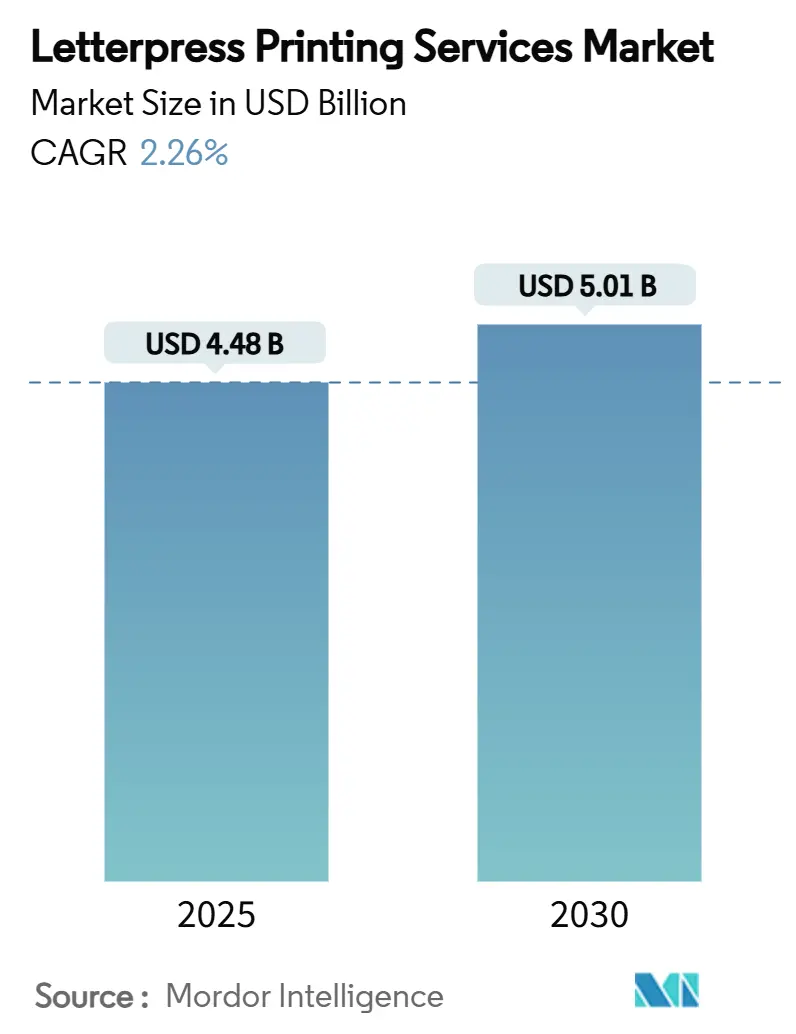
| Market Size (2025) | USD 4.48 Billion |
| Market Size (2030) | USD 5.01 Billion |
| Growth Rate (2025 - 2030) | 2.26 % |
| Fastest Growing Market | Asia Pacific |
| Largest Market | North America |
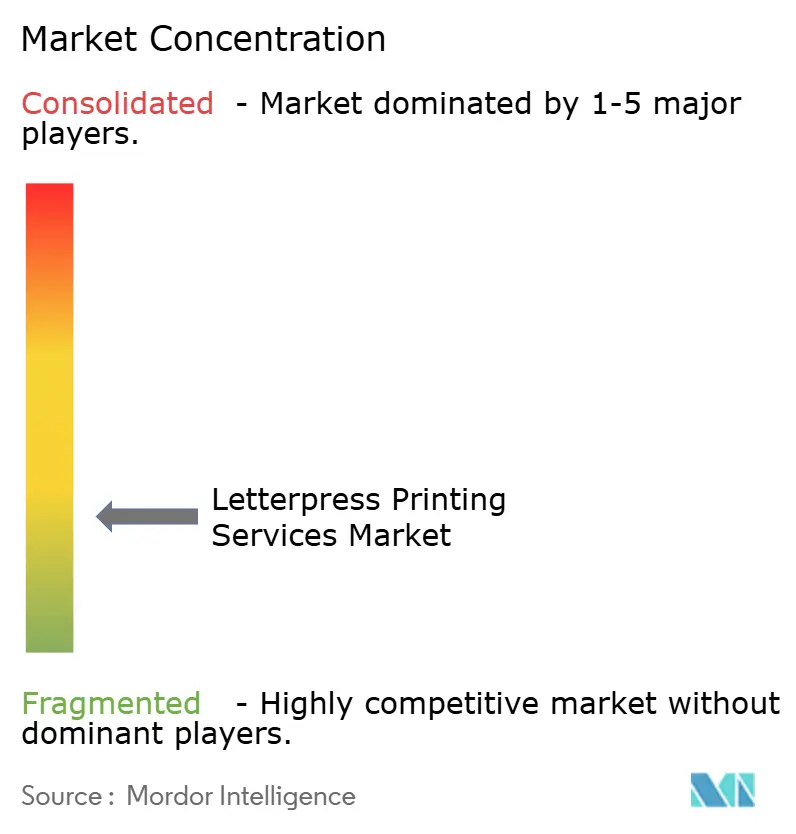
| Market Concentration | Low |
Major Players
*Disclaimer: Major Players sorted in no particular order Image © Mordor Intelligence. Reuse requires attribution under CC BY 4.0. |
|
Letterpress Printing Services Market Analysis by Mordor Intelligence
The letterpress printing services market size stands at USD 4.48 billion in 2025 and is forecast to climb to USD 5.01 billion by 2030, expanding at a 2.26% CAGR during the period. Demand concentrates on premium niches where the tactile impression creates brand value that digital methods cannot match.[1] Luxury packaging, bespoke wedding stationery and craft-driven art prints anchor revenue growth as consumers seek authenticity and sensory engagement. Sustainability mandates steer procurement toward recycled papers and low-VOC inks, while digital design platforms lower entry barriers for small businesses and remote buyers. Regional specialists dominate because close collaboration with clients preserves craftsmanship quality, yet technology-enabled networks are beginning to create scale opportunities without eroding artisanal appeal.
Key Report Takeaways
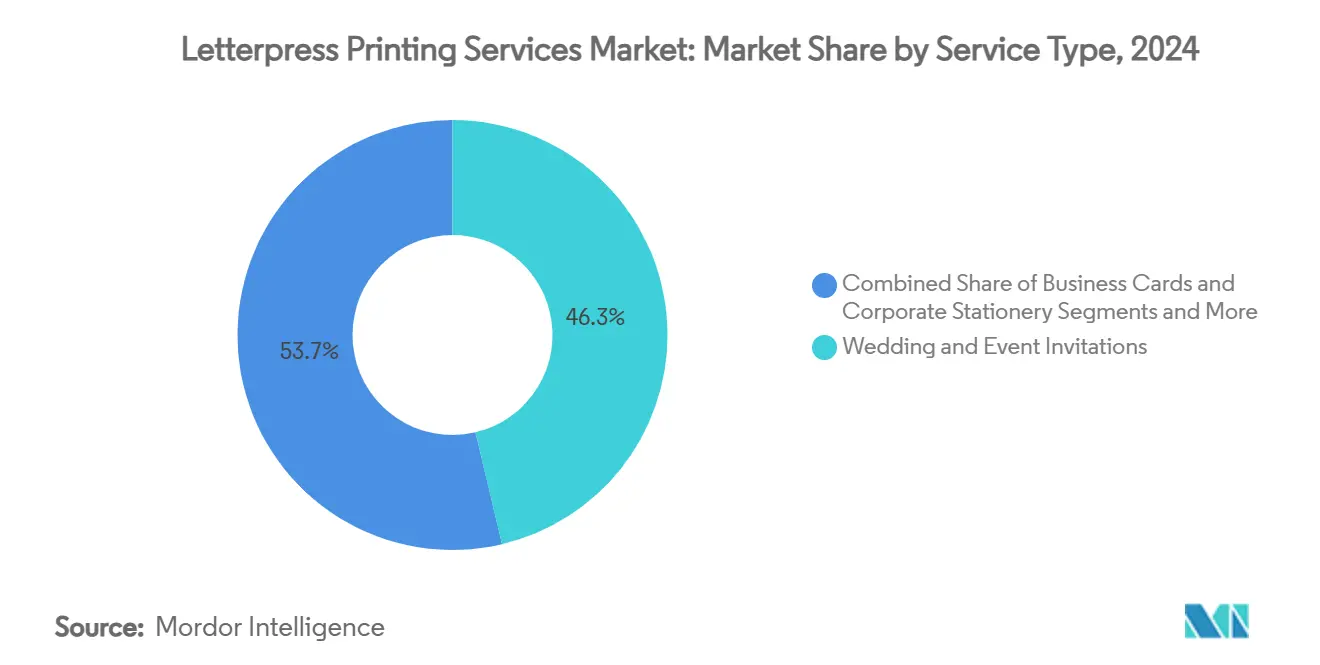
- By service type, wedding and event invitations held a 46.3% share of the letterpress printing services market in 2024, whereas luxury packaging and labels are projected to advance at a 3.1% CAGR to 2030.
- By substrate, 100% cotton rag paper commanded 52.4% of the letterpress printing services market share in 2024, while recycled paper alternatives are poised for 2.8% CAGR growth through 2030.
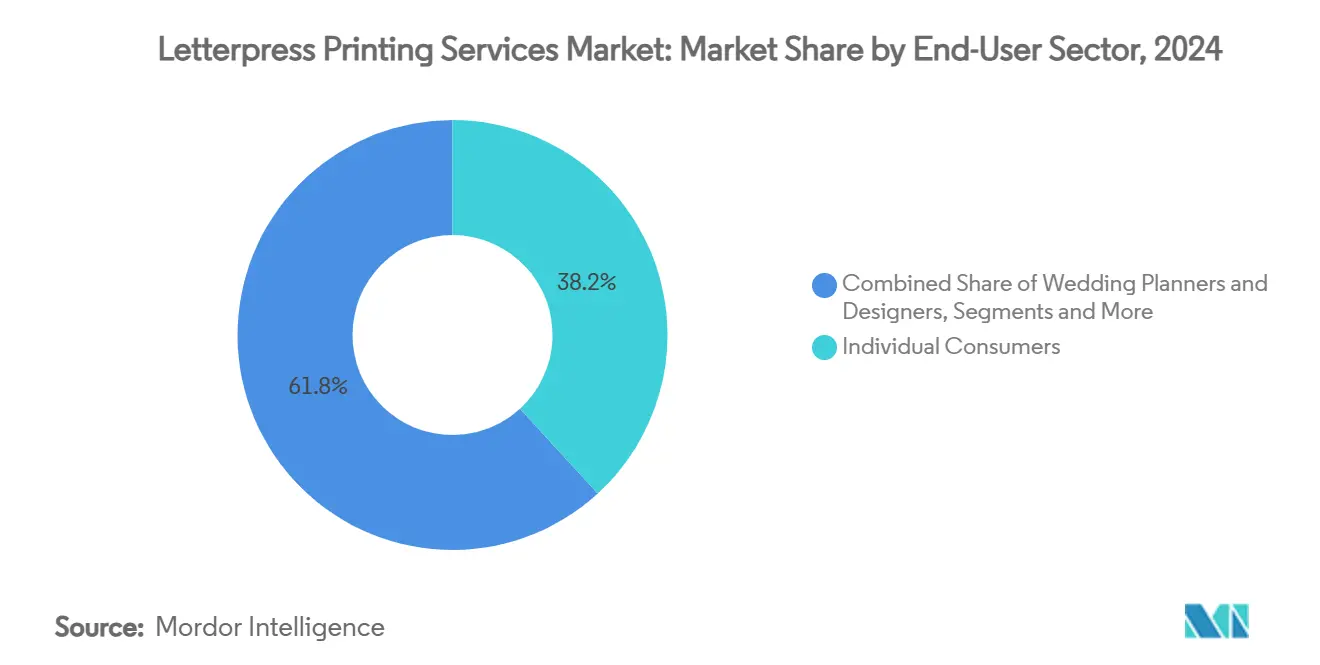
- By end-user, individual consumers accounted for 38.2% of the letterpress printing services market size in 2024; luxury retail and hospitality represent the fastest commercial adopters with a 2.5% CAGR outlook.
- By print-run size, micro-batches under 100 units captured 44.6% of the letterpress printing services market in 2024 and are forecast to expand at a 2.7% CAGR through 2030.
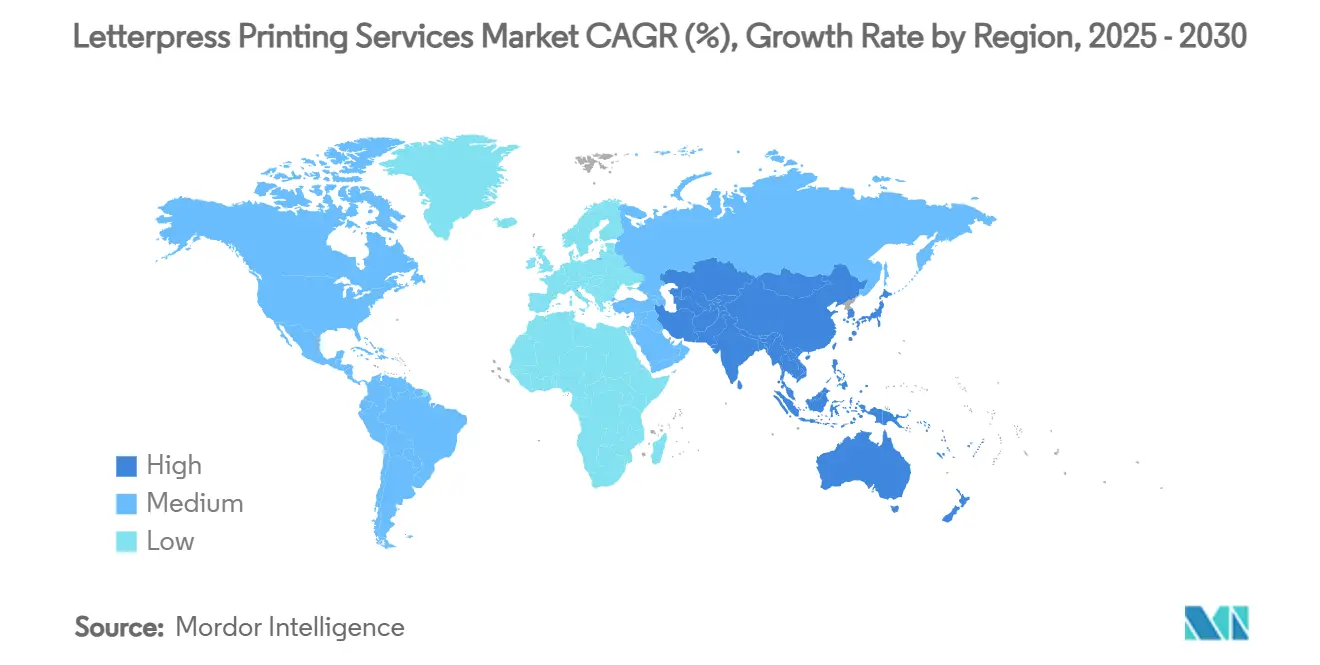
- By geography, North America led with 35.1% revenue share in 2024, whereas Asia Pacific is on track for the highest regional CAGR at 2.9% to 2030.
Note: Market size and forecast figures in this report are generated using Mordor Intelligence’s proprietary estimation framework, updated with the latest available data and insights as of January 2026.
Market Trends and Insights
Drivers Impact Analysis of Letterpress Printing Services Market*
| Driver | (~) % Impact on CAGR Forecast | Geographic Relevance | Impact Timeline |
|---|---|---|---|
| Wedding and event stationery boom | +0.8% | North America and Europe, expanding to Asia Pacific | Medium term (2-4 years) |
| Resurgence of craft/DIY culture | +0.6% | Global, strongest in developed markets | Long term (≥ 4 years) |
| Premium sustainable business cards demand | +0.4% | North America and EU, early adoption in urban Asia | Short term (≤ 2 years) |
| Bespoke e-commerce design-to-print platforms | +0.5% | Global, led by North America and Europe | Medium term (2-4 years) |
| Luxury unboxing inserts for e-commerce | +0.7% | Global, concentrated in premium retail hubs | Short term (≤ 2 years) |
| Digital-detox handwritten correspondence clubs | +0.3% | Developed markets, niche urban communities | Long term (≥ 4 years) |
| Source: Mordor Intelligence | |||
Wedding and Event Stationery Boom
Post-pandemic wedding spending now prioritizes tactile invitations that act as keepsakes, stimulating multi-touchpoint demand for save-the-dates, menu cards and thank-you notes. Smaller guest lists free budget for premium paper and finishing, which sustains the letterpress printing services market during cyclical downturns. Couples perceive handcrafted invitations as emotional storytelling tools that outweigh digital convenience. Providers capitalize on this sentiment by bundling design, calligraphy and finishing, thereby lifting average order values. Regional variations persist, yet cross-cultural adoption rises as destination weddings popularize Western stationery traditions.
Resurgence of Craft/DIY Culture
A broader consumer shift toward handmade goods elevates letterpress from obsolete machinery to a respected craft medium. Workshops and studio experiences generate additional revenue streams while reinforcing brand authenticity. Limited-edition art prints showcase deep impressions and deckled edges, outcomes that digital devices cannot replicate. Social media amplifies the aesthetic appeal, driving aspirational demand among younger demographics. Collectors and design influencers further validate the medium, ensuring long-term relevance of artisanal processes.
Premium Sustainable Business Cards Demand
Corporate sustainability programs increasingly require recycled or cotton-based substrates for business cards as visual proof of environmental commitment. Cotton pricing stability reported by the U.S. Department of Agriculture preserves margins on 100% rag stock. [2] Professional services and luxury brands use deep impressions, edge painting and foil accents to convey exclusivity while meeting ESG goals. Providers respond with low-VOC inks and carbon-neutral shipping options, aligning premium aesthetics with responsible sourcing.
Bespoke E-Commerce Design-to-Print Platforms
Online configurators allow customers to design, preview and order custom letterpress goods, blending digital ease with tactile output. These platforms widen geographic reach without diluting craftsmanship by routing files to regional studios for production. Automated proofing shortens lead times, while variable-data capabilities support mass-customization runs that remain cost-effective under 500 units. The model attracts small businesses seeking brand differentiation yet constrained by time and location.
Restraints Impact Analysis of Letterpress Printing Services Market*
| Restraint | (~) % Impact on CAGR Forecast | Geographic Relevance | Impact Timeline |
|---|---|---|---|
| High cost versus digital printing | -0.9% | Global, greatest in price-sensitive markets | Short term (≤ 2 years) |
| Skilled labor and vintage press scarcity | -1.2% | Global, acute in developed economies | Long term (≥ 4 years) |
| Cotton-rag paper supply volatility | -0.4% | Global | Medium term (2-4 years) |
| Environmental scrutiny of solvent inks | -0.5% | Developed markets with strict rules | Medium term (2-4 years) |
| Source: Mordor Intelligence | |||
High Cost Versus Digital Printing
Letterpress setup demands make per-unit pricing uncompetitive for large runs, limiting uptake among budget-conscious users. The mean wage for printing press operators reached USD 44,450 in 2024, outpacing digital press technicians and reinforcing cost gaps.[3] Overhead includes make-ready sheets, bespoke polymer plates and slower throughput, which diminishes price elasticity. Providers mitigate with tiered pricing, hybrid workflows and value-added finishes, yet sticker shock remains a near-term barrier.
Skilled Labor and Vintage Press Scarcity
Industry employment for traditional press operators is projected to decline 10% from 2023 to 2033, creating shortages at precisely the moment premium demand accelerates.[4]Many presses were scrapped during the digital pivot, constraining capacity. Apprenticeship programs and retrofitting projects aim to preserve institutional knowledge, yet the skill pipeline remains thin, posing the largest structural risk.
*Our forecasts treat driver/restraint impacts as directional, not additive. The impact forecasts reflect baseline growth, mix effects, and variable interactions.
Letterpress Printing Services Market Segment Analysis
By Service Type:
Wedding Invitations Sustain Volume, Luxury Packaging AcceleratesWedding and event invitations contributed 46.3% to the letterpress printing services market size in 2024 and remain the anchor revenue stream through 2030. Luxury packaging and labels, although smaller in absolute numbers, post the highest 3.1% CAGR as e-commerce brands adopt premium tactile inserts to elevate unboxing experiences.
Customer willingness to allocate higher per-unit spend on milestone celebrations underpins steady invitation demand even during macroeconomic slowdowns. Conversely, packaging applications thrive on repeat corporate orders that scale gradually as brands expand product lines. Providers that straddle both segments hedge seasonality while cross-selling design services, which reinforces client loyalty and boosts lifetime value across the letterpress printing services market.

By Substrate/Paper Type:
Cotton Dominance Faces Green ImperativesCotton rag paper held a commanding 52.4% of the letterpress printing services market share in 2024, demonstrating enduring preference for deep impression quality and archival longevity. Recycled fiber grades, however, show a 2.8% CAGR as corporate ESG targets tighten.
Cotton’s superior ink absorption anchors its leadership, yet price sensitivity and sustainability messaging accelerate trial of recycled and blended sheets. Makers now promote mixed-cotton stocks (25-75%) that balance cost, feel and eco-credentials. Specialty handmade papers remain a boutique choice for art editions, drawing high margins despite volume limits. These portfolio dynamics allow printers to match material narratives with project objectives across the letterpress printing services market.
By End-User Sector:
Consumers Lead While Luxury Retail OutpacesIndividual consumers generated 38.2% of 2024 revenue, propelled by weddings, personal stationery and bespoke gifting. Luxury retail and hospitality, though smaller base segments, are expected to log a 2.5% CAGR by 2030 as brands compete on sensory touchpoints.
Wedding planners and graphic designers influence consumer orders by educating clients on tactile benefits, while corporate purchasers tie letterpress collateral to brand storytelling. Hospitality groups integrate letterpress menus and room collateral to project luxury positioning, keeping the letterpress printing services industry relevant amid digital encroachments.
By Print-Run Size:
Micro-Runs Anchor Mass CustomizationMicro-batches below 100 units dominated with 44.6% share in 2024 and will grow at 2.7% CAGR, reflecting the strategic shift toward personalization over scale. Small runs between 100 and 999 units serve business card and corporate stationery applications where the tactile edge justifies premium pricing.
Medium runs support wedding suites and branded collateral, yet efficiency gains remain secondary to craftsmanship perceptions. Large volumes above 5,000 units surface only when tactile differentiation outweighs cost disparities, maintaining niche status in the broader letterpress printing services market.
Geography Analysis
North America Letterpress Printing Services Market
North America accounted for 35.1% of global revenue in 2024, supported by robust wedding spend, high disposable income and a mature network of boutique studios. The region employs 353,900 printing workers, with letterpress operators earning premium rates that mirror their scarcity. Established craft communities in cities such as New York, Los Angeles and Toronto foster continuous demand for workshops and limited-edition art prints. Corporate buyers in professional services favor deep-impression business cards as status symbols that signal meticulousness during client introductions.
Europe Letterpress Printing Services Market
Europe ranks second by turnover and leads in sustainable innovation, driven by rigorous environmental rules that push adoption of low-VOC inks and recycled substrates. Heritage luxury houses in France, Italy and the United Kingdom deploy letterpress for product authentication inserts and seasonal lookbooks. Cultural emphasis on artisanal quality supports premium pricing, yet studio consolidation remains limited due to language, design and regulatory nuances across markets.
APAC Letterpress Printing Services Market
Asia Pacific represents the fastest-growing region at a 2.9% CAGR to 2030, owing to rising middle-class incomes and the Westernization of wedding traditions. Urban centers such as Tokyo, Seoul, Shanghai and Singapore display escalating demand for luxury invitations and corporate stationery that conform to global etiquette. Supply constraints include a thin bench of skilled operators and reliance on imported cotton stock, yet strategic partnerships with Western craft brands are bridging gaps. International Paper projects sustained expansion in Asian fiber-based packaging, which may spill into letterpress labels and inserts.
Competitive Landscape
The letterpress printing services market is highly fragmented, populated by hundreds of regional studios that compete on craftsmanship rather than economies of scale. Barrier to entry is moderate for design-centric entrepreneurs equipped with refurbished presses yet sourcing challenges and training curves limit national expansion. Studios differentiate through proprietary plate-making techniques, house-blended inks and curated type libraries that foster brand loyalty.
Technology integration now separates front-runners from hobbyists. Cloud-based design portals, automated quote engines and color-management systems elevate throughput while preserving artisanal output. Cimpress exemplifies this hybrid model, reporting USD 3.3 billion in fiscal-2024 revenue across mass-customization platforms that include letterpress SKUs. Acquisition pipelines targeting niche studios accelerate know-how transfer and geographic coverage.
Strategic moves in adjacent printing technologies also influence letterpress positioning. Koenig & Bauer’s record order backlog in 2024 underscores resilience in packaging equipment demand. Heidelberg’s 175-year growth blueprint emphasizes digital and sustainable presses, signaling potential synergies whereby hybrid shops combine offset, digital and letterpress to serve diverse client briefs. Studio collaborations with luxury brands further entrench high-margin applications, while skilled-labor mentorship programs aim to safeguard institutional knowledge.
Letterpress Printing Services Industry Leaders
-
Crane and Co.
-
The Wren Press
-
Dempsey and Carroll
-
Ladyfingers Letterpress
-
Vistaprint
- *Disclaimer: Major Players sorted in no particular order
Letterpress Printing Services Market Companies Covered in this Report
- Crane and Co.
- The Wren Press
- Dempsey and Carroll
- Vistaprint
- Ladyfingers Letterpress
- Power and Light Press
- Hammerpress
- A Fine Press
- Littleford Letterpress
- Blackbird Letterpress
- The Alphabet Press
- The Artisan Press
- Salt and Cedar
- Sawtooth Printhouse
- 7 Ton Letterpress Collective
- Typothecary Press
- Permanent Collection Press
- Intima Press
- Missive Press
- Smokeproof Press
- Bella Figura
Recent Industry Developments in Letterpress Printing Services Market
- February 2025: Koenig & Bauer AG reported Q4 2024 operating EBIT of EUR 46.5 million and revenue of EUR 1,274.4 million, reaching the highest order backlog in its history.
- January 2025: Heidelberger Druckmaschinen AG kicked off its 175th anniversary with a growth strategy targeting more than EUR 300 million in incremental sales by 2029.
- September 2024: AstroNova Inc. acquired MTEX NS to boost capabilities in color digital package printing.
- August 2024: Nano Dimension completed the acquisition of Desktop Metal Inc. to expand its digital manufacturing footprint.
Global Letterpress Printing Services Market Report Scope
| Wedding and Event Invitations |
| Business Cards and Corporate Stationery |
| Luxury Packaging and Labels |
| Fine Art and Limited-Edition Prints |
| Others (Postcards, Coasters, etc.) |
| 100% Cotton Rag Paper |
| Mixed Cotton Paper (25-75%) |
| Recycled Paper |
| Specialty Hand-made Paper |
| Individual Consumers |
| Wedding Planners and Designers |
| Corporate and SME Branding |
| Luxury Retail and Hospitality |
| Creative Agencies and Artisans |
| <100 Units (Micro Runs) |
| 100 - 999 Units (Small Runs) |
| 1,000 - 4,999 Units (Medium Runs) |
| ≥5,000 Units (Large Runs) |
| North America | United States |
| Canada | |
| Mexico | |
| South America | Brazil |
| Argentina | |
| Rest of South America | |
| Europe | Germany |
| United Kingdom | |
| France | |
| Italy | |
| Spain | |
| Russia | |
| Rest of Europe | |
| Asia Pacific | China |
| Japan | |
| India | |
| South Korea | |
| Australia | |
| Rest of Asia Pacific | |
| Middle East and Africa | Middle East |
| Africa |
| By Service Type | Wedding and Event Invitations | |
| Business Cards and Corporate Stationery | ||
| Luxury Packaging and Labels | ||
| Fine Art and Limited-Edition Prints | ||
| Others (Postcards, Coasters, etc.) | ||
| By Substrate/Paper Type | 100% Cotton Rag Paper | |
| Mixed Cotton Paper (25-75%) | ||
| Recycled Paper | ||
| Specialty Hand-made Paper | ||
| By End-User Sector | Individual Consumers | |
| Wedding Planners and Designers | ||
| Corporate and SME Branding | ||
| Luxury Retail and Hospitality | ||
| Creative Agencies and Artisans | ||
| By Print-Run Size (Volume) | <100 Units (Micro Runs) | |
| 100 - 999 Units (Small Runs) | ||
| 1,000 - 4,999 Units (Medium Runs) | ||
| ≥5,000 Units (Large Runs) | ||
| By Geography | North America | United States |
| Canada | ||
| Mexico | ||
| South America | Brazil | |
| Argentina | ||
| Rest of South America | ||
| Europe | Germany | |
| United Kingdom | ||
| France | ||
| Italy | ||
| Spain | ||
| Russia | ||
| Rest of Europe | ||
| Asia Pacific | China | |
| Japan | ||
| India | ||
| South Korea | ||
| Australia | ||
| Rest of Asia Pacific | ||
| Middle East and Africa | Middle East | |
| Africa | ||
Key Questions Answered in the Report
What is the current value of the letterpress printing services market?
The letterpress printing services market size stands at USD 4.48 billion in 2025.
How fast is the letterpress printing services market growing?
The market is projected to register a 2.26% CAGR, reaching USD 5.01 billion by 2030.
Which segment holds the largest share of revenue?
Wedding and event invitations lead with 46.3% of 2024 revenue.
Why is Asia Pacific the fastest-growing region?
Rising incomes, expanding wedding spending and adoption of luxury branding practices drive a 2.9% CAGR outlook in Asia Pacific.
What key factor limits broader adoption of letterpress?
High per-unit costs relative to digital printing remain the chief restraint, especially in price-sensitive markets.
How are printers addressing sustainability requirements?
Studios increasingly adopt recycled papers, low-VOC inks and carbon-neutral shipping to align with corporate ESG targets.