
Letterpress Printing Machines Market Size and Share
Market Overview
| Study Period | 2019 - 2030 |
|---|---|
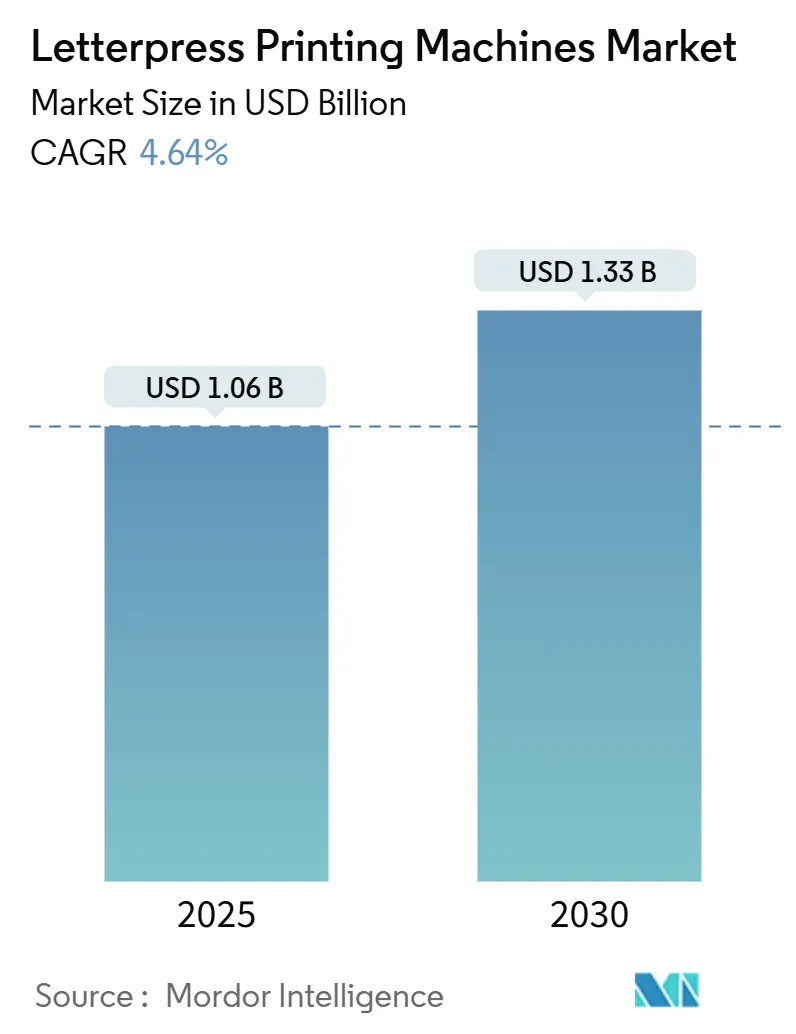
| Market Size (2025) | USD 1.06 Billion |
| Market Size (2030) | USD 1.33 Billion |
| Growth Rate (2025 - 2030) | 4.64% CAGR |
| Fastest Growing Market | Asia Pacific |
| Largest Market | Europe |
| Market Concentration | Medium |
Major Players *Disclaimer: Major Players sorted in no particular order Image © Mordor Intelligence. Reuse requires attribution under CC BY 4.0. | |
Letterpress Printing Machines Market Analysis by Mordor Intelligence
The letterpress printing machines market is valued at USD 1.06 billion in 2025 and is projected to reach USD 1.33 billion by 2030, growing at a 4.64% CAGR. This outlook reflects sustained demand for high-quality tactile packaging, continuing investments in security‐grade substrates, and steady upgrades to high-speed rotary technology. Europe anchors global revenues thanks to its established graphic arts ecosystem, while the Asia-Pacific region registers the fastest expansion, driven by rising consumer-goods production and mid-tier equipment purchases. Hybrid digital-letterpress configurations are gaining momentum as converters seek to achieve short-run flexibility without compromising impression depth. At the same time, automation investments offset skilled-operator shortages and improve press uptime, helping producers contain labor costs in mature markets.
Key Report Takeaways
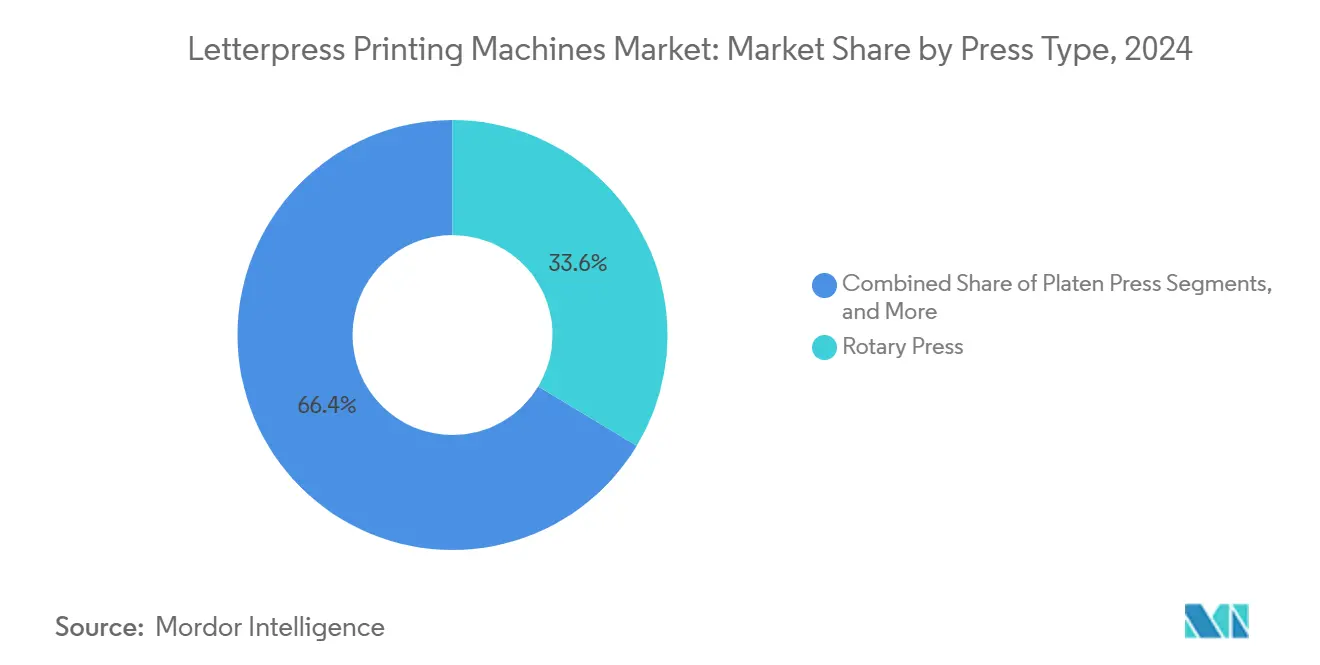
- By press type, rotary presses led with a 33.61% market share of the letterpress printing machines in 2024; however, Hybrid digital-letterpress shows the fastest growth of 6.23% through 2030.
- By application, packaging, and labels commanded 35.83% of the 2024 revenue from letterpress printing machines; specialty and artisanal printing is projected to post the highest 5.51% CAGR to 2030.
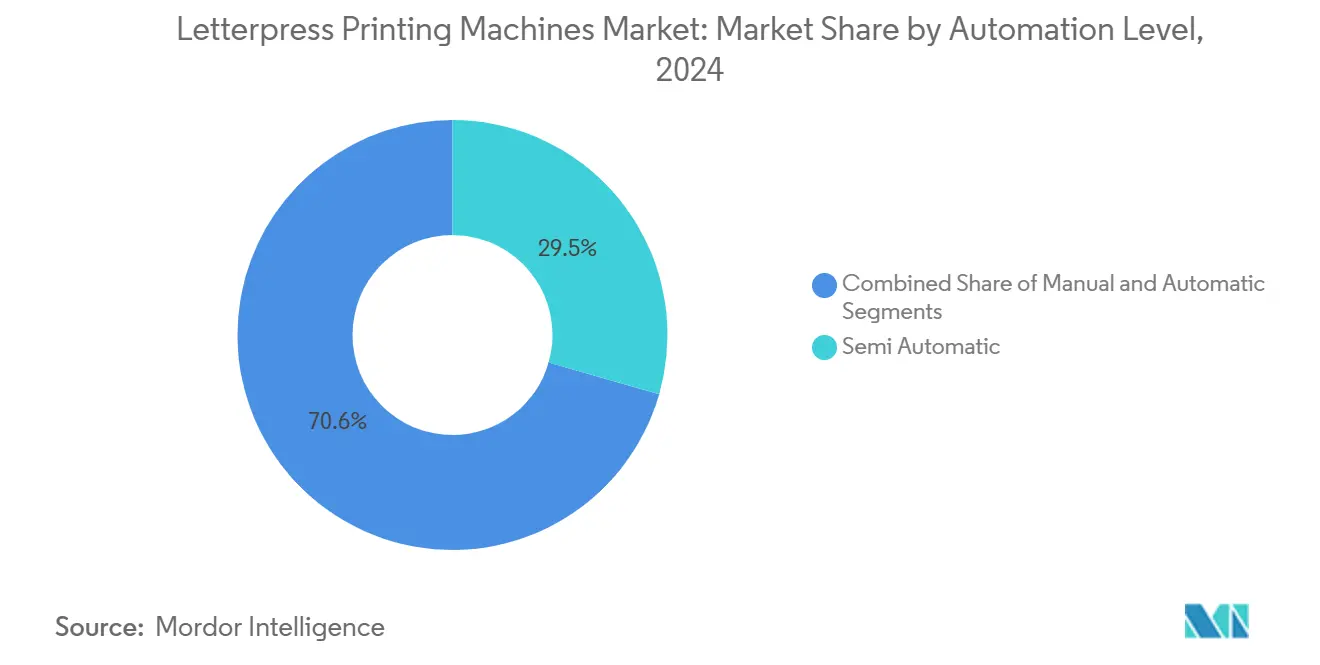
- By automation level, semi-automatic units held a 29.45% revenue share in 2024; however, automatic systems are projected to post a 5.76% CAGR from 2025-2030.
- By substrate, paper retained a 32.17% share of the letterpress printing machines market size in 2024; however, metallic foils and laminates are expected to show the fastest growth of 5.32% through 2030.
- By geography, Europe held 28.63% of the letterpress printing machines market in 2024; Asia-Pacific is forecast to post a 5.81% CAGR between 2025 and 2030.
Global Letterpress Printing Machines Market Trends and Insights
Drivers Impact Analysis
| Driver | % Impact on CAGR Forecast | Geographic Relevance | Impact Timeline |
|---|---|---|---|
| Resurgence in artisanal and luxury packaging demand | +1.2% | Global, with concentration in North America amd Europe | Medium term (2-4 years) |
| Technological upgrades in high-speed rotary presses | +0.9% | Europe and Asia-Pacific manufacturing hubs | Long term (≥ 4 years) |
| Expansion of security/anti-counterfeit printing needs | +0.8% | Global, led by government facilities | Long term (≥ 4 years) |
| Craft-label boom in beverages and gourmet foods | +0.7% | North America and Europe premium markets | Short term (≤ 2 years) |
| Eco-friendly LED-UV curing and water-based inks adoption | +0.6% | EU regulatory compliance regions | Medium term (2-4 years) |
| Rise of web-to-print platforms for small-batch jobs | +0.4% | Developed markets with digital infrastructure | Short term (≤ 2 years) |
| Source: Mordor Intelligence | |||
Resurgence in Artisanal and Luxury Packaging Demand
Luxury-goods producers and premium FMCG brands are increasingly commissioning textured cartons and labels that can only be supplied at scale by a letterpress unit. Printed packaging volumes across European converters increased by 12.1% in 2022, underscoring the demand for tactile finishes that enhance shelf appeal.[1]Intergraf, “Economic Report 2023–2024,” intergraf.eu Heidelberger’s Speedmaster XL 106 21K, engineered for folding-carton runs, answers this demand with faster makereadies and heavier substrates.[2]Heidelberger Druckmaschinen AG, “Financial Year 2024/25 Results,” heidelberg.com Specialty runs for craft chocolates, fragrances, and boutique apparel deepen the addressable base, pushing the letterpress printing machines market toward high-margin segments. Converters also retrofit legacy presses with LED-UV units to cure thicker inks on uncoated boards, expanding design latitude while meeting sustainability mandates. Collectively, luxury packaging keeps pressrooms booked with short- to mid-length jobs that defend pricing power amid commoditized digital print offerings.
Technological Upgrades in High-speed Rotary Presses
Vendors integrate simultaneous plate-changing, inline vision systems, and LED-UV curing to increase throughput to over 20,000 sheets per hour while minimizing setup waste.[3]Koenig & Bauer AG, “Annual Report 2024,” koenig-bauer.com The enhancements help automatic platforms capture volume assignments once reserved for offset or flexo by matching speed without relinquishing letterpress impression depth. Energy-efficient dryers reduce operating costs and meet EU carbon emission directives, making new models more attractive across Germany, Italy, and Japan. Open-architecture software links presses to MES dashboards, improving preventive maintenance and job scheduling accuracy. As producers pursue lights-out manufacturing, advanced rotary units position the letterpress printing machines market for sustainable volume gains over the long term.
Expansion of Security/Anti-counterfeit Printing Needs
Central banks and government agencies stipulate raised-print features that resist digital simulation, keeping letterpress vital in modern banknote production. The Bureau of Engraving and Printing recorded USD 1.012 billion in revenue in 2024 and is building a new Beltsville site to house automated presses with multi-foil laydown and tactile emboss capability. Similar mandates cover tax stamps, passports, and academic certificates in Asia and Latin America. Commercial players follow suit, offering warranty seals and high-value vouchers, thereby expanding substrate diversity from cotton papers to security laminates. Because digital presses struggle to replicate deep relief patterns, orders for specialist letterpress kits stay firm, reinforcing the letterpress printing machines market over the forecast window.
Craft-label Boom in Beverages and Gourmet Foods
North American microbreweries and European artisanal food makers lean on textured labels to convey authenticity. Web-to-print storefronts simplify ordering, allowing small brands to purchase 500-piece runs without incurring a capital outlay. Typography-driven designs pair well with recycled-paper stocks, dovetailing with eco-branding narratives. The trend extends into specialty coffee, olive oil, and non-alcoholic tonics, where tactile cues can secure shelf differentiation. With unit margins outweighing throughput, craft converters often pick platen or hybrid presses that marry digital artwork with letterpress deboss zones. The segment’s steady line-up of seasonal releases supports recurring equipment upgrades, enhancing growth momentum for the letterpress printing machines market.
Restraints Impact Analysis
| Restraint | % Impact on CAGR Forecast | Geographic Relevance | Impact Timeline |
|---|---|---|---|
| Intensifying competition from digital and flexo presses | -1.1% | Global, particularly in commercial printing | Medium term (2-4 years) |
| Shortage of skilled typesetters and press operators | -0.8% | Developed markets with aging workforce | Long term (≥ 4 years) |
| High upfront cost of modern rotary presses | -0.6% | Emerging markets with capital constraints | Medium term (2-4 years) |
| Stringent VOC / emissions compliance costs | -0.4% | EU and North America regulatory regions | Short term (≤ 2 years) |
| Source: Mordor Intelligence | |||
Intensifying Competition from Digital and Flexo Presses
High-resolution inkjet systems close the quality gap each product cycle, offering same-day turnaround and variable data printing that legacy letterpress workflows cannot match for general commercial work. Element Solutions Inc. shed its flexographic plate unit for USD 325 million, signaling capital reallocation toward faster-growing digital technologies. Heidelberger’s Gallus One digital label line illustrates incumbent efforts to straddle both camps, but price competition in four-color short runs compresses margins for pure-play letterpress houses. The squeeze is most acute in advertising collateral and direct-mail pieces, where tactile depth delivers limited ROI to brand owners.
Shortage of Skilled Typesetters and Press Operators
Retirements outpace apprenticeships across Europe and North America, leaving shops to run bottlenecks on multi-color changeovers. Heidelberger and Koenig & Bauer AG answer with full-auto plate loaders and AI-guided registration to cut human touchpoints. Yet training gaps still delay adoption among small jobbers, tempering equipment upgrades even as demand rises. Industry associations expand their certification courses, but their reach remains modest compared to the attrition curve. Consequently, some converters shift routine work to digital lines, reducing growth potential for the letterpress printing machines market until labor pipelines recover.
Segment Analysis
By Press Type: Rotary Systems Consolidate High-Volume Work
Rotary units retained a 33.61% share of the letterpress printing machines market in 2024, underpinned by the need to process corrugated, folding carton, and wraparound label stock at commercial speeds. Hybrid digital-letterpress configurations, however, carry the highest 6.23% CAGR as converters seek variable-data flexibility without forfeiting relief depth.
Koenig & Bauer’s purchase of Celmacch strengthened its corrugated portfolio, adding wide-format rotary heads capable of 20,000 sheets per hour on micro-flute board. Inline cameras flag bounce defects in real time, trimming waste while safeguarding brand-owner compliance. Cylinder presses maintain a niche in producing security-grade documents that require micro-emboss fidelity. Meanwhile, platen models cater to boutique studios, prioritizing setup agility over throughput for artisanal labels. Continuous R&D in servo drives and LED-UV curing keeps rotary technology competitive, reinforcing its command of the letterpress printing machines market.
Note: Segment shares of all individual segments available upon report purchase
By Application: Packaging Leads as Commercial Print Plateaus
Packaging and labels commanded 35.83% of 2024 revenues and anchor the long-term ceiling for the letterpress printing machines market. The global shift of more than 33% of print volumes into packaging confirms the structural pivot powering this segment.
Specialty and artisanal work marks the quickest rise at 5.51% CAGR, propelled by craft beverages, handmade cosmetics, and boutique confectionery producers. In Europe, printed packaging output increased at a nominal rate over the 2-3 years preceding 2025, despite a 1.2% decline in mainstream graphic print. Security printing endures thanks to central bank upgrades and anti-tamper needs, while commercial printing faces pricing pressure from digital alternatives. Across these lanes, the letterpress printing machines market size for packaging substrates is forecast to grow significantly through 2030, validating ongoing capex on dedicated packaging lines.
By Automation Level: Semi-Automatic Today, Automatic Tomorrow
Semi-automatic platforms held 29.45% of 2024 revenue, striking a balance between flexibility and faster changeovers. Yet automatic systems are projected to post a 5.76% CAGR as producers battle labor scarcity and pursue lights-out operations.
Modern designs feature robotic blanket washers, auto-register cameras, and ERP-ready data ports that feed factory dashboards. These upgrades enhance OEE and justify higher sticker prices, driving the market size for fully automatic lines in the letterpress printing machines market by 2030, alongside a 4-point share gain. Manual presses still appeal to artisanal shops where bespoke card runs prioritize tactile authenticity over speed, but remain a small, stable niche.
Note: Segment shares of all individual segments available upon report purchase
By Substrate: Paper Prevails, Foils Accelerate
Paper maintained a 32.17% share of the letterpress printing machines market in 2024, favored for stationery, books, and premium labels that prize crisp deboss effects. Metallic foils and laminates, however, track the fastest 5.32% CAGR as luxury brands and monetary authorities embed tactile security features.
The Bureau of Engraving and Printing’s Beltsville facility will support multi-foil stamps and raised‐ink serial numbers, underscoring robust institutional demand. Cardboard grades grow in parallel with e-commerce packaging, while polymer films edge into flexible pouches where relief icons enhance grip and shelf presence. Sustainable water-based ink sets and low-VOC LED-UV lamps widen substrate compatibility while aligning with EPA best-practice frameworks.
Geography Analysis
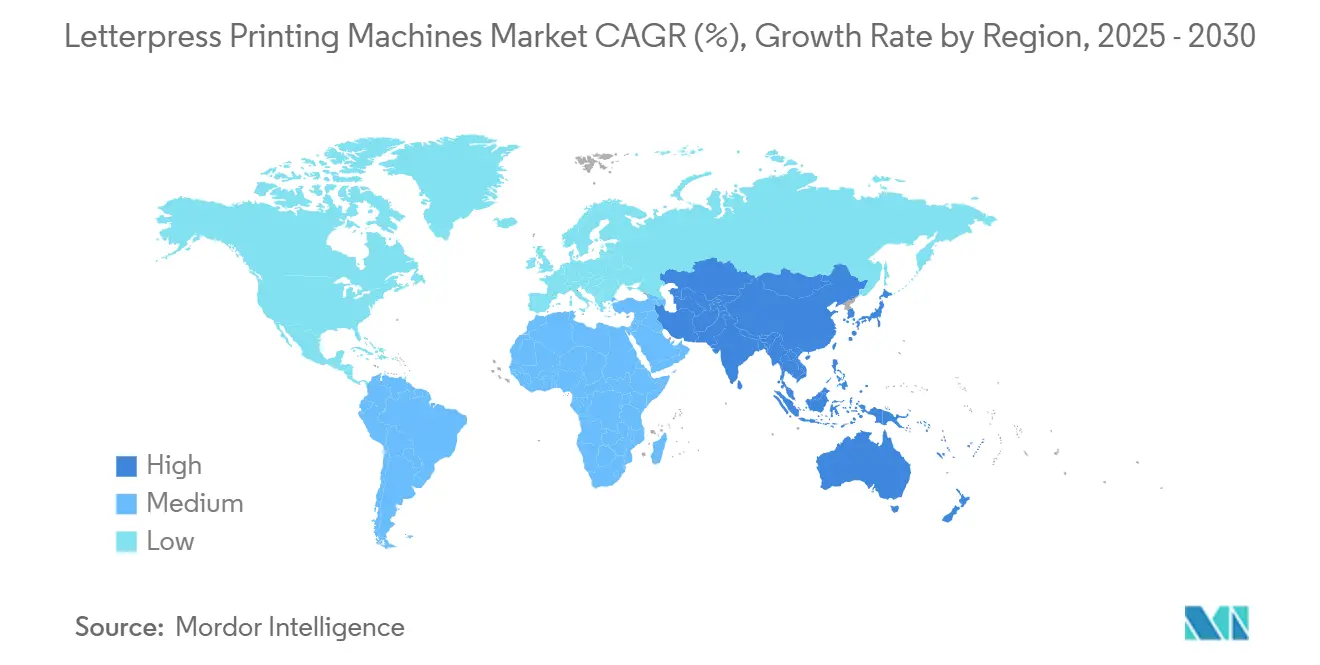
Europe held 28.63% of the letterpress printing machines market in 2024, driven by a EUR 70 billion (USD 75.7 billion) graphic sector that employed 610,000 staff across 110,000 firms. Germany’s Heidelberg and Würzburg-based Koenig & Bauer collectively pushed EUR 3.7 billion (USD 4 billion) sales by emphasizing packaging-optimized presses and carbon-neutral R&D pipelines. Strict REACH and VOC directives accelerate the shift toward LED-UV curing, benefitting local OEMs that bundle sustainability credentials into capex pitches.
The Asia-Pacific region is forecast to record a 5.81% CAGR between 2025 and 2030, as China, Japan, and India scale up their premium consumer-goods lines. Regional converters favor mid-tier automatic presses that strike a balance between cost and higher uptime, thereby expanding the market for letterpress printing machines to include first-time buyers. Joint ventures with European firms transfer know-how while shortening delivery lead times. Government grant schemes in South Korea and Singapore subsidize security-grade printing hubs, adding to regional demand.
North America maintains a sizeable installed base tied to security print and craft-label dynamics. The Bureau of Engraving and Printing alone invested in automated letterpress floors for new USD 100 note designs, reinforcing domestic demand for advanced presses. Meanwhile, the United States craft-beer scene surpassed 9,500 breweries in 2024, each seeking bespoke labels that leverage letterpress textures to convey heritage. Canada follows similar trajectories in artisanal spirits and organic foods, ensuring a steady refurbishment cycle across mid-size converters.
Competitive Landscape
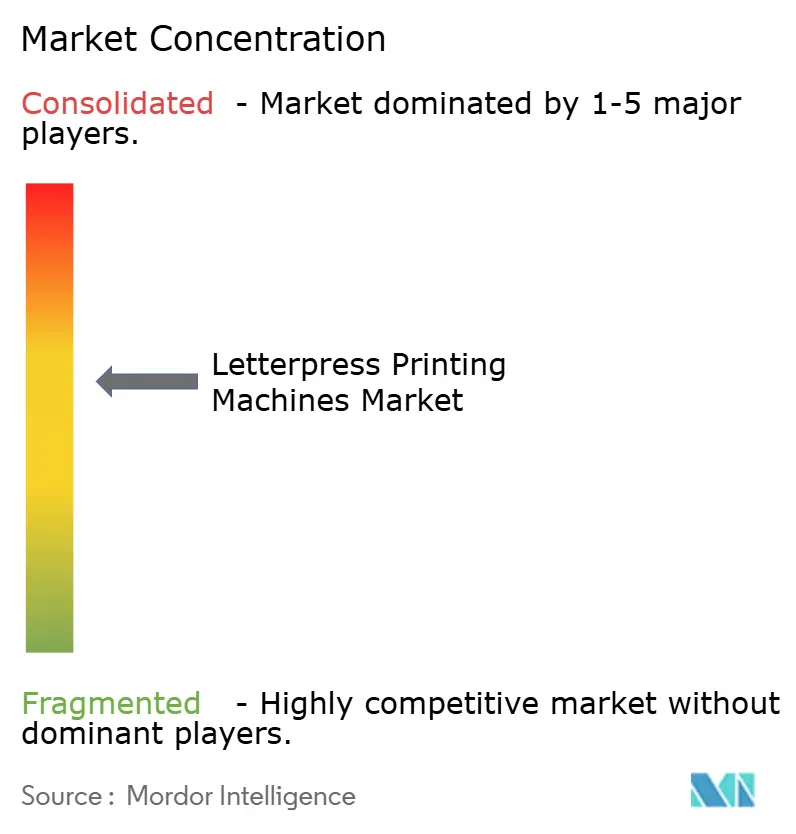
The letterpress printing machines market features a moderately consolidated field where the top five OEMs command a significant share of global revenue. Heidelberg leverages EUR 2.43 billion (USD 2.62 billion) turnover and a robust service network to push Speedmaster XL lines into packaging outfits. Koenig & Bauer, with EUR 1.3 billion (USD 1.40 billion) sales, advances RotaJET hybrids and corrugated upgrades following the Celmacch acquisition. Japanese and Taiwanese entrants compete on price, supplying compact rotary units to Southeast Asia’s burgeoning label segment.
Strategic thrusts center on hybrid configurations that combine inkjet personalization with letterpress embossing stations, enabling converters to run variable data on secure or luxury substrates. Patent filings cover auto-plate loaders, AI registration, and low-energy curing lamps that cut per-sheet electricity by up to 30%. Sustainability pledges aim for carbon-neutral manufacturing by 2030, aligning with brand-owner procurement scorecards.
Mergers and localized assembly underpin expansion strategies into emerging regions. Koenig & Bauer reorganized into Paper and Packaging Sheetfed Systems and Special and New Technologies in 2025 to sharpen market focus. Heidelberg opened parts hubs in Mexico and Vietnam, shrinking downtime for installed bases. Such moves, paired with subscription-style maintenance contracts, enhance switching barriers and reinforce brand loyalty inside the letterpress printing machines market.
Letterpress Printing Machines Industry Leaders
Labelmen Machinery Co., Ltd.
Croma Iberica S.L.
Eidos S.p.A.
Ernst Reiner GmbH & Co. KG
HANWHA Machinery
- *Disclaimer: Major Players sorted in no particular order
Recent Industry Developments
- March 2025: Bureau of Engraving and Printing confirmed progress on its Beltsville modernization, adding robotic press lines with enhanced security features.
- February 2025: Koenig & Bauer unveiled a two-segment structure, Paper and Packaging Sheetfed Systems and Special and New Technologies, to align with packaging growth.
- December 2024: Heidelberger Druckmaschinen recorded 12% revenue growth to EUR 2.43 billion (USD 2.63 billion), driven by folding-carton demand and Speedmaster XL 106 21K installations.
- November 2024: Koenig & Bauer presented the RotaJET digital press at drupa, showcasing hybrid digital-letterpress capability for flexible packaging.
Global Letterpress Printing Machines Market Report Scope
The Letterpress Printing Machines Market Report is Segmented by Press Type (Rotary Press, Platen Press, Cylinder Press, and Hybrid Digital-Letterpress), Application (Packaging and Labels, Security Printing, Commercial Printing, and Specialty and Artisanal Printing), Automation Level (Manual, Semi-Automatic, and Automatic), Substrate (Paper, Cardboard, Plastic Films, and Metallic Foils and Laminates), and Geography (North America, Europe, Asia Pacific, South America, and Middle East and Africa). The Market Forecasts are Provided in Terms of Value (USD).
| Rotary Press |
| Platen Press |
| Cylinder Press |
| Hybrid Digital-Letterpress |
| Packaging and Labels |
| Security Printing |
| Commercial Printing |
| Specialty and Artisanal Printing |
| Manual |
| Semi-automatic |
| Automatic |
| Paper |
| Cardboard |
| Plastic Films |
| Metallic Foils and Laminates |
| North America | United States | |
| Canada | ||
| Mexico | ||
| Europe | Germany | |
| United Kingdom | ||
| France | ||
| Italy | ||
| Spain | ||
| Russia | ||
| Rest of Europe | ||
| Asia Pacific | China | |
| Japan | ||
| India | ||
| South Korea | ||
| Rest of Asia Pacific | ||
| South America | Brazil | |
| Argentina | ||
| Chile | ||
| Rest of South America | ||
| Middle East and Africa | Middle East | Saudi Arabia |
| United Arab Emirates | ||
| Turkey | ||
| Rest of Middle East | ||
| Africa | South Africa | |
| Rest of Africa | ||
| Press Type | Rotary Press | ||
| Platen Press | |||
| Cylinder Press | |||
| Hybrid Digital-Letterpress | |||
| Application | Packaging and Labels | ||
| Security Printing | |||
| Commercial Printing | |||
| Specialty and Artisanal Printing | |||
| Automation Level | Manual | ||
| Semi-automatic | |||
| Automatic | |||
| Substrate | Paper | ||
| Cardboard | |||
| Plastic Films | |||
| Metallic Foils and Laminates | |||
| Geography | North America | United States | |
| Canada | |||
| Mexico | |||
| Europe | Germany | ||
| United Kingdom | |||
| France | |||
| Italy | |||
| Spain | |||
| Russia | |||
| Rest of Europe | |||
| Asia Pacific | China | ||
| Japan | |||
| India | |||
| South Korea | |||
| Rest of Asia Pacific | |||
| South America | Brazil | ||
| Argentina | |||
| Chile | |||
| Rest of South America | |||
| Middle East and Africa | Middle East | Saudi Arabia | |
| United Arab Emirates | |||
| Turkey | |||
| Rest of Middle East | |||
| Africa | South Africa | ||
| Rest of Africa | |||
Key Questions Answered in the Report
What is the current value of the letterpress printing machines market?
The letterpress printing machines market is valued at USD 1.06 billion in 2025.
How fast is the market expected to grow?
It is forecast to expand at a 4.64% CAGR, reaching USD 1.33 billion by 2030.
Which region leads in market revenue?
Europe leads with 28.63% of 2024 global revenue, backed by an extensive graphic-arts manufacturing base.
What application segment is growing the fastest?
Specialty and artisanal printing is the fastest, posting a 5.51% CAGR through 2030.
Why are hybrid digital-letterpress systems gaining traction?
They merge variable-data flexibility with tactile depth, offering converters cost-effective diversification and supporting a 6.23% CAGR outlook.


