
Lemon Essential Oil Market Size and Share
Market Overview
| Study Period | 2021 - 2031 |
|---|---|
| Market Size (2026) | USD 2.26 Billion |
| Market Size (2031) | USD 3.02 Billion |
| Growth Rate (2026 - 2031) | 5.97 % |
| Fastest Growing Market | Asia-Pacific |
| Largest Market | Europe |
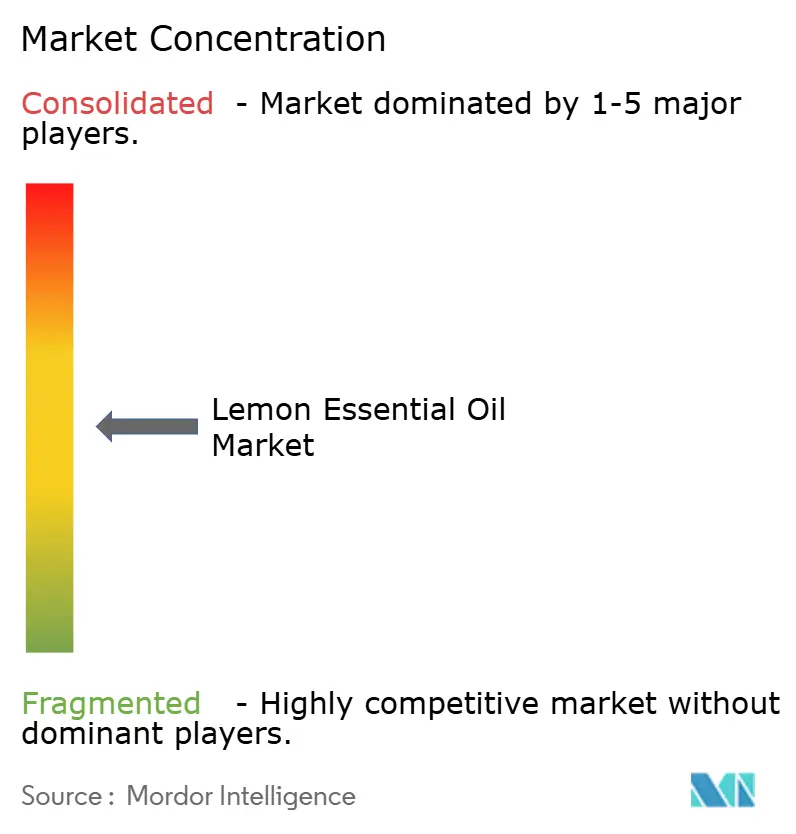
| Market Concentration | Medium |
Major Players *Disclaimer: Major Players sorted in no particular order Image © Mordor Intelligence. Reuse requires attribution under CC BY 4.0. | |
Lemon Essential Oil Market Analysis by Mordor Intelligence
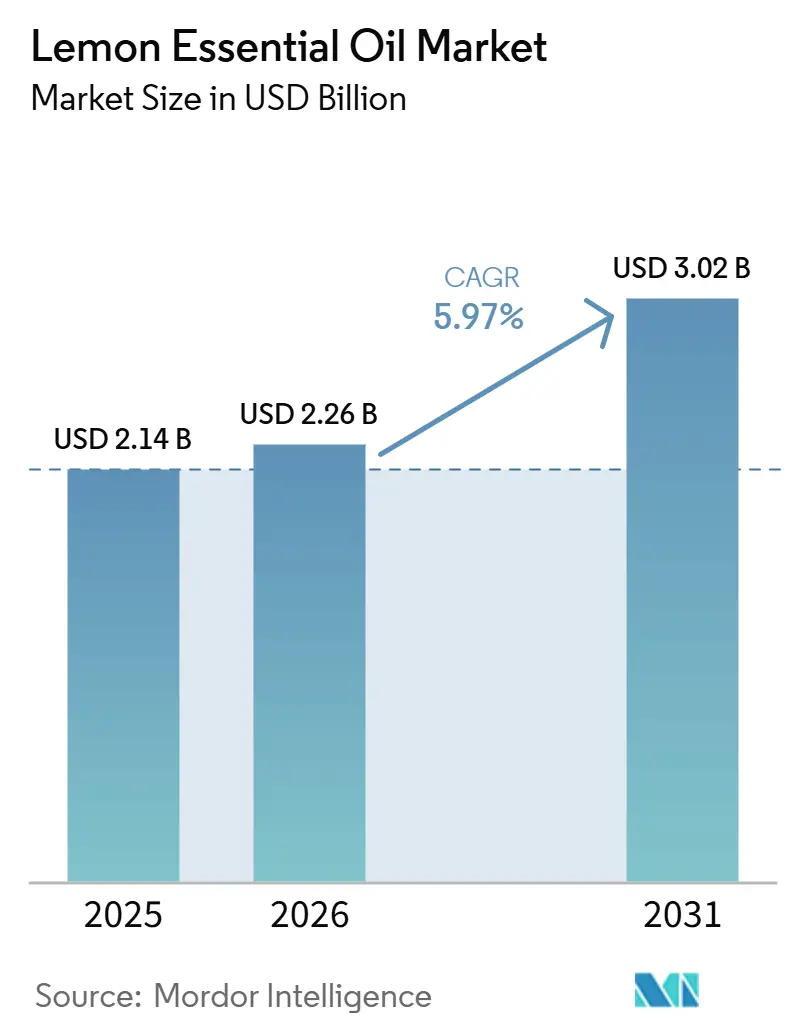
The lemon essential oil market size is expected to grow from USD 2.14 billion in 2025 to USD 2.26 billion in 2026 and is forecast to reach USD 3.02 billion by 2031 at 5.97% CAGR over 2026-2031. The market transformation is primarily driven by rising consumer awareness of health and wellness, increasingly stringent organic certification protocols, and significant technological advances in CO₂ and microwave-assisted extraction processes. These developments have optimized production efficiency and improved product quality standards across the industry. Large-scale manufacturers maintain their market positions through established vertical integration networks in key producing regions, such as Spain, Mexico, and India. Meanwhile, medium-sized producers have built a strong market presence by focusing on high-value certified-organic and therapeutic-grade products, particularly in aromatherapy, cosmetics, and functional foods. Market expansion is further supported by consumers’ growing preference for natural ingredients and regulatory frameworks that limit the use of synthetic preservatives in food and beverage applications.
Key Report Takeaways
- By extraction method, cold-pressed oil led with 48.72% of lemon essential oil market share in 2025, whereas CO₂ supercritical extraction is projected to post a 7.07% CAGR through 2031.
- By type, conventional grade captured 77.95% of the lemon essential oil market size in 2025; certified-organic products are forecast to advance at a 6.95% CAGR between 2026-2031.
- By application, food and beverage held 37.49% revenue share in 2025, while aromatherapy and wellness is expected to expand at a 6.98% CAGR through 2031.
- By geography, Europe accounted for 35.08% of the lemon essential oil market in 2025, Asia-Pacific is projected to advance at a 7.28% CAGR through 2031.
Note: Market size and forecast figures in this report are generated using Mordor Intelligence’s proprietary estimation framework, updated with the latest available data and insights as of January 2026.
Market Trends and Insights
Drivers Impact Analysis of Lemon Essential Oil Market*
| Driver | (~) % Impact on CAGR Forecast | Geographic Relevance | Impact Timeline |
|---|---|---|---|
| Growing preference for organically and sustainably sourced products | +1.2% | Global, with highest impact in North America and Europe | Medium term (2-4 years) |
| Increasing adoption as a natural flavoring ingredient in food and beverage products | +1.0% | Global, particularly strong in Asia-Pacific | Short term (≤ 2 years) |
| Growing demand for essential oils in aromatherapy applications | +0.9% | North America, Europe, emerging in Asia-Pacific | Long term (≥ 4 years) |
| Rising shift toward clean-label and plant-based products | +0.8% | Global, led by developed markets | Medium term (2-4 years) |
| Advancements in extraction and purification technologies | +0.6% | Global, concentrated in major production hubs | Long term (≥ 4 years) |
| Increasing preference for environmentally friendly and biodegradable ingredients | +0.5% | Europe, North America, expanding globally | Long term (≥ 4 years) |
| Source: Mordor Intelligence | |||
Growing Preference for Organically and Sustainably Sourced Products
Organic lemon essential oil is gaining popularity across personal care, aromatherapy, food, and household applications due to its perceived purity and absence of synthetic chemicals. Manufacturers are responding by sourcing certified organic lemons, adopting sustainable farming practices, and obtaining certifications that strengthen consumer trust and premium product positioning. This trend is particularly evident among younger consumers, who place greater importance on ethical sourcing and environmental stewardship. According to the Organic Trade Association, United States organic food and product sales reached a record USD 76.6 billion in 2025, reflecting 6.8% year-over-year growth, with younger consumers representing the fastest-growing buyer group[1]. The continued expansion of the organic products sector is encouraging essential oil producers to increase investments in certified organic cultivation and sustainable supply chains, thereby supporting long-term market growth for lemon essential oil.
Increasing Adoption as a Natural Flavoring Ingredient in Food and Beverage Products
The increasing adoption of lemon essential oil as a natural flavoring ingredient in food and beverage products is a significant driver of market growth. As consumer demand for clean-label and naturally sourced ingredients continues to rise, manufacturers are replacing artificial flavoring agents with plant-derived alternatives that offer authentic taste and aroma. Food and beverage manufacturers are replacing synthetic citrus flavor systems with cold-pressed lemon essential oil as ingredient transparency requirements become tighter and consumers increasingly scrutinize product labels[2]. Lemon essential oil is widely used in beverages, confectionery, bakery products, dairy items, and functional foods to impart a fresh citrus flavor while supporting natural product positioning. Its dual functionality as a flavoring and natural ingredient aligns well with evolving regulatory standards and clean-label trends.
Growing Demand for Essential Oils in Aromatherapy Applications
The growing demand for essential oils in aromatherapy applications is a key driver of the lemon essential oil market. Consumers are increasingly turning to aromatherapy as a natural approach to managing stress, enhancing mood, and promoting mental well-being, boosting the use of citrus-based essential oils. Lemon essential oil is widely valued for its refreshing aroma, uplifting properties, and ability to create a calming and energizing environment in homes, spas, wellness centers, and yoga studios. The expanding wellness industry, coupled with rising awareness of holistic health practices, is encouraging greater adoption of aromatherapy products containing lemon essential oil. Manufacturers are also introducing diffuser blends, massage oils, candles, and personal care products infused with lemon essential oil to cater to growing consumer demand.
Rising Shift toward Clean-Label and Plant-Based Products
Consumers increasingly prefer products formulated with natural, recognizable, and plant-derived ingredients, prompting manufacturers to replace synthetic additives with botanical alternatives such as lemon essential oil. Its natural origin, pleasant citrus aroma, and multifunctional properties make it an attractive ingredient for clean-label formulations. According to research by the CBI Ministry of Foreign Affairs, clean-label products are projected to constitute more than 70% of product portfolios in 2025 and 2026, up from 52% in 2021, highlighting the rapid transformation of product development strategies[3]. This trend is encouraging companies to expand the use of naturally sourced ingredients to meet evolving consumer expectations and retailer requirements. As plant-based innovation continues to accelerate across multiple end-use industries, the demand for lemon essential oil is expected to strengthen due to its compatibility with transparent labeling and sustainable product positioning.
Restraints Impact Analysis of Lemon Essential Oil Market*
| Restraint | (~) % Impact on CAGR Forecast | Geographic Relevance | Impact Timeline |
|---|---|---|---|
| Strict environmental regulations on farming practices and extraction processes | -0.8% | Global, most stringent in Europe and North America | Medium term (2-4 years) |
| Limited shelf life and highly volatile nature of essential oils | -0.6% | Global, particularly challenging in developing regions | Short term (≤ 2 years) |
| Risk of product adulteration and inconsistent quality | -0.5% | Global, most problematic in unregulated markets | Short term (≤ 2 years) |
| Low consumer awareness across certain developing regions | -0.4% | Asia-Pacific, Middle East and Africa, South America | Long term (≥ 4 years) |
| Source: Mordor Intelligence | |||
Strict Environmental Regulations on Farming Practices and Extraction Processes
Strict environmental regulations on farming practices and extraction processes act as a significant restraint on the lemon essential oil market. Governments and regulatory authorities are increasingly enforcing standards related to pesticide use, water consumption, waste management, emissions, and sustainable agricultural practices to reduce the environmental impact of citrus cultivation and essential oil production. Compliance with these regulations often requires investments in eco-friendly farming methods, certified organic cultivation, advanced extraction technologies, and environmental monitoring systems, increasing operational costs for producers. Smaller manufacturers and growers may face financial and technical challenges in meeting these evolving requirements, limiting production capacity and market participation. In addition, regulatory approvals and certification processes can extend product development timelines and delay market entry.
Limited Shelf Life and Highly Volatile Nature of Essential Oils
The limited shelf life and highly volatile nature of lemon essential oil present a significant restraint to market growth. Lemon essential oil is sensitive to exposure to heat, light, oxygen, and moisture, which can accelerate oxidation and lead to the loss of its characteristic aroma, therapeutic properties, and overall quality over time. This necessitates the use of specialized packaging, controlled storage conditions, and efficient transportation, increasing handling and logistics costs. Manufacturers and distributors must also maintain stringent inventory management practices to minimize product degradation and wastage. The challenge is particularly significant in regions with warm climates or underdeveloped cold-chain and storage infrastructure, where maintaining product stability can be difficult. These factors increase operational complexity and costs while limiting the commercial viability of lemon essential oil in certain markets and applications.
*Our forecasts treat driver/restraint impacts as directional, not additive. The impact forecasts reflect baseline growth, mix effects, and variable interactions.
Lemon Essential Oil Market Segment Analysis
By Extraction Method:
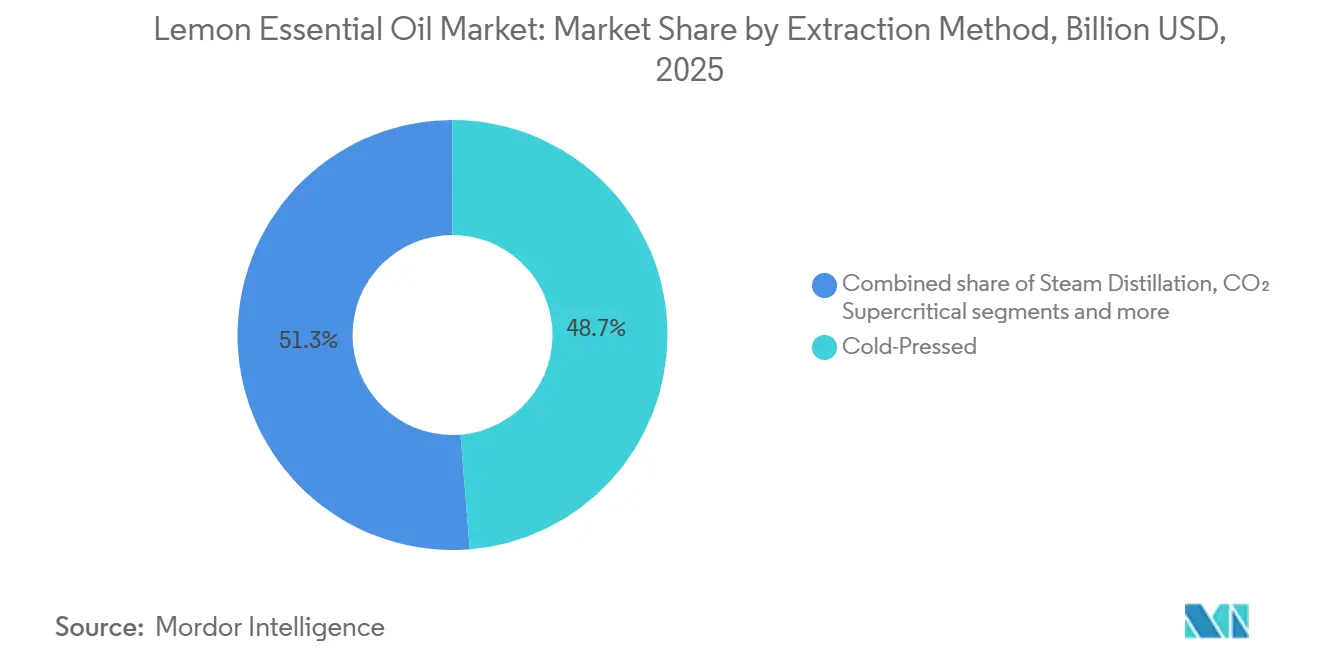
Cold-Pressed Premium Faces a Supercritical Structural ChallengeCold-pressed extraction accounted for 48.72% of the lemon essential oil market in 2025, making it the leading extraction method due to its ability to preserve the oil's natural aroma, freshness, and bioactive compounds. The process involves mechanically pressing the lemon peel without the use of heat or chemical solvents, helping retain volatile compounds such as limonene and citral that define the oil's characteristic fragrance. This extraction method is widely preferred for applications in aromatherapy, personal care, food and beverages, and natural household products where authenticity and product quality are critical. Growing consumer demand for clean-label, minimally processed, and naturally derived ingredients continues to strengthen the adoption of cold-pressed lemon essential oil.
CO₂ supercritical extraction is projected to register the fastest CAGR of 7.07% through 2031, driven by rising demand for premium-quality essential oils with superior purity and consistency. The technology uses supercritical carbon dioxide as a solvent, enabling efficient extraction at low temperatures while preserving delicate aromatic and therapeutic compounds that may degrade during conventional processing. It produces solvent-free extracts with minimal oxidation, making the oils particularly suitable for high-value applications in pharmaceuticals, cosmetics, nutraceuticals, and premium aromatherapy products.

By Type:
Conventional Scale Masks an Organic Inflection PointConventional-grade lemon essential oil accounted for 77.95% of the global lemon essential oil market in 2025, making it the dominant segment by type. Its leadership is primarily attributed to its broad availability, cost-effectiveness, and extensive use across multiple end-use industries, including food and beverages, personal care, household cleaning products, and industrial fragrances. Conventional lemon essential oil is widely adopted by manufacturers because it provides consistent quality and reliable supply at competitive prices, making it suitable for high-volume commercial applications. The segment also benefits from well-established cultivation and processing infrastructure in major lemon-producing countries, ensuring stable production and distribution.
Certified-organic lemon essential oil is projected to register the fastest CAGR of 6.95% during 2026–2031, driven by increasing consumer preference for natural, sustainably produced, and chemical-free ingredients. Growing awareness of environmental sustainability and the health benefits associated with organic products is encouraging manufacturers to expand their certified-organic product portfolios. Organic lemon essential oil is increasingly used in premium aromatherapy, natural cosmetics, clean-label food products, and wellness formulations, where consumers place greater value on certified sourcing and production transparency.
By Application:
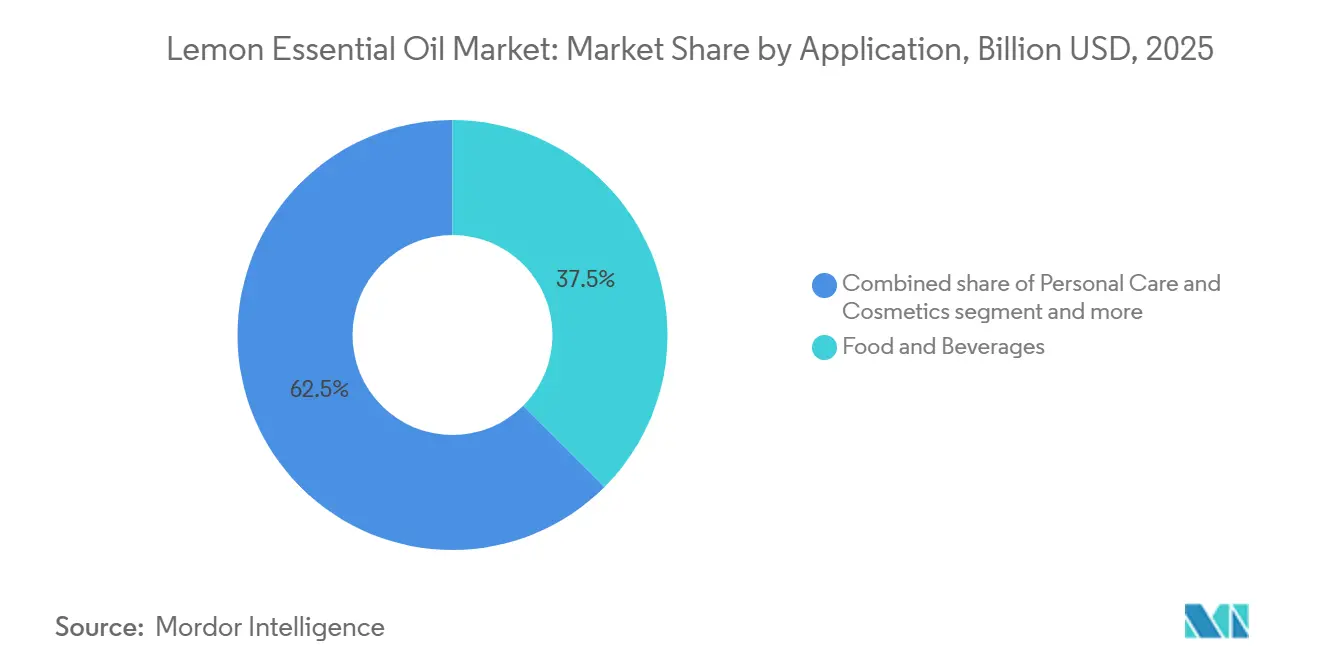
Food and Beverage Anchors Volume, Aromatherapy Commands GrowthThe food and beverage segment accounted for 37.49% of the global lemon essential oil market revenue in 2025, making it the largest application area. Lemon essential oil is widely used as a natural flavoring ingredient in beverages, confectionery, bakery products, dairy items, sauces, and functional foods due to its fresh citrus aroma and taste-enhancing properties. Growing consumer preference for clean-label products and natural flavor ingredients has encouraged food manufacturers to replace synthetic additives with plant-derived alternatives such as lemon essential oil. The ingredient also provides antimicrobial and antioxidant properties, making it valuable in certain food preservation and formulation applications.
The aromatherapy and wellness segment is projected to register the fastest CAGR of 6.98% through 2031, driven by increasing consumer interest in natural health, stress management, and holistic well-being. Lemon essential oil is extensively used in diffusers, massage oils, spa treatments, and wellness products because of its refreshing fragrance and perceived mood-enhancing and uplifting properties. Growing awareness of mental wellness and the increasing adoption of essential oils in home aromatherapy practices are significantly boosting demand for lemon essential oil.
Geography Analysis
Europe Lemon Essential Oil Market
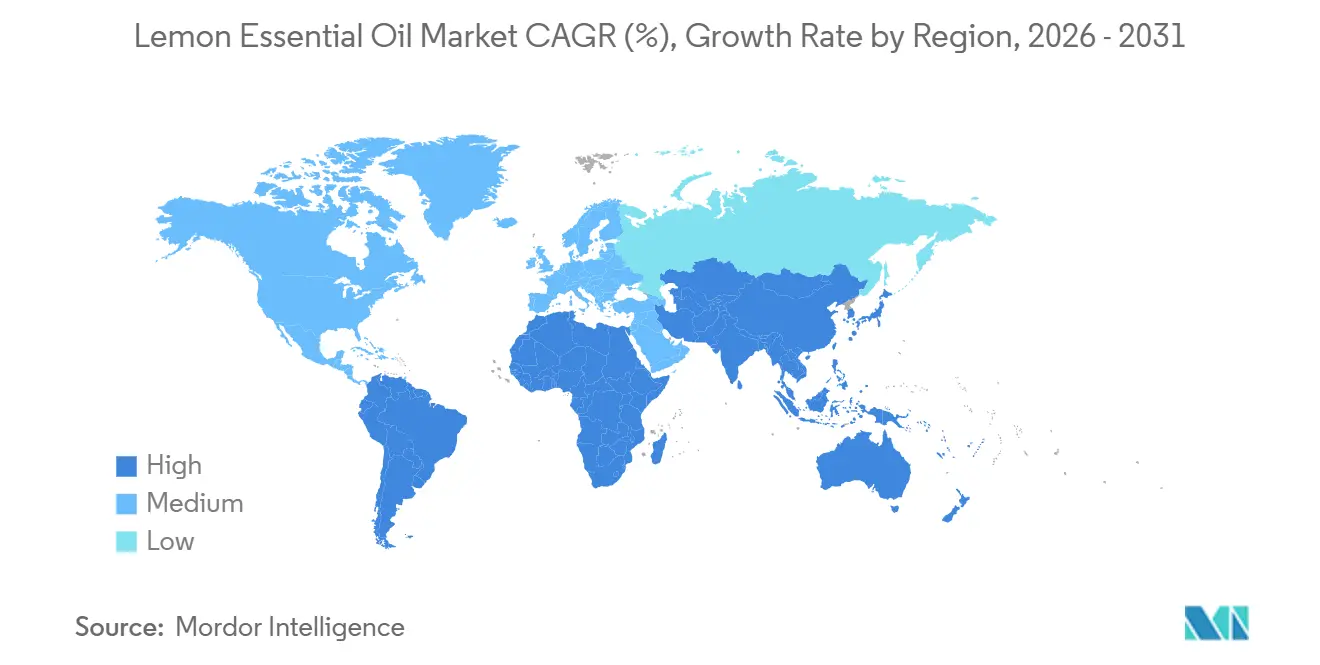
Europe accounted for 35.08% of the global lemon essential oil market in 2025, making it the largest regional market. The region benefits from strong demand across the food and beverage, cosmetics, personal care, aromatherapy, and household cleaning industries, all of which extensively utilize lemon essential oil as a natural ingredient. Consumer preference for clean-label, plant-based, and sustainably sourced products has encouraged manufacturers to incorporate citrus essential oils into premium formulations. Europe also has a well-established natural cosmetics industry and stringent regulations favoring high-quality, traceable essential oils, supporting market expansion.
APAC Lemon Essential Oil Market
Asia-Pacific is projected to register the fastest CAGR of 7.28% through 2031, driven by rising disposable incomes, expanding middle-class populations, and increasing awareness of natural health and wellness products. The region is witnessing rapid growth in aromatherapy, personal care, functional foods, and natural household care products, creating strong demand for lemon essential oil. Countries such as China, India, Japan, South Korea, and Australia are experiencing increased consumption of essential oils across both consumer and industrial applications.
The Americas and MEA Lemon Essential Oil Market
North America remains a significant market, supported by strong demand for natural flavors, clean-label food ingredients, aromatherapy products, and premium personal care formulations, particularly in the United States and Canada. South America benefits from abundant citrus cultivation, especially in Brazil and Argentina, where lemon essential oil production supports both domestic consumption and export markets while supplying the global flavor and fragrance industry. The Middle East and Africa represent an emerging growth region, with increasing demand for premium fragrances, halal-certified personal care products, and wellness solutions contributing to market expansion.
Competitive Landscape
The lemon essential oil market shows a moderate level of concentration, with competition shaped by the interplay between established companies that leverage operational advantages and specialized producers that have built niche positions through quality differentiation. Industry leaders, such as Treatt Plc, Lebermuth, Inc., and Citrus and Allied Essences Ltd., use comprehensive vertical integration strategies to maintain strict quality control across their supply chain operations, from raw material sourcing to final product delivery. This approach helps these companies secure premium positions in highly regulated sectors, including food and cosmetics.
Market differentiation primarily stems from strategic technology adoption, particularly in extraction methods. Companies that invest in advanced techniques, such as supercritical CO₂ extraction, achieve superior product quality while meeting increasingly stringent sustainability requirements that influence buyer decisions. The industry’s consolidation strategy has shifted toward acquiring specialized capabilities rather than expanding scale, as demonstrated by Ashland’s recent divestment of its Avoca fragrance fixative business to Mane. New market entrants have established a presence by emphasizing strong sustainability credentials and using direct-to-consumer distribution channels.
The market continues to offer substantial growth opportunities in therapeutic-grade products, driven by expanding clinical research that validates the efficacy of essential oils. This validation has increased demand for pharmaceutical-quality standards across the industry, requiring manufacturers to develop specialized production capabilities and demonstrate strong regulatory compliance expertise. Companies that meet these stringent requirements while maintaining consistent product quality are well-positioned to capture value in this growing market segment.
Lemon Essential Oil Industry Leaders
-
Citromax Flavors Inc.
-
Treatt Plc
-
Lebermuth, Inc.
-
Citrus and Allied Essences Ltd.
-
NOW Health Group, Inc.
- *Disclaimer: Major Players sorted in no particular order
Lemon Essential Oil Market Companies Covered in this Report
- Treatt Plc
- Lebermuth, Inc.
- NOW Health Group, Inc.
- Citrus and Allied Essences Ltd.
- Citromax Flavors Inc.
- Ultra International B.V.
- Lionel Hitchen Ltd.
- Grupo Tradebe Medioambiente, s.l.
- Bontoux S.A.
- VedaOils
- doTERRA International LLC
- Young Living Essential Oils
- Mountain Rose Herbs
- LemonConcentrate S.L.
- AOS Products Pvt. Ltd.
- Essential Oils of New Zealand Ltd.
- US Organic Group Corp
- Plant Therapy Inc.
- Sensient Technologies Corporation
- Frey + Lau GmbH
Recent Industry Developments in Lemon Essential Oil Market
- March 2026: Treatt Plc's AGM Trading Update stated the planned launch of powdered citrus extracts in H2 FY26. The company developed these extracts as price-stable solutions for customers managing citrus market headwinds. This product format diversification expands Treatt's lemon oil processing beyond liquid essential oils into ingredients designed for dry formulation applications in food and nutraceutical manufacturing.
- April 2025: International Flavors & Fragrances Inc. strengthened its customer service capabilities by consolidating most of its Mexican operations at a new facility in Mexico City's Tecnoparque business complex.
- December 2024: Biolandes established an Environmental, Social, and Governance (ESG) team at its Le Sen facility to enhance regulatory compliance and sustainability practices. This development reflects the company's commitment to environmental protection, social responsibility, and corporate governance standards.
Global Lemon Essential Oil Market Report Scope
Lemon essential oil is a concentrated, volatile plant extract obtained primarily from the peel of fresh lemons (Citrus limon) through cold pressing or steam distillation. The lemon essential oil market is segmented by extraction method, type, application and geography. Based on extraction method, the market is segmented into cold-pressed, steam distillation, co₂ supercritica and others. Based on type, the market is segmented into organic and conventional. Based on application, the market is segmented into food and beverage, personal care and cosmetics aromatherapy and wellness, pharmaceuticals and nutraceuticals and others. By geography, the market is segmented into North America, Europe, Asia-Pacific, South America, and Middle-East and Africa. The market forecasts are provided in terms of value (USD).
Segmentation Overview
| Cold-Pressed |
| Steam Distillation |
| CO₂ Supercritical |
| Others |
| Organic/Certified Organic |
| Conventional |
| Food and Beverage |
| Personal Care and Cosmetics |
| Aromatherapy and Wellness |
| Pharmaceuticals and Nutraceuticals |
| Others |
| North America | United States |
| Canada | |
| Mexico | |
| Rest of North America | |
| Europe | Germany |
| United Kingdom | |
| Italy | |
| France | |
| Spain | |
| Rest of Europe | |
| Asia-Pacific | China |
| India | |
| Japan | |
| Australia | |
| Rest of Asia-Pacific | |
| South America | Brazil |
| Argentina | |
| Rest of South America | |
| Middle East and Africa | South Africa |
| Saudi Arabia | |
| United Arab Emirates | |
| Rest of Middle East and Africa |
| By Extraction Method | Cold-Pressed | |
| Steam Distillation | ||
| CO₂ Supercritical | ||
| Others | ||
| By Type | Organic/Certified Organic | |
| Conventional | ||
| By Application | Food and Beverage | |
| Personal Care and Cosmetics | ||
| Aromatherapy and Wellness | ||
| Pharmaceuticals and Nutraceuticals | ||
| Others | ||
| By Geography | North America | United States |
| Canada | ||
| Mexico | ||
| Rest of North America | ||
| Europe | Germany | |
| United Kingdom | ||
| Italy | ||
| France | ||
| Spain | ||
| Rest of Europe | ||
| Asia-Pacific | China | |
| India | ||
| Japan | ||
| Australia | ||
| Rest of Asia-Pacific | ||
| South America | Brazil | |
| Argentina | ||
| Rest of South America | ||
| Middle East and Africa | South Africa | |
| Saudi Arabia | ||
| United Arab Emirates | ||
| Rest of Middle East and Africa | ||
Key Questions Answered in the Report
What is the 2031 outlook for lemon essential oil demand?
The lemon essential oil market is forecast to reach USD 3.02 billion by 2031 from USD 2.26 billion in 2026, supported by a 5.97% CAGR over 2026-2031.
Which application generates the most revenue for lemon essential oil suppliers?
Food and beverage led demand in 2025 with 37.49% of revenue, helped by clean-label reformulation and added preservative functionality in some food systems.
Which region is growing fastest for lemon essential oil consumption?
Asia-Pacific is the fastest-growing region with a projected 7.28% CAGR through 2031, supported by wellness adoption, natural personal care demand, and digital access.
Why does cold-pressed lemon oil still lead over other extraction routes?
Cold-pressed oil held 48.72% of revenue in 2025 because buyers still value its fuller terpene profile, aldehyde strength, and stronger authentication markers.
What is the main supply-side risk affecting lemon oil procurement?
Lower output in Spain and Argentina, together with climate stress and orchard losses, is tightening feedstock availability and raising sourcing risk.