
Basil Essential Oil Market Size and Share
Market Overview
| Study Period | 2021 - 2031 |
|---|---|
| Market Size (2026) | USD 222.87 Million |
| Market Size (2030) | USD 331.46 Million |
| Growth Rate (2026 - 2031) | 7.78 % |
| Fastest Growing Market | Asia-Pacific |
| Largest Market | Europe |
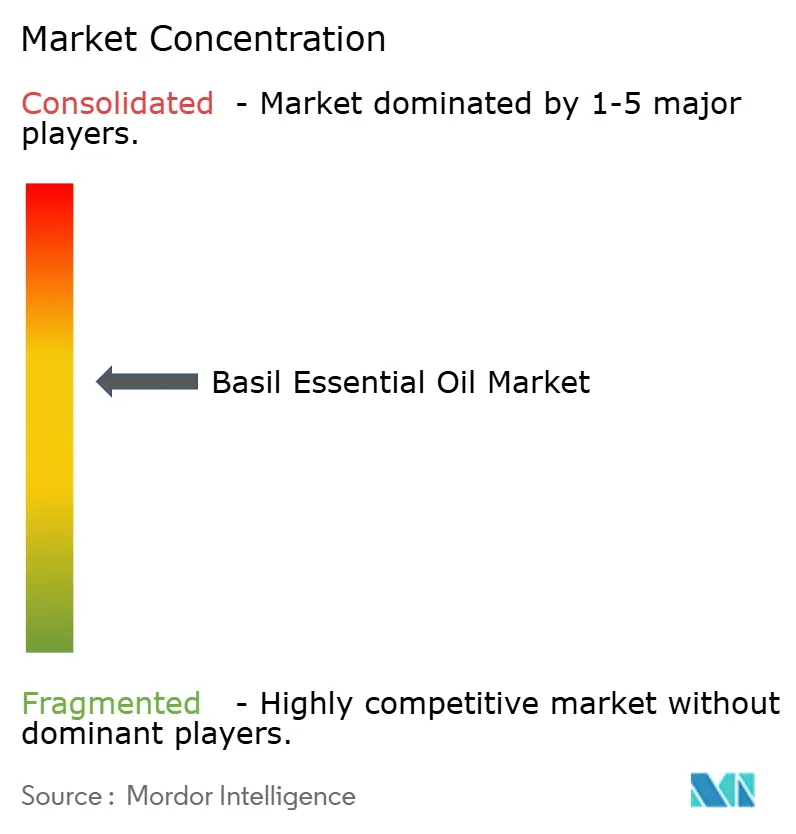
| Market Concentration | Medium |
Major Players *Disclaimer: Major Players sorted in no particular order Image © Mordor Intelligence. Reuse requires attribution under CC BY 4.0. | |
Basil Essential Oil Market Analysis by Mordor Intelligence
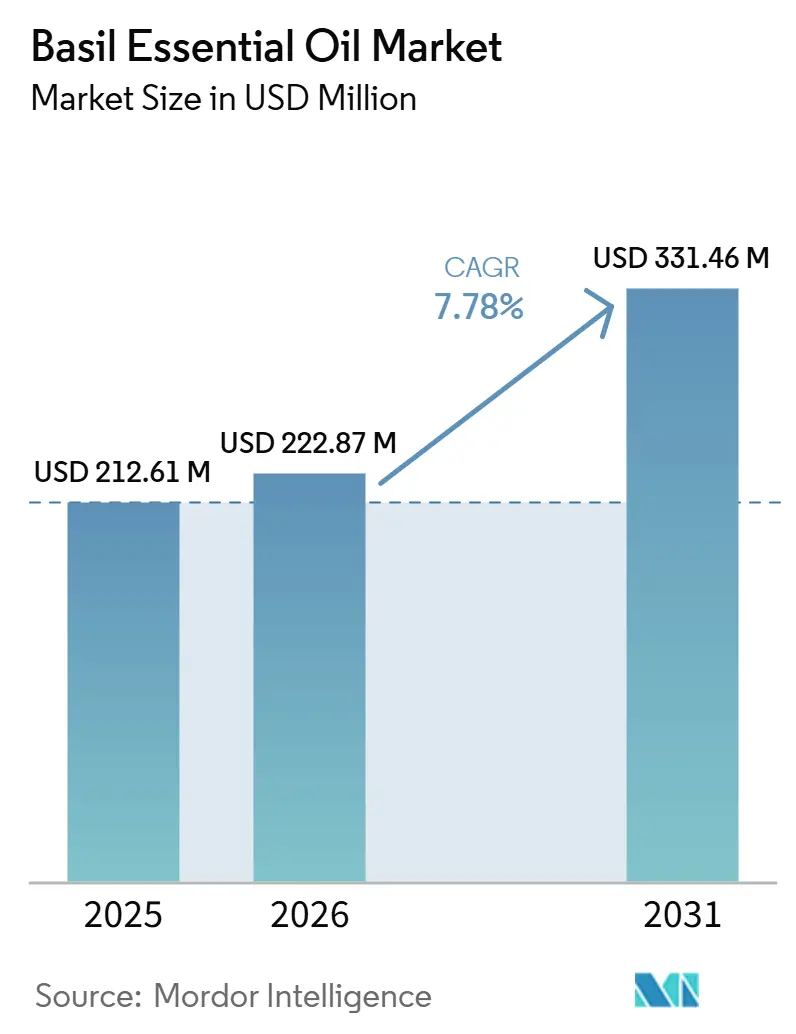
The basil essential oil market size is expected to grow from USD 212.61 million in 2025 to USD 227.87 million in 2026 and is forecast to reach USD 331.46 million by 2031 at 7.78% CAGR over 2026-2031. The basil essential oil market draws demand from food flavoring, personal care, aromatherapy, wellness, and pharmaceutical applications, giving suppliers a broader revenue base than many single-use botanical ingredients. Buying patterns across the basil essential oil market are shifting toward botanically sourced and traceable materials as clean-label retail standards, premium wellness spending, and stricter ingredient disclosure requirements influence procurement. Producers are responding by moving away from bulk extraction and focusing on certified, specification-led supply with stronger quality records. The basil essential oil market also has a medium level of concentration. Large flavor and fragrance houses leverage testing capabilities and global sourcing networks, while smaller suppliers compete through chemotype precision, single-origin positioning, and organic certification.
Key Report Takeaways
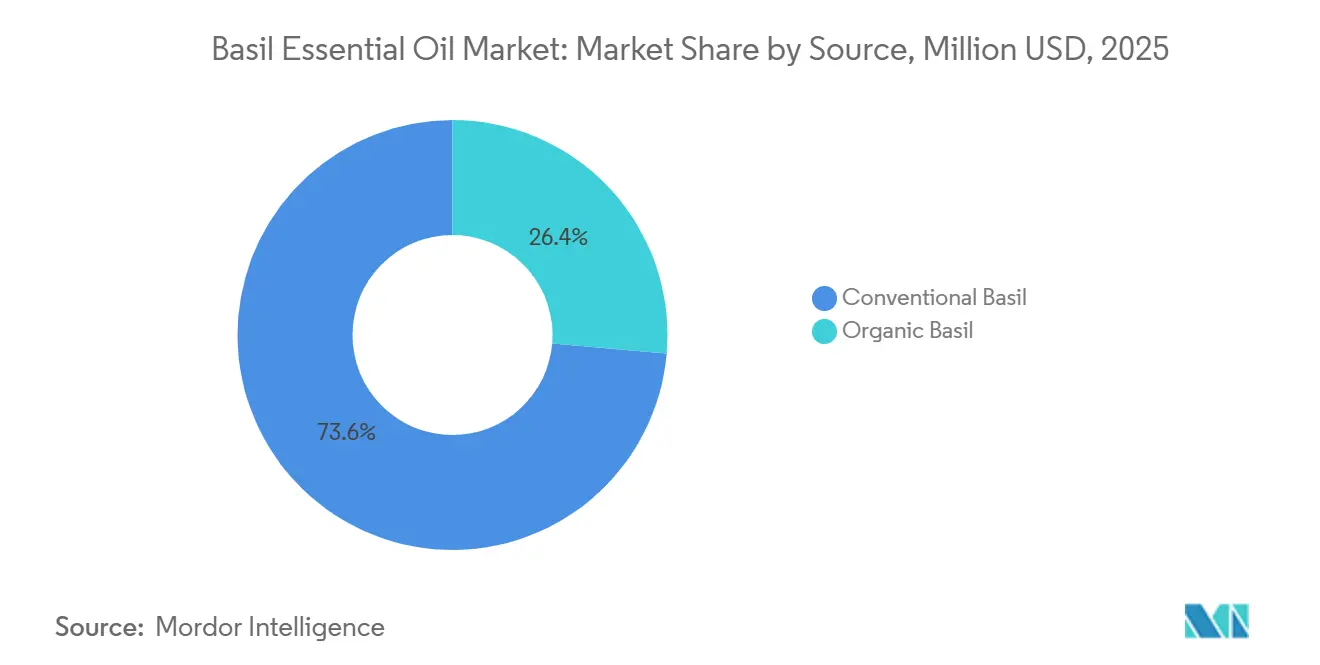
- By source, conventional basil held 73.63% share in 2025, while organic basil is forecast to expand at 9.56% CAGR through 2031.
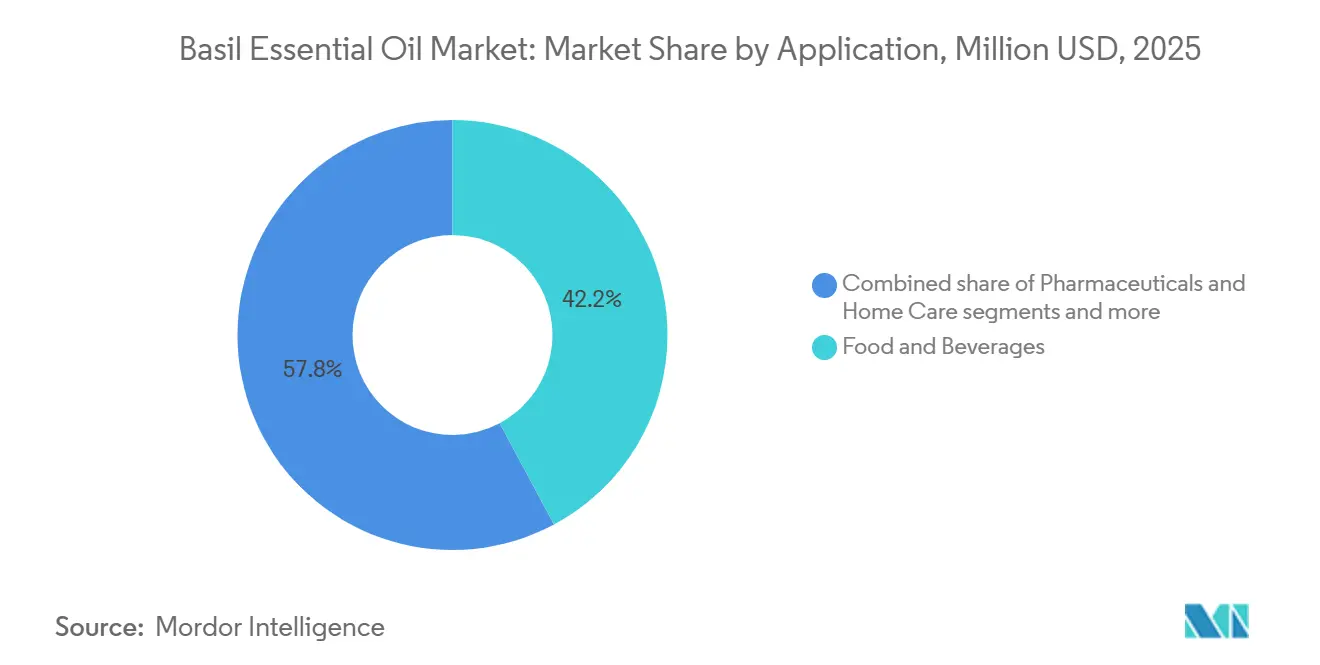
- By application, food and beverages accounted for 42.18% of the basil essential oil market size in 2025, while aromatherapy and wellness is projected to grow at 10.12% CAGR through 2031.
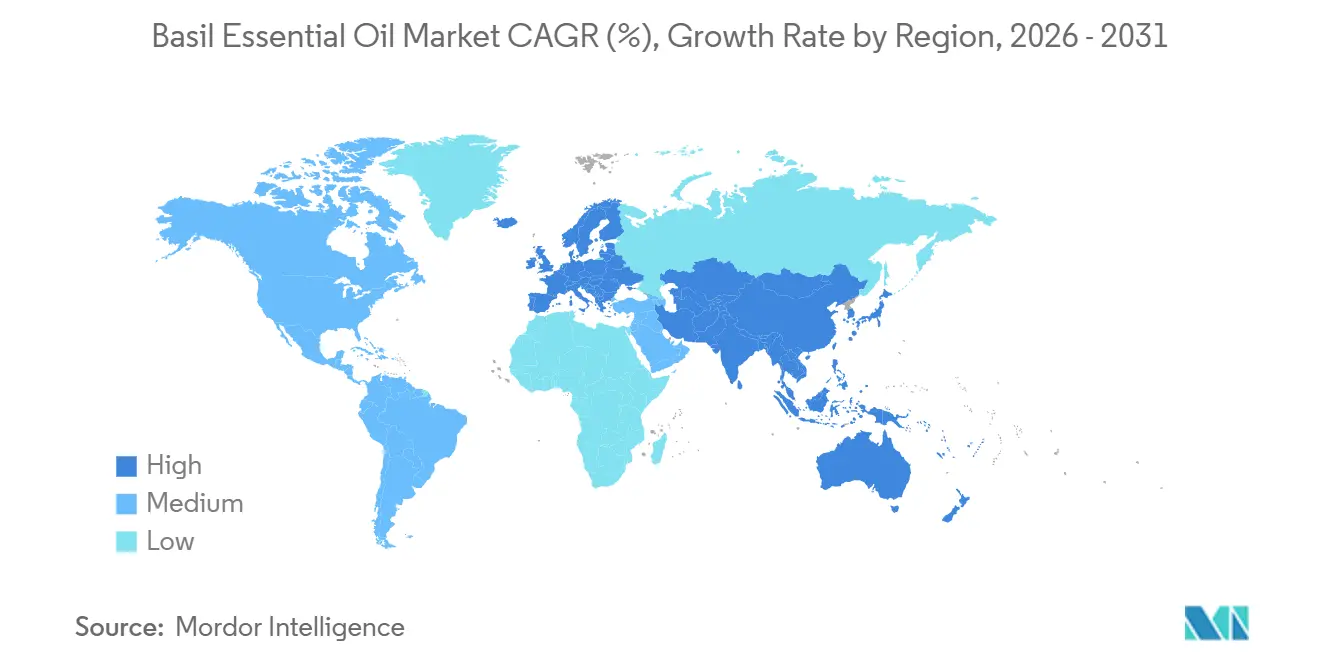
- By geography, Europe held 39.58% of the basil essential oil market share in 2025, while Asia-Pacific recorded the highest projected CAGR at 8.96% through 2031.
Note: Market size and forecast figures in this report are generated using Mordor Intelligence’s proprietary estimation framework, updated with the latest available data and insights as of January 2026.
Market Trends and Insights
Drivers Impact Analysis of Basil Essential Oil Market*
| Driver | (~) % Impact on CAGR Forecast | Geographic Relevance | Impact Timeline |
|---|---|---|---|
| Rising demand for natural aromatherapy products | +2.1% | Global, led by Europe and North America | Short term (≤ 2 years) |
| Growing use in personal care and cosmetic formulations | +1.5% | Europe, North America, Asia-Pacific core | Medium term (2-4 years) |
| Increasing consumer preference for plant-based ingredients | +1.2% | Global | Long term (≥ 4 years) |
| Expanding application in food and beverage flavoring | +1.3% | North America, Europe, Asia-Pacific | Medium term (2-4 years) |
| Growing demand for multifunctional botanical ingredients | +0.8% | Europe, North America | Medium term (2-4 years) |
| Growing popularity of herbal wellness and holistic healthcare | +0.6% | Asia-Pacific core, spill-over to Middle East and Africa | Long term (≥ 4 years) |
| Source: Mordor Intelligence | |||
Rising demand for natural aromatherapy products
Growing consumer interest in holistic wellness and natural therapeutic solutions is significantly increasing the adoption of basil essential oil across aromatherapy applications. The oil is widely used in diffusers, massage oils, bath products, and wellness blends because of its refreshing aroma and its perceived calming and revitalizing properties. Increasing awareness of stress management, mental well-being, and relaxation techniques has encouraged consumers to incorporate aromatherapy into their daily lifestyles. The expansion of spas, wellness centers, yoga studios, and home-based self-care practices has further strengthened demand for essential oils. Consumers are also showing a stronger preference for plant-derived, chemical-free products, creating favorable opportunities for basil essential oil in premium wellness formulations.
Growing use in personal care and cosmetic formulations
Increasing consumer preference for natural and plant-based ingredients is accelerating the incorporation of basil essential oil into personal care and cosmetic formulations. The oil is widely used in skincare, haircare, soaps, lotions, facial cleansers, and aromatherapy-inspired beauty products due to its natural fragrance and beneficial antioxidant and antimicrobial properties. This trend is reinforced by growing consumer awareness of ingredient transparency and clean-label beauty products. A March 2025 NSF study revealed that 74% of consumers now prioritize organic ingredients in their personal care products, highlighting a significant shift toward plant-based actives in cosmetic formulations[1]Source: NSF International, “Global Consumer Insights on Personal Care,”nsf.org. In response, manufacturers are expanding their portfolios with botanical ingredient-based products that align with evolving consumer preferences for sustainable and chemical-free solutions. Continuous product innovation and the premiumization of natural beauty products are further increasing the demand for basil essential oil across the global cosmetics industry.
Increasing consumer preference for plant-based ingredients
Growing consumer awareness of health, sustainability, and clean-label products is significantly increasing the preference for plant-based ingredients across multiple industries. Basil essential oil, being a naturally derived botanical extract, is gaining wider acceptance as consumers seek alternatives to synthetic flavors, fragrances, and chemical-based additives. Food and beverage manufacturers, cosmetic brands, and wellness companies are increasingly incorporating plant-derived ingredients into their product formulations to meet evolving consumer expectations. This shift is further supported by rising demand for vegan, organic, and environmentally responsible products that align with sustainable lifestyles. In addition, increasing transparency in ingredient labeling has encouraged consumers to choose products containing recognizable and naturally sourced components.
Expanding application in food and beverage flavoring
The expanding use of basil essential oil as a natural flavoring ingredient in the food and beverage industry is contributing significantly to market growth. Its distinctive herbaceous aroma and flavor make it a preferred ingredient in sauces, dressings, seasonings, beverages, confectionery, and ready-to-eat food products. The shift toward clean-label formulations and natural flavor alternatives is encouraging food manufacturers to replace synthetic additives with plant-derived ingredients. This trend is further supported by changing consumer preferences, as the International Food Information Council’s Food and Health Survey 2024 found that 67% of Americans prioritize healthfulness in their food and beverage choices[2]Source: International Food Information Council, “2024 Food & Health Survey,” ific.org. As a result, manufacturers are increasingly incorporating natural botanical ingredients such as basil essential oil into product formulations to meet evolving consumer expectations.
Restraints Impact Analysis of Basil Essential Oil Market*
| Restraint | (~) % Impact on CAGR Forecast | Geographic Relevance | Impact Timeline |
|---|---|---|---|
| High production and extraction costs | -1.0% | Global | Medium term (2-4 years) |
| Price volatility of raw materials | -0.7% | Asia-Pacific and Middle East and Africa production hubs, with global spill-over | Short term (≤ 2 years) |
| Stringent regulations governing essential oil quality and labeling | -0.6% | Europe, North America | Medium term (2-4 years) |
| Competition from alternative essential oils | -0.5% | Global | Long term (≥ 4 years) |
| Source: Mordor Intelligence | |||
High production and extraction costs
High production and extraction costs remain a significant challenge for the basil essential oil market, as the manufacturing process requires substantial quantities of fresh basil to produce relatively small volumes of oil. Steam distillation, the most commonly used extraction method, involves specialized equipment, considerable energy consumption, and strict quality control measures, all of which increase operational expenses. Fluctuations in raw material availability due to seasonal variations and climatic conditions can further elevate production costs and affect supply consistency. In addition, labor-intensive harvesting and post-harvest handling contribute to higher overall manufacturing expenditures. These cost pressures are often reflected in the final product price, limiting affordability for price-sensitive consumers and industrial buyers.
Price volatility of raw materials
Price volatility of raw materials presents a significant challenge for the basil essential oil market, as the availability and cost of basil leaves are heavily influenced by seasonal production, weather conditions, and agricultural uncertainties. Factors such as droughts, excessive rainfall, pest infestations, and fluctuations in crop yields can disrupt the supply of high-quality basil, resulting in unstable raw material prices. These cost fluctuations directly affect manufacturers' production expenses and reduce the predictability of procurement planning. In addition, increasing labor costs, transportation expenses, and input prices for fertilizers and irrigation further contribute to variability in cultivation costs. Manufacturers may find it difficult to maintain stable pricing for basil essential oil, particularly under long-term supply agreements with industrial customers.
*Our forecasts treat driver/restraint impacts as directional, not additive. The impact forecasts reflect baseline growth, mix effects, and variable interactions.
Basil Essential Oil Market Segment Analysis
By Source:
Conventional Dominates as Organic Certification Reshapes Value DistributionConventional basil accounted for the largest share of the basil essential oil market, representing 73.63% of total revenue in 2025, owing to its abundant cultivation, established supply chains, and cost-effective production. Conventional farming methods enable large-scale cultivation of basil, ensuring a consistent supply of raw materials for essential oil extraction. This source is widely preferred by manufacturers serving the food and beverage, fragrance, personal care, and aromatherapy industries due to its competitive pricing and reliable availability. Conventional basil essential oil also meets the quality and performance requirements of a broad range of industrial applications, making it the preferred choice for high-volume production.
Organic basil is projected to register the fastest CAGR of 9.56% through 2031, driven by growing consumer preference for certified organic and sustainably sourced natural products. Rising awareness of the potential health and environmental benefits associated with organic cultivation is encouraging manufacturers to expand their portfolios of organic essential oils. Demand is particularly strong in premium aromatherapy, natural cosmetics, clean-label food products, and wellness applications, where consumers increasingly seek chemical-free ingredients.


By Application:
Food and Beverages Anchors Volume as Wellness Channels Drive Margin ExpansionFood and beverages accounted for the largest share of the basil essential oil market, representing 42.18% of total revenue in 2025, driven by the growing use of natural flavoring agents and clean-label ingredients in processed foods and beverages. Basil essential oil is widely incorporated into sauces, dressings, seasonings, confectionery products, beverages, and ready-to-eat foods because of its distinctive aroma, flavor profile, and natural preservative properties. Increasing consumer preference for plant-based and minimally processed ingredients has encouraged food manufacturers to replace synthetic flavors with botanical extracts.
Aromatherapy and wellness are projected to register the fastest CAGR of 10.12% through 2031, fueled by increasing consumer awareness of holistic health, stress management, and natural therapeutic solutions. Basil essential oil is widely valued in aromatherapy for its refreshing, calming, and revitalizing properties, making it a popular ingredient in massage oils, diffusers, wellness blends, and spa treatments. The growing prevalence of stress-related disorders and increasing consumer focus on mental well-being have significantly expanded the demand for essential oil-based wellness products.

Geography Analysis
Europe Basil Essential Oil Market
Europe dominated the basil essential oil market in 2025, accounting for 39.58% of the global market share, supported by strong demand from the food and beverage, cosmetics, fragrance, and aromatherapy industries. The region has a well-established market for natural and organic ingredients, with consumers increasingly favoring botanical extracts over synthetic alternatives. Countries such as France, Germany, Italy, and the United Kingdom are major consumers of basil essential oil due to their advanced personal care, flavor, and wellness sectors. Strict regulations governing the use of artificial additives have further encouraged manufacturers to incorporate natural essential oils into consumer products.
APAC Basil Essential Oil Market
Asia-Pacific is projected to register the highest CAGR of 8.96% through 2031, driven by increasing demand for natural ingredients across food processing, cosmetics, pharmaceuticals, and wellness applications. Rapid urbanization, rising disposable incomes, and growing consumer awareness of herbal and plant-based products are fueling market expansion throughout the region. Around 54% of the global urban population, more than 2.2 billion people, live in Asia. By 2050, the urban population in Asia is expected to grow by 50% - an additional 1.2 billion people[3]Source: UN-Habaitat, “Asia and the Pacific Region”, unhabitat.org. Countries such as India, China, Japan, and Australia are witnessing rising consumption of basil essential oil in aromatherapy, functional foods, and personal care formulations.
The Americas and MEA Basil Essential Oil Market
North America, South America, and the Middle East and Africa offer promising growth opportunities for the basil essential oil market, as end-use industries increasingly adopt basil essential oil. North America drives steady demand through clean-label foods, aromatherapy products, natural cosmetics, and holistic wellness solutions. South America expands through aromatic herb cultivation, botanical ingredient consumption, and growth in the food and personal care industries. The Middle East and Africa is developing as a market, supported by the use of essential oils in traditional medicine, perfumes, personal care products, and hospitality wellness services.

Competitive Landscape
The basil essential oil market is moderately concentrated, with competition characterized by the presence of established essential oil manufacturers, botanical extract producers, fragrance companies, and specialty ingredient suppliers. Market participants compete primarily on product quality, purity, sourcing capabilities, extraction technology, and compliance with international quality and sustainability standards. Companies with vertically integrated supply chains and direct access to basil cultivation regions are better positioned to ensure consistent raw material availability and maintain stable product quality. The growing demand for natural ingredients across food, cosmetics, pharmaceuticals, and aromatherapy applications has further intensified competition among leading producers.
Leading companies are investing in advanced steam distillation and extraction technologies to improve essential oil yield, preserve aromatic compounds, and ensure consistent chemical composition. Strategic initiatives such as expanding organic-certified product portfolios, strengthening distribution networks, and forming long-term partnerships with growers and distributors have become key competitive strategies. Manufacturers are also emphasizing sustainable sourcing, traceability, and environmentally responsible production practices to meet evolving consumer expectations and regulatory requirements.
The competitive landscape is also shaped by rising demand for premium-quality and certified organic basil essential oils, particularly in developed markets where consumers prioritize clean-label and natural products. Companies are expanding their presence through acquisitions, regional distribution partnerships, and investments in emerging markets with growing demand for botanical ingredients. Digital sales channels and direct-to-consumer strategies are further helping manufacturers reach a broader customer base while enhancing brand recognition.
Basil Essential Oil Industry Leaders
Synthite Industries Pvt. Ltd.
Ozone Naturals Private Limited
Blue Ridge Botanicals Co., Ltd.
Robertet SA
Lebermuth Company, Inc.
- *Disclaimer: Major Players sorted in no particular order
Basil Essential Oil Market Companies Covered in this Report
- Synthite Industries Pvt. Ltd.
- Ozone Naturals Private Limited
- Blue Ridge Botanicals Co., Ltd.
- Robertet SA
- Lebermuth Company, Inc.
- Augustus Oils Ltd
- Ajmal Biotech Pvt Ltd.
- Givaudan
- A.fakhry & Co.
- KM Chemicals
- Aadhunik Ayurveda Vitals
- Ultra International Limited
- Proma Arochem
- Sivaroma Naturals Private Limited
- Mountain Rose Herbs
- New Directions Aromatics Inc.
- Ultra International B.V.
- Gangotri Essential Oils Pvt. Ltd.
- Vigon International, LLC
- Biolandes SAS

Recent Industry Developments in Basil Essential Oil Market
- February 2026: Givaudan announced its investment in Campus 52, reinforcing its long-term strategy to strengthen innovation capabilities and expand its global operational footprint. The initiative is aimed at enhancing collaborative research, product development, and cross-functional innovation across its Fragrance & Beauty and Taste & Wellbeing divisions. The investment underscores the company’s focus on building advanced infrastructure to support future growth in high-value segments such as fragranve ingredients including herb derived oils.
- April 2025: International Flavors & Fragrances Inc. strengthened its customer service capabilities by consolidating most of its Mexican operations at a new facility in Mexico City’s Tecnoparque business complex. The company centralized these operations to improve coordination, accelerate customer response times, and enhance service delivery across its Mexican business.
- November 2024: Robertet's new production facility in Karawang, Indonesia, commenced operations. In 2024, the group boasted a 12% surge in revenue and made strategic investments in Southeast Asia and East Africa, enhancing its raw material sourcing and processing capabilities


Global Basil Essential Oil Market Report Scope
Basil essential oil is a concentrated volatile oil extracted primarily from the leaves and flowering tops of the basil plant (Ocimum basilicum), typically through steam distillation. The basil essential oil market is segmented by source, application and geography. Based on source, the market is segmented into organic and conventional basil. Based on application, the market is segmented into food and beverages, personal care and cosmetics, pharmaceuticals, aromatherapy and wellness, perfumery and fragrances and home care. By geography, the market is segmented into North America, Europe, Asia-Pacific, South America, and Middle-East and Africa. For each segment, the market sizing and forecasting have been done in value terms (USD million).
| Organic Basil |
| Conventional Basil |
| Food and Beverages | Bakery and Confectionery |
| Dairy | |
| Functional Drinks | |
| Other Food and Beverages | |
| Personal Care and Cosmetics | |
| Pharmaceuticals | |
| Aromatherapy and Wellness | |
| Perfumery and Fragrances | |
| Home Care | |
| Others |
| North America |
| Europe |
| Asia-Pacific |
| South America |
| Middle East and Africa |
| By Source | Organic Basil | |
| Conventional Basil | ||
| By Application | Food and Beverages | Bakery and Confectionery |
| Dairy | ||
| Functional Drinks | ||
| Other Food and Beverages | ||
| Personal Care and Cosmetics | ||
| Pharmaceuticals | ||
| Aromatherapy and Wellness | ||
| Perfumery and Fragrances | ||
| Home Care | ||
| Others | ||
| By Geography | North America | |
| Europe | ||
| Asia-Pacific | ||
| South America | ||
| Middle East and Africa | ||


Key Questions Answered in the Report
What is the 2031 outlook for basil essential oil demand?
The basil essential oil market is forecast to reach USD 331.46 million by 2031, rising from USD 227.87 million in 2026 at a 7.78% CAGR over 2026-2031.
Which application generates the most revenue for basil essential oil?
Food and beverages remained the largest application with 42.18% share in 2025, supported by broad use in savory foods, dairy, beverages, and other flavor systems.
Which end use is growing the fastest for basil essential oil?
Aromatherapy and wellness is projected to grow at 10.12% CAGR through 2031, helped by stronger demand from organized wellness operators and higher-quality procurement standards.
Why does Europe lead basil essential oil consumption?
Europe held 39.58% share in 2025 because of its strong fragrance ecosystem, mature personal care sector, and tighter documentation needs in cosmetic ingredients.
Page last updated on:


 Your data is secure and never sold or shared.


