
ITSM In Healthcare Market Size and Share
Market Overview
| Study Period | 2020 - 2031 |
|---|---|
| Market Size (2026) | USD 1.48 Billion |
| Market Size (2031) | USD 3.32 Billion |
| Growth Rate (2026 - 2031) | 17.51 % |
| Fastest Growing Market | Asia-Pacific |
| Largest Market | North America |
| Market Concentration | Medium |
Major Players *Disclaimer: Major Players sorted in no particular order Image © Mordor Intelligence. Reuse requires attribution under CC BY 4.0. | |
ITSM In Healthcare Market Analysis by Mordor Intelligence
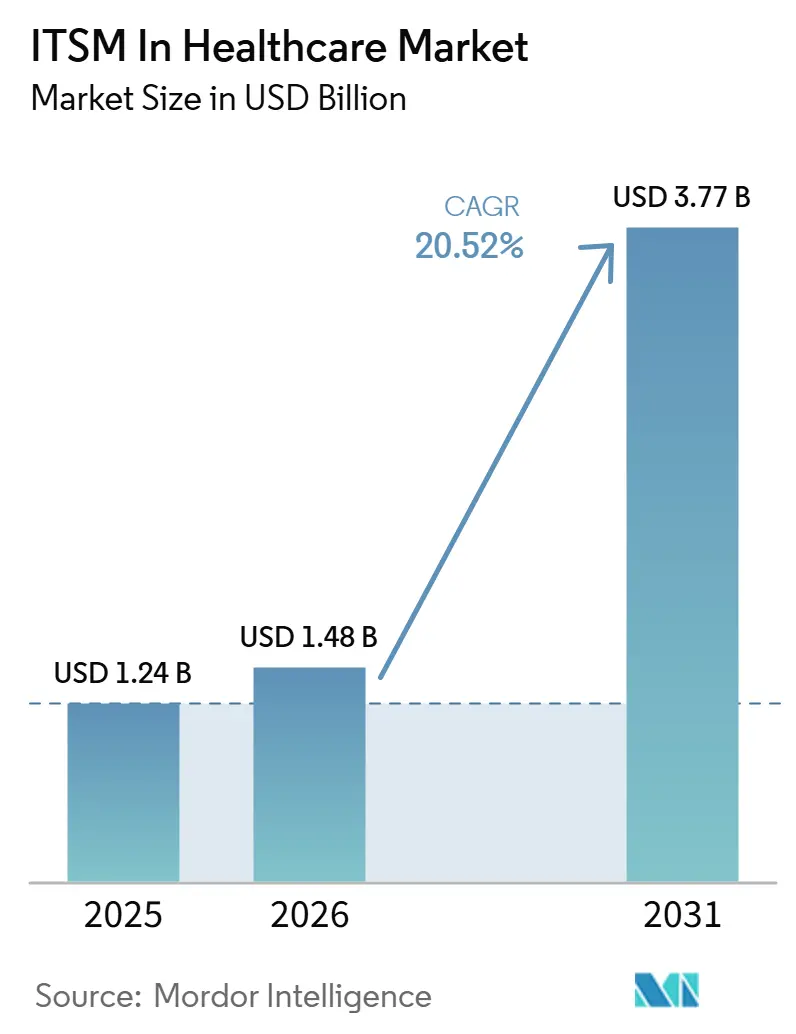
The ITSM in Healthcare Market size is projected to expand from USD 1.24 billion in 2025 and USD 1.48 billion in 2026 to USD 3.32 billion by 2031, registering a CAGR of 17.51% between 2026 and 2031. The market is expanding because healthcare IT environments now sit closer to clinical care, as EHR platforms connect billing tools, diagnostic systems, medical devices, and identity systems inside one operating environment. That wider technology footprint has made downtime harder to absorb, since an unavailable record or failed interface can interrupt care delivery, delay workflows, and raise regulatory exposure. The ITSM in healthcare market is also benefiting from wider cloud use, stronger demand for AI-assisted support, and a shift toward governed self-service for routine issues. Competition is moving along two tracks, with large workflow platforms adding healthcare-specific functions while AI-focused vendors compete on resolution speed and automation depth. Budget controls and legacy system integration still slow some rollouts, but the ITSM in healthcare market remains supported by the fact that incident management, service continuity, and auditability are now essential parts of clinical operations.
Key Report Takeaways
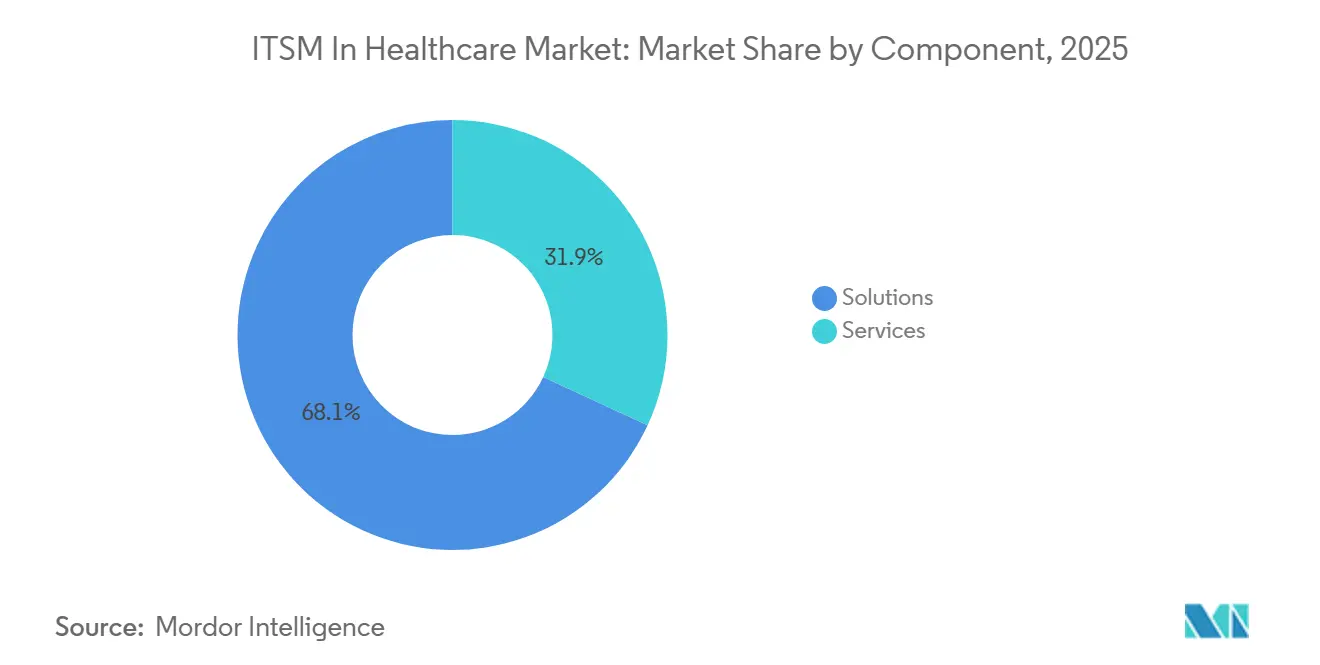
- By component, solutions held 68.10% share in 2025 in the ITSM in healthcare market, while services are projected to expand at a 19.10% CAGR through 2031.
- By deployment, cloud accounted for 78.35% share in 2025, while cloud is also expected to record the fastest growth at an 18.78% CAGR through 2031.
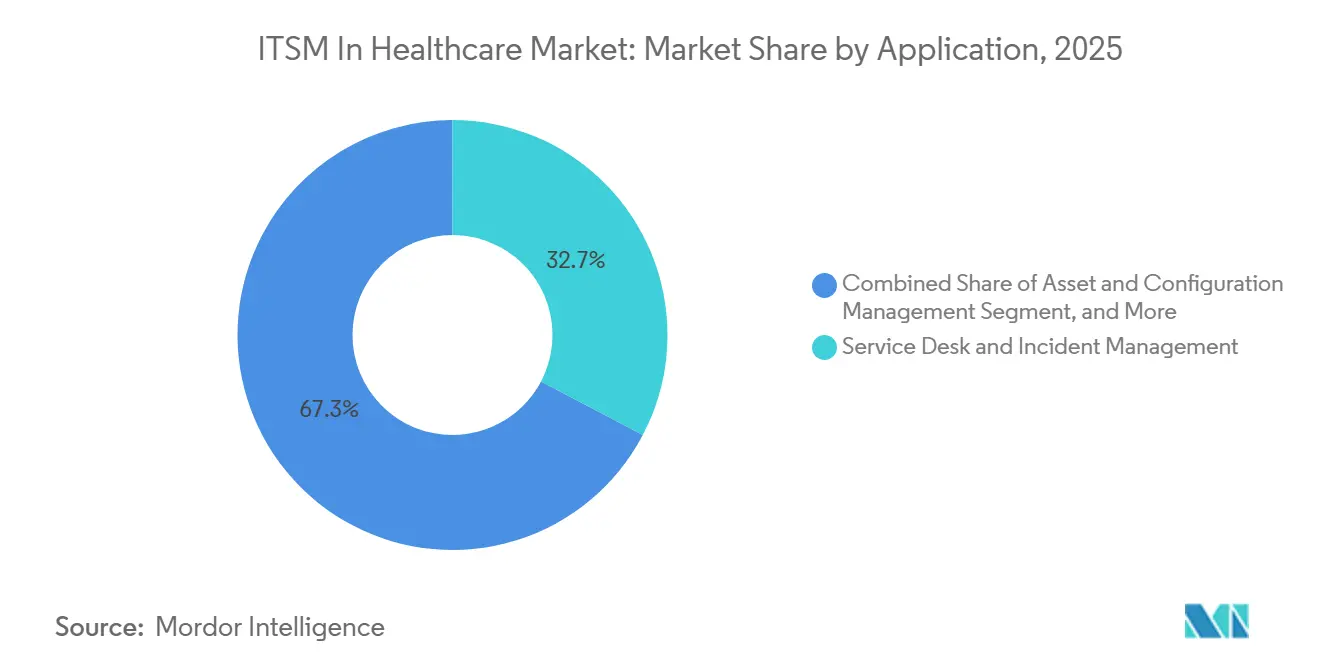
- By application, service desk and incident management captured 32.70% share in 2025, while knowledge management is projected to grow at an 18.10% CAGR through 2031.
- By enterprise size, large enterprises held 65.50% share in 2025, while SMEs are expected to post the highest CAGR at 19.35% through 2031.
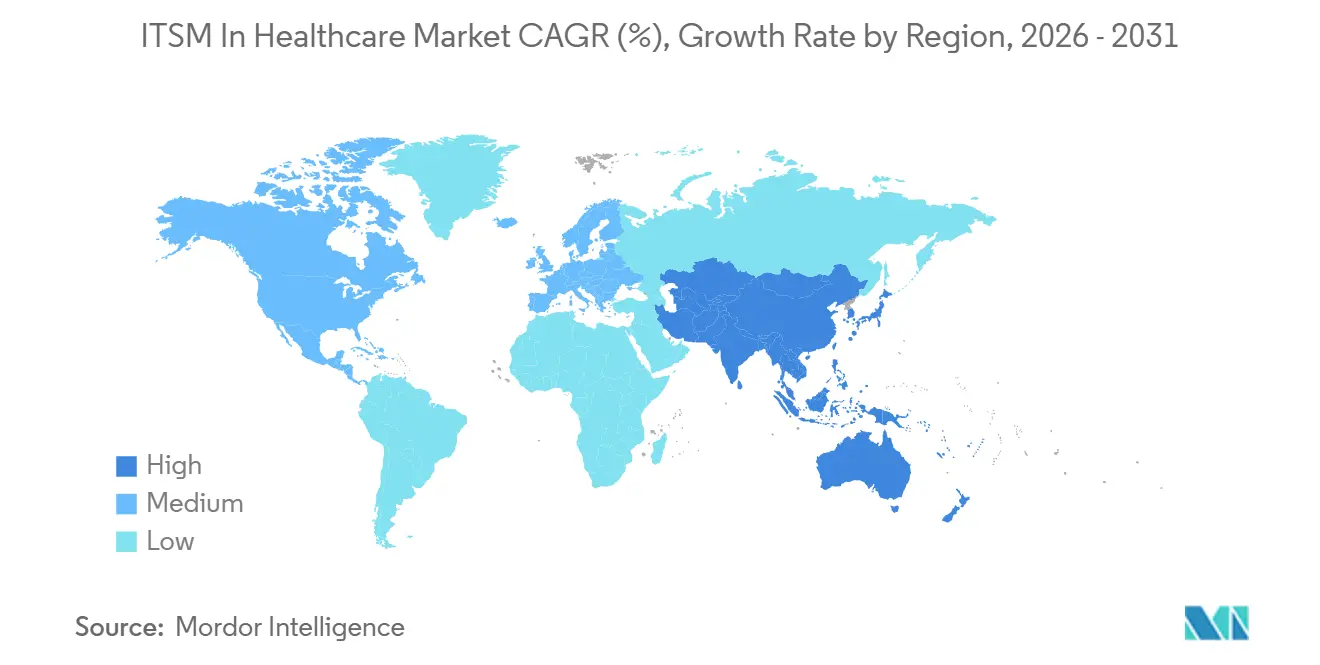
- By geography, North America accounted for 46.10% share in 2025, while Asia-Pacific is projected to expand at a 19.45% CAGR through 2031.
Note: Market size and forecast figures in this report are generated using Mordor Intelligence’s proprietary estimation framework, updated with the latest available data and insights as of January 2026.
Market Trends and Insights
Drivers Impact Analysis of ITSM In Healthcare Market*
| Driver | (~) % Impact on CAGR Forecast | Geographic Relevance | Impact Timeline |
|---|---|---|---|
| Rising Electronic Health Record Workflow Complexity | +3.5% | North America, Europe, Asia-Pacific core markets | Medium term (2-4 years) |
| Telehealth and Remote Care Expansion | +3.0% | North America, Asia-Pacific, with spill-over to Europe | Short term (≤ 2 years) |
| Cybersecurity and Ransomware Pressure on Clinical Operations | +2.5% | North America, Europe, with early gains in Middle East and Africa | Short term (≤ 2 years) |
| Need for Faster IT Incident Resolution in Patient-Critical Environments | +2.0% | Global | Medium term (2-4 years) |
| Interoperability Demands Across EHR, Medical Devices, and Identity Systems | +1.5% | North America and EU, with spill-over to Asia-Pacific | Long term (≥ 4 years) |
| AI-Assisted Service Automation for Clinical Support Teams | +1.2% | Global, with early gains in North America and Asia-Pacific | Short term (≤ 2 years) |
| Source: Mordor Intelligence | |||
Rising Electronic Health Record Workflow Complexity
EHR platforms now operate as integration hubs rather than stand-alone record systems, and that shift keeps adding new service dependencies inside the ITSM in healthcare market. Each connection to medical devices, telehealth tools, identity systems, billing platforms, and imaging environments creates new failure points that support teams must monitor and resolve. This makes the service layer itself more critical, because a routing error, access issue, or failed interface can affect clinical work rather than only office productivity. ONC expanded the data exchange framework again in July 2025 through USCDI Version 6, which added new standardized elements for cross-system exchange and widened the governance workload for healthcare IT teams[1]. As a result, the ITSM in healthcare market is gaining from the need to manage larger and more connected digital care environments.
Telehealth and Remote Care Expansion
Telehealth has changed the support burden in the ITSM in healthcare market because care now continues well outside normal IT staffing hours. Virtual visits, remote monitoring, and distributed access points increase the number of devices, portals, and user identities that service teams must keep available. CMS simplified remote patient monitoring billing and documentation rules in the 2026 Physician Fee Schedule, which supports wider deployment of connected care tools across ambulatory and chronic care settings. HHS also extended core telehealth flexibilities through December 31, 2027, including audio-only services and broader distant-site eligibility for Federally Qualified Health Centers. That means the ITSM in healthcare market is serving a care model where one portal failure or access error can affect patients across multiple locations at the same time.
Cybersecurity and Ransomware Pressure on Clinical Operations
Cyber risk is strengthening demand in the ITSM in healthcare market because healthcare providers need faster detection, containment, and escalation when service disruptions carry patient and compliance consequences. The pressure is no longer limited to restoring systems after an outage, since teams also need governed workflows for asset visibility, endpoint isolation, incident classification, and notification steps. HHS OCR proposed a major update to the HIPAA Security Rule in January 2025 that would move items such as multifactor authentication, encryption, segmentation, and annual penetration testing into a stricter compliance posture. ServiceNow’s April 2026 completion of the Armis acquisition also shows where vendor strategy is moving, with stronger attention on real-time visibility across medical devices, IoT endpoints, and OT assets that sit close to clinical operations. Together, these shifts are pushing the ITSM in healthcare market toward security-aware service workflows rather than basic ticketing.
Need for Faster IT Incident Resolution in Patient-Critical Environments
Clinical downtime now has a direct operational effect, which keeps incident speed central to the ITSM in healthcare market. Hospitals are formalizing downtime procedures through structured workflows so that requests, approvals, escalations, and service handoffs can be tracked across departments in one system. ServiceNow’s Q1 2026 Healthcare Operations release added AI agent triage, routing, and request tracking across biomedical, facilities, environmental services, and IT teams. That type of shared operational record matters because support issues in clinical settings rarely stay inside one function once they begin to affect equipment access, staff workflows, or room readiness. The ITSM in healthcare market is therefore expanding around the idea that faster resolution supports service continuity at the point of care.
Restraints Impact Analysis of ITSM In Healthcare Market*
| Restraint | (~) % Impact on CAGR Forecast | Geographic Relevance | Impact Timeline |
|---|---|---|---|
| Budget Constraints in Provider and Payer IT Modernization | -2.5% | Global | Short term (≤ 2 years) |
| Integration Complexity With Legacy Hospital Systems | -2.0% | North America, Europe | Medium term (2-4 years) |
| Regulatory and Data Privacy Compliance Burden | -1.5% | North America and EU, with early gains in Asia-Pacific | Long term (≥ 4 years) |
| Change Resistance Among Clinicians and Biomedical Teams | -1.0% | Global | Long term (≥ 4 years) |
| Source: Mordor Intelligence | |||
Budget Constraints in Provider and Payer IT Modernization
Budget discipline remains a real limit on the ITSM in healthcare market, even when the need for modernization is clear. Many providers still phase deployments over time, starting with incident and request modules and delaying broader capabilities such as asset, change, and knowledge management. That approach helps control near-term spending, but it also slows full platform adoption and stretches vendor revenue across longer cycles. The pressure is sharper when cybersecurity, infrastructure refresh, and clinical software projects are drawing from the same funding pool. As a result, the ITSM in healthcare market often grows through staged adoption rather than full-suite replacement.
Integration Complexity With Legacy Hospital Systems
Legacy hospital systems still slow the ITSM in healthcare market because many provider environments were built around older interfaces and departmental tools that do not fit modern API-first platforms easily. Integration work can become a separate program in itself when hospitals need to connect legacy clinical applications, biomedical devices, and historical workflows to a unified service layer. In many cases, organizations must keep parallel support processes in place until those older systems are retired or moved into a newer architecture. That extends sales cycles, lowers initial contract scope, and favors phased deployments over enterprise-wide transformation. The ITSM in healthcare market therefore faces a longer path in hospitals where core clinical modernization is still underway.
*Our forecasts treat driver/restraint impacts as directional, not additive. The impact forecasts reflect baseline growth, mix effects, and variable interactions.
ITSM In Healthcare Market Segment Analysis
By Component:
Solutions Dominate as Services AccelerateSolutions held 68.10% of the ITSM in healthcare market share in 2025, which reflected the strong preference for software platforms that already include healthcare workflows, audit trails, and integration connectors. Large health systems have favored these platforms because their clinical and administrative environments are too broad to manage through fragmented point tools. The lead position also shows that buyers increasingly want a governed framework for incidents, service requests, device visibility, and workflow accountability. In the ITSM in healthcare market, that preference supports vendors that can offer pre-configured functionality without requiring customers to build core processes from scratch.
Services are projected to expand at a 19.10% CAGR through 2031, which points to a different growth layer inside the same market. More healthcare organizations now want outside help with configuration, optimization, rollout sequencing, and post-deployment support because internal teams are stretched across many digital priorities. This is especially relevant for providers that can license a platform but cannot continuously tune workflows or knowledge content on their own. Over time, the ITSM in healthcare market is likely to see services gain importance as platform complexity rises with more automation and AI-based functions.
By Deployment:
Cloud Consolidates Healthcare’s ITSM InfrastructureCloud captured 78.35% share in 2025, which made it the clear center of deployment demand in the ITSM in healthcare market. Multi-site provider groups benefit from a single service environment that can cover hospitals, clinics, remote care settings, and partner locations without carrying local release management burdens at every site. Cloud delivery also supports faster rollout of AI tools, workflow updates, and self-service changes across distributed care networks. This has made the cloud the practical default for many healthcare customers who want scalability and governance in one operating model.
Cloud is also expected to grow at an 18.78% CAGR through 2031, which reinforces its lead as healthcare organizations modernize service operations. At the same time, on-premise and hybrid models remain relevant where data residency, sovereign control, or isolated clinical networks shape architecture choices. Ivanti’s January 2026 Sovereign Edition EU for Neurons showed that vendors still see value in products designed for regulated environments that require stronger auditability and location control. Because of that, the ITSM in healthcare market is not moving toward a fully uniform deployment model, even though cloud continues to lead.
By Application:
Incident Management Anchors Demand as Knowledge Tools SurgeService desk and incident management accounted for 32.70% share in 2025, which kept it at the center of application demand across the ITSM in healthcare market. Providers continue to prioritize this area because downtime reduction offers the clearest link between IT performance and clinical continuity. Asset and configuration management, change and release management, and service request management all add value, but they still tend to build around the incident core. In practical terms, this means the market remains anchored by the need to classify, route, and resolve service interruptions quickly.
Knowledge management is projected to expand at an 18.10% CAGR through 2031, showing that support models are moving beyond static documentation. Healthcare organizations are placing more value on searchable, governed knowledge layers that can help staff resolve common issues before a ticket is created. A study published in JMIR Medical Informatics in April 2026 found that a unified knowledge platform at University Hospital Schleswig-Holstein reduced redundant support escalation across departments by harmonizing access to health and research information. That direction strengthens the ITSM in healthcare market because knowledge is becoming part of operational support, not a separate reference library.

By Enterprise Size:
Large Enterprises Anchor Spend, SMEs Close the GapLarge enterprises held 65.50% share in 2025, which reflected their higher spending capacity and wider operational scope within the ITSM in healthcare market. Multi-hospital systems, academic medical centers, and integrated payer-provider groups manage large application estates, large endpoint fleets, and broad change control requirements. Those conditions support multi-module deployments and higher contract values than smaller organizations can usually absorb. They also make large enterprises the main reference customers for vendors that want to prove scale and healthcare readiness.
SMEs are expected to grow at a 19.35% CAGR through 2031, showing that the market is broadening beyond its traditional large-system base. Community hospitals, ambulatory groups, and specialty clinics have been gaining access as SaaS delivery, faster deployment models, and simpler pricing reduce adoption barriers. Freshworks and Unisys announced a strategic reseller relationship in February 2025 that positioned Freshservice as a faster rollout option for global clients, with deployment timing that appealed to mid-market buyers[2]. This widening base supports the ITSM in healthcare market by opening demand among providers that previously viewed enterprise service management as too costly or too complex.
Geography Analysis
North America ITSM in Healthcare Market
North America held 46.10% of the ITSM in healthcare market share in 2025, which kept it as the largest regional contributor. The region benefits from mature enterprise software procurement, large integrated delivery networks, and a compliance environment that gives structured service management a clear operational purpose. ONC’s July 2025 USCDI Version 6 release expanded standardized exchange elements, which pushed governance needs further into connected application environments rather than keeping them inside internal IT alone[3]. That backdrop continues to support the ITSM in healthcare market across the United States and Canada.
APAC ITSM in Healthcare Market
Asia-Pacific is projected to grow at a 19.45% CAGR through 2031, making it the fastest-expanding regional segment in the ITSM in healthcare market size mix. Japan is moving through a foundational infrastructure cycle, and the May 2026 healthcare sovereign cloud collaboration between Fujitsu and IBM Japan showed that local health systems are building the cloud base needed for larger service management deployments[4]. India is creating a different path, with government-led digital health programs driving first-time adoption of records, portals, and connected workflows across public and private care settings. China adds another layer of demand through cybersecurity requirements and hospital modernization standards that increase the need for governed operational support. Taken together, these country patterns show why Asia-Pacific is widening the future addressable base for healthcare service management.
EMEA and South America ITSM in Healthcare Market
Europe occupies a more measured position because hospital modernization is advancing alongside local compliance, localization, and migration demands. The region still shows meaningful adoption, and specialist vendors such as Matrix42 and KIX Service Software demonstrate that locally focused platforms can build durable healthcare positions where implementation fit matters. South America remains earlier in adoption, with Brazil and Argentina representing the main growth pockets as private hospital groups invest in clinical IT management tools. In the Middle East and Africa, Gulf smart hospital programs and telehealth-led delivery models are creating early demand for cloud-based service management in both public and partner-supported care settings.
Competitive Landscape
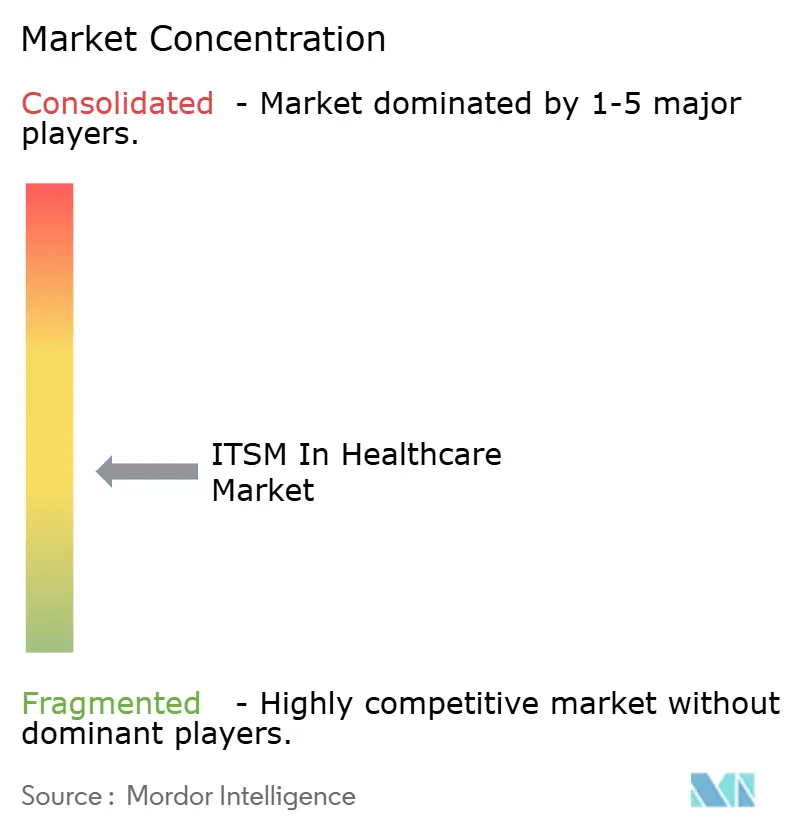
The ITSM in healthcare market remains moderately fragmented at the enterprise tier, with ServiceNow holding a strong position through its healthcare and life sciences service management offering, broad integration depth, and established compliance posture. The April 2026 completion of the Armis acquisition extended that position into cyber asset visibility for medical devices, IoT endpoints, and OT systems, which are important gaps in many traditional service management environments. Freshworks also pushed further into the space in May 2026 with Freddy AI Agent Studio and an MCP Gateway in Freshservice, aimed at buyers who value simpler setup and faster deployment. Ivanti added to the pressure in April 2026 through the controlled release of the Neurons AI Self-Service Agent, which focused on autonomous handling of common ITSM tasks. These moves show that the ITSM in healthcare market is competing on automation quality as much as on platform breadth.
The June 2026 carve-out of BMC Helix into an independent ServiceOps entity under Montagu Private Equity pointed to a market that is separating into broad incumbents and more focused specialists. That matters for healthcare buyers because platform extension and purpose-built augmentation are becoming distinct purchase paths rather than the same decision. A white-space opportunity remains in governed healthcare knowledge management, where few vendors yet offer domain-tuned, AI-searchable support layers designed for compliance-heavy clinical workflows. Aisera’s positioning as a Visionary in 2025 and its expansion of a coordinated AI agent architecture support that direction.
The field is still broad enough that no single vendor dictates every buying pattern across hospitals, clinics, and payer-linked environments. Large-platform providers lead where scale, integrations, and cross-functional workflows matter most, while smaller and AI-native players can win where deployment speed or resolution-based value matters more. This keeps the ITSM in healthcare market active across both enterprise and mid-market customer groups. It also explains why competition continues to center on compliance readiness, healthcare workflow fit, automation depth, and the ability to support distributed care operations without adding service friction.
ITSM In Healthcare Industry Leaders
-
ServiceNow, Inc.
-
BMC Software, Inc.
-
Atlassian Corporation Plc
-
Ivanti, Inc.
-
Freshworks Inc.
- *Disclaimer: Major Players sorted in no particular order
ITSM In Healthcare Market Companies Covered in this Report
- ServiceNow, Inc.
- BMC Software, Inc.
- Atlassian Corporation Plc
- Ivanti, Inc.
- Freshworks Inc.
- 4me (Xurrent)
- IBM Corporation
- ManageEngine
- Nexthink
- SolarWinds Corporation
- EasyVista, Inc.
- TOPdesk Nederland B.V.
- Matrix42 AG
- SysAid Technologies Ltd.
- Aisera, Inc.
- Zendesk, Inc.
- IFS AB
- InvGate S.A.
- Halo Service Desk
- SymphonyAI
Recent Industry Developments in ITSM In Healthcare Market
- May 2026: Freshworks unveiled Freddy AI Agent Studio and an MCP Gateway at its annual Refresh 2026 conference, embedding a no-code agentic AI builder directly into Freshservice. The release, which also incorporated FireHydrant's incident management capabilities acquired earlier in 2026, consolidates ITSM, IT asset management, and incident response operations on a single data layer, reducing the integration overhead that mid-market healthcare organizations face when managing multiple point solutions.
- April 2026: ServiceNow completed its USD 7.75 billion acquisition of Armis, a cyber exposure management company with specialized coverage of medical devices, IoT, and OT endpoints. The deal more than triples ServiceNow's addressable market in security and risk management for healthcare, directly addressing the FDA's push for comprehensive medical device cybersecurity governance and giving health systems a single platform for IT service management and clinical asset cyber risk prioritization.
- April 2026: Ivanti released the Neurons AI Self-Service Agent on a controlled basis, its first fully autonomous ITSM solution. Built on Ivanti's Conversational AI Framework with persona-based agents, the release targets healthcare use cases including EHR access request resolution and multi-site device provisioning, key pain points for clinical IT teams managing large, distributed endpoint estates.
- December 2025: ServiceNow completed the USD 2.85 billion acquisition of Moveworks, adding front-end agentic AI and enterprise search to its platform. The acquisition strengthens ServiceNow's clinical staff self-service capabilities, enabling employees to resolve IT requests through natural-language interactions in Microsoft Teams or employee portals, reducing ITSM ticket volumes and freeing clinical IT teams for higher-acuity incident management.
Global ITSM In Healthcare Market Report Scope
IT Service Management in Healthcare addresses the end‑to‑end management, governance, and continuous improvement of IT services that underpin Electronic Health Records (EHR), telemedicine, clinical systems, imaging, and point‑of‑care devices, prioritizing availability, data security, and patient safety.
The ITSM in Healthcare Market Report is Segmented by Component (Solutions and Services), Deployment (Cloud, On-premise, and Hybrid), Application (Service Desk and Incident Management, Asset and Configuration Management, Change and Release Management, Service Request Management, Knowledge Management, and Other Applications), Enterprise Size (Large Enterprises and Small and Mid-size Enterprises (SME)), and (North America, South America, Europe, Asia-Pacific, Middle East, and Africa. The Market Forecasts are Provided in Terms of Value (USD).
Segmentation Overview
| Solutions |
| Services |
| Cloud |
| On-premise |
| Hybrid |
| Service Desk and Incident Management |
| Asset and Configuration Management |
| Change and Release Management |
| Service Request Management |
| Knowledge Management |
| Other Applications |
| Large Enterprises |
| Small and Mid-size Enterprises (SME) |
| North America | United States | |
| Canada | ||
| Mexico | ||
| South America | Brazil | |
| Argentina | ||
| Rest of South America | ||
| Europe | Germany | |
| United Kingdom | ||
| France | ||
| Russia | ||
| Spain | ||
| Rest of Europe | ||
| Asia-Pacific | China | |
| Japan | ||
| India | ||
| South Korea | ||
| Southeast Asia | ||
| Rest of Asia-Pacific | ||
| Middle East and Africa | Middle East | Saudi Arabia |
| United Arab Emirates | ||
| Turkey | ||
| Rest of Middle East | ||
| Africa | South Africa | |
| Nigeria | ||
| Egypt | ||
| Rest of Africa | ||
| By Component | Solutions | ||
| Services | |||
| By Deployment | Cloud | ||
| On-premise | |||
| Hybrid | |||
| By Application | Service Desk and Incident Management | ||
| Asset and Configuration Management | |||
| Change and Release Management | |||
| Service Request Management | |||
| Knowledge Management | |||
| Other Applications | |||
| By Enterprise Size | Large Enterprises | ||
| Small and Mid-size Enterprises (SME) | |||
| By Geography | North America | United States | |
| Canada | |||
| Mexico | |||
| South America | Brazil | ||
| Argentina | |||
| Rest of South America | |||
| Europe | Germany | ||
| United Kingdom | |||
| France | |||
| Russia | |||
| Spain | |||
| Rest of Europe | |||
| Asia-Pacific | China | ||
| Japan | |||
| India | |||
| South Korea | |||
| Southeast Asia | |||
| Rest of Asia-Pacific | |||
| Middle East and Africa | Middle East | Saudi Arabia | |
| United Arab Emirates | |||
| Turkey | |||
| Rest of Middle East | |||
| Africa | South Africa | ||
| Nigeria | |||
| Egypt | |||
| Rest of Africa | |||
Key Questions Answered in the Report
What is the current and forecast value of ITSM in healthcare?
The ITSM in healthcare market size is USD 1.48 billion in 2026 and is projected to reach USD 3.77 billion by 2031 at a 17.51% CAGR.
Which component leads spending on healthcare IT service management?
Solutions led the market with a 68.10% share in 2025 because providers favored pre-configured platforms over custom-heavy deployments.
Why is cloud deployment leading adoption in this space?
Cloud held 78.35% share in 2025 because health systems want one service layer across hospitals, clinics, remote care settings, and partner environments.
Which application area is growing the fastest?
Knowledge management is the fastest-growing application, with an 18.10% CAGR through 2031, driven by AI-enabled self-service and governed support content.
Which customer group is expanding fastest?
SMEs are expected to grow at a 19.35% CAGR through 2031 as SaaS delivery, faster implementation, and easier pricing lower adoption barriers.
Which region offers the strongest growth outlook?
Asia-Pacific is forecast to expand at a 19.45% CAGR through 2031 as digital health programs, sovereign cloud investment, and hospital modernization create new deployment demand.