
China ITSM Market Size and Share
Market Overview
| Study Period | 2020 - 2031 |
|---|---|
| Forecast Data Period | 2026 - 2031 |
| Base Year Market Size (2025) | USD 0.99 Billion |
| Market Size (2026) | USD 1.17 Billion |
| Market Size (2031) | USD 2.82 Billion |
| Growth Rate (2026 - 2031) | 19.17 % |
| Market Concentration | Medium |
Major Players *Disclaimer: Major Players sorted in no particular order Image © Mordor Intelligence. Reuse requires attribution under CC BY 4.0. | |
China ITSM Market Analysis by Mordor Intelligence
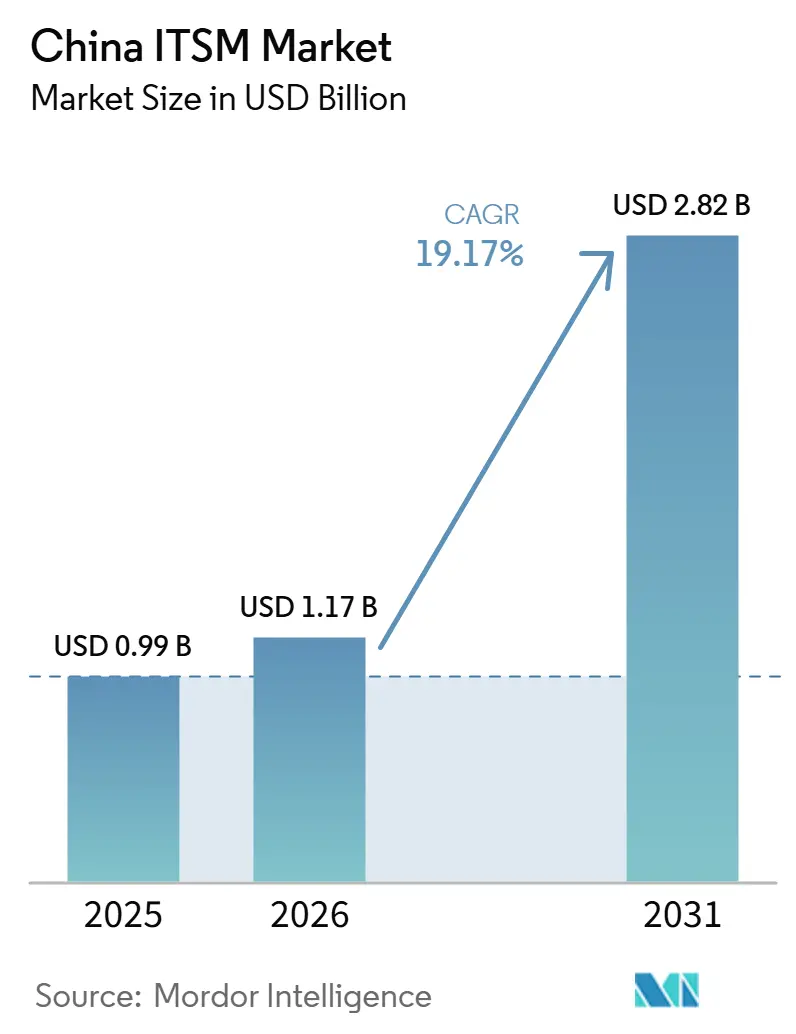
The China IT service management market size is projected to be USD 0.99 billion in 2025, USD 1.17 billion in 2026, and reach USD 2.82 billion by 2031, growing at a CAGR of 19.17% from 2026 to 2031. The China IT service management market is moving from basic support functions toward more structured and intelligence-led service operations as enterprise digitalization expands across sectors. Demand is also rising because cloud-ready infrastructure, AI deployment programs, and tighter operational accountability are pushing enterprises to modernize service workflows faster than before. The China IT service management market is also becoming more localized, as domestic vendors are better positioned to address language, integration, and compliance requirements that matter in regulated and public-sector accounts. At the same time, global vendors still retain a role in multinational and large private enterprise environments, where platform consistency and broader enterprise software alignment remain important. These conditions keep the China IT service management market on a fast growth path while also making vendor strategy, deployment flexibility, and implementation speed more important than feature breadth alone.
Key Report Takeaways
- By component, solutions led with 61.62% revenue share in 2025 of the China ITSM market, while services are projected to expand at a 21.62% CAGR through 2031.
- By deployment, cloud held a 58.62% share of the China ITSM market in 2025 and is also projected to record the fastest CAGR of 21.34% through 2031.
- By application, service desk and incident management accounted for 35.72% of the China ITSM market in 2025, while knowledge management is projected to expand at a 20.76% CAGR through 2031.
- By end-user industry, BFSI held 24.73% share of the China ITSM market in 2025, while healthcare is projected to record the highest CAGR of 20.84% through 2031.
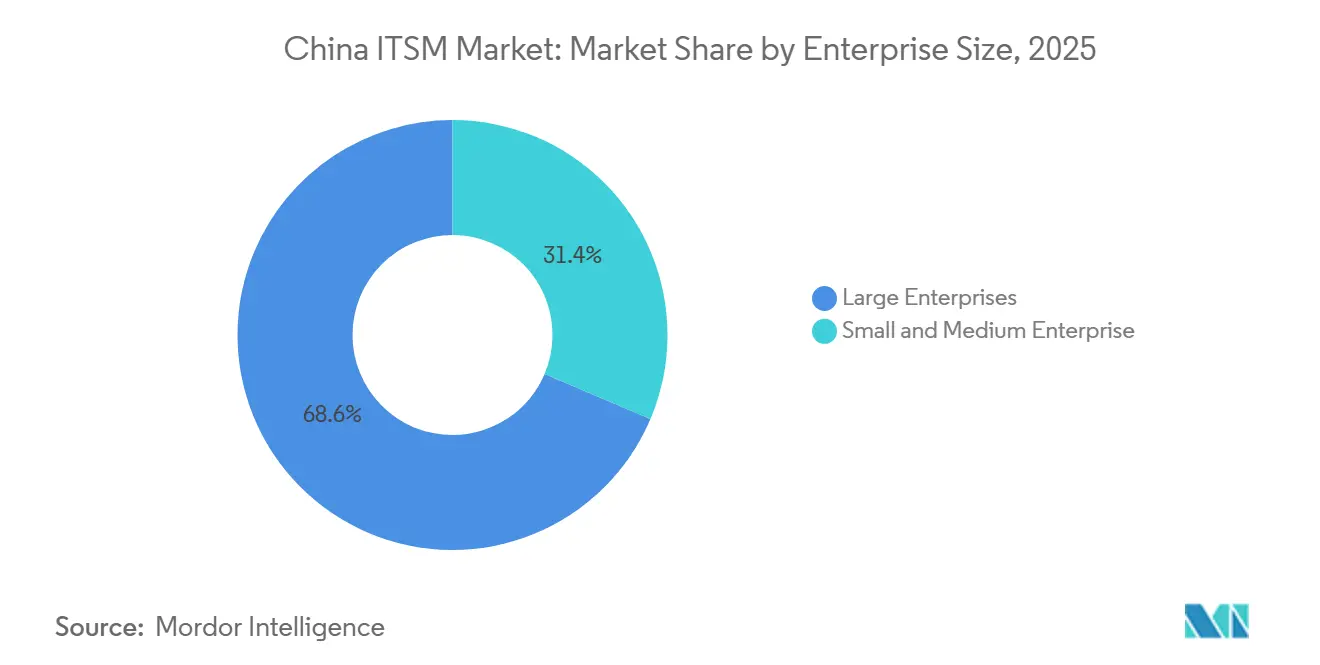
- By enterprise size, large enterprises accounted for 68.62% of the China ITSM market in 2025, while SMEs are projected to expand at a 21.67% CAGR through 2031.
Note: Market size and forecast figures in this report are generated using Mordor Intelligence’s proprietary estimation framework, updated with the latest available data and insights as of January 2026.
China ITSM Market Trends and Insights
Drivers Impact Analysis*
| Driver | (~) % Impact on CAGR Forecast | Geographic Relevance | Impact Timeline |
|---|---|---|---|
| Shift To Cloud-Native ITSM Platforms | +4.2% | National, with early gains in Beijing, Shanghai, and Shenzhen | Short term (≤ 2 years) |
| AI-Driven Service Automation Across Enterprises | +3.8% | National, concentrated in Tier 1 cities and state-owned enterprise clusters | Medium term (2-4 years) |
| Unified Service Management For Hybrid And Multi-Cloud Environments | +3.1% | National, with spill-over to APAC supply chain integrations | Medium term (2-4 years) |
| Rise Of Low-Code And No-Code ITSM Orchestration | +2.9% | National, with strongest uptake in SME-dense coastal provinces | Short term (≤ 2 years) |
| FinOps And GreenOps Reporting Embedded In ITSM Workflows | +2.4% | National, with compliance pressure in publicly listed enterprises | Medium term (2-4 years) |
| Growing Adoption Of ITSM For Edge Computing And Industrial IoT | +1.8% | National, concentrated in eastern and central industrial corridors | Long term (≥ 4 years) |
| Source: Mordor Intelligence | |||
Shift To Cloud-Native ITSM Platforms In Mainland China
The China IT service management market is benefiting from a broad move toward cloud-ready enterprise operations. China’s 2026 policy mix continues to support innovation, digitalization, and the national AI Plus agenda, which keeps enterprise technology upgrades high on management agendas. A documented case from a multinational company’s China headquarters showed that a localized ITSM migration could be completed within a strict compliance timeline, indicating that cloud-ready, locally adapted delivery models are now more practical for large organizations. As enterprises deploy more business systems on scalable digital infrastructure, they want service platforms that can connect to those environments without lengthy manual configuration cycles. That shortens the replacement window for older on-premise tools and increases the appeal of subscription-based deployment. It also favors vendors that can deliver fast implementation, local language support, and easier integration with domestic enterprise tools.
AI-Driven Service Automation Across Enterprises
AI is changing the role of IT service management from workflow administration to more automated operational support in the China IT service management market. Huawei introduced AUTINOps at MWC 2026 as an AI-native intelligent operations solution that places digital employees beside human engineers and supports more proactive operations.[1] China Construction Bank’s 2025 annual report also showed 398 AI application scenarios across business functions, reflecting the scale of service governance needed as AI becomes part of everyday enterprise activity.[2] In the China IT service management market, this means buyers are no longer looking only for ticket handling efficiency. They are also looking for platforms that can absorb operational knowledge, support faster resolution, and improve consistency across large support teams. Vendors that build stronger enterprise-specific process models are therefore likely to hold customers longer than vendors that only add generic AI features.
Unified Service Management For Hybrid and Multi-Cloud Environments
The China IT service management market is also being shaped by the need to manage mixed technology environments through one service layer. Large enterprises in banking, manufacturing, telecom, and government often run a combination of on-premise systems, cloud tenants, and edge environments, which makes fragmented point tools harder to justify. The State Council’s April 2026 guidance on service sector digitalization supports the wider deployment of digital infrastructure and edge-oriented service models, underscoring the need for coordinated service operations. The CanWay migration case also showed that enterprises want compliance alignment and broad systems integration in the same project rather than as separate workstreams. That pushes buyers toward unified platforms that can connect service requests, change records, asset data, and operational oversight in one environment. Vendors that package workflow control with compliance support are likely to replace siloed tools more quickly in the China IT service management market.
Rise Of Low-Code and No-Code ITSM Orchestration
Low-code service design is widening the addressable user base in the China IT service management market. The CanWay Blue Whale case showed that a low-code workflow engine supported a complex migration program while meeting MLPS Level 3 compliance and integration needs at a multinational company’s China headquarters. This matters because enterprises increasingly want line-of-business teams and local support units to configure service flows without waiting for long development cycles. In practice, that shortens rollout time and reduces dependence on scarce technical specialists for every workflow update. It also changes buying behavior because ease of implementation now carries more weight during procurement. As a result, vendors with visual workflow tools and simpler orchestration models are gaining stronger consideration across both large organizations and mid-sized buyers in the China IT service management market.
Restraints Impact Analysis*
| Restraint | (~) % Impact on CAGR Forecast | Geographic Relevance | Impact Timeline |
|---|---|---|---|
| Legacy Migration Complexity And High Switching Costs | -2.6% | National, highest in state-owned enterprise and banking clusters | Long term (≥ 4 years) |
| Shortage Of Skilled ITSM And ITOM Professionals | -2.1% | National, with acute pressure in Tier 2 and Tier 3 cities | Long term (≥ 4 years) |
| Data Residency, Security, And Compliance Frameworks | -1.8% | National, under China-specific cybersecurity and data governance rules | Short term (≤ 2 years) |
| Rising Observability Data Costs Causing Tool Sprawl | -1.4% | Broadly relevant, with sharper pressure in cloud-first enterprises | Medium term (2-4 years) |
| Source: Mordor Intelligence | |||
Legacy Migration Complexity and High Switching Costs
Legacy migration remains a meaningful drag on the China IT service management market. Many large organizations still rely on deeply customized ticketing environments and older process structures that are tied to ERP, HR, and asset systems. In the China IT service management market, the real difficulty is not only software replacement but also redesigning embedded processes that have grown up around old systems over the years. This lengthens implementation timelines and increases ownership costs for buyers with complex governance structures. It also slows new contract conversion in the largest enterprise accounts, where proof of low-disruption migration matters more than product positioning alone.
Shortage of Skilled ITSM And ITOM Professionals
The China IT service management market is also constrained by a shortage of people who can bridge service process design, automation, and modern operations models. It is noted that AI-native operations now require teams that understand both established service practices and newer agent-based automation models. This gap is most visible outside the largest coastal cities, where enterprise modernization is expanding, but specialist staffing remains thin. That imbalance helps cloud-delivered platforms by reducing the local technical effort required for routine deployment and support. Even so, larger programs still depend on experienced architects for workflow design and organizational change. The result is a market where demand is growing quickly, but high-skill implementation capacity still limits how fast complex projects can scale.
*Our forecasts treat driver/restraint impacts as directional, not additive. The impact forecasts reflect baseline growth, mix effects, and variable interactions.
Segment Analysis
By Component: Solutions Anchor Revenue While Services Scale
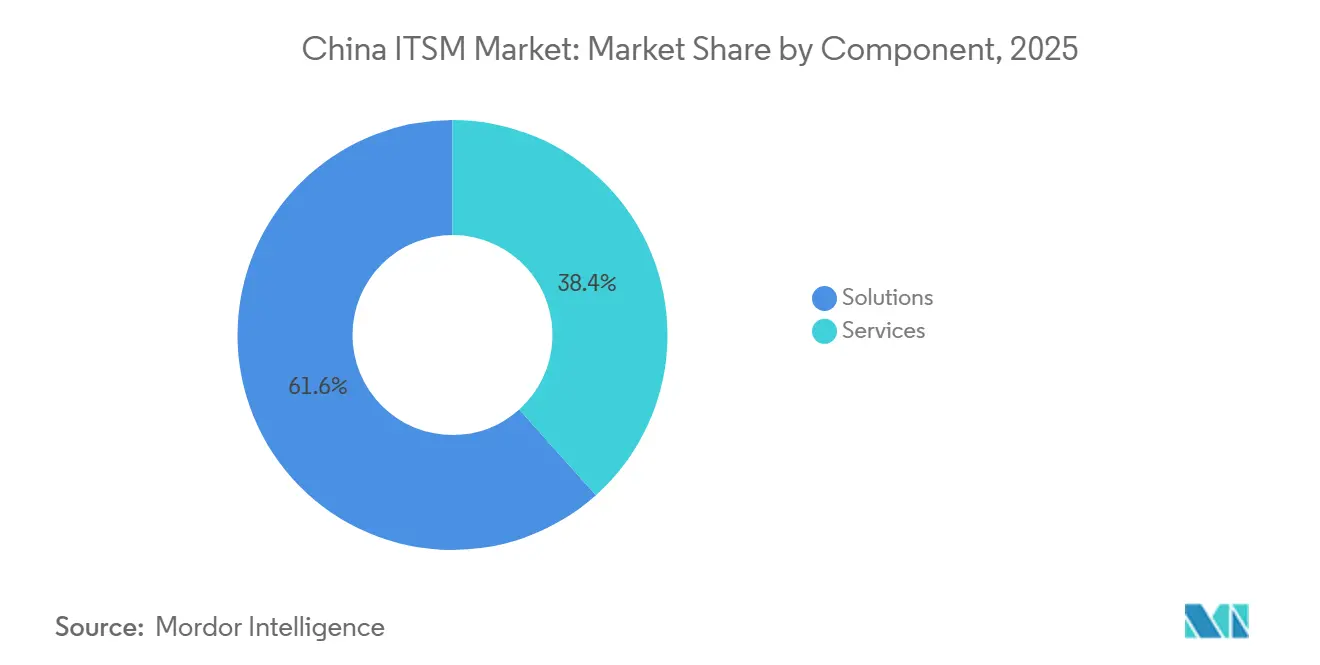
Solutions commanded 61.62% of the China IT service management market share in 2025, which kept the revenue base centered on integrated software suites rather than pure service delivery. These platforms usually combine incident management, change management, service catalog functions, and configuration visibility in a single environment, which explains why enterprises still allocate most spending to software-led rollouts. The China IT service management market has also favored solution vendors, as buyers seek greater control over workflow design, policy alignment, and long-term process standardization. That pattern remains strongest in large accounts where service operations are tied to audit readiness and business continuity practices. In that setting, software remains the anchor, even when services are included in the purchase.
Services, however, are projected to expand at a 21.62% CAGR through 2031, making them the fastest-growing component of the China IT service management market. The shift reflects rising demand for implementation support, managed operations, AI advisory work, and post-deployment optimization. This is especially relevant when buyers want faster time-to-value but do not yet have sufficient internal ITSM depth to manage a full rollout on their own. Atlassian’s October 2025 launch of Service Collection showed how product vendors are broadening their role around enterprise service delivery, which further blurs the line between software and service value.[3] The China IT service management industry is therefore seeing a more recurring revenue mix, where services increasingly support retention and expansion after the core platform is deployed.
By Deployment: Cloud Convergence Accelerates Across Enterprise Tiers
Cloud deployment held 58.62% of the China IT service management market size in 2025, and it is also projected to record the fastest 21.34% CAGR through 2031. That combination shows that the leading deployment model is still gaining strength rather than reaching maturity. In the China IT service management market, cloud deployment appeals to enterprises seeking faster rollouts, easier updates, and reduced reliance on local infrastructure management. It also suits organizations that are trying to standardize service processes across multiple offices and user groups. This is why cloud adoption is moving beyond new buyers and into replacement cycles among established enterprises.
On-premise deployment still matters in defense-linked environments, classified government networks, and selected financial institutions where physical control and strict certification remain important. The hybrid model continues to serve enterprises that run production-critical environments on-site while moving less sensitive workflows to cloud-based systems. Freshworks expanded Freshservice in April 2026 through continuous discovery and dependency mapping across cloud, hybrid, and on-premises environments, demonstrating that hybrid service management still needs active product development rather than just simple deployment flexibility. In practical terms, the China IT service management market is rewarding vendors that can help buyers manage mixed estates rather than force a full one-step migration path. The China IT service management industry is therefore moving toward cloud-centered deployment, but it is doing so through staged operational convergence rather than a clean break from legacy environments.
By Application: Service Desk Leads While Knowledge Management Gains Ground
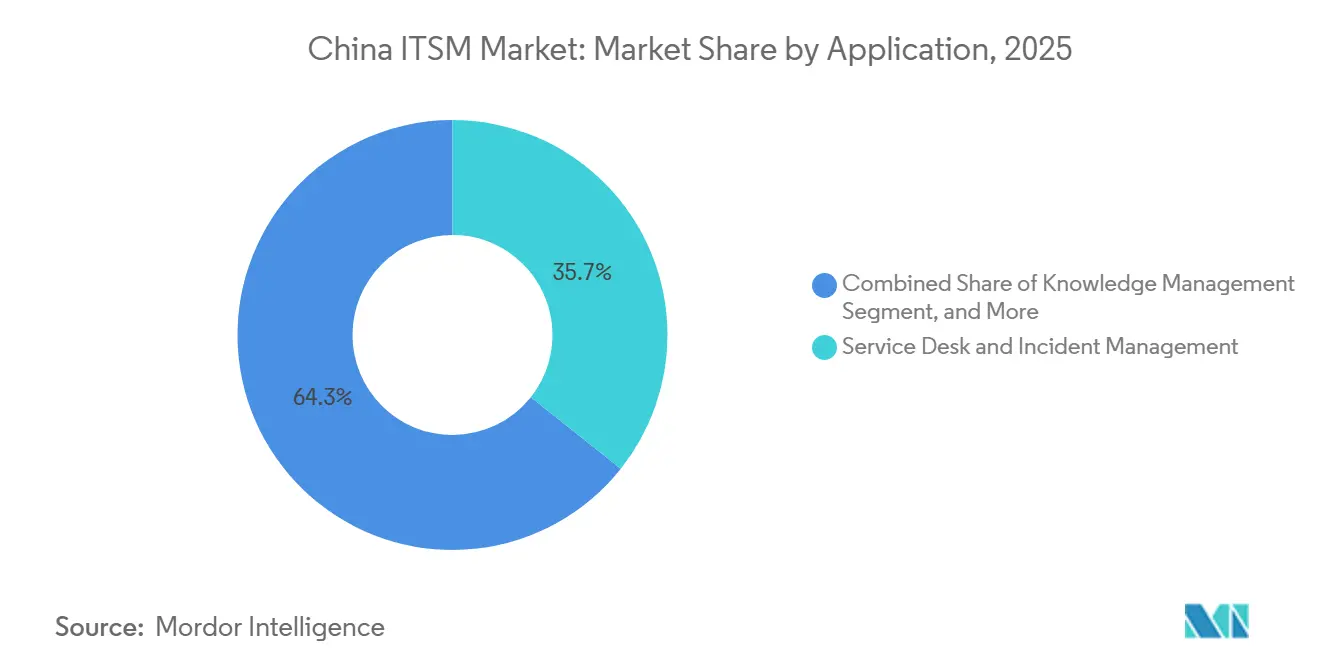
Service desk and incident management accounted for 35.72% of the China IT service management market in 2025, keeping ticket-centric operations at the core of enterprise demand. The reason is simple: this application remains the main point where users, support teams, and service commitments meet. In the China IT service management market, this layer is also the easiest place for buyers to measure operational gains through faster resolution, better request visibility, and more consistent workflow handling. It remains essential for organizations that want stronger internal accountability without redesigning every support process at once. That is why the largest application segment continues to anchor current spending.
Knowledge management is projected to expand at a 20.76% CAGR through 2031, which makes it the fastest-growing application in the China IT service management market. Freshworks reported a 32% AI-driven ticket deflection rate at Seagate after deploying Freshservice, which helps explain why enterprises are placing more value on captured operational knowledge and reusable answers. The application is gaining traction because incident knowledge now supports not only human agents but also automation and guided self-service. Asset and configuration management, change and release management, and service request management still provide the process backbone for structured IT organizations, so their role remains steady even without breakout growth. The China IT service management market is therefore expanding from a service desk base into a broader knowledge-led operating model that can support more autonomous resolution over time.

By End-User Industry: BFSI Holds The Lead While Healthcare Moves Fastest
BFSI accounted for 24.73% of the China IT service management market in 2025, making it the largest end-user vertical. The sector has long depended on structured workflows, service accountability, audit trails, and reliable system availability, which align naturally with mature ITSM spending. China Construction Bank’s 2025 annual report showed 398 AI application scenarios across areas such as wealth management, inclusive finance, and risk management, while enterprise cloud computing capacity grew 12.10%. Those figures reflect how deeply service coordination now supports core financial operations rather than only back-office support. In the China IT service management market, BFSI remains a stable demand anchor because service disruptions, compliance failures, and poor workflow control each entail high operational costs.
Healthcare is projected to expand at a 20.84% CAGR through 2031, which makes it the fastest-growing vertical in the China IT service management market. A 2025 Journal of Medical Systems article reported that DeepSeek-based architectures had been deployed in more than 90 tertiary hospitals in China, suggesting a broader need for reliable service support for AI-assisted care environments. As digital clinical tools, telehealth systems, and smart hospital programs spread, hospitals need clearer change control, service continuity, and issue resolution processes. Manufacturing, government and public sector, IT and telecommunications, retail and e-commerce, and travel and hospitality continue to add demand through their own digital transformation programs. The China IT service management market is therefore anchored by heavily governed sectors today, while healthcare is opening a strong new path for future adoption.
By Enterprise Size: Large Enterprises Lead Spending While SMEs Drive Growth
Large enterprises held 68.62% of the China IT service management market share in 2025, which reflects years of accumulated spending on structured service operations, integrated tooling, and governance-heavy IT environments. The China IT service management market has grown around these buyers because they operate at a larger scale and usually support more complex user, asset, and workflow footprints. Large organizations also tend to replace earlier-generation tools with broader platforms rather than start from manual processes, which keeps their spending intensity high. In addition, they often need tighter reporting, internal controls, and cross-functional service coordination than smaller firms. This means they continue to shape vendor roadmaps even as adoption broadens.
SMEs are projected to record the fastest 21.67% CAGR through 2031, which makes them the strongest growth engine in the China IT service management market. Their expansion is linked to rising interest in lower-cost, faster-to-deploy service platforms that do not require large in-house specialist teams. The market is opening up as many smaller firms move away from manual handling and homegrown systems toward subscription-based tools with easier configuration. That demand is especially important in commercial and industrial clusters where digital operations are spreading faster but local service management capability remains less mature. The China IT service management market is therefore advancing through 2 different demand paths at once, with large enterprises driving value through upgrades and SMEs driving volume through first-time adoption.
Geography Analysis
The China IT service management market operates within one national market, but adoption maturity is not evenly distributed across locations. Tier 1 cities such as Beijing, Shanghai, Shenzhen, and Guangzhou account for the largest concentration of current enterprise ITSM spending because they host the headquarters of major banks, state-owned enterprises, and multinational technology firms. These cities also act as early test beds for advanced service models, since complex enterprise environments there create stronger demand for AI-enabled and compliance-ready workflows. A documented migration at a multinational company’s China headquarters showed that localized ITSM replacement with MLPS Level 3 compliance could be executed in a Tier 1 setting under tight operational requirements. The China IT service management market therefore continues to draw its highest-value projects from top-tier urban centers where digital systems are already broad and deeply embedded.
Tier 2 cities such as Chengdu, Wuhan, Hangzhou, and Nanjing are becoming the next major growth layer in the China IT service management market. China’s 15th Five-Year Plan targets the digital economy’s core value-added at 12.5% of GDP by 2030, which supports wider enterprise technology investment beyond the biggest coastal hubs. As enterprise activity spreads inward, these locations are seeing more demand for service platforms that can be deployed quickly and managed with fewer local specialists. Domestic vendors often have an advantage here because they offer Chinese-language workflow design, familiar local integrations, and pricing better suited to emerging regional budgets. That mix is helping the China IT service management market reach a broader set of buyers without depending only on the most mature coastal centers.
Western and northeastern China remain earlier-stage areas in the China IT service management market, yet policy support is steadily raising their relevance. The State Council’s April 2026 direction on service industry digitalization called for continued work on digital infrastructure and edge-oriented service environments, which should increase service management needs in inland operating corridors. These regions historically relied more on manual operations, but wider industrial digitalization creates a stronger case for standardized incident, change, and asset processes. This gives the China IT service management market a longer expansion runway, with future growth likely to come from geographic spread as much as from deeper penetration in top-tier cities.
Competitive Landscape
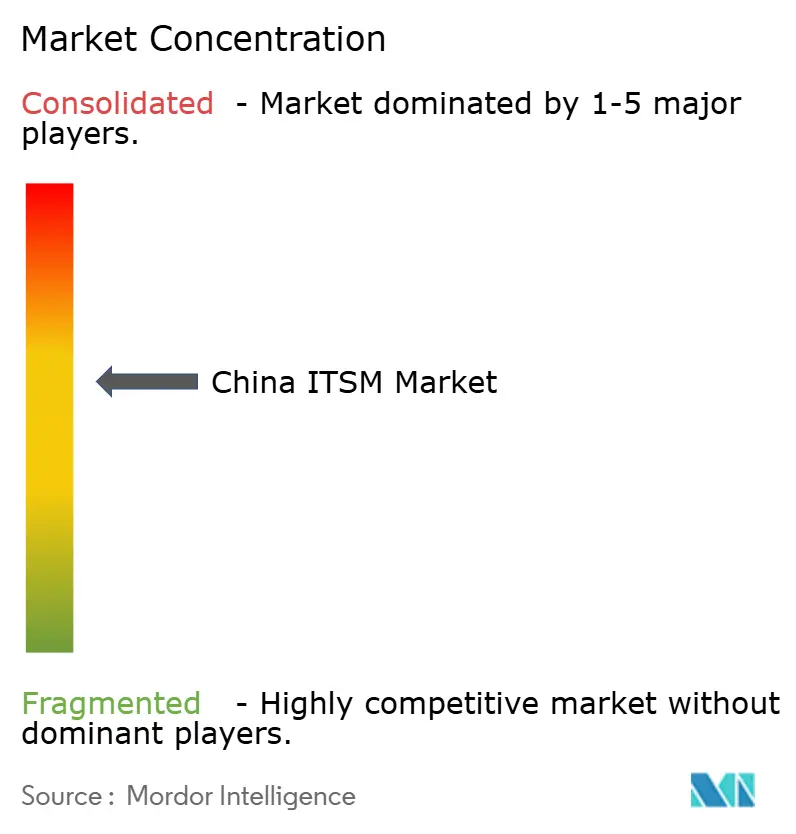
The China IT service management market has a fragmented competitive landscape, with global enterprise software vendors competing alongside a growing domestic vendor base. Global platforms still hold an important position in multinational and large private enterprise accounts where buyers want wider ecosystem alignment, mature workflow libraries, and cross-border platform consistency. ServiceNow and Lenovo announced an expanded multi-year agreement in May 2026 that combines Lenovo’s xIQ Digital Workplace Platform with ServiceNow’s AI Control Tower and Workflow Data Fabric, showing how global vendors are extending service management into broader digital workplace operations. Atlassian’s October 2025 Service Collection launch also showed how platform vendors are integrating service management, customer service, and asset management more closely within a single environment. In the China IT service management market, these moves matter because private-sector buyers increasingly want service tools that align with broader enterprise software strategy rather than stand alone.
Domestic vendors are gaining ground in the China IT service management market because they are closer to local compliance needs, domestic operating environments, and Chinese-language workflow design. Yonyou introduced YonLOM in February 2026 as an enterprise-level AI model meant to integrate data, AI, and business process execution across finance, supply chain, and IT service management functions. That move suggests that local vendors are not treating ITSM as a narrow software category, but as part of a wider enterprise intelligence layer. Huawei’s September 2025 recognition as a representative vendor for campus infrastructure and operations software also supports the view that local players are building stronger end-to-end operations capability. In regulated sectors, these companies benefit from stronger compatibility with domestic systems and clearer positioning around localized support expectations. This is why the China IT service management market is not following a simple imported-software model, but is instead forming around 2 different vendor routes that appeal to different buyer groups.
Strategic positioning in the China IT service management market now depends less on brand awareness alone and more on implementation fit, platform breadth, and local delivery readiness. Global vendors remain relevant where organizations want common architectures across countries and tighter links with developer, HR, or customer service tools. Domestic vendors remain better placed where policy, localization, and domestic infrastructure compatibility are decisive in the purchase decision. ZTE’s 2025 sustainability reporting highlighted formal business continuity and GreenOps-related management practices, which points to the level of compliance-aware documentation enterprise customers now expect from supporting platforms. The China IT service management market is therefore becoming more segmented by buyer context, with multinational alignment driving one part of demand and localized operational fit driving another.
China ITSM Industry Leaders
-
ServiceNow, Inc.
-
International Business Machines Corporation
-
BMC Software, Inc.
-
Atlassian Corporation Plc
-
Ivanti, Inc.
- *Disclaimer: Major Players sorted in no particular order
Recent Industry Developments
- May 2026: ServiceNow and Lenovo announced an expanded multi-year strategic agreement at Knowledge 2026, combining Lenovo's xIQ Digital Workplace Platform with ServiceNow's AI Control Tower and Workflow Data Fabric. Internal testing indicates expected outcomes of up to 30% reduction in IT support costs, up to 50% faster employee onboarding, and up to 40% proactive IT issue resolution, the collaboration launched across Australia, New Zealand, Hong Kong, and Singapore with global expansion planned.
- May 2026: Freshworks launched AI Agent Studio with over 20 prebuilt agentic workflows and MCP Gateway for native integration with external AI tools at Refresh 2026, alongside full integration of IT Asset Management, via Device42 acquisition, and ITOM, via FireHydrant, into a single unified Freshservice operations platform, consolidating hardware, software, and incident response into one operational environment.
- April 2026: Huawei Cloud announced a CNY 200 million (USD 28.9 million) AI ecosystem fund at the Global Smart Finance Summit, HiFS 2026, partnering with Cloudwise to deliver AI infrastructure intelligent operations and automated change management workflows integrating Cloudwise ITSM, Huawei NCE network cloud engine, and Huawei DCS data communication systems for global financial institutions.
- March 2026: Huawei launched AUTINOps, described as the industry's first AI-native intelligent operations solution, at the 4th Intelligent Operations Forum at MWC 2026. AUTINOps introduces a three-layer architecture covering Foundation, Service, and Expert layers, deploying digital employees alongside human engineers to target autonomous fault prevention and proactive operations, positioning for Autonomous Network Level 4 progression.
China ITSM Market Report Scope
The China IT Service Management Market is Segmented by Component (Solutions, and Services), Deployment (Cloud, On-Premise, and Hybrid), Application (Service Desk and Incident Management, Asset and Configuration Management, Change and Release Management, Service Request Management, Knowledge Management, and Others), End-User Industry (BFSI, Manufacturing, Government and Public Sector, IT and Telecommunications, Retail and E-Commerce, Healthcare, and Others), and Enterprise Size (Large Enterprises, and Small and Medium Enterprises). The Market Forecasts are Provided in Terms of Value (USD).
| Solutions |
| Services |
| Cloud |
| On-Premise |
| Hybrid |
| Service Desk and Incident Management |
| Asset and Configuration Management |
| Change and Release Management |
| Service Request Management |
| Knowledge Management |
| Other ITSM Applications |
| BFSI |
| Manufacturing |
| Government and Public Sector |
| IT and Telecommunications |
| Retail and E-Commerce |
| Healthcare |
| Travel and Hospitality |
| Other End-User Industries |
| Large Enterprises |
| Small and Mid-Size Enterprises (SME) |
| By Component | Solutions |
| Services | |
| By Deployment | Cloud |
| On-Premise | |
| Hybrid | |
| By Application | Service Desk and Incident Management |
| Asset and Configuration Management | |
| Change and Release Management | |
| Service Request Management | |
| Knowledge Management | |
| Other ITSM Applications | |
| By End-User Industry | BFSI |
| Manufacturing | |
| Government and Public Sector | |
| IT and Telecommunications | |
| Retail and E-Commerce | |
| Healthcare | |
| Travel and Hospitality | |
| Other End-User Industries | |
| By Enterprise Size | Large Enterprises |
| Small and Mid-Size Enterprises (SME) |
Key Questions Answered in the Report
What is the China IT service management market size in 2026 and what will it reach by 2031?
The China IT service management market stands at USD 1.17 billion in 2026 and is forecast to reach USD 2.82 billion by 2031, growing at a 19.17% CAGR over 2026-2031.
Which deployment model is leading adoption in China?
Cloud deployment leads with 58.62% share in 2025 and is also the fastest-growing deployment model, with a projected 21.34% CAGR through 2031.
Which application area generates the most demand for ITSM platforms in China?
Service desk and incident management leads with 35.72% share in 2025 because it remains the main operational layer for ticket handling, response control, and user support.
Which end-user sector is currently the largest buyer of ITSM solutions in China?
BFSI is the largest vertical, holding 24.73% share in 2025, supported by strong needs around workflow control, audit readiness, and high-availability service operations.
Which customer group is creating the strongest future growth opportunity?
SMEs are projected to grow at a 21.67% CAGR through 2031, which makes them the fastest-growing enterprise size segment as more smaller firms move from manual service handling to formal platforms.