
ITSM In Government and Public Sector Market Size and Share
Market Overview
| Study Period | 2020 - 2031 |
|---|---|
| Market Size (2026) | USD 1.71 Billion |
| Market Size (2031) | USD 3.46 Billion |
| Growth Rate (2026 - 2031) | 15.13 % |
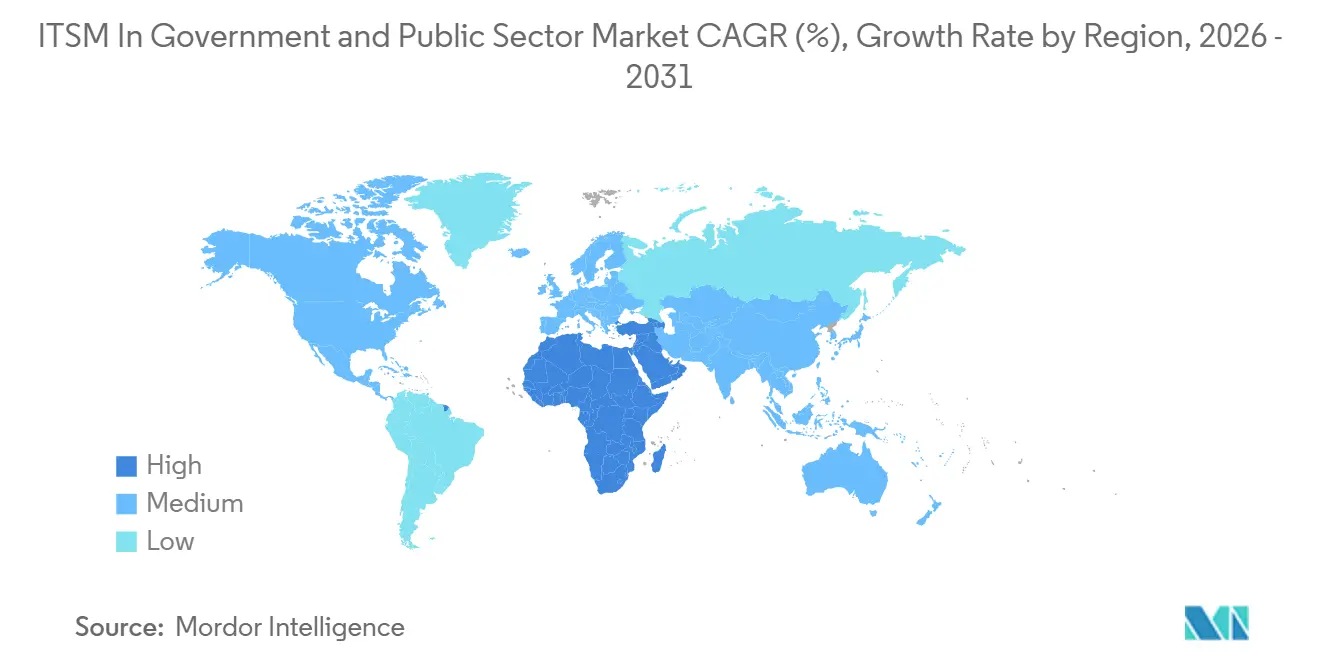
| Fastest Growing Market | Middle East and Africa |
| Largest Market | North America |
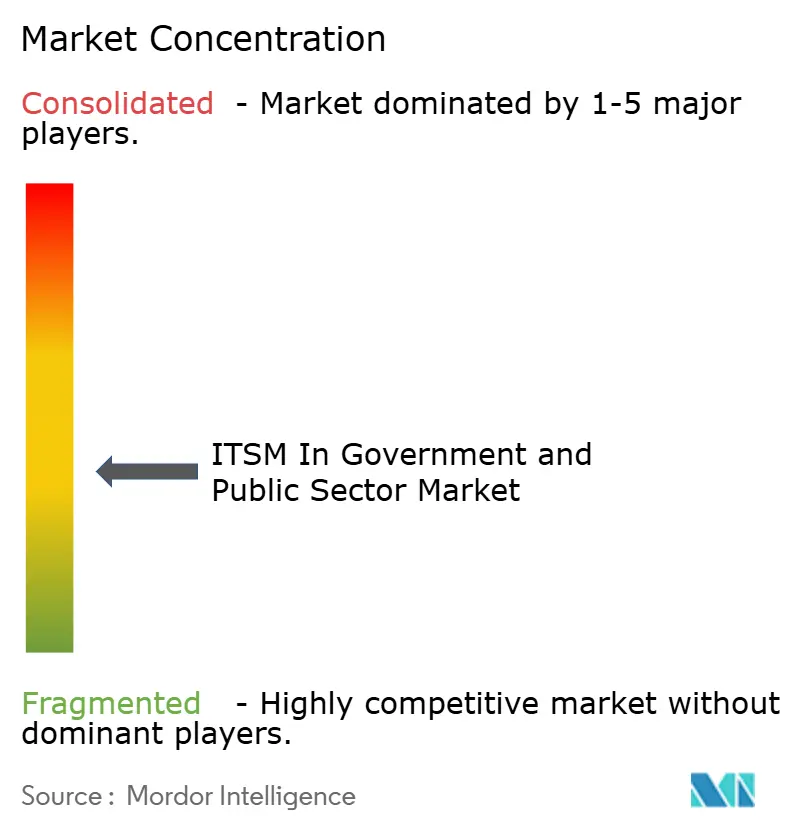
| Market Concentration | Medium |
Major Players *Disclaimer: Major Players sorted in no particular order Image © Mordor Intelligence. Reuse requires attribution under CC BY 4.0. | |
ITSM In Government and Public Sector Market Analysis by Mordor Intelligence
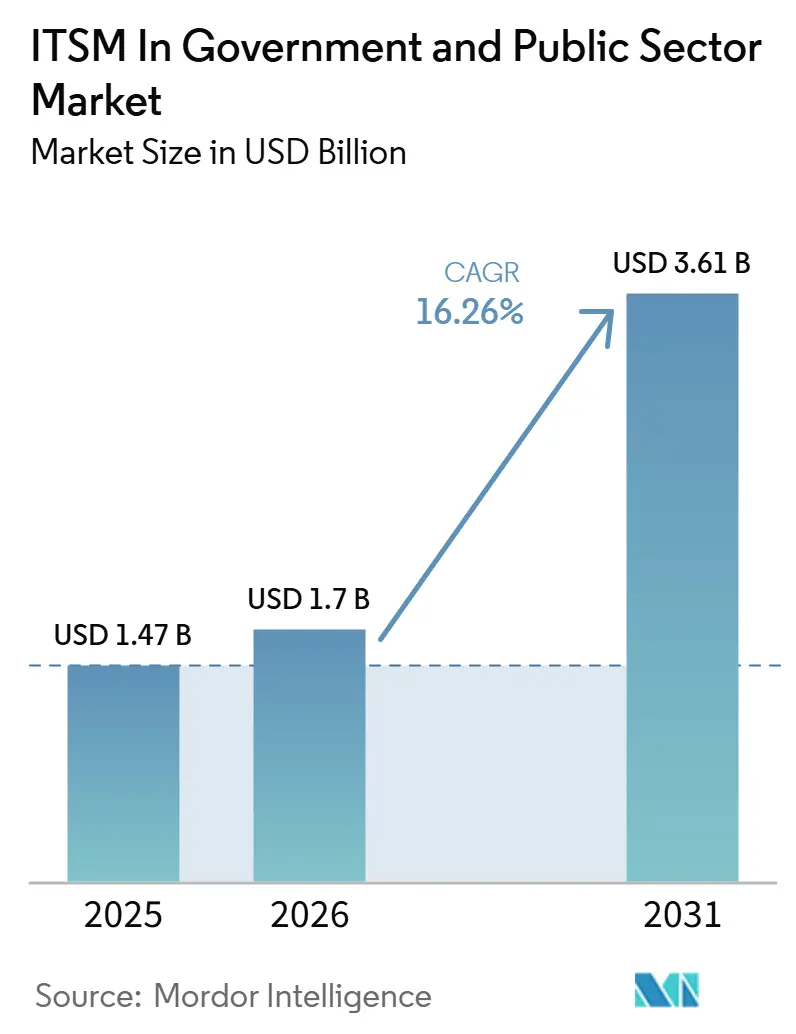
The ITSM in the Government and Public Sector Market size is expected to increase from USD 1.47 billion in 2025 to USD 1.71 billion in 2026 and reach USD 3.46 billion by 2031, growing at a CAGR of 15.13% over 2026-2031. The ITSM in the government and public sector market is expanding because public agencies are moving away from periodic infrastructure refreshes and toward continuous, platform-based service operations shaped by ITIL 4 practices. Cloud-first mandates, rising expectations for simple digital public services, and stronger pressure to show operating efficiency are keeping service management high on modernization agendas. End-of-support deadlines for older platforms are also forcing procurement decisions that many agencies had delayed for years, especially where cybersecurity, audit, and data control requirements have become more demanding. Competition is increasingly shaped by compliance authorizations, sovereign cloud readiness, and modular deployment models that make adoption practical for both large ministries and smaller agencies. Deployment speed and data residency still limit execution in some settings, yet the ITSM in government and public sector market continues to benefit from a broader pool of compliant AI tools and government-backed digital transformation programs.
Key Report Takeaways
- By component, Solutions held 64.40% of the market in 2025, while Services is projected to expand at a 15.70% CAGR through 2031.
- By deployment, Cloud held 63.10% of the market in 2025 and is also projected to record the fastest growth at a 16.10% CAGR through 2031.
- By application, Service Desk and Incident Management accounted for a 30.65% share in 2025, while Knowledge Management is projected to advance at a 15.50% CAGR through 2031.
- By enterprise size, Large Enterprises held 66.05% of the market in 2025, while SMEs are projected to expand at a 15.60% CAGR through 2031.
- By geography, North America accounted for 40.20% of the ITSM in the government and public sector market size in 2025, while the Middle East and Africa are projected to grow at a 16.05% CAGR through 2031.
Note: Market size and forecast figures in this report are generated using Mordor Intelligence’s proprietary estimation framework, updated with the latest available data and insights as of January 2026.
Market Trends and Insights
Drivers Impact Analysis of ITSM In Government and Public Sector Market*
| Driver | (~) % Impact on CAGR Forecast | Geographic Relevance | Impact Timeline |
|---|---|---|---|
| Cloud-First Public Sector Modernization | +4.2% | Global, strongest pull in North America, Europe, and Gulf states | Short term (≤ 2 years) |
| AI-Powered Service Desk Deflection and Self-Service Automation | +2.8% | Global, led by North America and Western Europe | Short term (≤ 2 years) |
| Cybersecurity and Compliance Pressure on Service Operations | +2.5% | North America and EU core, spill-over to APAC and Middle East and Africa | Medium term (2-4 years) |
| Shared Services and Cross-Agency Workflow Standardization | +1.8% | North America, EU, and Australia | Medium term (2-4 years) |
| Zero-Touch Request Fulfillment for Citizen-Facing and Employee-Facing Services | +1.2% | Global, early adoption in Gulf and Southeast Asia | Long term (≥ 4 years) |
| Lifecycle Management of Public Sector Hardware and Software Assets | +0.9% | Global | Medium term (2-4 years) |
| Source: Mordor Intelligence | |||
Cloud-First Public Sector Modernization
Government cloud adoption has shifted from policy language to practical procurement direction, and the ITSM in the government and public sector market benefits early because service management platforms sit at the center of daily IT operations and workflow control. Shared Services Canada stated in its 2025-26 Departmental Plan that it plans to complete onboarding of remaining service partners to its enterprise ITSM tool by 2026-27, with automated real-time synchronization of ticketing data identified as a core delivery milestone. That kind of program shows that cloud-first modernization is no longer a narrow infrastructure decision, because agencies want one operating layer for service requests, incidents, and operational reporting across departments. Germany reinforced the same direction in May 2026 when the BMDS awarded a sovereign AI cloud contract worth EUR 250 million (USD 278 million), with zero-trust, open-source, and key-sovereignty requirements built into the architecture for federal use[1]. The practical effect is that unsupported on-premise tools are becoming harder to justify, because agencies face a direct tradeoff between compliance exposure and modernization spending. This forced replacement cycle is a major reason the ITSM in government and public sector market continues to expand even in environments where overall budget approval remains cautious.
AI-Powered Service Desk Deflection and Self-Service Automation
AI is moving quickly into government service desks because public-sector ticket volumes are repetitive, rules-based, and large enough to support meaningful automation gains without changing the basic service model. Atlassian reported in 2025 that 93% of organizations saw higher efficiency from AI, and 98% were already using AI in some capacity, which supports broader adoption patterns around service workflows and knowledge handling. ServiceNow’s public-sector portfolio is already structured around digital services, case management, workflow automation, and secure service delivery, which makes AI deflection a direct extension of the existing operating model rather than a separate program. In February 2026, Moveworks from ServiceNow achieved FedRAMP Moderate authorization, widening the pool of secure conversational AI tools available to federal and public-sector organizations in controlled cloud environments. As agencies turn resolved incidents into searchable knowledge, guided responses, and reusable workflows, self-service becomes easier to scale across the ITSM in the government and public sector market. This is why knowledge-based automation is moving from optional experimentation to a practical operating requirement in many public environments.
Cybersecurity and Compliance Pressure on Service Operations
Security and compliance requirements now shape service management buying decisions as strongly as product breadth does, especially in the upper end of the ITSM in the government and public sector market. ServiceNow’s public-sector offer carries FedRAMP High and DoD Impact Level 4 and 5 authorizations, and those credentials effectively set the minimum standard for many sensitive U.S. procurements. When agencies need certified operating environments, vendors without equivalent approvals are often filtered out before product evaluation begins, which narrows competitive choice in large contracts. GAO reported in February 2025 that only 3 of 10 critical federal legacy systems identified for modernization in 2019 had been completed, which keeps operational risk and audit pressure visible at the leadership level. The same GAO report also noted that 2 of the remaining 7 systems had no planned completion date, showing how security exposure can persist when modernization timelines slip. The result is a market where certified platforms gain an advantage not only in trust but also in procurement eligibility, renewal stability, and the ability to expand into adjacent workflow areas.
Shared Services and Cross-Agency Workflow Standardization
Shared-service models are emerging as a durable growth path because a single platform contract can support multiple agencies and create standardized workflows across a broader administrative base in the ITSM in the government and public sector market. France’s SUMiT program, built on the open-source iTop platform, had already been deployed across 8 académies by mid-2024, and 2 additional academic regions were preparing migration in early 2025. Germany’s IT-Planungsrat also embedded ITSM capabilities within the Deutsche Verwaltungscloud target architecture, which shows that service management is being treated as part of the core public cloud operating framework. China’s 15th Five-Year Plan for 2026-2030 calls for cross-departmental data sharing and unified digital service platforms, reinforcing the same requirement for coordinated workflows across administrative levels. Once agencies join common platforms, shared incident data and reusable workflow logic improve consistency and can reduce the time needed to resolve similar service issues. This gives standardization a clear operating value beyond procurement efficiency and helps sustain long-term expansion in the ITSM in the government and public sector market.
Restraints Impact Analysis of ITSM In Government and Public Sector Market*
| Restraint | (~) % Impact on CAGR Forecast | Geographic Relevance | Impact Timeline |
|---|---|---|---|
| Legacy Procurement Cycles Slow Platform Replacement | -2.5% | Global, most pronounced in North America and Europe | Short term (≤ 2 years) |
| Data Residency and Sovereignty Constraints Limit Cloud Adoption | -1.8% | EU, Middle East, and APAC | Medium term (2-4 years) |
| Fragmented Agency Operating Models Reduce Process Standardization | -1.2% | Global, most acute in federal systems with high agency autonomy | Long term (≥ 4 years) |
| Skills Gaps in ITSM Automation and CMDB Governance | -0.9% | Global | Medium term (2-4 years) |
| Source: Mordor Intelligence | |||
Legacy Procurement Cycles Slow Platform Replacement
Government procurement still runs on multiyear budget approvals and tender processes, and that timing often slows real deployment even when modernization policy is already in place. GAO reported in February 2025 that only 3 of 10 critical federal legacy systems identified in 2019 had been modernized, while 2 of the remaining 7 still had no planned completion date. This gap matters for the ITSM in the government and public sector market because the agencies with the oldest platforms are often the ones least able to execute a fast replacement. Annual appropriations, mandatory competition, and cautious change control extend the period between project approval and operational go-live in many public programs. Even when funding is approved, replacement cycles frequently lag vendor release schedules and AI feature development, which weakens the pace of implementation rather than the level of demand. The restraint is therefore less about whether agencies want modern ITSM, and more about how slowly many of them can move from policy intent to production use.
Data Residency and Sovereignty Constraints Limit Cloud Adoption
Data residency rules continue to limit how quickly fully shared SaaS models can spread across the ITSM in the government and public sector market. Germany’s BMDS designed its sovereign AI cloud contract around zero-trust, open-source, and key-sovereignty requirements, showing how tightly architecture choices are tied to public control of data and access. When dedicated in-country infrastructure is unavailable, agencies may delay migration or keep sensitive workloads in isolated environments even when cloud economics are favorable. ServiceNow’s Government Community Cloud and National Security Cloud illustrate the vendor response, which is to offer deployment paths that fit stricter sovereignty and mission boundaries[2]. These conditions do not stop adoption, but they do narrow platform choice and raise implementation complexity for governments that need modernization, together with strict jurisdictional control. As a result, deployment decisions in the ITSM in the government and public sector market are often shaped by residency compliance first and feature preference second.
*Our forecasts treat driver/restraint impacts as directional, not additive. The impact forecasts reflect baseline growth, mix effects, and variable interactions.
ITSM In Government and Public Sector Market Segment Analysis
By Component:
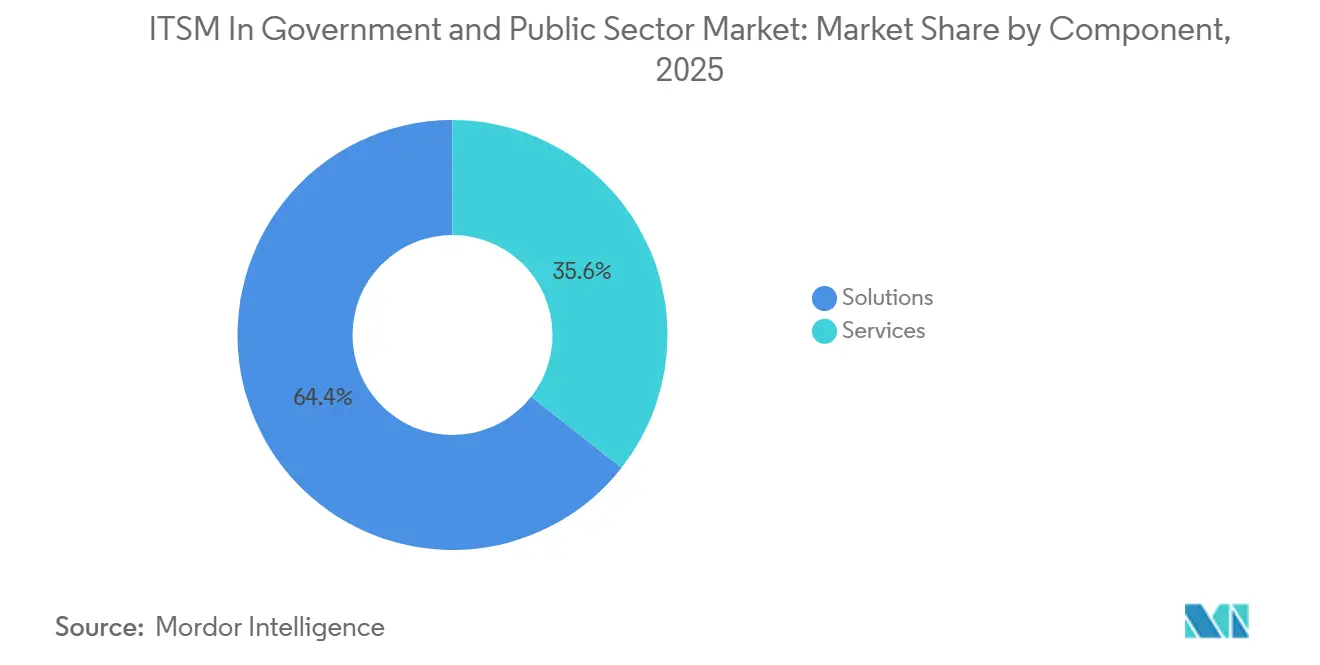
Solutions Anchor Revenue While Services Deepen AdoptionSolutions held 64.40% of the ITSM in the government and public sector market share in 2025, reflecting the strong preference for one platform that combines incident management, CMDB, change orchestration, and self-service under a single licensing framework. That preference keeps software revenue concentrated because agencies usually begin with core workflows and then expand into adjacent modules as user adoption grows across departments. In many public organizations, a single integrated platform is easier to govern than a collection of separate tools, especially when reporting, approvals, audit trails, and service definitions need to stay consistent. The solutions layer also benefits from long configuration life cycles, since process models, service catalogs, and asset records become deeply embedded in day-to-day operations once implementation is complete. This embedded role helps explain why the ITSM in the government and public sector market continues to favor platform-led buying behavior even when budgets are carefully staged.
Services are the fastest-growing component, with the ITSM in the government and public sector market size for services projected to expand at a 15.70% CAGR between 2026 and 2031. Agencies increasingly recognize that software alone does not deliver outcomes unless it is supported by implementation planning, workforce enablement, governance discipline, and regular optimization. As AI functions become more common, services work becomes even more important because automation rules, data quality controls, integration logic, and knowledge design need active management after go-live. Public bodies also face process variation across departments, which creates a continuing need for advisory and managed support rather than a one-time deployment exercise. This is why system integrators and specialist partners remain important to the ITSM in government and public sector industry, especially where agencies need to stabilize service operations while modernizing them.
By Deployment:
Cloud Leads the Installed Base and Future GrowthCloud held 63.10% of the ITSM in the government and public sector market in 2025, and the ITSM in the government and public sector market size for cloud deployment is projected to expand at a 16.10% CAGR through 2031. This dual position shows that the move from on-premise to cloud is still active across many agencies rather than already complete. Cloud-first procurement policies are helping the segment because governments want faster upgrades, simpler workflow scaling, and broader access to AI-enabled features without maintaining large local stacks. Shared Services Canada’s enterprise onboarding plan also points to a model in which common service tooling can support wider administrative coordination and more unified ticket data flows. The BMDS sovereign cloud award further shows that cloud adoption in public administration now reaches mission-critical workloads when control and sovereignty requirements are addressed directly.
On-premise and hybrid deployments still hold value in classified, defense-linked, or sovereignty-sensitive environments where shared SaaS models do not meet policy requirements. This means deployment is no longer a simple cloud-versus-on-premise decision, because agencies often place different workloads in different environments according to sensitivity, control, and audit needs. In many tenders, authorization status matters more than feature differences, since agencies need certified operating conditions before they compare workflow depth or interface design. Vendors that can offer cloud flexibility together with secure isolation are therefore better positioned to win across a wider range of public use cases. The ITSM in government and public sector market is likely to keep favoring cloud growth, but the winning model will remain compliance-shaped rather than purely feature-led.
By Application:
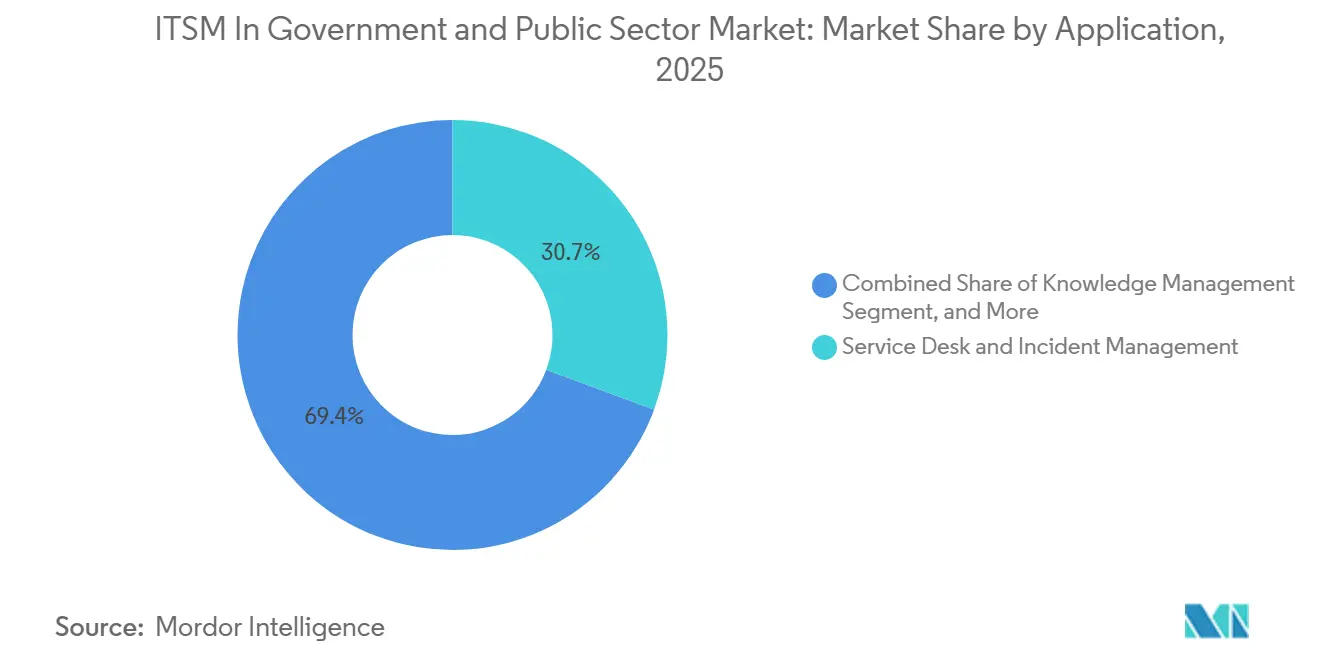
Service Desk Holds the Core While Knowledge Management Gains SpeedService Desk and Incident Management held 30.65% of the application base in 2025, which reflects its role as the main operational entry point for citizen requests, internal incidents, change approvals, and cross-agency escalations. The segment benefits from the broadest day-to-day usage because every other service workflow depends on reliable intake, routing, prioritization, and closure processes. It also creates the largest volume of structured operational data, which helps agencies improve service classification, escalation logic, and reporting discipline over time. In practical terms, this makes the service desk the anchor application for the ITSM in the government and public sector market, even when agencies later add advanced modules around it. Its central role is unlikely to weaken because governments still need one trusted front door for support requests across large, distributed organizations.
Knowledge Management is the fastest-growing application, with the ITSM in the government and public sector market size for this segment projected to rise at a 15.50% CAGR through 2031. Agencies are investing in AI-ready repositories that convert resolved incidents into reusable articles, guided responses, and self-service assets that reduce repeat demand. Atlassian noted in 2025 that AI knowledge systems are moving from passive repositories toward self-updating assets that learn from operational context and reduce knowledge gaps before users encounter them[3]. That shift matters because government support teams often face recurring volumes that can be handled more efficiently when answers are searchable, structured, and tied to workflow actions. This is one of the clearest growth paths inside the ITSM in government and public sector industry, since better knowledge handling strengthens automation without requiring agencies to redesign the entire support model.

By Enterprise Size:
Large Agencies Hold Scale While SMEs Expand ReachLarge enterprises held 66.05% of the ITSM in the government and public sector market in 2025, supported by enterprise-wide contracts, dedicated governance teams, and the ability to fund multiyear implementation programs. Federal ministries, defense bodies, and national health authorities fit this profile because they manage broad user bases, complex security requirements, and large service catalogs across multiple business units. Their scale allows them to absorb lengthy design, migration, and training efforts that smaller organizations often cannot manage as easily. Large contracts also tend to bring follow-on opportunities in workflow expansion, asset governance, and service operations management, which reinforces vendor presence over time. This is why top-tier platforms remain firmly rooted in the largest accounts within the ITSM in the government and public sector market.
SMEs are the fastest-growing enterprise-size segment at 15.60% CAGR from 2026 to 2031, showing that smaller public bodies are finding modern service management more accessible than before. Cloud-native pricing, modular deployment, and out-of-the-box workflows are lowering entry barriers for municipal governments, regional authorities, independent agencies, and smaller education bodies. The UK Government’s SME Digital Adoption Taskforce recommended sector-specific incentives and cloud competency certification programs in June 2025, pointing to policy support that could reduce adoption friction for smaller organizations. As these barriers ease, the addressable base of the ITSM in government and public sector industry continues to widen beyond the traditional concentration in very large public institutions. The segment’s growth also suggests that modular service management is becoming practical for agencies that once viewed enterprise-grade platforms as too costly or too complex.
Geography Analysis
North America ITSM in Government and Public Sector Market
North America held 40.20% of the ITSM in the government and public sector market share in 2025, supported by large federal modernization budgets, a dense pool of authorized vendors, and procurement structures that can aggregate demand across agencies. The United States remains central to this lead because certified cloud environments and mission-specific compliance standards make enterprise procurement more structured than in many other regions. The GSA strengthened that position in September 2025 through its OneGov agreement with ServiceNow, offering eligible federal customers discounts of up to 70% on ITSM Pro and Pro Plus bundles through September 2028[4]. Canada is also moving through a coordinated service tooling program, with Shared Services Canada working to complete onboarding of remaining partner agencies to its enterprise ITSM tool by 2026-27. Together, these moves keep North America at the front of the ITSM in the government and public sector market by combining budget scale, procurement leverage, and compliance-ready deployment options.
Europe ITSM in Government and Public Sector Market
Europe remains a major regional block in the ITSM in government and public sector market, with growth shaped less by one common pattern and more by national sovereignty rules, procurement architecture, and public cloud design choices. Germany is one of the clearest examples, where sovereign cloud development has been tied directly to federal digital modernization and public control of keys, infrastructure, and platform design. The IT-Planungsrat’s Deutsche Verwaltungscloud target architecture also embeds service management functions within a broader national cloud framework, which helps formalize standardization at the architecture level. This means European demand is positive, but platform choice is often filtered through residency, compliance, and public-control requirements before agencies assess product breadth or interface quality. The region therefore remains important to the ITSM in government and public sector market, but it rewards vendors that can align modernization with sovereignty rather than speed alone.
MEA and APAC ITSM in Government and Public Sector Market
The Middle East and Africa is the fastest-growing geography, with the ITSM in government and public sector market size for the region projected to expand at a 16.05% CAGR from 2026 to 2031. Research published in the European Scientific Journal found that Saudi government agencies with stronger ITSM maturity showed materially better system uptime and citizen satisfaction, giving the region a clear operational case for continued investment. Ethiopia added a visible public reference point in June 2026 when MESOB was launched as Africa’s first unified digital service application, bringing services from multiple government institutions onto one platform. Asia-Pacific is a secondary growth area in the ITSM in government and public sector market, supported by government cloud programs and by China’s 15th Five-Year Plan requirement for integrated, AI-enabled digital governance across administrative layers. China’s emphasis on cross-departmental data sharing and unified digital platforms supports the same service-management logic that is shaping modernization elsewhere. Across both regions, governments are building unified digital service layers that make structured service management more relevant to daily public operations. That common direction should keep the ITSM in government and public sector market on a positive path even though procurement maturity still differs widely by country.
Competitive Landscape
The ITSM in the government and public sector market is moderately fragmented in large federal and national accounts, but it becomes more fragmented across regional, municipal, and education environments, where deployment complexity and contract size are lower. ServiceNow holds the strongest position in the upper tier because FedRAMP High and DoD Impact Level 4 and 5 authorizations place it on shortlists for the most security-sensitive U.S. public procurements. BMC Software remains relevant where agencies want deep CMDB, asset, and lifecycle control, especially in complex operational settings that place a premium on governance depth. Ivanti, Atlassian, and Freshworks continue to gain space in mid-tier agency contexts where speed of deployment, usability, and lower ownership cost matter more than full enterprise-suite breadth. The rest of the field remains active because many public organizations still value platform simplicity, local support, and configuration flexibility over the scale advantages of the largest vendors.
One clear winning strategy is to widen the platform through AI capabilities rather than compete only on core ticketing and workflow features. ServiceNow closed its Moveworks acquisition in December 2025, and the combined platform secured FedRAMP Moderate authorization in February 2026, which broadened secure conversational AI options for public-sector users. Another strategy is to use centralized procurement to lock in standardization, as shown by the GSA OneGov agreement that gives eligible federal customers discounted access to ServiceNow ITSM bundles through September 2028. A third route is sovereignty-compliant deployment design, where vendors compete by offering government-specific cloud environments that satisfy residency, mission, and access-control needs. These approaches raise the competitive bar because AI capability, procurement leverage, and compliance architecture now shape vendor choice together.
Vendors without top-level certifications can still grow, but they tend to win where sector specialization, lower complexity, or regional familiarity matters more than large federal authorizations. TeamDynamix, TOPdesk, Hornbill, EasyVista, and Matrix42 fit that pattern in selected higher education, municipal, and European public-sector settings, where local operating needs can outweigh the scale benefits of larger suites. This creates a two-speed structure in the ITSM in government and public sector market, with a narrow enterprise leader group at the top and a broader long tail serving specialized agency requirements. White space remains in classified-environment automation, sub-1,000 seat public deployments, and IT asset lifecycle support for hardware-intensive agencies that still need strong service discipline. Competitive advantage is therefore no longer built on workflow breadth alone, because public buyers increasingly expect a mix of certified deployment options, AI readiness, and implementation practicality. That combination should keep the enterprise tier relatively concentrated while still allowing room for smaller vendors that align closely with specific agency needs and procurement realities.
ITSM In Government and Public Sector Industry Leaders
-
ServiceNow, Inc.
-
BMC Software, Inc.
-
Atlassian Corporation Plc
-
Ivanti, Inc.
-
Freshworks Inc.
- *Disclaimer: Major Players sorted in no particular order
ITSM In Government and Public Sector Market Companies Covered in this Report
- ServiceNow, Inc.
- BMC Software, Inc.
- Atlassian Corporation Plc
- Ivanti, Inc.
- Freshworks Inc.
- Open Text Corporation
- ManageEngine
- IBM Corporation
- Broadcom Inc.
- SolarWinds Corporation
- TOPdesk Nederland B.V.
- SysAid Technologies Ltd.
- EasyVista, Inc.
- Matrix42 AG
- TeamDynamix
- Halo Service Solutions
- Hornbill
- SAP
- Unisys
Recent Industry Developments in ITSM In Government and Public Sector Market
- May 2026: Germany's Federal Ministry for Digital and State Modernization awarded a sovereign AI cloud Platform-as-a-Service contract worth EUR 250 million (USD 278 million) to 2 European consortia led by T-Systems International and SVA System Vertrieb Alexander, embedding zero-trust, open-source, and key-sovereignty requirements that set a new architecture benchmark for AI-enabled public-sector ITSM in the EU.
- February 2026: Moveworks from ServiceNow achieved FedRAMP Moderate Authorization, enabling federal agencies and public-sector organizations to deploy Moveworks' AI Assistant in a dedicated AWS GovCloud environment supporting over 100 languages and serving as an AI front door for government enterprise operations.
- September 2025: The U.S. General Services Administration signed a OneGov agreement with ServiceNow providing eligible federal customers up to 70% off ITSM Pro and Pro Plus bundles through September 2028, with projected workflow efficiency gains of up to 30% aligned to the White House's America's AI Action Plan.
- March 2025: TJDEED Technology delivered a comprehensive ITSM modernization project for a major Saudi public-sector organization, replacing legacy systems with a custom-configured, latest-version ITSM platform aligned to Vision 2030 digital transformation objectives.
Global ITSM In Government and Public Sector Market Report Scope
IT Service Management (ITSM) in Government and Public Sector encompasses the end‑to‑end design, delivery, governance, and continuous improvement of IT services that support public administration, citizen services, law enforcement, social welfare systems, and critical infrastructure, with an overriding focus on availability, security, auditability, and regulatory compliance. It includes incident, problem, change, configuration/asset, service‑request, knowledge, and service‑continuity management processes, together with self‑service portals, reporting/analytics, and automation to improve responsiveness and reduce operational cost.
The ITSM in Government and Public Sector Market Report is Segmented by Component (Solutions and Services), Deployment (Cloud, On-premise, and Hybrid), Application (Service Desk and Incident Management, Asset and Configuration Management, Change and Release Management, Service Request Management, Knowledge Management, and Other Applications), Enterprise Size (Large Enterprises and Small and Mid-size Enterprises (SME)), and (North America, South America, Europe, Asia-Pacific, Middle East, and Africa. The Market Forecasts are Provided in Terms of Value (USD).
Segmentation Overview
| Solutions |
| Services |
| Cloud |
| On-premise |
| Hybrid |
| Service Desk and Incident Management |
| Asset and Configuration Management |
| Change and Release Management |
| Service Request Management |
| Knowledge Management |
| Other Applications |
| Large Enterprises |
| Small and Mid-size Enterprises (SME) |
| North America | United States | |
| Canada | ||
| Mexico | ||
| South America | Brazil | |
| Argentina | ||
| Rest of South America | ||
| Europe | Germany | |
| United Kingdom | ||
| France | ||
| Russia | ||
| Spain | ||
| Rest of Europe | ||
| Asia-Pacific | China | |
| Japan | ||
| India | ||
| South Korea | ||
| Southeast Asia | ||
| Rest of Asia-Pacific | ||
| Middle East and Africa | Middle East | Saudi Arabia |
| United Arab Emirates | ||
| Turkey | ||
| Rest of Middle East | ||
| Africa | South Africa | |
| Nigeria | ||
| Egypt | ||
| Rest of Africa | ||
| By Component | Solutions | ||
| Services | |||
| By Deployment | Cloud | ||
| On-premise | |||
| Hybrid | |||
| By Application | Service Desk and Incident Management | ||
| Asset and Configuration Management | |||
| Change and Release Management | |||
| Service Request Management | |||
| Knowledge Management | |||
| Other Applications | |||
| By Enterprise Size | Large Enterprises | ||
| Small and Mid-size Enterprises (SME) | |||
| By Geography | North America | United States | |
| Canada | |||
| Mexico | |||
| South America | Brazil | ||
| Argentina | |||
| Rest of South America | |||
| Europe | Germany | ||
| United Kingdom | |||
| France | |||
| Russia | |||
| Spain | |||
| Rest of Europe | |||
| Asia-Pacific | China | ||
| Japan | |||
| India | |||
| South Korea | |||
| Southeast Asia | |||
| Rest of Asia-Pacific | |||
| Middle East and Africa | Middle East | Saudi Arabia | |
| United Arab Emirates | |||
| Turkey | |||
| Rest of Middle East | |||
| Africa | South Africa | ||
| Nigeria | |||
| Egypt | |||
| Rest of Africa | |||
Key Questions Answered in the Report
What is the size of the ITSM in government and public sector market in 2026 and 2031?
The ITSM in government and public sector market stands at USD 1.71 million in 2026 and is forecast to reach USD 3.46 billion by 2031, growing at a 15.13% CAGR over 2026-2031.
Which deployment model leads public-sector ITSM adoption?
Cloud leads adoption with a 63.10% share in 2025 and is also the fastest-growing deployment model, with a 16.10% CAGR through 2031.
What is driving stronger demand for government ITSM platforms?
The main drivers are cloud-first modernization, AI-based self-service and ticket deflection, stronger cybersecurity and compliance needs, and the push for cross-agency workflow standardization.
Which application area is growing fastest in public-sector ITSM?
Knowledge Management is the fastest-growing application segment, projected to expand at a 15.50% CAGR through 2031, as agencies turn resolved tickets into reusable AI-ready knowledge assets.
Which regions are most important for future growth?
North America led with a 40.20% share in 2025, while the Middle East and Africa is expected to post the fastest growth at a 16.05% CAGR through 2031.
Why are smaller public agencies becoming more relevant to vendors?
SMEs are projected to grow at a 15.60% CAGR through 2031 because cloud-native pricing, modular deployment, and policy support are making service management tools easier to adopt outside the largest agencies.