
Canada ITSM Market Size and Share
Market Overview
| Study Period | 2020 - 2031 |
|---|---|
| Forecast Data Period | 2026 - 2031 |
| Base Year Market Size (2025) | USD 0.42 Billion |
| Market Size (2026) | USD 0.48 Billion |
| Market Size (2031) | USD 0.97 Billion |
| Growth Rate (2026 - 2031) | 15.02 % |
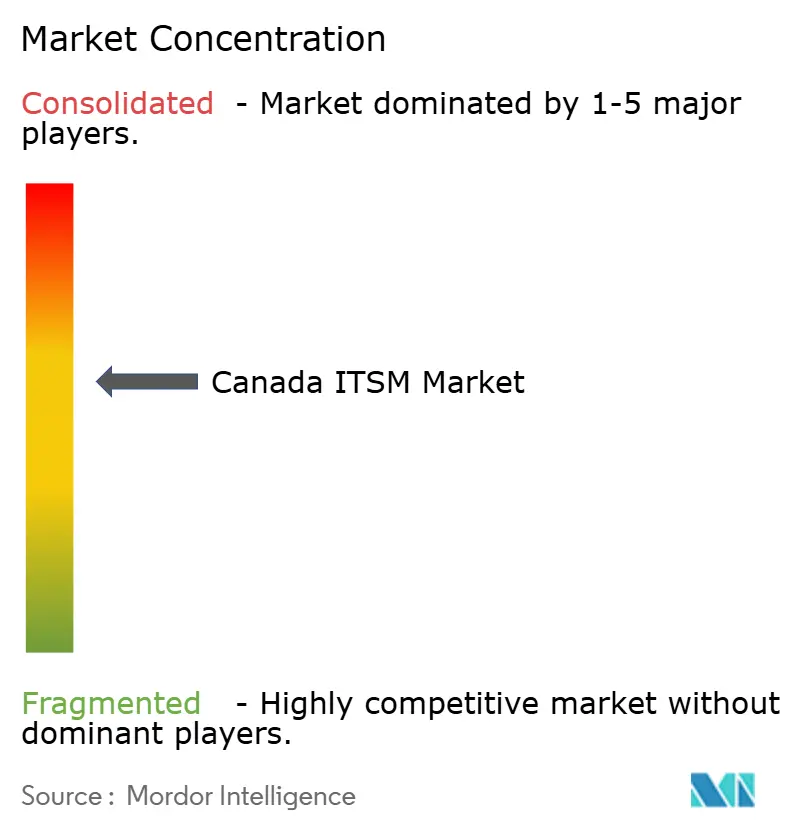
| Market Concentration | Medium |
Major Players *Disclaimer: Major Players sorted in no particular order Image © Mordor Intelligence. Reuse requires attribution under CC BY 4.0. | |
Canada ITSM Market Analysis by Mordor Intelligence
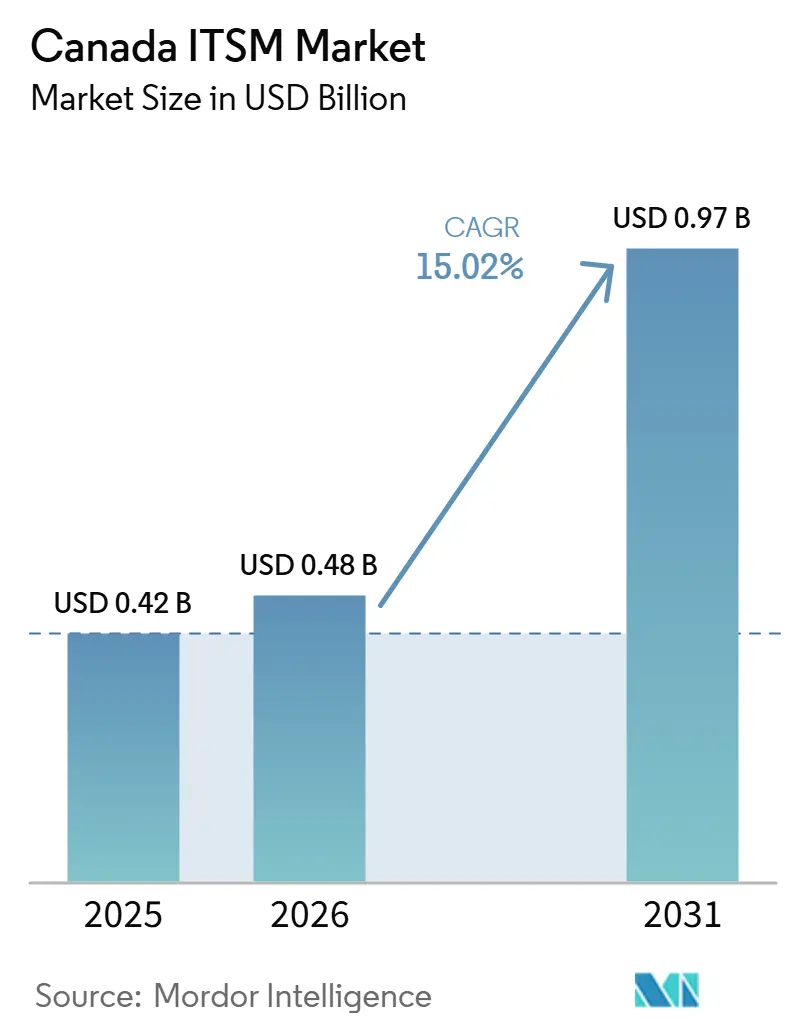
The Canada IT service management market size is projected to be USD 0.42 billion in 2025, USD 0.48 billion in 2026, and reach USD 0.97 billion by 2031, growing at a CAGR of 15.02% from 2026 to 2031. The Canada IT service management market is being shaped by broad migration toward cloud-native service platforms that help organizations reduce infrastructure dependence, accelerate updates, and make service operations easier to scale across complex environments. Agentic AI is also moving from controlled pilots into live service desk workflows, which is changing how buyers evaluate automation, knowledge retrieval, ticket classification, and first-line resolution across enterprise support teams. Compliance pressure in finance, healthcare, and the public sector is bringing forward replacement demand because older tools often struggle to support auditability, privacy governance, and data residency expectations with the consistency that regulated organizations now require. Competition remains active across premium enterprise suites and lower-cost cloud challengers, pushing vendors to combine platform breadth with faster deployment, stronger AI layers, and pricing models easier for buyers to justify. This backdrop leaves room for continued expansion, as many organizations are still modernizing legacy support environments and consolidating fragmented IT operations, security, endpoint, and asset management tools into fewer service platforms.
Key Report Takeaways
- By component, solutions held 61.62% of the Canada IT service management market share in 2025, while services are projected to expand at 17.62% CAGR through 2031.
- By deployment, cloud accounted for 56.82% of the Canada IT service management market size in 2025, and cloud is also expected to record the highest CAGR at 17.34% through 2031.
- By application, service desk and incident management represented 31.62% of the Canada IT service management market share in 2025, while knowledge management is projected to grow fastest at 16.76% through 2031.
- By end-user industry, BFSI captured 27.73% of the Canada IT service management market share in 2025, while healthcare is expected to advance at 16.84% CAGR through 2031.
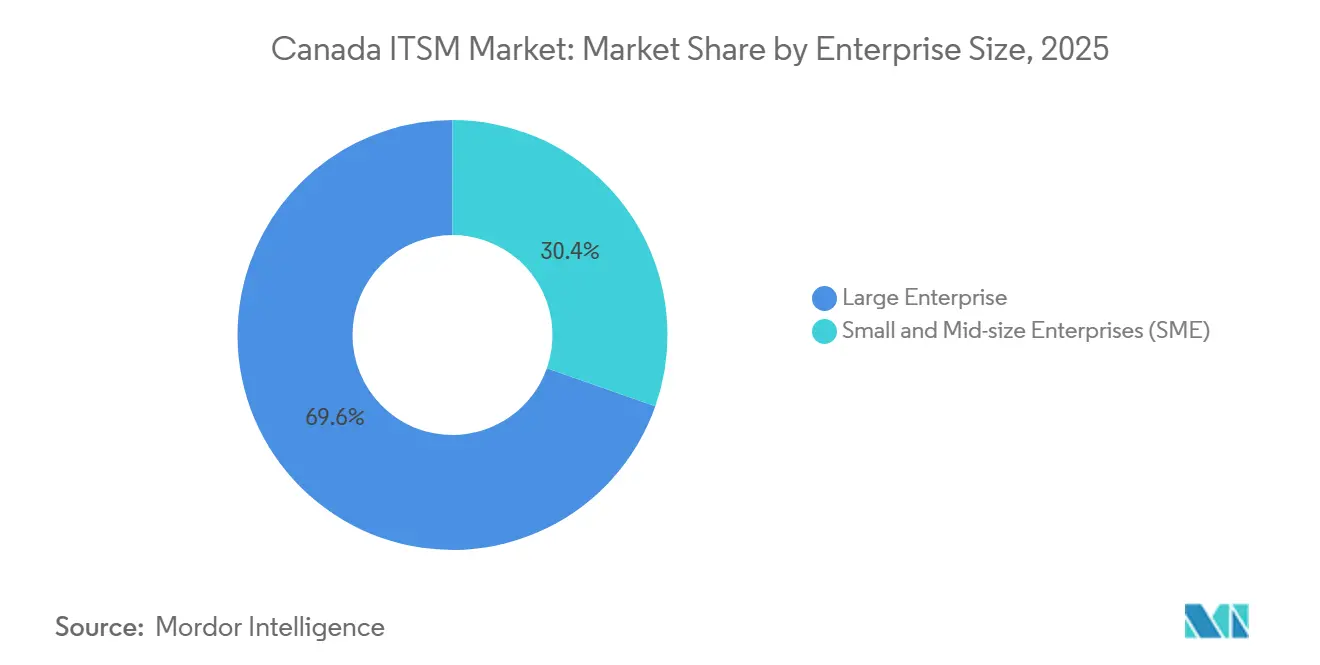
- By enterprise size, large enterprises held 69.62% of the Canada IT service management market share in 20255, while small and mid-size enterprises are projected to expand at 17.67% CAGR through 2031.
Note: Market size and forecast figures in this report are generated using Mordor Intelligence’s proprietary estimation framework, updated with the latest available data and insights as of January 2026.
Canada ITSM Market Trends and Insights
Drivers Impact Analysis*
| Driver | (~) % Impact on CAGR Forecast | Geographic Relevance | Impact Timeline |
|---|---|---|---|
| Cloud-First ITSM Modernization Across Regulated Canada | +4.8% | National, concentrated in Ontario, British Columbia, and Quebec | Short term (≤ 2 years) |
| AI-Assisted Ticket Triage and Workflow Automation | +4.2% | National, accelerated in urban enterprise centers including Toronto, Montreal, and Vancouver | Short term (≤ 2 years) |
| Sovereign Cloud and Data Residency Readiness in Public Sector | +2.5% | National, highest in federal agencies and crown corporations | Medium term (2-4 years) |
| Quebec Law 25 and OSFI B-13 Driven Auditability and Compliance | +1.8% | National, concentrated in Quebec and federally regulated financial institutions | Short term (≤ 2 years) |
| Vendor Consolidation in Mid-Market IT Stacks | +1.5% | National, most pronounced in Ontario and Quebec | Medium term (2-4 years) |
| ITSM Integration With Security, Endpoint, and Asset Management | +1.2% | National, accelerated in BFSI and government and public sector | Medium term (2-4 years) |
| Source: Mordor Intelligence | |||
Cloud-First ITSM Modernization Across Regulated Canada
Cloud migration is the strongest demand lever in the Canada IT service management market because regulated sectors are no longer treating service management as a basic support tool and are instead using it as part of a broader operating model for resilient digital service delivery. Banking, insurance, healthcare, and government buyers increasingly need Canadian data residency, stronger access control structures, and reliable audit logs for protected workloads, which makes cloud architecture questions more central to purchase decisions than they were in earlier upgrade cycles.[1] Shared Services Canada is continuing to retire older infrastructure and move federal environments toward modern cloud and zero-trust settings, and that is giving both public and private organizations a clearer reference model for ITSM modernization programs. ServiceNow’s December 2025 commitment of CAD 110 million (USD 79.6 million) to Canadian-hosted, AI-ready infrastructure shows that leading vendors are aligning their delivery models with these requirements rather than treating hosting and residency as secondary topics. That is why cloud ITSM in Canada is now being evaluated less as a simple software format and more as a compliance-ready foundation for enterprise service operations.
AI-Assisted Ticket Triage And Workflow Automation
AI-assisted triage is becoming a core buying criterion in the Canada IT service management market because buyers increasingly want platforms that can interpret intent, prioritize work, and guide resolution without depending on rigid rule trees for every support scenario. These newer systems classify requests in natural language, retrieve related knowledge, suggest or complete actions, and reduce manual queue handling for recurring L1 issues, which makes the automation layer much more visible in vendor comparisons. Statistics Canada reported that 17.9% of Canadian businesses planned to adopt AI software in the following 12 months in 2025, up from 11.5% in 2024, and that the share reached 27.4% in finance and insurance, one of the most valuable buying groups for advanced ITSM platforms.[2] Ivanti added persona-based agentic AI to Neurons for ITSM in 2026, while Atlassian made Rovo Service generally available in Jira Service Management in 2026, showing that major vendors now see autonomous support as a standard product layer rather than a limited add-on.[3] As this product direction becomes more common, buyers are placing greater weight on resolution speed, knowledge quality, and service desk productivity gains when evaluating platform value.
Sovereign Cloud And Data Residency Readiness In Public Sector
Sovereign cloud readiness has become a distinct purchasing filter in the Canada IT service management market because public sector organizations and regulated private buyers are treating legal control over data as a separate issue from simple hosting location. The federal white paper on data sovereignty states clearly that residency on its own does not remove jurisdictional risk, which means buyers are now examining vendor structure, hosting model, and governance approach together rather than accepting a narrow data center answer. GC Cloud One includes a private cloud option under Canadian jurisdiction, and that has made sovereign deployment readiness more relevant to ITSM platform selection in government-led programs and adjacent regulated sectors. ManageEngine’s Canadian data center launch and ServiceNow’s Canadian-hosted infrastructure investment both show that vendors are responding directly to this demand with location-specific operating choices rather than relying only on generic North American cloud claims. This is widening the gap between vendors that can present a credible sovereignty story in Canada and vendors that still depend on exceptions, workarounds, or custom negotiation.
Quebec Law 25 and OSFI B-13 Driven Auditability And Compliance
Compliance rules are turning auditability from a useful platform feature into a baseline requirement in the Canada IT service management market because buyers in financial and privacy-sensitive environments now need systems that can stand up to more formal review. OSFI Guideline B-13 requires federally regulated financial institutions to maintain documented technology and cyber risk management practices, including incident management processes that can respond to material changes in technology arrangements and support a controlled governance structure. In Quebec, stronger privacy governance expectations have increased the need for incident tracking for confidentiality incidents, clear ownership, and controlled workflows within service environments, thereby raising the minimum practical standard for enterprise ITSM design. That shift is making older tools harder to defend when they lack durable logging, structured approvals, and consistent evidence capture across support and change processes. Vendors that can support policy-linked workflows, evidence retention, and role-based accountability are therefore gaining a clearer edge in regulated accounts, especially where modernization and compliance work now happen together.
Restraints Impact Analysis*
| Restraint | (~) % Impact on CAGR Forecast | Geographic Relevance | Impact Timeline |
|---|---|---|---|
| Long Replacement Cycles in Deeply Embedded Legacy Environments | -1.8% | National, most prominent in public sector and manufacturing | Long term (≥ 4 years) |
| High Switching Cost and Process Re-Engineering Burden | -1.4% | National, highest impact in BFSI and healthcare | Medium term (2-4 years) |
| Procurement Scrutiny, Security Reviews, and Vendor Risk | -1.1% | National, concentrated in government and public sector | Medium term (2-4 years) |
| AI Governance, Data Residency, and Compliance Concerns | -0.8% | National, concentrated in regulated sectors | Medium term (2-4 years) |
| Source: Mordor Intelligence | |||
Long Replacement Cycles In Deeply Embedded Legacy Environments
Long replacement cycles are slowing part of the Canada IT service management market because many organizations have spent years adapting legacy platforms to fit internal approval structures, change processes, and support routines that are now deeply embedded in daily operations. These environments often sit inside release management, vendor coordination, service request routing, and configuration practices, which means replacement affects a wide operating model rather than only the ticketing layer that users see most directly. Every extra integration and workaround raises the switching threshold, so some buyers continue to defer modernization even when cloud-native platforms offer clearer advantages in usability, AI support, and governance controls. The result is a two-speed market where progressive adopters move further into autonomous, cloud-led service operations, while legacy-heavy organizations remain tied to reactive queues and slower change cycles. This restraint is most visible in public-sector and manufacturing settings, where continuity and process stability can outweigh the near-term appeal of platform change.
High Switching Cost And Process Re-Engineering Burden
High switching cost and process redesign continue to slow movement in the Canada IT service management market because most migrations require organizations to rebuild service catalogs, SLAs, workflows, and configuration logic instead of simply moving records into a new interface. That work competes with daily IT responsibilities, which makes even committed buyers pause when internal teams are already stretched by security work, endpoint management, application change, and user support. The burden is heavier in BFSI and healthcare because service interruptions, audit risk, and sensitive data handling all increase execution costs and narrow the room for project errors. Buyers also have to retrain staff, revise approval paths, and validate new operating logic before the replacement can be trusted at scale, which lengthens decision-making and pushes more projects into phased transitions. Vendors that reduce migration friction can still win these deals, but the effort involved remains a meaningful brake on how quickly replacement demand converts into closed business.
*Our forecasts treat driver/restraint impacts as directional, not additive. The impact forecasts reflect baseline growth, mix effects, and variable interactions.
Segment Analysis
By Component: Solutions Anchor Revenue While Services Gain Faster Momentum
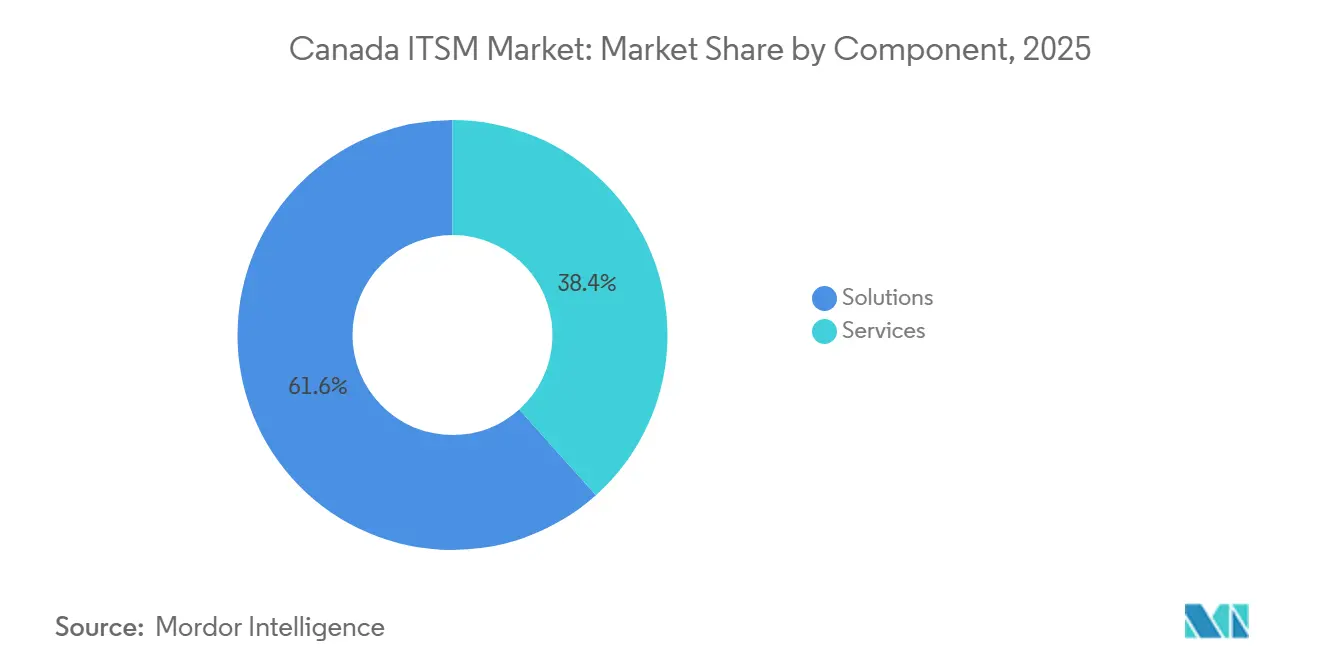
Solutions held 61.62% of the Canada IT service management market share in 2025, underscoring that platform licenses and subscriptions still accounted for most spending across large enterprises, major institutions, and government-linked organizations. That lead reflects the fact that software remains the core control layer for incident handling, workflow design, approvals, service catalogs, and reporting, so buyers usually commit to the platform before committing to surrounding services. Multi-year software agreements also make the revenue base more stable because organizations do not replace foundational ITSM platforms as frequently as they change narrower operational tools. In practical terms, this has kept the software layer at the center of budget planning even when enterprises slow or phase out parts of their broader modernization roadmaps.
Services are projected to grow at 17.62% CAGR through 2031, the fastest pace among component categories, as organizations increasingly combine software purchases with implementation, migration, optimization, and managed support work. This growth is tied to the rising complexity of cloud migration, AI rollout, workflow redesign, and compliance alignment, because each of those tasks requires buyers to move beyond product selection into execution detail. Regulated environments also require more careful configuration of approvals, logging, access roles, and evidence capture, which increases reliance on external expertise during deployment and post-go-live tuning. Internal teams are often managing too many priorities to absorb that workload alone, especially when service desk modernization is happening alongside endpoint, security, and asset management consolidation. For that reason, the Canada IT service management market is likely to remain software-led in revenue mix while services continue to take a larger role in how organizations realize value from those platforms.
By Deployment: Cloud Leads Adoption And Extends Its Advantage
Cloud deployment accounted for 56.82% of the Canada IT service management market size in 2025 and is projected to advance at 17.34% CAGR through 2031, making it both the largest and fastest-growing deployment model in the current structure. Buyers continue to favor cloud because upgrades are easier, feature delivery is faster, and platform scaling is less dependent on local infrastructure decisions that slow change and absorb internal resources. Cloud also gives vendors a cleaner path to ship AI functionality, analytics improvements, and workflow updates more regularly, which matters now that buyers expect constant improvement rather than occasional major releases. This advantage reinforces a broader shift away from infrastructure-heavy support models across organizations seeking faster deployment and less operational drag.
On-prem deployments still matter for workloads where sovereign hosting and direct control are difficult to guarantee with standard multi-tenant SaaS offerings, especially in environments with protected data or stricter governance requirements. Financial institutions and public bodies, therefore, continue to maintain on-premises or private-cloud setups for specific processes even as broader modernization work moves toward the cloud. Hybrid remains relevant because it offers a practical transition path, letting organizations move routine workflows first while retaining tighter control over more sensitive records and operating flows that cannot shift quickly. Shared Services Canada’s cloud framework and Atlassian’s isolated single-tenant cloud offering both show that vendors are building more flexible deployment options for regulated accounts rather than forcing a single model on all buyers. That is why cloud keeps widening its lead while slower-moving organizations still have room to modernize in stages inside the Canada IT service management market.
By Application: Service Desk Holds The Core While Knowledge Management Rises
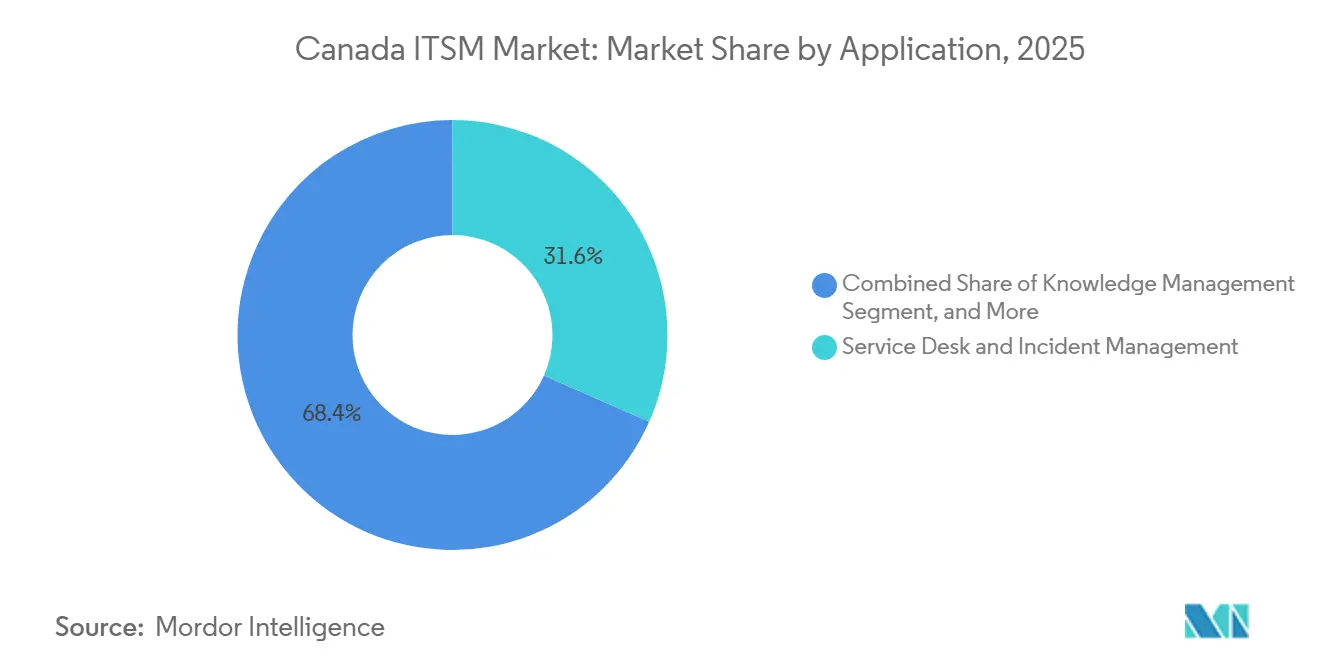
Service desk and incident management held 31.62% of revenue in 2025, which kept it at the operational center of most deployments across the Canada IT service management market. This position is rooted in the adoption sequence, because nearly every organization starts with intake, routing, and issue resolution before expanding into broader change, asset, request, and enterprise service functions. The module also provides everyday visibility for both users and administrators, making service desk performance one of the clearest measures of whether an ITSM investment is working. Because it sits at the front of user interaction, it has become the natural landing point for automation, AI copilots, virtual agents, and self-service improvements that promise shorter queues and more consistent resolution.
Knowledge management is projected to grow at a 16.76% CAGR through 2031, the fastest pace among application categories, because AI-assisted service operations depend on usable, governed, and up-to-date knowledge to perform effectively. Better article structures improve search quality, reduce repeated ticket work, strengthen resolution consistency, and make automated responses less dependent on manual escalation for routine issues. PeopleCert’s ITIL guidance recognizes generative AI as a supporting technology for knowledge management, which supports the shift away from static article libraries toward continuously refreshed repositories that feed both agents and analysts. Asset and configuration management, change and release management, and service request management continue to expand as organizations move beyond reactive ticket handling and want stronger control over linked operational processes. Other ITSM applications are also gaining traction as enterprises apply service discipline to HR onboarding, facilities coordination, and related internal service functions that were once managed in disconnected tools.

By End-User Industry: BFSI Leads Demand While Healthcare Expands Faster
BFSI captured 27.73% of revenue in 2025 and remained the largest end-user segment in the Canada IT service management market, which reflects the high operational and governance demands of banking, insurance, and wealth management environments. These organizations run large, interconnected technology estates that require structured incident handling, change control, service availability monitoring, and strong documentation across many internal and customer-facing systems. That operating complexity raises the value of enterprise ITSM suites that support resilience, audit readiness, and visibility across multiple teams, rather than just basic help desk tasks. National Bank of Canada’s migration to ServiceNow for ITSM and IT Operations Management shows the scale of modernization that financial institutions are prepared to support when service continuity and oversight are central priorities.
Healthcare is projected to expand at 16.84% CAGR through 2031, the fastest pace among end-user industries, as hospitals and provincial care networks continue to digitize service processes and connect more clinical and administrative systems. Electronic Medical Record integration is a major driver, as support teams need stronger workflows for access issues, incidents, application changes, and user provisioning in environments where downtime has broader consequences. Post-pandemic care pathway digitization is also increasing the number of digital touchpoints that depend on consistent service support, which broadens the practical role of formal ITSM platforms. Government and public sector demand remains significant because federal modernization plans are still pushing agencies away from legacy environments and toward more structured cloud-aligned operating models. Travel and hospitality, retail and e-commerce, and other smaller verticals are also adopting ITSM where workforce coordination, service consistency, and operational complexity are creating a clearer need for structured support processes.
By Enterprise Size: Large Enterprises Hold Scale While SMEs Lift Growth
Large enterprises held 69.62% of revenue in 2025, reflecting their broader license footprints, deeper service desk operations, and more established procurement cycles across banking, telecommunications, and federal functions. These organizations also manage more layered workflows, heavier ticket volumes, and a wider range of integrations, which keeps demand strong for platforms that can support governance, reporting, automation, and cross-functional service design at scale. The resulting account size gives enterprise buyers outsized weight in vendor roadmaps, partner ecosystems, and commercial structures across the Canada IT service management market. That is why large organizations continue to shape the market's revenue center even as adoption widens across other buyer groups.
Small and mid-size enterprises are projected to grow at 17.67% CAGR through 2031, the highest rate across enterprise-size categories, as more firms move beyond email and spreadsheet-based support into cloud platforms that are easier to deploy and maintain. CFIB reported in 2025 that professional services, finance, insurance, and real estate SMEs were among the digital frontrunners, with more than 40% having invested in AI, cloud, and IT infrastructure, which supports the emerging demand profile for lighter ITSM solutions. These buyers usually need faster deployment, easier administration, and pricing that fits smaller teams, which makes no-code or lower-complexity product design more attractive than enterprise-heavy implementations. Vendors such as Freshworks, SysAid, and TeamDynamix are targeting this need with simplified configuration and more accessible operating models for smaller support environments. As this cohort expands, it is broadening the customer base of the Canada IT service management market beyond the traditional enterprise center.
Geography Analysis
Ontario remained the largest provincial demand center in 2025 within the Canada IT service management market because it combines the country’s strongest concentration of banks, insurers, large enterprises, and federal agency activity in one operating region. Toronto’s role as a financial and business hub keeps enterprise support requirements high, and that sustains demand for platforms that can manage incidents, change workflows, approvals, and service visibility across complex organizations. The province also benefits from the deepest ecosystem of implementation specialists, service partners, and enterprise sales coverage, which helps large modernization programs move from evaluation into deployment. British Columbia followed as another major demand pocket, supported by technology employers, resource companies, and provincial health organizations that increasingly value scalable cloud service models. In both provinces, cloud adoption and AI-enabled support operations are pushing buyers toward subscription-based platforms that can deliver faster releases and more continuous workflow improvement.
Quebec is the most regulation-sensitive geography in the Canada IT service management market, and that is raising minimum product requirements rather than suppressing demand. Privacy governance expectations have made audit trails, controlled workflows, and confidentiality-related process discipline more important in procurement decisions, which favors vendors that can align platform behavior with formal governance needs. C2 ITSM shows how Quebec-based platforms are using local compliance familiarity and language alignment to defend regional positions in mid-sized and institutionally sensitive accounts C2 ITSM. Banyan Software’s November 2025 acquisition of Montreal-founded Octopus ITSM also highlights the commercial value of Quebec-built service management assets that already have traction in Canada and French-speaking markets. ManageEngine’s Canadian data center presence and related certifications further show that broader vendors are adapting delivery models to Canadian hosting expectations rather than relying only on generic regional infrastructure claims.
Alberta and Atlantic Canada are smaller markets, but each carries a clear demand pattern that makes them strategically relevant. Alberta’s energy producers create stronger need for asset, configuration, and change management because their operational environments are complex, distributed, and highly dependent on controlled service support. Atlantic Canada is seeing more digital service activity in healthcare and government settings, which is widening the role of formal ITSM platforms in provincial organizations that need more structured support models. The Prairies and Northern territories remain less penetrated, which leaves room for managed-service-led expansion as the Canada IT service management market matures outside the main urban centers.
Competitive Landscape
ServiceNow held the clearest enterprise leadership position in the Canada IT service management market in 2026 because it combined platform breadth, data residency alignment, and strong public sector relevance at a time when those factors were carrying more weight in buying decisions. Its CAD 110 million (USD 79.6 million) investment in Canadian-hosted, AI-ready infrastructure and a Canada Centre of Excellence strengthened that position by tying product capability to local delivery commitments rather than abstract market messaging. IBM and BMC remained important in large installed environments where mainframe links, long process histories, and mature ITIL workflows still matter to buyers that are not ready for rapid platform change. Those incumbents continue to benefit from customer familiarity and embedded integrations, but they also face pressure from vendors that can deploy faster, simplify administration, and bring AI capabilities to market more quickly. This keeps the Canada IT service management market competitive at the platform, operating model, and delivery level rather than only at the license level.
Strategic activity in 2025 and 2026 centered on AI-native differentiation and broader platform coverage, which shows where vendors believe replacement demand and wallet share are moving. Freshworks completed its FireHydrant acquisition in Q1 2026 to combine ITSM and incident reliability workflows on a single data layer, a move aimed at strengthening its ability to challenge larger suite providers with a more unified ServiceOps proposition. Atlassian expanded Jira Service Management with Rovo Service and workforce management features in 2026, extending its role in AI-assisted employee support and making the platform more relevant for teams that want service, scheduling, and automation in one environment. Xurrent launched autonomous AI agents and an open Model Context Protocol server in May 2026, which positioned it against vendor lock-in concerns at the orchestration layer and gave it a more distinct automation angle. These moves show that competition is shifting toward who can automate more support work, reduce complexity, and shorten time to value for buyers.
White space in the Canada IT service management market remains strongest in French-language offerings, sovereign cloud setups for mid-market buyers, and vertically adapted models for healthcare and government organizations that need more than generic workflows. SysAid’s launch of Dex in June 2026 points to growing experimentation with outcome-based pricing, especially for managed service providers and smaller support teams that care more about resolved work than seat counts. ManageEngine improved its procurement standing in 2025 by securing ITIL certification for 14 practices in ServiceDesk Plus, which matters in regulated buying environments where formal validation supports shortlist inclusion. Overall competition looks active rather than tightly held because several global leaders and a visible layer of mid-market challengers are shaping buyer choice at the same time.
Canada ITSM Industry Leaders
-
ServiceNow, Inc.
-
IBM Corporation
-
BMC Software, Inc.
-
Atlassian Corporation Plc
-
Ivanti, Inc.
- *Disclaimer: Major Players sorted in no particular order
Recent Industry Developments
- June 2026: SysAid Launches Dex, an Autonomous AI IT Engineer for MSPs. SysAid introduced Dex, a fully autonomous AI IT engineer capable of resolving up to 90% of requests end-to-end across Microsoft 365, Google Workspace, Okta, and API-connected SaaS platforms. Dex operates on a per-resolution pricing model, fundamentally restructuring the economics of managed ITSM delivery for Canada’s growing MSP channel.
- June 2026: UST and HaloITSM Announce Global Partnership. HaloITSM Limited and UST announced a global partnership to extend HaloITSM’s enterprise service management platform across UST’s worldwide client base, including North American enterprise and healthcare accounts. The agreement expands HaloITSM’s reach into regulated industries with advisory, implementation, and transformation services.
- May 2026: Freshworks Unveils Freddy AI Agent Studio and MCP Gateway at Refresh Conference. Freshworks launched the Freddy AI Agent Studio within Freshservice, a no-code environment allowing enterprises to build, customize, and deploy prebuilt AI agents across service workflows. The announcement also included a Model Context Protocol Gateway connecting Freddy AI to third-party tools and a new AI Insights analytics layer with Experience Level Agreements.
- March 2026: Carahsoft and ServiceNow Expand Partnership to Canada. Carahsoft Technology Corp. and ServiceNow expanded their partnership to open the ServiceNow AI Platform across Carahsoft’s 10,000-plus reseller ecosystem in the United States and Canada for the first time, including healthcare, financial services, and critical infrastructure verticals. This materially broadened ServiceNow’s distribution reach in Canada’s regulated mid-market.
Canada ITSM Market Report Scope
The Canada IT Service Management Market is Segmented by Component (Solutions, Services), Deployment (Cloud, On-Premise, Hybrid), Application (Service Desk and Incident Management, Asset and Configuration Management, Change and Release Management, Service Request Management, Knowledge Management, Others), End-User Industry (BFSI, Manufacturing, Government and Public Sector, IT and Telecommunications, Retail and E-Commerce, Healthcare, Others), and Enterprise Size (Large Enterprises, SME). The Market Forecasts are Provided in Terms of Value (USD).
| Solutions |
| Services |
| Cloud |
| On-Premise |
| Hybrid |
| Service Desk and Incident Management |
| Asset and Configuration Management |
| Change and Release Management |
| Service Request Management |
| Knowledge Management |
| Other ITSM Applications |
| BFSI |
| Manufacturing |
| Government and Public Sector |
| IT and Telecommunications |
| Retail and E-Commerce |
| Healthcare |
| Travel and Hospitality |
| Other End-User Industries |
| Large Enterprises |
| Small and Mid-Size Enterprises (SME) |
| By Component | Solutions |
| Services | |
| By Deployment | Cloud |
| On-Premise | |
| Hybrid | |
| By Application | Service Desk and Incident Management |
| Asset and Configuration Management | |
| Change and Release Management | |
| Service Request Management | |
| Knowledge Management | |
| Other ITSM Applications | |
| By End-User Industry | BFSI |
| Manufacturing | |
| Government and Public Sector | |
| IT and Telecommunications | |
| Retail and E-Commerce | |
| Healthcare | |
| Travel and Hospitality | |
| Other End-User Industries | |
| By Enterprise Size | Large Enterprises |
| Small and Mid-Size Enterprises (SME) |
Key Questions Answered in the Report
What is the size of the Canada IT service management (ITSM) market in 2026?
The Canada IT service management market is valued at USD 0.48 billion in 2026 and is projected to reach USD 0.97 billion by 2031 at a 15.02% CAGR.
How fast will demand grow through 2031?
Growth is forecast at a 15.02% CAGR from 2026 to 2031, supported by cloud migration, AI-led workflow automation, and compliance-driven replacement demand.
Which deployment model is leading adoption in Canada?
Cloud leads with 56.82% share in 2025 and is also the fastest-growing deployment model, with a projected 17.34% CAGR through 2031.
Which application area remains the core of most deployments?
Service desk and incident management remains the core application area, holding 31.62% of revenue in 2025 because it is usually the first module organizations deploy.
Why are BFSI and healthcare so important in Canada?
BFSI led end-user demand with 27.73% share in 2025, while healthcare is the fastest-growing vertical at 16.84% CAGR because both sectors face high service continuity and governance needs.