
Hoodies and Sweatshirts Market Size and Share
Market Overview
| Study Period | 2021 - 2031 |
|---|---|
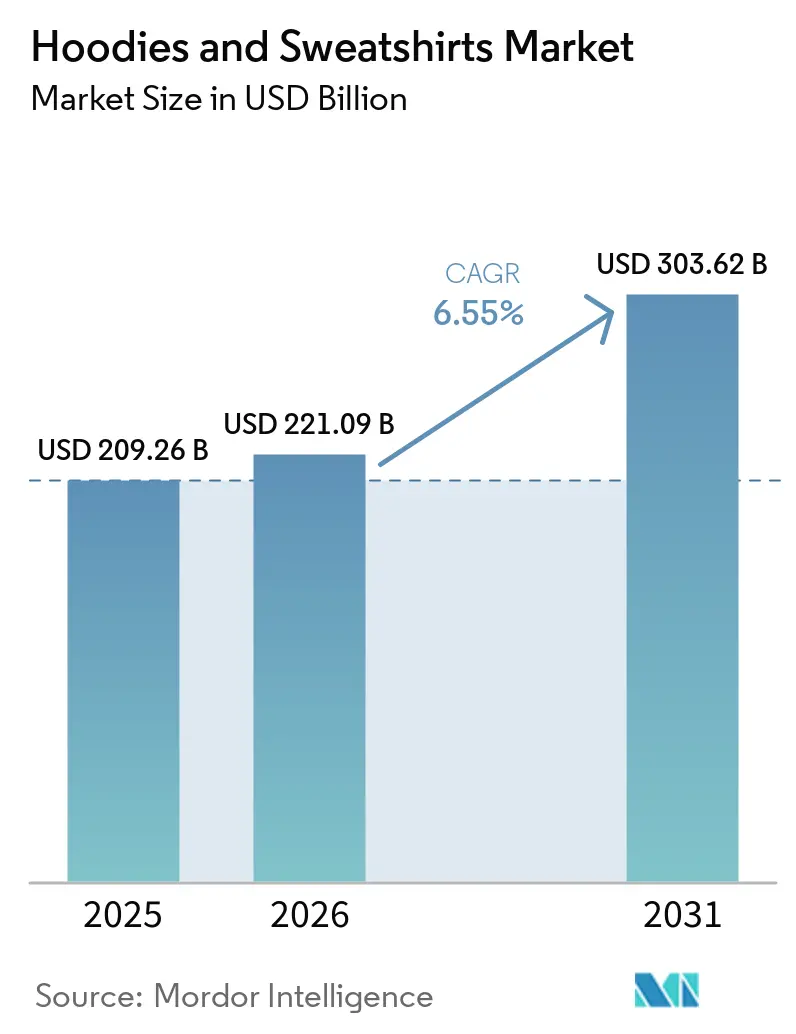
| Market Size (2026) | USD 221.09 Billion |
| Market Size (2031) | USD 303.62 Billion |
| Growth Rate (2026 - 2031) | 6.55 % |
| Fastest Growing Market | Asia-Pacific |
| Largest Market | North America |
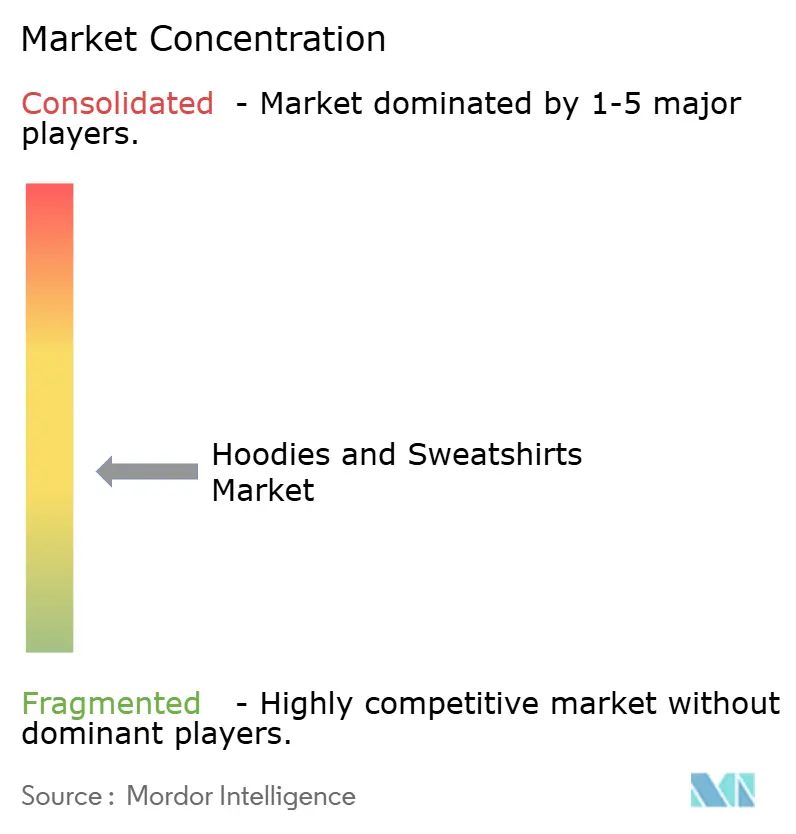
| Market Concentration | Medium |
Major Players *Disclaimer: Major Players sorted in no particular order Image © Mordor Intelligence. Reuse requires attribution under CC BY 4.0. | |
Hoodies and Sweatshirts Market Analysis by Mordor Intelligence
The Hoodies and Sweatshirts Market is expected to be valued at USD 209.26 billion in 2025 and is projected to grow from USD 221.09 billion in 2026 to USD 303.62 billion by 2031, registering a CAGR of 6.55% during the forecast period. The increasing preference for comfortable, versatile, and fashion-forward apparel that aligns with evolving casualwear and athleisure trends is driving market growth. Continuous innovation in fabric technologies, including moisture-managing, stretchable, lightweight, and sustainable materials, is further improving product performance and consumer appeal. At the same time, the expansion of e-commerce platforms, greater availability of customization options, and rising adoption of eco-friendly textiles are creating new growth opportunities for manufacturers.
Key Report Takeaways
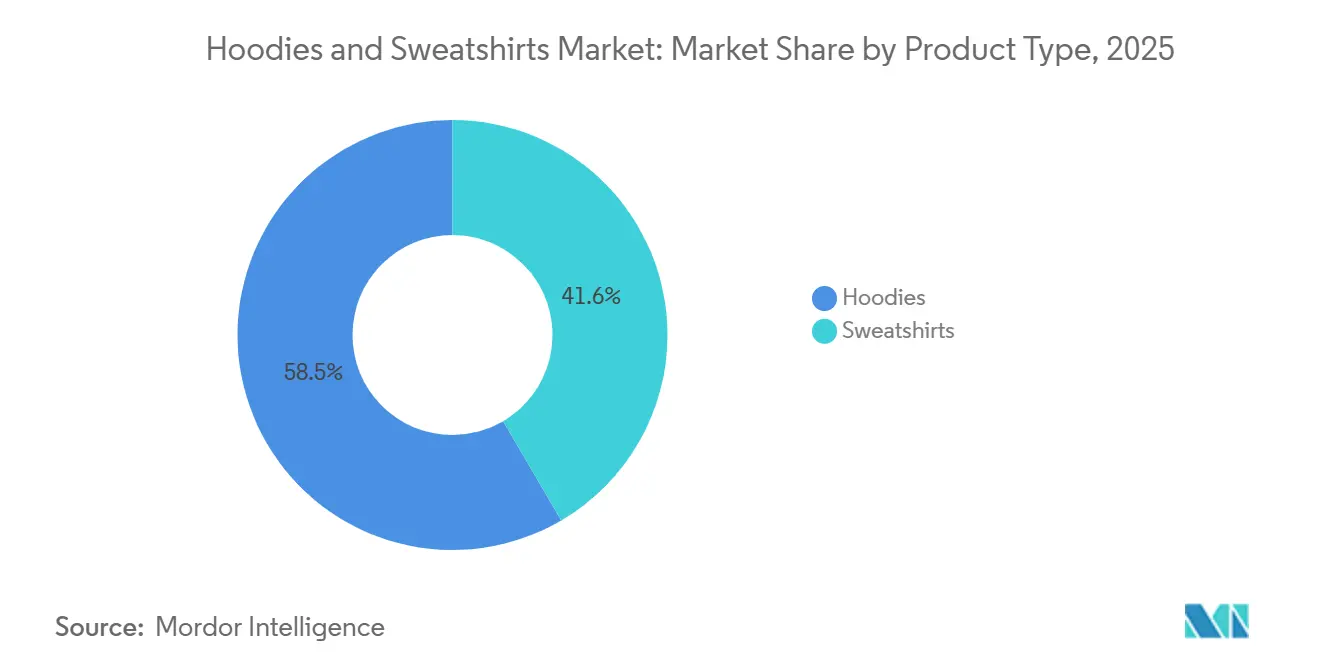
- By product type, hoodies led with 58.45% revenue share in 2025, while sweatshirts are forecast to expand at a 7.32% CAGR through 2031.
- By material type, cotton held 36.78% share in 2025, while synthetic materials are projected to record the fastest 7.55% CAGR through 2031.
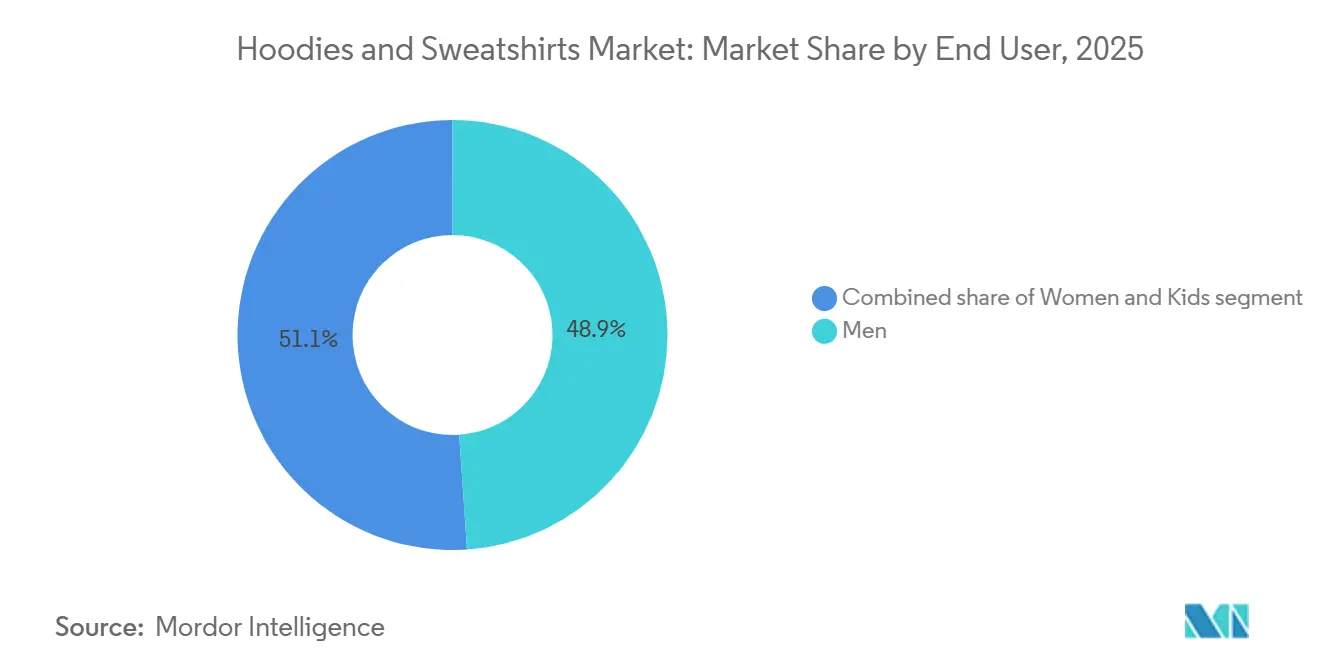
- By end user, men accounted for 48.92% of the hoodies and sweatshirts market share in 2025, while women are set to grow at the highest 7.55% CAGR through 2031.
- By distribution channel, offline stores captured 68.92% of the hoodies and sweatshirts market size in 2025, while online retail stores are advancing at an 8.91% CAGR through 2031.
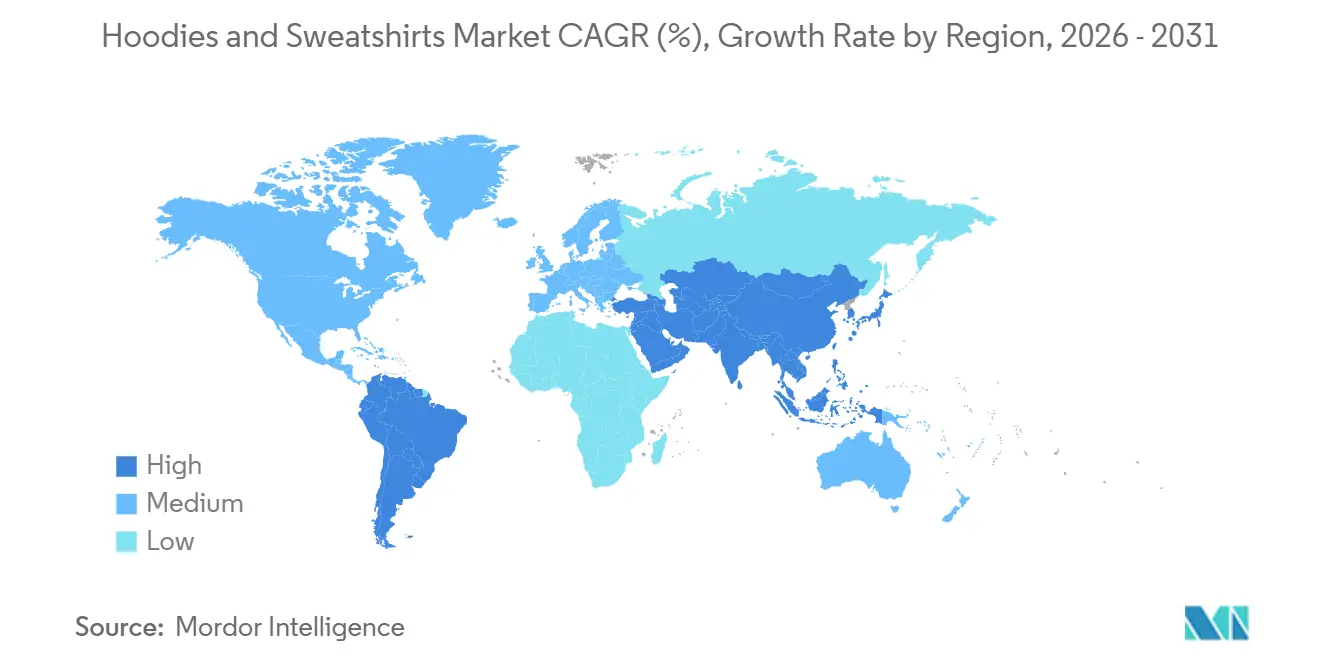
- By geography, North America held 33.45% of global value in 2025, while Asia-Pacific is forecast to expand at a 7.87% CAGR through 2031.
Note: Market size and forecast figures in this report are generated using Mordor Intelligence’s proprietary estimation framework, updated with the latest available data and insights as of January 2026.
Market Trends and Insights
Drivers Impact Analysis of Hoodies and Sweatshirts Market*
| Driver | (~) % Impact on CAGR Forecast | Geographic Relevance | Impact Timeline |
|---|---|---|---|
| Surging popularity of sports and outdoor activities | +1.4% | Global, with concentration in North America, Europe, and Asia-Pacific | Long term (≥ 4 years) |
| Demand for comfortable and versatile everyday apparel | +1.3% | Global, particularly strong in North America and Western Europe | Long term (≥ 4 years) |
| Influence of social media, celebrities, and fashion influencers | +0.9% | Global, highest impact in North America and Asia-Pacific | Short term (≤ 2 years) |
| Adoption of sustainable and eco-friendly materials | +0.8% | Global, early gains concentrated in Europe and North America | Medium term (2-4 years) |
| Advancements in fabric technologies for enhanced comfort | +0.7% | Global, Research and Development concentrated in United States, Japan, and Germany | Long term (≥ 4 years) |
| Popularity of customization and personalized apparel | +0.6% | North America-led, expanding to Europe and Asia-Pacific | Medium term (2-4 years) |
| Source: Mordor Intelligence | |||
Surging popularity of sports and outdoor activities
Growing participation in sports and outdoor recreation is significantly boosting demand for hoodies and sweatshirts, as consumers increasingly seek apparel that provides comfort, flexibility, and thermal protection before, during, and after physical activities. Consumers prefer these garments as outerwear for activities such as hiking, camping, jogging, cycling, and recreational sports because they support ease of movement while providing warmth across varying weather conditions. Manufacturers are introducing lightweight, moisture-managing, stretchable, and durable fabric constructions to enhance performance and all-day comfort. According to the Sports & Fitness Industry Association (SFIA), 58.6% of the population participated in outdoor activities in 2024, reflecting the expanding base of active consumers who regularly purchase functional casual apparel [1]. The continued rise in outdoor recreation is expected to sustain demand for hoodies and sweatshirts as essential lifestyle garments.
Demand for comfortable and versatile everyday apparel
The growing preference for comfortable and versatile clothing is a key factor driving the hoodies and sweatshirts market, as consumers prioritize garments that adapt seamlessly to different occasions and lifestyles. Hoodies and sweatshirts offer a strong balance of comfort, functionality, and style, making them suitable for year-round daily wear. Consumers can layer them with other clothing items to enhance wardrobe flexibility, while innovations in soft-touch fabrics, breathable knit constructions, and ergonomic fits have further improved wearability. Growing interest in relaxed fashion, hybrid work environments, and effortless styling has elevated these garments from seasonal essentials to everyday wardrobe staples. Their enduring appeal across multiple fashion preferences continues to support sustained demand and product innovation in the global market.
Influence of social media, celebrities, and fashion influencers
The growing influence of social media platforms, celebrities, and fashion influencers is accelerating demand for hoodies and sweatshirts by rapidly shaping consumer preferences and apparel trends. Limited-edition merchandise, celebrity-inspired collections, and influencer collaborations generate significant consumer engagement and encourage repeat purchases. Digital platforms allow brands to showcase new designs, styling ideas, and exclusive product launches to a global audience, increasing product visibility and strengthening brand loyalty. The popularity of celebrity merchandise has further expanded the market for graphic hoodies and sweatshirts. For instance, in August 2025, Rihanna is expected to unveil the "R20" merchandise collection and box set, demonstrating how celebrity-led product launches can stimulate consumer interest and drive sales across the category.
Adoption of sustainable and eco-friendly materials
The increasing adoption of sustainable and eco-friendly materials is driving growth in the hoodies and sweatshirts market, as consumers and brands place greater emphasis on environmentally responsible apparel. Manufacturers are using recycled fibers, organic cotton, and regenerated textiles to reduce resource consumption and minimize textile waste while maintaining product quality and durability. Advances in sustainable fabric processing and circular manufacturing practices enable manufacturers to produce high-performance garments with a lower environmental footprint. These initiatives also support brand sustainability commitments and strengthen consumer confidence in eco-conscious fashion. For instance, Caslay offers a pullover hoodie that is equivalent to 40% recycled PET bottle scrap, highlighting the industry’s growing shift toward recycled raw materials and sustainable apparel production.
Restraints Impact Analysis of Hoodies and Sweatshirts Market*
| Restraint | (~) % Impact on CAGR Forecast | Geographic Relevance | Impact Timeline |
|---|---|---|---|
| Growing concerns over textile waste and environmental impact | -0.4% | Global, most acute in Europe and North America | Long term (≥ 4 years) |
| Availability of counterfeit and imitation branded apparel | -0.3% | Global, concentrated in Asia-Pacific and Middle-East and Africa distribution channels | Medium term (2-4 years) |
| Volatility in raw material prices for cotton, polyester, and blended fabrics | -0.3% | Global, with acute exposure in South Asia and Southeast Asian sourcing hubs | Medium term (2-4 years) |
| Seasonal demand fluctuations affecting sales performance | -0.2% | Global, highest in markets with distinct seasons (North America, Europe) | Short term (≤ 2 years) |
| Source: Mordor Intelligence | |||
Growing concerns over textile waste and environmental impact
Growing concerns over textile waste and environmental impact are restraining the hoodies and sweatshirts market, as consumers, regulators, and environmental organizations increasingly scrutinize the fashion industry's ecological footprint. Conventional textile production often requires high water consumption, chemical-intensive dyeing processes, and generates significant textile waste. In addition, synthetic fabrics contribute to microplastic pollution during washing. These concerns are raising sustainability expectations and prompting brands to redesign products, adopt cleaner manufacturing processes, and invest in recyclable or biodegradable materials, which can increase production complexity and costs. As environmental awareness continues to rise, manufacturers that rely on conventional materials and linear production models may face challenges in maintaining consumer confidence and long-term market competitiveness.
Availability of counterfeit and imitation branded apparel
The widespread availability of counterfeit and imitation branded apparel restrains the hoodies and sweatshirts market by diverting sales from legitimate manufacturers and weakening consumer trust in established brands. Counterfeit products often mimic the appearance of premium hoodies and sweatshirts at significantly lower prices, making it difficult for consumers to distinguish authentic products from imitations. Manufacturers typically use inferior materials and lower production standards for these products, resulting in inconsistent quality and reduced durability, which can damage brand reputation. The expansion of unauthorized online marketplaces and informal retail channels has further increased the circulation of counterfeit apparel, creating pricing pressure for genuine brands and forcing companies to invest more in brand protection, authentication technologies, and intellectual property enforcement.
*Our forecasts treat driver/restraint impacts as directional, not additive. The impact forecasts reflect baseline growth, mix effects, and variable interactions.
Hoodies and Sweatshirts Market Segment Analysis
By Product Type:
Hoodies Lead While Sweatshirts Gain Design MomentumHoodies are expected to account for a dominant 58.45% value share in 2025, supported by their strong appeal as versatile wardrobe essentials that blend comfort, functionality, and contemporary fashion. Their adaptable design supports year-round wear through layering, extending their use beyond colder seasons. Continuous innovation in silhouettes, premium fabrics, moisture-management finishes, brushed fleece interiors, and oversized fits has broadened consumer appeal across age groups and style preferences. Growing demand for minimalist aesthetics, gender-neutral designs, and premium casualwear has further strengthened the category's market position. Frequent seasonal collections, designer collaborations, graphic prints, and customization options encourage repeat purchases and enhance brand engagement.
Sweatshirts are projected to register the fastest growth, at a CAGR of 7.32% through 2031, driven by the rising preference for clean, understated fashion that emphasizes simplicity and versatility. Sweatshirts offer a streamlined silhouette that pairs easily with both casual and semi-formal outfits, making them increasingly popular for everyday styling. The growing influence of premium basics and capsule wardrobes has increased demand for high-quality sweatshirts featuring refined cuts, ribbed detailing, and elevated finishes. Fashion brands are expanding their collections with crewneck, quarter-zip, and mock-neck designs to cater to diverse style preferences, while innovations in knit construction and garment finishing improve shape retention and create a more polished appearance.
By Material Type:
Cotton Holds Volume, Synthetics Command GrowthCotton is expected to account for a dominant 36.78% material share in 2025, supported by its exceptional breathability, softness, and natural comfort, which make it the preferred fabric for hoodies and sweatshirts. Its effective moisture absorption and skin-friendly properties strengthen consumer preference for prolonged everyday use. Cotton fibers also provide excellent printability and dye retention, enabling manufacturers to produce vibrant graphics, premium finishes, and durable designs that retain their appearance over time. The material’s versatility allows manufacturers to use it in both lightweight and heavyweight fabric constructions, catering to diverse style preferences and seasonal collections. According to the National Cotton Council, global cotton production is expected to reach approximately 119.79 million 480-pound bales in the 2025/26 season, ensuring a stable raw material base that supports large-scale apparel manufacturing and consistent product availability [2].
Synthetic materials are projected to be the fastest-growing material category, registering a CAGR of 7.55% through 2031, driven by continuous advancements in performance textiles and engineered fabrics. Polyester, nylon, and elastane blends offer superior durability, wrinkle resistance, color retention, and faster drying compared to many natural fibers, making them increasingly suitable for modern apparel. Manufacturers are also incorporating recycled synthetic fibers and innovative fabric technologies to improve stretch, shape retention, thermal insulation, and moisture management without compromising comfort. These materials enable the production of lightweight yet durable garments that retain their appearance after repeated washing and regular wear.
By End User:
Men Drive Volume, Women Define Innovation DirectionMen are expected to account for the largest end-user share, at 48.92%, in 2025, driven by sustained demand for versatile apparel that integrates seamlessly into everyday wardrobes. Hoodies and sweatshirts have become essential clothing items due to their adaptability across multiple dressing styles, including casual, smart-casual, and athleisure-inspired looks. The category benefits from a wide range of fits, neutral color palettes, graphic designs, and premium fabric options that cater to diverse style preferences. Frequent wardrobe replacement cycles, rising interest in functional fashion, and the increasing availability of seasonal collections have further strengthened purchasing activity. The expansion of premium essentials, oversized silhouettes, and minimalist designs has also encouraged consumers to invest in higher-quality garments, reinforcing the segment’s leading market position.
Women are projected to be the fastest-growing end-user segment, registering a CAGR of 7.49% through 2031. This growth is driven by the rapid evolution of fashion trends that increasingly incorporate hoodies and sweatshirts into everyday styling. Designers are introducing a broader range of silhouettes, cropped styles, oversized fits, pastel color palettes, premium textures, and fashion-forward details to align with changing consumer preferences. The growing influence of mix-and-match dressing, elevated casualwear, and contemporary layering trends has further increased the versatility of these garments across wardrobes. Rising demand for apparel that combines style and comfort has encouraged brands to diversify women’s collections with innovative designs, refined tailoring, and premium fabric finishes, supporting sustained growth in this end-user segment.

By Distribution Channel:
Physical Retail Holds Value, Online Channels Set the Growth AgendaOffline stores are expected to account for a dominant 68.92% value share in 2025, driven by consumers' preference to physically evaluate apparel before purchase, particularly fit, fabric texture, comfort, color accuracy, and overall garment quality. The ability to try on different sizes and compare styles in person reduces uncertainty and increases purchase confidence. Physical retail outlets also provide immediate product availability, eliminate delivery waiting times, and enable instant ownership. In-store visual merchandising, seasonal displays, exclusive collections, and personalized customer assistance further improve the shopping experience and support higher conversion rates. Well-established retail networks and brand-exclusive outlets continue to strengthen consumer engagement and support the leading position of offline stores in the hoodies and sweatshirts market.
Online retail stores are projected to grow at a CAGR of 8.91% through 2031, driven by the increasing availability of extensive product assortments that allow consumers to compare styles, colors, sizes, and prices with ease. Digital platforms frequently introduce exclusive online collections, early-access launches, and customizable apparel options to encourage repeat purchases. Advanced recommendation algorithms, virtual fitting technologies, detailed product imagery, and user-generated reviews have improved purchase confidence and enhanced the overall shopping experience. Flexible payment options, simplified return policies, and convenient doorstep delivery further support online apparel purchases. The growing integration of mobile shopping, live commerce, and social media storefronts continues to expand digital consumer engagement, supporting the strong growth of online retail channels.
Geography Analysis
North America Hoodies and Sweatshirts Market
North America is expected to account for the largest share of the global Hoodies & Sweatshirts Market, representing 33.45% of the market value in 2025. Strong consumer preference for casual and lifestyle apparel, widespread acceptance of athleisure fashion, and high demand for premium-quality garments support the region's leadership. Frequent seasonal collection launches, strong brand loyalty, and rapid adoption of fashion trends continue to drive product sales. The region also benefits from an established retail ecosystem that combines extensive physical store networks with mature e-commerce platforms, enabling brands to reach consumers through multiple sales channels. Continuous innovation in fabrics, sustainable materials, and product customization further strengthens market growth across North America.
APAC Hoodies and Sweatshirts Market
Asia-Pacific is projected to register the fastest growth, expanding at a CAGR of 7.87% through 2031, supported by favorable demographics, rapid urbanization, and evolving fashion preferences among younger consumers. The region has become a major global apparel manufacturing and sourcing hub, enabling faster product innovation and competitive pricing. According to the World Trade Organization (WTO), China accounted for 29.6% of the global clothing export value in 2024, highlighting its dominant position in the international apparel supply chain [3]. The increasing influence of digital fashion trends, expanding online retail platforms, and growing demand for contemporary casualwear continue to accelerate market expansion across Asia-Pacific.
EMEA and South America Hoodies and Sweatshirts Market
Europe represents a mature market characterized by strong demand for premium apparel, sustainable textiles, and fashion-forward product designs. Consumers in the region increasingly prefer high-quality garments made from environmentally responsible materials. South America is experiencing steady growth, supported by the rising popularity of casual clothing, expanding retail infrastructure, and increasing adoption of international fashion trends. Meanwhile, the Middle East and Africa market is gradually expanding as modern retail formats, the presence of global fashion brands, and growing interest in contemporary lifestyle apparel improve product accessibility and consumer adoption across the region.
Competitive Landscape
The global Hoodies & Sweatshirts Market is moderately fragmented, with established global sportswear companies, fast-fashion retailers, lifestyle apparel brands, and regional manufacturers driving competition. Market participants compete through continuous product innovation, improved fabric quality, contemporary designs, and frequent collection launches to address evolving consumer preferences. Companies increasingly differentiate their offerings through premium materials, sustainable manufacturing practices, customization options, and collaborations with designers, celebrities, and popular franchises to enhance brand visibility and consumer engagement.
Key players operating in the market include Nike, Inc., Adidas AG, Puma SE, Under Armour, Inc., and H & M Hennes & Mauritz AB. These companies continue to strengthen their market positions by expanding product portfolios, introducing innovative fabric technologies, enhancing omnichannel retail capabilities, and investing in digital marketing initiatives. Leading brands focus strategically on limited-edition collections, performance-inspired casualwear, and environmentally responsible materials to remain competitive while addressing changing fashion trends and consumer expectations.
Mergers, acquisitions, and strategic partnerships further shape the competitive landscape, as companies aim to expand manufacturing capabilities and brand portfolios. For instance, in December 2025, Gildan is expected to complete the acquisition of HanesBrands, strengthening its presence in the global apparel industry and broadening its portfolio of everyday clothing products. Such strategic developments are expected to enhance production efficiencies, expand distribution networks, and intensify competition as companies seek to increase market share through scale, operational synergies, and broader product offerings.
Hoodies and Sweatshirts Industry Leaders
-
Nike, Inc.
-
Adidas AG
-
Puma SE
-
Under Armour, Inc.
-
H & M Hennes and Mauritz AB
- *Disclaimer: Major Players sorted in no particular order
Hoodies and Sweatshirts Market Companies Covered in this Report
- Nike, Inc.
- Adidas AG
- Puma SE
- Under Armour, Inc.
- H & M Hennes and Mauritz AB
- Fast Retailing Co., Ltd.
- Hanesbrands Inc.
- Gildan Activewear Inc.
- VF Corporation
- Columbia Sportswear Company
- Lululemon Athletica Inc.
- American Eagle Outfitters, Inc.
- Urban Outfitters, Inc.
- ASOS plc
- Boohoo Group plc
- Gap Inc.
- Levi Strauss and Co.
- Abercrombie and Fitch Co.
- Superdry plc
- Ralph Lauren Corporation
Recent Industry Developments in Hoodies and Sweatshirts Market
- June 2026: Kith and New Balance expanded their partnership by opening New Balance at Kith, a permanent collaborative retail space inside Kith’s West Hollywood flagship. The space features exclusive collaborative apparel collections and a curated assortment of third-party menswear.
- May 2026: Nike and global pop icons BTS collaborated on the BTS WORLD TOUR “ARIRANG,” launching an exclusive line of tour merchandise and a first-of-its-kind Nike By You customization experience. The collection includes limited-edition T-shirts, a hoodie, and a region-exclusive cap.
- December 2025: American Giant unveiled the redesigned version of its Classic Full Zip hooded sweatshirt, which is 100% sourced and manufactured through a United States based supply chain, with cotton grown and harvested in the Southeast.
Global Hoodies and Sweatshirts Market Report Scope
Hoodies and sweatshirts are comfortable, long-sleeved casual tops made from thick, soft fabric designed to keep warm. The hoodies and sweatshirts market is segmented by product type, material type, end user, distribution channel, and geography. Based on product type, the market is segmented into hoodies and sweatshirts. Based on material type, the market is segmented into cotton, synthetic materials, wool, and others. Based on end user, the market is segmented into men, women, and kids. Based on distribution channel, the market is segmented into offline stores and online stores. Based on geography, the market is segmented into North America, Europe, Asia-Pacific, South America, and Middle East and Africa. For each segment, the market sizing and forecast have been done based on the value (in USD million).
Segmentation Overview
| Hoodies |
| Sweatshirts |
| Cotton |
| Synthetic Materials |
| Wool |
| Others |
| Men |
| Women |
| Kids |
| Offline Stores |
| Online Stores |
| North America | United States |
| Canada | |
| Mexico | |
| Rest of North America | |
| Europe | Germany |
| United Kingdom | |
| Italy | |
| France | |
| Spain | |
| Netherlands | |
| Poland | |
| Belgium | |
| Sweden | |
| Rest of Europe | |
| Asia-Pacific | China |
| India | |
| Japan | |
| Australia | |
| Indonesia | |
| South Korea | |
| Thailand | |
| Singapore | |
| Rest of Asia-Pacific | |
| South America | Brazil |
| Argentina | |
| Colombia | |
| Chile | |
| Peru | |
| Rest of South America | |
| Middle East and Africa | South Africa |
| Saudi Arabia | |
| United Arab Emirates | |
| Nigeria | |
| Egypt | |
| Morocco | |
| Turkey | |
| Rest of Middle East and Africa |
| By Product Type | Hoodies | |
| Sweatshirts | ||
| By Material Type | Cotton | |
| Synthetic Materials | ||
| Wool | ||
| Others | ||
| By End User | Men | |
| Women | ||
| Kids | ||
| By Distribution Channel | Offline Stores | |
| Online Stores | ||
| By Geography | North America | United States |
| Canada | ||
| Mexico | ||
| Rest of North America | ||
| Europe | Germany | |
| United Kingdom | ||
| Italy | ||
| France | ||
| Spain | ||
| Netherlands | ||
| Poland | ||
| Belgium | ||
| Sweden | ||
| Rest of Europe | ||
| Asia-Pacific | China | |
| India | ||
| Japan | ||
| Australia | ||
| Indonesia | ||
| South Korea | ||
| Thailand | ||
| Singapore | ||
| Rest of Asia-Pacific | ||
| South America | Brazil | |
| Argentina | ||
| Colombia | ||
| Chile | ||
| Peru | ||
| Rest of South America | ||
| Middle East and Africa | South Africa | |
| Saudi Arabia | ||
| United Arab Emirates | ||
| Nigeria | ||
| Egypt | ||
| Morocco | ||
| Turkey | ||
| Rest of Middle East and Africa | ||
Key Questions Answered in the Report
What is the 2031 outlook for hoodies and sweatshirts?
The category is forecast to reach USD 303.62 billion by 2031 from USD 221.09 billion in 2026, growing at a 6.55% CAGR.
Which product category is leading demand in 2026?
Hoodies remain the largest product type based on their 58.45% share in 2025, supported by utility, streetwear relevance, and broad age-group appeal.
Why are sweatshirts growing faster than hoodies?
Sweatshirts are projected to expand at a 7.32% CAGR because cleaner silhouettes fit more settings, including work, travel, and everyday casual dressing.
Which sales channel is expanding the fastest?
Online retail stores are growing at an 8.91% CAGR through 2031 as mobile shopping, social discovery, and direct brand platforms keep gaining traction.