
Women Plus Size Clothing Market Size and Share
Market Overview
| Study Period | 2021 - 2031 |
|---|---|
| Market Size (2026) | USD 103.21 Billion |
| Market Size (2031) | USD 149.45 Billion |
| Growth Rate (2026 - 2031) | 7.68 % |
| Fastest Growing Market | Asia-Pacific |
| Largest Market | North America |
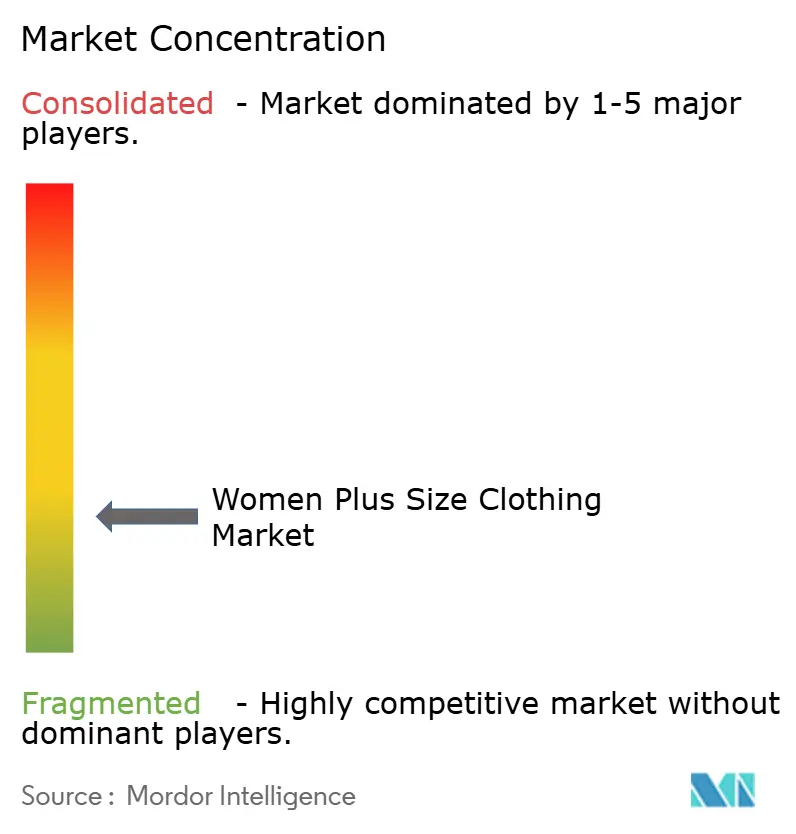
| Market Concentration | Low |
Major Players *Disclaimer: Major Players sorted in no particular order Image © Mordor Intelligence. Reuse requires attribution under CC BY 4.0. | |
Women Plus Size Clothing Market Analysis by Mordor Intelligence
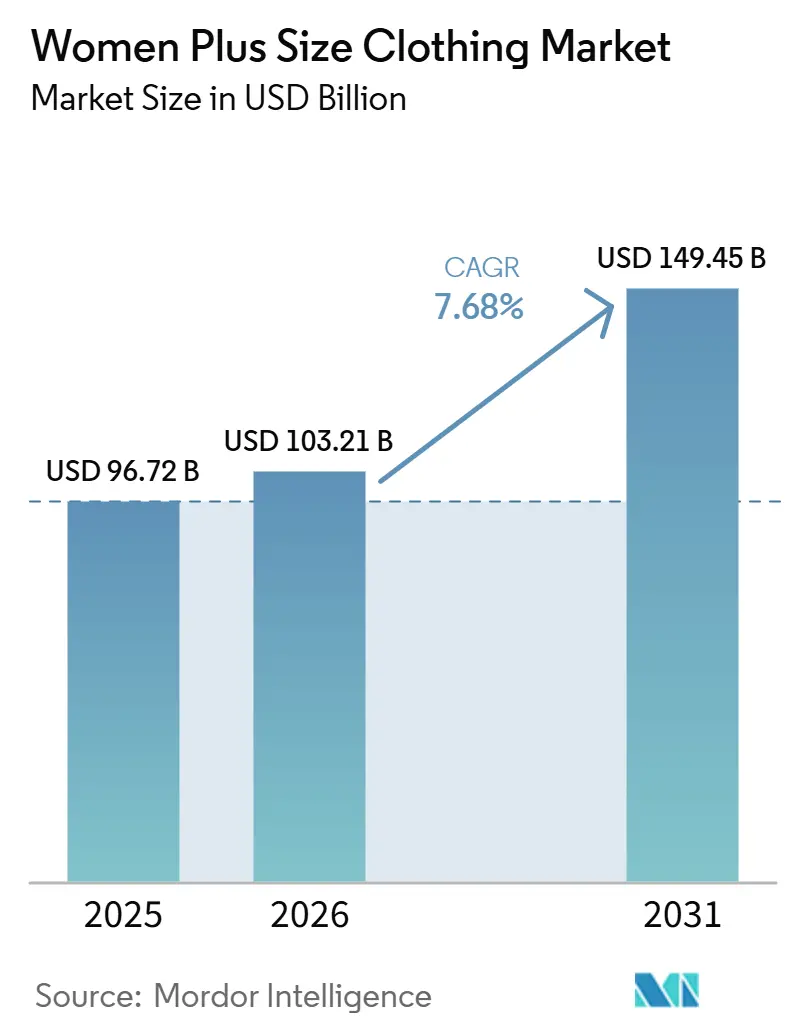
The women plus size clothing market size is expected to grow from USD 96.72 billion in 2025 to USD 103.21 billion in 2026 and is forecast to reach USD 149.45 billion by 2031 at 7.68% CAGR over 2026-2031. The market growth is being supported by increasing body positivity movements, greater representation of diverse body types, and rising consumer demand for inclusive fashion offerings across global markets. Fashion retailers and brands are expanding their plus size portfolios by introducing trend-focused designs, premium collections, and wider size ranges to address previously underserved consumer segments. The rapid growth of e-commerce platforms has further improved accessibility, enabling consumers to explore a broader selection of plus size apparel with improved fit customization and convenience. Additionally, rising disposable incomes among women, increasing fashion consciousness, and changing social perceptions toward body inclusivity are encouraging higher spending on plus size clothing.
Key Report Takeaways
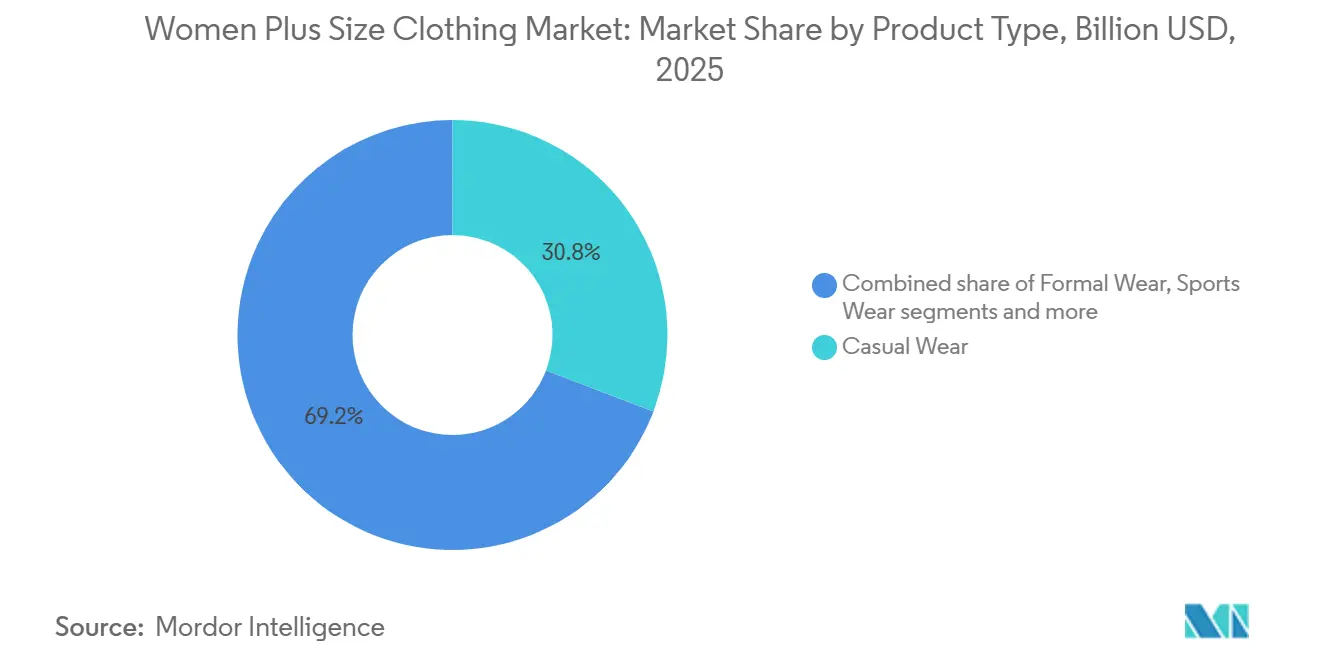
- By product type, casual wear led with 30.78% revenue share in 2025, while sports wear is projected to expand at 8.61% CAGR through 2031.
- By price range, mass held 74.39% share of the women plus size clothing market size in 2025, while premium/luxury is forecast to grow at 8.89% CAGR through 2031.
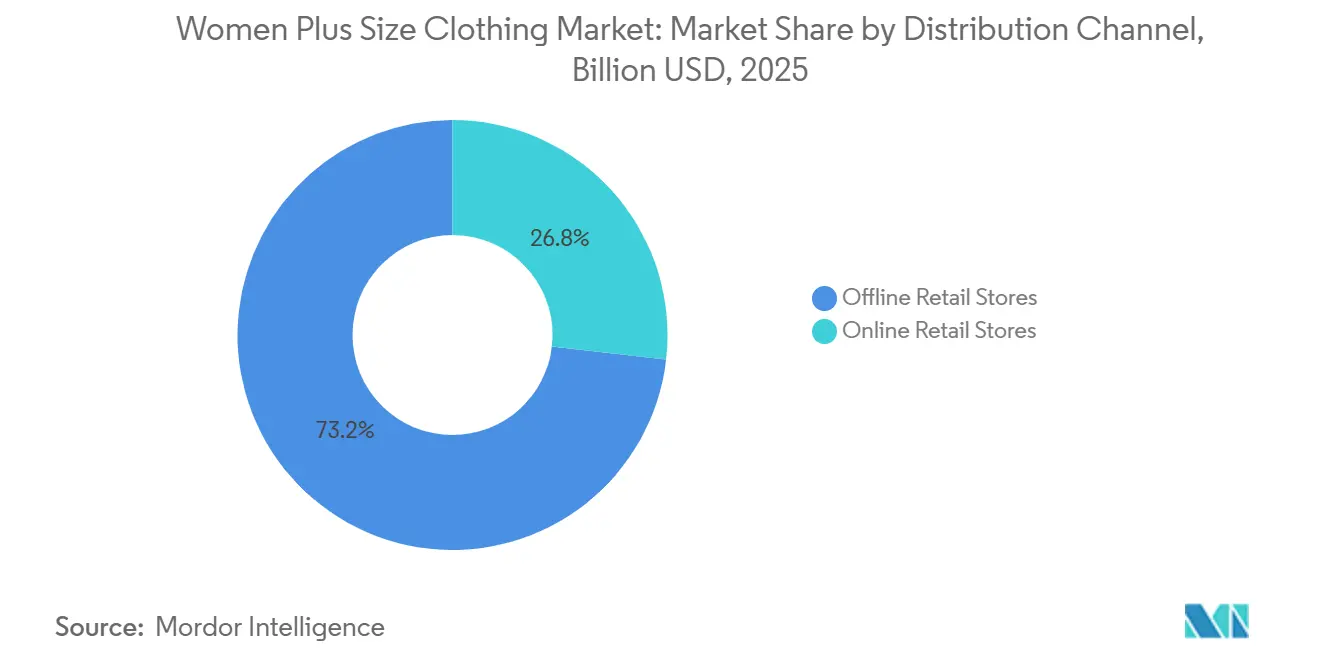
- By distribution channel, offline retail stores held 73.18% of the women plus size clothing market share in 2025, while online retail stores are expected to advance at 9.43% CAGR through 2031.
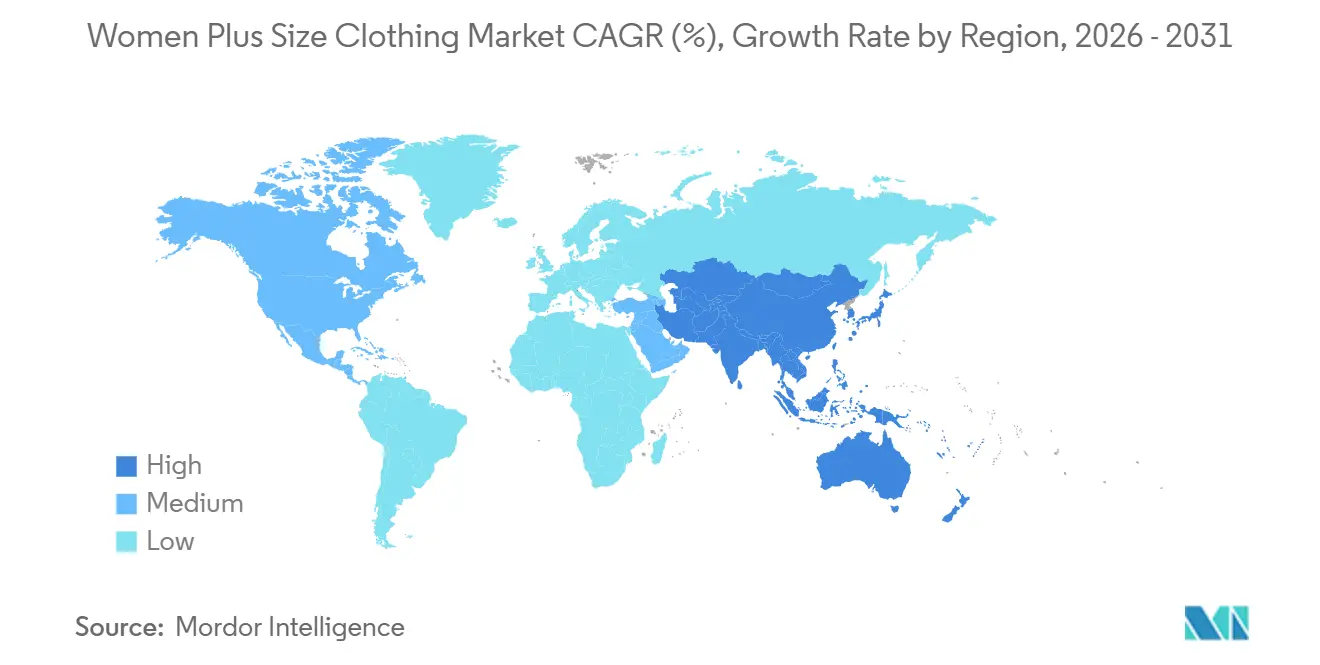
- By geography, North America held 43.71% of global revenue in 2025, while Asia-Pacific is forecast to grow at 8.59% CAGR through 2031.
Note: Market size and forecast figures in this report are generated using Mordor Intelligence’s proprietary estimation framework, updated with the latest available data and insights as of January 2026.
Market Trends and Insights
Drivers Impact Analysis of Women Plus Size Clothing Market*
| Driver | (~) % Impact on CAGR Forecast | Geographic Relevance | Impact Timeline |
|---|---|---|---|
| Rising prevalence of overweight and obesity among women | +2.3% | Global, particularly North America, Middle Easr, and South America | Long term (≥ 4 years) |
| Growing demand for size-inclusive fashion | +1.6% | North America, Europe, urban Asia-Pacific | Medium term (2-4 years) |
| Increasing body positivity and self-acceptance movements | +1.0% | North America, Western Europe, Australia | Medium term (2-4 years) |
| Greater availability of trendy and premium plus-size apparel | +0.8% | North America, Europe, online-first Asia-Pacific | Short term (≤ 2 years) |
| Celebrity and influencer promotion of inclusive fashion | +0.7% | Global, particularly social-media-dense markets | Short term (≤ 2 years) |
| Advancements in fabric technology for improved comfort and fit | +0.5% | Global, with early gains in North America and Europe | Long term (≥ 4 years) |
| Source: Mordor Intelligence | |||
Rising prevalence of overweight and obesity among women
The increasing share of overweight and obese women across major economies is expanding the consumer base for plus size apparel and creating sustained demand for size-inclusive fashion. As more women require extended-size clothing, apparel brands are broadening their product portfolios with better-fitting garments, trend-focused collections, and a wider range of styles across casual, formal, and activewear categories. According to the Our World in Data Report, the share of women classified as obese reached 42.4% in the United States and 33.9% in Brazil in 2024, highlighting the growing need for inclusive clothing solutions in two of the world's largest apparel markets[1]. This demographic shift is encouraging manufacturers and retailers to invest in improved sizing standards, enhanced fit technologies, and dedicated plus size collections. The growing acceptance of body diversity and increasing consumer preference for fashionable extended-size apparel are further supporting market expansion.
Growing demand for size-inclusive fashion
Growing demand for size-inclusive fashion is reshaping the women's apparel industry as consumers increasingly expect brands to offer stylish clothing across a wider range of sizes. Fashion retailers are expanding their size offerings beyond traditional standards to better serve diverse body types while improving fit, comfort, and design consistency. This shift is supported by increasing body positivity movements and greater representation of plus size models in advertising, social media, and fashion campaigns, encouraging consumers to seek trend-driven apparel without size limitations. Both specialist plus size brands and mainstream fashion companies are launching dedicated collections to address previously underserved market segments. In addition, advancements in garment design, pattern grading, and fit technology are enabling manufacturers to develop products that combine functionality with contemporary fashion trends.
Increasing body positivity and self-acceptance movements
Increasing body positivity and self-acceptance movements are encouraging women to embrace diverse body shapes and express their personal style with greater confidence, supporting higher demand for plus size apparel. Social media platforms, digital creators, celebrities, and advocacy campaigns have played a significant role in challenging traditional beauty standards and promoting greater representation of different body types. In response, fashion brands are adopting more inclusive marketing strategies and featuring plus size models across advertising campaigns, online stores, and runway collections. This cultural shift has encouraged consumers to prioritize fashionable, well-fitting clothing rather than limiting purchases to basic or functional apparel. Retailers are also expanding their size ranges and introducing trend-led collections to meet evolving consumer expectations for inclusivity and style.
Greater availability of trendy and premium plus-size apparel
The growing availability of trendy and premium plus-size apparel is encouraging more women to invest in fashionable clothing that combines style, quality, and comfort. Apparel brands are expanding their premium collections with contemporary designs, better-fitting silhouettes, and high-quality fabrics, moving beyond the traditional focus on basic essentials. This shift is attracting fashion-conscious consumers who seek the same variety and styling options available in standard-size clothing. In the United States, spending patterns further reflect this demand, with the 45–60 age group emerging as the highest spenders in the women's and girls' clothing segment in 2024, recording an average annual expenditure of USD 942[2]. This high purchasing power is prompting manufacturers and retailers to introduce premium plus-size collections across casual wear, workwear, occasion wear, and activewear categories.
Restraints Impact Analysis of Women Plus Size Clothing Market*
| Restraint | (~) % Impact on CAGR Forecast | Geographic Relevance | Impact Timeline |
|---|---|---|---|
| Higher production costs due to complex sizing and pattern grading | -1.8% | Global, with intensified pressure in North America and Europe | Long term (≥ 4 years) |
| Inventory management challenges from wider size assortments | -1.3% | North America primarily, with spillover to the United Kingdom and Australia, New Zealand | Medium term (2-4 years) |
| Limited availability of plus-size clothing in physical retail stores | -0.9% | Europe, Asia-Pacific, and Middle East and Africa | Medium term (2-4 years) |
| Persistent social stigma associated with plus-size fashion in some regions | -0.6% | Southeast Asia, select Middle East and North Africa markets, and parts of South America | Long term (≥ 4 years) |
| Source: Mordor Intelligence | |||
Higher production costs due to complex sizing and pattern grading
Higher production costs associated with complex sizing and pattern grading remain a significant challenge for the women plus size clothing market. Unlike standard apparel, plus size garments require separate pattern development, extensive fit testing, and multiple prototype iterations to ensure comfort, durability, and proportional sizing across a broader size range. Manufacturers must also use additional fabric, reinforced stitching, and specialized construction techniques to maintain garment quality and fit, increasing material and production expenses. These added costs often result in higher retail prices, which can limit affordability for price-sensitive consumers. In addition, managing a wider range of sizes increases inventory complexity and raises warehousing and logistics costs for retailers.
Inventory management challenges from wider size assortments
The women plus size clothing market also faces inventory problems because size depth is harder to balance than in categories with narrower fit variation. Retailers need to hold more combinations of size, style, and fit, yet demand can shift unevenly by region, channel, and age cohort. This makes annual or seasonal planning less reliable, especially for physical store networks that were built around a more stable size curve. Torrid reduced its store count from 632 to 463 between Q1 FY25 and Q1 FY26 and reported a 14.3% year-on-year net sales decline in Q4 fiscal 2025, which shows how fixed retail infrastructure can become a drag when demand patterns change[3]. The women plus size clothing market therefore favors operators that can rebalance inventory quickly across stores and digital channels. Digital-first models and internationally diversified sales bases are better placed to absorb these shifts than single-region brick-and-mortar specialists.
*Our forecasts treat driver/restraint impacts as directional, not additive. The impact forecasts reflect baseline growth, mix effects, and variable interactions.
Women Plus Size Clothing Market Segment Analysis
By Product Type:
Performance Apparel Narrows the Gap With CasualwearCasual wear accounted for the largest share of the women plus size clothing market, capturing 30.78% of total revenue in 2025. The segment's leadership is driven by growing consumer preference for comfortable, versatile, and everyday apparel that can be worn across work, leisure, and social occasions. Increasing demand for fashionable plus size basics, including T-shirts, jeans, tops, dresses, and casual outerwear, has encouraged brands to expand their product portfolios with inclusive sizing and modern designs. The widespread availability of casual wear through online platforms and retail stores has further strengthened its market position by offering greater variety and accessibility.
Sports wear is projected to register the fastest growth in the women plus size clothing market, expanding at a CAGR of 8.61% during 2026–2031. Rising health awareness and increasing participation of plus size women in fitness activities, yoga, gym workouts, and outdoor recreation are driving demand for inclusive activewear. Consumers are seeking performance-oriented apparel that combines comfort, flexibility, moisture-wicking properties, and stylish designs without compromising fit. Leading apparel companies are responding by introducing extended-size activewear collections featuring leggings, sports bras, training tops, and athleisure wear tailored specifically for curvier body types.

By Price Range:
Premium Momentum in a Mass-Dominated MarketThe mass price range dominated the women plus size clothing market, accounting for 74.39% of total revenue in 2025. Its leading position is primarily attributed to the strong consumer preference for affordable and value-oriented apparel that balances style, quality, and accessibility. Mass-market brands offer an extensive selection of plus size clothing across casual wear, workwear, activewear, and occasion wear, making them attractive to a broad customer base. The widespread presence of these products in supermarkets, department stores, specialty retailers, and e-commerce platforms has significantly improved product availability and convenience.
The premium/luxury price range is projected to register the fastest growth in the women plus size clothing market, expanding at a CAGR of 8.89% during 2026–2031. Rising disposable incomes, changing fashion preferences, and growing demand for high-quality, designer-inspired apparel are encouraging consumers to invest in premium plus size clothing. Consumers are increasingly seeking garments made from superior fabrics, offering enhanced fit, craftsmanship, and exclusive styling that cater specifically to curvier body types. Luxury fashion brands are also expanding their size-inclusive collections, reflecting a broader industry shift toward diversity and body inclusivity.
By Distribution Channel:
Digital Penetration Accelerates Inclusive AccessOffline retail stores accounted for the largest share of the women plus size clothing market, representing 73.18% of total revenue in 2025. The segment continues to lead because consumers prefer trying on garments before purchasing to ensure proper fit, comfort, and style, which is particularly important in plus size apparel. Department stores, specialty fashion retailers, brand-exclusive outlets, and hypermarkets provide customers with personalized assistance, immediate product availability, and a wider selection of sizes. In-store shopping also allows consumers to evaluate fabric quality, tailoring, and overall garment appearance, helping reduce the likelihood of returns.
Online retail stores are projected to witness the fastest growth in the women plus size clothing market, registering a CAGR of 9.43% during 2026–2031. The rapid expansion of e-commerce platforms, increasing internet penetration, and widespread smartphone usage have made online shopping more convenient and accessible for consumers worldwide. Digital channels offer an extensive variety of plus size apparel, allowing shoppers to compare styles, brands, prices, and customer reviews from the comfort of their homes. The adoption of advanced technologies such as virtual fitting tools, AI-powered size recommendations, and flexible return policies has improved consumer confidence in purchasing apparel online.
Geography Analysis
North America Women Plus Size Clothing Market
North America accounted for the largest share of the global women plus size clothing market, contributing 43.71% of total revenue in 2025. The region's leadership is supported by high consumer spending on apparel, strong awareness of body positivity, and the widespread availability of size-inclusive fashion collections. Major apparel brands and specialty retailers have significantly expanded their plus size offerings, introducing trend-driven designs across casual, formal, activewear, and occasion wear categories. The well-established e-commerce ecosystem, combined with organized retail networks, enables consumers to access an extensive range of products with convenient shopping options.
APAC Women Plus Size Clothing Market
Asia-Pacific is projected to register the fastest growth in the women plus size clothing market, expanding at a CAGR of 8.59% during 2026–2031. Rapid urbanization, rising disposable incomes, and evolving fashion preferences are encouraging greater demand for size-inclusive apparel across emerging economies. Increasing internet penetration and the rapid adoption of online shopping platforms have improved access to global and regional plus size fashion brands. International apparel companies are expanding their presence in countries such as China, India, Japan, and South Korea while local brands are also introducing dedicated plus size collections to meet growing consumer demand.
EMEA and South America Women Plus Size Clothing Market
Europe is a mature market, supported by high fashion consciousness, sustainability initiatives, and rising demand for inclusive collections across premium and mass-market brands. Consumers increasingly prioritize ethical fashion, quality fabrics, and stylish extended-size apparel, encouraging retailers to expand plus-size portfolios. South America is growing steadily due to urbanization, expanding middle-class populations, and modern fashion trends, particularly in Brazil and Argentina. Meanwhile, the Middle East & Africa market is gradually expanding as organized retail, international brands, and e-commerce platforms strengthen their regional presence.
Competitive Landscape
The women plus size clothing market remains fragmented, with competition distributed among specialist plus size apparel brands, digital-native retailers, and established fashion companies that have expanded into inclusive sizing. No single company commands a dominant global market share, as consumer preferences vary considerably by region, price point, product category, and shopping channel. Specialist brands continue to maintain a loyal customer base by focusing on superior fit, body-positive messaging, and collections designed specifically for curvier body types. At the same time, mainstream apparel companies are integrating extended-size ranges into their core product portfolios to appeal to a broader consumer audience.
Digital transformation has become a major competitive factor, with online-first brands leveraging e-commerce, social media, and influencer collaborations to strengthen customer engagement and expand market reach. Companies are investing in artificial intelligence-driven size recommendation tools, virtual fitting technologies, and data analytics to improve fit accuracy and reduce product returns. Direct-to-consumer business models enable brands to respond more quickly to changing fashion trends while offering personalized shopping experiences and exclusive collections.
Competition is also being driven by expanding investments in product diversification, sustainability, and inclusive brand positioning. Manufacturers are introducing broader size ranges across casual wear, activewear, workwear, and occasion wear while incorporating eco-friendly materials and responsible sourcing practices to meet evolving consumer expectations. Strategic partnerships with designers, celebrities, and body-positive influencers are helping brands strengthen visibility and enhance consumer trust.
Women Plus Size Clothing Industry Leaders
-
Torrid Holdings Inc.
-
FullBeauty Brands Holdings Corp.
-
Ralph Lauren Corporation
-
NIKE, Inc.
-
Adidas AG
- *Disclaimer: Major Players sorted in no particular order
Women Plus Size Clothing Market Companies Covered in this Report
- Torrid Holdings Inc.
- FullBeauty Brands Holdings Corp.
- Ashley Stewart, Inc.
- City Chic Collective Limited
- Hennes & Mauritz AB
- Inditex, S.A.
- Mango MNG Holding, S.L.U.
- Next plc
- Marks and Spencer p.l.c.
- Levi Strauss & Co.
- Ralph Lauren Corporation
- NIKE, Inc.
- Adidas AG
- PUMA SE
- ASOS plc
- boohoo group plc
- Universal Standard Inc.
- Ulla Popken GmbH
- Marina Rinaldi S.r.l.
- Evans Clothing Limited
Recent Industry Developments in Women Plus Size Clothing Market
- February 2026: Indian plus-size fashion brand Pluss expanded its denim portfolio with new styles and fits to address growing demand for fashionable plus-size denim among Indian consumers. The expansion included broader sizing and trend-focused designs.
- January 2026: Lane Bryant expanded into Canada through an exclusive partnership with Walmart Canada. The collection (sizes 1X–4X in stores and up to 6X online) became available online in January and rolled out to approximately 320 Walmart stores beginning February 1, marking Lane Bryant's first major Canadian retail expansion.
- February 2025: Lucy and Yak, in collaboration with True Fit, harnessed AI-driven sizing for its United States e-commerce platform, tapping into insights from 82 million shoppers. This partnership is expected to enhance the online shopping experience by providing more accurate size recommendations.
Global Women Plus Size Clothing Market Report Scope
The plus-size clothing market caters to individuals whose body measurements exceed standard sizing. This segment of the apparel industry is responding to the rising demand for inclusive fashion, providing stylish and comfortable options for those seeking extended sizes. The market is segmented by product type, price range, distribution channel, and geography. By product type, the market is segmented into formal wear, casual wear, sportswear, nightwear and loungewear, intimate and shapewear, and maternity wear. By price range, the market is segmented into mass-market and premium or luxury offerings. By distribution channel, the market is segmented into online retail platforms and offline retail stores. By geography, the market is segmented into North America, Europe, Asia-Pacific, South America, and the Middle East and Africa. The report offers market size and forecasts in value (USD billion) for the above segments.
Segmentation Overview
| Formal Wear |
| Casual Wear |
| Sportswear |
| Nightwear and Loungewear |
| Intimate and Shapewear |
| Maternity Wear |
| Others |
| Mass |
| Premium/Luxury |
| Offline Retail Stores |
| Online Retail Stores |
| North America | United States |
| Canada | |
| Mexico | |
| Rest of North America | |
| Europe | Germany |
| United Kingdom | |
| Italy | |
| France | |
| Spain | |
| Netherlands | |
| Poland | |
| Belgium | |
| Sweden | |
| Rest of Europe | |
| Asia-Pacific | China |
| India | |
| Japan | |
| Australia | |
| Indonesia | |
| South Korea | |
| Thailand | |
| Singapore | |
| Rest of Asia-Pacific | |
| South America | Brazil |
| Argentina | |
| Colombia | |
| Chile | |
| Peru | |
| Rest of South America | |
| Middle East & Africa | South Africa |
| Saudi Arabia | |
| United Arab Emirates | |
| Nigeria | |
| Egypt | |
| Morocco | |
| Turkey | |
| Rest of Middle East and Africa |
| By Product Type | Formal Wear | |
| Casual Wear | ||
| Sportswear | ||
| Nightwear and Loungewear | ||
| Intimate and Shapewear | ||
| Maternity Wear | ||
| Others | ||
| By Price Range | Mass | |
| Premium/Luxury | ||
| By Distribution Channel | Offline Retail Stores | |
| Online Retail Stores | ||
| By Geography | North America | United States |
| Canada | ||
| Mexico | ||
| Rest of North America | ||
| Europe | Germany | |
| United Kingdom | ||
| Italy | ||
| France | ||
| Spain | ||
| Netherlands | ||
| Poland | ||
| Belgium | ||
| Sweden | ||
| Rest of Europe | ||
| Asia-Pacific | China | |
| India | ||
| Japan | ||
| Australia | ||
| Indonesia | ||
| South Korea | ||
| Thailand | ||
| Singapore | ||
| Rest of Asia-Pacific | ||
| South America | Brazil | |
| Argentina | ||
| Colombia | ||
| Chile | ||
| Peru | ||
| Rest of South America | ||
| Middle East & Africa | South Africa | |
| Saudi Arabia | ||
| United Arab Emirates | ||
| Nigeria | ||
| Egypt | ||
| Morocco | ||
| Turkey | ||
| Rest of Middle East and Africa | ||
Key Questions Answered in the Report
What is the projected value of women plus size clothing by 2031?
The market is projected to reach USD 149.45 billion by 2031, rising from USD 103.21 billion in 2026 at a 7.68% CAGR.
Which product type leads global revenue in this space?
Casual Wear led in 2025 with 30.78% share, supported by steady wardrobe replenishment and wide availability across channels.
Which product area is growing the fastest through 2031?
Sports Wear is forecast to grow at 8.61% CAGR, helped by activewear adoption in daily wear and broader extended-size offers from major sports brands.
Why does North America remain the largest regional base?
North America held 43.71% of global revenue in 2025 because it combines a large demand pool with the deepest specialist and mainstream retail infrastructure.
What is pushing online sales higher for women plus size clothing?
Online Retail Stores are set to grow at 9.43% CAGR because digital platforms offer wider assortments, better size guidance, easier returns, and faster product rotation.