
Streetwear Market Size and Share
Streetwear Market Analysis by Mordor Intelligence
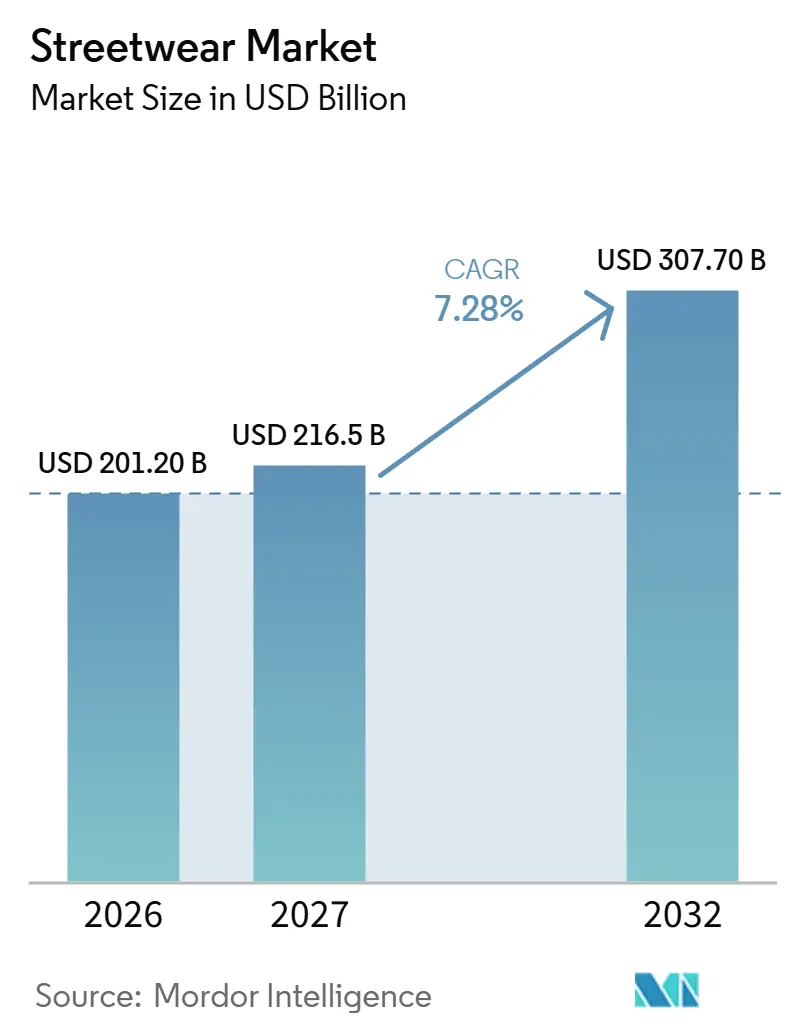
The streetwear market size was valued at USD 201.2 billion in 2026 and estimated to grow from USD 216.5 billion in 2027 to reach USD 307.7 billion by 2032, at a CAGR of 7.28% during the forecast period (2027-2032).
Teen clothing demand in the United States and social discovery in Indonesia give suppliers ways to connect brand identity with identifiable audiences. Collaborative ranges and controlled sneaker access can turn that recognition into a differentiated product proposition. Integrated selling channels can help convert interest, while counterfeits and rapid style changes threaten authentic transactions and full-price revenue. Suppliers therefore need product identity and retail execution to reinforce each other as they pursue broader demand.
Key Report Takeaways
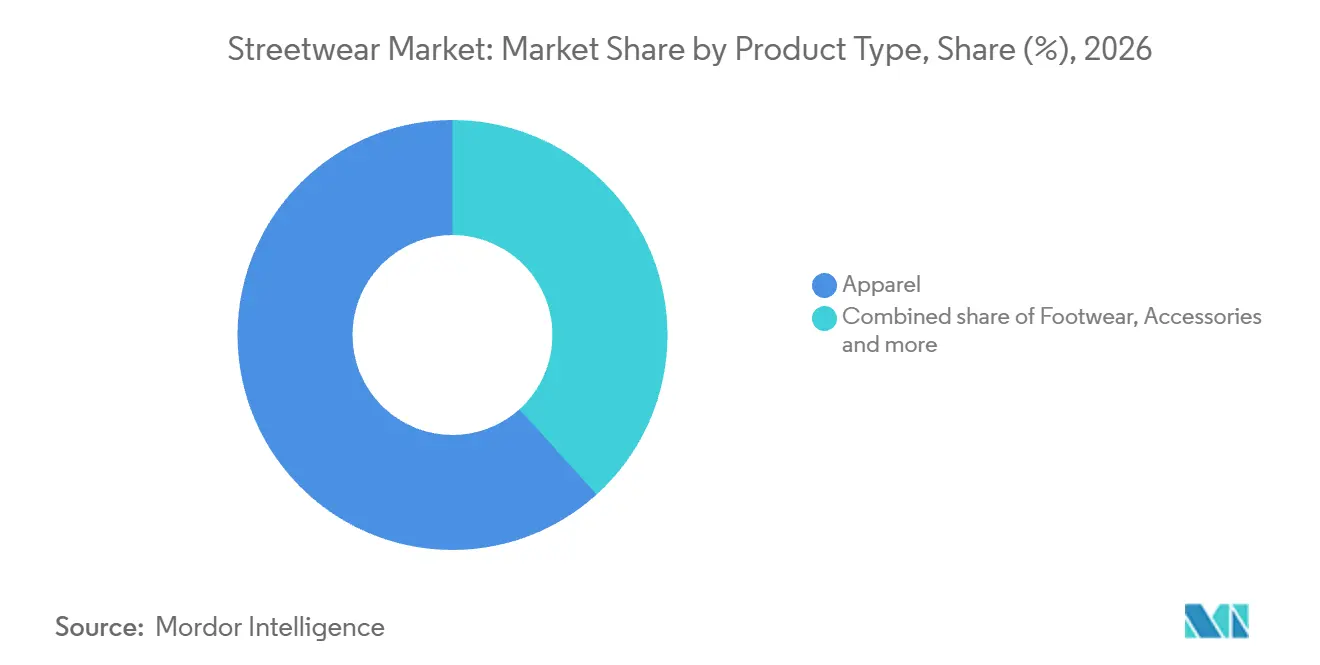
- By product type, apparel led with a 61.69% share of the streetwear market size in 2026, while footwear is forecast to be the fastest-growing segment at a CAGR of 8.05% during 2027-2032.
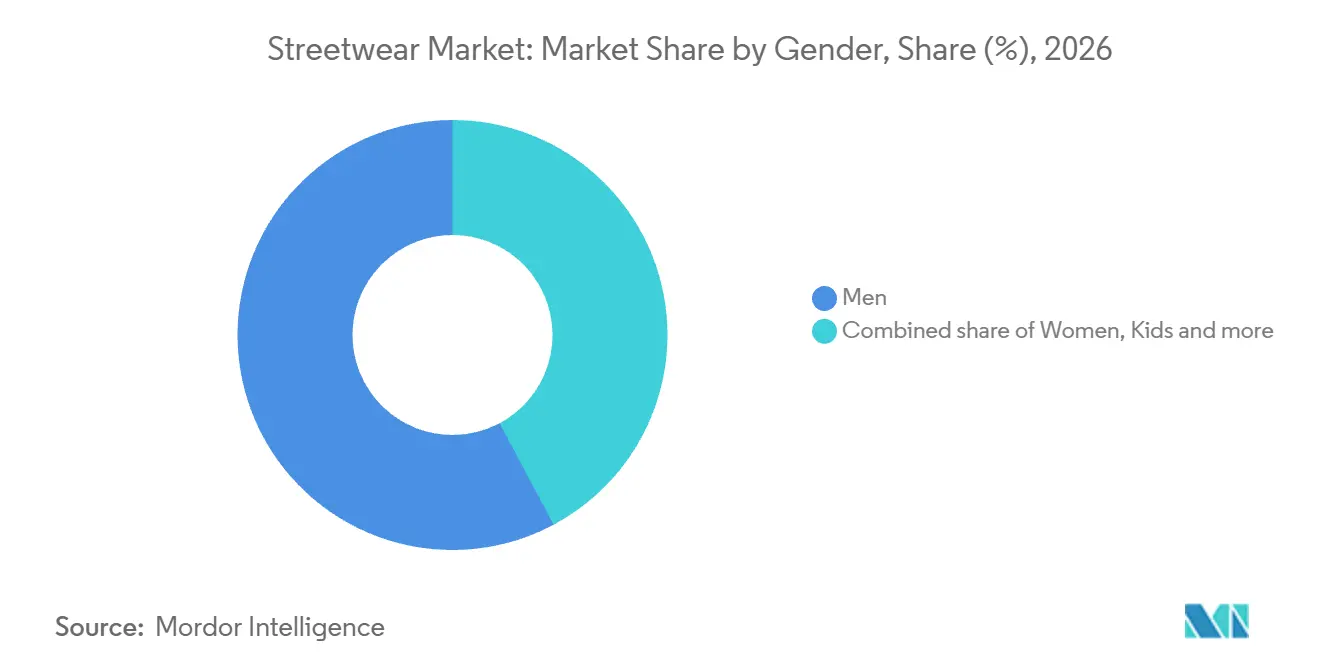
- Within the gender mix, men represented a 57.8% streetwear market share in 2026, and women are forecast to grow fastest at a CAGR of 8.6% during 2027-2032.
- Across price categories, mid-market products held 43.58% of consumer streetwear spending in 2026, with premium forecast to be the fastest-growing segment at a CAGR of 8.4% during 2027-2032.
- Distribution channels were led by offline retail stores at 59.42% of consumer streetwear spending in 2026, and online retail stores are forecast to grow fastest at a CAGR of 8.45% during 2027-2032.
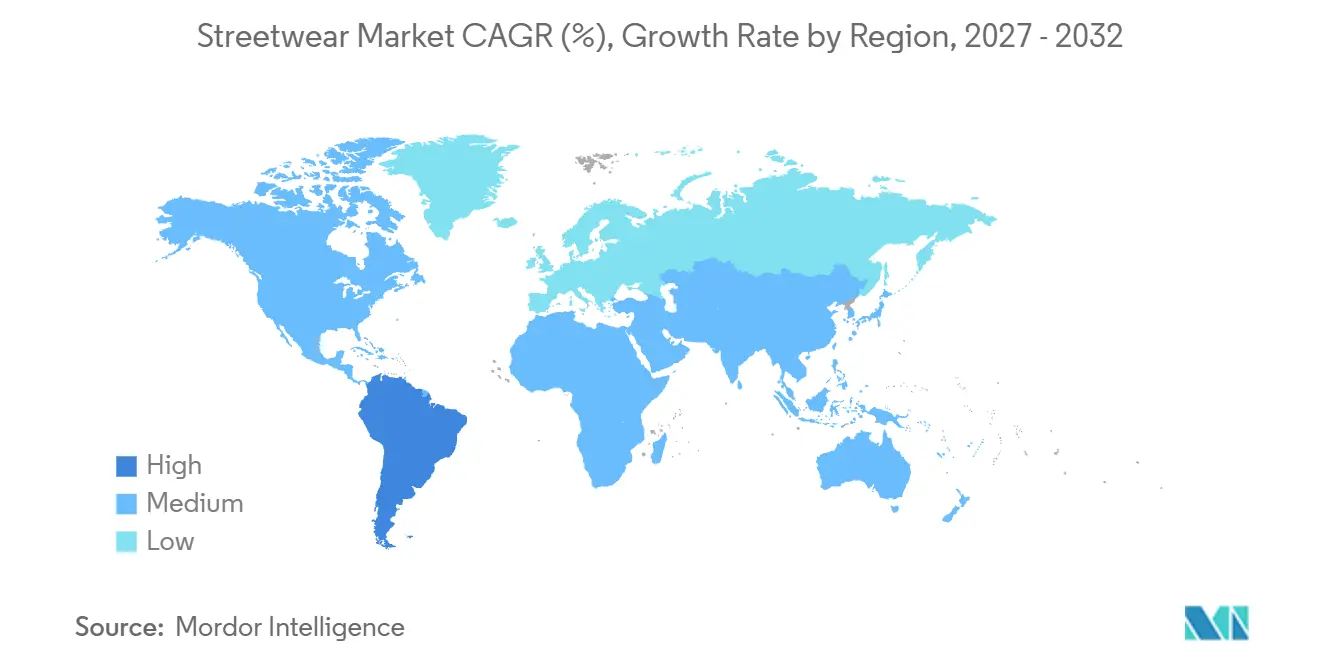
- Geographically, Asia-Pacific led with 34.81% of consumer streetwear spending in 2026, whereas South America is forecast to grow fastest at a CAGR of 8.55% during 2027-2032.
Note: Market numbers in this report are based on Mordor Intelligence's proprietary estimation framework, which combines nine months of actuals with Q4 projections for base year 2026.
Market Trends and Insights
Drivers Impact Analysis of Streetwear Market*
| Driver | (~) % Impact on CAGR Forecast | Geographic Relevance | Impact Timeline |
|---|---|---|---|
| Youth Culture and Demographics | +2.3% | United States of America | Long term (≥ 4 years) |
| Social Media Impact | +2.5% | Republic of Indonesia | Short term (≤ 2 years) |
| Scarcity and Exclusivity | +1.8% | United States of America | Short term (≤ 2 years) |
| Collaborations and Partnerships | +2.1% | North America, Europe and Asia-Pacific | Medium term (2-4 years) |
| Sustainability and Ethical Fashion | +0.7% | Countries of the European Union | Long term (≥ 4 years) |
| Digital and Omnichannel Engagement | +1.4% | North America, Europe and Asia-Pacific | Medium term (2-4 years) |
| Source: Mordor Intelligence | |||
Youth Culture and Demographics
Teen clothing demand gives streetwear brands an audience whose spending capacity and brand preferences can inform distinct commercial choices. Piper Sandler's Fall 2025 US survey of 10,969 teens ranked Nike first among clothing brands.[1] Among upper-income teens, clothing's share of the wallet grew by 1 percentage point year over year, driven by female teens after a 1% decline the previous spring. The ranking covers surveyed teens overall, whereas the clothing-allocation increase concerns the upper-income group. Nike's top ranking among surveyed teens favors smaller labels developing a distinct offer for female teens behind the upper-income wallet-share gain, rather than mirroring its range.
Social Media Impact
Social media can connect streetwear style discovery with a purchase decision when communication reaches consumers already interested in the category. A 2026 study surveyed 103 Generation Z respondents in Surabaya, Indonesia, who actively used social media and had bought streetwear within the previous 6 months. It found positive, significant effects from fashion influencers and digital promotion, with digital promotion showing the strongest influence. For brands addressing comparable buyers, that distinction supports combining creator exposure with promotion that helps consumers act on product interest. Within that mix, digital promotion's stronger purchase-decision association favors giving it budget priority over creator fees alone.
Scarcity and Exclusivity
Scarcity gives a coveted sneaker release a distinct commercial proposition when more consumers want the product than available supply can satisfy. Nike says demand for coveted SNKRS sneaker drops often exceeds supply and offers members limited-time access to selected products. Exclusive Access provides an opportunity to buy rather than a reservation or a guarantee of receiving the sneaker. For a brand operating this model, access design becomes part of the offer because interest alone cannot secure a pair. By making access time-limited, the model can give fans a reason to engage with SNKRS membership and seek the next release even when they do not obtain a pair.
Collaborations and Partnerships
Collaborations allow a streetwear brand to expand its design proposition through a partner while retaining a recognizable identity across the collection. On September 24, 2025, Stüssy and Wales Bonner announced a capsule featuring co-branded T-shirts and cotton poplin oxfords. The announcement scheduled worldwide availability for September 26 through select Stüssy chapter stores and both brands' websites. Applying a shared visual treatment to casual and more structured garments gives the partnership more than a single-product role. It can connect different wearing occasions within one identifiable offer without requiring a separate label. With the announced route spanning select Stüssy stores and both websites, the capsule could reach either label's shoppers without first securing a new independent retailer.
Restraints Impact Analysis of Streetwear Market*
| Restraint | (~) % Impact on CAGR Forecast | Geographic Relevance | Impact Timeline |
|---|---|---|---|
| Counterfeit Products | -1.3% | United Kingdom of Great Britain and Northern Ireland | Medium term (2-4 years) |
| Rapid Trend Cycles | -1.1% | North America, Europe and Asia-Pacific | Short term (≤ 2 years) |
| High Production and Retail Costs | -0.7% | United States of America | Short term (≤ 2 years) |
| Supply Chain Disruptions | -0.4% | United States of America | Short term (≤ 2 years) |
| Source: Mordor Intelligence | |||
Counterfeit Products
Counterfeit sports footwear creates a competing purchase option for brands selling genuine sneakers. The UK Intellectual Property Office's 2025 research included 172 respondents who had knowingly bought counterfeit sports footwear. Asked about their most recent purchase, 27% said they would buy directly from the brand if counterfeit sports footwear were unavailable.[2] For buyers naming the brand's own channel as their alternative, the counterfeit offer could displace a direct genuine-brand sale, putting that revenue at risk even when consumers know they are buying counterfeit footwear.
Rapid Trend Cycles
Rapid style changes can shorten the period in which a streetwear retailer can sell a collection at its intended price. In its fiscal 2025 risk disclosure, Zumiez said misjudging changing styles could produce lower-than-predicted sales, unsold inventory, and markdowns across its streetwear and other lifestyle retail business. This exposure makes a successful design insufficient if the retailer commits to quantities that outlast its appeal. Discounting can clear slow-moving stock. A misjudged collection can therefore leave the retailer with fewer sales than forecast and reduced receipts on units that require markdowns.
*Our forecasts treat driver/restraint impacts as directional, not additive. The impact forecasts reflect baseline growth, mix effects, and variable interactions.
Streetwear Market Segment Analysis
By Product Type:
Apparel Scale Meets Footwear ExpansionApparel accounted for a 61.69% share of the streetwear market size in 2026. Men's apparel represented 47% of merchandise sales at Zumiez, a specialty retailer serving action-sports, streetwear, and other lifestyle customers, in the fiscal year ended January 31, 2026. That retailer's mix gives clothing vendors a substantial route into customers interested in several related lifestyles, linking garment sales to a broader specialty-retail proposition. Apparel suppliers can therefore address a large part of this retailer's merchandise business through a men's range, without needing to enter its separate footwear or hardgoods categories.
Footwear is forecast to be the fastest-growing segment, at a CAGR of 8.05% during 2027-2032. Amer Sports reported that Salomon footwear growth in 2025 was led by Greater China and Asia-Pacific, with a growth inflection in Europe and North America. Growth across several regional bases gives a footwear brand more than one commercial route to expand, with its product proposition needing to work in different markets. Accessories accounted for 16% of Zumiez's merchandise sales in the year ended January 31, 2026, unchanged from the year ended February 1, 2025. Their place in that retailer's mix gives suppliers a complementary collection category, allowing an offer to extend across more finished products than footwear alone.

By Gender:
Men's Scale Frames a Distinct Women's OpportunityThe men's segment represented a 57.8% streetwear market share in 2026, making it the largest segment. International Association of Department Stores (IADS) members reported menswear at an average 17% of total turnover in 2025, up from 16% in 2024. IADS noted that members' store formats, tourism exposure, and price architectures varied, while describing menswear as stable or growing. Streetwear suppliers pursuing these department-store buyers can tailor a men's proposition to the intended store format, since the category operates across different tourism and price exposures.
Women are forecast to be the fastest-growing segment, at a CAGR of 8.6% during 2027-2032. JD Sports Fashion reported approximately 2% organic growth in North American apparel and accessories for the 26 weeks ended August 1, 2026, with women's ranges and own brands performing particularly well. Organic growth excludes acquisitions and disposals and uses constant exchange rates. NIKE Brand Women's revenue was USD 9.72 billion in fiscal 2025, down 6% from fiscal 2024 on a reported basis. JD Sports' women's-range performance makes its North American apparel business a potential partner for suppliers targeting that demand, while Nike's fiscal 2025 decline describes one brand's global result rather than the segment's growth ceiling.
By Category:
Price Position and Specialist Retailing Shape DemandMid-market products formed the largest segment, with 43.58% of streetwear consumer spending in 2026. For buyers assembling an outfit within an intermediate budget, a lower commitment per garment can make coordinated purchases feasible without premium-tier spending. A multibrand assortment could serve that need by allowing comparisons across garment styles and prices within one retail setting. The tier's commercial opening is therefore a coordinated outfit at an accessible total price, giving apparel suppliers a reason to design complementary pieces rather than depend on a single scarce release.
Premium is forecast to be the fastest-growing segment, at a CAGR of 8.4% during 2027-2032. Footshop Group, a European streetwear retailer of premium casual footwear and apparel, reported 2025 company-wide net revenue of about CZK 1.89 billion (USD 86.1 million), up 32.1% year over year. Its first-half 2026 company-wide revenue rose 8% year over year to CZK 961 million (USD 46.1 million). Footshop said the lower growth matched expectations and reflected a strong comparison period, particularly the first quarter of 2025, and it lowered its full-year outlook. Specialist retail therefore offers premium suppliers an established route to expand sales, but the slower subsequent growth favors matching commitments to retailer demand rather than extrapolating the earlier surge.
By Distribution Channel:
Store Networks and Brand-Operated E-Commerce Shape AccessOffline retail stores were the largest segment, accounting for 59.42% of consumer spending in 2026. Zumiez, which serves streetwear and related lifestyles, reported 714 stores across the United States, Canada, Europe, and Australia on August 29, 2026. That network shows how a specialist retail proposition can be repeated across regional markets, giving consumers local points of access to apparel, footwear, and accessories. One relationship with a specialist chain can open access to multiple local outlets, making retailer fit a route to physical distribution for brands seeking repeatable geographic reach.
Online retail stores are forecast to be the fastest-growing segment, at a CAGR of 8.45% during 2027-2032. Adidas-brand e-commerce sales increased 16% on a currency-neutral basis in 2025, with Yeezy sales excluded from the prior-year comparison. Adidas reported a continued focus on full-price propositions in this channel. Brand-operated online selling gives suppliers a consumer sales route in which they can retain control over the range and its presentation. For streetwear labels, the expansion mechanism is direct access to buyers beyond individual store catchments, with commercial value depending on converting that access into full-price purchases.
Geography Analysis
Asia-Pacific Streetwear Market
Asia-Pacific was the largest geography, accounting for 34.81% of the streetwear market size in 2026. In Greater China, Adidas's Lifestyle category of footwear, apparel, and accessories born from sport and worn for style grew at a double-digit rate in 2025. China's above-designated-size retail units sold CNY 121.3 billion (USD 18.1 billion) of clothing, footwear, hats, and textiles in September 2026, up 1.2% year over year in nominal terms. China's 1.2% nominal category growth in September 2026 favors competing through a distinctive range over relying on category lift, while Adidas's double-digit Lifestyle growth in Greater China in 2025 illustrates the opportunity.
South America Streetwear Market
South America is forecast to be the fastest-growing geography, at a CAGR of 8.55% during 2027-2032. Adidas opened Brazil's first Originals concept store in Pinheiros, São Paulo, in 2025, expanding its urban lifestyle retail channel. Centauro, Grupo SBF's Brazilian sports retailer, reported digital-platform net revenue growth of 19.9% in 2025 compared with 2024. Yet Brazil's broader retail sales volume for fabrics, clothing, and footwear fell 3.9% year over year in August 2026. Digital selling and curated urban stores offer suppliers routes to reach buyers beyond undifferentiated retail, making channel-specific expansion a more credible growth mechanism than assuming recovery across Brazil's wider clothing-and-footwear category.
In North America, Adidas's 2025 operating model included creation centers in Portland and Los Angeles for tailoring products to local consumer needs. In Europe, its broader Lifestyle business grew at a high-single-digit rate in 2025, with Sportswear growing double digits and Originals at high single digits. Local product development gives a brand a way to adapt its offer, while European sales growth creates a commercial base for its broader lifestyle ranges. Within the Middle East and Africa, a 2025 Doha Festival City report described young shoppers at the Qatar mall pairing streetwear with modest silhouettes. For suppliers addressing such shoppers, recognizable streetwear styling can coexist with modest garment shapes, making the silhouette part of the local product proposition.
Regulatory Framework and Outlook
The comparison covers selected jurisdictions from the perspective of large suppliers selling covered streetwear textile apparel. Fiber labels, input traceability, and conformity assessment place different tasks between the finished garment and its retail sale. Defined labeling duties can be incorporated into repeatable product preparation, while certification makes market placement depend on an additional assessment step.
Regulatory Table of Streetwear Market
| Decision factor | United States | United Kingdom | China | Brazil | Saudi Arabia |
|---|---|---|---|---|---|
| Primary authority | Federal Trade Commission; Consumer Product Safety Commission | Local Trading Standards Services in England, Scotland and Wales | State Administration for Market Regulation; local market-regulation departments | Inmetro | Saudi Standards, Metrology and Quality Organization |
| Key instruments or direction | 16 CFR Part 303; pre-rule consideration of a spandex flammability exemption | 2012 textile-labeling regulations in England, Scotland and Wales | Fiber-product measures effective July 1, 2026; forthcoming recommended fiber-identification standard | Portaria Inmetro No. 118/2021, including textile-label exemptions | Textile Products Regulation, Issue 2; coverage includes products with at least 80% textile fibers by weight |
| Commercial effect | Label or invoice covered textiles as required and align advertising with the rules | Manufacturers or UK importers provide English, durable, legible, visible and accessible fiber labels showing each differing component's content | Producers retain input-inspection records for at least 2 years; labels identify reused inputs when used | Covered domestic and imported textiles disclose fiber type, percentage and generic name, with care and packaging requirements | Market-placement suppliers obtain applicable conformity certificates from approved assessment bodies |
| Current policy attractiveness | High | High | Medium | High | Low |
| Future direction of policy attractiveness | Easing | No change | No change | No change | No change |
| Source: Mordor Intelligence | |||||
For large textile-apparel suppliers, the United States merits High for defined labeling duties and qualifying-fabric testing exemptions, while Easing reflects CPSC's 2026 pre-rule consideration of a spandex exemption, with none adopted by October 16, 2026. The United Kingdom merits High for defined fiber-labeling duties in England, Scotland, and Wales and No change because no textile-specific amendment followed the March 31, 2026 proposal to consolidate enforcement powers in one statutory instrument. China's binding input-record duties effective July 1, 2026 support Medium, while the recommended GB/T 29862-2026 replacement of GB/T 29862-2013 on August 1, 2027 supports No change by leaving those binding duties intact. Brazil's Portaria Inmetro 118/2021 composition-and-care labeling supports High and Saudi Arabia's applicable TYPE 3 or TYPE 1A certification under Issue 2 supports Low, with No change reflecting continuing duties without scheduled transitions.
Value Chain Stages
The value chain compares how branded product development, component supply, manufacturing, and retail convert a design into a consumer sale. Nike's Jordan Brand designs, distributes, and licenses athletic and casual footwear, apparel, and accessories focused predominantly on sport performance and streetwear.[3] Pou Chen Corporation derived 70% of consolidated operating revenue from footwear manufacturing in 2025 and reported separate external-customer revenue for shoemaking, combined sporting-goods retail and wholesale, and other activities in first-half 2026. This separation creates different earnings mechanisms for owners of the consumer proposition and suppliers paid to make the product.
Value Chain Analysis Table of Streetwear Market
| Primary activity | Key participants | Value capture | Bottleneck | Resilience response |
|---|---|---|---|---|
| Product design and licensing | Brand owners such as Nike Inc through Jordan Brand | Branded product sales and licensing revenue | Preserving design coherence across footwear, apparel and accessories | Apply shared design standards across product briefs |
| Footwear component production | Component manufacturers such as Nike-owned Air Manufacturing Innovation and Pou Chen Corporation | Component supply revenue | Design revisions arriving after component production commitments | Coordinate component and finished-shoe design revisions |
| Finished-footwear manufacturing | Contract footwear manufacturers such as Pou Chen Corporation | Contract manufacturing sales | Fiscal 2026 NIKE Brand footwear production concentrated in Vietnam, Indonesia and China | Develop local sourcing for responsive product lines |
| Wholesale and consumer retail | Brand sellers such as Adidas AG and VF Corporation through Vans | Wholesale merchandise sales and consumer product sales | Coordinating product releases across partner and owned channels | Use channel-specific launch plans across stores and websites |
| Source: Mordor Intelligence | ||||
Adidas reported increasing local-for-local sourcing in Greater China, India, Brazil, and Argentina in 2025, with its Greater China model enabling shorter end-to-end lead times for responsive articles. That example places resilience at the sourcing-design interface, where production choices can change how quickly a brand responds to demand. More local sourcing would make execution within individual markets a stronger competitive consideration alongside global manufacturing scale.
Competitive Landscape
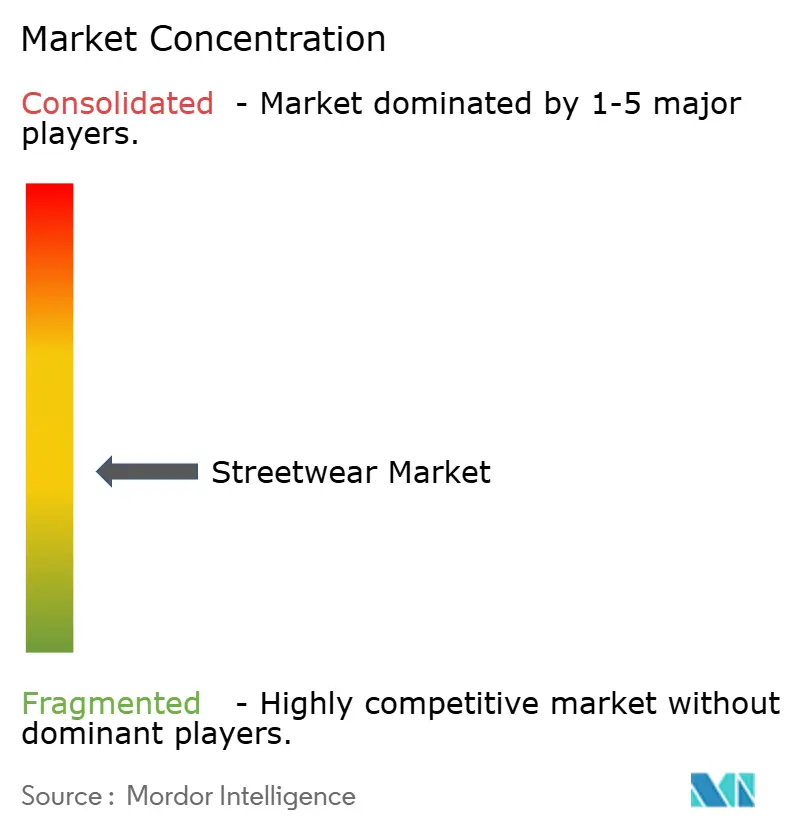
Competition is moderately fragmented across diversified footwear-and-apparel suppliers and specialist streetwear labels. Major players include Nike Inc across footwear, apparel, and accessories, Adidas AG across footwear, apparel, and accessories, Puma SE through wholesale and consumer channels, VF Corporation through Vans, and Cold Culture through its streetwear storefront. In first-half 2026, Puma's global wholesale sales value fell 8.2% from first-half 2025, while direct-to-consumer sales value grew 2%, both on a currency-adjusted basis. Prior-year comparatives were adjusted for discontinued operations, and direct-to-consumer includes owned stores and e-commerce. Channel selection consequently matters alongside product breadth, because wholesale supply and own-channel selling can generate different commercial outcomes for the same brand in the same period.
Cold Culture opened one Barcelona flagship in 2025, adding a physical location to its streetwear retail network. On September 9, 2025, Bicycle announced a limited-edition global Cold Culture capsule of customized playing cards and 2 streetwear T-shirts, with online availability and flagships in Madrid, Barcelona, Berlin, London, and Amsterdam. Adidas-brand footwear revenue grew 12% on a currency-neutral basis in 2025. For a specialist label competing alongside such a larger footwear business, a partner capsule and owned flagships can connect a distinctive release directly to buyers without first winning wholesale shelf space.
VF Corporation's Vans brand recorded a 9% global revenue decline in fiscal 2026, including a 2% favorable currency impact. Nike's fiscal 2026 filing identified unsuccessful intellectual property enforcement as a risk that could harm its sales and brand and shift consumer preference away from its products. Protection against continued counterfeit or infringing sales can therefore complement collection quality in keeping consumer preference and revenue with the brand owner.
Streetwear Industry Leaders
-
Nike Inc
-
Adidas AG
-
Puma SE
-
VF Corporation
-
Cold Culture
- *Disclaimer: Major Players sorted in no particular order
Streetwear Market Companies Covered in this Report
- Nike Inc
- Adidas AG
- VF Corporation
- Puma SE
- Cold Culture
- XinDeSheng
- New Balance Athletics Inc.
- Stussy Inc.
- A Bathing Ape (BAPE)
- Palace Skateboards
- Kith Retail LLC
- LVMH
- ASICS Corp.
- Deckers Outdoor Corporation
- Converse Inc.
- Skechers USA, Inc.
- Reebok International Ltd.
- HUF Worldwide LLC
- Carhartt WIP
- Vans
Key Opportunities for Market Participants
The opportunities compare consumer-product sales routes for streetwear sellers responding to EU restrictions on destroying unsold goods. An EU prohibition on large companies destroying unsold clothes, clothing accessories, and footwear took effect on July 19, 2026, subject to limited exceptions. Brand-owned archive ranges and retailer partnerships can give eligible unsold products an additional route to consumers, with commercial value depending on converting the product offer into retail sales.
Market Opportunities Table of Streetwear Market
| Opportunity | Why now | Buyer / lead segment | Recommended play | Main barrier | Likely beneficiaries |
|---|---|---|---|---|---|
| Brand-controlled archive apparel | Covered sellers have an incentive to retain a sales route for unsold apparel | Apparel buyers seeking prior-season branded styles | Build a distinct consumer-facing archive range within owned channels | Keeping the archive offer distinct from current collections | Apparel brands such as Cold Culture |
| Specialist retail of authorized unsold footwear | The covered footwear scope supports a retail outlet for eligible products | Branded-footwear buyers using specialist retailers | Source authorized unsold footwear for a defined consumer retail assortment | Securing a dependable flow of authorized branded products | Specialist retailers such as Footshop Group |
| Retail partnerships for medium-sized labels | Medium-sized companies enter the prohibition from 2030 | Consumer audiences of medium-sized EU streetwear labels | Develop consumer-retail partnerships before the phase-in | Agreeing assortment control and pricing responsibilities | Retail partners such as Footshop Group |
| Source: Mordor Intelligence | |||||
Keeping eligible products available for consumer purchase can turn an obligation over unsold goods into a retail opportunity. That opportunity depends on an assortment whose brand identity is clear at the point of sale. Seller control over presentation and access to an appropriate retail audience then determine whether the additional route can generate consumer spending.
Recent Industry Developments in Streetwear Market
- Oct 2026: Nike announced Pace, a global operating-model transformation that includes supply-chain modernization and is expected to deliver approximately USD 2.5 billion in cumulative savings through fiscal 2031, before expected charges and future reinvestment.
- Jul 2026: Vans, a VF Corporation brand, made its KPop Demon Hunters Golden capsule available online and in stores. The collection featured Old Skool footwear and apparel T-shirts in a collaboration with Netflix's KPop Demon Hunters.
Streetwear Market Report Scope and Research Methodology
Market Definition and Coverage
The Streetwear market measures annual consumer spending on streetwear apparel, footwear, and accessories globally. Sales are classified by product type, intended gender, category, distribution channel, and geography.
Scope exclusions: Separately sold textiles and other raw materials, wholesale transfers between businesses, separately sold repair and alteration services, and apparel, footwear, and accessories that are not streetwear are excluded.
Segments Covered in This Report
- By Product Type
- Apparel
- Footwear
- Sneakers
- Boots
- Others (sandals, flip-flops, and slippers)
- Accessories
- By Gender
- Men
- Women
- Kids
- By Category
- Luxury
- Premium
- Mid-Market
- Mass Market
- By Distribution Channel
- Offline Retail Stores
- Online Retail Stores
- By Geography
- North America
- United States
- Canada
- Mexico
- Rest of North America
- Europe
- Germany
- United Kingdom
- Italy
- France
- Spain
- Netherlands
- Poland
- Belgium
- Sweden
- Rest of Europe
- Asia-Pacific
- China
- India
- Japan
- Australia
- Indonesia
- South Korea
- Thailand
- Singapore
- Rest of Asia-Pacific
- South America
- Brazil
- Argentina
- Colombia
- Chile
- Peru
- Rest of South America
- Middle East and Africa
- South Africa
- Saudi Arabia
- United Arab Emirates
- Nigeria
- Egypt
- Morocco
- Turkey
- Rest of Middle East and Africa
- North America
Data Sources, Market Sizing, and Validation
Desk Research
Eurostat household and e-commerce statistics, the United Nations World Population Prospects, Piper Sandler's teen survey, and UK Intellectual Property Office counterfeit research provide examples of public evidence on retail activity, demographic context, consumer channels, and product authenticity. These sources help frame regional and channel indicators and consumer behavior, while customs and trade data can help distinguish finished-product flows from upstream materials.
Company annual reports, investor materials, earnings releases, and reputable business press provide additional evidence on product ranges, retail channels, sales performance, and regional exposure. These records can cross-check category and company signals against public statistical series. The named sources are not exhaustive, and further sources inform collection, validation, and clarification.
Primary Interviews and Surveys
Structured interviews and surveys would target brand and retail executives, product and merchandising leaders, and channel managers with experience in streetwear apparel, footwear, and accessories across global regions. Their responses would test secondary evidence on product, price tier, channel, and regional demand, and clarify where public records leave a coverage or timing gap. Analysts would compare respondent evidence with independent market and company indicators, recording unresolved differences for follow-up rather than treating any single response as a market total.
Distribution of primary research fieldwork respondents
| Company type | Respondent position | Region |
|---|---|---|
| Top tier: 35% | CXOs: 20% | APAC: 40% |
| Mid tier: 45% | Functional/Unit leaders: 35% | EMEA: 30% |
| Smaller Players: 20% | Managers: 45% | Americas: 30% |
Market-Sizing & Forecasting
The estimate starts with a top-down view of global consumer retail spending on finished streetwear products, organized by apparel, footwear, and accessories, and checked selectively against supplier and retailer sales disclosures and sampled retail price times observed product volumes where public evidence permits. Analysts build product, gender, price-category, channel, and regional shares from reported sales mixes, retail indicators, and product coverage, then reconcile the shares to the global total without counting wholesale transfers twice. Relevant indicators include household clothing and footwear spending, online clothing and footwear purchase activity, population by age and region, apparel and footwear retail sales trends, and company-reported channel and regional growth. These indicators inform demand scale, channel mix, or geographic allocation. Scenario analysis carries these demand and channel signals into the 2027-2032 outlook, with price and product mix considered where disclosed. Missing observations are bridged with the nearest comparable public series and checked against the market boundary. Primary respondents would review the direction and relevance of variable-level assumptions, while selective bottom-up checks would test whether observed retail and supplier activity is consistent with the top-down totals.
Data Validation & Update Cycle
Analysts triangulate public spending, retail, trade, demographic, and company signals with respondent evidence, then investigate anomalies and material variances against the prior estimate and adjacent categories before sign-off. A second review checks source dates, units, market boundary, segment shares, and arithmetic. Follow-up contact is triggered when a source is ambiguous or independent indicators point in different directions. The model is refreshed annually, reviewed between cycles when a material market event changes demand or channel conditions, and given a fresh source and consistency review before delivery.
Mordor Intelligence's Streetwear Market Sizing Compared With Other Published Estimates
Published estimates can differ in the transactions and products they count and the inputs used to model demand. The Streetwear market measures annual consumer spending on streetwear apparel, footwear, and accessories globally.
Key Gap Drivers include the study's defined coverage and market-specific modeling choices. Analysts build product, gender, price-category, channel, and regional shares from reported sales mixes, retail indicators, and product coverage, then reconcile the shares to the global total without counting wholesale transfers twice.
Benchmark comparison
| Source | Market Size | Gaps in Research Methodology |
|---|---|---|
| Mordor Intelligence | USD 216.5 B (2027) | |
| Global Consultancy A | USD 273.67 B (2025) | At its 2025 base, this estimate is 26.4% above this report's 2027 value of USD 216.5 B, 2 years later. Its listed distribution channels include resale platforms, which may include secondary consumer transactions beyond the report's brand and retailer sales measure. |
| Global Consultancy B | USD 199.1 B (2025) | At its 2025 base, this estimate is 8.0% below this report's 2027 value of USD 216.5 B, 2 years later. Its published value is for 2025, two years before this report's comparison year. |
Mordor Intelligence's analysts triangulate public spending, retail, trade, demographic, and company signals with respondent evidence, then investigate anomalies and material variances against the prior estimate and adjacent categories before sign-off.
Key Questions Answered in the Report
What is the streetwear market size and growth outlook?
The size was USD 201.2 billion in 2026 and is estimated at USD 216.5 billion in 2027. It is forecast to reach USD 307.7 billion by 2032, at a CAGR of 7.28% during 2027-2032.
What supports demand for streetwear products?
Youth brand affinity and digital promotion help connect styles with buyers. In Piper Sandler's Fall 2025 US survey of 10,969 teens, Nike ranked first among clothing brands.
Which product category leads streetwear sales?
Apparel held 61.69% of consumer spending in 2026. Footwear is forecast to grow fastest at a CAGR of 8.05% during 2027-2032.
Which companies shape streetwear competition?
Major participants include Nike Inc, Adidas AG, Puma SE, VF Corporation, and Cold Culture.
How do fashion cycles affect streetwear retailers?
Zumiez's fiscal 2025 risk disclosure said misjudging changing styles could leave its streetwear and other lifestyle business with unsold merchandise and require markdowns.
Which regions lead streetwear spending and growth?
Asia-Pacific led with 34.81% of consumer spending in 2026. South America is forecast to grow fastest at a CAGR of 8.55% during 2027-2032.