
Guatemala Telecom MNO Market Size and Share
Market Overview
| Study Period | 2019 - 2030 |
|---|---|
| Forecast Data Period | 2025 - 2030 |
| Historical Data Period | 2019 - 2023 |
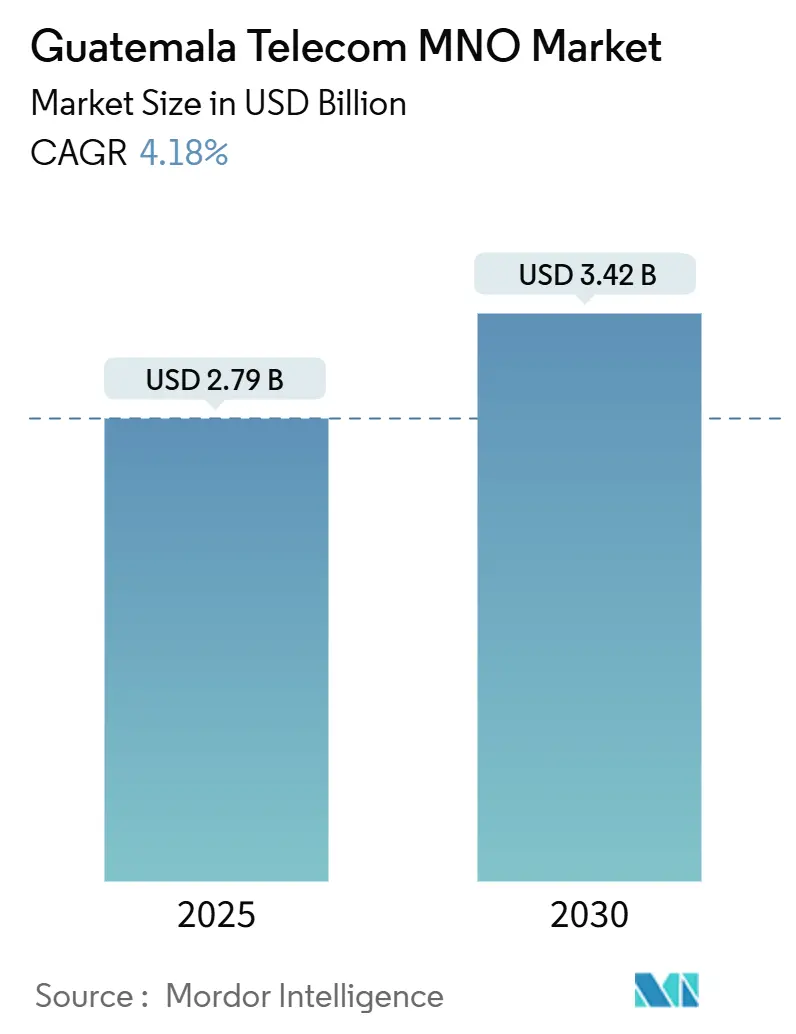
| Market Size (2025) | USD 2.79 Billion |
| Market Size (2030) | USD 3.42 Billion |
| Growth Rate (2025 - 2030) | 4.18 % |
| Market Concentration | High |
Major Players *Disclaimer: Major Players sorted in no particular order Image © Mordor Intelligence. Reuse requires attribution under CC BY 4.0. | |
Guatemala Telecom MNO Market Analysis by Mordor Intelligence
The Guatemala Telecom MNO Market size is estimated at USD 2.79 billion in 2025, and is expected to reach USD 3.42 billion by 2030, at a CAGR of 4.18% during the forecast period (2025-2030). In terms of subscriber volume, the market is expected to grow from 23.92 million subscribers in 2025 to 28.98 million subscribers by 2030, at a CAGR of 3.91% during the forecast period (2025-2030).
Growth in the Guatemalan telecom MNO market is driven by high mobile penetration, rising remittance-funded consumption, and aggressive data-centric pricing that offsets voice cannibalization. Macroeconomic stability and 19% of GDP remittance inflows channel disposable income toward smartphones and fintech apps, which in turn inflate traffic volumes. [1]Western Hemisphere Dept., “Remittances and Reserves Accumulation in Guatemala,” IMF.org Nationwide 4G coverage, initial 5G launches, and fiber builds are lifting average revenue per user as operators pivot from coverage races to experience differentiation. Convergent quad-play bundles and PayTV integration create sticky subscriber bases, while tower monetization unlocks capital for rural expansion.
Key Report Takeaways
- By service type, data and internet services held 44.67% of Guatemala telecom MNO market share in 2024, and OTT and PayTV services recorded the fastest 4.56% CAGR through 2030.
- By end user, consumer accounts for 80.19% of the Guatemala telecom MNO market size in 2024, while the enterprise segment is expanding at a 4.70% CAGR to 2030.
Guatemala Telecom MNO Market Trends and Insights
Drivers Impact Analysis*
| Driver | (~) % Impact on CAGR Forecast | Geographic Relevance | Impact Timeline |
|---|---|---|---|
| Surging Mobile-data Consumption from Affordable Smartphones and Social Media | +1.2% | Urban clusters of Guatemala City, Mixco, Quetzaltenango | Short term (≤ 2 years) |
| Nationwide 4G Coverage and Initial 5G Launches Lifting ARPU | +0.8% | National, urban first then rural | Medium term (2-4 years) |
| Accelerating FTTH Roll-outs Raising Fixed-broadband Uptake | +0.6% | Urban, extending to secondary cities | Medium term (2-4 years) |
| Convergent Quad-play Bundles Boosting PayTV and Overall Revenue | +0.4% | Urban and suburban households | Short term (≤ 2 years) |
| Cross-border E-commerce Boom Among SMEs Spurring B2B Fiber and IoT Demand | +0.3% | Border regions and commerce hubs | Long term (≥ 4 years) |
| Remittance-backed Fintech Apps Driving Incremental Mobile Data Traffic | +0.5% | Nationwide, remittance corridors | Short term (≤ 2 years) |
| Source: Mordor Intelligence | |||
Surging Mobile-Data Consumption from Affordable Smartphones and Social Media
Smartphone affordability and a median age of 23.4 years push data traffic well beyond historical voice patterns, as 92.3% of internet users engage at least one social platform. Young consumers generate up to fivefold higher data usage, which naturally lifts ARPU without premium tariffs. Bundled unlimited social media plans and device financing reduce churn, expand tenure, and reinforce the Guatemala telecom MNO market revenue stream. Operators monetize the wave through tiered data offers and value-added services that transform connectivity into a lifestyle utility. Social channels are also embedding shopping and payment tools, so data plans effectively become an on-ramp to digital commerce.
Nationwide 4G Coverage and Initial 5G Launches Lifting ARPU
Coverage has reached 92% of the population, shifting the competitive focus from signal presence to quality of experience. [2]G. Katz, “Latin American Telecommunications at the Crossroads of Passive Infrastructure Sharing,” TelecomAdvisoryServices.com Tigo’s early 5G introduction and Claro’s premium 449.29 Mbps median downloads position the brands for upselling to latency-sensitive consumer and enterprise use cases. [3]Ookla Research, “Speedtest Connectivity Report H1 2024,” Ookla.comReallocated spectrum from the 2023 auctions provides bandwidth for differentiated 5G propositions, starting with fixed wireless access in fiber-scarce areas. This evolution strengthens the Guatemala telecom MNO market as operators blend mobile and fixed offerings to raise spend per account.
Accelerating FTTH Roll-outs Raising Fixed-Broadband Uptake
Millicom has earmarked USD 700 million over two years for fiber that delivers symmetrical speeds vital for remote work and cloud workloads. [4]Millicom, “Annual Report 2023,” Millicom.com FTTH expansion supports quad-play bundles that lift customer lifetime value and curb churn. Geospatial analytics optimize trench routes and minimize capex. Government commitments of USD 2.3 billion toward infrastructure dovetail with universal service funds to subsidize rural fiber. The resulting fixed-line uplift complements mobile growth, broadening Guatemala telecom MNO market revenue channels.
Convergent Quad-Play Bundles Boosting PayTV and Overall Revenue
PayTV subscribers in Latin America stabilized at 53-54 million after years of decline, underscoring the role of integrated video in retaining customers. Guatemalan operators package live TV, broadband, and mobile under a single bill, reducing acquisition costs and raising switching barriers. Local content investments and premium sports partnerships sharpen differentiation versus streaming-only rivals. Bundles also drive mobile up-sell as fixed customers adopt companion handsets, magnifying Guatemala telecom MNO market profitability.
Restraints Impact Analysis*
| Restraint | (~) % Impact on CAGR Forecast | Geographic Relevance | Impact Timeline |
|---|---|---|---|
| Elevated Spectrum Fees and Sector-specific Taxes Squeezing Margins | -0.7% | National | Medium term (2-4 years) |
| Low Rural Disposable Income Limiting Broadband Affordability | -0.5% | Rural indigenous communities | Long term (≥ 4 years) |
| Municipal Right-of-way Permit Delays Slowing Fiber Deployment | -0.3% | Urban expansion zones | Short term (≤ 2 years) |
| Free OTT Voice Apps Cannibalizing Traditional Voice Revenue | -0.6% | National, urban skew | Short term (≤ 2 years) |
| Source: Mordor Intelligence | |||
Elevated Spectrum Fees and Sector-Specific Taxes Squeezing Margins
Operators face high spectrum renewal costs and extra levies that strain cash generation and could deter 5G rollout, especially for smaller entrants. The fee structure tops regional averages, making Guatemala less attractive than neighboring investment destinations. Tax complexity adds planning risk that may slow network upgrades, tempering Guatemala telecom MNO market growth despite demand momentum.
Free OTT Voice Apps Cannibalizing Traditional Voice Revenue
WhatsApp, Telegram, and similar apps displace billable voice minutes, accelerating legacy revenue decline. Operators respond with unlimited voice bundled into data plans, effectively pricing calls as a free add-on. The shift forces greater investment in data capacity even as monetization pivots to volume-based pricing, creating a squeeze that limits margin expansion in the Guatemala telecom MNO market.
*Our forecasts treat driver/restraint impacts as directional, not additive. The impact forecasts reflect baseline growth, mix effects, and variable interactions.
Segment Analysis
By Service Type: Data Services Dominate Revenues and Propel Growth
Data and internet services accounted for 44.67% of Guatemala telecom MNO market share in 2024, underscoring the centrality of broadband to consumer and enterprise lifestyles. OTT and PayTV offerings are accelerating at a 4.56% CAGR as streaming, gaming, and remote education normalize, expanding the Guatemala telecom MNO market size tied to content-rich plans. Voice still yields meaningful cash flows in rural corridors where broadband remains sparse, yet its proportional contribution recedes annually.
Messaging revenues continue to fall because WhatsApp displacement is near complete in urban clusters, prompting operators to launch rich-communication business APIs. IoT and M2M demand emerges from logistics, agro-tech, and retail automation, creating a nascent but high-margin layer. Other value-added services, such as roaming, cloud storage, and cybersecurity, diversify portfolios. The blend points to an evolution from connectivity provider to digital-service orchestrator, reshaping competitive dynamics within the Guatemala telecom MNO market.




By End User: Enterprise Uptake Outpaces a Saturated Consumer Base
The consumer segment represented 80.19% of Guatemala telecom MNO market size in 2024, reflecting SIM penetration above 110% of the population. Growth is largely substitutional as operators lure rivals’ users through bundled offers and device financing. Remittance-driven households fuel app-based transactions that lift per-user data-consumption profiles.
In contrast, enterprise lines grow at a 4.70% CAGR to 2030, propelled by SME cloud adoption, cross-border e-commerce, and IoT solutions that demand dedicated fiber and secure mobile connectivity. Managed services, cybersecurity, and edge computing foster deeper B2B spending. As a result, the enterprise slice enlarges its Guatemala telecom MNO market share even as consumer revenues plateau, offering carriers a path to sustained top-line expansion.

Geography Analysis
Guatemala City and its satellite cities command the highest revenue density, benefiting from near-universal 4G and early 5G coverage that supports premium pricing. Secondary urban centers such as Quetzaltenango and Escuintla are next in line for 5G rollout as operators chase affluent user pockets. In these hubs, fiber builds and small cell densification improve customer experience, reinforcing the Guatemala telecom MNO market’s urban skew.
Rural regions, where broadband adoption is 45.83%, wrestle with low disposable income and challenging topography that inflate deployment costs. Government pledges of USD 2.3 billion for 2025 infrastructure aim to subsidize backhaul and towers, closing the urban–rural gap. Satellite backhaul and fixed wireless access via 5G are viewed as cost-effective stopgaps. Indigenous highland communities also contend with cultural and linguistic barriers, so tailored digital-literacy programs accompany network expansion.
Border areas with Mexico, Belize, El Salvador, and Honduras see rising cross-border traffic tied to e-commerce and remittances, spurring demand for reliable roaming and fintech connectivity. The Pacific coast and eastern lowlands present flatter terrain that eases fiber construction and supports agro-industrial IoT solutions, adding niche growth corridors to the Guatemala telecom MNO market. Climate resilience is also a geographic imperative, as hurricanes and floods necessitate hardened, redundant networks, increasing capex but reducing service disruption risk.
Competitive Landscape
The sector is consolidated with three national network operators. Tigo Guatemala leverages its 11.7 million customers and the largest broadband base of 720,000 fixed lines to cross-sell quad-play bundles, securing the lead in the Guatemala telecom MNO market share. Its USD 975 million sale-and-leaseback of 7,000 towers to SBA Communications frees capital for 5G densification and rural fiber builds.
Claro competes on network quality, registering top 5G speeds and partnering with satellite providers to reach underserved zones. Movistar targets price-sensitive consumers and SMEs through aggressive bundles and shared-network cost optimization. Infrastructure sharing, mandated in part by regulators, allows all three to deploy faster at lower cost while focusing differentiation on services rather than passive assets.
Enterprise IoT, cloud connectivity, and fintech tie-ups constitute new battlegrounds as operators pursue margin-rich verticals. Regulatory spectrum allocations, stricter device-registration compliance, and potential fines up to USD 25,800 shape competitive behavior. Overall, technology leadership, customer experience, and convergence depth define positioning in the evolving Guatemala telecom MNO market.
Guatemala Telecom MNO Industry Leaders
Tigo Guatemala
Claro Guatemala
Movistar Guatemala
- *Disclaimer: Major Players sorted in no particular order


Recent Industry Developments
- March 2025: Guatemala launched a USD 3 million public-service digitalization project backed by the UN and EU, opening demand for secure government connectivity.
- November 2024: Claro teamed with Starlink to offer satellite broadband in Colombia, setting a precedent for rural-reach strategies relevant to Guatemala.
- October 2024: Millicom and SBA Communications closed a USD 975 million sale-and-leaseback covering 7,000 towers, including a build-to-suit pipeline of 2,500 sites.


Guatemala Telecom MNO Market Report Scope
| Voice Services |
| Data and Internet Services |
| Messaging Services |
| IoT and M2M Services |
| OTT and PayTV Services |
| Other Services (VAS, Roaming and International Services, Enterprise and Wholesale Services, etc.) |
| Enterprises |
| Consumer |
| Service Type | Voice Services |
| Data and Internet Services | |
| Messaging Services | |
| IoT and M2M Services | |
| OTT and PayTV Services | |
| Other Services (VAS, Roaming and International Services, Enterprise and Wholesale Services, etc.) | |
| End-user | Enterprises |
| Consumer |


Key Questions Answered in the Report
What is the current size of the Guatemala telecom MNO market?
The Guatemala telecom MNO market size is USD 2.79 billion in 2025 and is forecast to climb to USD 3.42 billion by 2030.
What CAGR is expected for the Guatemala telecom MNO market between 2025 and 2030?
The market is projected to register a 4.18% CAGR over the forecast window.
Which service type holds the largest share in the Guatemala telecom MNO market?
Data and internet services lead with 44.67% of revenue as of 2024.
Which end-user segment is growing fastest in the Guatemala telecom MNO market?
Enterprise lines are expanding at a 4.70% CAGR thanks to SME digitalization and cross-border e-commerce.
Who is the leading operator in Guatemala’s telecom MNO space?
Tigo Guatemala tops the field with 11.7 million mobile customers and the broadest broadband footprint.
How will 5G influence Guatemala’s telecom MNO market growth?
5G rollouts, beginning in urban centers, are expected to lift ARPU through enhanced speeds and fixed-wireless access services, supporting long-term revenue expansion.
Page last updated on:





