
GPU Rental Market Size and Share
Market Overview
| Study Period | 2020 - 2031 |
|---|---|
| Market Size (2026) | USD 52.04 Billion |
| Market Size (2031) | USD 198.74 Billion |
| Growth Rate (2026 - 2031) | 30.73 % |
| Fastest Growing Market | Asia-Pacific |
| Largest Market | North America |
| Market Concentration | Medium |
Major Players *Disclaimer: Major Players sorted in no particular order Image © Mordor Intelligence. Reuse requires attribution under CC BY 4.0. | |
GPU Rental Market Analysis by Mordor Intelligence
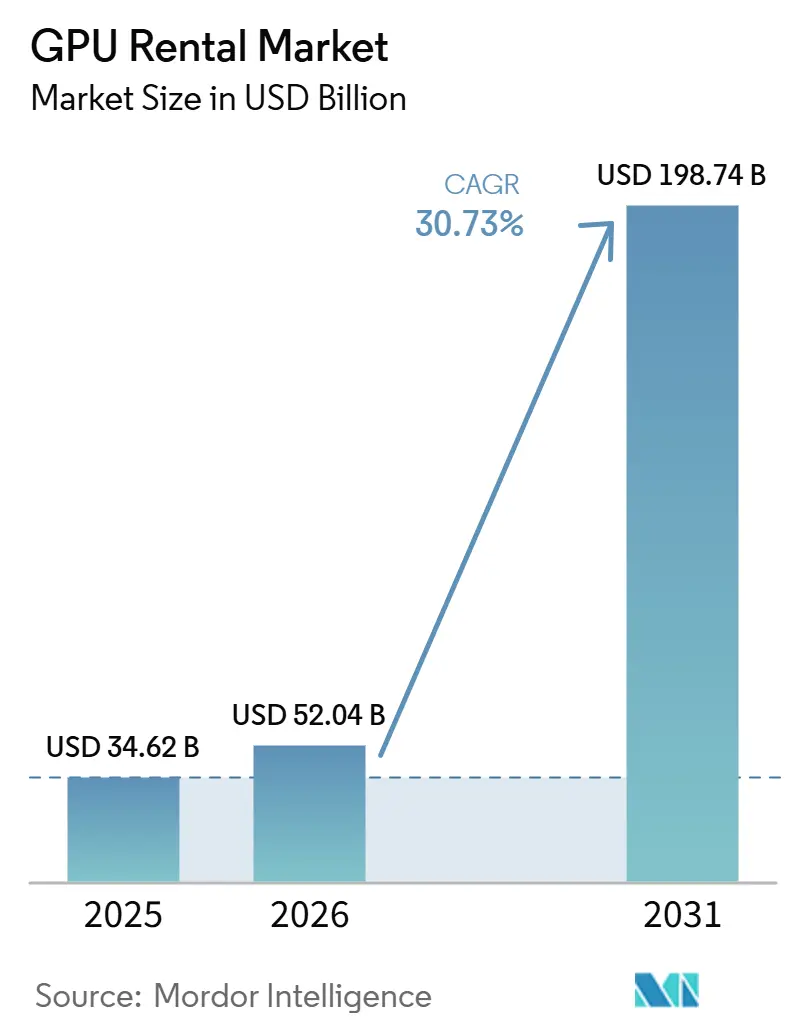
The GPU rental market size is expected to increase from USD 34.62 billion in 2025 to USD 52.04 billion in 2026 and reach USD 198.74 billion by 2031, growing at a CAGR of 30.73% over 2026-2031. The GPU rental market is expanding because AI workloads now sit within daily business operations, keeping demand for compute active for longer periods rather than short project cycles. Public programs for sovereign compute and regulated data handling are also widening the buyer base beyond technology firms and into government, research, and national infrastructure projects. The rental model remains attractive because it gives users access to newer GPU generations without the capital burden and utilization risk of ownership. At the same time, supply discipline in advanced systems still matters, which supports providers that can secure inventory, maintain uptime, and meet local compliance requirements.
Key Report Takeaways
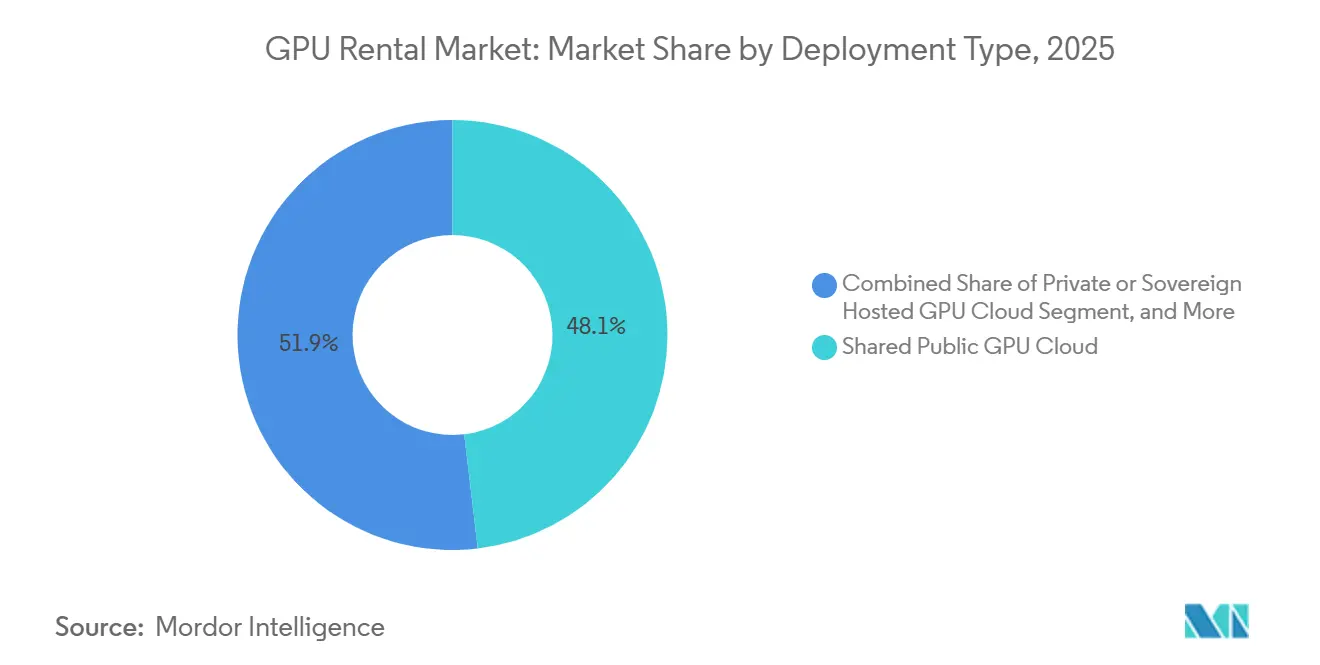
- By deployment type, shared public GPU cloud led with 48.13% of the GPU rental market share in 2025, while private or sovereign hosted GPU cloud is projected to expand at a 31.58% CAGR through 2031.
- By service model, GPU Infrastructure as a Service held 58.32% of revenue in 2025, while serverless and container GPU services are expected to grow at a 32.17% CAGR through 2031 in the GPU rental market.
- By application, artificial intelligence and machine learning accounted for 73.04% share in 2025 and are projected to advance at a 32.63% CAGR through 2031.
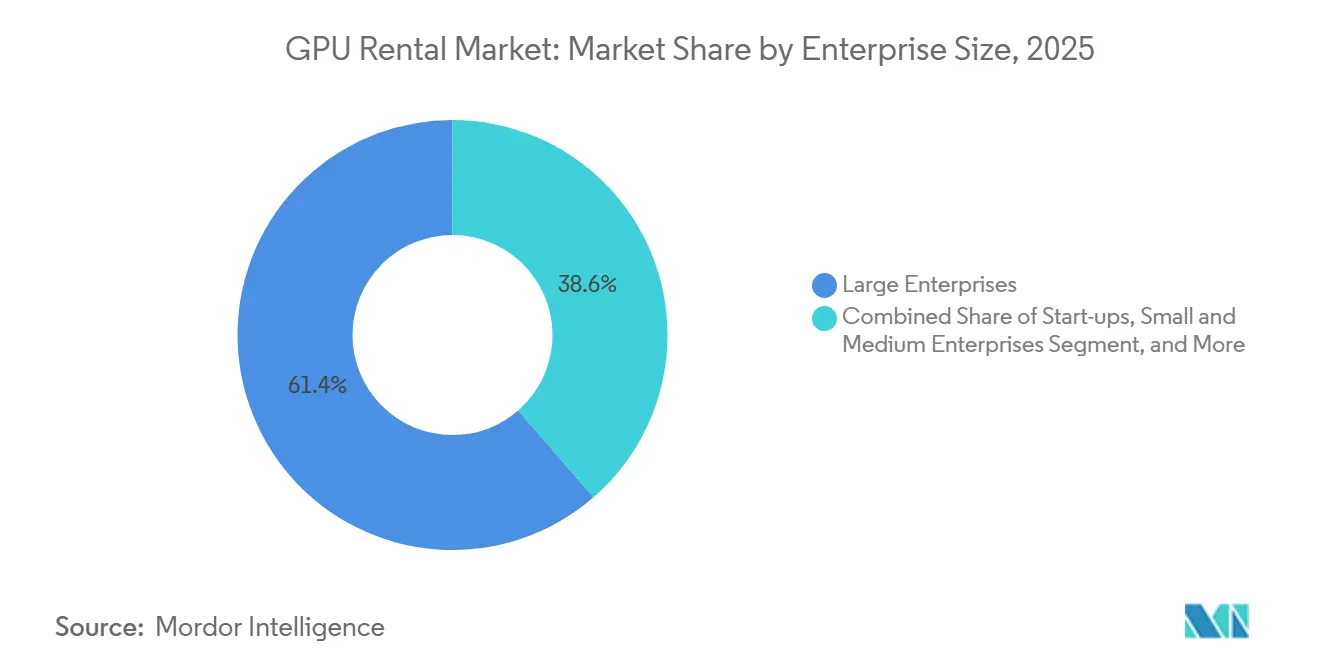
- By enterprise size, large enterprises held 61.38% of revenue in 2025, while start-ups and small and medium enterprises are projected to expand at a 31.92% CAGR through 2031.
- By end-user industry, IT, cloud, and communications captured 47.29% of the GPU rental market share in 2025, while government, defense, education, and research is projected to grow at a 32.26% CAGR through 2031.
- By geography, North America held 51.25% share in 2025, while Asia-Pacific is projected to expand at a 32.54% CAGR through 2031.
Note: Market size and forecast figures in this report are generated using Mordor Intelligence’s proprietary estimation framework, updated with the latest available data and insights as of January 2026.
Market Trends and Insights
Drivers Impact Analysis of GPU Rental Market*
| Driver | (~) % Impact on CAGR Forecast | Geographic Relevance | Impact Timeline |
|---|---|---|---|
| Rising Generative AI And LLM Training Demand | +9.5% | Global, concentrated in North America and the Asia-Pacific | Medium term (2-4 years) |
| Shift From CapEx to Pay-Per-Use GPU Access | +6.2% | Global, accelerated adoption in SME and emerging market segments | Short term (≤ 2 years) |
| Fractional GPU Orchestration and Multi-Tenant Scheduling | +4.8% | North America and Europe, spill over to the Asia-Pacific | Medium term (2-4 years) |
| Sovereign AI And Regulated Workload Adoption | +4.1% | Global, with the highest intensity in Europe, Asia-Pacific, the Middle East, and Africa | Long term (≥ 4 years) |
| Cloud Gaming and Real-Time Rendering Expansion | +2.9% | North America, Europe, and the Asia-Pacific core | Short term (≤ 2 years) |
| Liquid-Cooled High-Density GPU Pod Deployment | +2.4% | Global, strongest near-term activity in North America and Europe | Long term (≥ 4 years) |
| Source: Mordor Intelligence | |||
Rising Generative AI And LLM Training Demand
The GPU rental market is seeing stronger baseline demand as generative AI moves from pilot work into regular production use across more teams and products. RunPod said in June 2026 that its platform had reached 1 million developers, indicating how broad the base of compute users has become for rented GPU access. KDDI launched on-demand access to NVIDIA GB200 NVL72 systems in April 2026, and SoftBank added NVIDIA GB200 NVL72 beta rental in March 2026, which shows that providers are adding new capacity around current AI development needs.[1]KDDI Corporation, “KDDI GPU Cloud Service Launch Announcement,” KDDI Newsroom, newsroom.kddi.com NVIDIA also invested USD 2 billion in Nebius in March 2026 and tied that partnership to more than 5 GW of NVIDIA computing by 2030, which signals confidence in sustained downstream infrastructure demand. These developments matter because the GPU rental market benefits when inference, fine-tuning, and model deployment all require ongoing access instead of one-time bursts. Providers that secured supply relationships early are therefore in a stronger position to hold utilization as generative AI adoption scales further.
Shift From CapEx to Pay-Per-Use GPU Access
The GPU rental market continues to benefit from users who want compute without a large upfront hardware commitment. KDDI stated that its GPU cloud launched with no upfront investment requirement, which directly supports the case for on-demand access over owned infrastructure for many workloads. This model suits projects where traffic, model size, and commercial timing can change quickly after launch. It also gives users a practical way to move to newer systems without waiting for owned assets to be fully utilized or retired. RunPod’s 1 million developer milestone reinforces that a large share of the GPU rental market now includes teams that prefer flexible access over fixed procurement cycles. Even when larger firms later build dedicated environments, rental often remains part of the operating model for testing, overflow demand, and new application rollout.
Fractional GPU Orchestration and Multi-Tenant Scheduling
The GPU rental market is also gaining from better software control over shared hardware. Canonical said in 2026 that NVIDIA donated the GPU DRA driver to the Cloud Native Computing Foundation, which helps standardize GPU resource handling across Kubernetes environments. IBM Research also published FLYT at ICPE 2026, which focused on transparent, elastic GPU provisioning for multi-tenant cloud services. These changes reduce the friction of splitting, scheduling, and isolating GPU resources across different users and workloads. For the GPU rental market, that means providers can improve asset utilization without adding the same amount of hardware. Over time, the operators that combine orchestration, quota control, and steady uptime should be able to defend margins more effectively than those that rely only on raw capacity.
Sovereign AI And Regulated Workload Adoption
Sovereign compute programs are creating a durable demand layer for the GPU rental market in regulated environments. Canada’s Sovereign AI Compute Strategy committed up to USD 1.7 billion, including USD 700 million for ecosystem compute access and USD 1 billion for public supercomputing infrastructure, which placed domestic compute capacity at the center of national AI competitiveness. In Japan, KDDI positioned its GPU cloud toward financial, medical, and autonomous mobility users, which shows how local providers are aligning infrastructure with sectors that require strong control over location and service quality. The EU AI Act adds another layer, because certain AI applications now carry documentation and oversight obligations that increase the value of locally governed infrastructure. This favors providers that can offer domestic hosting, audit readiness, and clearer contractual separation between tenants. As a result, the GPU rental market is expanding not only to meet technical needs but also to meet policy and procurement requirements.
Restraints Impact Analysis of GPU Rental Market*
| Restraint | (~) % Impact on CAGR Forecast | Geographic Relevance | Impact Timeline |
|---|---|---|---|
| HBM And Advanced Packaging Supply Constraints | -3.8% | Global, most acute for North America and the Asia-Pacific | Medium term (2-4 years) |
| Data Sovereignty and Cross-Border Compliance Risk | -2.9% | Europe, Asia-Pacific, the Middle East, and Africa | Long term (≥ 4 years) |
| Power Tariff Pressure and Carbon Reporting Burden | -2.1% | Europe and North America | Medium term (2-4 years) |
| GPU Spot Capacity, Volatility, and Margin Compression | -1.7% | Global, most acute for independent neoclouds | Short term (≤ 2 years) |
| Source: Mordor Intelligence | |||
HBM and Advanced Packaging Supply Constraints
The GPU rental market still depends on the pace at which the newest systems can be brought into service. KDDI launched NVIDIA GB200 NVL72 access in April 2026, SoftBank added GB200 NVL72 beta rental in March 2026, and Nebius mapped a multi-year buildout with NVIDIA across future computing platforms, which shows how growth is tied to timely hardware availability. When several operators target the same generation of systems simultaneously, procurement strength becomes a competitive filter. That tends to favor providers with deeper supplier ties, stronger financing, or earlier reservation windows. Smaller platforms can still compete, but they may expand more slowly when access to current hardware tightens. In the GPU rental market, this does not stop demand, but it can delay capacity additions and widen the gap between the largest providers and the rest of the field.
Data Sovereignty and Cross-Border Compliance Risk
Compliance complexity remains a real drag on the GPU rental market when customers operate across multiple jurisdictions. The EU AI Act increased the importance of audit trails, documentation, and governance for certain AI uses, thereby raising the value of local infrastructure that can meet those obligations. Canada’s compute strategy and Japan’s locally positioned GPU cloud offerings show that national and sector-specific requirements are shaping where workloads can be placed. For providers, this means a single global deployment model is often not enough for enterprise and public-sector accounts. Separate infrastructure footprints, local certifications, and jurisdiction-specific controls can raise costs and slow rollout. The GPU rental market, therefore, grows faster for operators that already have domestic capacity and compliance resources in place.
*Our forecasts treat driver/restraint impacts as directional, not additive. The impact forecasts reflect baseline growth, mix effects, and variable interactions.
GPU Rental Market Segment Analysis
By Deployment Type:
Sovereign Infrastructure Reshapes the Shared Cloud BaselineShared public GPU cloud held 48.13% of the GPU rental market share in 2025, making it the largest deployment mode because it offers broad reach, pooled capacity, and easier handling of burst demand. Private or sovereign-hosted GPU cloud is projected to expand at a 31.58% CAGR through 2031, reflecting stronger demand from buyers that want dedicated resources and tighter control over data location. In the GPU rental market, shared environments still set the baseline because they spread infrastructure across many users and reduce the burden of internal capacity planning. That advantage remains important for development teams that need quick provisioning and the flexibility to scale usage up or down as models move through testing and deployment.
The growth pattern is shifting, though, because sovereign and private models are becoming more practical to operate. In 2026, Canonical said NVIDIA donated the GPU DRA driver to CNCF, which helps private Kubernetes clusters use more standardized GPU scheduling and allocation methods. IBM Research also continued work on transparent, elastic provisioning for multi-tenant cloud services, which supports better use of dedicated environments without sacrificing as much operational efficiency. KDDI’s launch in Japan and Deutsche Telekom’s industrial AI cloud in Germany show that domestic operators are building controlled GPU environments around local enterprise and public requirements. This means the GPU rental market is no longer defined only by public cloud scale, it is also being shaped by who can provide controlled access with local accountability.



By Service Model:
Serverless Abstraction Narrows the Infrastructure Skills GapGPU Infrastructure as a Service accounted for 58.32% of service model revenue in 2025, indicating that direct access to compute remained the preferred route for many engineering teams. Serverless and container GPU services are projected to grow at a 32.17% CAGR through 2031, which reflects demand for simpler deployment paths and less hands-on infrastructure work. This shift matters because more users now want to focus on application logic, model serving, and workflow performance rather than cluster setup. In the GPU rental market, this lowers the skills barrier and broadens the addressable customer base to smaller development teams and product groups.
The service model stack is also tightening faster than it did in earlier cloud cycles. RunPod’s 1 million developer milestone suggests that developer-focused platforms are already operating at meaningful scale inside the GPU rental market. Vast.ai’s June 2026 product update added NVIDIA B200 and B300 Blackwell Ultra GPUs, indicating that platform operators are pairing easier access models with newer hardware generations rather than limiting advanced systems to larger contracts. Managed environments still serve users who need more support, but the direction of travel is clear. As service abstraction improves, more of the GPU rental industry can compete on developer experience and speed to production rather than solely on raw hardware access.
By Application:
AI Inference Keeps the Largest Workload Category in FrontAI and ML accounted for 73.04% of revenue by application in 2025, and this segment is projected to grow at a 32.63% CAGR through 2031. That means the largest workload class is also the fastest-growing, keeping demand concentrated in the part of the GPU rental market most closely tied to commercial AI deployment. The core reason is simple: once AI services go live, usage becomes persistent across coding tools, customer service systems, search, media creation, and enterprise automation. In the GPU rental market, that favors providers that can keep resources available across both experimentation and steady production demand are favored.
Other applications still matter because they widen utilization beyond AI-native users. NVIDIA said in May 2026 that GeForce NOW expanded its RTX 5080-class server infrastructure across nearly its entire 2,300-title library for Ultimate subscribers, indicating continued investment in cloud gaming and real-time rendering workloads. Roblox also introduced a hybrid cloud architecture for photorealistic multiplayer gaming in April 2026, pointing to rising graphics and simulation needs that still require high-performance GPU access. High-performance computing, rendering, VFX, and simulation, therefore, remain useful secondary demand pools for the GPU rental market.[2]Roblox, “Introducing the Roblox Hybrid Architecture: Democratizing Photorealistic, Multiplayer Gaming,” Roblox Newsroom, about.roblox.com They do not displace AI and ML, but they help providers fill capacity with workloads that value performance, low latency, and graphics capability.
By Enterprise Size:
SME Momentum Builds a Parallel Demand LayerLarge enterprises accounted for 61.38% of revenue in 2025, reflecting their stronger procurement capacity, broader AI roadmaps, and established cloud relationships. Start-ups and small and medium enterprises are projected to grow at a 31.92% CAGR through 2031, indicating that demand is also spreading quickly across the largest accounts. This creates a 2-speed pattern in the GPU rental market, where major buyers secure scale and reliability, while smaller users place a premium on speed, flexibility, and lower commitment. The result is a broader customer mix than a hardware-ownership model would typically support.
RunPod said it had reached 1 million developers in June 2026, a milestone that signals that smaller teams are already a meaningful force in the GPU rental market. Public sector and research demand add a third layer. Canada’s Sovereign AI Compute Strategy named ecosystem compute access and public infrastructure as core priorities, which supports wider participation beyond large commercial buyers alone. This means the GPU rental market is not growing only through large enterprise contracts. It is also expanding through start-ups, research institutions, and smaller teams that need current compute without the delays of owned deployment.
By End-User Industry:
Government Acceleration Diversifies Beyond the IT CoreIT, cloud, and communications led end-user demand, accounting for 47.29% of revenue in 2025, consistent with the sector’s role as both a supplier and a heavy internal user of AI compute. Government, defense, education, and research are projected to grow at a 32.26% CAGR through 2031, making them the fastest-growing end-user group in the GPU rental market. This reflects the widening role of compute as public infrastructure rather than a purely commercial input. The GPU rental market, therefore, has a deeper demand base than one tied only to software companies and cloud providers.
The sector mix is broadening in visible ways. KDDI said its Osaka Sakai launch targets financial, medical, and autonomous mobility use cases, which shows how regulated and high-value workloads are entering the GPU rental market through sector-specific offerings. Canada’s public compute strategy and Europe’s governance push under the EU AI Act also support a larger role for research, education, and state-backed deployments. Healthcare, BFSI, and mobility remain important because they combine high data value with performance-sensitive workloads. Over time, the GPU rental market should continue to diversify as more industries require both accelerated compute and stronger control over where and how that compute is used.
Geography Analysis
North America GPU Rental Market
North America held 51.25% of the GPU rental market share in 2025, making it the largest regional base for both demand and supply. The region benefits from the concentration of hyperscalers, AI labs, and developer platforms that already operate at meaningful scale in commercial AI. RunPod in June 2026, which had passed 1 million developers, supports the view that the North American GPU rental market remains deeply tied to active product development and deployment communities. Canada added a second layer of regional demand through its Sovereign AI Compute Strategy, which committed up to USD 1.7 billion across compute access and public infrastructure.
Europe GPU Rental Market
Europe is ranked behind North America, but its role in the GPU rental market is becoming more strategic as compliance and data residency carry greater weight in procurement decisions. The EU AI Act increased the need for documented governance and local oversight in certain AI uses, which supports demand for regionally controlled infrastructure. Deutsche Telekom launched Germany’s first industrial AI cloud in Munich in early 2026, featuring nearly 10,000 NVIDIA Blackwell GPUs and up to 0.5 ExaFLOPS of compute, demonstrating that Europe is building meaningful domestic capacity rather than relying solely on external providers.[3]Deutsche Telekom, “Germany’s First AI Factory for Industry Officially Starts Operations in Munich,” Deutsche Telekom, telekom.com This gives the European GPU rental market a stronger sovereign and enterprise compliance profile, especially for users that want local accountability and regional service coverage.
APAC, South America and MEA GPU Rental Market
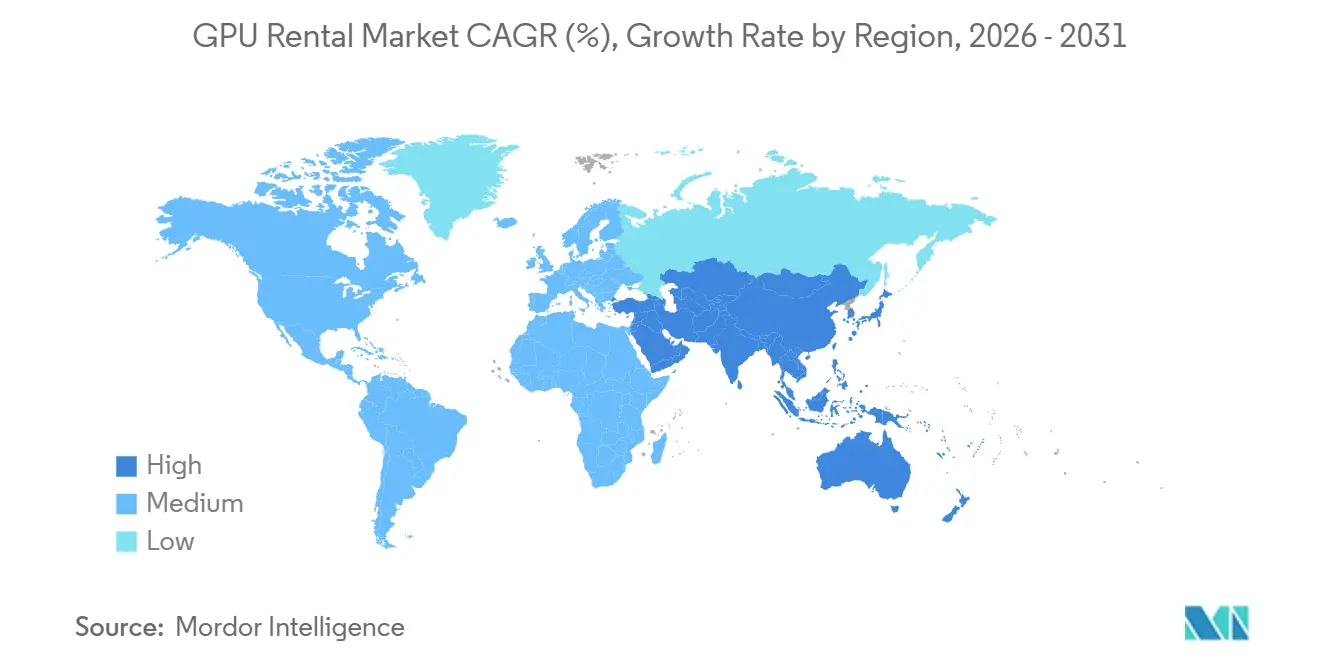
Asia-Pacific is projected to grow at a 32.54% CAGR through 2031, which makes it the fastest-growing region in the GPU rental market size. Japan is already showing that momentum through direct service launches. KDDI launched GPU cloud capacity in April 2026 with NVIDIA GB200 NVL72 access, and SoftBank added NVIDIA GB200 NVL72 beta rental in March 2026, both on Japan-hosted infrastructure. These moves suggest that domestic availability, local support, and regulated sector alignment are becoming central buying factors across the region. Asia-Pacific therefore appears positioned for faster expansion because it combines commercial AI demand with rising national interest in local compute control. South America and the Middle East and Africa remain earlier-stage parts of the GPU rental market, but the same sovereign and localization themes could support their next phase of capacity buildout.

Competitive Landscape
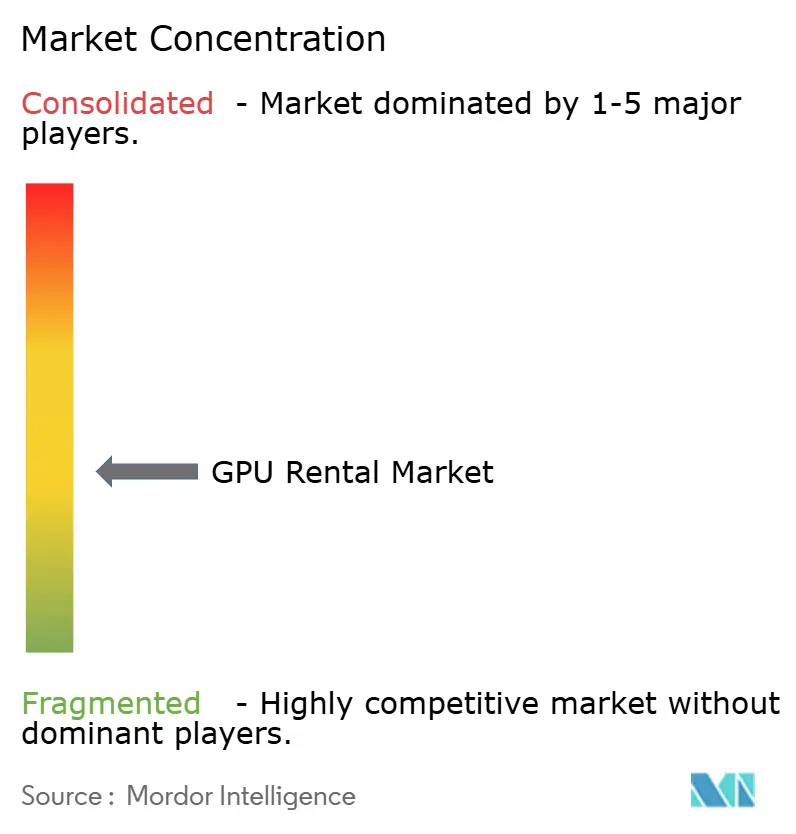
The GPU rental market is moderately fragmented. Large cloud platforms still hold structural advantages because they combine compute with storage, networking, developer services, and enterprise support under a single contract. That makes them hard to displace for customers that already run core workloads inside those broader ecosystems. At the same time, the GPU rental market leaves room for independent operators that can move faster, simplify access, or meet local hosting requirements more directly than a global cloud platform.
One clear strategic pattern is capacity expansion through direct supplier alignment. NVIDIA invested USD 2 billion in Nebius in March 2026, and the partnership aimed to deliver more than 5 GW of NVIDIA computing by 2030 across future AI factory deployments. Another pattern is local infrastructure positioning. Deutsche Telekom’s industrial AI cloud in Munich and KDDI’s launch in Osaka-Sakai show how telecom and regional infrastructure operators are turning domestic networks and data center assets into competitive advantages in the GPU rental market. A third pattern is hardware refresh as a competitive signal. Vast.ai’s June 2026 update added NVIDIA B200 and B300 Blackwell Ultra GPUs, which shows that marketplace-style providers are also pushing to stay current on performance capability.
Tooling is becoming another differentiator in the GPU rental market. Canonical highlighted NVIDIA’s donation of the GPU DRA driver to CNCF, and that move lowers the friction of advanced scheduling and shared resource control across cloud-native environments. IBM Research’s work on elastic multi-tenant provisioning points in the same direction, with better orchestration becoming part of the competitive baseline rather than a niche feature.[4]IBM Research, “FLYT: Transparent and Elastic GPU Provisioning for Multi-Tenant Cloud Services,” IBM Research, research.ibm.com RunPod’s 1 million developer milestone also suggests that platform familiarity and workflow convenience can create stickiness even in a crowded field. Overall, the GPU rental market remains open enough for specialist providers to gain share, but the firms that combine supply access, compliant infrastructure, and easier software handling should have the strongest staying power.
GPU Rental Industry Leaders
Lambda, Inc.
Runpod Inc.
Vast.ai, Inc.
Crusoe Energy Systems LLC
Fluidstack Ltd.
- *Disclaimer: Major Players sorted in no particular order
GPU Rental Market Companies Covered in this Report
- Lambda, Inc.
- Runpod Inc.
- Vast.ai, Inc.
- Crusoe Energy Systems LLC
- Fluidstack Ltd.
- Nebius B.V.
- Scaleway SAS
- OVH Groupe SA
- Akamai Technologies, Inc.
- DigitalOcean, LLC
- Oracle Corporation
- Alibaba Cloud Computing Co., Ltd.
- Google LLC
- Microsoft Corporation
- Amazon Web Services, Inc.
- IBM Corporation

Recent Industry Developments in GPU Rental Market
- June 2026: Vast.ai added NVIDIA B200 and B300 Blackwell Ultra GPUs to its marketplace, with the B300 featuring 288 GB of HBM3e and 8 TB/s memory bandwidth to address VRAM-constrained large-scale inference and reasoning model workloads.
- April 2026: KDDI launched KDDI GPU Cloud at its Osaka Sakai Data Center, offering NVIDIA GB200 NVL72 on demand with no upfront investment requirement. The service provides carrier-grade network-backed sovereign GPU access targeting Japan's financial, medical, and autonomous mobility sectors.
- March 2026: NVIDIA invested USD 2 billion in Nebius Group and announced a strategic partnership to deploy over 5 GW of NVIDIA computing through Nebius by 2030, spanning Vera Rubin, Rubin Ultra, and BlueField-based AI factory deployments.
- March 2026: SoftBank added NVIDIA GB200 NVL72 in beta to its AI Data Center GPU Cloud, offering minimum 7-day rentals on Japan-hosted sovereign infrastructure for generative AI model development and LLM training.


Global GPU Rental Market Report Scope
The GPU rental market refers to the provision of graphics processing unit (GPU) computing resources on a rental or pay-as-you-go basis, enabling enterprises, developers, researchers, and other users to access high-performance computing capacity without owning the hardware. The scope of the report covers GPU rental services used for applications such as artificial intelligence, machine learning, deep learning, data analytics, rendering, gaming, and scientific computing, across deployment models, end-user industries, and geographic regions.
The GPU Rental Market Report is Segmented by Deployment Type (Shared Public GPU Cloud, Dedicated / Bare-Metal GPU Cloud, and Private or Sovereign Hosted GPU Cloud), Service Model (GPU Infrastructure as a Service, Managed GPU Platform as a Service, and Serverless / Container GPU Services), Application (Artificial Intelligence and Machine Learning, High-Performance Computing and Scientific Computing, Rendering, VFX, Cloud Gaming, and 3D Visualization, and Other Applications), Enterprise Size (Start-ups and Small and Medium Enterprises, Large Enterprises, and Government, Academic, and Research Institutions), End-User (IT, Cloud, and Communications, BFSI, Automotive and Mobility, Healthcare and Life Sciences, Media and Entertainment, Government, Defense, Education, and Research, and Other End-User Industries), and Geography (North America, Europe, Asia-Pacific, South America, and Middle East and Africa). The Market Forecasts are Provided in Terms of Value (USD).
| Shared Public GPU Cloud |
| Dedicated / Bare-Metal GPU Cloud |
| Private or Sovereign Hosted GPU Cloud |
| GPU Infrastructure as a Service |
| Managed GPU Platform as a Service |
| Serverless / Container GPU Services |
| Artificial Intelligence and Machine Learning |
| High-Performance Computing and Scientific Computing |
| Rendering, VFX, Cloud Gaming, and 3D Visualization |
| Other Applications |
| Start-ups and Small and Medium Enterprises |
| Large Enterprises |
| Government, Academic, and Research Institutions |
| IT, Cloud, and Communications |
| BFSI |
| Automotive and Mobility |
| Healthcare and Life Sciences |
| Media and Entertainment |
| Government, Defense, Education, and Research |
| Other End-User Industries |
| North America | United States |
| Canada | |
| Mexico | |
| Europe | Germany |
| United Kingdom | |
| France | |
| Italy | |
| Rest of Europe | |
| Asia-Pacific | China |
| Japan | |
| South Korea | |
| India | |
| Southeast Asia | |
| Rest of Asia-Pacific | |
| South America | |
| Middle East and Africa |
| By Deployment Type | Shared Public GPU Cloud | |
| Dedicated / Bare-Metal GPU Cloud | ||
| Private or Sovereign Hosted GPU Cloud | ||
| By Service Model | GPU Infrastructure as a Service | |
| Managed GPU Platform as a Service | ||
| Serverless / Container GPU Services | ||
| By Application | Artificial Intelligence and Machine Learning | |
| High-Performance Computing and Scientific Computing | ||
| Rendering, VFX, Cloud Gaming, and 3D Visualization | ||
| Other Applications | ||
| By Enterprise Size | Start-ups and Small and Medium Enterprises | |
| Large Enterprises | ||
| Government, Academic, and Research Institutions | ||
| By End-User Industry | IT, Cloud, and Communications | |
| BFSI | ||
| Automotive and Mobility | ||
| Healthcare and Life Sciences | ||
| Media and Entertainment | ||
| Government, Defense, Education, and Research | ||
| Other End-User Industries | ||
| By Geography | North America | United States |
| Canada | ||
| Mexico | ||
| Europe | Germany | |
| United Kingdom | ||
| France | ||
| Italy | ||
| Rest of Europe | ||
| Asia-Pacific | China | |
| Japan | ||
| South Korea | ||
| India | ||
| Southeast Asia | ||
| Rest of Asia-Pacific | ||
| South America | ||
| Middle East and Africa | ||


Key Questions Answered in the Report
What is the current size and outlook for the GPU rental sector?
The GPU rental market stood at USD 34.62 billion in 2025, is valued at USD 52.04 billion in 2026, and is projected to reach USD 198.74 billion by 2031 at a 30.73% CAGR.
Which application area drives the most revenue for rented GPU capacity?
Artificial Intelligence and Machine Learning led with 73.04% of revenue in 2025 and is also projected to post the fastest application CAGR at 32.63% through 2031.
Which region is growing the fastest for rented GPU services?
Asia-Pacific is projected to expand at a 32.54% CAGR through 2031, supported by domestic capacity rollouts and stronger interest in locally governed compute.
Why are companies choosing rented GPU access instead of ownership?
On-demand access reduces upfront commitment, speeds up deployment, and lets users move to newer systems without carrying underused hardware on their balance sheets.
Which customer group is expanding the fastest in this space?
Start-ups and small and medium enterprises are projected to grow at a 31.92% CAGR through 2031, indicating that demand is expanding beyond large enterprise contracts.
What makes government and research demand important for future growth?
Government, defense, education, and research are projected to grow at a 32.26% CAGR through 2031, supported by sovereign compute programs and stricter local control requirements.
Page last updated on:





