
Edible Insects For Animal Feed Market Size and Share
Market Overview
| Study Period | 2022 - 2032 |
|---|---|
| Market Size (2027) | USD 1.83 Billion |
| Market Size (2032) | USD 3.54 Billion |
| Growth Rate (2027 - 2032) | 14.11 % |
| Fastest Growing Market | Asia Pacific |
| Largest Market | Europe |
| Market Concentration | Low |
Major Players *Disclaimer: Major Players sorted in no particular order Image © Mordor Intelligence. Reuse requires attribution under CC BY 4.0. | |
Edible Insects For Animal Feed Market Analysis by Mordor Intelligence
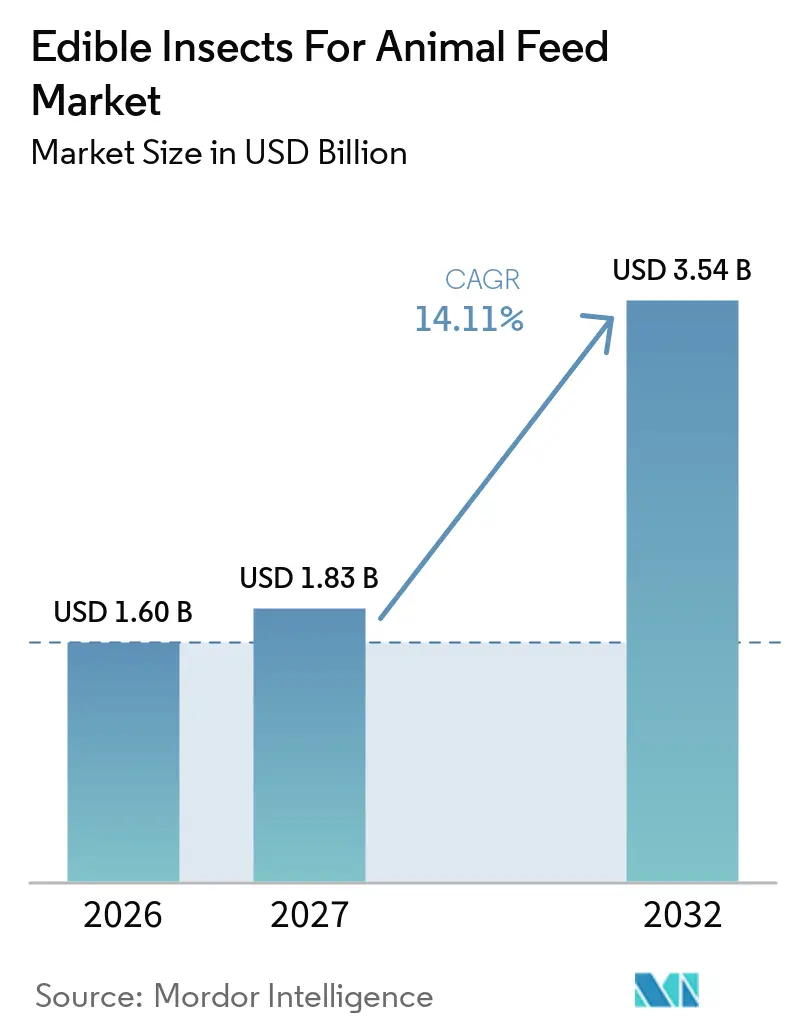
The edible insects for animal feed market was valued at USD 1.60 billion in 2026 and is forecast to grow from USD 1.83 billion in 2027 to USD 3.54 billion by 2032, at a CAGR of 14.11% from 2027 to 2032. Declining production costs for black soldier fly larvae, expanding regulatory approvals in animal feed, and growing millennial demand for sustainable proteins are accelerating adoption across aquafeed and premium pet-food channels. Rapid scaling of automated vertical farms is tilting species economics toward black soldier fly, while oil extraction technologies are unlocking new premium niches. Environmental, social, and governance (ESG), carbon-credit incentives, and co-location with agri-processing plants further strengthen the business case for insect-based proteins.
Key Report Takeaways
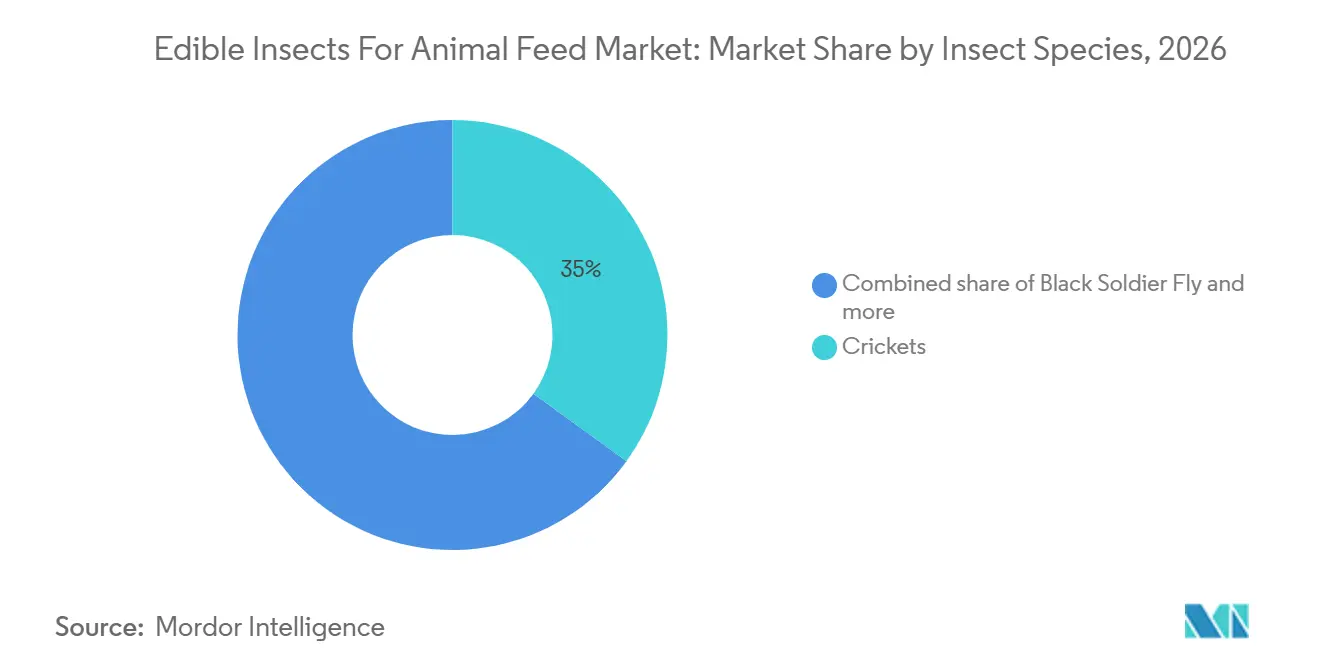
- By insect species, crickets were the largest segment and accounted for 35% of the edible insects for animal feed market share in 2026, while black soldier flies are forecast to grow at the fastest CAGR of 16.0% from 2027 to 2032.
- By form, powdered meals were the largest segment and accounted for 47% of the edible insects for animal feed market share in 2026, while oil is forecast to grow at the fastest CAGR of 15.0% from 2027 to 2032.
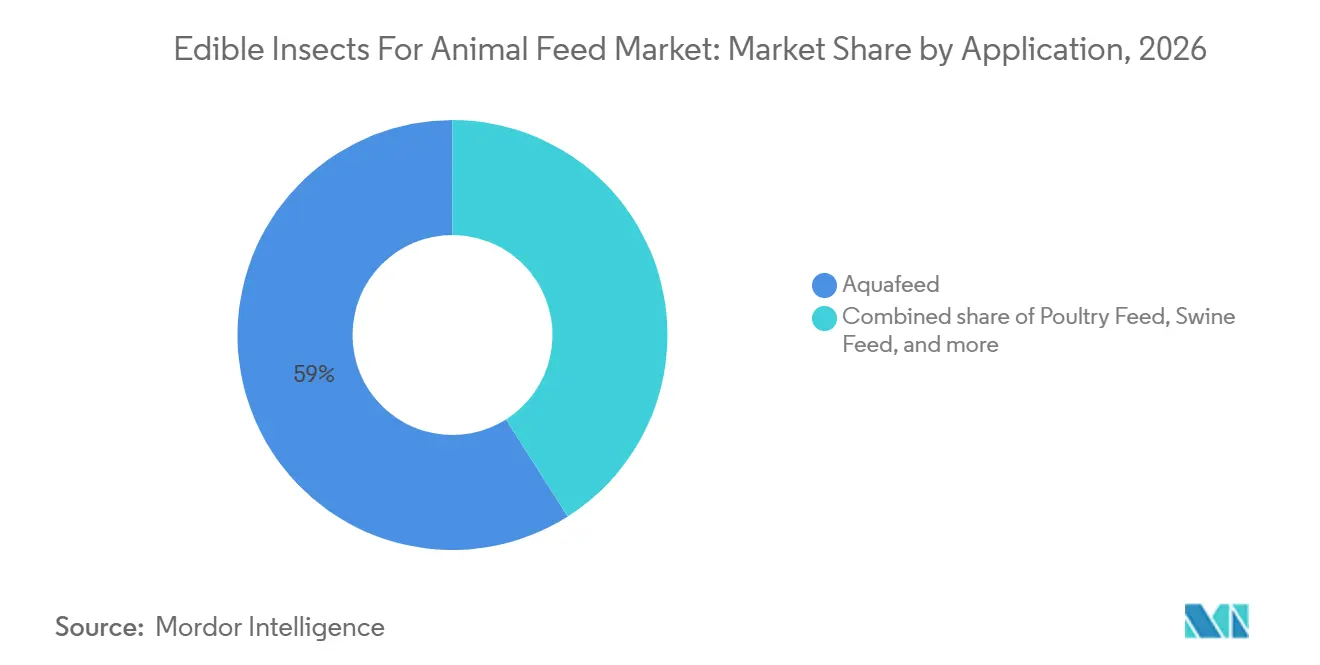
- By application, aquafeed was the largest segment and accounted for 59% of the edible insects for animal feed market share in 2026, and is forecast to grow at the fastest CAGR of 14.8% from 2027 to 2032.
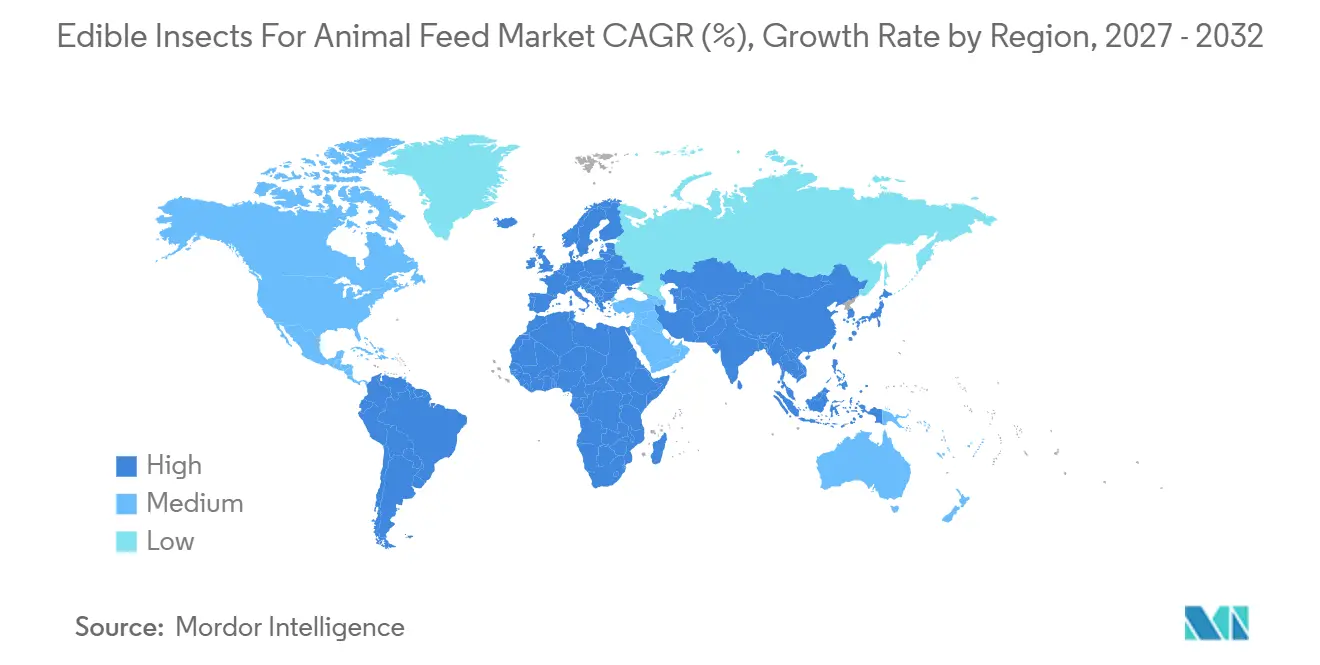
- By geography, Europe was the largest region and accounted for 41% of the edible insects for animal feed market share in 2026, while Asia-Pacific is forecast to grow at the fastest CAGR of 15.4% from 2027 to 2032.
Note: Market numbers in this report are based on Mordor Intelligence's proprietary estimation framework, which combines nine months of actuals with Q4 projections for base year 2026.
Market Trends and Insights
Drivers Impact Analysis of Edible Insects For Animal Feed Market*
| Driver | (~) % Impact on CAGR Forecast | Geographic Relevance | Impact Timeline |
|---|---|---|---|
| The Black Soldier Fly Production Cost Curve Continues to Fall | +8.5% | Global, early gains in France, the Netherlands, and Vietnam | Medium term (2-4 years) |
| Tightening Aquaculture Environmental, Social, and Governance (ESG)-Linked Financing Pushes Insect Protein Adoption | +7.2% | Asia-Pacific core, spill-over to Europe and South America | Short term (≤2 years) |
| Pet-Parent Demand for Hypoallergenic and Novel Proteins | +5.8% | North America and Europe, and emerging urban Asia-Pacific | Medium term (2-4 years) |
| European Union and the United States Green-Light Wider Insect-Based Feed Inclusion | +6.5% | Europe and North America, and influencing regulatory harmonization in the Asia-Pacific | Long term (≥4 years) |
| Food-Grade Upcycling Incentives for Agri-Waste-to-Insect Protein | +4.3% | Europe and Asia-Pacific, and pilots in South America | Medium term (2-4 years) |
| Synthetic-Biology Enhanced Frass as a Bio-Fertilizer Revenue Booster | +2.7% | Global, R&D centered in Europe and North America | Long term (≥4 years) |
| Source: Mordor Intelligence | |||
The Black Soldier Fly Production Cost Curve Continues to Fall
The ongoing reduction in production costs, particularly for black soldier fly (BSF) larvae, is enhancing price competitiveness compared to fishmeal and soy meal. Advances in automation, genetic optimization, and scale efficiencies are driving a continuous decline in cost per metric ton. This trend is fostering increased adoption in aquaculture, poultry, and pet food, particularly in regions experiencing high feed price volatility. Automated larval handling, AI-driven feeding systems, and optimized substrates are projected to further reduce cash costs by 2027. These developments are strengthening the position of edible insects in the animal feed market, especially within the price-sensitive aquaculture segment. Additionally, the expansion of industrial-scale facilities in Europe, led by companies such as Ÿnsect and Protix, has introduced automated vertical farms. These farms reduce labor requirements and enhance output consistency, further accelerating the commercial viability of edible insects.
Tightening Aquaculture Environmental, Social, and Governance (ESG)-Linked Financing Pushes Insect Protein Adoption
Environmental, Social, and Governance (ESG) requirements are prompting the aquaculture and livestock industries to reduce the carbon footprint of feed inputs. Insect protein, characterized by its lower land and water usage and compatibility with circular-economy principles through the upcycling of agricultural waste, is gaining recognition as a sustainable alternative. The Farm Animal Investment Risk and Return (FAIRR) initiative has highlighted alternative proteins, including insect meal, as effective ways to address climate risks in feed supply chains. According to the FAIRR Climate Risk Tool, under a business-as-usual scenario, climate change-related impacts such as reduced yields of animal feed, increased livestock heat stress, and water scarcity could lead to losses totaling USD 23.7 billion by 2030 for 40 of the largest livestock companies, which significantly influence the market[1].
Pet-Parent Demand for Hypoallergenic and Novel Proteins
The pet food market, characterized by high margins, is an early adopter of insect protein. As a novel, hypoallergenic protein source, insect protein appeals to pet owners seeking solutions for pets with food sensitivities. Premiumization trends in North America and Europe further support the use of sustainable ingredients, allowing for price premiums. Direct-to-consumer pet-food brands pitch insect protein as allergy-friendly and climate-smart. Association of American Feed Control Officials (AAFCO) January 2024 clearance of mealworm protein for adult dogs opened the United States premium kibble segment[2]. This consumer pull is steering R&D toward palatable formulations that command 30% price premiums, reinforcing the profitability of the edible insect market.
Synthetic-Biology Enhanced Frass as a Bio-Fertilizer Revenue Booster
Advancements in synthetic biology and microbiome management are enhancing feed conversion ratios and nutrient profiles. Furthermore, insect frass, a by-product, is gaining traction as a biofertilizer, contributing to dual revenue streams and improving overall project economics. Collaborative research efforts between insect farming companies and European biotech institutions are focused on optimizing larval growth efficiency, which positively impacts the internal rate of return (IRR) for vertically integrated insect farms. While organic certification challenges remain in the United States, European greenhouse growers are rapidly adopting these practices, adding a distinct dimension to the edible insect market.
Restraints Impact Analysis of Edible Insects For Animal Feed Market*
| Restraint | (~) % Impact on CAGR Forecast | Geographic Relevance | Impact Timeline |
|---|---|---|---|
| Slow Regulatory Headway for Poultry and Swine Feed Inclusion in the United States | −4.8% | North America, spill-over to exporters | Medium term (2-4 years) |
| High Upfront Capital Expenditures (CapEx) for Vertical Insect Farms | −5.5% | Global, acute in capital-scarce emerging markets | Short term (≤2 years) |
| Ethical Concerns Around Large-Scale Insect Welfare | −2.2% | Europe and North America, and with minor in Asia-Pacific | Long term (≥4 years) |
| Supply-Chain Bio-Security Risks from Mono-Culture Insect Species | −3.1% | Global, higher in dense production clusters | Medium term (2-4 years) |
| Source: Mordor Intelligence | |||
Slow Regulatory Headway for Poultry and Swine Feed Inclusion in the United States
Despite advancements, the adoption of black soldier fly larvae (BSFL) in large-scale poultry and swine feed in the United States remains limited due to inclusion caps and regulatory caution. Variations in state-level regulations and early approvals restricting BSFL use to specific species and life stages have further delayed broader integration. Over the past five years, the United States Food and Drug Administration has recommended revising the Association of American Feed Control Officials (AAFCO) ingredient definition for dried black soldier fly larvae (BSFL) to permit their use in poultry feed, as per EnviroFlight LLC [3]. In contrast, Europe’s 20% inclusion limits create a competitive disparity, compelling United States producers to concentrate on aquafeed and pet food markets. These segments account for only 15% of domestic protein demand, thereby limiting the growth potential of the edible insect market in North America.
Ethical Concerns Around Large-Scale Insect Welfare
Advocacy groups argue that larvae feel pain, pushing for humane stunning before processing. The Platform on Animal Welfare’s February 2025 guidelines would add high costs. Protix voluntarily adopted rapid chilling, raising expenses by 8% but safeguarding supply contracts with welfare-sensitive salmon-feed buyers. Debate is loudest in Europe and North America, risking brand reputation and possible compliance costs across the edible insect market. Ethical concerns about insect sentience and mass production practices, though less prominent than debates on livestock welfare, are gaining attention, particularly in Europe.
*Our forecasts treat driver/restraint impacts as directional, not additive. The impact forecasts reflect baseline growth, mix effects, and variable interactions.
Edible Insects For Animal Feed Market Segment Analysis
By Insect Species:
Cost-Efficient Larvae Spur Market ShiftCrickets were the largest segment and accounted for 35% of the edible insect share in the animal feed market in 2026. Cricket protein remains a niche product but is gaining traction in specialty aquafeed due to chitin's gut-health benefits. Niche species such as silkworms and grasshoppers account for a significant share of the edible insects for animal feed market size, but are attracting research and development focused on region-specific waste streams.
Black soldier flies are forecast to grow at the fastest CAGR of 16.0% from 2027 to 2032, outpacing all rivals. Regulatory bodies in Europe, Asia, and North America are increasingly approving their use across various livestock classes. Mealworm demand is primarily driven by its use in premium pet food, where its neutral flavor enhances palatability. Genetic selection programs targeting faster growth cycles and higher lipid content may enable the inclusion of mealworms in poultry diets.

By Form:
Oil Extraction Unlocks Premium MarginsPowdered meals were the largest segment and accounted for 47% of the edible insects for animal feed market share in 2026, primarily serving the aquaculture and poultry channels, where direct substitution for fishmeal is straightforward. Whole dried insects are targeted at backyard poultry and ornamental fish keepers who prioritize maintaining the feed's intact structure. Chitin and chitosan byproducts offer additional revenue opportunities, enhancing the circular-economy credentials of edible insects in the animal-feed market.
Oil is the fastest-growing segment, advancing at a 15.0% CAGR from 2027 to 2032, as supercritical CO₂ extraction yields lauric-rich lipids commanding high price premiums. Standardized protein levels streamline feed-formulation software inputs, reducing the time required for reformulation. The oil extraction process and its medium-chain fatty acids contribute to health benefits in pet nutrition. Premium pet food brands are using lauric-acid-rich lipids that resemble coconut oil profiles to cater to owners seeking innovative, allergen-free formulations.
By Application:
Aquafeed Leads and Records the Fastest GrowthAquafeed was the largest segment and accounted for 59% of the edible insects for animal feed market size in 2026, and is the fastest-growing segment, forecast to expand at a 14.8% CAGR from 2027 to 2032. Insect protein has demonstrated its ability to replace fishmeal in shrimp and salmon diets without negatively impacting growth rates or fillet quality. This substitution aligns with environmental, social, and governance (ESG) loan covenants set by lenders.
Poultry feed has achieved a significant share but is constrained by the United States Food and Drug Administration (FDA) regulations that limit the use of insect protein to starter rations. This restriction impedes the replacement of soybean meal in the region's largest livestock category. Swine feed and ruminant feed together accounted for a smaller share, restricted by regulatory caution surrounding novel proteins in monogastric and ruminant diets, as well as competition from established alternatives such as dried distillers' grains.
Geography Analysis
Europe was the largest region, accounting for 41% of the edible insects for animal feed market share in 2026, supported by strong regulatory frameworks and a well-established aquaculture industry. Facilities such as Innovafeed’s megafactory in Nesle, France, and Protix’s Zeeland site in the Netherlands highlight the region's role as a hub for insect production. Denmark’s Enorm facility demonstrates how northern European countries are integrating large-scale production with low carbon footprints. As carbon-pricing regulations become stricter, European feed formulators are increasingly securing insect meal purchase contracts, which stabilizes demand but tempers growth rates.
Asia-Pacific is forecast to grow at the fastest CAGR of 15.4% from 2027 to 2032. Singapore’s approval of 16 insect species in 2024 and Thailand’s establishment of black soldier fly production standards have attracted investors to countries like Malaysia, Vietnam, and Indonesia, which benefit from abundant waste substrates. The region’s aquaculture output exceeds 60 million metric tons, driving consistent demand for low-carbon feed ingredients. Companies such as Entobel, with its cross-border supply chains, and Nasekomo, with its neonate shipping services, exemplify a distributed production model supported by centralized genetic resources.
North America holds a significant market share and presents untapped potential. Ynsect’s approval for insect-based dog food in the United States in January 2024 has removed a critical barrier to market entry. Additionally, Beta Hatch’s facility in Washington indicates the development of industrial-scale production capacity within the region. Federal grants awarded to Innovafeed for insect-based fertilizers demonstrate policy support in related markets. Aligning FDA inclusion limits with aquaculture standards will be crucial for expanding the use of insect-based feeds in the poultry and swine industries.
Competitive Landscape
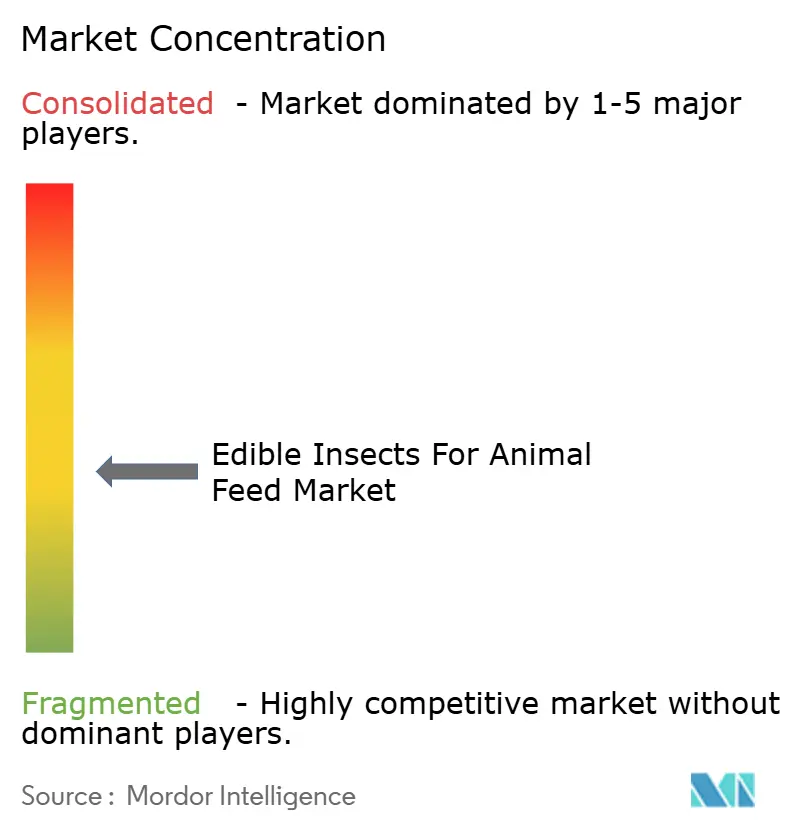
The edible insects for animal feed market is moderately fragmented. Ÿnsect SAS, Innovafeed SAS, Protix B.V., Darling Ingredients Inc. (EnviroFlight), and Entobel Holding PTE. LTD collectively held a significant market share in 2026. Ÿnsect, Innovafeed, and Protix lead the market, benefiting from early regulatory approvals and strategic alliances with established feed companies. The market structure favors companies that achieve vertical integration across breeding, production, and processing. For instance, in 2023, Protix partnered with Tyson Foods to build production facilities in the United States, while Innovafeed SAS collaborates with Cargill on aquaculture feed development.
Opportunities in the market include advancements in substrate optimization and genetic engineering, enabling companies to improve feed conversion ratios and production efficiency. For instance, in 2024, Macquarie University's patent applications for genetically engineered black soldier flies highlight how intellectual property development can provide a competitive edge. The development of automated farming technologies is streamlining insect farming processes, reducing labor costs, and improving scalability. The growing interest in circular economy practices is also encouraging the use of organic waste as feed for insects, creating additional revenue streams and addressing sustainability concerns.
High capital requirements create significant entry barriers, favoring companies with strategic partnerships with agricultural conglomerates. Financial challenges faced by established players, such as Ÿnsect, which is exploring strategic options including a potential takeover, suggest that market consolidation may occur as the industry matures and scaling operational costs increase. The emergence of regional players with localized production capabilities is intensifying competition and driving innovation. The increasing focus on regulatory compliance and quality standards is also shaping the competitive landscape, favoring companies with robust operational frameworks and certifications.
Edible Insects For Animal Feed Industry Leaders
-
Innovafeed SAS
-
Protix B.V.
-
Ÿnsect SAS
-
Entobel Holding PTE. LTD
-
Darling Ingredients Inc (EnviroFlight)
- *Disclaimer: Major Players sorted in no particular order
Edible Insects For Animal Feed Market Companies Covered in this Report
- Ÿnsect SAS
- Innovafeed SAS
- Protix B.V.
- Entobel Holding PTE. LTD
- Darling Ingredients Inc. (EnviroFlight)
- nextProtein SA
- Hexafly Limited
- Sentara Group
- Beta Hatch Inc
- FlyFarm Worldwide Ltd.
- Maltento (Pty) Ltd.
- Inseco Private Limited
- Nasekomo B.V.
- Aspire Food Group
- Keetup And Co.
Recent Industry Developments in Edible Insects For Animal Feed Market
- July 2024: Innovafeed SAS completed the Phase 3 expansion of its production facility in Nesle, France, which increased its larval production capacity fivefold and established it as the world's largest insect production site.
- February 2024: Innovafeed SAS introduced Hilucia, a new brand uniting its insect-based protein, oil, and frass solutions derived from Hermetia illucens (black soldier fly larvae) for livestock, aquaculture, pets, and crops. The launch includes products such as Hilucia Protein for monogastrics and Hilucia Oil for aquaculture, developed through a sustainable upcycling process that converts plant feed into biomass with a low environmental footprint.
- November 2023: Entobel Holding PTE. LTD established Asia's largest insect protein production facility in Ba Ria-Vung Tau, Vietnam. The USD 33 million facility has an annual production capacity of 10,000 metric tons of black soldier fly protein meal. The highly automated plant produces insect oil and organic fertilizer for aquaculture and livestock feed markets. The facility incorporates advanced robotics and operates a 50-level vertical rearing system.
Global Edible Insects For Animal Feed Market Report Scope
Edible insects are insects that can be consumed at various life stages, including larvae, pupae, and adults, and are recognized for their high protein content. The edible insects for animal feed market is segmented by insect species (black soldier fly, mealworms, crickets, and others), by form (whole dried, powdered meal, and more), by application (aquafeed, poultry feed, swine feed, and more), and by geography (North America, Europe, Asia-Pacific, South America, Africa, and the Middle East). The report offers market size and forecasts in terms of value (USD).
Segmentation Overview
| Black Soldier Fly |
| Mealworms |
| Crickets |
| Others |
| Whole Dried |
| Powdered Meal |
| Oil |
| Extracts and Hydrolysates |
| Aquafeed |
| Poultry Feed |
| Swine Feed |
| Ruminant Feed |
| Pet Food |
| North America | United States |
| Canada | |
| Mexico | |
| Rest of North America | |
| South America | Brazil |
| Argentina | |
| Rest of South America | |
| Europe | Germany |
| France | |
| United Kingdom | |
| Netherlands | |
| Norway | |
| Spain | |
| Italy | |
| Russia | |
| Rest of Europe | |
| Asia-Pacific | China |
| India | |
| Japan | |
| South Korea | |
| Indonesia | |
| Thailand | |
| Vietnam | |
| Australia | |
| New Zealand | |
| Rest of Asia-Pacific | |
| Middle East | Saudi Arabia |
| United Arab Emirates | |
| Turkey | |
| Rest of Middle East | |
| Africa | South Africa |
| Kenya | |
| Nigeria | |
| Rest of Africa |
| By Insect Species | Black Soldier Fly | |
| Mealworms | ||
| Crickets | ||
| Others | ||
| By Form | Whole Dried | |
| Powdered Meal | ||
| Oil | ||
| Extracts and Hydrolysates | ||
| By Application | Aquafeed | |
| Poultry Feed | ||
| Swine Feed | ||
| Ruminant Feed | ||
| Pet Food | ||
| By Geography | North America | United States |
| Canada | ||
| Mexico | ||
| Rest of North America | ||
| South America | Brazil | |
| Argentina | ||
| Rest of South America | ||
| Europe | Germany | |
| France | ||
| United Kingdom | ||
| Netherlands | ||
| Norway | ||
| Spain | ||
| Italy | ||
| Russia | ||
| Rest of Europe | ||
| Asia-Pacific | China | |
| India | ||
| Japan | ||
| South Korea | ||
| Indonesia | ||
| Thailand | ||
| Vietnam | ||
| Australia | ||
| New Zealand | ||
| Rest of Asia-Pacific | ||
| Middle East | Saudi Arabia | |
| United Arab Emirates | ||
| Turkey | ||
| Rest of Middle East | ||
| Africa | South Africa | |
| Kenya | ||
| Nigeria | ||
| Rest of Africa | ||
Key Questions Answered in the Report
How large is the edible insects for animal feed market in 2026?
The edible insects for animal feed market was valued at USD 1.60 billion in 2026 and is forecast to grow from USD 1.83 billion in 2027 to USD 3.54 billion by 2032, at a CAGR of 14.11% from 2027 to 2032.
Which region leads the edible insects for animal feed market?
Europe accounted for the largest market share at 41% in 2026, supported by an established regulatory framework for insect-derived feed ingredients and commercial insect-production capacity in countries such as France and the Netherlands.
What limits the adoption of insect protein in livestock feed in the United States?
Regulatory constraints on approved insect-derived feed ingredients, permitted animal species, and conditions of use continue to limit broader adoption in the United States livestock feed.
Which application segment is expanding the fastest?
Aquafeed is forecast to grow at the fastest CAGR of 14.8% from 2027 to 2032, supported by increasing use of insect-derived protein and oil as alternative feed ingredients in aquaculture formulations.