
Animal Feed Ethoxyquin Market Size and Share
Market Overview
| Study Period | 2020 - 2030 |
|---|---|
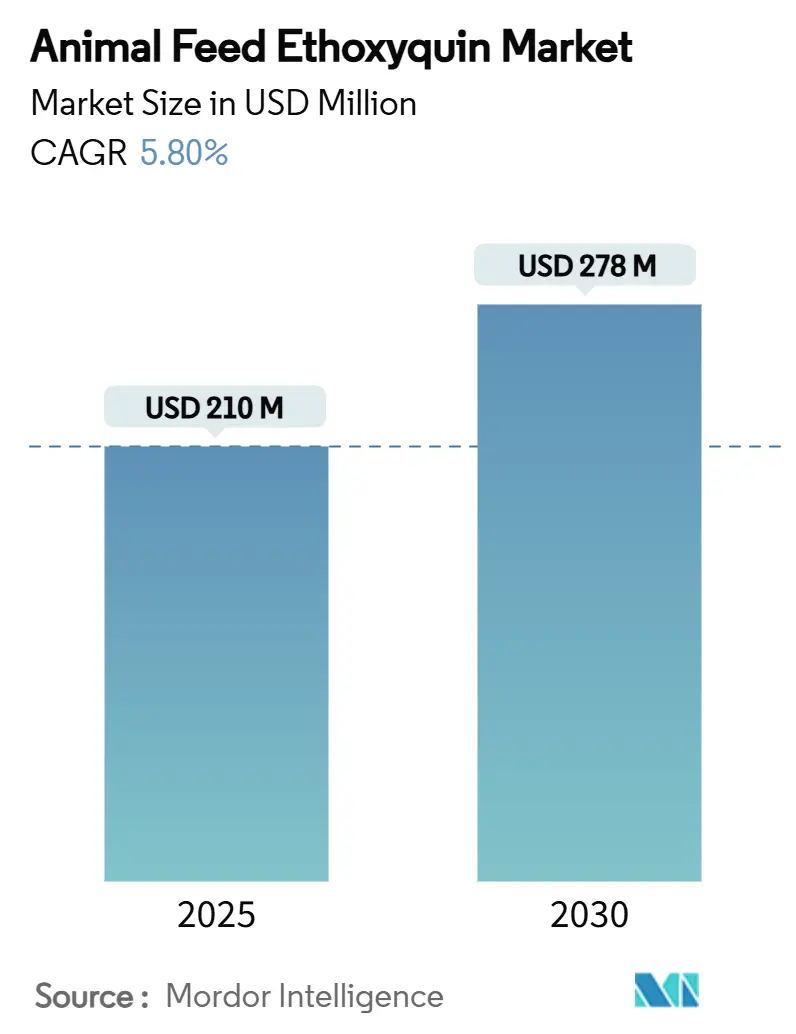
| Market Size (2025) | USD 210 Million |
| Market Size (2030) | USD 278 Million |
| Growth Rate (2025 - 2030) | 5.80 % |
| Fastest Growing Market | Asia Pacific |
| Largest Market | North America |
| Market Concentration | Medium |
Major Players *Disclaimer: Major Players sorted in no particular order Image © Mordor Intelligence. Reuse requires attribution under CC BY 4.0. | |
Animal Feed Ethoxyquin Market Analysis by Mordor Intelligence
The animal feed ethoxyquin market size stands at USD 210 million in 2025 and is forecast to reach USD 278 million by 2030, registering a 5.8% CAGR. Demand holds firm in price-sensitive regions because the synthetic antioxidant costs 30-50% less than natural substitutes while delivering equal protection at lower inclusion rates. Asia-Pacific’s rapid aquaculture expansion, tougher export shelf-life requirements, and the compound’s proven ability to curb lipid peroxidation keep volumes growing even as Europe’s suspension of ethoxyquin reshapes global trade patterns. Regulatory divergence forces producers to juggle synthetic output for permissive regions with R&D pipelines focused on encapsulation and controlled-release formats. Logistics costs rise after the International Maritime Organization (IMO) reclassified liquid ethoxyquin as hazardous cargo, favoring dry powders that simplify storage and shipping.
Key Report Takeaways
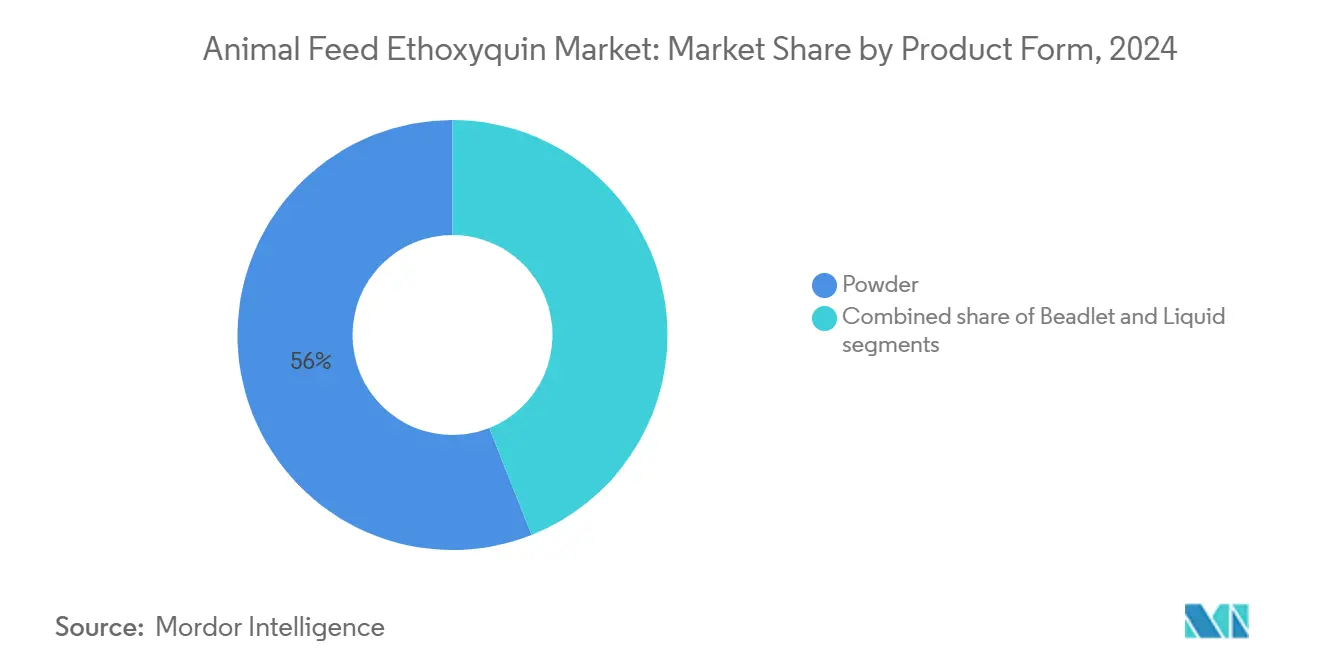
- By product form, powder led with a 56.0% of the animal feed ethoxyquin market size in 2024, and beadlet is projected to expand at an 8.0% CAGR through 2030.
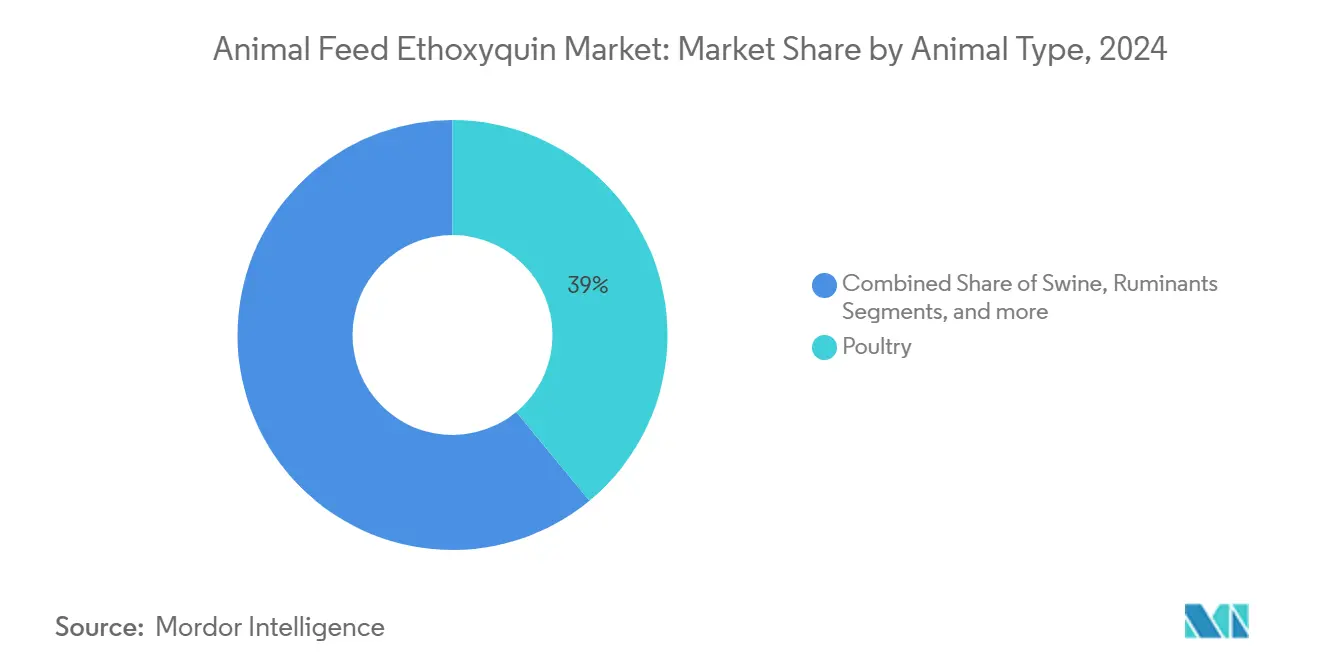
- By animal type, poultry commanded a 39.0% of the animal feed ethoxyquin market share in 2024, whereas aquaculture will rise at an 8.4% CAGR through 2030.
- By purity grade, ≥ 90% Technical led with a 66.5% market share of the animal feed ethoxyquin market in 2024, and 50% Feed Grade is projected to expand at a 7.6% CAGR through 2030.
- By geography, North America retained a 31.4% market share of the animal feed ethoxyquin market in 2024, and the Asia-Pacific market size is set to grow at a 6.6% CAGR to 2030.
- By company concentration, the five largest producers, including Kemin Industries, Novus International, Camlin Fine Sciences, Eastman Chemical Company, and Impextraco NV, collectively held 62.0% share of the animal feed ethoxyquin market in 2024.
Global Animal Feed Ethoxyquin Market Trends and Insights
Drivers Impact Analysis*
| Driver | (~) % Impact on CAGR Forecast | Geographic Relevance | Impact Timeline |
|---|---|---|---|
| Rising need to prevent lipid peroxidation in high-fat animal feeds | +1.2% | Global, strongest in Asia-Pacific and North America | Medium term (2-4 years) |
| Growth of commercial aquaculture in Asia-Pacific | +1.8% | Asia-Pacific core, spill-over to South America | Long term (≥4 years) |
| Shelf-life mandates for export-oriented compound feed | +0.9% | Global, particularly export-focused regions | Short term (≤2 years) |
| Cost advantage versus natural antioxidants in feed | +0.7% | Emerging markets, price-sensitive segments | Medium term (2-4 years) |
| Proven effectiveness in stabilizing fat-soluble vitamins in compound feed | +0.4% | North America agricultural regions | Long term (≥4 years) |
| Nanoencapsulation enabling sub-50 ppm compliance | +0.3% | Regulated markets with strict residue limits | Long term (≥4 years) |
| Source: Mordor Intelligence | |||
Rising Need to Prevent Lipid Peroxidation in High-Fat Animal Feeds
The intensification of livestock production systems drives demand for ethoxyquin in animal feed, as feed formulations increasingly incorporate high-fat ingredients to boost energy density. Modern broiler diets contain 6-8% added fats, compared to 2-3% in traditional formulations, which creates oxidative stress that degrades vitamins A and E within 30 days of storage [1]. Ethoxyquin is effective at 50-150 ppm and can reduce peroxide values in rendered poultry fat by more than 60% over the first 21 days of storage, thereby limiting rancid-flavor complaints that often trigger product recalls [2]. Fish meal presents an even higher lipid challenge, with spontaneous combustion incidents reported in Chile in 2024 dropping sharply after mills adopted 125 ppm ethoxyquin, underscoring its fire-prevention benefit. Feed mills in North America cite consistent pellet durability indices when ethoxyquin is dosed correctly, which helps maintain pellet quality during hot summer months when fat oxidation accelerates.
Growth of Commercial Aquaculture in Asia-Pacific
The Asia-Pacific region maintains its dominance in global aquaculture production, accounting for 92% of the world's farmed fish, crustaceans, molluscs, and other aquatic foods. China produces 58 million metric tons through aquaculture, while Indonesia follows with 15 million metric tons. Tropical climates raise water temperatures that hasten lipid degradation, so producers require antioxidant protection that keeps feeds stable on farm sites where cold storage is scarce. Vietnam’s shrimp farmers substitute ethoxyquin with higher-priced tocopherols, but many Thai and Indian operators continue using ethoxyquin under domestic rules to manage freight times that exceed 25 days. Feed manufacturers report that ethoxyquin supplementation cuts dry-matter loss by 4-6% during monsoon shipping, preserving pellet integrity when humidity exceeds 80%.
Shelf-Life Mandates for Export-Oriented Compound Feed
Major seafood importers, such as those in the European Union, now run peroxide and anisidine testing on every shipment, rejecting consignments that exceed oxidative thresholds set for animal-based proteins. To protect USD 927 million in seafood exports, Vietnam banned ethoxyquin but simultaneously tightened maximum peroxide values, compelling domestic feed makers to re-engineer formulations for longer stability windows. Indian shrimp exporters shipping to the United States hold feed inventories for up to 120 days due to port congestion, with tests showing ethoxyquin retains vitamin A potency 28% better than untreated control diets over that period. Peruvian fishmeal exporters, facing 50-day trans-Pacific voyages, report that ethoxyquin usage cuts spoilage claims by 30%, safeguarding trade margins.
Nanoencapsulation Enabling Sub-50 ppm Compliance
Researchers in South Korea embedded ethoxyquin inside lipid nanocarriers, achieving the same peroxide reduction at 35 ppm that conventional powder delivered at 100 ppm, a threefold efficiency gain. Shrimp diets coated with nanocapsules held peroxide values below 2 meq/kg after eight weeks in 35 °C storage, surpassing EU oxidative-quality targets. Encapsulation masks the distinct odor that historically limited ethoxyquin use in premium pet formulations, improving palatability scores by 10% in taste-panel trials. Feed mills report smoother dispersion and less dusting when nanocapsules replace standard powders, cutting housekeeping costs by 15% and boosting worker safety metrics.
Restraints Impact Analysis*
| Restraint | (~) % Impact on CAGR Forecast | Geographic Relevance | Impact Timeline |
|---|---|---|---|
| European Union suspension and possible global bans | -1.4% | Europe primary, spillover to aligned markets | Short term (≤2 years) |
| Consumer pivot to natural antioxidants | -0.8% | Developed markets, premium segments | Medium term (2-4 years) |
| IMO hazardous-cargo reclassification raising logistics cost | -0.3% | Global shipping routes, island markets | Short term (≤2 years) |
| Higher insurance premiums for synthetic antioxidant storage | -0.2% | Feed mills with large storage capacity | Medium term (2-4 years) |
| Source: Mordor Intelligence | |||
European Union Suspension and Possible Global Bans
The European Union (EU) withdrew ethoxyquin authorization after the European Food Safety Authority (EFSA) highlighted uncertain toxicological data on the impurity p-phenetidine and its oxidized metabolites. This removal of ethoxyquin authorization has eliminated roughly 25,000 metric tons of annual additive demand in those markets. Vietnam removed ethoxyquin from aquafeed to safeguard USD 927 million in EU seafood exports, demonstrating how European policy cascades into Asia. Japan’s Food Safety Commission set an acceptable daily intake of 0.0083 mg/kg body weight, signaling tighter scrutiny that could restrict inclusion rates region-wide. EFSA’s opinion reiterated unresolved data gaps on long-lived animal species, lowering prospects for reauthorization before 2027.
Consumer Pivot to Natural Antioxidants
Clean-label trends in pet food grew 12% year over year in the United States in 2024, with shoppers citing “no synthetic preservatives” among their top three purchase drivers. The Food and Drug Administration's (FDA) guidance, which reduces ethoxyquin in dog food to 75 ppm, still influences perception, while social media campaigns frequently misinterpret the science yet sway premium brand formulations. Kemin Industries’ 2024 approval for rosemary extract in European Union pet food highlights how suppliers are pivoting to plant-based protectants that carry “natural” label claims, even when they are more costly. A survey revealed that 32% of United States consumers would switch brands to avoid synthetic antioxidants, a rise from 24% in 2022, reinforcing the need for defensive reformulation among feed and treat manufacturers.
*Our forecasts treat driver/restraint impacts as directional, not additive. The impact forecasts reflect baseline growth, mix effects, and variable interactions.
Segment Analysis
By Product Form: Powder Leads Despite Handling Challenges
The powder form dominates the animal feed ethoxyquin market size, accounting for 56% of the total share due to its ease of blending, and represents more than two-thirds of the animal feed ethoxyquin market value in 2024. Kemin Industries’ Endox Dry leverages proprietary carriers that yield homogeneous dispersion in premixes, a key performance attribute for large feed mills. Beadlet products, designed for aquafeed exporters requiring controlled release during extended transit times, are projected to grow at a CAGR of 8.0% through 2030.
Liquid animal feed ethoxyquin remains attractive for direct fat spraying but faces rising freight rates after the International Maritime Organization (IMO) deemed the product hazardous cargo in 2024. Shipowners now demand specialized containers and higher insurance coverage, narrowing price gaps and nudging customers toward powders. Pilot trials in Thailand show beadlets achieve identical peroxide-value control at 20% lower dosage, suggesting a gradual shift from liquids in the animal feed ethoxyquin market.

By Purity Grade: Technical Grade Drives Industrial Applications
Technical-grade (≥90% purity) ethoxyquin acquires a 66.5% market share due to its use in high-performance feed, where users demand maximal scavenging activity. 50% purity ethoxyquin has gained wider adoption in commodity feeds and is projected to grow at a 7.6% CAGR through 2030, particularly among price-sensitive buyers in South America and Africa.
New encapsulation methods blur grade boundaries. Trials in Vietnam show 50% feed-grade ethoxyquin encapsulated within lipid nanocarriers delivers equivalent peroxide inhibition to 90% technical powder at half the inclusion rate, hinting at disruptive cost efficiencies. As purity verification costs rise under tighter residue monitoring, analytical advances from the Journal of AOAC International demonstrate faster liquid chromatography protocols that cut lab time by 40%[3].
By Animal Type: Poultry Dominance Challenged by Aquaculture Surge
Poultry applications secured 39.0% of the animal feed ethoxyquin market share in 2024, driven by the sector's reliance on high-fat broiler diets containing 6-8% added fats that require effective antioxidant protection to prevent vitamin A and E degradation during storage. Research demonstrates that ethoxyquin supplementation at 125 ppm significantly improves body weight gain and feed conversion ratios in broilers fed oxidized oil, making it essential for maintaining feed quality in intensive production systems.
Aquaculture emerges as the fastest-growing segment, with an 8.4% CAGR through 2030, supported by China's production expansion to 58.1 million metric tons in 2023 and FAO projections indicating that global aquaculture will exceed 100 million metric tonnes by 2027. This growth trajectory reflects the sector's increasing reliance on high-energy feeds containing fish meal with 8-12% natural lipid content that requires effective antioxidant protection during transport and storage. Research indicates that ethoxyquin levels exceeding 50 mg/kg in fish diets can negatively impact growth performance in species such as the large yellow croaker, creating optimization challenges that drive innovation in feed formulation.
Geography Analysis
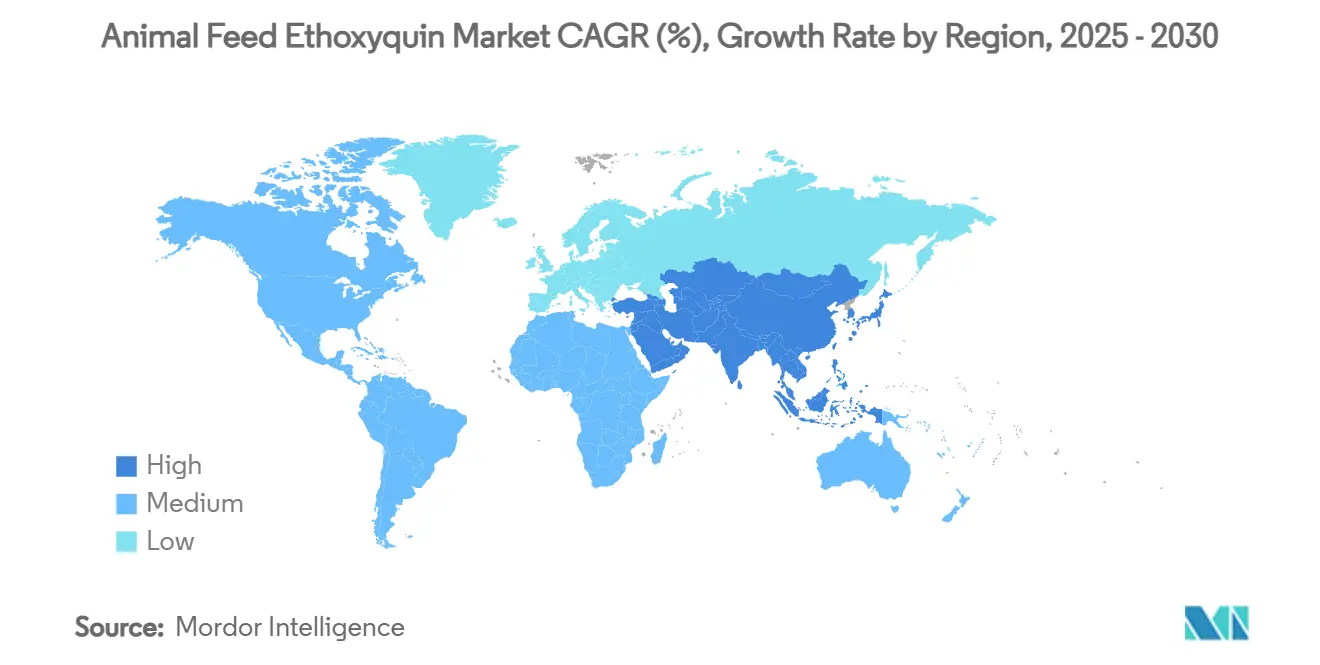
North America held the largest market share of 31.4% in the animal feed ethoxyquin market in 2024, driven by Food and Drug Administration (FDA) regulations that permit up to 150 ppm in animal feeds, creating a stable regulatory framework. High corn and soybean inclusion in cattle feed also sustains consistent demand for antioxidants during the seasonal storage of grains.
The Asia-Pacific region is projected to post the fastest growth at a 6.6% CAGR. China, Indonesia, and India collectively added over 10 million metric tons of new aquaculture output between 2021 and 2023, resulting in a greater demand for shelf-stable feedstuffs. Vietnam’s ban mirrors European Union norms, whereas Japan sets a conservative acceptable daily intake of 0.0083 mg/kg body weight, but still permits limited use. These mixed regulations compel global suppliers to segment strategies by country.
The European market exhibits the lowest growth rate, following the suspension of ethoxyquin and the European Food Safety Authority's (EFSA) reinforcement of safety concerns. Russia remains the only European country permitting ethoxyquin usage. The region influences trade partners, as exporters in South America and Southeast Asia reduce ethoxyquin residues to meet European import checks, altering formulation practices worldwide. The Middle East and Africa log industries are experiencing moderate growth rates, driven by the expansion of tilapia and catfish farming in Egypt and Nigeria, where regulatory scrutiny remains relatively light.
Competitive Landscape
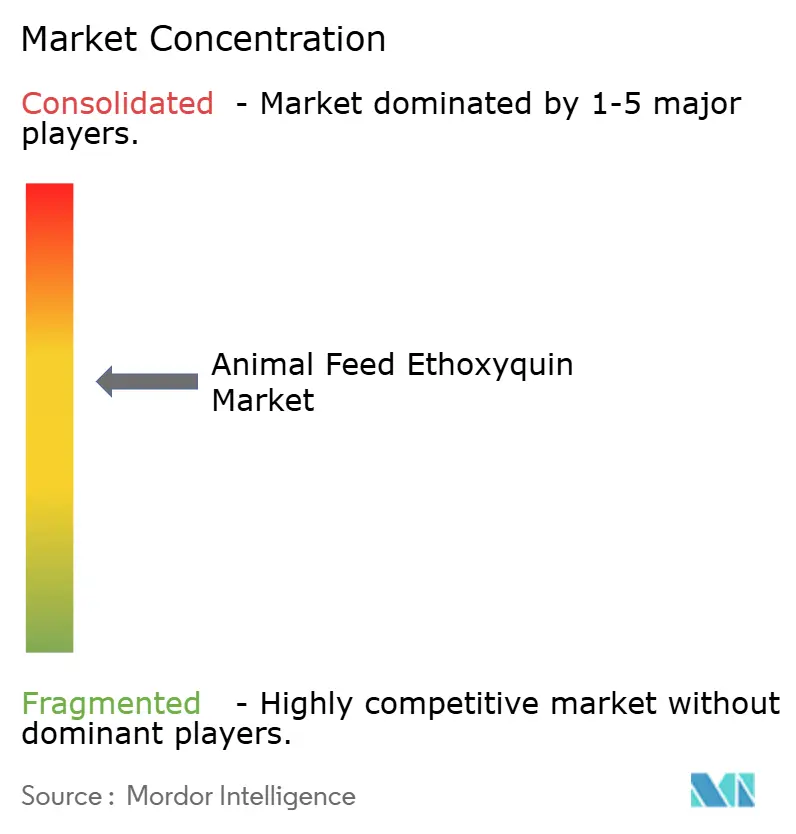
The animal feed ethoxyquin market demonstrates moderate concentration, with five companies controlling around 62.0% of the global market share in 2024. Kemin Industries, Novus International, Camlin Fine Sciences, Eastman Chemical Company, and Impextraco NV maintain their market positions through established chemical synthesis capabilities, regulatory compliance, and extensive distribution networks.
Strategically, incumbents hedge against European restrictions. Cargill, Incorporated invested in encapsulation research and development at its Minnesota innovation center in 2020, targeting the inclusion of sub-50 ppm ethoxyquin for North American poultry integrators. Nutreco N.V. pilots beadlet delivery systems in Chile’s salmon sector, with potential 15% lower peroxide values in test feeds.
Smaller regional players, particularly in China’s coastal provinces, face a capital strain as IMO shipping surcharges inflate their transport budgets. Some pivot to local aquaculture clients that ship domestically, bypassing stricter European Union residue protocols. Intellectual property around nanocarrier formulations could widen the gap: patent filings from 2024 suggest Kemin Industries and Alltech Inc. now hold at least seven encapsulation patents, raising the competitive threshold for late entrants.
Animal Feed Ethoxyquin Industry Leaders
-
Kemin Industries
-
Novus International Inc.
-
Camlin Fine Sciences
-
Eastman Chemical Company
-
Impextraco NV
- *Disclaimer: Major Players sorted in no particular order
Recent Industry Developments
- July 2025: The Organization for Economic Co-operation and Development (OECD) and the Food and Agriculture Organization (FAO) Agricultural Outlook 2025–2034 projects a ~17% rise in meat, dairy, and egg output and 7% growth in livestock inventories, likely driving increased demand for animal feed ethoxyquin as a feed preservative and antioxidant to support quality retention.
- March 2024: The United States Department of Agriculture report of China’s 58.1 million metric tons of aquaculture harvest in 2023, up 4.4% YoY, signals rising demand for animal feed ethoxyquin to preserve aquatic feed quality.
- January 2024: Food and Agriculture Organization (FAO) projection of global aquaculture surpassing 100 million metric tons by 2027, led by Asia, indicates a growing need for animal feed ethoxyquin to stabilize high-protein aquatic feeds.
Global Animal Feed Ethoxyquin Market Report Scope
Animal feed ethoxyquin is a synthetic antioxidant added to animal feed to prevent lipid oxidation, preserve vitamins, and extend the shelf life of high-fat feed ingredients. The Animal Feed Ethoxyquin Market Report is segmented by product form (Powder, Beadlet, and Liquid), animal type (Poultry, Swine, Ruminants, Aquaculture, and Pet Food), purity grade (≥90% Technical and 50%), and geography (North America, South America, Europe, Asia-Pacific, Middle East, and Africa). Market forecasts are provided in value terms (USD)
| Powder |
| Beadlet |
| Liquid |
| Poultry |
| Swine |
| Ruminants |
| Aquaculture |
| Pet Food |
| ≥ 90% Technical |
| 50% |
| North America | United States |
| Canada | |
| Rest of North America | |
| South America | Brazil |
| Argentina | |
| Rest of South America | |
| Europe | Russia |
| Rest of Europe | |
| Asia-Pacific | China |
| India | |
| Japan | |
| Rest of Asia-Pacific | |
| Middle East | Saudi Arabia |
| United Arab Emirates | |
| Rest of Middle East | |
| Africa | South Africa |
| Nigeria | |
| Rest of Africa |
| By Product Form | Powder | |
| Beadlet | ||
| Liquid | ||
| By Animal Type | Poultry | |
| Swine | ||
| Ruminants | ||
| Aquaculture | ||
| Pet Food | ||
| By Purity Grade | ≥ 90% Technical | |
| 50% | ||
| Geography | North America | United States |
| Canada | ||
| Rest of North America | ||
| South America | Brazil | |
| Argentina | ||
| Rest of South America | ||
| Europe | Russia | |
| Rest of Europe | ||
| Asia-Pacific | China | |
| India | ||
| Japan | ||
| Rest of Asia-Pacific | ||
| Middle East | Saudi Arabia | |
| United Arab Emirates | ||
| Rest of Middle East | ||
| Africa | South Africa | |
| Nigeria | ||
| Rest of Africa | ||
Key Questions Answered in the Report
What is the current size and growth outlook for the global animal feed ethoxyquin market?
The global animal feed ethoxyquin market is valued at USD 210 million in 2025 and is projected to reach USD 278 million by 2030, expanding at a CAGR of 5.8% during the forecast period.
What emerging technologies are impacting the animal feed ethoxyquin market?
Nanoencapsulation technologies are emerging to enable sub-50 ppm compliance levels, potentially addressing regulatory concerns while maintaining ethoxyquin's cost advantages over natural alternatives
Which animal type segment leads the animal feed ethoxyquin market?
Poultry animals dominate the animal feed ethoxyquin market with 39.0% market share in 2024.
How does animal feed ethoxyquin compare to natural antioxidants in terms of cost and effectiveness?
Animal feed ethoxyquin maintains a 30-50% cost advantage over natural alternatives like tocopherols and rosemary extract.
Which regions show the strongest growth potential for animal feed ethoxyquin?
Asia-Pacific emerges as the fastest-growing region with 6.6% CAGR through 2030.