
Generative AI In HR Market Size and Share
Market Overview
| Study Period | 2020 - 2031 |
|---|---|
| Market Size (2026) | USD 2.75 Billion |
| Market Size (2031) | USD 7.97 Billion |
| Growth Rate (2026 - 2031) | 23.67 % |
| Fastest Growing Market | Asia-Pacific |
| Largest Market | North America |
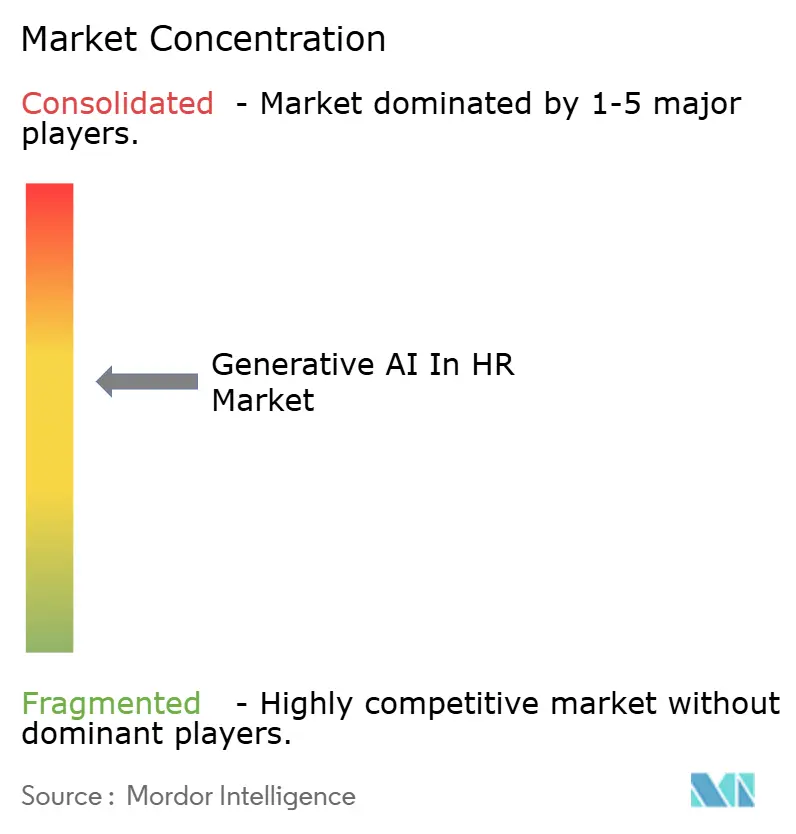
| Market Concentration | Medium |
Major Players *Disclaimer: Major Players sorted in no particular order Image © Mordor Intelligence. Reuse requires attribution under CC BY 4.0. | |
Generative AI In HR Market Analysis by Mordor Intelligence
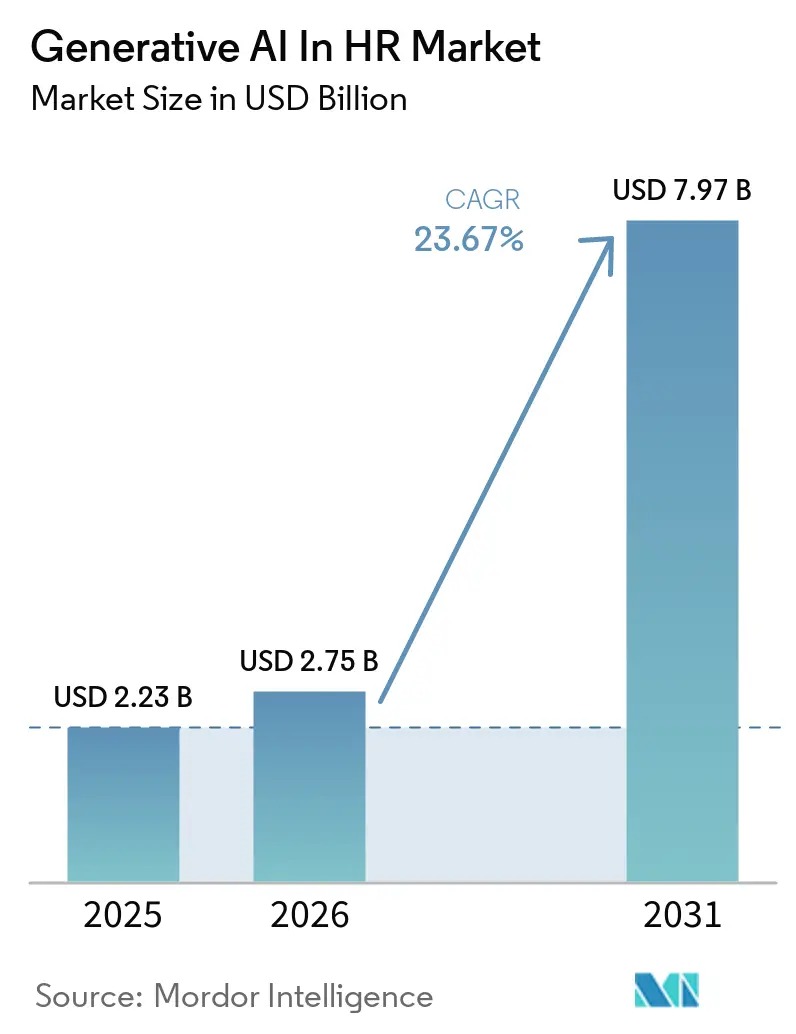
The generative AI in HR market size is expected to increase from USD 2.23 billion in 2025 to USD 2.75 billion in 2026 and reach USD 7.97 billion by 2031, growing at a CAGR of 23.67% over 2026-2031. Rapid maturation of large language models trained on enterprise talent data is pushing the generative AI in HR market beyond narrow task automation toward full-cycle orchestration of recruitment, learning, performance and compliance workflows. Buyers are shifting evaluation criteria from feature checklists to proof of explainability, audit trails, and regulatory alignment, which is raising the bar for vendors claiming enterprise-readiness. Consumption-based cloud pricing and low-code interfaces are expanding addressable demand among mid-market firms, while sovereign-cloud regions and confidential-computing enclaves protect data residency for highly regulated employers. Competitive differentiation is narrowing on the breadth of proprietary HR datasets and the depth of partnerships with collaboration platforms that bring conversational agents directly into employee workspaces.
Key Report Takeaways
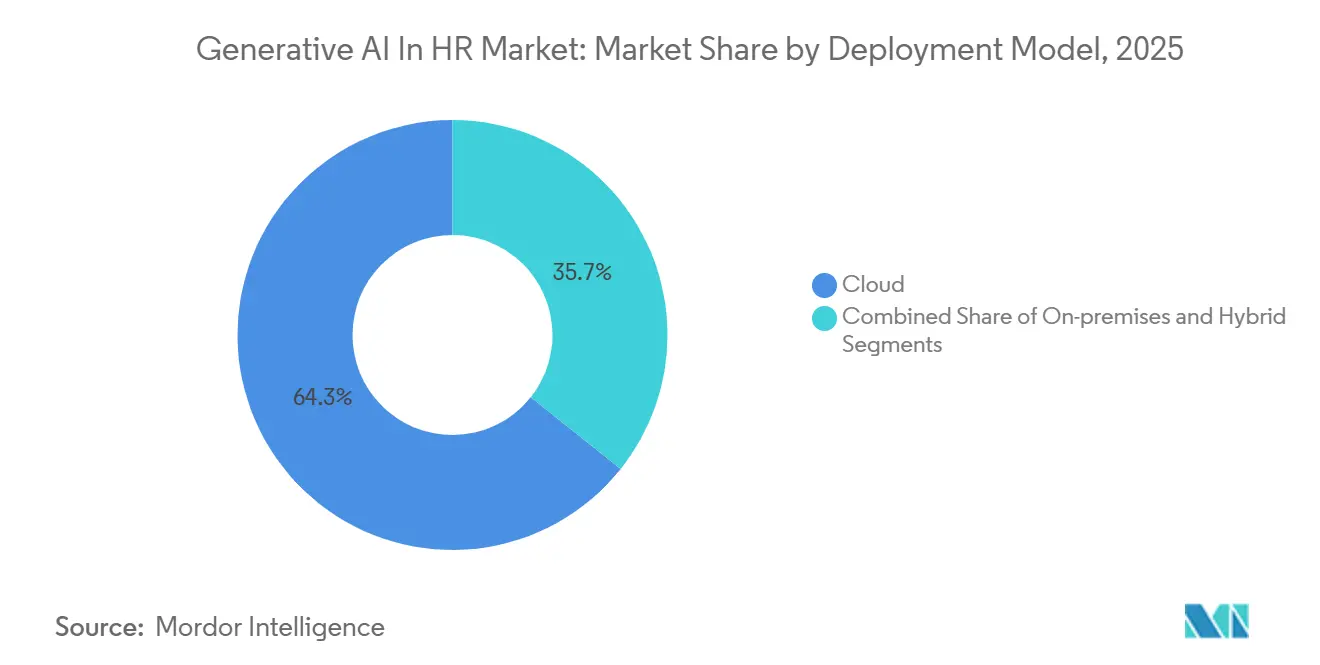
- By deployment model, cloud platforms captured 64.29% of the generative AI in HR market share in 2025, whereas hybrid architectures are forecast to expand at a 26.77% CAGR through 2031.
- By HR function, recruitment and talent acquisition led with 28.45% of the generative AI in HR market size in 2025, while HR analytics and workforce planning is projected to grow at the fastest 25.85% CAGR over 2026-2031.
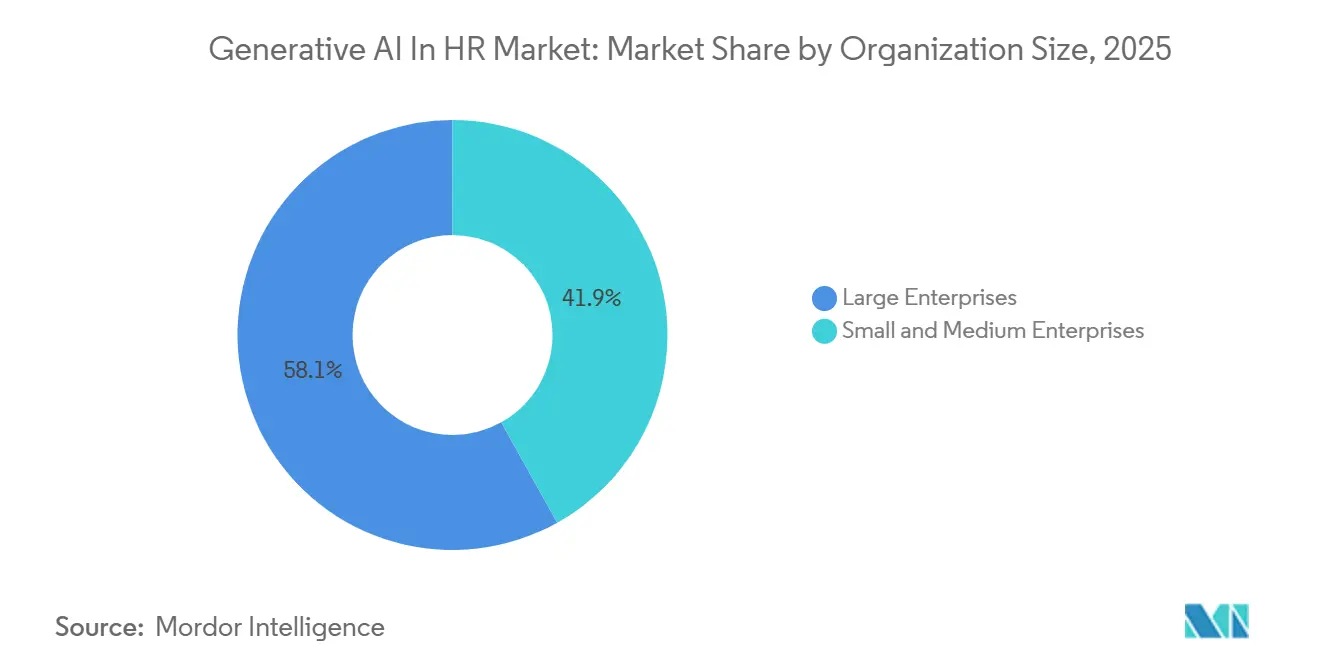
- By organization size, large enterprises accounted for 58.10% adoption of the generative AI in HR market in 2025, but small and medium enterprises are set to advance at a 27.00% CAGR as entry barriers fall.
- By end-use industry, IT and telecom held 23.44% revenue share of the generative AI in HR market in 2025, whereas healthcare and life sciences is positioned to record the highest 25.11% CAGR through 2031.
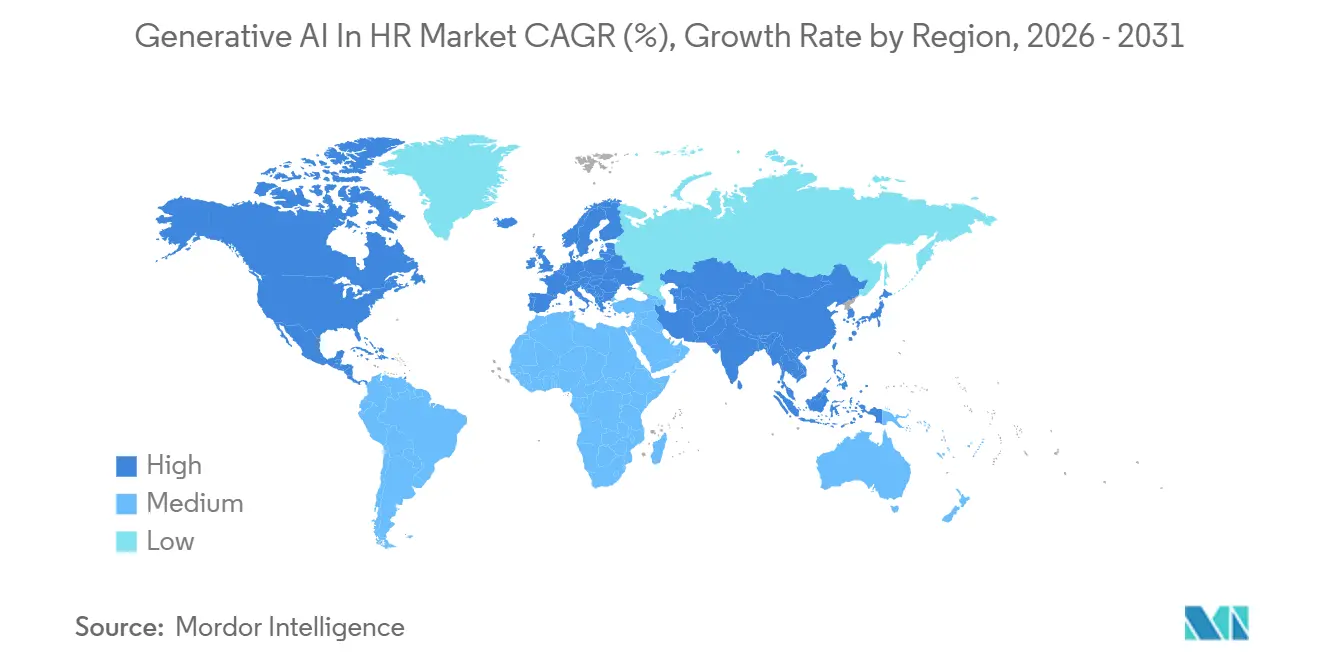
- By geography, North America maintained 35.27% generative AI in HR market share in 2025, and Asia-Pacific is forecast to register a 26.20% CAGR over 2026-2031.
Note: Market size and forecast figures in this report are generated using Mordor Intelligence’s proprietary estimation framework, updated with the latest available data and insights as of January 2026.
Market Trends and Insights
Drivers Impact Analysis of Generative AI In HR Market*
| Driver | (~) % Impact on CAGR Forecast | Geographic Relevance | Impact Timeline |
|---|---|---|---|
| Rapid Advancement of Large Language Models in Enterprise SaaS | +6.2% | Global, early adoption in North America and Europe | Medium term (2-4 years) |
| Rising Pressure to Automate High-Volume Talent Acquisition Tasks | +5.8% | Global, strong in North America, Asia-Pacific manufacturing hubs, and European retail | Short term (≤ 2 years) |
| Growing Adoption of Conversational AI for Employee Self-Service | +4.9% | Global, rapid scaling in Asia-Pacific and North America | Short term (≤ 2 years) |
| Mainstreaming of Skills-Based Workforce Planning Frameworks | +3.7% | North America and Europe lead, Asia-Pacific accelerating | Medium term (2-4 years) |
| Integration of GenAI with Low-Code HR Tech Stacks | +2.4% | Global, SME concentration in North America and Europe | Medium term (2-4 years) |
| Increasing Employer Demand for Hyper-Personalized Learning Content | +2.1% | Global, budgets concentrated in North America, Europe, Asia-Pacific | Long term (≥ 4 years) |
| Source: Mordor Intelligence | |||
Rapid Advancement of Large Language Models in Enterprise SaaS
Domain-tuned foundation models are overtaking generic chatbots as employers require explainability, auditability and domain-specific accuracy. Workday Illuminate ingests more than 800 billion business transactions to automate job description creation, talent summarization and succession planning, while preserving process context across HR and finance environments. Microsoft joined forces with IBM in February 2026 to pair watsonx governance controls with the Copilot collaboration layer, enabling confidential deployment of HR agents for benefits queries and onboarding without exposing personal data to public training loops. Specialist vendors such as Wisq are launching proprietary HR language models that embed bias checks aligned to EEOC and GDPR frameworks, closing the gap between model capability and regulatory expectation. As these models mature, the generative AI in HR market gains credibility among risk-averse sectors that previously limited pilots to low-stakes tasks.
Rising Pressure to Automate High-Volume Talent Acquisition Tasks
Frontline and hourly hiring remains largely undigitized even though it represents a majority of global headcount. ICIMS Frontline AI now engages applicants around the clock across SMS, WhatsApp and web chat, reducing time-to-fill by up to 75% and allowing tenfold more hires per recruiter.[1]Paradox’s Olivia assistant schedules interviews and conducts pre-screens at scale, while Eightfold AI’s structured video interviewer compresses documentation time by 90% to satisfy emerging audit mandates under NYC Local Law 144. These efficiency gains fuel employer willingness to invest, propelling the generative AI in HR market into core hiring workflows once dominated by manual labor.
Growing Adoption of Conversational AI for Employee Self-Service
Ticket-based service desks are giving way to always-on conversational agents that resolve routine inquiries in natural language. IBM’s AskHR agent already processes more than 10 million employee interactions a year with a 94% first-contact resolution rate and 40% cost reduction, demonstrating clear ROI. Sector case studies reveal a typical 33% drop in HR service tickets and a 50-point rise in hiring-manager net promoter scores when conversational AI is deployed. Lattice extended its AI Agent in March 2026 to deliver real-time coaching and goal recommendations directly inside manager workflows, cutting preparation time for performance conversations by an estimated 60%. These tangible productivity wins reinforce adoption, deepening the moat for the generative AI in HR market against traditional ticketing tools.
Mainstreaming of Skills-Based Workforce Planning Frameworks
Organizations are shifting from job titles to granular skills ontologies so they can redeploy talent quickly, uncover hidden expertise and close capability gaps. Deloitte research finds skills-based firms far outperform peers on retention and placement metrics, yet legacy HRIS lack the semantic engines to map skills across functions. Gloat’s Agentic HR integration with Microsoft 365 Copilot streams an employee’s skills, project history and learning progress into Teams chat, enabling friction-free discovery of internal gigs. KPMG’s Q1 2026 pulse shows 87% of leaders ranking upskilling as the top budget priority, underscoring why skills engines are now a baseline requirement in every generative AI in HR market procurement.
Restraints Impact Analysis of Generative AI In HR Market*
| Restraint | (~) % Impact on CAGR Forecast | Geographic Relevance | Impact Timeline |
|---|---|---|---|
| Data Privacy and Bias Concerns in Workforce-Related AI Models | -3.8% | Global, heightened scrutiny in Europe and California | Short term (≤ 2 years) |
| Limited Availability of HR-Specific High-Quality Training Data | -2.6% | Global, acute for SMEs and emerging markets | Medium term (2-4 years) |
| Rising Total Cost of Ownership for GenAI Model Fine-Tuning | -1.9% | Global, sensitivity highest among mid-market buyers | Medium term (2-4 years) |
| Uncertain Intellectual Property Rights Around AI-Generated Content | -1.2% | Global, precedents emerging in North America and Europe | Long term (≥ 4 years) |
| Source: Mordor Intelligence | |||
Data Privacy and Bias Concerns in Workforce-Related AI Models
Algorithmic bias, privacy lapses and opaque decision logic expose employers to hefty penalties. The EU AI Act imposes fines of up to EUR 35 million (USD 39.6 million) or 7% of global turnover for deploying prohibited systems, yet only 18% of organizations feel very prepared for the August 2026 deadline. NYC Local Law 144 already requires bias audits for automated hiring tools, forcing vendors to publish audit results and notify candidates, while ISO 42001 offers an optional governance blueprint. Compliance complexity is delaying high-risk use cases in the generative AI in HR market, particularly performance evaluation and promotion selection.
Limited Availability of HR-Specific High-Quality Training Data
Transforming historical talent data into anonymized, bias-checked training corpora is labor-intensive and expensive, especially for SMEs with sparse records. Vendors must reconcile the need for representative datasets with privacy constraints that forbid re-identification. Without high-fidelity data, model accuracy drops and bias risks rise, dampening demand in segments of the generative AI in HR market where defensibility is paramount. Incumbents with large installed bases have an advantage, but even they face rising marginal costs for localization and industry-specific fine-tuning.
*Our forecasts treat driver/restraint impacts as directional, not additive. The impact forecasts reflect baseline growth, mix effects, and variable interactions.
Generative AI In HR Market Segment Analysis
By Deployment Model:
Hybrid Architectures Balance Control and ScalabilityHybrid deployments are forecast to expand at a 26.77% CAGR as employers seek the agility of cloud inference paired with on-premises control of personal data. Cloud services nonetheless retained 64.29% of the 2025 generative AI in HR market share because subscription pricing, rapid release cycles and vendor-managed security appeal to mid-market buyers. Multinationals operating under strict localization mandates in China or the Middle East now pilot sovereign-cloud regions and confidential-computing enclaves to avoid repatriation risk, keeping sensitive records on-premises while sending de-identified metadata to cloud engines. Major hyperscalers have responded with dedicated HR connectors for Workday, SAP SuccessFactors and Oracle HCM that let customers unlock generative features without moving core data. This coexistence model preserves existing audit controls yet accelerates the generative AI in HR market penetration among compliance-heavy industries.
On-premises installations persist in defense, intelligence and critical-infrastructure environments, but their overall share continues to slide as vendors document equivalence between sovereign-cloud certifications and traditional air-gaps. ADP’s global payroll integration with SAP exemplifies the shift: firms can now orchestrate payroll anomaly detection, reporting and employee self-service across 140 countries without uprooting incumbent HR stacks.[2]Such API-first extensions lower migration risk and reinforce hybrid as the default operating model within the generative AI in HR market.

By HR Function:
Analytics and Workforce Planning Gain MomentumHR analytics and workforce planning is projected to grow at the fastest 25.85% CAGR, signaling a pivot from transactional hiring metrics toward predictive skills forecasting, scenario modeling and organizational design. Recruitment still commanded 28.45% of the 2025 generative AI in HR market size, but feature parity in chatbots and scheduling tools is pushing buyers to look further downstream for incremental value. Platforms such as Workday Illuminate generate onboarding bottleneck reports, succession shortlists and compensation insights by ingesting enterprise-specific process data. Meanwhile learning systems leverage generative engines to produce customized micro-lessons, reducing spend on external content libraries.
Employee engagement suites embed sentiment analysis and AI-generated action plans so managers can respond to burnout signals in real time, raising stickiness of the generative AI in HR market within human capital strategies. Performance management remains a cautious frontier due to liability worries, but explainable AI dashboards and human-in-the-loop approvals are gradually winning executive sponsorship.
By Organization Size:
SMEs Close the Adoption GapLarge enterprises held 58.10% share in 2025 thanks to deep IT benches and established vendor ties, yet SMEs are expected to register the strongest 27.00% CAGR. Low-code interfaces, consumption pricing and vendor-managed compliance tooling are pulling smaller firms into the generative AI in HR market sooner than past technology waves. Workable and Greenhouse embed AI job description generators, sourcing tools and inclusive-writing guidance directly into everyday workflows, enabling single-person HR teams to compete for scarce talent. KPMG’s latest pulse shows average AI budgets doubling year over year, with mid-market companies earmarking USD 25 million solely for new tech hires, underscoring maturing in-house capabilities.
SMEs prioritize time-to-value over configurability, tilting demand toward cloud SaaS with out-of-the-box templates. This preference is expanding the generative AI in HR market beyond traditional Fortune 500 budgets, reshaping vendor go-to-market playbooks around community support, in-app tutorials and freemium tiers.
By End-Use Industry:
Healthcare and Life Sciences AccelerateIT and telecom dominated 23.44% of 2025 spending, reflecting early AI literacy and large-scale digital transformation programs. Yet healthcare and life sciences is projected to register the leading 25.11% CAGR, propelled by clinician shortages, strict credentialing demands and the rise of distributed care. Generative tools automate license verifications, match nurse competencies to patient acuity and auto-populate continuing education records, shrinking administrative overhead in overburdened hospital systems. Financial services deploy generative AI for compliance training and skills-based succession planning as regulators tighten oversight on algorithmic bias.
Manufacturing leverages chatbots for frontline scheduling, while retail and e-commerce automate seasonal hiring surges. These cross-industry adoptions collectively propel the generative AI in HR market deeper into operational use cases once siloed within talent acquisition.
Geography Analysis
North America Generative AI in HR Market
North America maintained 35.27% share of the generative AI in HR market in 2025, buoyed by venture capital depth, concentration of HR tech vendors and a historically permissive regulatory climate. Rising patchwork rules, California CCPA, New York Local Law 144 and forthcoming federal guidelines, are shifting selection criteria toward platforms with turnkey compliance dashboards. Employers operating on both sides of the Atlantic now rate regulatory agility as high as feature scope, giving advantage to vendors with embedded audit reporting.
APAC Generative AI in HR Market
Asia-Pacific is anticipated to post the fastest 26.20% CAGR through 2031. China’s national AI strategy mandates large-scale reskilling and workforce analytics, driving adoption of Mandarin-trained models that can scale across state-owned enterprises. India’s IT services giants use generative agents to automate offshore recruitment workflows, cut attrition and personalize learning paths, while Japan pilots AI-driven succession planning to hedge against population aging. Australia and New Zealand model EU-style transparency rules, turning the region into a sandbox where vendors prove compliance readiness before European rollouts.
EMEA and South America Generative AI in HR Market
Europe, the Middle East and Africa display uneven momentum. European employers face procedural complexity under the EU AI Act, mandatory works-council consultation and conformity assessments lengthen buying cycles, temporarily tempering the generative AI in HR market expansion. Littler’s 2025 survey revealed only 18% readiness for the August 2026 deadline, spotlighting a short-term bottleneck.[3]The Middle East channels sovereign wealth into AI workforce nationalization programs, particularly in the UAE and Saudi Arabia, while African demand centers on mobile-first chatbots optimised for low bandwidth. South America, led by Brazil and Argentina, applies conversational AI to high-volume retail and agriculture hiring, though macroeconomic volatility still limits multi-year transformation budgets.
Competitive Landscape
The generative AI in HR market is moderately fragmented. Enterprise suite vendors including Workday, Oracle, SAP and ADP embed generative capabilities to protect installed bases, while cloud hyperscalers Microsoft and Google position collaboration layers as orchestration hubs. Pure-play vendors such as Eightfold AI, Phenom, Gloat and Paradox target greenfield deployments with domain-trained models and vertical features. Competitive advantage increasingly hinges on proprietary talent datasets: the more résumés, job postings and performance records a vendor controls, the better its models’ predictive accuracy.
Mergers and acquisitions accelerate capability expansion. ICIMS bought conversational specialist Apli to automate 90% of frontline hiring; Greenhouse partnered with Textio to inject inclusive-language guidance within existing ATS workflows. IBM’s watsonx differentiates on governance, serving heavily regulated sectors that demand transparent AI pipelines. White-space remains in performance management, succession planning and compliance documentation, where legal exposure and cultural skepticism slow penetration. Vendors that pair explainable AI tooling with seamless integrations into payroll, learning and collaboration environments are best placed to capture incremental share of the generative AI in HR market.
Generative AI In HR Industry Leaders
-
ADP, Inc.
-
Workday, Inc.
-
Oracle Corporation
-
SAP SE
-
Eightfold AI, Inc.
- *Disclaimer: Major Players sorted in no particular order
Generative AI In HR Market Companies Covered in this Report
- ADP, Inc.
- Workday, Inc.
- Oracle Corporation
- SAP SE
- International Business Machines Corporation
- Microsoft Corporation
- Google LLC
- Eightfold AI, Inc.
- Phenom People, Inc.
- Paradox.ai, Inc.
- Beamery Ltd.
- HireVue, Inc.
- iCIMS, Inc.
- Greenhouse Software, Inc.
- Lever, Inc.
- Textio, Inc.
- Gloat, Inc.
- Retrain.ai Ltd.
- SeekOut Inc.
- Lattice, Inc.
Recent Industry Developments in Generative AI In HR Market
- April 2026: Gloat integrated Agentic HR into Microsoft 365 Copilot and Teams, releasing the Gloat Copilot Agent via the Microsoft marketplace.
- March 2026: ICIMS rolled out Frontline AI, a 24/7 conversational layer for high-volume hiring, claiming up to 75% reduction in time-to-fill.
- February 2026: Greenhouse announced Textio as its first ATS integration, surfacing inclusive-writing scores and guidance inside Greenhouse job posts.
- February 2026: IBM and Microsoft formed the Enterprise Advantage partnership combining watsonx HR agents with Microsoft 365 Copilot for compliant conversational HR.
Global Generative AI In HR Market Report Scope
The Generative AI in HR Market centers on AI systems crafting content, predictions, recommendations, and automating workflows for HR tasks like recruitment, talent development, and workforce analytics. Tools in this market generate job descriptions, interview questions, learning content, career-path models, and predictive workforce scenarios. Enterprises increasingly adopt these tools to lighten manual workloads, enhance decision-making accuracy, and scale personalized HR experiences. As enterprises weave GenAI into core HCM platforms and regulatory frameworks around responsible AI in HR mature, the market witnesses rapid expansion.
The Generative AI in HR Market Report is Segmented by Deployment Model (Cloud, On-premises, and Hybrid), HR Function (Recruitment and Talent Acquisition, Learning and Development, Employee Engagement and Experience, Performance Management, HR Analytics and Workforce Planning, and Other HR Functions), Organization Size (Large Enterprises, and Small and Medium Enterprises), End-use Industry (IT and Telecom, BFSI, Healthcare and Life Sciences, Manufacturing, Retail and E-commerce, and Other End-use Industries), and Geography (North America, South America, Europe, Asia-Pacific, Middle East, and Africa). The Market Forecasts are Provided in Terms of Value (USD).
Segmentation Overview
| Cloud |
| On-premises |
| Hybrid |
| Recruitment and Talent Acquisition |
| Learning and Development |
| Employee Engagement and Experience |
| Performance Management |
| HR Analytics and Workforce Planning |
| Other HR Functions |
| Large Enterprises |
| Small and Medium Enterprises |
| IT and Telecom |
| BFSI |
| Healthcare and Life Sciences |
| Manufacturing |
| Retail and E-commerce |
| Other End-use Industries |
| North America | United States |
| Canada | |
| Mexico | |
| South America | Brazil |
| Argentina | |
| Rest of South America | |
| Europe | Germany |
| United Kingdom | |
| France | |
| Italy | |
| Spain | |
| Russia | |
| Rest of Europe | |
| Asia-Pacific | China |
| Japan | |
| India | |
| South Korea | |
| Australia | |
| Rest of Asia-Pacific | |
| Middle East | Saudi Arabia |
| United Arab Emirates | |
| Turkey | |
| Rest of Middle East | |
| Africa | South Africa |
| Nigeria | |
| Egypt | |
| Rest of Africa |
| By Deployment Model | Cloud | |
| On-premises | ||
| Hybrid | ||
| By HR Function | Recruitment and Talent Acquisition | |
| Learning and Development | ||
| Employee Engagement and Experience | ||
| Performance Management | ||
| HR Analytics and Workforce Planning | ||
| Other HR Functions | ||
| By Organization Size | Large Enterprises | |
| Small and Medium Enterprises | ||
| By End-use Industry | IT and Telecom | |
| BFSI | ||
| Healthcare and Life Sciences | ||
| Manufacturing | ||
| Retail and E-commerce | ||
| Other End-use Industries | ||
| By Geography | North America | United States |
| Canada | ||
| Mexico | ||
| South America | Brazil | |
| Argentina | ||
| Rest of South America | ||
| Europe | Germany | |
| United Kingdom | ||
| France | ||
| Italy | ||
| Spain | ||
| Russia | ||
| Rest of Europe | ||
| Asia-Pacific | China | |
| Japan | ||
| India | ||
| South Korea | ||
| Australia | ||
| Rest of Asia-Pacific | ||
| Middle East | Saudi Arabia | |
| United Arab Emirates | ||
| Turkey | ||
| Rest of Middle East | ||
| Africa | South Africa | |
| Nigeria | ||
| Egypt | ||
| Rest of Africa | ||
Key Questions Answered in the Report
What is the current size of the generative AI in HR market and how fast is it growing?
The generative AI in HR market size reached USD 2.75 billion in 2026 and is projected to reach USD 7.97 billion by 2031, reflecting a 23.67% CAGR.
Which deployment model is gaining the most traction among employers?
Hybrid architectures are registering the fastest 26.77% CAGR because they combine cloud-based AI inference with on-premises data control needed for jurisdictional compliance.
Which HR function will contribute most to future growth?
HR analytics and workforce planning is forecast to expand at a 25.85% CAGR as organizations shift from reactive hiring toward skills-based forecasting and scenario planning.
How are small and medium enterprises adopting generative AI tools?
SMEs increasingly adopt plug-and-play SaaS platforms that bundle job-description generators, sourcing tools and conversational assistants, driving a 27.00% CAGR in the segment.
What region is expected to post the fastest growth through 2031?
Asia-Pacific is projected to lead with a 26.20% CAGR, supported by government-led AI initiatives, rapid HR digitalization and demographic pressures such as workforce aging in Japan.