
Freeze-dried Vegetable Powder Market Size and Share
Market Overview
| Study Period | 2020 - 2030 |
|---|---|
| Market Size (2025) | USD 2.94 Billion |
| Market Size (2030) | USD 4.18 Billion |
| Growth Rate (2025 - 2030) | 7.32 % |
| Fastest Growing Market | North America |
| Largest Market | Asia Pacific |
| Market Concentration | Medium |
Major Players
*Disclaimer: Major Players sorted in no particular order Image © Mordor Intelligence. Reuse requires attribution under CC BY 4.0. |
|
Freeze-dried Vegetable Powder Market Analysis by Mordor Intelligence
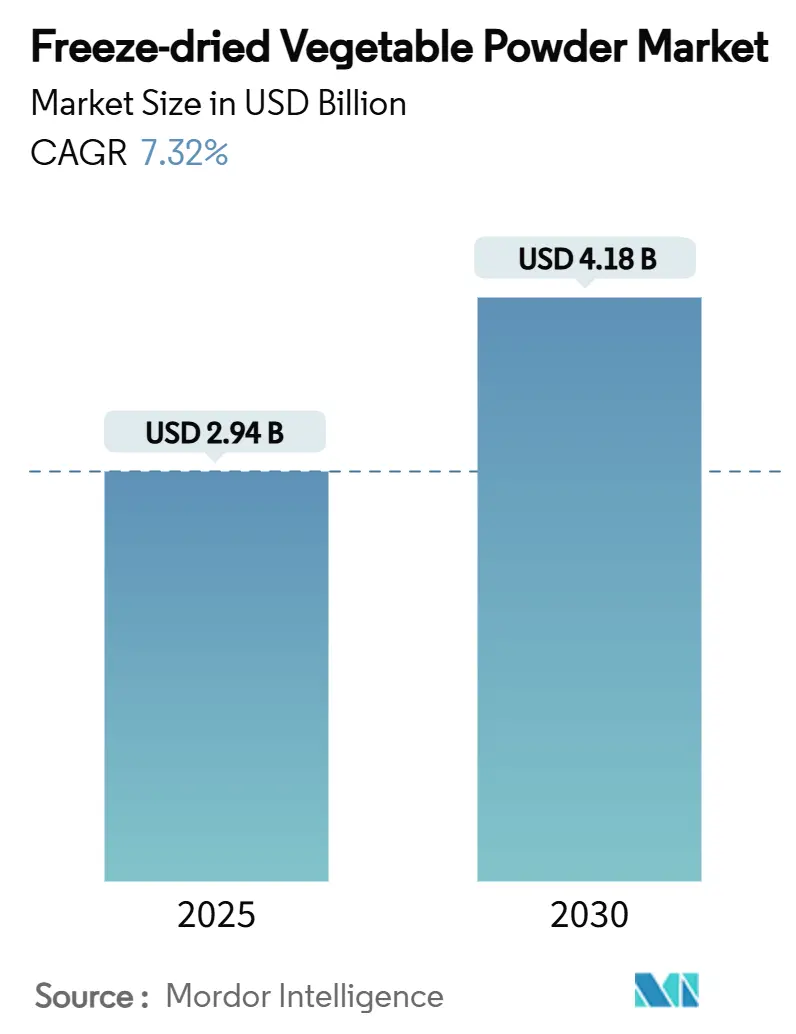
The global freeze-dried vegetable powder market demonstrated significant value at USD 2.94 billion in 2025 and shows promising growth potential, with expectations to reach USD 4.18 billion by 2030, representing a steady CAGR of 7.32% during the forecast period. This market expansion reflects the increasing industrial and consumer demand for shelf-stable, nutrient-dense ingredients that streamline modern food processing operations. Market growth is underpinned by several factors, including evolving consumer preferences toward convenient food solutions, well-established regulatory frameworks governing water activity standards, and improved supply-chain efficiencies across food manufacturing, foodservice operations, and direct-to-consumer channels. The industry has benefited from technological progress, particularly in spray freeze drying techniques, which have substantially improved nutrient preservation and product porosity characteristics, enabling manufacturers to position their products in premium market segments. Additionally, the market's reach has expanded through multiple growth channels, including robust e-commerce platforms, increased consumer interest in organic certifications, and the strategic shift from expensive cold-chain logistics to more cost-effective ambient storage solutions across both developed and emerging economic regions.
Key Report Takeaways
- By product type, carrot powder held 32.13% of the freeze-dried vegetable powder market share in 2024, while beetroot powder is projected to grow at 8.47% CAGR through 2030.
- By nature, conventional products accounted for 68.37% of the freeze-dried vegetable powder market size in 2024, whereas organic variants are forecast to expand at 8.43% CAGR over 2025-2030.
- By distribution channel, supermarkets and hypermarkets led with 58.12% revenue share in 2024, but online stores are set to post the highest 8.22% CAGR to 2030.
- By geography, North America commanded 35.22% share in 2024, whereas Asia-Pacific is advancing at an 8.84% CAGR to 2030.
Note: Market size and forecast figures in this report are generated using Mordor Intelligence’s proprietary estimation framework, updated with the latest available data and insights as of January 2026.
Market Trends and Insights
Drivers Impact Analysis of Freeze-dried Vegetable Powder Market*
| Driver | (~) % Impact on CAGR Forecast | Geographic Relevance | Impact Timeline |
|---|---|---|---|
| Growing demand for convenient and easy-to-use food ingredients | +1.2% | Global, with strongest impact in North America & Europe | Medium term (2-4 years) |
| Increasing trend toward organic and clean-label food products | +1.1% | Europe & North America core, expanding to APAC | Long term (≥ 4 years) |
| Expansion of online retail channels improving market accessibility | +0.9% | Global, with accelerated adoption in Asia-Pacific | Short term (≤ 2 years) |
| Rising consumer preference for long shelf-life food products | +0.8% | Global, particularly strong in developing regions | Medium term (2-4 years) |
| Enhanced preservation of nutrients and flavor by freeze-drying | +0.7% | Global, premium segments in developed markets | Long term (≥ 4 years) |
| Innovations in product offerings such as rehydratable mixes and value packs | +0.6% | North America & Europe, expanding globally | Medium term (2-4 years) |
| Source: Mordor Intelligence | |||
Growing Demand for Convenient and Easy-to-Use Food Ingredients
The significant shift toward convenience-focused consumption patterns has fundamentally transformed how businesses approach food ingredient procurement across commercial and retail sectors. Food service operators have recognized the operational benefits of ingredients that reduce kitchen preparation time while maintaining essential nutritional value. In this context, freeze-dried vegetable powders have emerged as a practical solution, offering immediate reconstitution capabilities that eliminate traditional food preparation steps such as washing, chopping, and complex storage requirements. This transformation has become particularly relevant amid persistent labor shortages in the food service industry, where these powders enable food service staff to maintain consistent portion control and achieve measurable waste reduction compared to fresh ingredients. The practical advantages extend into supply chain operations, as freeze-dried products eliminate the need for temperature-controlled storage and substantially reduce transportation expenses by removing water content. The market has responded positively to dual-functional freeze-dried vegetable powders, which simultaneously address nutritional requirements and enhance flavor profiles, enabling businesses to command premium prices while offering products with streamlined ingredient declarations.
Increasing Trend Toward Organic and Clean-Label Food Products
The food industry is witnessing a transformative shift in consumer preferences, with transparency in food production becoming a fundamental requirement. This evolution has propelled organic and clean-label products from niche market segments into essential mainstream offerings, particularly benefiting freeze-dried vegetable powders due to their minimal processing characteristics. The European market, with its regulatory framework favoring natural additives over synthetic alternatives, has created substantial opportunities for these powders as dual-functional ingredients offering both preservation and nutritional benefits. Market projections for 2025 indicate an increase in organic crop production, which is expected to influence pricing dynamics for organic commodities, including vegetables used in powder production, presenting strategic advantages for food processors to secure raw materials at competitive prices while meeting clean-label demand. The clean-label movement has expanded beyond simplified ingredient lists to encompass production method transparency, making freeze-drying's chemical-free preservation process particularly appealing to consumers. Brazilian market research emphasizes the implementation of comprehensive labeling and traceability systems for clean-label products, addressing food safety considerations associated with innovative ingredients and highlighting the necessity for thorough quality assurance protocols throughout the production process [1]Source: Brazilian Journal of Food Technology, “Emerging ingredients for clean label products and food safety,” scielo.br.
Expansion of Online Retail Channels Improving Market Accessibility
The rise of digital commerce has fundamentally transformed how freeze-dried vegetable powders reach consumers, with online sales channels consistently outperforming traditional retail formats in growth. This transformation is evident in the increasing number of American households embracing online grocery shopping, a trend that particularly benefits shelf-stable products like freeze-dried powders. These products have a distinct advantage in e-commerce as they avoid the complex cold chain logistics required for fresh produce distribution. Through online platforms, companies can now establish direct relationships with consumers, eliminating traditional distributor markups while providing comprehensive product information and usage instructions. The e-commerce business model also brings substantial improvements to inventory management, as the long shelf life of freeze-dried products reduces the risk of stockouts and supports cost-effective bulk purchasing options. In the European food and beverage market, e-commerce continues to reshape the retail landscape by offering unprecedented convenience and accessibility to specialty products, including plant-based and freeze-dried items. This digital transformation has been particularly beneficial for small producers, who can now compete in global markets without the need for extensive physical distribution networks, fostering increased market competition through direct consumer engagement. India's e-commerce market growth is driven by new online shoppers from Tier 2 and Tier 3 cities, who account for 50% to 60% of the customer base. The expansion of affordable internet access, local-language platforms, and improved last-mile logistics has enhanced market reach beyond metropolitan regions [2]Source: India Brand Equity Foundation, "E-commerce Industry in India," ibef.org.
Rising Consumer Preference for Long Shelf-Life Food Products
The heightened focus on emergency preparedness, influenced by global supply chain vulnerabilities and increasing climate-related events, has fundamentally changed how consumers and organizations approach long-term food storage. Freeze-dried vegetable powders, which maintain their nutritional integrity for 25-30 years under appropriate storage conditions, have evolved from being solely emergency supplies to becoming practical household necessities for families seeking food security. This transformation in consumer behavior has resonated across various institutional sectors, with schools, hospitals, and military organizations incorporating these products into their procurement strategies to ensure consistent nutritional value and stable inventory management. The University of Nebraska-Lincoln's educational initiatives on home freeze-drying techniques reflect this growing consumer interest, particularly as households recognize the benefits of nutrient retention and emergency readiness. The recent global supply chain challenges have emphasized the practical advantages of shelf-stable ingredients that eliminate refrigeration requirements, while the implementation of food export restrictions by 16 countries during recent disruptions has reinforced the strategic importance of maintaining reliable domestic food reserves through freeze-dried products.
Restraints Impact Analysis of Freeze-dried Vegetable Powder Market*
| Restraint | (~) % Impact on CAGR Forecast | Geographic Relevance | Impact Timeline |
|---|---|---|---|
| High cost of freeze-drying technology and equipment | -1.8% | Global, particularly impacting smaller producers | Long term (≥ 4 years) |
| Limited awareness among consumers in developing regions | -1.3% | Asia-Pacific, Latin America, Africa | Medium term (2-4 years) |
| Supply chain disruptions impacting raw material availability | -0.9% | Global, with regional variations | Short term (≤ 2 years) |
| Complexity of freeze-drying process leading to production challenges | -0.7% | Global, affecting new market entrants | Medium term (2-4 years) |
| Source: Mordor Intelligence | |||
High Cost of Freeze-Drying Technology and Equipment
The freeze-drying market faces substantial entry barriers due to significant capital requirements, with industrial-scale equipment demanding substantial investments per production line. This capital intensity naturally favors established companies with robust financial resources and access to capital markets. The technology's considerable energy consumption, which substantially exceeds conventional drying methods, increases operational costs and restricts market adoption, particularly in regions experiencing high electricity costs or unreliable power infrastructure. Recent technological advancements, such as Mirai Intex's air cycle refrigeration systems for retrofitting existing freeze-dryers, help reduce both capital and operational expenses. While regulatory requirements, including FDA-mandated water activity testing and HACCP implementation, increase operational costs, they simultaneously create competitive advantages for manufacturers who maintain compliance with these standards.
Limited Awareness Among Consumers in Developing Regions
Limited consumer awareness in emerging markets hinders the adoption of freeze-dried vegetable powder. Many consumers lack understanding of product reconstitution methods and nutritional value compared to fresh vegetables. Studies in Albania and Kosovo highlight regional differences in processed food acceptance. Albanian consumers show skepticism towards food safety regulations and prefer fresh produce, while Kosovo consumers demonstrate greater acceptance of processed foods. Consumers in developing regions often perceive freeze-dried products as costly without recognizing benefits like concentration ratios and extended shelf life. Educational programs, such as the University of Nebraska-Lincoln's guidelines on freeze-drying practices, emphasize the role of consumer education in market expansion. Infrastructure constraints in developing regions, particularly cold chain requirements for fresh produce, create opportunities for shelf-stable alternatives. However, consumer preferences remain strongly aligned with traditional fresh products. Research from Tanzania indicates that training programs for smallholder farmers significantly increase the adoption of food processing technologies.
*Our forecasts treat driver/restraint impacts as directional, not additive. The impact forecasts reflect baseline growth, mix effects, and variable interactions.
Freeze-dried Vegetable Powder Market Segment Analysis
By Type:
Carrot Dominance Drives Market MaturityCarrot powder dominates the market with a substantial 32.13% share in 2024, establishing itself as a fundamental ingredient across the food industry. Its widespread adoption stems from manufacturers' confidence in its consistent performance and consumers' acceptance of its natural properties. The powder's applications span multiple categories, from infant nutrition products to commercial baking operations, where it serves as both a functional ingredient and natural colorant.
The market dynamics show varied growth patterns across different powder segments. While beetroot powder demonstrates robust expansion at 8.47% CAGR through 2030, capitalizing on increasing consumer interest in natural performance-enhancing ingredients and health-focused products. Tomato powder maintains its position as a crucial ingredient in food processing, valued for its ability to enhance flavor profiles and provide natural coloring properties. Corn powder continues to fulfill specific requirements in gluten-free product development and industrial food applications, and onion powder remains indispensable in the formulation of seasoning blends and ready-to-eat meals, meeting the growing demand for convenience foods.




By Nature:
Organic Growth Challenges Conventional StabilityThe conventional freeze-dried vegetable powder market maintains its strong market position, commanding a substantial 68.37% share in 2024. This leadership stems from extensive investments in supply chain infrastructure, which has enabled efficient cost management and enhanced production capabilities. Food manufacturers consistently choose conventional freeze-dried powders, recognizing their reliability in industrial processing, consistent quality standards, and competitive price points. The conventional segment's success lies in its ability to meet large-scale manufacturing demands while maintaining product uniformity and cost-effectiveness throughout the food production value chain.
The organic segment demonstrates exceptional market performance, achieving an 8.43% CAGR through 2030. This growth reflects evolving consumer preferences, as buyers increasingly invest in certified organic ingredients that align with their sustainability values and clean-label requirements. The organic market landscape is undergoing significant changes, with 2025 forecasts indicating increased organic crop production that may influence pricing dynamics while preserving processor profitability. European regulations, particularly the European Food Safety Authority's stringent standards, create distinct market advantages for organic freeze-dried products compared to synthetic alternatives. The Common Agricultural Policy's emphasis on local plant protein production and sustainable farming practices strengthens the organic vegetable cultivation sector. While organic products gain traction, conventional products remain essential in cost-sensitive applications and industrial processing, where organic certification offers limited added value, ensuring their continued market presence despite slower growth rates.
By Distribution Channel:
Digital Transformation Accelerates Online GrowthSupermarkets and hypermarkets maintain their dominant position in traditional retail channels, commanding a substantial 58.12% market share in 2024. These retail establishments excel in providing comprehensive product visibility through strategic in-store demonstrations and effective cross-merchandising initiatives. The strength of these channels lies in their long-standing relationships with food manufacturers, enabling them to offer attractive bulk purchasing options that resonate with both commercial buyers and households with larger consumption needs.
Convenience stores have carved out a distinct role in urban market environments, where spatial constraints necessitate a focus on concentrated products, particularly freeze-dried powders that optimize inventory management. The "Others" category encompasses a diverse range of distribution channels, including food service distributors and industrial channels. These specialized channels facilitate direct manufacturer purchases for restaurants and institutional customers, ensuring efficient supply chain operations and meeting specific business requirements.

Geography Analysis
North America Freeze-dried Vegetable Powder Market
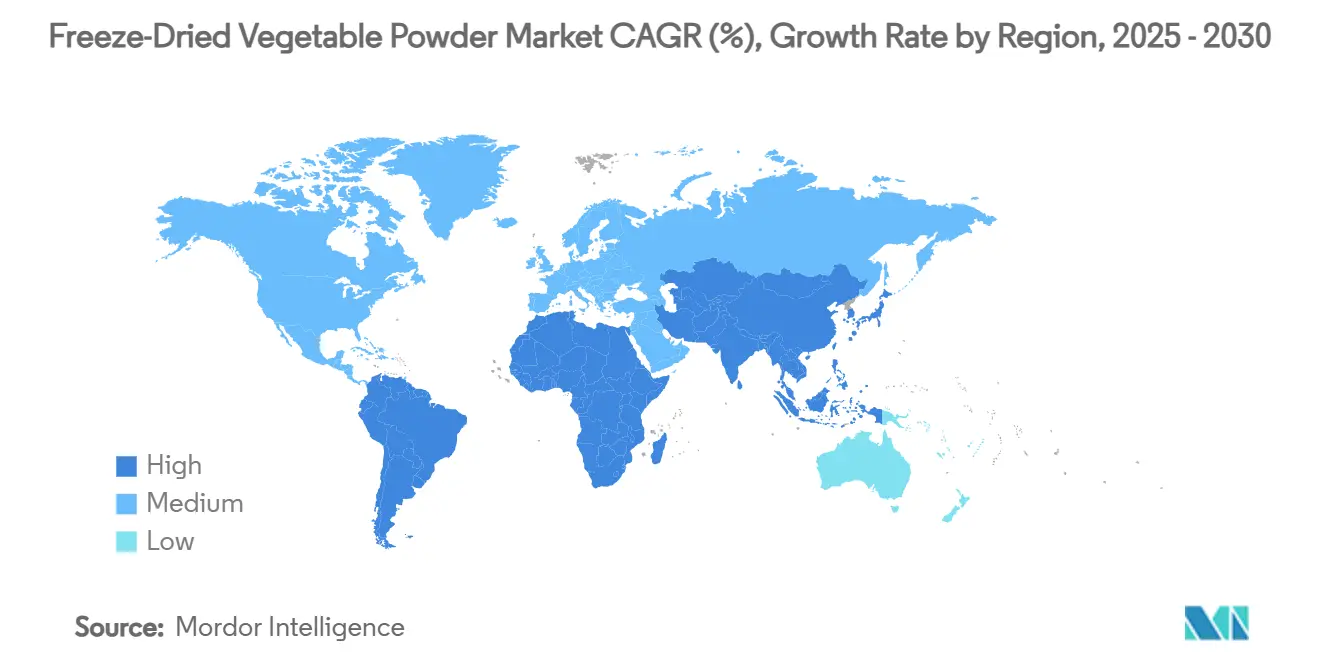
North America maintains its dominant position in the freeze-dried vegetable market, commanding a substantial 35.22% share in 2024. This leadership position stems from the region's sophisticated regulatory environment, extensive cold storage network, and widespread consumer familiarity with processed food products. The market's robustness is exemplified by industry players like Van Drunen Farms, which maintains significant operations across Illinois and Indiana. The company's impressive annual revenue of USD 149.5 million, coupled with a notable 12% growth in workforce, underscores the market's expansion trajectory. The Canadian market further strengthens the region's position, with 60 specialized freeze-dried vegetable producers maintaining strict adherence to Canadian Food Inspection Agency standards while prioritizing sustainable sourcing practices.
APAC Freeze-dried Vegetable Powder Market
The Asia-Pacific region emerges as the most dynamic market segment, projecting an impressive growth rate of 8.84% CAGR through 2030. This remarkable growth trajectory is fueled by several key factors: accelerating urbanization patterns, substantial increases in consumer disposable income, and evolving dietary preferences that increasingly favor convenient yet nutritious food options. The region's position as a major hub for global fruit and vegetable imports creates substantial opportunities for processed alternatives, particularly in addressing supply chain vulnerabilities and shelf-life extension needs. Market development in China receives significant support from Van Drunen Farms' strategic Qingdao facility, which houses specialized quality and purchasing teams. Japan's technological prowess in freeze-drying equipment, represented by companies like Tofflon Science and Technology, further reinforces the region's growth momentum.
Europe Freeze-dried Vegetable Powder Market
The European market demonstrates steady development, characterized by rigorous food safety protocols and consumer preferences aligned with natural, sustainable food solutions. The regulatory framework established by the European Food Safety Authority specifically favors natural additives over synthetic alternatives, creating a favorable environment for freeze-dried vegetable powders, particularly in applications requiring clean-label ingredients [3]Source: Government of the Netherlands, “European natural food additives market,” cbi.eu. This regulatory landscape, combined with consumer preferences, positions Europe as a significant market for continued growth in the freeze-dried vegetable sector.

Competitive Landscape
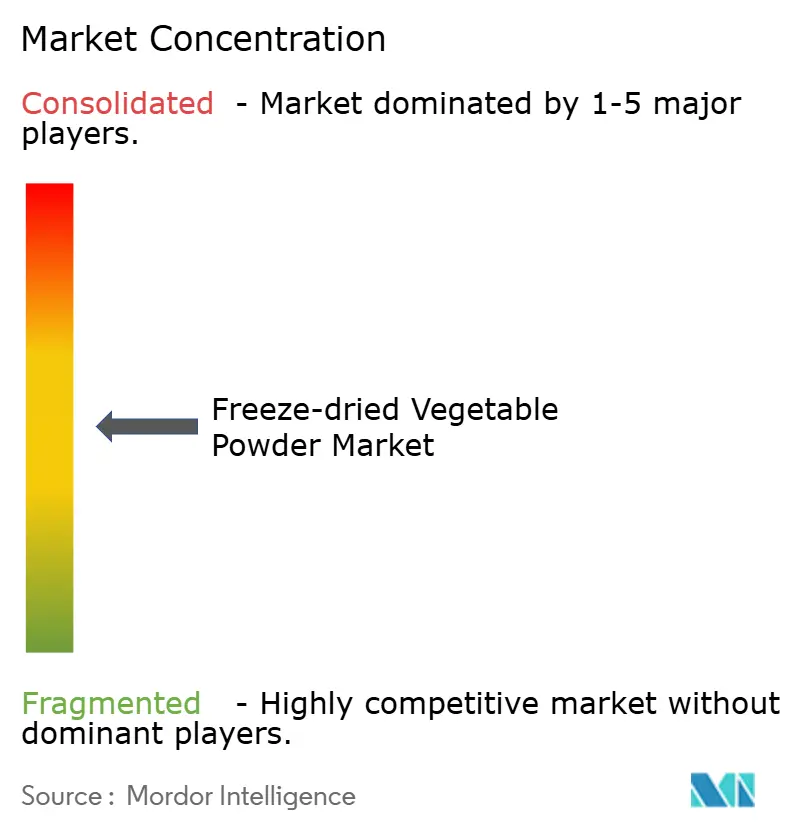
The freeze-dried vegetable powder market demonstrates moderate fragmentation, creating significant opportunities for industry consolidation as production costs continue to decrease and operational capacities expand. Market leaders have successfully implemented comprehensive vertical integration strategies by establishing direct partnerships with farmers and maintaining control over raw material sourcing. This approach has proven particularly effective in regions like Latin America, where the ability to manage crop quality and maintain price stability provides substantial competitive advantages in the market. Companies that have developed robust supply chain networks and maintained strong relationships with agricultural partners have positioned themselves favorably in this competitive landscape.
Van Drunen Farms exemplifies this strategic approach through its extensive integrated facility network spanning multiple locations across Illinois, Indiana, and China. The company has invested in dedicated purchasing teams that work directly with farmers to secure premium-quality raw materials while maintaining rigorous product standards across all production facilities. In the technological sphere, industry participants like GEA Group have made significant strides by introducing advanced batch freeze dryers that substantially improve operational efficiency and product quality. The implementation of spray freeze drying technology has emerged as a game-changing innovation, providing early adopters with distinct competitive advantages by enabling the production of highly porous powders with enhanced bioavailability, which commands premium pricing in pharmaceutical and nutraceutical applications.
The regulatory landscape, particularly the FDA's FSIS Notice 51-23, has established comprehensive microbiological sampling requirements for freeze-dried products, creating a competitive advantage for established companies while raising significant barriers to entry for new market participants. The market continues to present valuable opportunities in specialized segments, including emergency preparedness and institutional food service, where the extended shelf life and superior nutritional retention of freeze-dried products provide compelling value propositions that justify premium pricing compared to conventional alternatives. These market dynamics have created a favorable environment for companies that can effectively combine operational excellence with regulatory compliance and innovative product development.
Freeze-dried Vegetable Powder Industry Leaders
-
Van Drunen Farms
-
Thrive Foods
-
Chaucer Foods
-
European Freeze Dry
-
Sensient Natural Ingredients
- *Disclaimer: Major Players sorted in no particular order
Freeze-dried Vegetable Powder Market Companies Covered in this Report
- Van Drunen Farms
- Thrive Foods
- Chaucer Foods
- European Freeze Dry
- Sensient Natural Ingredients
- Olam Food Ingredients
- Freeze-Dry Foods GmbH
- Ajinomoto (Corporate Powder Division)
- Nutriseed
- Flex Foods Ltd
- Jian Jain Irrigation (Dried Div.)
- DMH Ingredients
- Harmony House Foods
- LiveKuna
- Sow Good Inc.
- Lyo Italia
- BCFoods
- Gourmet Nut
- Thrive Life
- Nutradry

Recent Industry Developments in Freeze-dried Vegetable Powder Market
- April 2024: Thrive Freeze Dry announced its definitive agreement to acquire Paradiesfrucht GmbH, a global freeze dryer based in Germany. The transaction, expected to close in 2024, aims to enhance Thrive’s manufacturing capabilities and expand its presence in Europe.
- January 2023: Thrive Foods, manufacturer of freeze-dried products including fruits and vegetables, opened freeze-drying facilities in North America in Oak Creek, Wisconsin, in summer 2023. This 341,000 sq. ft. state-of-the-art plant enhances processing capacity, focusing on pet treats and probiotics, further strengthening Thrive’s manufacturing footprint in the region.


Global Freeze-dried Vegetable Powder Market Report Scope
| Carrot |
| Tomato |
| Corn |
| Onion |
| Beetroot |
| Pea |
| Others |
| Organic |
| Conventional |
| Supermarkets / Hypermarkets |
| Convenience Stores |
| Online Stores |
| Others |
| North America | United States |
| Canada | |
| Mexico | |
| Rest of North America | |
| Europe | Germany |
| United Kingdom | |
| Italy | |
| France | |
| Spain | |
| Rest of Europe | |
| Asia-Pacific | China |
| India | |
| Japan | |
| Australia | |
| Rest of Asia-Pacific | |
| South America | Brazil |
| Argentina | |
| Rest of South America | |
| Middle East and Africa | South Africa |
| Saudi Arabia | |
| United Arab Emirates | |
| Rest of Middle East and Africa |
| By Type | Carrot | |
| Tomato | ||
| Corn | ||
| Onion | ||
| Beetroot | ||
| Pea | ||
| Others | ||
| By Nature | Organic | |
| Conventional | ||
| By Distribution Channel | Supermarkets / Hypermarkets | |
| Convenience Stores | ||
| Online Stores | ||
| Others | ||
| By Geography | North America | United States |
| Canada | ||
| Mexico | ||
| Rest of North America | ||
| Europe | Germany | |
| United Kingdom | ||
| Italy | ||
| France | ||
| Spain | ||
| Rest of Europe | ||
| Asia-Pacific | China | |
| India | ||
| Japan | ||
| Australia | ||
| Rest of Asia-Pacific | ||
| South America | Brazil | |
| Argentina | ||
| Rest of South America | ||
| Middle East and Africa | South Africa | |
| Saudi Arabia | ||
| United Arab Emirates | ||
| Rest of Middle East and Africa | ||


Key Questions Answered in the Report
What is the projected value of the freeze-dried vegetable powder market by 2030?
The market is forecast to reach USD 4.18 billion by 2030 based on a 7.32% CAGR between 2025 and 2030.
Which product type is growing the fastest?
Beetroot powder is expected to post the fastest 8.47% CAGR through 2030 due to its antioxidant profile and natural coloring attributes.
Why are online channels important for freeze-dried vegetable powders?
Online stores enable detailed product education, bulk subscription models, and cost-efficient distribution of shelf-stable powders, supporting an 8.22% CAGR to 2030.
What limits adoption in developing regions?
Limited consumer awareness, higher price perception, and distribution infrastructure constraints slow uptake, though educational programs are improving familiarity.
What is driving organic freeze-dried powder demand?
Clean-label preferences and favorable European regulations support an 8.43% CAGR for organic variants, even as abundant organic crop supply tempers raw-material premiums.
Page last updated on:


 Your data is secure and never sold or shared.


