
Market Overview
| Study Period | 2020 - 2031 |
|---|---|
| Forecast Data Period | 2026 - 2031 |
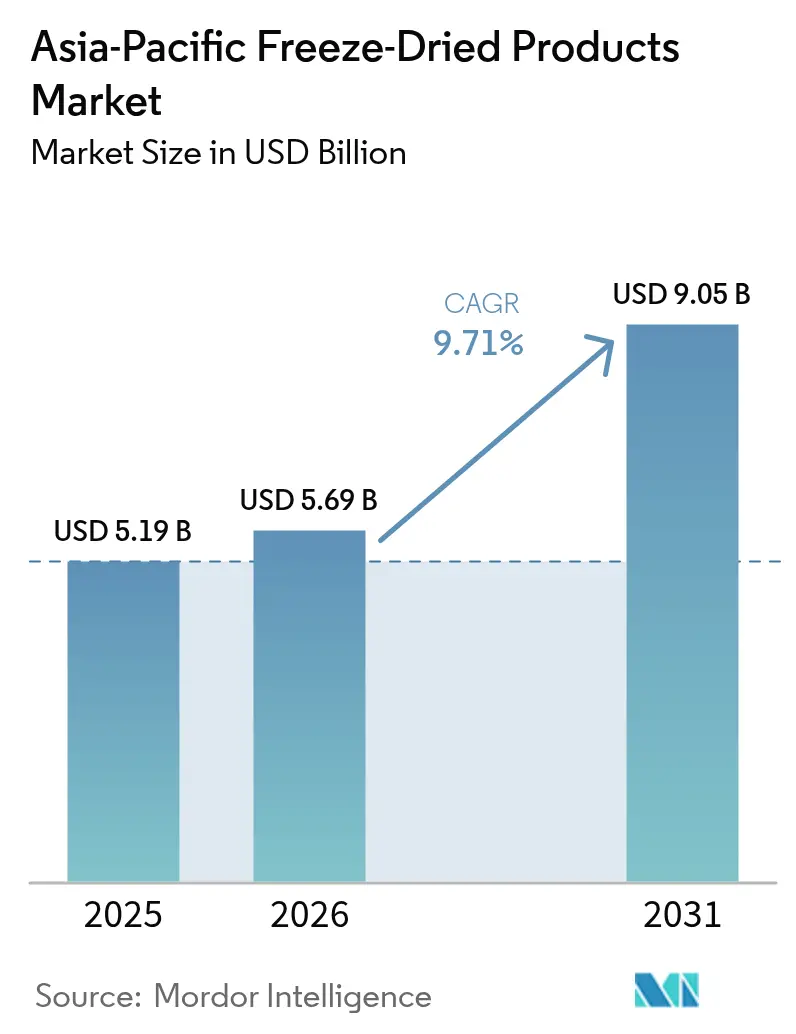
| Base Year Market Size (2025) | USD 5.19 Billion |
| Market Size (2026) | USD 5.69 Billion |
| Market Size (2031) | USD 9.05 Billion |
| Growth Rate (2026 - 2031) | 9.71 % |
| Market Concentration | Medium |
Major Players *Disclaimer: Major Players sorted in no particular order Image © Mordor Intelligence. Reuse requires attribution under CC BY 4.0. | |
Asia-Pacific Freeze-Dried Products Market Analysis by Mordor Intelligence
Asia-Pacific freeze-dried products market size in 2026 is estimated at USD 5.69 billion, growing from 2025 value of USD 5.19 billion with 2031 projections showing USD 9.05 billion, growing at 9.71% CAGR over 2026-2031. Rising demand for nutritious, shelf-stable foods, coupled with urbanization-driven lifestyle changes and consistent investments in advanced preservation technologies, fuels strong growth across both developed and emerging economies. Snack manufacturers are increasingly turning to freeze-drying, a method that safeguards vitamins and flavor without the need for refrigeration. Retailers, on the other hand, appreciate the lighter shipping weight that freeze-drying offers, leading to reduced logistics costs. In a bid to bolster the agricultural sector, local governments are championing value-addition programs. This initiative not only aids processors in securing raw materials but also ensures they do so at predictable prices. The surge in digital commerce amplifies product visibility, while trends in premiumization ignite innovation, particularly in areas like protein-fortified dairy, plant-based meal kits, and single-serve convenience lines. Regional players are keenly attuned to diverse cultural preferences, customizing flavors, package sizes, and labeling to resonate with each national market.
Key Report Takeaways
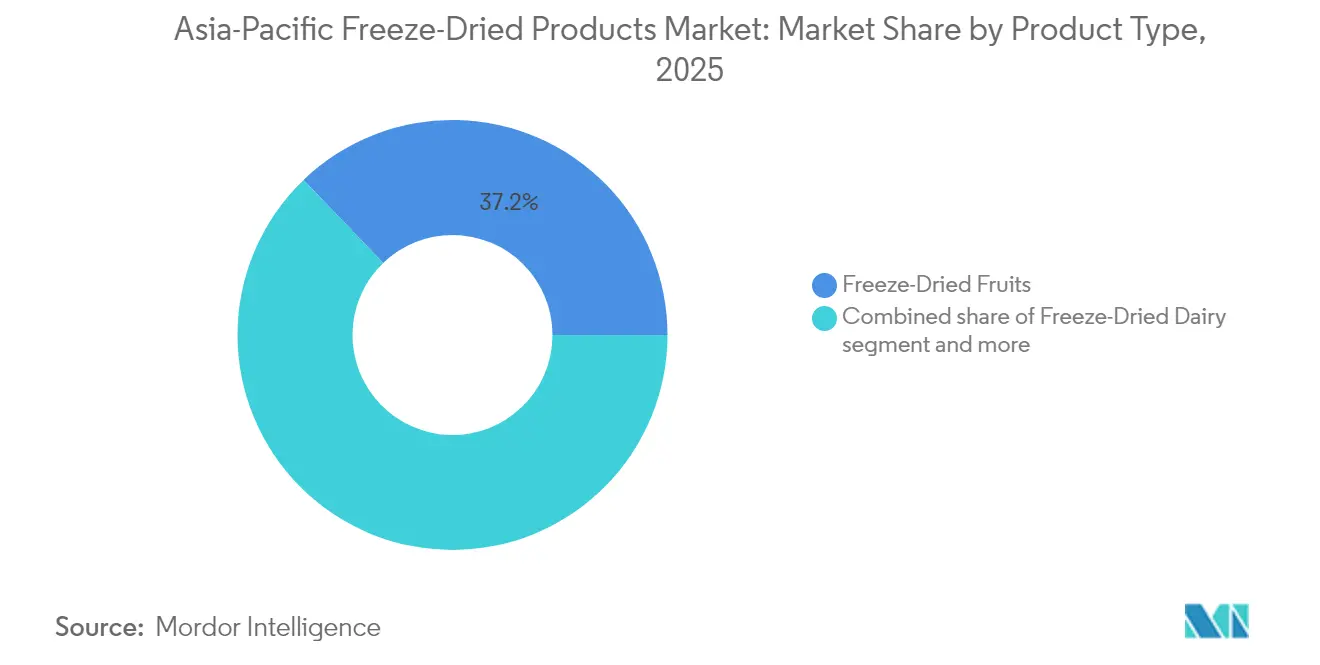
- By product type, freeze-dried fruits held 37.18% of the 2025 Asia-Pacific freeze-dried products market share, and freeze-dried dairy is projected to register a 11.98% CAGR during 2026-2031.
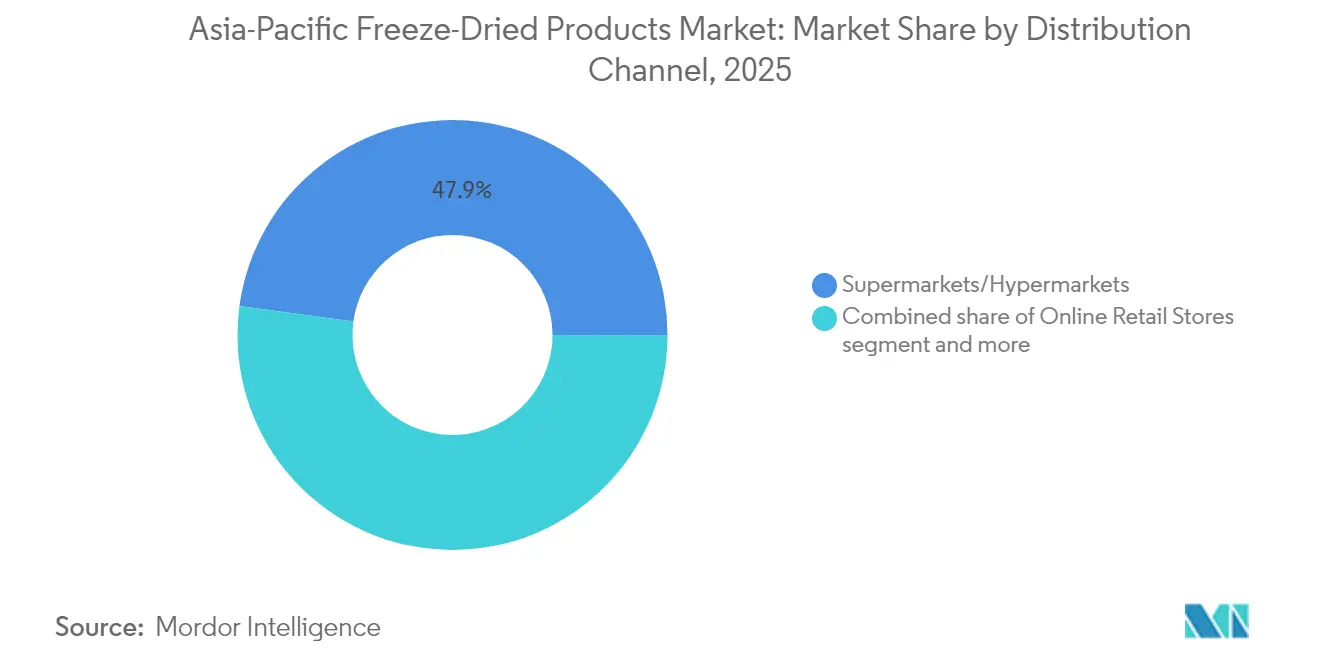
- By distribution channel, supermarkets/hypermarkets controlled 47.85% of the 2025 share, while online retail is expected to grow at a 13.05% CAGR through 2031.
- By nature, conventional lines represented 73.62% of the 2025 market, and organic alternatives are forecast to expand at an 11.06% CAGR over the same period.
- By geography, China accounted for 43.78% of the 2025 value, whereas India is set to post a 14.84% CAGR between 2026 and 2031.
Note: Market size and forecast figures in this report are generated using Mordor Intelligence’s proprietary estimation framework, updated with the latest available data and insights as of 2026.
Market Trends and Insights
Drivers Impact Analysis of Asia-Pacific Freeze-Dried Products Market*
| Driver | (~) % Impact on CAGR Forecast | Geographic Relevance | Impact Timeline |
|---|---|---|---|
| Rising demand for long-shelf-life healthy snacks | +2.1% | Global, with early gains in China, Japan, Southeast Asia | Medium term (2-4 years) |
| Expansion of e-grocery platforms | +1.8% | Asia-pacific core, spill-over to emerging markets | Short term (≤ 2 years) |
| Rising consumer demand for convenient ready-to-eat meals | +2.3% | Global, particularly strong in urban centers | Short term (≤ 2 years) |
| Preference for clean-label, natural ingredients over additives | +1.6% | North America and Europe influence spreading to Asia-Pacific | Medium term (2-4 years) |
| Plant-based meal-kit brands incorporating freeze-dried produce | +1.2% | Premium markets: Japan, Australia, urban China | Long term (≥ 4 years) |
| Government-backed programs to valorise climate-impacted crops | +0.9% | National, with early gains in Thailand, Philippines, Indonesia | Long term (≥ 4 years) |
| Source: Mordor Intelligence | |||
Rising demand for long-shelf-life healthy snacks
Health-conscious consumers are increasingly opting for high-protein, fiber-rich snacks that are portable and don't require refrigeration. These snacks cater to the growing demand for convenient yet nutritious options, aligning with shifting dietary preferences. Freeze-drying, which preserves color, texture, and micronutrients more effectively than thermal dehydration, is becoming the preferred method for producing fruit, yogurt, and vegetable chips. This technique not only enhances the shelf life of products but also maintains their nutritional value, making them appealing to health-focused buyers. Japanese processors are witnessing triple-digit growth by promoting single-serve vegetable portions, catering to busy households that prioritize premium convenience and are willing to pay a premium for quality. In response to tightening additive limits from food safety agencies, brands are emphasizing their clean-label credentials and showcasing natural ingredient lists, which resonate strongly with consumers seeking transparency and healthier choices.
Expansion of e-grocery platforms
Mobile-first shoppers are turning to digital marketplaces for their pantry staples. Freeze-dried products, thanks to their low shipping weight, long shelf life, and tamper-evident packaging, navigate parcel networks with ease. In tier-one Chinese cities, same-day fulfillment fosters consumer trust. Meanwhile, click-and-collect services in Indonesia and Vietnam address local infrastructure challenges. The Indo-Pacific's mobile-centric shopping, bolstered by platforms like Tmall, Lazada, and Shopee, mitigates purchase risks with standardized policies and offers competitive listings for packaged goods [1]. Supermarket chains are adapting by aligning their online assortments with in-store inventory, maintaining uniform pricing and promotions. Brands that prioritize product imagery, recipe videos, and localized keywords see a boost in search rankings and conversions.
Rising consumer demand for convenient ready-to-eat meals
In the Philippines, retail sales of ready meals surged by 12% in 2020, reaching USD 81 million, as consumers adapted to post-pandemic lifestyles [2]. Amidst COVID-19 disruptions, the demand for ready-to-eat solutions remained robust, driven by remote work and fragmented meal occasions. This trend has led to heightened interest in rehydratable soups, porridges, and rice bowls. In response, Japanese innovators introduced freeze-dried chazuke kits, which can be reconstituted with cold water. These kits have garnered attention from both office workers and those preparing for emergencies. As of 2024, Philippine ready-meal sales continued their upward trajectory, climbing another 12%. Processors, however, anticipate a more tempered mid-single-digit growth moving forward, suggesting that these new eating habits may be here to stay. Meanwhile, research and development teams are honing freeze-dry cycles, aiming to maintain the integrity of complex sauces and protein inclusions. Their goal is to achieve a sensory experience on par with chilled counterparts. Additionally, government standards on shelf-life labeling are leaning towards this technology, as it allows for predictable “best before” dating without the need for preservatives.
Preference for clean-label, natural ingredients over additives
As health consciousness rises across diverse demographics, a notable shift in consumer demand toward clean-label, natural ingredients is significantly propelling the market. In the region, consumers are closely scrutinizing ingredient lists, actively favoring minimally processed foods devoid of synthetic additives or intricate chemical components. This preference aligns seamlessly with the core attributes of freeze-dried products. Urban middle-class populations and younger consumers, who prioritize transparency and nutritional integrity in their premium food selections, particularly underscore this trend. In response, manufacturers are innovating and reformulating their products, eliminating artificial preservatives and opting for simple, recognizable ingredients. This shift directly amplifies the appeal of freeze-dried offerings. The market growth is further bolstered by the clean-label's association with sustainability, food safety, and plant-based trends. This has prompted companies to carve out distinctions in both mainstream and niche categories. Consequently, the clean-label movement not only fortifies consumer trust but also propels long-term growth for freeze-dried food manufacturers throughout the Asia-Pacific region.
Restraints Impact Analysis of Asia-Pacific Freeze-Dried Products Market*
| Restraint | (~) % Impact on CAGR Forecast | Geographic Relevance | Impact Timeline |
|---|---|---|---|
| High capital expenditure of freeze-drying equipment | -1.8% | Global, particularly affecting SME market entry | Medium term (2-4 years) |
| Growing popularity of "fresh-equivalent" HPP and aseptic technologies | -1.4% | North America and Europe, spreading to premium Asia-Pacific segments | Long term (≥ 4 years) |
| Volatile upstream energy prices impacting process costs | -2.1% | Global, with acute impact in energy-import dependent markets | Short term (≤ 2 years) |
| Tightening Chinese export rules on agri-by-products | -0.9% | China-centric, affecting regional supply chains | Medium term (2-4 years) |
| Source: Mordor Intelligence | |||
High capital expenditure of freeze-drying equipment
Commercial freeze-dryers, priced between USD 1–3 million, pose a significant hurdle for small and mid-sized processors. Their large footprints necessitate purpose-built facilities, complete with reinforced floors and a clean-room design, leading to increased construction costs. On average, producing a kilogram of the finished product consumes 2.65 kWh of electricity, contributing to elevated operating expenses. While equipment manufacturers have introduced energy-efficient condensers and modular shelf systems that can nearly halve energy consumption, the payback periods for these investments still surpass three years. To navigate these challenges, contract manufacturing steps in, providing tolling services with minimal volume requirements, although scheduling queues can sometimes push back product launches.
Growing popularity of "fresh-equivalent" HPP and aseptic technologies
High-pressure processing (HPP) and aseptic filling are extending the chilled shelf life of products while maintaining their sensory quality. This advancement poses a challenge to freeze-drying, especially in the premium juice and ready-to-eat meat markets. HPP offers several advantages, including lower capital costs per pound processed and vitamin retention rates that are comparable to those of raw produce, making it an attractive option for manufacturers aiming to deliver high-quality products. However, the need for continuous refrigeration complicates logistics, particularly outside urban cold chains, where maintaining a consistent cold supply chain can be resource-intensive and costly. Furthermore, some regulators in ASEAN countries have not yet recognized HPP as being on par with pasteurization, which restricts interstate trade and limits market expansion opportunities for producers relying on this technology. In response to these challenges, hybrid brands are mitigating risks by pairing HPP beverages with freeze-dried toppings, marketing them as mix-ins to appeal to consumers seeking convenience and premium product offerings.
*Our forecasts treat driver/restraint impacts as directional, not additive. The impact forecasts reflect baseline growth, mix effects, and variable interactions.
Asia-Pacific Freeze-Dried Products Market Segment Analysis
By Product Type:
Fruits Retain Leadership, Dairy Gains MomentumIn 2025, freeze-dried fruits dominated the Asia-Pacific freeze-dried products market, securing a 37.18% share. Their authentic flavor and versatility in snacks, breakfast cereals, and bakery fillings drove this popularity. With abundant local fruit harvests and a boom in domestic tourism, the demand for snacks and gifting surged. Freeze-dried fruits emerged as the go-to portable souvenir. Manufacturers, in collaboration with flavor houses, are crafting unique retail offerings by infusing tropical notes and botanicals. Innovations in snacks and custom cereal blends bolster the fruit segment's appeal. Sensory panels fine-tune sweetness and crunch to cater to diverse regional preferences. Thanks to advances in vacuum drying, throughput has surged by up to 20%, enabling large-scale supply while preserving nutrient integrity. Premium pet food brands harness freeze-drying to maintain amino acids and cut out preservatives, allowing them to command premium prices at specialty retailers.
While freeze-dried dairy holds a smaller market share, it's the fastest-growing segment, projected to leap at a 11.98% CAGR. This growth is fueled by consumers' heightened focus on protein quality and immune benefits. Processors are introducing yogurt bites, cheese crisps, and portable milk powder, targeting urban consumers and school lunchboxes in Asia-Pacific. Dairy-fruit fusion cubes for smoothies highlight innovative collaborations, introducing novel textures and flavors. The micro-encapsulation of heat-sensitive probiotics is steering product development, bolstering functional claims that resonate with health-conscious buyers. The market's growth is underpinned by a rising appetite for shelf-stable dairy and the ability to bridge cold-chain logistics gaps in rural areas with limited refrigeration. Several manufacturers are experimenting with proprietary vacuum profiles and advanced freeze-drying techniques, aiming to optimize cycle time and enhance product integrity, thus propelling both market growth and technological advancements in the segment.

By Nature:
Conventional Dominates, Organic AcceleratesIn 2025, conventional freeze-dried products captured a dominant 73.62% share of the Asia-Pacific market. This surge was driven by cost-effective conventional farming methods and the widespread availability of these products in supermarkets, catering to a trend of bulk buying and value-oriented consumption. Middle-income families and institutional buyers are drawn to these products, thanks to established logistics and retail collaborations that strike a balance between price and quality. These scale advantages not only enhance throughput but also enable processors to cater to both spontaneous and planned purchases, all while keeping distribution costs in check. With a vast supermarket presence and strategic pushes, conventional products enjoy robust repeat sales, riding the wave of increasing demand for convenience foods. Retailers, banking on the familiarity of conventional stock-keeping units (SKUs), ensure swift shelf turnover, maintaining market equilibrium even as premium segments see growth.
While organic freeze-dried products currently hold a smaller market share, they're witnessing the fastest growth at an impressive 11.06% CAGR. This surge is largely attributed to rising urban affluence and heightened consumer awareness regarding pesticide residues. Brands boasting certifications from USDA, JAS, or EU schemes can command a notable 20–40% price premium. However, this premium is being tempered by increasing disposable incomes and the advantageous trends in e-commerce, which empower niche producers to sidestep traditional listing fees. Furthermore, brands are leveraging blockchain-based traceability platforms to authenticate farm origins a feature that resonates deeply with millennials and parents prioritizing chemical safety. Retailers are experimenting with “store-in-store” organic sections, integrating QR codes that narrate farm stories and highlight carbon footprints, thereby bolstering trust and emphasizing premium attributes.
By Distribution Channel:
Brick-and-Mortar Holds Scale, Online Races AheadIn 2025, supermarkets and hypermarkets commanded a dominant 47.85% share of the retail turnover in the Asia-Pacific freeze-dried products market. They achieved this by leveraging expansive assortments, in-store sampling, and loyalty programs, effectively driving both impulse purchases and routine replenishments. Merchandisers strategically position freeze-dried snacks alongside breakfast cereals and trail mixes, capitalizing on cross-merchandising opportunities. Meanwhile, premium duty-free assortments at airports cater to the burgeoning trend of healthy gifting. Convenience stores, recognizing the urban pace, expand single-serve offerings for late-night shoppers and transit commuters, effectively capturing impulse sales.
Online sales are on a rapid ascent, projected to grow at a CAGR of 13.05%. This surge is bolstered by the widespread adoption of mobile payment solutions and dependable parcel logistics in the Asia-Pacific's interconnected markets. Subscription models via virtual storefronts successfully entice monthly repeat buyers. At the same time, cross-border e-commerce empowers niche brands from Australia and Japan, granting them direct access to Southeast Asian consumers without the hurdles of shelf placement. Retailers are also embracing omnichannel strategies, implementing click-and-collect counters, AI-driven inventory planning, and dynamic pricing engines that adjust promotions in real-time to maximize margins and minimize waste. South Korea, as an early adopter, is piloting voice-commerce reordering through smart speakers, broadening access for tech-savvy demographics.
Geography Analysis
China Freeze-Dried Products Market
In 2025, China secured its leading position with 43.78% of sales, driven by large-scale manufacturing, a sophisticated domestic e-commerce landscape, and robust government backing for agri-processing enhancements. While the lifting of quarantine restrictions on frozen fruit imports broadens the spectrum of raw material choices, exporters still grapple with shifting labeling regulations and tariff schedules. Local suppliers are bolstering regional advantages by offering competitively priced custom freeze-dryers. As middle-class households elevate their spending, there's a noticeable surge in demand for premium organic imports .
India and Japan Freeze-Dried Products Market
India is experiencing rapid growth, with a projected CAGR of 14.84% until 2031. Key drivers include urbanization, increased investments in cold-chain infrastructure, and nutrition-focused advertising, which are boosting the demand for ready-to-eat fruit and dairy snacks. Export incentives are encouraging the development of integrated processing parks that enhance supply chain efficiency by incorporating pre-cooling, freeze-drying, and packaging processes. However, the complex state regulations on food additives and labeling require careful compliance. Japan continues to lead in technological advancements, with companies driving innovation in meal and beverage solutions.
APAC Freeze-Dried Products Market
Australia, Thailand, Vietnam, and Indonesia are establishing distinct positions in the market. Australia focuses on premium products, highlighting freeze-dried berries and honey-infused yogurt crisps. Thailand is utilizing funds from its bio-circular economy initiative for pilot projects that convert surplus pineapples and jackfruits into export-ready, shelf-stable products. In Vietnam, contract manufacturing hubs are offering tolling services to regional brands, benefiting from the country's competitive labor costs and strategic port locations.
Regulatory Landscape
Across Asia-Pacific, freeze-dried foods fall under general food safety, additives, and labeling regimes, and several jurisdictions apply product-specific standards to tighten technical requirements for fast-growing snack and ingredient formats. In China, the group standard T/ACCEM 038-2024 introduced technical requirements and labeling expectations for categories such as freeze-dried fruit/yogurt/vegetable melts, tying compliance to additive provisions under GB 2760 and reinforcing label scrutiny that also impacts export-facing SKUs. At the regional level, ASEAN continues to use Codex-aligned frameworks for prepackaged food labeling (through the ASEAN General Standard for the Labelling of Prepackaged Food) and maintains a harmonized standards repository to reduce technical barriers for intra-ASEAN trade.
In Oceania, Food Standards Australia New Zealand (FSANZ) governs composition, additives, and novel food permissions via the Food Standards Code (March 2026 compilation), with periodic updates issued through Code amendments. FSANZ Amendment No. 250 (June 2026) reflects the ongoing cadence of schedule updates that manufacturers track for ingredient permissions and labeling impacts across Australia and New Zealand. In Southeast Asia, Vietnam issued Decree No. 46/2026/ND-CP (January 2026) to elaborate implementation of the Law on Food Safety, clarifying compliance measures and management jurisdictions, which shapes how imported and domestically produced shelf-stable products are registered, inspected, and labeled.
Competitive Landscape
In a landscape marked by moderate industry concentration, both multinationals and agile local specialists find their footing. Leveraging category management expertise, robust research and development pipelines, and multi-country manufacturing assets, giants like Ajinomoto, Asahi Group, and Nestlé work diligently to maintain their market share. After introducing freeze-dried soups enriched with amino acids, Ajinomoto celebrated a fiscal 2024 uptick in regional food sales, reaching JPY 399.2 billion. Meanwhile, major players are channeling investments into energy-efficient condensers and advanced smart factory systems, a move that's not only slashing unit costs but also amplifying profit margins.
Regional specialists carve out their niche, emphasizing organic certifications, unique ethnic flavor profiles, or a commitment to plant-based offerings. Thrive Freeze Dry broadened its horizons by acquiring Germany's Paradiesfrucht, a strategic move that bolstered its European berry sourcing and strengthened customer ties. In Vietnam, Asuzac Foods is making waves, scaling operations with adaptable batch capacities tailored for niche Japanese retailers who prioritize low minimum order quantities.
Strategic maneuvers abound: from vertical integration into fruit orchards ensuring a steady supply, to partnerships with packaging pioneers crafting oxygen-barrier pouches. Brands are also venturing into direct-to-consumer webshops, harnessing the power of first-party data. Not stopping there, they're dabbling in augmented-reality labeling, letting consumers visualize the farm-to-fork journey right on their smartphones. Patent filings are buzzing around innovations like vacuum cycle optimization and natural flavor encapsulation. The Asia-Pacific freeze-dried products industry stands as a testament to the rewards of agility, be it in innovation, navigating regulations, or diversifying channels.
Asia-Pacific Freeze-Dried Products Industry Leaders
-
Asahi Group Holdings, Ltd.
-
Harmony House Foods, Inc.
-
Ajinomoto Co. Inc
-
Fujian Lixing Foods Co. Ltd.
-
Nestle S.A.
- *Disclaimer: Major Players sorted in no particular order

Asia-Pacific Freeze-Dried Products Market Companies Covered in this Report
- Ajinomoto Co Inc.
- Asahi Group Holdings Ltd.
- Expedition Foods Ltd.
- Campers Pantry Pty Ltd.
- Harmony House Foods Inc.
- Nestle S.A.
- The Forager Food Co.
- Priffco Foods
- Fujian Lixing Foods Co Ltd.
- Nagatanien Holdings Co Ltd.
- Zhejiang Natural Foods Co Ltd.
- Chongqing Jinglong Freeze-Dry Co.
- Guangzhou Lvyuan Foods Co Ltd.
- Qingdao Liuting Food Co Ltd.
- Gansu Dunhuang Seed Freeze-Dry
- Lyofood Sp. z o.o. (APAC subsidiary)
- Kirin FreezeTech Co.
- Dalian Tianshan Freeze-Dry Foods
- Backpacker's Pantry (Asia operations)
- Thrive Life LLC (Asia distributors)
Read Analysis of Asia-Pacific Freeze-Dried Products Companies
Market Opportunities and Future Outlook
A near-term opportunity is building in freeze-dried beverage ingredients and adjacent high-throughput applications, where premiumization can support equipment and scale-up economics, particularly in coffee. Food Empire Holdings announced an USD 80 million investment in a new freeze-dried soluble coffee manufacturing facility in Binh Dinh province, Vietnam, and later reported full capacity utilization at its existing spray-dried and freeze-dried facilities in India during 1Q2026, pointing to operational tightness that strengthens the case for added capacity, tolling, and upstream supply security. In India, Vintage Coffee and Beverages commissioned a brownfield expansion at its Nagar Kurnool plant in Telangana, raising soluble coffee capacity from 6,500 to 11,000 MTPA, and also started a separate greenfield freeze-dried instant-coffee facility near Hyderabad planned at 5,500 MTPA, reinforcing demand for equipment, utilities optimization, and contract manufacturing services as new brand launches move forward.
On the food side, the clearest whitespace is clean-label, shelf-stable formats for urban snacking and ready-to-eat meal components that move well through e-grocery parcel networks (including platforms such as Tmall, Lazada, and Shopee). Process and equipment upgrades that lower energy intensity and improve consistency are becoming a practical lever to widen adoption beyond large incumbents; for example, GEA Group introduced the RAY Plus freeze dryer series (October 2024), featuring modular design and engineering-led performance tools aligned with manufacturers looking to control unit costs amid volatile energy prices. Regulatory harmonization also supports cross-border SKU expansion within ASEAN using Codex-aligned labeling, while FSANZ ongoing work programs and Code updates in Australia and New Zealand keep ingredient permission pathways visible for brands developing functional fruit, dairy, and meal-kit inclusions.
Recent Industry Developments in Asia-Pacific Freeze-Dried Products Market
- June 2026: Food Standards Australia New Zealand (FSANZ) published Amendment No. 250 to the Food Standards Code, updating multiple schedules used for food safety and compositional compliance. The update reinforces the need for regional manufacturers and importers to keep active regulatory change-control in place for labeling and ingredient permissions across Australia and New Zealand.
- January 2026: The Government of Vietnam promulgated Decree No. 46/2026/ND-CP to elaborate implementation of the Law on Food Safety and clarify management responsibilities. The decree affects how shelf-stable packaged foods are administered under Vietnam food safety oversight, shaping compliance workflows for domestic processors and cross-border suppliers.
- September 2024: 3 Seasons Holdings in Thailand launched a new range of freeze-dried fruits and vegetables spanning B2B powders and retail snacks, produced at its Chonburi facility. The line was positioned around clean-label requirements and certifications such as halal, kosher, and USDA Organic, supporting expansion into Middle Eastern export channels and widening addressable demand for Thai-sourced freeze-dried ingredients.
Asia-Pacific Freeze-Dried Products Market Report Scope and Research Methodology
Market Definition and Coverage
For this study, the market covers freeze dried products sold across Asia-Pacific. The value is counted based on freeze drying across food and related consumer uses, with volumes and pricing observed as products move through retail and commercial channels.
Scope exclusions: We exclude non-freeze drying preservation formats (such as air drying, spray drying, vacuum drying, and dehydrated products) even if they are marketed for similar shelf-life benefits.
Segments Covered in This Report
- By Product Type
- Freeze-Dried Fruits
- Strawberry
- Raspberry
- Pineapple
- Apple
- Mango
- Other Fruits
- Freeze-Dried Vegetables
- Pea
- Corn
- Carrot
- Potato
- Mushroom
- Other Vegetables
- Freeze-Dried Meat and Seafood
- Freeze-Dried Dairy Products
- Freeze-Dried Beverages
- Prepared Meals
- Pet Food
- Freeze-Dried Fruits
- By Nature
- Conventional
- Organic
- Distribution Channel
- Supermarkets/Hypermarkets
- Convenience/Grocery Stores
- Online Retail Stores
- Other Distribution Channel
- By Geography
- China
- Japan
- India
- Australia
- New Zealand
- Indonesia
- Thailand
- Vietnam
- Malaysia
- Philippines
- Rest of Asia-Pacific
Data Sources, Market Sizing, and Validation
Desk Research
Desk work started with mapping what is counted as freeze dried, then checking demand and supply signals visible in public data. We relied on sources such as national statistical offices in key Asia-Pacific economies, customs and trade statistics portals, food standards and safety regulator publications, and trade association releases covering processed foods and ingredients.
Company annual reports, investor presentations, and reputed press were also reviewed to track capacity moves, product launches, and distribution expansion in the region. For harder-to-pin items like product mix shifts and price direction, we supplemented with paid subscriptions for company financials and intelligence, plus an import and export shipment-level database to sanity-check trade-linked volumes. These desk research sources are illustrative only, and many other public and paid references were reviewed to collect, validate, and clarify the data used in the model.
Primary Interviews and Surveys
Primary interviews and surveys were used to confirm what is actually selling as freeze dried, how channels behave across Asia-Pacific, and how pricing differs by format and end use. We spoke with processors, ingredient suppliers, distributors, retailers, and large buyers across food and pet-related categories, and then re-checked inputs across the larger producing and consuming countries in the region.
Distribution of primary research fieldwork respondents
| Company type | Respondent position |
|---|---|
| Top tier: 38% | CXOs: 17% |
| Mid tier: 43% | Functional/Unit leaders: 28% |
| Smaller Players: 19% | Managers: 55% |
Market-Sizing & Forecasting
Sizing was built using a top-down approach where production and trade indicators were used to reconstruct the addressable freeze dried supply pool for Asia-Pacific, then adjusted using channel penetration and category mix validated in interviews. To keep the outputs grounded, we also ran selective bottom-up approximations using sampled price points and typical volume ranges for key product groups, and then tuned the model where the two views did not align.
Inputs were selected to reflect how this market behaves in practice. The model tracked indicators such as processed food output trends, freeze dried usage in snacks and ready-to-eat formats, pet food premiumization, online grocery share, and import dependence for niche fruits, vegetables, and ingredients. Pricing assumptions were handled through an average selling price ladder by product family and channel (with organic premiums treated separately), and gaps were handled using proxy mixes from comparable countries followed by expert re-checks.
Forecasting relied on scenario analysis supported by smoothing of key demand indicators, and the outlook was stress-tested against what respondents expect on capacity additions, raw material availability, and channel expansion. When the main clause comes at the end, the logic stays simple, volumes are projected first, prices follow with inflation and mix effects, and value is produced as the final step.
Data Validation & Update Cycle
Outputs are checked against independent signals, like trade movements, category growth rates in packaged foods, and disclosed expansion plans, so major mismatches are caught early. If an outlier shows up, we re-check the input series, redo currency conversions for the relevant year, and re-contact a small set of respondents to confirm whether a shift is real.
Before sign-off, the model goes through multi-step analyst review where assumptions, calculations, and year-to-year movements are challenged and documented. Reports are refreshed annually, with interim updates triggered when material events occur (such as major capacity changes or sharp price swings). Right before delivery, a final update pass is completed so clients receive the most current view available.
Mordor Intelligence's Asia Pacific Freeze Dried Product Market Size Measured Against Other Published Estimates
Published totals for this market often do not match because the included products and year anchors vary, and because some sources mix food-only coverage with broader consumer uses. Differences also come from how prices are converted to USD, whether online channels are treated as incremental or overlapping, and how quickly assumptions are updated when new capacity or new product formats enter the market.
Some external estimates are presented as freeze dried food only, or they are built from limited category baskets that undercount prepared meals and pet-related demand, so the totals drift depending on what is left out. The table spread also reflects modeling choices like using a single regional price curve versus building country-level ASP ladders, and using older reference years that do not reflect the latest channel mix shift. Some estimates fold in adjacent dried categories, while Mordor Intelligence counts only items produced through freeze drying across fruits, vegetables, meat and seafood, dairy, beverages, prepared meals, and pet food in Asia-Pacific.
Benchmark comparison
| Source | Market Size | Gaps in Research Methodology |
|---|---|---|
| Mordor Intelligence | USD 5.19 B (2025) | |
| Global Consultancy A | USD 4.45 B (2023) | Uses an earlier reference year and a different base-year structure, which can miss later shifts in online and premium mixes, and the USD conversion timing may not align with recent inflation across APAC. |
| Industry Publisher B | USD 8.05 B (2025) | Applies broader pricing and coverage assumptions at a high level, which can overstate value when category prices are averaged too widely and volume checks against trade-linked signals are limited. |
Overall, the differences across published figures are explained by product basket choices, the year used for the headline number, and how pricing is applied across countries and channels. By tying the estimate to visible demand and supply indicators and then re-checking the key assumptions through interviews, the result stays traceable and repeatable for practical planning.
Key Questions Answered in the Report
What is the projected value of the Asia-Pacific freeze-dried products market in 2031?
It is expected to reach USD 9.05 billion.
Which country will grow the fastest in freeze-dried products sales through 2031?
India is forecast to post a 14.84% CAGR.
Which product type currently holds the largest share?
Freeze-dried fruits lead with 37.18% of 2025 sales.
Which channel is expanding quickest?
Online retail is projected to grow at a 13.05% CAGR.