
Footwear Sole Material Market Size and Share
Market Overview
| Study Period | 2021 - 2031 |
|---|---|
| Market Size (2026) | USD 24.81 Billion |
| Market Size (2031) | USD 31.86 Billion |
| Growth Rate (2026 - 2031) | 5.13 % |
| Fastest Growing Market | Asia Pacific |
| Largest Market | Middle East and Africa |
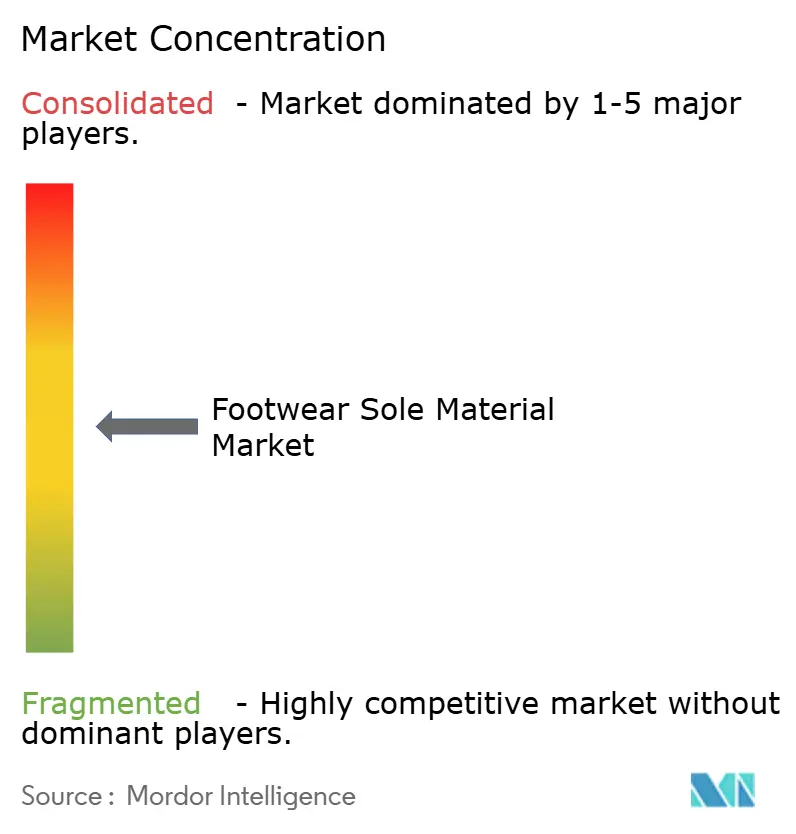
| Market Concentration | Medium |
Major Players *Disclaimer: Major Players sorted in no particular order Image © Mordor Intelligence. Reuse requires attribution under CC BY 4.0. | |
Footwear Sole Material Market Analysis by Mordor Intelligence
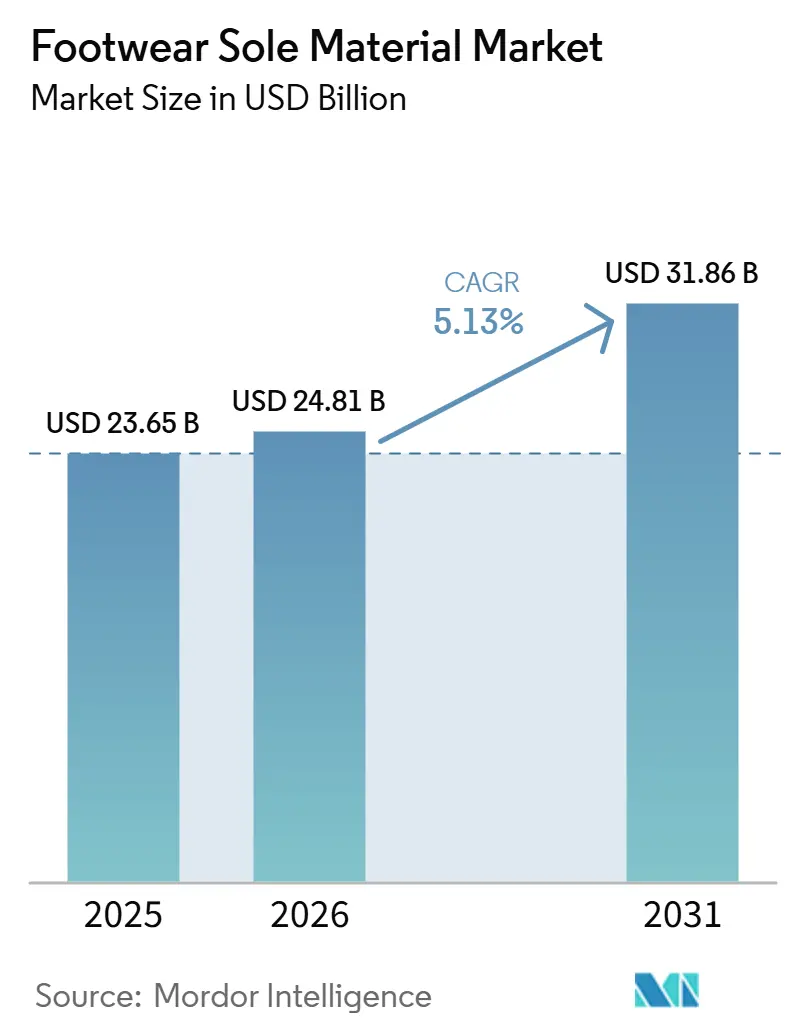
The Footwear Sole Material Market size is projected to be USD 23.65 billion in 2025, USD 24.81 billion in 2026, and reach USD 31.86 billion by 2031, growing at a CAGR of 5.13% from 2026 to 2031. Asia-Pacific supplied 88% of the world’s 23.9 billion-pair footwear output in 2024, driving demand for polyurethane, thermoplastic rubber, and ethylene-vinyl acetate compounds, and providing regional manufacturers with significant bargaining power with global brands. Polyurethane’s durability and design flexibility ensured its position as the preferred material for athletic midsoles, while automation in injection equipment reduced cycle times and improved quality, helping to sustain margins despite increasing labor costs. Additionally, bio-based polyols, recycled EVA, and 3-D printing resins are gaining momentum as brands prepare for the European Union’s Product Environmental Footprint disclosure rules and similar mandates in other regions. Petrochemical price increases in early 2026 prompted compounders to revise formulation strategies, accelerating vertical integration efforts such as Covestro’s new 120,000-tonne TPU complex in Zhuhai, China.
Key Report Takeaways
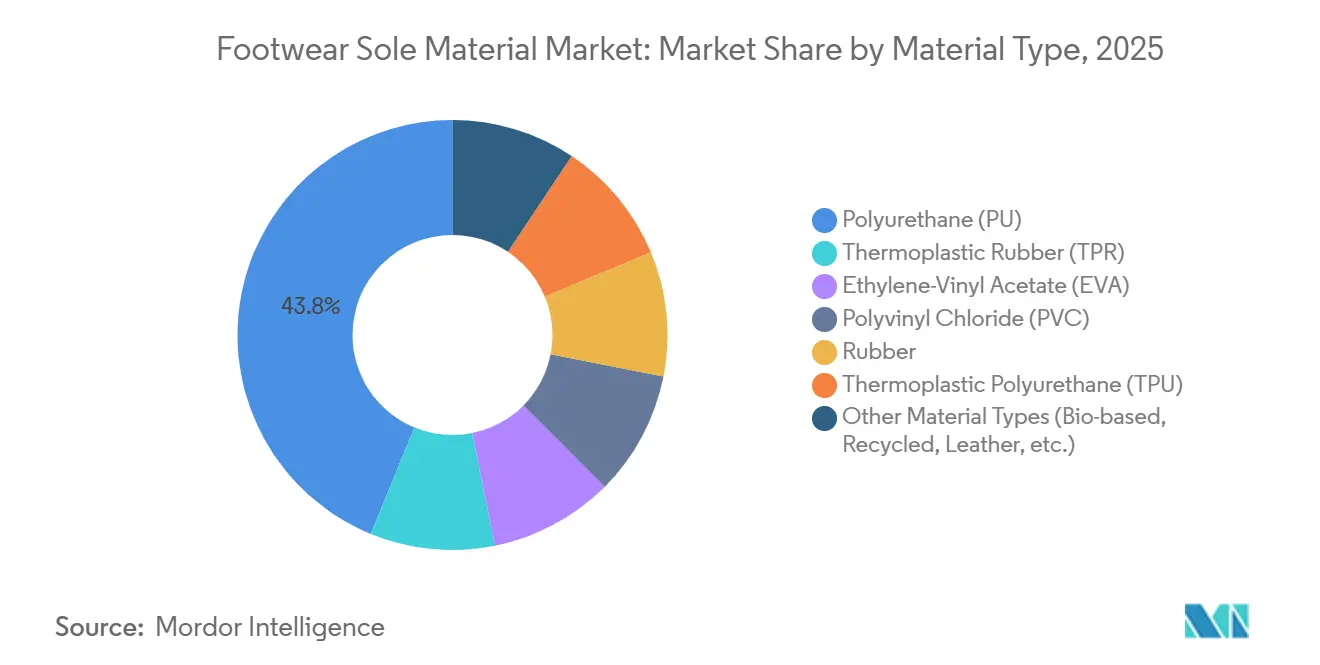
- By material type, polyurethane led with 43.80% of the footwear sole material market share in 2025, while other material types (bio-based, recycled, leather, etc.) are projected to post an 4.67% CAGR through 2031.
- By manufacturing process, injection molding accounted for 54.20% of the footwear sole material market share in 2025, while other manufacturing processes (3-D printing, etc.) are forecast to advance at a 4.96% CAGR through 2031.
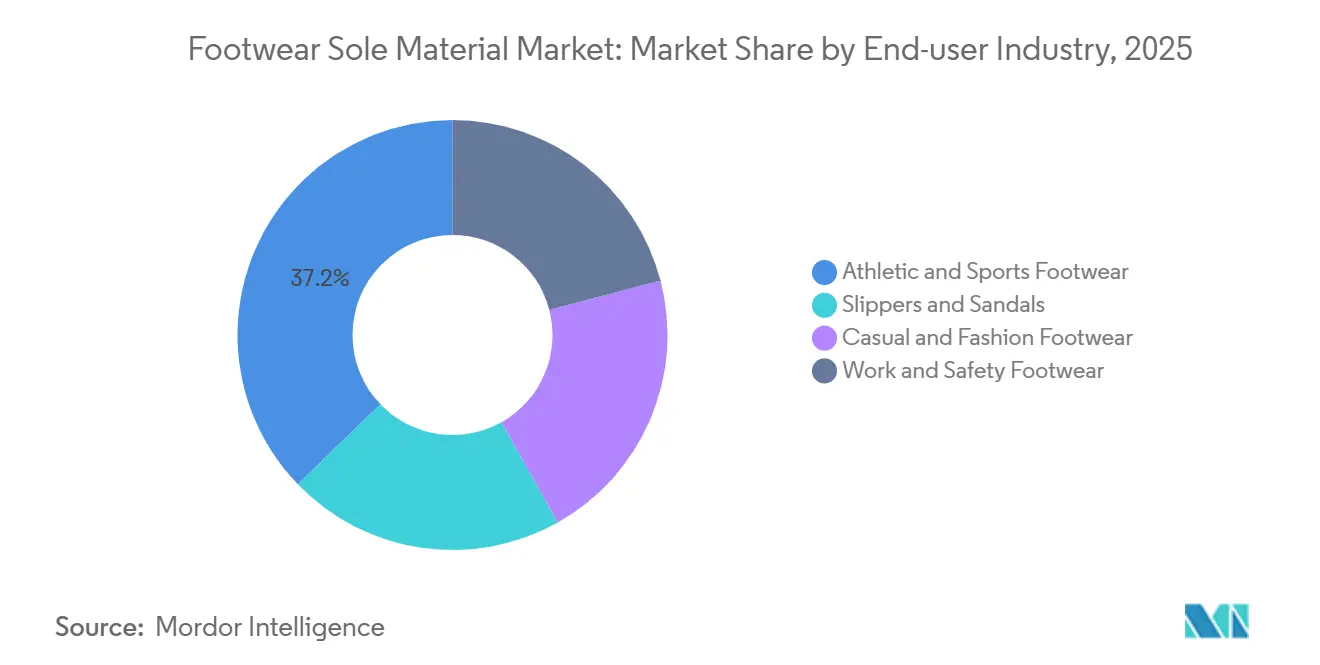
- By end-user industry, athletic and sports footwear captured 37.20% of the footwear sole material market share in 2025; slippers and sandals are expected to grow at a 5.12% CAGR through 2031.
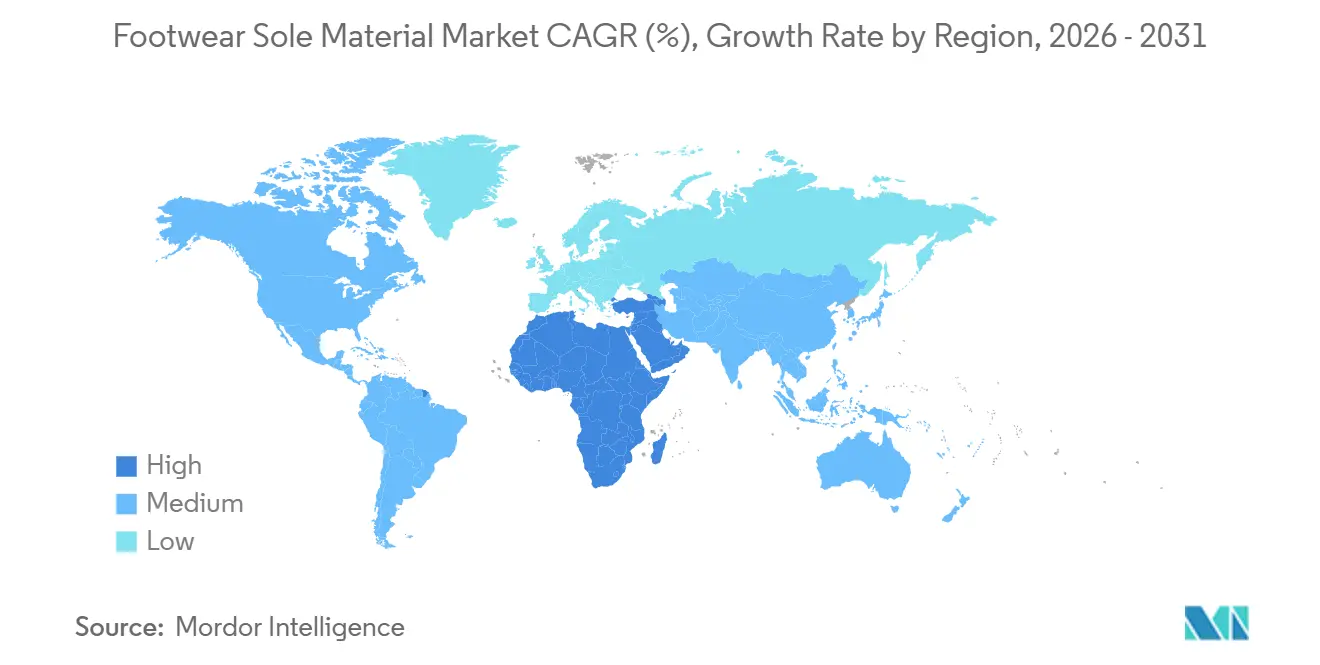
- By geography, Asia-Pacific held 40.10% of the footwear sole material market share in 2025, whereas the Middle-East and Africa region is projected to expand at a 4.87% CAGR through 2031.
Note: Market size and forecast figures in this report are generated using Mordor Intelligence’s proprietary estimation framework, updated with the latest available data and insights as of January 2026.
Market Trends and Insights
Drivers Impact Analysis of Footwear Sole Material Market*
| Driver | (~) % Impact on CAGR Forecast | Geographic Relevance | Impact Timeline |
|---|---|---|---|
| Growing global footwear output and consumption | +1.2% | Global, with APAC core driving 88% of production volume | Medium term (2-4 years) |
| Rising demand for lightweight-cushioning compounds | +0.9% | North America, Europe, APAC athletic footwear hubs | Short term (≤ 2 years) |
| Popularity uptick in sports/athletic footwear | +1.1% | Global, led by North America and APAC urban centers | Medium term (2-4 years) |
| Automated injection-moulding and digital-twin adoption | +0.6% | APAC manufacturing clusters (China, Vietnam, India) | Long term (≥ 4 years) |
| 3-D printing enabling localised sole manufacture | +0.4% | North America, Europe pilot projects; APAC scale-up | Long term (≥ 4 years) |
| Source: Mordor Intelligence | |||
Growing Global Footwear Output and Consumption
Worldwide production recovered to 23.9 billion pairs in 2024, reversing pandemic-induced declines and reflecting renewed consumer confidence across casual, athletic, and safety categories. Asia-Pacific factories in China, Vietnam, Indonesia, and India produced 88% of this volume and are now committing to minimum recycled-content thresholds in export collections, ensuring consistent demand for responsibly sourced pellets and polyols. Value-segment shoes priced below USD 250 continued to expand their market share in 2025, increasing cost pressures on compounders. Sole suppliers responded by reducing midsole gram-weights through higher-expansion foams and precision-metered molding. This production growth supports the footwear sole material market while pushing material producers toward leaner, performance-oriented formulations.
Rising Demand for Lightweight-Cushioning Compounds
Athletic brands have increased their adoption of energy-return foams. BASF’s Infinergy expanded-bead TPU provides 55% rebound, enabling marathon-shoe manufacturers to offer reduced runner fatigue. Arkema’s Pebax elastomers deliver stiffness-to-weight benefits for speed-focused racing shoes. Chinese sportswear company Li-Ning introduced nitrogen-infused TPU beads with an 82% energy return, giving domestic brands a competitive edge against global players. Concurrently, fashion trends favor ultra-thin ballerina-style sneakers, prompting polymer suppliers to maintain a wide range of density options. This diverse performance spectrum expands the addressable tonnage for the footwear sole material market while accommodating niche aesthetic preferences.
Popularity Uptick in Sports/Athletic Footwear
Sport-centric footwear styles continue to gain momentum as athleisure trends dominate workplaces and campuses. Google Trends indicates a sustained increase in searches for “eco-friendly sneakers,” highlighting the importance of environmental considerations in consumer purchasing decisions. Retro designs like Adidas Samba and New Balance 574 require gum-rubber outsoles with specific hardness properties, maintaining demand for natural and synthetic rubber blends. Collaborative projects, such as Nike x Jacquemus and Adidas x Wales Bonner, necessitate custom tread geometries and color-fast TPU compounds for limited-edition runs, driving small-batch compound orders at premium prices. These factors collectively support volume stability in the high-margin footwear sole material market segment.
Automated Injection-Molding and Digital-Twin Adoption
Servo-driven EVA injectors now reduce cycle times to 65 seconds and cut electricity consumption by 18% compared to older hydraulic systems. In 2025, Autec’s robotic polyurethane systems, deployed in Vietnamese production lines, incorporated real-time viscosity feedback to minimize scrap. Additionally, companies like Adidas and Li-Ning are leveraging digital-twin simulations to predict compressive-set fatigue before physical tooling begins, accelerating the design-to-production timeline by eight months. These technological advancements help safeguard margins in the footwear sole material industry despite petrochemical price volatility. However, the capital-intensive nature of these technologies widens the gap between tier-one manufacturers and smaller subcontractors.
Restraints Impact Analysis of Footwear Sole Material Market*
| Restraint | (~) % Impact on CAGR Forecast | Geographic Relevance | Impact Timeline |
|---|---|---|---|
| Petrochemical raw-material price volatility | -0.8% | Global, acute in regions dependent on Middle-East feedstocks | Short term (≤ 2 years) |
| Environmental scrutiny of non-biodegradable soles | -0.5% | Europe, North America; spillover to APAC export-oriented producers | Medium term (2-4 years) |
| Mechanical-performance gap in bio-based soles | -0.4% | Global, particularly affecting athletic and work-safety footwear segments | Medium term (2-4 years) |
| Source: Mordor Intelligence | |||
Petrochemical Raw-Material Price Volatility
Feedstocks such as ethylene, propylene oxide, and MDI experienced price spikes following early-2026 shipping disruptions in the Persian Gulf. Kraton raised polymer prices by USD 440-700 per tonne, LANXESS imposed surcharges of up to 50%, and Orion increased specialty carbon black prices by 25%. Footwear brands resisted passing these costs onto consumers, putting pressure on compounder margins. To address these challenges, strategies such as filler optimization, polymeric-MDI extension, and selective polyol substitution have been adopted, though these approaches risk compromising tensile strength. Covestro’s integrated Zhuhai plant helps mitigate supply chain disruptions by internalizing TPU intermediates and securing downstream customers.
Environmental Scrutiny of Non-Biodegradable Soles
The EU’s June 2025 Product Environmental Footprint rules require cradle-to-grave disclosure, prompting a shift toward recycled or bio-based content in footwear soles[1]European Commission, “Product Environmental Footprint Category Rules for Footwear,” europa.eu. Japan’s updated Eco Mark now mandates 30% recycled or plant-derived content, raising standards for exporters targeting environmentally conscious consumers. However, plant-based TPU currently lags behind petroleum-based alternatives by 10-15% in abrasion resistance, limiting its application in rugged outdoor or safety footwear. Covestro’s CQ sustainable TPU, which incorporates 25% alternative raw materials, demonstrated comparable flex-fatigue performance in lab trials, suggesting potential parity by 2027. These regulatory developments are steering the footwear sole material market toward greener solutions, even as performance requirements become more stringent.
*Our forecasts treat driver/restraint impacts as directional, not additive. The impact forecasts reflect baseline growth, mix effects, and variable interactions.
Footwear Sole Material Market Segment Analysis
By Material Type:
Polyurethane Faces Bio-Based InsurgentsPolyurethane held 43.80% of the footwear sole material market share in 2025, attributed to its adaptability in hardness, excellent abrasion resistance, and ease of color customization. Ethylene-vinyl acetate continues to be a key material for lightweight midsoles, while thermoplastic rubber is widely used in children’s and casual footwear. Natural and synthetic rubbers dominate oil-resistant work-boot outsoles. The fastest-growing category, which includes bio-based, recycled, and leather-alternative materials, is gaining traction due to initiatives like Arkema’s tripling of castor-oil-based polyamide 11 capacity in Singapore and Soleic’s launch of plant-based TPU, which reduces carbon emissions by 40% compared to traditional grades. As cost differences diminish, these materials could challenge polyurethane's dominance, altering the allocation of market share in the footwear sole material market.
The market for other material types is expected to grow at a 4.67% CAGR from 2026 to 2031, driven by the adoption of sugarcane-derived polyols and recycled EVA to meet European import regulations. However, the ability to scale feedstock availability and improve abrasion resistance will be critical for their application in high-wear segments like trail-running and industrial safety footwear.



By Manufacturing Process:
Injection Molding Leads, 3-D Printing DisruptsInjection molding accounted for 54.20% of the footwear sole material market share in 2025, owing to its high cavitation rates and flexibility in handling multiple compounds, particularly in China’s Fujian and Guangdong regions. Servo-electric presses extend mold life and reduce energy costs, offsetting the higher initial investment in machinery. Compression molding remains relevant for vulcanized rubber applications where tear resistance is prioritized over production speed. Blow molding serves niche applications, such as air-cushioned heels.
3-D printing, categorized under other processes, is projected to grow at a 4.96% CAGR through 2031. Adidas’ milestone of producing 100,000 pairs demonstrated the potential for additive manufacturing to scale from prototyping to commercial production. Innovations such as EOS TPU powders and DWS ceramic-composite resins are expanding the range of printable materials.
By End-user Industry:
Athletic Footwear Commands Revenue, Slippers ClimbAthletic and sports footwear led the market with 37.20% revenue in 2025, driven by the increasing adoption of athleisure in workplace dress codes and the growing popularity of marathons. Lightweight midsoles, carbon plates, and data-driven cushioning technologies continue to drive demand for technical compounds. Casual fashion sneakers follow closely, combining streetwear trends with comfort expectations.
Slippers and sandals are expected to grow at the fastest rate, with a 5.12% CAGR through 2031. Demand is supported by warm-climate regions and the rise of remote work, while their simpler performance requirements allow manufacturers to incorporate higher-recycled-content EVA with minimal risk.
Geography Analysis
APAC Footwear Sole Material Market
The footwear sole material market size in Asia-Pacific amounted to 40.10% of total revenue in 2025. China’s production benefits from the close integration of resin synthesis, compounding, and molding in coastal provinces. India’s Production-Linked Incentive program supports EVA and TPU capacity expansion by subsidizing machinery investments. Vietnam aims to source 25% of sole inputs from recycled ocean plastics by mid-2026 to maintain access to European markets with strict eco-label requirements. Covestro’s new TPU line in Zhuhai and BASF’s elastomer expansion in Guangzhou strengthen regional feedstock security.
EMEA Footwear Sole Material Market
The Middle-East and Africa’s footwear sole material market is projected to achieve the highest growth rate, with a 4.87% CAGR through 2031. African sneaker revenues reached USD 2.17 billion in 2024, with local brands like Bathu and Enda leveraging authentic storytelling to compete with multinational companies. However, the expiration of the African Growth and Opportunity Act in 2025 introduced U.S. tariffs of up to 32%, prompting a shift toward intra-African trade under AfCFTA and European markets.
The Americas and Europe Footwear Sole Material Market
North America and Europe emphasize sustainability and circular economy models. California’s 2025 extended-producer-responsibility proposal could require brands to fund take-back programs, increasing demand for mono-material soles that simplify recycling. The EU’s Product Environmental Footprint regulations are driving higher recycled-content thresholds, encouraging compounders to develop CQ-grade TPUs and castor-oil-based polyamides. South America remains a smaller market due to economic challenges, including currency fluctuations in Brazil and Argentina, which limit disposable income growth. However, domestic producers benefit from protective tariffs that support local manufacturing.

Competitive Landscape
The footwear sole material market hosts moderate fragmentation. Global chemical companies such as BASF, Covestro, Dow, and Huntsman hold significant shares in polyurethane and TPU production. BASF introduced Elastollan GripTec in March 2026, enhancing wet traction by 18% for trail-running soles. Covestro’s integrated Zhuhai hub strengthens feedstock supply for Asia-Pacific’s athletic footwear market[2]“Zhuhai TPU Plant Commissioning,” Covestro, covestro.com. Huntsman reported USD 3.7 billion in polyurethane sales in 2025, reflecting its broad geographic presence.
Regional polymer producers, including Wanhua Chemical, LG Chem, and Mitsui Chemicals, supply EVA and TPR to manufacturers in China and Japan. Niche players like OrthoLite, Vibram, and Trelleborg differentiate themselves with specialized products such as cushioning insoles, high-grip rubber sheets, and oil-resistant outsoles. Emerging companies like Soleic focus on plant-based TPU, while Carbon and EOS are advancing digital fabrication for midsoles. Material price volatility intensifies competition, with suppliers investing in feedstock integration, automation, and low-carbon R&D gaining a competitive edge, while those reliant on volatile petrochemical markets risk losing market share.
Footwear Sole Material Industry Leaders
BASF
Dow
LG Chem
Covestro AG
Huntsman International LLC
- *Disclaimer: Major Players sorted in no particular order
Footwear Sole Material Market Companies Covered in this Report
- Arkema
- Asahi Kasei Corp.
- BASF
- Celanese Corporation
- Coim Group
- Covestro AG
- Dow
- Evonik Industries AG
- Hexpol
- Huntsman International LLC
- KURARAY CO., LTD.
- LG Chem
- Lubrizol
- Mitsui Chemicals
- OrthoLite
- Solvay
- Teknor Apex
- Trelleborg AB
- Vibram Corporation
- Wanhua Chemical

Recent Industry Developments in Footwear Sole Material Market
- March 2026: BASF unveiled the Elastollan GripTec TPU series at CHINAPLAS 2026 in Shanghai. This portfolio of thermoplastic polyurethane (TPU) was specifically developed to improve traction in the sports footwear industry, with three distinct grades designed for running, hiking, and lifestyle footwear.
- January 2026: Covestro AG began production at its new 45,000-square-meter Thermoplastic Polyurethane (TPU) plant in Zhuhai, South China. The facility, designed to be the company's largest global site, initially produced 30,000 tons annually (Phase 1) and planned to expand to 120,000 tons by the 2030s to serve the high-growth Asia-Pacific markets.


Global Footwear Sole Material Market Report Scope
Footwear sole materials are specialized substances, either natural or synthetic, that form the bottom structure of shoes. These materials are designed to offer traction, shock absorption, durability, and support. Commonly used materials include rubber (durable and provides grip), EVA (lightweight and cushioning), polyurethane (PU) (durable and firm), TPR (flexible and durable), and leather (breathable and luxurious).
The Footwear Sole Material Market is segmented by material type, manufacturing process, and geography. By material type, the market is segmented into polyurethane (PU), thermoplastic rubber (TPR), ethylene-vinyl acetate (EVA), polyvinyl chloride (PVC), rubber, thermoplastic polyurethane (TPU), and other material types (bio-based, recycled, leather, etc.). By manufacturing process, the market is segmented into injection moulding, compression moulding, blow moulding, and other manufacturing processes (3-D printing, etc.). By end-user industry, the market is segmented into athletic and sports footwear, casual and fashion footwear, work and safety footwear, and slippers and sandals. The report also covers the market size and forecasts for footwear sole material in 17 countries across major regions. For each segment, the market sizing and forecasts have been done on the basis of value (USD).
| Polyurethane (PU) |
| Thermoplastic Rubber (TPR) |
| Ethylene-Vinyl Acetate (EVA) |
| Polyvinyl Chloride (PVC) |
| Rubber |
| Thermoplastic Polyurethane (TPU) |
| Other Material Types (Bio-based, Recycled, Leather, etc.) |
| Injection Moulding |
| Compression Moulding |
| Blow Moulding |
| Other Manufacturing Processes (3-D Printing, etc.) |
| Athletic and Sports Footwear |
| Casual and Fashion Footwear |
| Work and Safety Footwear |
| Slippers and Sandals |
| Asia-Pacific | China |
| Japan | |
| India | |
| South Korea | |
| ASEAN Countries | |
| Rest of Asia-Pacific | |
| North America | United States |
| Canada | |
| Mexico | |
| Europe | Germany |
| United Kingdom | |
| France | |
| Italy | |
| Spain | |
| Russia | |
| NORDIC Countries | |
| Rest of Europe | |
| South America | Brazil |
| Argentina | |
| Rest of South America | |
| Middle-East and Africa | Saudi Arabia |
| South Africa | |
| Rest of Middle-East and Africa |
| By Material Type | Polyurethane (PU) | |
| Thermoplastic Rubber (TPR) | ||
| Ethylene-Vinyl Acetate (EVA) | ||
| Polyvinyl Chloride (PVC) | ||
| Rubber | ||
| Thermoplastic Polyurethane (TPU) | ||
| Other Material Types (Bio-based, Recycled, Leather, etc.) | ||
| By Manufacturing Process | Injection Moulding | |
| Compression Moulding | ||
| Blow Moulding | ||
| Other Manufacturing Processes (3-D Printing, etc.) | ||
| By End-user Industry | Athletic and Sports Footwear | |
| Casual and Fashion Footwear | ||
| Work and Safety Footwear | ||
| Slippers and Sandals | ||
| By Geography | Asia-Pacific | China |
| Japan | ||
| India | ||
| South Korea | ||
| ASEAN Countries | ||
| Rest of Asia-Pacific | ||
| North America | United States | |
| Canada | ||
| Mexico | ||
| Europe | Germany | |
| United Kingdom | ||
| France | ||
| Italy | ||
| Spain | ||
| Russia | ||
| NORDIC Countries | ||
| Rest of Europe | ||
| South America | Brazil | |
| Argentina | ||
| Rest of South America | ||
| Middle-East and Africa | Saudi Arabia | |
| South Africa | ||
| Rest of Middle-East and Africa | ||


Key Questions Answered in the Report
What is the size of the footwear sole material market?
The footwear sole material market stands at USD 24.81 billion in 2026 and is projected to reach USD 31.86 billion by 2031.
Which material type dominates revenue in 2025?
Polyurethane leads, capturing 43.80% revenue in 2025 thanks to its balance of cushioning, abrasion resistance, and design freedom.
What is the fastest-growing manufacturing process through 2031?
Other manufacturing processes (3-D Printing, etc.) are forecast to grow at 4.96% CAGR through 2031 as brands adopt lattice midsoles for performance running shoes.
How are regulations shaping material choices?
The EU’s Product Environmental Footprint rules and Japanese Eco Mark updates push brands to adopt recycled or bio-based soles, accelerating R&D into plant-derived TPU and castor-oil polyamides.
Page last updated on:





