
Flight Inspection Market Size and Share
Market Overview
| Study Period | 2019 - 2031 |
|---|---|
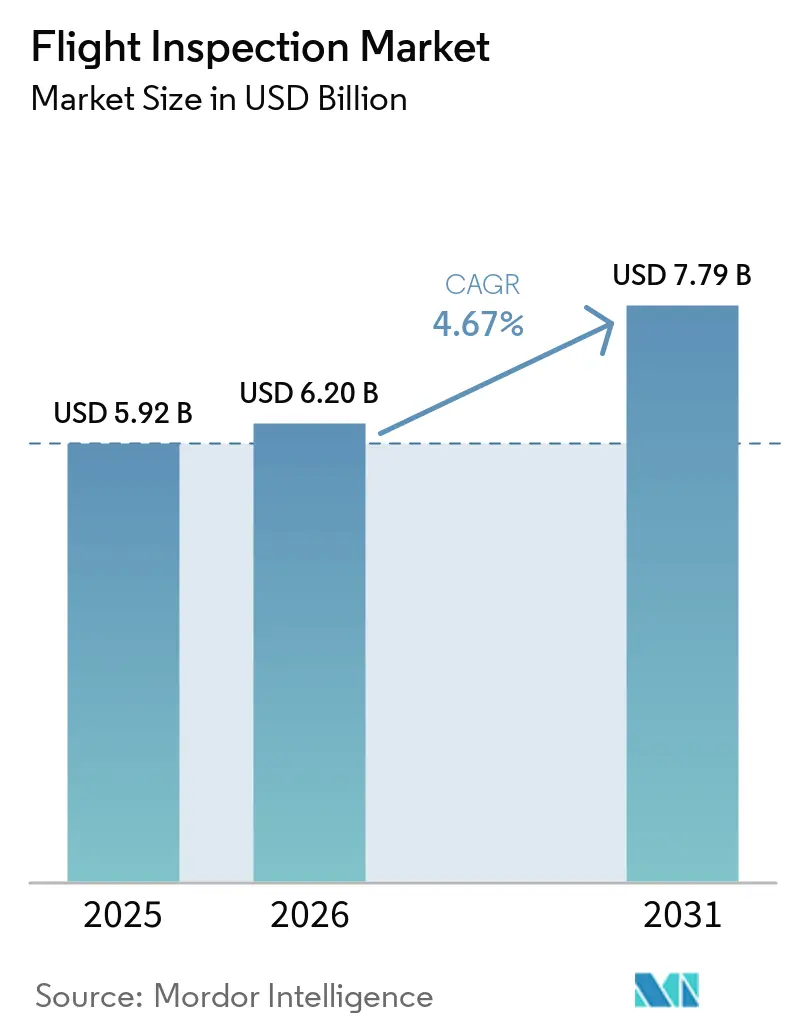
| Market Size (2026) | USD 6.20 Billion |
| Market Size (2031) | USD 7.79 Billion |
| Growth Rate (2026 - 2031) | 4.67 % |
| Fastest Growing Market | Asia Pacific |
| Largest Market | North America |
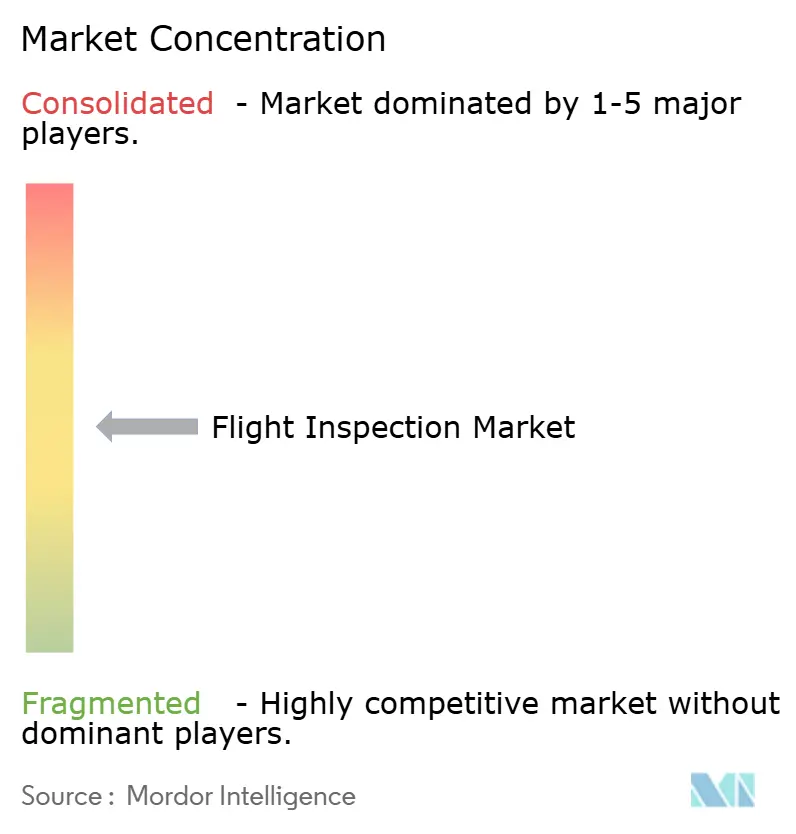
| Market Concentration | Medium |
Major Players *Disclaimer: Major Players sorted in no particular order Image © Mordor Intelligence. Reuse requires attribution under CC BY 4.0. | |
Flight Inspection Market Analysis by Mordor Intelligence
The flight inspection market size was valued at USD 5.92 billion in 2025 and estimated to grow from USD 6.20 billion in 2026 to reach USD 7.79 billion by 2031, at a CAGR of 4.67% during the forecast period. The flight inspection market is supported by the recurring requirement to validate navigation aids and instrument procedures before they enter service and at scheduled intervals afterward. Digital CNS/ATM upgrades add inspection needs for new equipment, while older ILS, VOR, and DME assets remain important backup systems where satellite navigation is unreliable. Operators are balancing owned aircraft fleets with outsourced capacity, especially when special inspections or temporary demand exceed internal resources. Contract decisions increasingly reflect the value of anti-jamming capability, data integration, and certified mission capacity. The flight inspection market also benefits when airport expansion, PBN implementation, and navigation modernization occur simultaneously.
Key Report Takeaways
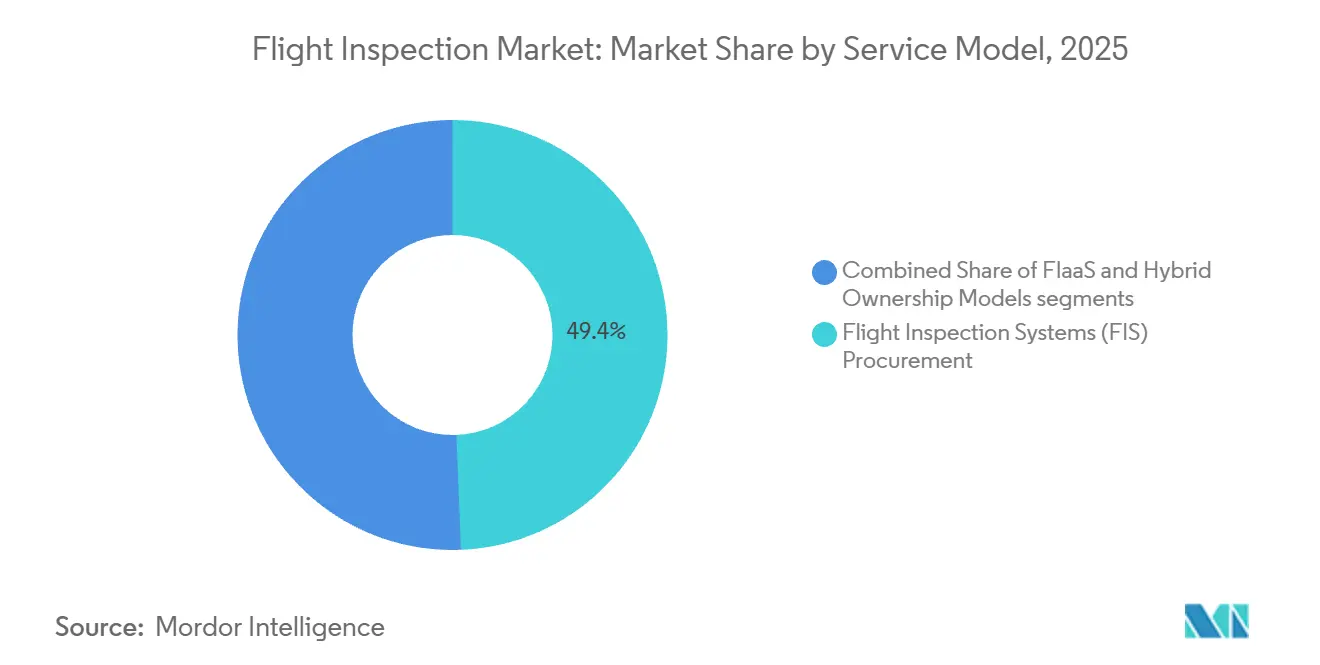
- By service model, flight inspection systems procurement held 49.37% of the segment share in 2025, while flight inspection as-a-service recorded the highest projected CAGR at 6.55% through 2031.
- By platform type, fixed-wing aircraft held 72.71% of the segment share in 2025, while rotary-wing aircraft recorded the highest projected CAGR at 5.89% through 2031.
- By system architecture, on-board integrated systems held 59.21% of the segment share in 2025, while portable/roll-on-roll-off systems recorded the highest projected CAGR at 5.27% through 2031.
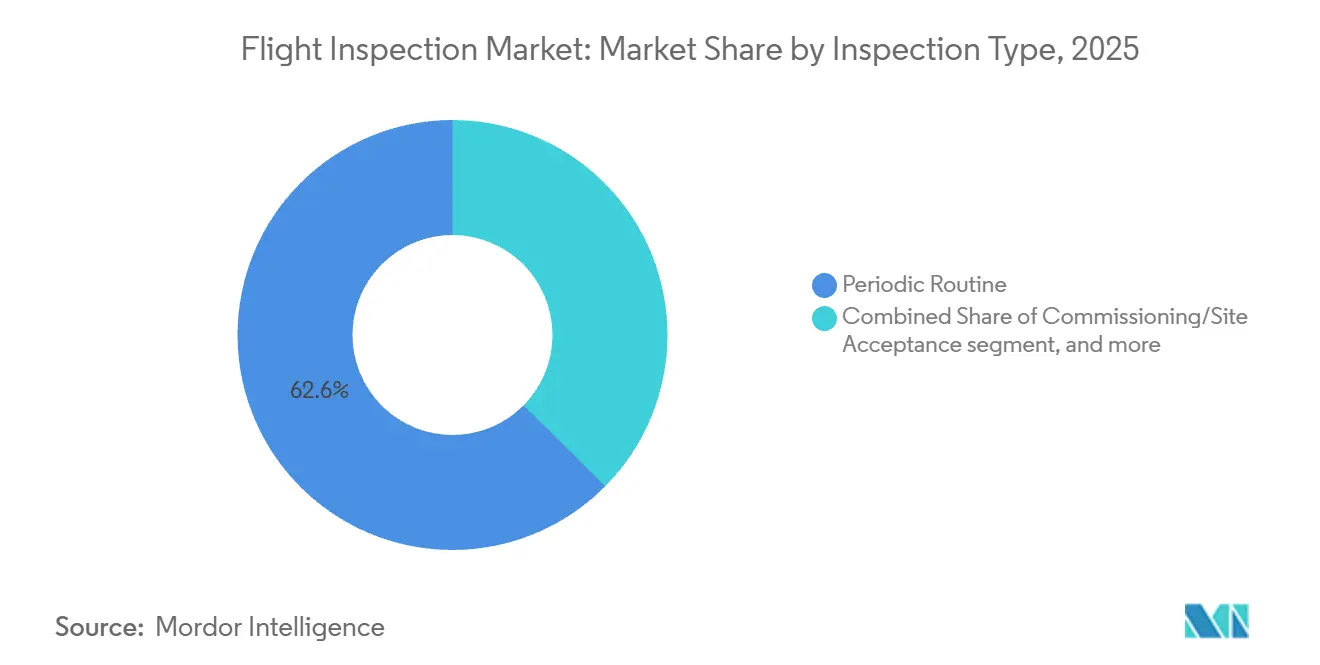
- By inspection type, periodic routine inspections held 62.59% of the segment share in 2025, while special and emergency inspections recorded the highest projected CAGR at 6.11% through 2031.
- By end user, ANSPs held 44.72% of the segment share in 2025, while private and business aviation recorded the highest projected CAGR at 5.88% through 2031.
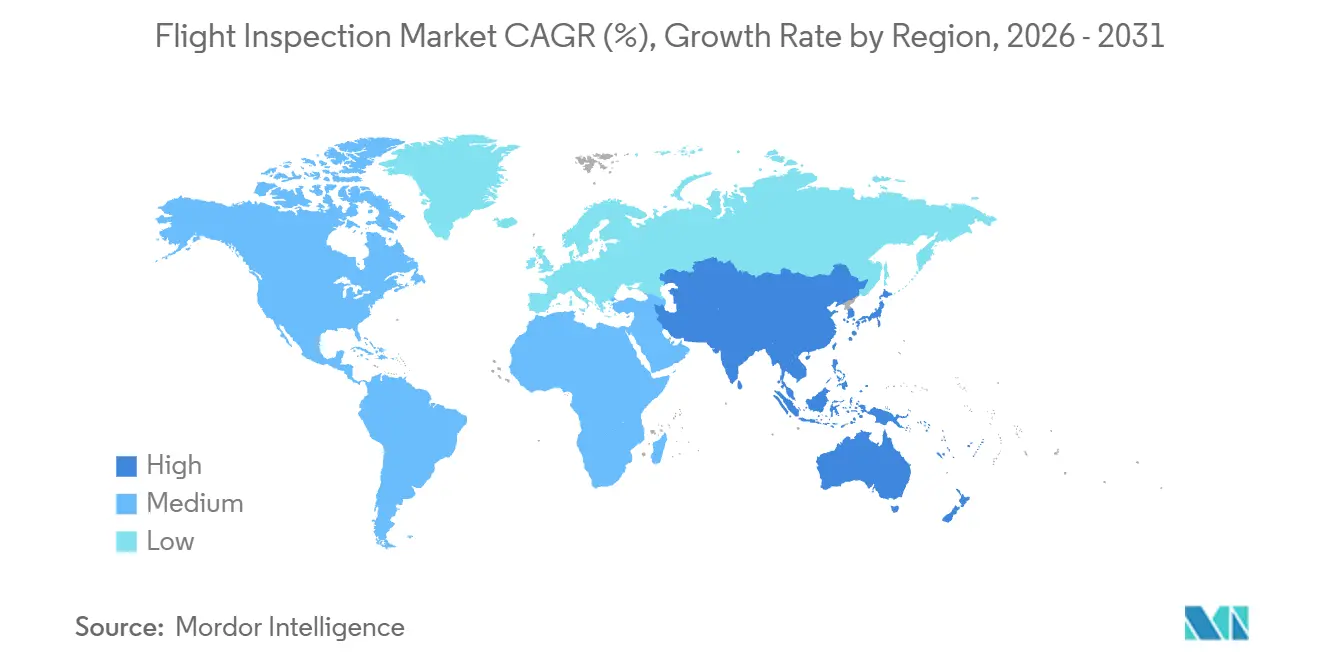
- By geography, North America held 30.13% of the segment share in 2025, while Asia-Pacific recorded the highest projected CAGR at 7.12% through 2031.
Note: Market size and forecast figures in this report are generated using Mordor Intelligence’s proprietary estimation framework, updated with the latest available data and insights as of January 2026.
Market Trends and Insights
Drivers Impact Analysis of Flight Inspection Market*
| Driver | (~) % Impact on CAGR Forecast | Geographic Relevance | Impact Timeline |
|---|---|---|---|
| Digitalization of CNS/ATM infrastructure | +1.0% | Global, with highest intensity in North America, Europe, and Asia-Pacific core | Medium term (2-4 years) |
| Surge in Performance-Based Navigation (PBN) implementations | +0.9% | Asia-Pacific core, with spillover to the Middle East, Africa, and South America | Medium term (2-4 years) |
| Adoption of cloud-connected flight-inspection analytics | +0.8% | North America and Northern Europe, expanding into Asia-Pacific | Medium term (2-4 years) |
| Fleet renewal toward next-generation turboprop fixed-wing calibration aircraft | +0.7% | Global, with early adoption in Europe and North America | Medium term (2-4 years) |
| Global runway-capacity optimization mandates | +0.6% | North America and Europe, with emerging demand in Gulf states | Short term (≤ 2 years) |
| Space-based ADS-B verification demand | +0.5% | Global, with the greatest relevance in oceanic and remote airspace | Long term (≥ 4 years) |
| Source: Mordor Intelligence | |||
Digitalization of CNS/ATM Infrastructure
Digital CNS/ATM investment broadens the scope of missions in the flight inspection market, as each new navigation or surveillance asset must be validated before operational use. GBAS installations, digital VOR equipment, and ADS-B ground stations introduce additional commissioning requirements beyond established periodic checks. Japan’s JCAB placed its GBAS at Haneda Airport into full operations in January 2025, representing Japan’s first CAT-I capable GBAS and requiring flight validation under the applicable procedure.[1]Source: Electronic Navigation Research Institute, “GBAS Implementation in Japan,” ENRI Seminar, enri.go.jp The same transition leaves many existing ground aids in place rather than replacing the inspection requirements for them. This overlap widens the work available to certified operators and system suppliers. The flight inspection market, therefore, gains from both installed-base maintenance and new digital infrastructure.
Surge in Performance-Based Navigation Implementations
PBN implementation drives demand in the flight inspection market, as new instrument procedures require acceptance checks before commercial activation. ICAO’s PBNICG/12 meeting in Beijing in December 2025 reaffirmed regional deployment activity.[2]International Civil Aviation Organization, “Final Report of the Twelfth Meeting of the Performance Based Navigation Implementation Coordination Group,” ICAO, icao.int Vietnam reported new RNP procedures at Tan Son Nhat and Long Thanh airports during the same period. These projects create work at commissioning and later during periodic review. ICAO also reported that the AFI region accounted for 50% of global Safety Significant Concerns, making reliable validation particularly important where procedures are being expanded. The flight inspection market is consequently linked to the quality and pace of procedure implementation as well as airport construction.
Adoption of Cloud-Connected Flight-Inspection Analytics
Cloud-connected systems shorten the time between data capture and technical review in the flight inspection market. Aerodata completed factory acceptance of two AeroFIS systems for NAV CANADA in January 2026, with direct data exchange between the aircraft and operations base included in the system design. This arrangement can reduce manual transfers after a mission and help operators retain a consistent record of calibration results. The accumulated data can also support monitoring of the navaid signal quality over time. Once data processes are embedded in an ANSP’s operational workflow, changing suppliers becomes more difficult. The flight inspection market may therefore favor providers that combine certified equipment, data handling, and ongoing support.
Space-Based ADS-B Verification Demand
Space-based ADS-B creates a new verification requirement for the flight inspection market as surveillance coverage extends beyond conventional terrestrial networks. Aireon’s VECTOR product uses satellite-based ADS-B data to establish aircraft tracks that are independent of onboard GPS for GNSS anomaly identification. The European Commission’s SATERA project is developing a combined ADS-B and space-based multilateration integrity estimator. The relevant performance and validation processes remain under development. Suppliers that participate in these processes can position their systems for later verification work. The flight inspection market has an opportunity to extend established integrity testing methods to remote and oceanic airspace.
Restraints Impact Analysis of Flight Inspection Market*
| Restraint | (~) % Impact on CAGR Forecast | Geographic Relevance | Impact Timeline |
|---|---|---|---|
| High acquisition and operating cost of specialised aircraft | -0.7% | Global, most acute for emerging-market ANSPs in South America and Africa | Long term (≥ 4 years) |
| Skilled-crew shortage for dual-pilot/dual-engine missions | -0.4% | Global, with the greatest pressure in Asia-Pacific and Middle East growth corridors | Medium term (2-4 years) |
| Spectrum-congestion interference in GNSS flight checks | -0.8% | Middle East, Eastern Europe, Baltic, Arctic, with global spillover | Medium term (2-4 years) |
| Limited operational endurance of rotary-wing aircraft on long-range inspection routes | -0.3% | Remote and mountainous areas, including Asia-Pacific islands and Sub-Saharan Africa | Medium term (2-4 years) |
| Source: Mordor Intelligence | |||
High Acquisition and Operating Cost of Specialized Aircraft
A dedicated inspection aircraft requires an airframe, an installed inspection system, certification, crew preparation, and continuing maintenance. These needs can delay procurement and make it difficult for smaller ANSPs to fund owned fleets. The constraint supports FIaaS demand because authorities can purchase missions without carrying the full initial investment. ICAO airworthiness requirements and national certification rules add continuing obligations after purchase. The effect is stronger in countries with limited aviation budgets and irregular mission volumes. The flight inspection market thus retains a barrier to new fleet operators while creating space for certified service providers.
Spectrum-Congestion Interference in GNSS Flight Checks
GNSS jamming and spoofing can compromise measurements used during satellite-based inspection activities. EASA identified active GNSS interference across multiple Flight Information Regions during the 30 days. The FAA has also described the spread of GPS disruptions as a civil aviation safety concern.[3]Source: Federal Aviation Administration, “SAFO 24002 GPS/GNSS Jamming and Spoofing,” FAA, faa.gov Operators may need to repeat flights, reject affected data, or modify aircraft with anti-jamming equipment. These measures raise operating costs even when they do not create matching revenue. The flight inspection market must therefore treat interference resilience as an operational requirement rather than an optional feature.
*Our forecasts treat driver/restraint impacts as directional, not additive. The impact forecasts reflect baseline growth, mix effects, and variable interactions.
Flight Inspection Market Segment Analysis
By Service Model:
FIaaS Growth Challenges Incumbent Ownership ModelsFIS procurement accounted for 49.37% of the service model segment in 2025. Large, state-funded ANSPs often retain fleets because they need direct control of safety-critical assets and schedules. Their internal teams can allocate aircraft across routine, commissioning, and contingency missions. That structure also preserves operational knowledge within the authority. FIaaS is forecast to grow at a 6.55% CAGR through 2031. Smaller airport authorities and developing-market regulators can use external capacity when fleet ownership would impose fixed costs beyond their budgets. Demand for FIaaS is supported by the need to meet inspection obligations without committing capital to specialized aircraft. Providers with certified crews and aircraft can also provide temporary capacity when their owned fleets are unavailable. The model is especially relevant when mission volumes are too low to support a dedicated aircraft and full-time crew. It also allows the customer to align the contract period with a construction program, procedure rollout, or temporary capacity gap.
Hybrid ownership arrangements sit between fully owned fleets and fully outsourced service contracts. In these models, a specialist can own the aircraft while an ANSP contributes scheduling, data management, or operational oversight. The flight inspection market is moving toward a tiered service structure in which large ANSPs maintain core fleet capacity and purchase external support for exceptional demand. FIaaS providers benefit when they can perform routine work and respond quickly to emergency requirements. Procurement decisions will continue to depend on certification coverage, fleet availability, and the operator’s ability to handle sensitive data. The flight inspection industry is therefore likely to retain both ownership and managed-service models.


By Platform Type:
Fixed-Wing Dominance Sustained by Endurance AdvantagesFixed-wing aircraft accounted for 72.71% of the platform segment in 2025. Their endurance allows operators to complete long en route surveys and inspect several facilities during a single mission. Their payload capacity also accommodates installed sensor systems and associated technical equipment. Established certification routes reinforce their continued role in high-precision work. Rotary-wing aircraft are forecast to grow at a CAGR of 5.89% through 2031, as they can serve sites where runway access, terrain, or local airspace constraints limit the practical use of fixed-wing aircraft. Demand for fixed-wing platforms remains tied to national networks that require broad route coverage. Fixed-wing systems also remain relevant for missions that require a stable, repeatable measurement platform. They can also support a planned sequence of checks across distant locations without multiple aircraft handovers. This operating range helps operators protect schedule reliability when weather or airport access changes during a mission.
New turboprop and business-jet platforms are renewing the aircraft base used by inspection operators. The shift includes King Air 360, CJ4, and Praetor 600 platforms, which can be integrated with specialized systems. EASA’s June 2026 update to its unmanned aircraft rules incorporated the SORA 2.5 package, providing a clearer compliance route for some UAS tasks. UAS tools can pre-calibrate selected assets while manned aircraft complete final validation. This combination can improve planning without removing the need for certified flight inspection aircraft. The flight inspection industry is therefore adding unmanned tools around, rather than in place of, core fixed-wing missions.
By System Architecture:
On-Board Integration Anchors Precision, Portability Gains TractionOn-board integrated systems accounted for 59.21% of the system architecture segment in 2025. These systems are used where ILS, GBAS, and precision approach validation require stable positioning and a certified sensor arrangement. Integration can also reduce variation between missions by keeping the equipment in a consistent aircraft configuration. Larger ANSPs often prefer this approach for regularly scheduled national programs. Portable and RORO systems are forecast to grow at a 5.27% CAGR through 2031. The system's modular design allows an operator to use one certified suite across several compatible airframes. Demand for portable systems is driven by operators who need flexibility across contracted missions and aircraft types. The architecture also gives providers a practical option when aircraft availability changes during a contract. Its main value lies not only in lower asset commitment but also in the ability to move certified capability between suitable platforms.
Modular systems can reduce the need to dedicate a single aircraft to every inspection role. These systems also enable providers to align cockpit layouts and technical workflows with customer requirements. Safran's CARNAC system was integrated by Bromma Air Maintenance into a Beechcraft Super King Air 200C and presented at IFIS 2026. Ground-based reference systems retain a more limited but useful role in pre-calibration and interference detection. The flight inspection market is moving toward software-defined and modular architectures, but integrated systems remain central to the highest-assurance missions. Hardware-focused suppliers may face pressure where customers demand greater portability and data interoperability.
By Inspection Type:
Routine Contracts Stabilize Revenue While Emergency Demand SurgesPeriodic routine inspections accounted for 62.59% of inspection activity in 2025. Multi-year agreements linked to mandated reinspection intervals provide predictable work for certified service providers. This recurring schedule reduces the effect of uneven airport commissioning cycles. It also helps operators plan crew use and aircraft maintenance. Special and emergency inspections are forecast to grow at a 6.11% CAGR through 2031. GNSS disruption in busy Flight Information Regions can require unscheduled checks of navigation signal integrity. Demand for emergency missions is also supported by the need to validate systems after unusual operational events. A provider with reserve capacity can meet these requests without diverting resources from its routine commitments. That balance is important because a delayed emergency check can affect the availability of an approach procedure or navigation facility.
Routine contracts remain central because navigation aids must be assessed over their operating life. Commissioning and site acceptance work is limited but can expand rapidly when airports, runways, or instrument procedures are added. A new facility may create a continuing requirement for routine inspections after initial acceptance. The flight inspection market rewards firms that can mobilize on short notice without disrupting contracted routine work. Emergency activity adds operational complexity because aircraft, crews, and technical approvals must be available quickly. The flight inspection industry, therefore, depends on both planned program management and flexible reserve capacity.
By End User:
ANSPs Lead but Private Aviation Signals a Structural ShiftANSPs accounted for 44.72% of the end-user segment in 2025 and are directly responsible for national airspace safety, often managing portfolios spanning many aerodromes and navigation aids. Its requirements include scheduled calibration, procedure validation, and response to equipment changes. Purchasing decisions tend to prioritize certification, availability, and operational continuity. Private and business aviation is forecast to grow at a 5.88% CAGR through 2031. New general aviation facilities in India’s UDAN network and expanding Gulf FBO activity can require commissioning support. ANSP demand remains the largest because national networks contain a broad installed base of regulated infrastructure. This group also has a continuing need to coordinate inspections with air traffic operations, airport availability, and safety oversight. These requirements can favor providers that understand both technical measurement and the operational constraints of a live airspace environment.
Airport operators represent another important user group because construction and expansion projects trigger commissioning work. Military aviation authorities provide a stable demand, although procurement details are often less visible. Private operators generally operate under more flexible service arrangements than national ANSPs. For airport operators, the timing of a mission is closely tied to the opening of a runway, a new approach, or a change to navigation equipment. For private facilities, access to a provider with suitable approvals can be more important than maintaining a permanent internal inspection capability.
Geography Analysis
North America Flight Inspection Market
North America held 30.13% of the flight inspection market in 2025. The region has a large base of instrument airports, recurring FAA-related validation needs, and parallel defense requirements. NextGen activity adds commissioning work for GBAS, ADS-B, datalink, and other CNS upgrades. NAV CANADA completed factory acceptance of two AeroFIS systems for King Air 360 aircraft in January 2026, with aircraft delivery scheduled for the end of 2027. This investment shows an ongoing modernization cycle in Canada.
APAC Flight Inspection Market
Asia-Pacific is forecast to grow at a 7.12% CAGR through 2031. India approved Modified UDAN 2.0 in March 2026 with an INR 288.80 billion outlay (equivalent to USD 3.40 billion) for 100 new airports over 10 years.[4]Prime Minister of India, “Cabinet Approves Regional Connectivity Scheme Modified UDAN,” Prime Minister of India, pmindia.gov.in These sites can create commissioning demand where inspection history is limited or absent. Japan combines mature technical capability with new UAS-based work and active GNSS correction-data procurement. China’s aviation plans continue to support airport construction and navigation-aid upgrades.
EMEA and South America Flight Inspection Market
Europe retains demand through SESAR-related modernization and EASA oversight of instrument procedures. EASA and EUROCONTROL issued a European action plan on GNSS radio-frequency interference in March 2026, reinforcing the importance of ILS, VOR, and DME as navigation backups. This supports continuing calibration of ground-based aids even as satellite navigation expands. The Middle East combines large airport projects with a high level of exposure to GNSS interference. African countries are progressing with navigation modernization under ICAO regional frameworks, while Brazil supports South American demand through continuing CNS development. The combination of new infrastructure, resilience needs, and differing procurement capacity shapes the flight inspection market across these regions.

Competitive Landscape
The flight inspection market is moderately fragmented in systems integration but more concentrated in certified operational capacity. Aerodata AG, Norwegian Special Mission, Safran, Bombardier Inc., and Textron Inc. have broad technical and geographic capabilities. Aerodata has supplied systems to NAV CANADA and advanced drone-based work with JCAB through NEC Corporation, combining AeroFIS software with selected airframes and local partners. Norwegian Special Mission offers UNIFIS 3000-G2 for FANS, ADS-C, GBAS, and ADS-B calibration, while Safran’s CARNAC serves operators seeking modular equipment for existing aircraft. Customers can choose among equipment suppliers, aircraft integrators, and managed-service providers.
An opening remains for a managed service combining global mission capacity with continuous cloud analytics. The supplied material does not describe any provider offering this complete model on a broad international scale. Such a service would benefit ANSPs needing external capacity and calibration data integration with airspace performance tools, while supporting long-term data retention and signal-trend monitoring. The market is likely to see more partnerships among system suppliers, operators, and regional aviation organizations, extending supplier involvement beyond aircraft delivery to maintenance, data support, and upgrades. Competition will remain active due to local certification, fleet access, and credibility in technical support. The flight inspection industry has a concentration score of 5 because fewer than 5 providers have broad, multi-continent capability. Still, the supplied material does not establish that the top 5 providers hold 60% or more of total revenue.
Flight Inspection Industry Leaders
Aerodata AG
Norwegian Special Mission AS
Textron Inc.
Bombardier Inc.
Safran S.A.
- *Disclaimer: Major Players sorted in no particular order
Flight Inspection Market Companies Covered in this Report
- Aerodata AG
- Textron Inc.
- Norwegian Special Mission AS
- Safran S.A.
- Bombardier Inc.
- Thales Group
- Flight Calibration Services Limited
- Embraer S.A.
- Lufthansa Technik AG
- SGI Aviation Services B.V.
- Flight Precision Ltd.
- Samana Special Mission
- ENAV S.p.A.
- International Flight Services Association

Recent Industry Developments in Flight Inspection Market
- May 2026: Aerodata AG, in collaboration with its partner, Japan Aerospace Corporation, and acting as a subcontractor to NEC Corporation, is delivering a flight inspection drone to the Japan Civil Aviation Bureau. The unmanned aircraft system will be used to inspect and calibrate instrument landing systems (ILS) and precision approach path indicators (PAPI).
- June 2025: Thales Group and Qatar Airways agreed to establish an IFE maintenance hub in Doha, signaling closer cooperation that could extend to regional flight inspection support for the airline’s airport projects.
- May 2025: BAM clinched several contracts for flight inspection services spanning Denmark, Norway, and Sweden. Its flight inspection team is set to calibrate navigational aids and approach systems at airports throughout the Nordic region.
- January 2025: Embraer SA and Turkish Aerospace signed a memorandum to explore E2 jet production in Türkiye, potentially expanding regional special-mission modification capacity.


Global Flight Inspection Market Report Scope
Flight inspection involves testing and evaluating ground-based and satellite-based air navigation aids, radar systems, and flight procedures from the air. Operators use specially equipped aircraft to ensure that signals remain safe, accurate, and reliable.
The flight inspection market is segmented by service model, platform type, system architecture, inspection type, end user, and geography. By service model, the market is segmented into flight inspection systems (FIS) procurement, flight inspection as-a-service (FIaaS), and hybrid ownership models. By platform type, the market is segmented into fixed-wing aircraft and rotary-wing aircraft. By system architecture, the market is segmented into on-board integrated systems, portable/roll-on roll-off systems, and ground-based reference systems. By inspection type, the market is segmented into commissioning/site acceptance, periodic routine, and special/emergency. By end user, the market is segmented into air navigation service providers (ANSPs), airport operators, military aviation authorities, and private/business aviation. The report also covers the market sizes and forecasts for the flight inspection market in major countries across different regions. For each segment, the market size is provided in terms of value (USD).
| Flight Inspection Systems (FIS) Procurement |
| Flight Inspection as-a-Service (FIaaS) |
| Hybrid Ownership Models |
| Fixed-Wing Aircraft |
| Rotary-Wing Aircraft |
| Onboard Integrated Systems |
| Portable/Roll-On Roll-Off Systems |
| Ground-Based Reference Systems |
| Commissioning/Site Acceptance |
| Periodic Routine |
| Special/Emergency |
| Air Navigation Service Providers (ANSPs) |
| Airport Operators |
| Military Aviation Authorities |
| Private/Business Aviation |
| North America | United States | |
| Canada | ||
| Mexico | ||
| Europe | United Kingdom | |
| France | ||
| Germany | ||
| Italy | ||
| Spain | ||
| Rest of Europe | ||
| Asia-Pacific | China | |
| Japan | ||
| India | ||
| South Korea | ||
| Australia | ||
| Rest of Asia-Pacific | ||
| South America | Brazil | |
| Rest of South America | ||
| Middle East and Africa | Middle East | United Arab Emirates |
| Saudi Arabia | ||
| Rest of Middle East | ||
| Africa | South Africa | |
| Rest of Africa | ||
| By Service Model | Flight Inspection Systems (FIS) Procurement | ||
| Flight Inspection as-a-Service (FIaaS) | |||
| Hybrid Ownership Models | |||
| By Platform Type | Fixed-Wing Aircraft | ||
| Rotary-Wing Aircraft | |||
| By System Architecture | Onboard Integrated Systems | ||
| Portable/Roll-On Roll-Off Systems | |||
| Ground-Based Reference Systems | |||
| By Inspection Type | Commissioning/Site Acceptance | ||
| Periodic Routine | |||
| Special/Emergency | |||
| By End User | Air Navigation Service Providers (ANSPs) | ||
| Airport Operators | |||
| Military Aviation Authorities | |||
| Private/Business Aviation | |||
| By Geography | North America | United States | |
| Canada | |||
| Mexico | |||
| Europe | United Kingdom | ||
| France | |||
| Germany | |||
| Italy | |||
| Spain | |||
| Rest of Europe | |||
| Asia-Pacific | China | ||
| Japan | |||
| India | |||
| South Korea | |||
| Australia | |||
| Rest of Asia-Pacific | |||
| South America | Brazil | ||
| Rest of South America | |||
| Middle East and Africa | Middle East | United Arab Emirates | |
| Saudi Arabia | |||
| Rest of Middle East | |||
| Africa | South Africa | ||
| Rest of Africa | |||


Key Questions Answered in the Report
What is the projected value of the flight inspection market by 2031?
The flight inspection market is projected to reach USD 7.79 billion by 2031, growing at a 4.67% CAGR during 2026-2031.
Which service model is growing fastest in flight inspection?
FIaaS is the fastest-growing service model, with a projected 6.55% CAGR through 2031.
Why are fixed-wing aircraft widely used for flight inspection?
Fixed-wing aircraft held 72.71% of the platform segment in 2025 because they support long-range surveys, multi-site missions, and installed sensor systems.
Which region is forecast to grow fastest through 2031?
Asia-Pacific is forecast to grow at a 7.12% CAGR, supported by airport development, procedure implementation, and navigation upgrades.
How does GNSS interference affect inspection operations?
Jamming and spoofing can invalidate measurements, require repeated missions, and increase the need for anti-jamming aircraft modifications.
Who are the main users of flight inspection services?
ANSPs were the largest end-user group in 2025, with a 44.72% share, because they manage national navigation infrastructure and airspace safety obligations.
Page last updated on:





