
Flight Management Systems Market Size and Share
Market Overview
| Study Period | 2019 - 2031 |
|---|---|
| Market Size (2026) | USD 4.70 Billion |
| Market Size (2031) | USD 6.27 Billion |
| Growth Rate (2026 - 2031) | 5.93 % |
| Fastest Growing Market | Asia-Pacific |
| Largest Market | North America |
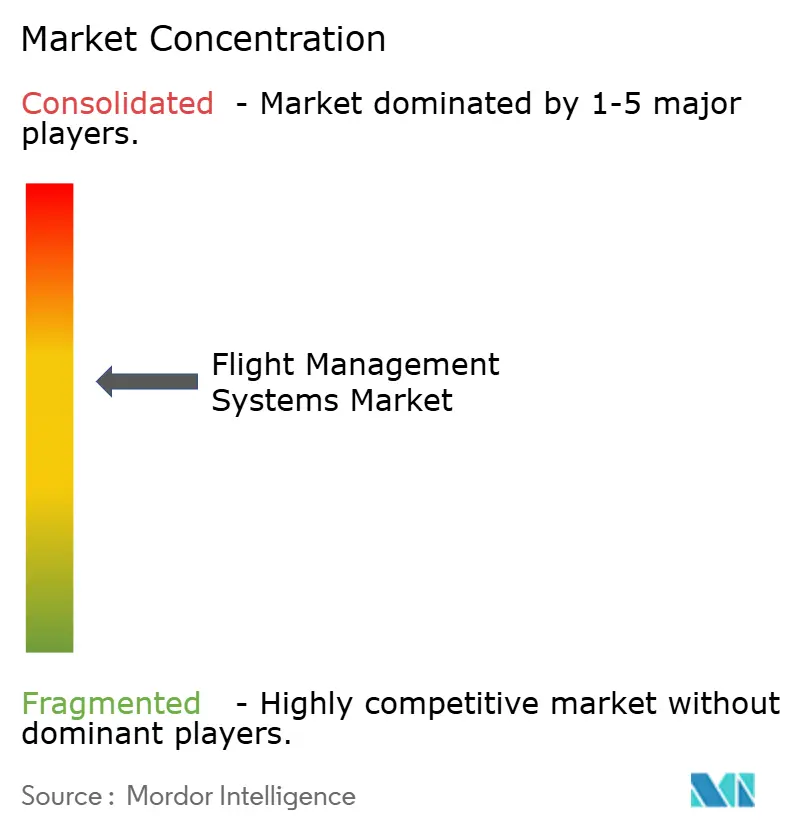
| Market Concentration | Medium |
Major Players *Disclaimer: Major Players sorted in no particular order Image © Mordor Intelligence. Reuse requires attribution under CC BY 4.0. | |
Flight Management Systems Market Analysis by Mordor Intelligence
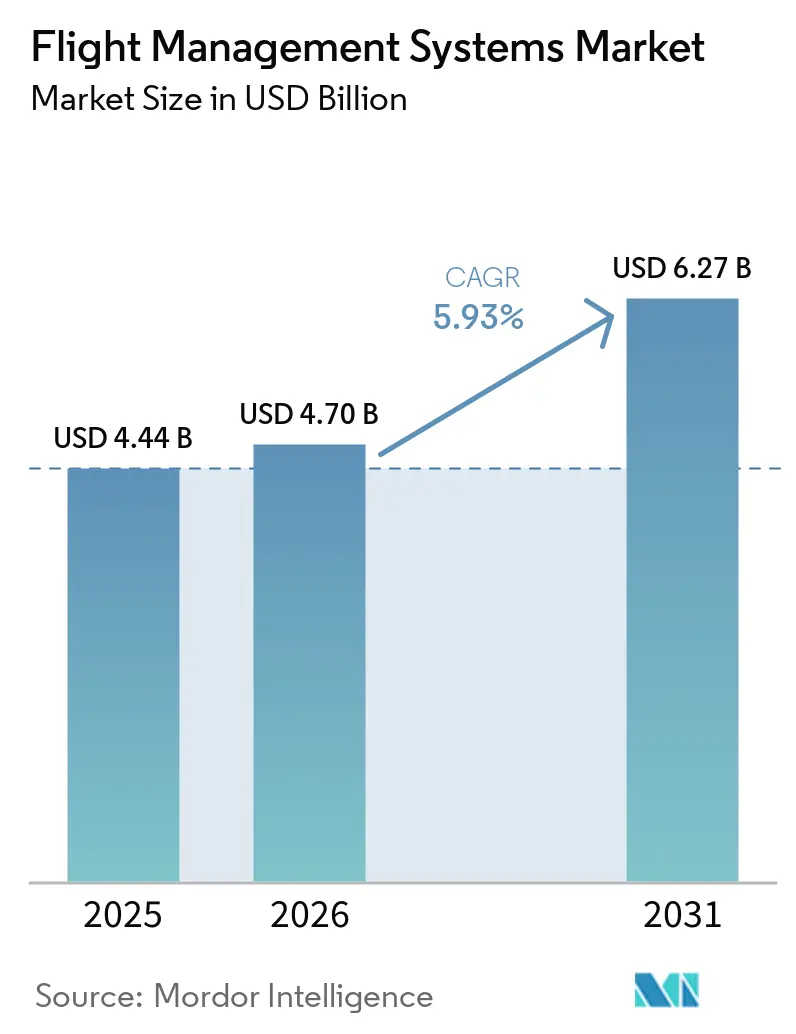
The flight management systems market size was valued at USD 4.44 billion in 2025 and estimated to grow from USD 4.70 billion in 2026 to reach USD 6.27 billion by 2031, at a CAGR of 5.93% during the forecast period (2026-2031). Higher commercial aircraft production, airline fuel-efficiency programs, and regulatory adoption of performance-based navigation support the flight management systems market. These factors create demand for new installations and software updates on aircraft already in service. Suppliers are also developing connected and software-defined architectures that can support navigation updates, data exchange, and new cockpit functions. Competition centers on certified linefit positions, where a supplier can establish a long-term aftermarket relationship with an aircraft operator. Delivery backlogs, component constraints, and cybersecurity certification requirements can defer installations, especially for newer aircraft programs.
Key Report Takeaways
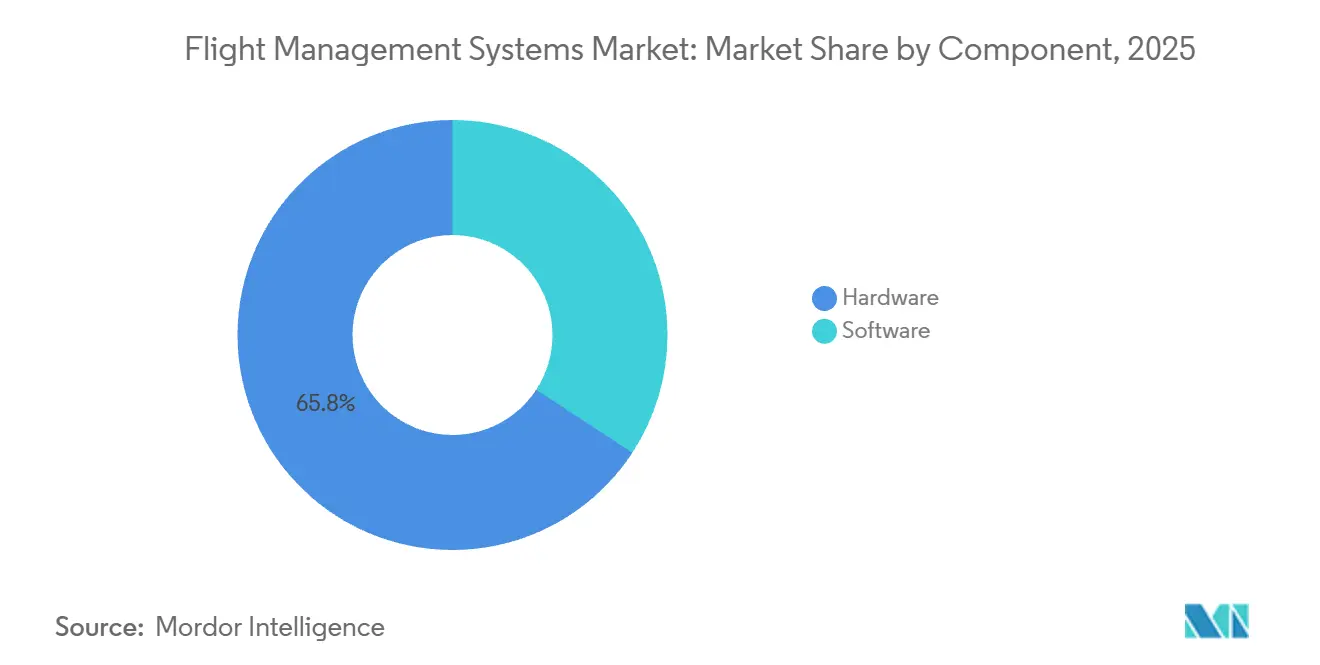
- By component, hardware held 65.78% of the flight management systems market share in 2025, while software is projected to grow at a 7.41% CAGR through 2031.
- By aircraft type, commercial aviation accounted for 74.89% of 2025 revenue, while urban air mobility is projected to grow at a 10.84% CAGR through 2031.
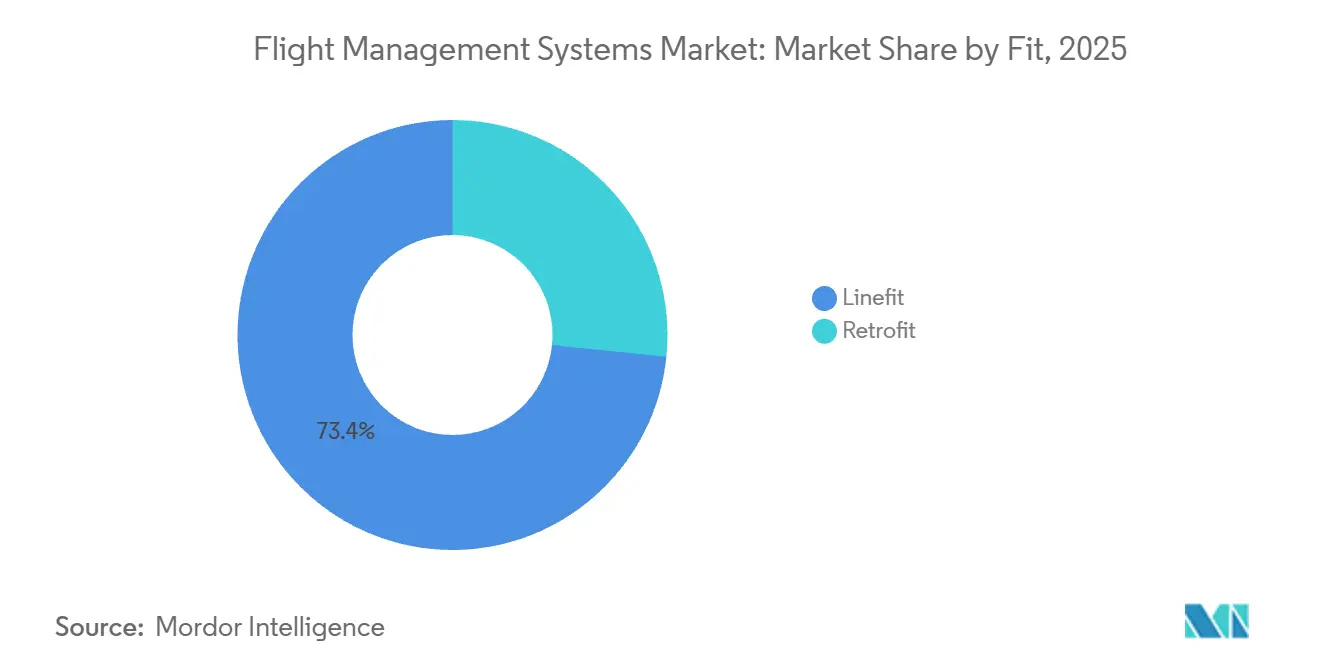
- By fit, linefit installations accounted for 73.39% of 2025 revenue, while retrofit is projected to grow at a 6.91% CAGR through 2031.
- By installation type, dual or triple-redundant FMS configurations accounted for 58.33% of 2025 revenue and were also the fastest-growing installation type, with a 7.38% CAGR through 2031.
- By geography, North America held 33.16% of the flight management systems market share in 2025, while Asia-Pacific is projected to grow at an 8.82% CAGR through 2031.
Note: Market size and forecast figures in this report are generated using Mordor Intelligence’s proprietary estimation framework, updated with the latest available data and insights as of January 2026.
Global Flight Management Systems Market Trends and Insights
Drivers Impact Analysis*
| Driver | (~) % Impact on CAGR Forecast | Geographic Relevance | Impact Timeline |
|---|---|---|---|
| Rising production rates of single-aisle commercial aircraft | +1.4% | Global, led by North America and Europe OEM hubs | Short term (≤ 2 years) |
| Increasing airline focus on fuel efficiency and operating cost reduction | +1.1% | Global, concentrated in Asia-Pacific and Middle East carriers | Medium term (2–4 years) |
| Mandatory compliance with advanced navigation performance standards | +0.9% | Global; Asia-Pacific and Middle East and Africa compliance lag driving retrofit pipeline | Medium term (2–4 years) |
| Expanding adoption of connected aircraft and real-time analytics | +0.8% | North America and Europe early adopters; Asia-Pacific spill-over | Medium term (2–4 years) |
| Advancements in AI-enabled cockpit decision-support systems | +0.7% | North America, Europe, growing Asia-Pacific adoption | Long term (≥ 4 years) |
| Integration of FMS with next-generation ATM platforms | +0.6% | Global; SESAR (Europe) and NextGen (US) as anchors | Long term (≥ 4 years) |
| Source: Mordor Intelligence | |||
Narrowbody Production Converts Backlogs Into Certified FMS Demand
Commercial aircraft output remains a direct source of unit demand in the flight management systems market. Airbus delivered 793 commercial aircraft in 2025 and targets 870 deliveries in 2026. The A320 Family accounted for around two-thirds of the company's 2025 delivery volume, keeping narrowbody programs central to avionics procurement. Each delivered aircraft requires a certified flight management system as part of its flight deck configuration. Suppliers need to reserve production capacity well before scheduled aircraft delivery because avionics parts and certification processes have long lead times. A linefit selection can therefore support hardware shipments at delivery and service revenue throughout the aircraft's operating life.
The flight management systems market benefits when aircraft manufacturers raise production because the same certified systems can be selected across a large aircraft family. Airbus has stated that it intends to increase A320 Family output to 75 aircraft per month in 2027.[1]Source: Airbus, “Ramping Up A320 Family Production,” Airbus, airbus.com These plans make supply readiness important for suppliers of flight management computer, display, and navigation software. Certified platforms have a strong position once installed because changing an avionics system involves engineering, testing, and approval costs. This pattern favors companies that secure positions early in an aircraft program. It also makes aircraft production schedules a meaningful indicator for near-term flight management systems market demand.
Fuel Optimization Supports Software Upgrade Demand
Airlines use flight management functions to plan efficient routes, manage aircraft performance, and respond to changing operating conditions. The flight management systems market is therefore linked to airline efforts to reduce fuel use and operating costs. Airbus reported that its GEESE collaboration tested Required Time of Arrival functions that can support wake energy retrieval through coordinated aircraft spacing.[2]Source: Airbus, “GEESE and ATM: Wake Energy Retrieval Collaboration Achieves New Milestones,” Airbus, airbus.com Such functions require close interaction between onboard flight management systems and air traffic management processes. They also place greater value on current performance data, navigation databases, and software capabilities.
The commercial model is changing as airlines look beyond the initial purchase of a flight management computer. Software updates can add navigation procedures, performance improvements, and compatibility with air traffic systems without replacing the hardware. Airbus described a software-defined aircraft approach in June 2026 that supports the deployment of applications, performance databases, and compliance updates through digital methods. This model can extend the revenue cycle after an aircraft enters service. It also gives operators a reason to keep software current as fuel, route, and operational requirements change. These conditions support the software portion of the flight management systems market.
Performance-Based Navigation Creates a Compliance Pipeline
Performance-based navigation requirements create demand that is less dependent on short-term airline purchasing decisions. The Federal Aviation Administration (FAA) states that its NextGen program supports modernization of the US air transportation system through improved navigation, communications, and information sharing.[3]Source: Federal Aviation Administration, “Next Generation Air Transportation System,” Federal Aviation Administration, faa.gov Flight management systems are central to this transition because they calculate and execute required navigation procedures. Airlines and other operators need compatible equipment and current databases to use these procedures reliably. This keeps regulatory compliance relevant to both new aircraft and retrofit programs.
Europe’s performance-based navigation framework also supports ongoing upgrades to flight management systems. The European Union requires specific navigation capabilities in defined airspace through its performance-based navigation regulation, while Regulation 2025/520 extends RNP 4 requirements to oceanic and remote continental airspace. These requirements support flight management systems market activity because many aircraft require software, database, or hardware changes to meet the required performance standards. Compliance needs can be particularly relevant for operators with older fleets. They also maintain a retrofit opportunity where airspace modernization progresses over time.
Connected Aircraft and AI-Assisted Operations Expand System Requirements
Connected aircraft programs increase the amount of operational information that can be shared between aircraft and ground systems. Airbus combined Navblue and Skywise in April 2026 to create a digital operations entity that connects around 12,000 aircraft. This development brings flight operations, maintenance, and data services closer together. It may increase the importance of flight management systems data in airline operations. It also gives airframe manufacturers a larger role in the digital services relationship after aircraft delivery.
AI-assisted cockpit functions are another developing requirement in the flight management systems market. DLR validated an Airborne Digital Assistant in 2025 for tasks that included air traffic control communication support, weather avoidance, and approach optimization. Airbus has described software-defined aircraft functions, including obstacle detection, speech-to-text support for air traffic control, and automatic landing assistance. These capabilities need dependable links to flight management logic when they affect route or trajectory decisions. The result is a greater need for secure computing, software integration, and clear certification pathways.
Restraints Impact Analysis*
| Restraint | (~) % Impact on CAGR Forecast | Geographic Relevance | Impact Timeline |
|---|---|---|---|
| Prolonged aircraft delivery backlogs affecting new system installations | -1.1% | Global; most acute in Asia-Pacific where order queues are longest | Short term (≤ 2 years) |
| Delays in certification of cyber-secure avionics architectures | -0.8% | Global; most acute for UAM and UAS new-entrant programs | Medium term (2–4 years) |
| Shortages of application-specific integrated circuits for avionics systems | -0.7% | Global; concentrated risk in Asia-based semiconductor fabs | Short term (≤ 2 years) |
| High retrofit costs limiting adoption in older aircraft fleets | -0.5% | Primarily South America, Middle East and Africa, and secondary Asia-Pacific carriers | Medium term (2–4 years) |
| Source: Mordor Intelligence | |||
Aircraft Delivery Backlogs Delay Linefit Revenue
Aircraft delivery backlogs can be delayed when linefit systems are installed and recognized as revenue. Flight management systems are usually scheduled against aircraft delivery milestones, so a production delay shifts the related installation into a later period. The impact is most visible where large order books extend delivery schedules for narrowbody aircraft. Component availability can complicate the issue because certified avionics rely on specialized parts that cannot be easily replaced. Application-specific integrated circuits require qualification for safety-critical use, which limits the number of acceptable substitute suppliers.
The flight management systems market also faces longer lead times when suppliers must requalify a part or alter a certified configuration. These constraints can affect the full aircraft delivery schedule even if most avionics equipment is available. Airlines may then receive aircraft later than planned, which postpones the start of associated service and software revenue. Backlogs do not remove the eventual need for flight management systems, but they can shift demand between forecast periods. The pressure is more immediate for linefit suppliers than for retrofit providers, which can pursue installations on aircraft already in operation.
Cybersecurity Certification Adds Development Risk
Cybersecurity requirements increase the work needed to certify connected avionics architectures. EASA’s certification standards include security considerations for systems that can be affected by intentional unauthorized electronic interaction. Suppliers must assess threats, define protections, and show that their system can maintain safe operation. This work adds time and engineering cost to aircraft programs that use new networking or software features. It is especially relevant for systems that exchange operational information with ground services or other aircraft systems.
The challenge is more pronounced for UAM and uncrewed aircraft programs because their architectures are still developing. New designs must combine navigation integrity, communications, automated functions, and cybersecurity controls in a system that regulators can approve. The flight management systems market may therefore see slower deployment for some advanced platforms despite high expected growth rates. Established commercial aircraft programs have more mature certification processes and installed equipment bases. Still, cybersecurity work can affect schedules whenever suppliers introduce a substantially different flight-management-system architecture.
*Our forecasts treat driver/restraint impacts as directional, not additive. The impact forecasts reflect baseline growth, mix effects, and variable interactions.
Segment Analysis
By Component: Hardware Leads While Software Expands the Revenue Cycle
Hardware held 65.78% of 2025 component revenue. Flight management computers, control display units, and visual display units form the certified physical core of an installation. Their value reflects the engineering needed to meet safety, reliability, and environmental requirements. Honeywell selected TTTech Aerospace’s TTEthernet End System for its next-generation FMS in September 2025.[4]Source: TTTech Aerospace, “TTTECH’s TTEthernet End System Selected by Honeywell Aerospace for Next-Gen Flight Management System,” TTTech, tttech.com The network supports deterministic data exchange and is intended for a system that can be certified to the highest design assurance level. This approach shows why hardware remains important even as software functions grow.
Software is the fastest-growing component, with the flight management systems market size for software projected to expand at a 7.41% CAGR through 2031. Software supports navigation databases, flight planning logic, aircraft performance calculations, and interfaces with other aircraft systems. Airbus’s software-defined aircraft work indicates that applications and data updates can be delivered without changing core hardware. That capability can create repeat work for suppliers after a system is installed. It can also help operators respond to changing performance-based navigation requirements. Hardware suppliers that offer software services may have a stronger long-term relationship with aircraft operators.



By Aircraft Type: Commercial Aviation Has the Largest Installed Demand Base
Commercial aviation accounted for 74.89% of market revenue in 2025. Large airline fleets require common navigation capabilities, standardized training, and ongoing database support. Narrowbody aircraft are especially important because they account for a large share of global commercial deliveries. Airbus expects Asia-Pacific to account for 19,560 of global demand for new commercial aircraft through 2044. This demand base supports new system installations as well as long-running support activity.
Military aviation provides a separate modernization path through mission computer and flight-deck upgrade programs. Curtiss-Wright was selected to supply mission computers for the US Air Force C-17 modernization program, with an estimated lifetime value above USD 400 million.[5]Source: Curtiss-Wright Corporation, “Curtiss-Wright Selected by Boeing to Supply Mission Computers for U.S. Air Force C-17 Fleet Modernization,” Curtiss-Wright, curtisswright.com General aviation and uncrewed aircraft add retrofit and specialized navigation demand. UAM is the fastest-growing aircraft category at a 10.84% CAGR through 2031. Safran was selected in July 2026 to supply dual SkyNaute hybrid inertial navigation systems for Eve Air Mobility’s eVTOL aircraft. The selection shows that UAM systems need specialized navigation performance in GNSS-degraded urban environments.
By Fit: Linefit Retains Scale While Retrofit Builds Momentum
Linefit installations accounted for 73.39% of 2025 fit revenue. Aircraft manufacturers and airline customers often select avionics during production to create a consistent fleet configuration from entry into service. This decision can establish an extended relationship for maintenance, databases, repairs, and upgrades. A common fleet configuration can also simplify operational support during the aircraft's service life. The agreement structure helps explain why linefit positions have value beyond an initial system selection.
Retrofit is the fastest-growing fit category at a 6.91% CAGR through 2031. Older aircraft may need upgrades to meet navigation requirements, improve cockpit capabilities, or extend service life. Business aircraft operators also update avionics to maintain aircraft utility and resale value. Universal Avionics, Collins Aerospace, and Garmin address different parts of the upgrade market with certified retrofit solutions. Garmin's G5000H was selected in December 2025 to modernize 24 Brazilian Air Force UH-60L Black Hawk helicopters. Retrofit work can be protected by aircraft-specific engineering and supplemental type certification requirements.
By Installation Type: Redundancy Becomes More Important for Advanced Operations
Dual- or triple-redundant FMS configurations accounted for 58.33% of market revenue in 2025. These systems use multiple units to provide continuity if one system fails. Redundancy is important for aircraft that perform advanced navigation procedures and need dependable flight guidance. It also supports the safety case for systems with more automated functions. The configuration is therefore common in commercial aircraft and other platforms with demanding operational requirements.
Dual or triple-redundant configurations were also the fastest-growing installation type with a 7.38% CAGR during the forecast period. RNP AR approach procedures require high navigation accuracy, which increases the importance of cross-monitoring and fault tolerance. Single-FMS configurations remain relevant in smaller piston aircraft, turboprops, and light business jets where weight and cost are more important. UAM aircraft may need redundant navigation and inertial systems to support continued safe flight and landing. Safran’s dual-system selection for Eve Air Mobility reflects this need for resilient navigation architecture.
Geography Analysis
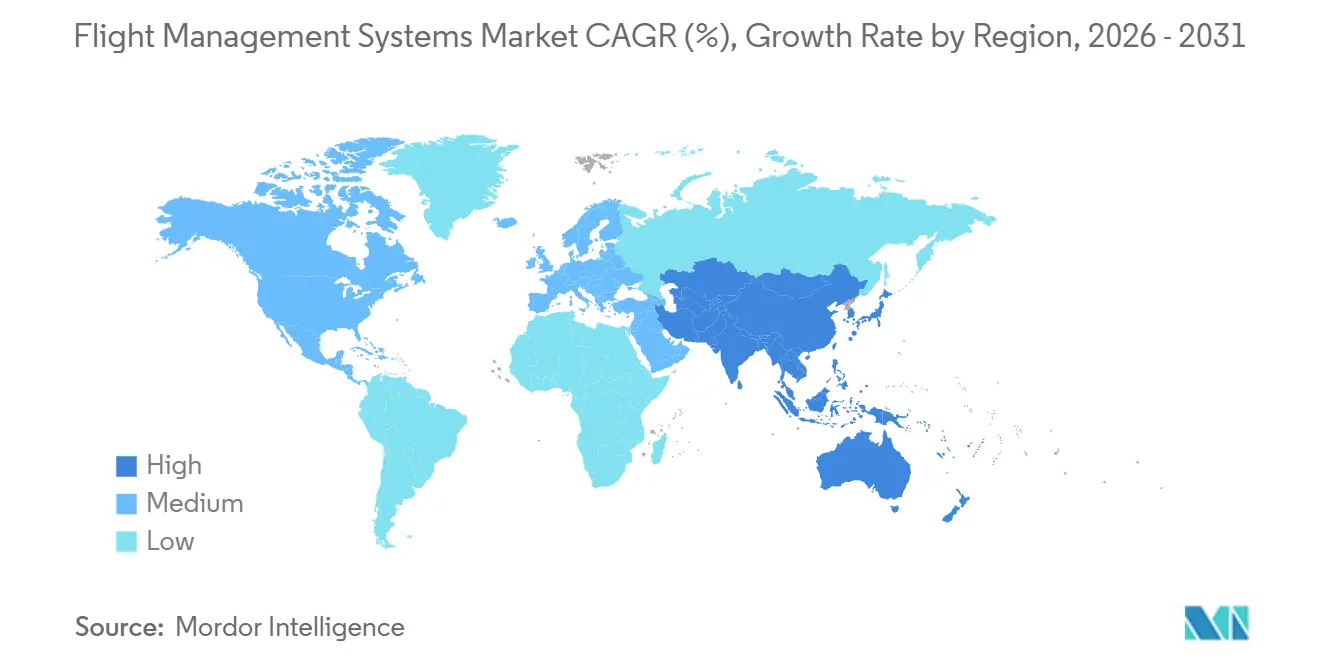
North America held 33.16% of the 2025 regional revenue. The region combines large aircraft manufacturing activity, major avionics suppliers, and the FAA NextGen modernization program. The FAA’s NextGen work supports navigation, communication, and information-sharing upgrades across the national airspace system. This environment supports aircraft upgrades and related flight management software activity.
Europe was the second-largest regional area in the flight management systems market. Airbus production sites in Toulouse, Hamburg, and Seville support the region’s aircraft manufacturing base. European airspace rules also require performance-based navigation capabilities on eligible operations. Regulation 2025/520 extends RNP 4 requirements into specified oceanic and remote continental operations. These rules can support demand for retrofits and software updates.
Asia-Pacific is projected to record an 8.82% CAGR through 2031, the fastest regional growth rate in the flight management systems market. Airbus forecasts 4.4% annual passenger traffic growth for the region through 2044. India, China, and Southeast Asia are important because they are expanding commercial fleets and air transport networks. India has also attracted major avionics service commitments for large A320-family fleets. China has developed a domestic civil aviation flight-planning system, which points to a different longer-term technology path in the country.
South America had a smaller but distinct flight management systems market demand base in 2025. Brazil supports regional activity through military aviation work and the development of UAM platforms. Widebody fleet needs, infrastructure development, and the age profile of operating aircraft shape demand in the Middle East and Africa. PBN implementation remains below the global average in parts of the region, creating a longer-term compliance opportunity as airspace and airport investment progress.

Competitive Landscape
The flight management systems market is moderately consolidated among large avionics suppliers. Honeywell International Inc., Thales Group, and RTX Corporation hold strong positions in commercial linefit programs. Their competitive advantage stems from certification expertise, established relationships with aircraft manufacturers, and the ability to support systems throughout long operating lifecycles. A linefit selection can create a long-term aftermarket relationship through repairs, maintenance, software updates, and data services. This structure makes it difficult for a new supplier to replace an installed prime system and makes competition for aircraft programs more important than a one-time equipment sale.
The flight management systems market also offers opportunities in military modernization, retrofit systems, and UAM navigation. Curtiss-Wright’s C-17 mission-computer award shows how open-architecture procurement can create opportunities alongside traditional defense suppliers. Garmin and Universal Avionics address retrofit demand with modular certified systems for different aircraft categories. Safran’s acquisition of Collins Aerospace’s flight-control and actuation activities in July 2025 added a broader set of flight-system capabilities. The transaction can support bundled offerings across flight controls, navigation, and related systems. As no combined market share for the leading companies was provided, the available information supports a moderate, rather than highly concentrated, market description.
Flight Management Systems Industry Leaders
Honeywell International Inc.
Thales Group
RTX Corporation
Garmin Ltd.
GE Aerospace (General Electric Company)
- *Disclaimer: Major Players sorted in no particular order

Recent Industry Developments
- July 2026: Safran Electronics & Defense was selected by Eve Air Mobility, an Embraer subsidiary, to supply dual SkyNaute hybrid inertial navigation systems for its eVTOL aircraft. The systems use HRG Crystal gyroscope technology to maintain navigation continuity in GNSS-degraded urban environments.
- April 2026: Airbus merged Navblue with Skywise to form a unified digital operations entity connecting approximately 12,000 aircraft globally, competing with avionics OEMs in the flight management optimization and airline software markets.
- February 2026: The Boeing Company was awarded a US Air Force contract to design and modernize the C-17 Globemaster III flight deck. Curtiss-Wright was subsequently selected to supply MOSA-aligned mission computers under a contract with an estimated lifetime value exceeding USD 400 million.


Global Flight Management Systems Market Report Scope
A flight management system (FMS) is a core onboard computer system in modern aircraft. It automates flight planning, multi-sensor navigation, and performance optimization. The system significantly reduces crew workload by calculating precise lateral and vertical flight paths, managing fuel consumption, and synchronizing with the autopilot.
The flight management systems market is segmented by component, aircraft type, fit, installation type, and geography. By component, the market is segmented into hardware and software. By aircraft type, the market is segmented into commercial aviation, military aviation, general aviation, unmanned aerial systems (UAS), and urban air mobility (UAM). By fit, the market is segmented into linefit and retrofit. By installation type, the market is segmented into single-FMS and dual/triple-redundant FMS. The report also covers the market sizes and forecasts for the flight management systems market in major countries across different regions. For each segment, the market size is provided in terms of value (USD).
| Hardware | Flight Management Computer (FMC) |
| Control Display Unit (CDU) | |
| Visual Display Unit (VDU) | |
| Software |
| Commercial Aircraft | Narrowbody |
| Widebody | |
| Regional Jets | |
| Military Aircraft | Combat |
| Transport | |
| Special Mission | |
| Helicopters | |
| General Aviation | Business Jets |
| Piston and Turboprops | |
| Commercial Helicopters | |
| Unmanned Aerial Systems (UAS) | Civil and Commercial |
| Defense and Government | |
| Urban Air Mobility (UAM) |
| Linefit |
| Retrofit |
| Single-FMS |
| Dual/Triple-Redundant FMS |
| North America | United States | |
| Canada | ||
| Mexico | ||
| Europe | United Kingdom | |
| France | ||
| Germany | ||
| Italy | ||
| Rest of Europe | ||
| Asia-Pacific | China | |
| India | ||
| Japan | ||
| South Korea | ||
| Australia | ||
| Rest of Asia-Pacific | ||
| South America | Brazil | |
| Rest of South America | ||
| Middle East and Africa | Middle East | Saudi Arabia |
| United Arab Emirates | ||
| Rest of Middle East | ||
| Africa | South Africa | |
| Rest of Africa | ||
| By Component | Hardware | Flight Management Computer (FMC) | |
| Control Display Unit (CDU) | |||
| Visual Display Unit (VDU) | |||
| Software | |||
| By Aircraft Type | Commercial Aircraft | Narrowbody | |
| Widebody | |||
| Regional Jets | |||
| Military Aircraft | Combat | ||
| Transport | |||
| Special Mission | |||
| Helicopters | |||
| General Aviation | Business Jets | ||
| Piston and Turboprops | |||
| Commercial Helicopters | |||
| Unmanned Aerial Systems (UAS) | Civil and Commercial | ||
| Defense and Government | |||
| Urban Air Mobility (UAM) | |||
| By Fit | Linefit | ||
| Retrofit | |||
| By Installation Type | Single-FMS | ||
| Dual/Triple-Redundant FMS | |||
| By Geography | North America | United States | |
| Canada | |||
| Mexico | |||
| Europe | United Kingdom | ||
| France | |||
| Germany | |||
| Italy | |||
| Rest of Europe | |||
| Asia-Pacific | China | ||
| India | |||
| Japan | |||
| South Korea | |||
| Australia | |||
| Rest of Asia-Pacific | |||
| South America | Brazil | ||
| Rest of South America | |||
| Middle East and Africa | Middle East | Saudi Arabia | |
| United Arab Emirates | |||
| Rest of Middle East | |||
| Africa | South Africa | ||
| Rest of Africa | |||


Key Questions Answered in the Report
What is driving demand for flight management systems?
Commercial aircraft output, fuel-efficiency needs, performance-based navigation requirements, and connected aircraft functions support demand for new systems and upgrades.
Which component is growing fastest?
Software is the fastest-growing component, with a projected 7.41% CAGR through 2031, while hardware held 65.78% share in 2025.
Which aircraft category has the strongest growth outlook?
Urban air mobility (UAM) is projected to be the fastest-growing aircraft category at a 10.84% CAGR through 2031.
Why are retrofit installations increasing?
Retrofit demand is supported by aging aircraft, navigation compliance needs, service-life extension, and cockpit modernization, with a projected 6.91% CAGR through 2031.
Which region is growing fastest?
Asia-Pacific is projected to grow at an 8.82% CAGR through 2031, supported by commercial fleet expansion in India, China, and Southeast Asia.
What limits adoption of advanced flight management systems?
Aircraft delivery delays and the time needed to certify cybersecure avionics systems can defer installations and new program deployment.
Page last updated on:


 Your data is secure and never sold or shared.


