
Europe CRM Marketing Services Market Size and Share
Market Overview
| Study Period | 2020 - 2031 |
|---|---|
| Forecast Data Period | 2026 - 2031 |
| Base Year Market Size (2025) | USD 9.06 Billion |
| Market Size (2026) | USD 9.93 Billion |
| Market Size (2031) | USD 15.66 Billion |
| Growth Rate (2026 - 2031) | 9.54 % |
| Market Concentration | Medium |
Major Players *Disclaimer: Major Players sorted in no particular order Image © Mordor Intelligence. Reuse requires attribution under CC BY 4.0. | |
Europe CRM Marketing Services Market Analysis by Mordor Intelligence
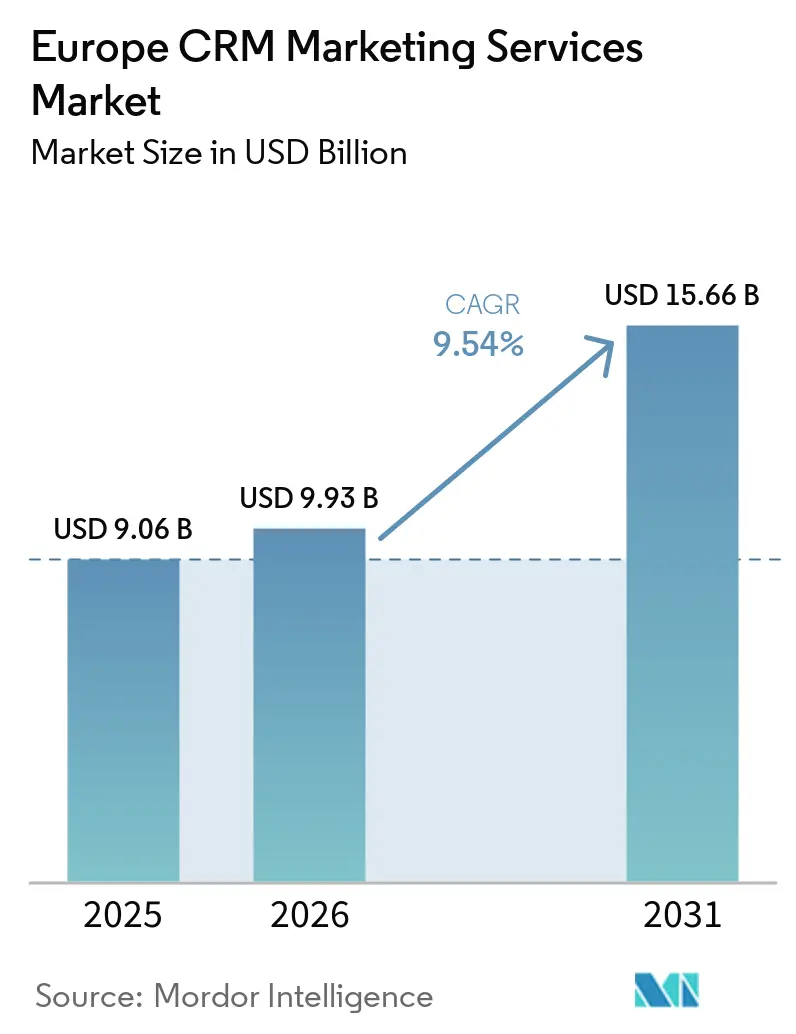
The Europe CRM marketing services market size is projected to be USD 9.06 billion in 2025, USD 9.93 billion in 2026, and reach USD 15.66 billion by 2031, growing at a CAGR of 9.54% from 2026 to 2031. The Europe CRM marketing services market still has meaningful room to expand because many enterprises are moving from fragmented customer systems into unified operating models that need outside implementation, support, and governance. Growth is being supported by stricter privacy expectations, wider use of AI in customer-facing processes, and rising demand for service partners that can keep CRM programs compliant across multiple countries and languages. The Europe CRM marketing services market is also shifting toward recurring managed relationships, as buyers increasingly want continuous optimization, workflow oversight, and operating support instead of only one-time deployment work. Competitive pressure remains high because global integrators, advisory-led firms, platform service arms, and specialist boutiques are pursuing the same mandates across overlapping layers of consulting, implementation, modernization, and managed delivery. Providers with stronger integration accelerators, sovereign cloud readiness, multilingual execution, and sector-specific CRM operating depth are in a better position to win larger programs in the Europe CRM marketing services market.
Key Report Takeaways
- By service type, CRM implementation and integration commanded a 32.57% share of the Europe CRM marketing services market in 2025, while CRM managed services are projected to expand at a 13.42% CAGR through 2031.
- By enterprise size, large enterprises held 68.34% share in 2025, while SMEs are projected to record the highest CAGR at 12.63% through 2031.
- By service application, customer acquisition accounted for 27.81% share of the Europe CRM marketing services market size in 2025, while omnichannel customer engagement is projected to grow at a 14.91% CAGR through 2031.
- By end-user industry, retail and e-commerce led with 23.24% share in 2025, while healthcare and life sciences are projected to expand at a 13.76% CAGR through 2031.
- By country, the United Kingdom held 24.31% of the Europe CRM marketing services market share in 2025, while Germany is projected to record the fastest CAGR at 13.53% through 2031.
Note: Market size and forecast figures in this report are generated using Mordor Intelligence’s proprietary estimation framework, updated with the latest available data and insights as of January 2026.
Market Trends and Insights
Drivers Impact Analysis of Europe CRM Marketing Services Market*
| DRIVER | (~) % IMPACT ON CAGR FORECAST | GEOGRAPHIC RELEVANCE | IMPACT TIMELINE |
|---|---|---|---|
| Increasing Demand for GDPR-Ready Customer Engagement Workflows | +2.1% | EU-27 and EEA-wide, highest intensity in UK, Germany, and France | Short term (≤ 2 years) |
| Rapid Shift Toward AI-Assisted Campaign Orchestration | +1.8% | Global, with concentrated traction in DACH, Nordics, and UK | Medium term (2-4 years) |
| Multilingual Personalization Across Fragmented European Markets | +1.4% | Western Europe and Nordics core, spillover to Southern and Eastern Europe | Medium term (2-4 years) |
| Outsourcing of Marketing Operations to Reduce Talent Gaps | +1.1% | UK-driven, with near-shore spillover to Poland, Romania, and Czech Republic | Short term (≤ 2 years) |
| Rising Adoption of Composable CRM and Marketing Technology Stacks | +0.8% | DACH, UK, and Nordics, gradual diffusion to Southern Europe | Long term (≥ 4 years) |
| Growth in Loyalty, Retention, and Customer Lifetime Value Programs | +0.6% | Retail-dense markets including UK, France, Germany, and the Netherlands | Medium term (2-4 years) |
| Source: Mordor Intelligence | |||
Increasing Demand for GDPR-Ready Customer Engagement Workflows
GDPR-ready workflow design has become a direct buying factor in the Europe CRM marketing services market because enterprises now expect compliance features to sit inside the operating model, not outside it. Salesforce said its France investment includes sovereign cloud deployment options, customer-controlled encryption keys, and real-time visibility into human and agent activity, which shows how privacy and control features are being built into CRM service design from the start.[1] Brevo said its AI Lab will develop European CRM AI tools on EU servers in compliance with GDPR, which reinforces how strongly buyers are linking CRM modernization with local data handling and audit confidence. Temedica built GDPR-compliant consent and preference management into its Omnichannel Patient Engagement Suite, which shows that regulated engagement programs now treat consent handling as part of the delivery scope rather than an adjacent legal process. Veeva said Vault CRM is designed to meet country-level business and compliance requirements across personal and digital channels, which reflects the same pressure in life sciences deployments that operate across multiple European markets. This is raising demand for service providers that can manage consent governance, workflow documentation, configuration control, and compliance-ready operating support throughout the life of a CRM program.
Rapid Shift Toward AI-Assisted Campaign Orchestration
AI-assisted campaign orchestration is moving from experimentation into live production, and this is changing what buyers expect from partners in the Europe CRM marketing services market. Salesforce said Agentforce reached USD 1.2 billion in annual recurring revenue in Q1 FY2027 and that Fin's AI agents resolve an average 76% of support volume end-to-end, which points to rapid commercial uptake of autonomous customer workflows. Salesforce also highlighted live deployments in France at Bouygues, Pierre Fabre, and Adecco, which shows that AI orchestration is already influencing customer engagement operations across several industries and use cases. This is lifting the bar for providers because buyers increasingly want implementation and managed service teams that can connect AI agents to CRM data, service logic, and governance controls without slowing deployment.
Multilingual Personalization Across Fragmented European Markets
Multilingual personalization remains a durable driver because service providers in the Europe CRM marketing services market must translate customer data into locally relevant engagement across fragmented national environments and channel mixes. Brevo said its AI Lab is focused on advanced marketing personalization for European CRM users, and its decision to keep those tools on EU infrastructure aligns personalization with local compliance expectations and data confidence.[2] Salesforce said French customers will be able to integrate local AI models such as Mistral, which supports more localized language and content handling inside enterprise CRM programs. The same France announcement showed how Pierre Fabre is using a unified One CRM program for more than 4,000 users across pharmaceutical and dermo-cosmetics activities, which reflects the need to coordinate communication across brands, functions, and customer groups. Temedica reported that its omnichannel approach delivered more than 15% higher patient engagement than standalone app solutions, which suggests that coordinated and context-aware interactions produce better response quality when users move across channels. This favors firms in the Europe CRM marketing services market that can combine content governance, localization support, workflow orchestration, and consent-aware deployment inside one service model.
Outsourcing of Marketing Operations to Reduce Talent Gaps
Outsourcing is gaining traction because many enterprises want CRM outcomes without carrying the full cost and hiring burden of a larger in-house delivery bench in the Europe CRM marketing services market. Salesforce said it is hiring in cybersecurity, data, agentic AI, and deployment engineering in France as part of its expanded investment program, which underlines how specialized the required talent mix has become even for leading ecosystem players. Veeva's January 2026 win at Novo Nordisk shows that large buyers are willing to rely on external platforms for commercial execution foundations across personal and digital channels. Merck KGaA, Darmstadt, Germany, made a similar global commitment in May 2026, reinforcing the case for long-duration partner-led CRM delivery rather than only internal capability building.
Restraints Impact Analysis of Europe CRM Marketing Services Market*
| RESTRAINT | (~) % IMPACT ON CAGR FORECAST | GEOGRAPHIC RELEVANCE | IMPACT TIMELINE |
|---|---|---|---|
| High Compliance Cost for Consent, Data Residency, and Audit Readiness | -1.8% | EU-27 and EEA-wide, highest burden on SME and mid-market segments | Short term (≤ 2 years) |
| Shortage of GDPR-Fluent CRM and Marketing Operations Specialists | -1.2% | EU-wide, acute shortfalls in Southern and Eastern Europe | Medium term (2-4 years) |
| Integration Complexity With Legacy ERP and Data Platforms | -0.9% | Large enterprise segment in Germany, France, and Italy | Long term (≥ 4 years) |
| Rising Total Cost of Ownership for Multi-Market Deployments | -0.6% | Pan-European enterprises with multi-country CRM operations | Medium term (2-4 years) |
| Source: Mordor Intelligence | |||
High Compliance Cost for Consent, Data Residency, and Audit Readiness
Compliance cost remains a real drag on buying speed because privacy, residency, and AI governance now shape both platform choice and service scope in the Europe CRM marketing services market. Salesforce's France program includes sovereign cloud deployment options, encryption key control, real-time visibility into human and agent activity, and support for local model integration, all of which add architecture and implementation work that buyers must fund before value is fully realized. Brevo committed EUR 50 million (USD 57.02 million) over 5 years to build EU-hosted AI agents for CRM, which shows that compliant AI delivery requires sustained infrastructure and product investment even before deployment services are priced into customer programs. Temedica tied its compliant consent and preference framework to measurable engagement outcomes, which reflects the extra design and oversight effort needed to make regulated engagement both operational and commercially useful. Veeva also positioned Vault CRM around country-level business and compliance requirements, which means buyers in regulated sectors often need broader configuration, validation, and governance work before they reach operating scale. These added layers can delay procurement in the Europe CRM marketing services market and can push mid-market enterprises to stage CRM programs more slowly than the underlying demand would otherwise support.
Shortage of GDPR-Fluent CRM and Marketing Operations Specialists
The shortage of CRM specialists who can work across platform delivery, privacy obligations, and AI governance is limiting execution capacity in the Europe CRM marketing services market. Salesforce said it is expanding hiring in France across cybersecurity, data, agentic AI, and deployment engineering, which signals that the required skill mix is narrow and still difficult to scale even in major European markets. Veeva's Novo Nordisk deployment shows that regulated sectors need specialists who understand both commercial execution and country-level compliance requirements. Merck KGaA, Darmstadt, Germany's global move to Vault CRM reinforces how scarce those blended skills become when programs span multiple countries, business units, and data environments.
*Our forecasts treat driver/restraint impacts as directional, not additive. The impact forecasts reflect baseline growth, mix effects, and variable interactions.
Europe CRM Marketing Services Market Segment Analysis
By Service Type:
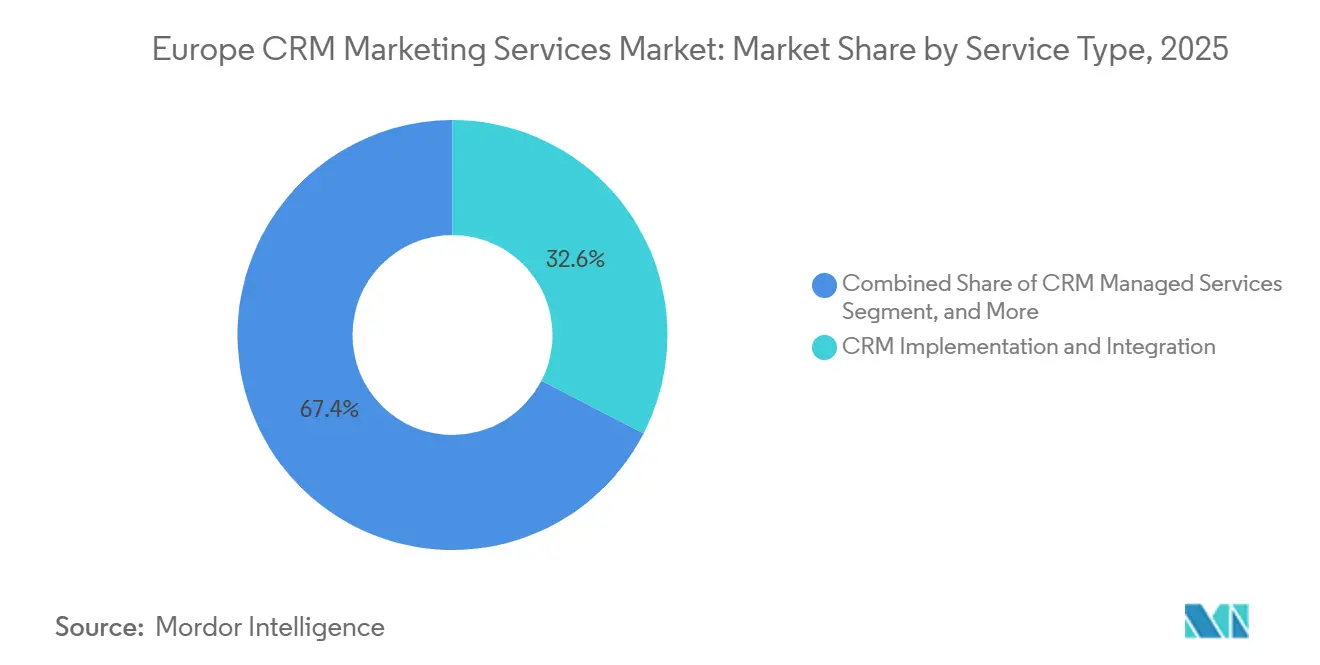
Implementation Leads, Managed Services Build Faster MomentumCRM Implementation and Integration held 32.57% of the Europe CRM marketing services market share in 2025, which kept it ahead of every other service type and confirmed the scale of heavy work still moving through the region. This part of the Europe CRM marketing services market remains anchored in multi-cloud programs that connect Salesforce, SAP, or Microsoft Dynamics 365 environments with ERP systems, analytics layers, data warehouses, and surrounding customer applications. The integration burden stays high because many enterprises still operate with uneven data structures, fragmented process ownership, and local system customizations that must be reconciled before a CRM program can run consistently across countries. That reality continues to support strong demand for professional services because buyers rarely start with clean customer data flows, simple workflow rules, or a fully standardized operating model. Strategy and consulting mandates remain important where enterprises are redesigning customer engagement from the ground up, while migration and modernization work is being driven by platform consolidation and planned exits from older customer systems.
CRM Managed Services is projected to grow at a 13.42% CAGR from 2026 to 2031, making it the fastest-expanding service type in the Europe CRM services industry and the clearest indicator of where recurring value is built. The segment benefits from enterprise demand for ongoing optimization, model oversight, compliance management, release management, and performance tuning rather than one-time setup work that ends after deployment. Outcome-based contracts are also gaining ground because clients increasingly want service fees tied to retention, campaign performance, or service quality instead of only hours billed or tickets closed. This shift is widening the addressable space in the Europe CRM marketing services market for mid-tier firms that can deliver GDPR-aware managed operations at lower total cost than the largest integrators, while still offering enough platform depth to manage day-to-day change.

By Enterprise Size:
Large Enterprises Hold Revenue Weight, SMEs Expand FasterLarge enterprises accounted for 68.34% of the market in 2025 and remained the main revenue base for complex CRM programs across the Europe CRM marketing services market. Their projects often span multiple customer databases, ERP systems, analytics tools, service platforms, and business units, which keeps engagement sizes high, delivery cycles long, and service scopes broader than in smaller accounts. BFSI, industrial manufacturing, and telecommunications continue to dominate this demand because these sectors depend on structured customer workflows, reporting discipline, channel control, and process consistency across geographies. Large enterprise programs also generate outsized demand for advisory services because platform choice, operating model design, governance rules, and rollout sequencing usually need to be settled before implementation begins. In the Europe CRM services industry, these mandates still shape the commercial rhythm for the largest providers because they concentrate budgets, strategic decisions, and multi-year delivery commitments in the same client group.
SMEs are projected to expand at a 12.63% CAGR from 2026 to 2031, making them the fastest-growing enterprise size cohort and an increasingly important volume opportunity in the Europe CRM marketing services market. Growth in this segment is being supported by lower-cost managed service models, pre-configured cloud platforms, and simpler deployment packages that reduce the implementation barrier for single-market operators and smaller regional businesses. SME buyers are also more willing to outsource administration, support, and incremental optimization when internal teams are lean, specialist hiring is difficult, and platform changes keep arriving faster than staff can absorb them. As a result, providers that package implementation, compliance support, training, and post-launch care into simpler offers are better placed to deepen SME penetration without relying on the same staffing intensity required by large enterprise programs.
By Service Application:
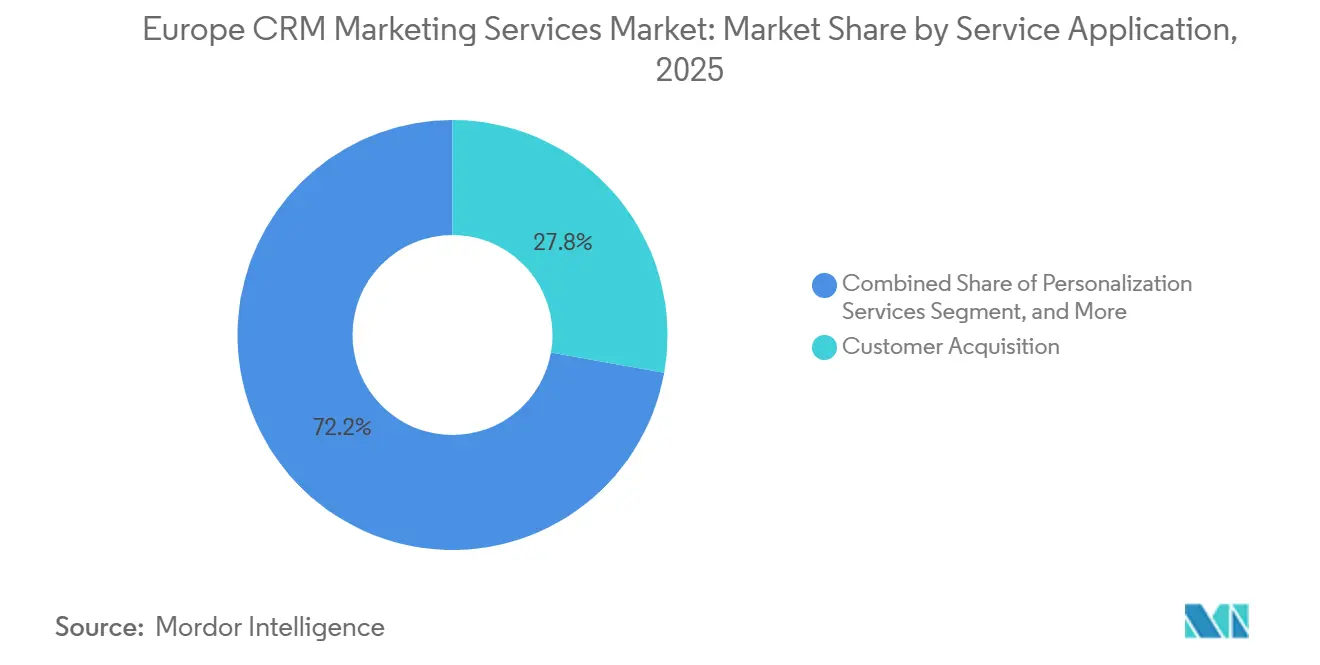
Acquisition Generates Volume, Omnichannel Engagement Sets the PaceCustomer Acquisition held 27.81% of the market in 2025 and remained the largest service application across the Europe CRM marketing services market because lead generation and pipeline control still sit at the center of commercial execution in many sectors. This position reflects the priority that B2B industries place on lead capture, pipeline management, qualification rules, and data quality, all of which shape how consistently sales and marketing can work from the same customer record. BFSI, IT services, and industrial businesses rely heavily on these workflows because revenue forecasting depends on disciplined qualification, repeatable routing logic, and strong customer record integrity. Customer Retention and Loyalty and Campaign Management Services followed as large application pools, especially in sectors where acquisition costs are high and the value of an existing customer relationship is rising. Marketing Automation Services, Customer Analytics and Insights, and Personalization Services also continue to expand as enterprises connect campaign activity more directly to CRM outcomes and expect clearer feedback loops between spend, engagement, and conversion.
Omnichannel Customer Engagement is projected to grow at a 14.91% CAGR through 2031, which makes it the fastest-growing application area and one of the strongest growth pockets within the Europe CRM marketing services market size outlook. Temedica said its Omnichannel Patient Engagement Suite delivered more than 15% higher patient engagement than standalone app solutions and supports access to over 40 million patients in the German-speaking region, which shows the operating value of connected interactions across channels in regulated use cases.[3] That result matters because omnichannel programs combine acquisition, retention, analytics, and personalization into one operating layer instead of treating them as separate workstreams with separate vendors. Providers that can run the underlying integration, consent management, orchestration logic, and performance monitoring are therefore positioned to capture larger multi-year contracts as omnichannel delivery becomes a more central part of the Europe CRM marketing services market.
By End-User Industry:
Retail Holds the Largest Base, Healthcare and Life Sciences Advances FastestRetail and E-Commerce held 23.24% of the market in 2025 and remained the largest end-user block for the Europe CRM marketing services market because unified commerce programs continue to demand heavy integration, process redesign, and customer data coordination. Investments across the United Kingdom and Germany are keeping this segment active because retailers are moving away from highly customized legacy environments and into integrated customer architectures that support digital and physical interaction in one system. BFSI followed as a large buyer group, with demand centered on onboarding automation, reporting integration, data accuracy, and campaign management for banking, wealth, and insurance products. Information Technology and Telecom also remain important because large operators still need CX transformation, sales enablement, and migration away from older customer systems that are difficult to scale across business lines. Industrial manufacturing and government programs add a steady pipeline as firms automate B2B sales workflows, dealer or partner coordination, and citizen engagement processes that need stronger data control.
Healthcare and Life Sciences is projected to expand at a 13.76% CAGR from 2026 to 2031, making it the fastest-growing end-user segment in the Europe CRM services industry and a major source of higher-complexity program demand. Veeva said Novo Nordisk International Operations committed to Vault CRM in January 2026 to support commercial execution across personal and digital channels, which reflects the push toward unified, compliant relationship management in life sciences.[4] Veeva also said Merck KGaA, Darmstadt, Germany, selected Vault CRM worldwide in May 2026 to standardize commercial processes and connect the platform with a broader data-driven ecosystem, which shows the scale of consolidation now underway in regulated customer engagement. Salesforce said Pierre Fabre is using Agentforce in a One CRM program for more than 4,000 users in France, which shows why life sciences buyers are becoming a major growth engine for the Europe CRM marketing services market as programs expand across medical, commercial, and digital channels.
Geography Analysis
United Kingdom and Germany CRM Marketing Services Market
The United Kingdom held 24.31% of the Europe CRM marketing services market share in 2025 and remained the largest country market in the region, reflecting both demand maturity and the depth of the local professional services ecosystem. Its lead rests on a deep digital services economy, dense retail and financial services activity, and a mature base of enterprises that already treat CRM as an operating platform rather than a narrow software tool. Mature demand in the United Kingdom also means buyers increasingly favor longer managed service relationships when they cannot sustain specialist capacity internally, which supports recurring revenue models more than isolated deployment work. Germany is projected to grow at a 13.53% CAGR from 2026 to 2031 and stands out as the fastest-growing national market in the Europe CRM marketing services market size outlook. Demand in Germany is being shaped by AI adoption in the Mittelstand, stronger interest in compliant cloud architectures, and a preference for delivery models that can support sovereignty expectations without sacrificing speed.
France, Netherlands and Nordics CRM Marketing Services Market
France remains one of the most strategic markets in the regional landscape because large buyers are linking CRM modernization with data sovereignty, infrastructure choice, and AI operating design. Salesforce announced a USD 2 billion investment in France through 2030, including an AI Innovation Hub in Paris and sovereign cloud deployment options across French platforms such as S3NS, Scaleway, Cloud Temple, and Orange. Salesforce also said French customers will be able to control encryption keys through partners and integrate local AI models, which raises France's role as a proving ground for compliant AI-native CRM architectures that could influence adoption elsewhere in the region. The Netherlands and the Nordic markets continue to attract high-value programs because cloud readiness is strong, digital engagement is already more mature, and buyers are often further along in using CRM to coordinate multiple customer touchpoints. These markets are especially relevant for personalization, loyalty, and retention programs where enterprises want faster experimentation, better use of first-party data, and stronger governance over how AI and automation touch customer interactions.
Broader European Markets
Italy, Spain, and the rest of Europe form a growing but earlier-stage demand pool within the Europe CRM marketing services market, which keeps modernization work active even when overall spending starts from a lower base. Many buyers in these markets are still moving from on-premises or semi-customized tools to cloud-based platforms, which sustains demand for migration, modernization, implementation, and post-launch support services. Poland and Romania are also becoming more important as delivery hubs, which support cross-border service models for enterprises that need multilingual rollout support, lower operating costs, and closer regional alignment on compliance. Across the wider region, adoption is broadening as enterprises seek unified CRM architectures that can support compliance, channel coordination, AI-enabled engagement, and steady post-launch optimization over a longer operating cycle.
Competitive Landscape
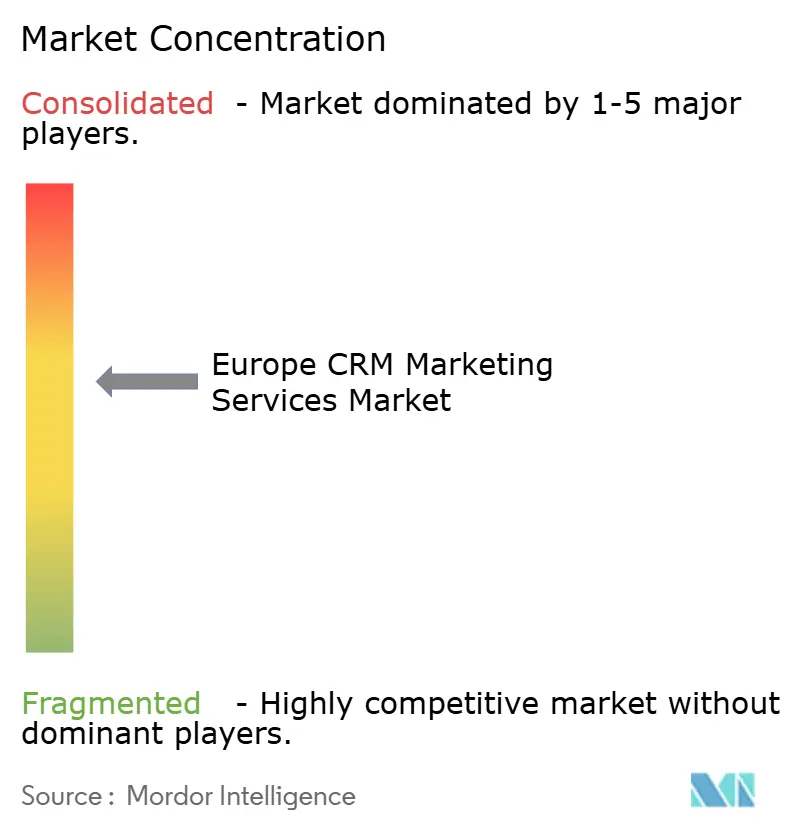
The Europe CRM marketing services market is moderately concentrated, with large global integrators, advisory-led firms, platform service arms, and specialist boutiques all competing for overlapping mandates across consulting, implementation, modernization, and managed delivery. The largest providers benefit from scale, certification depth, cross-country delivery models, and a stronger ability to absorb longer procurement cycles when projects involve regulated sectors or multi-cloud integration. Even so, the middle of the market remains open because many buyers still prefer providers that can move faster, localize delivery, or focus deeply on one platform and one industry instead of offering every service line. Differentiation is increasingly tied to sovereign cloud readiness, AI agent deployment capability, sector templates, and the ability to manage compliance as part of daily operations rather than as a periodic review exercise. This keeps pricing pressure high in standard implementation work while preserving stronger margins in managed services, AI-enabled orchestration, and higher-complexity transformation programs that need deeper operating support.
Salesforce's June 2026 agreement to acquire Fin for approximately USD 3.6 billion is one of the clearest strategic moves shaping the competitive field in the Europe CRM marketing services market. Salesforce said Fin's AI agents resolve an average 76% of support volume end-to-end and that the company serves more than 30,000 customers, which strengthens Salesforce's position in autonomous customer operations and gives partners a larger AI execution layer to deploy around CRM programs. Salesforce also committed USD 2 billion in France through 2030, which signals that local infrastructure, sovereignty options, local model support, and ecosystem depth are becoming competitive assets rather than supporting features. Brevo launched an AI Lab in Paris in February 2025 with a EUR 50 million (USD 57.02 million) investment over 5 years to build EU-hosted AI agents for CRM, which positions it as a regional challenger built around GDPR-native infrastructure and European data positioning. These moves show that competition is no longer limited to implementation capacity because product direction, data location, AI governance, and deployment architecture now influence provider choice much earlier in the buying cycle.
Veeva's January 2026 win at Novo Nordisk shows how vertical specialization can create durable advantage in regulated customer engagement programs where country-level requirements matter and commercial execution must stay aligned across channels. It's May 2026 global commitment from Merck KGaA, Darmstadt, Germany, reinforces the same point and highlights the value of CRM platforms that can sit inside broader data-driven ecosystems rather than operate as stand-alone commercial tools.[5] As a result, competition in the Europe CRM marketing services market is expected to remain centered on platform depth, industry specialization, AI-enabled service delivery, compliance capabilities, and the ability to combine consulting, implementation, and managed operations into integrated customer engagement programs.
Europe CRM Marketing Services Industry Leaders
-
Accenture plc
-
Publicis Groupe S.A.
-
Capgemini SE
-
IBM Corporation
-
Cognizant Technology Solutions Corporation
- *Disclaimer: Major Players sorted in no particular order
Europe CRM Marketing Services Market Companies Covered in this Report
- Accenture plc
- Publicis Groupe S.A.
- Capgemini SE
- IBM Corporation
- Cognizant Technology Solutions Corporation
- Wipro Limited
- Tata Consultancy Services Limited
- Infosys Limited
- HCL Technologies Limited
- Deloitte Touche Tohmatsu Limited
- Ernst and Young Global Limited
- PricewaterhouseCoopers International Limited
- KPMG International Limited
- Salesforce, Inc.
- Adobe Inc.
- Oracle Corporation
- Microsoft Corporation
- SAP SE
- HubSpot, Inc.
- Brevo
- Zoho Corporation Pvt. Ltd.
- Pipedrive OU
- Freshworks Inc.
- Zendesk, Inc.
- SugarCRM Inc.
Recent Industry Developments in Europe CRM Marketing Services Market
- June 2026: Salesforce signed a definitive agreement to acquire Fin (formerly Intercom) for approximately USD 3.6 billion. Fin's AI agents deliver an average 76% end-to-end support resolution rate and serve over 30,000 companies globally. The acquisition is expected to accelerate Agentforce adoption for SMBs and commercial-tier customers across Europe.
- June 2026: Salesforce announced a USD 2 billion investment in France through 2030, disclosed at the Choose France summit on June 1, 2026, including Salesforce's first EU AI Innovation Hub in Paris and data sovereignty options across French sovereign cloud platforms, including S3NS, Scaleway, and Orange.
- January 2026: Novo Nordisk International Operations committed to Veeva Vault CRM for commercial execution across personal and digital channels, expanding Veeva's biopharma CRM footprint in European and international markets.
- February 2025: Brevo launched an AI Lab in Paris, committing EUR 50 million (USD 57.02 million) over 5 years to develop EU-hosted AI agents for CRM and marketing personalization, positioning as a GDPR-native alternative to US-headquartered CRM platforms. Annual recurring revenue stood at EUR 179 million (USD 194.2 million) in 2024.
Europe CRM Marketing Services Market Report Scope
Europe CRM marketing services encompass solutions and professional services that enable businesses across Europe to manage customer relationships, optimize marketing operations, and enhance customer engagement. These services include customer data management, campaign automation, analytics, personalization, and omnichannel communication. They help organizations comply with European data privacy regulations while strengthening customer loyalty and supporting revenue growth.
The Europe CRM Marketing Services Market Report is Segmented by Service Type (CRM Strategy and Consulting, CRM Implementation and Integration, CRM Migration and Modernization, CRM Managed Services, and CRM Training and Support), Enterprise Size (Large Enterprises, and Small and Medium Enterprises), Service Application (Customer Acquisition, Customer Retention and Loyalty, Campaign Management Services, Marketing Automation Services, Customer Analytics and Insights, Omnichannel Customer Engagement, and Personalization Services), End-user Industry (Banking, Financial Services, and Insurance (BFSI), Healthcare and Life Sciences, Information Technology and Telecom, Retail and E-commerce, Industrial Manufacturing, Government and Public Administration, and Other End-user Industries), and Country (United Kingdom, Germany, France, Italy, Spain, Netherlands, Nordics, and Rest of Europe). The Market Forecasts are Provided in Terms of Value (USD).
Segmentation Overview
| CRM Strategy and Consulting |
| CRM Implementation and Integration |
| CRM Migration and Modernization |
| CRM Managed Services |
| CRM Training and Support |
| Large Enterprises |
| Small and Medium Enterprises |
| Customer Acquisition |
| Customer Retention and Loyalty |
| Campaign Management Services |
| Marketing Automation Services |
| Customer Analytics and Insights |
| Omnichannel Customer Engagement |
| Personalization Services |
| Banking, Financial Services, and Insurance (BFSI) |
| Healthcare and Life Sciences |
| Information Technology and Telecom |
| Retail and E-commerce |
| Industrial Manufacturing |
| Government and Public Administration |
| Other End-user Industries |
| United Kingdom |
| Germany |
| France |
| Italy |
| Spain |
| Netherlands |
| Nordics |
| Rest of Europe |
| By Service Type | CRM Strategy and Consulting |
| CRM Implementation and Integration | |
| CRM Migration and Modernization | |
| CRM Managed Services | |
| CRM Training and Support | |
| By Enterprise Size | Large Enterprises |
| Small and Medium Enterprises | |
| By Service Application | Customer Acquisition |
| Customer Retention and Loyalty | |
| Campaign Management Services | |
| Marketing Automation Services | |
| Customer Analytics and Insights | |
| Omnichannel Customer Engagement | |
| Personalization Services | |
| By End-user Industry | Banking, Financial Services, and Insurance (BFSI) |
| Healthcare and Life Sciences | |
| Information Technology and Telecom | |
| Retail and E-commerce | |
| Industrial Manufacturing | |
| Government and Public Administration | |
| Other End-user Industries | |
| By Country | United Kingdom |
| Germany | |
| France | |
| Italy | |
| Spain | |
| Netherlands | |
| Nordics | |
| Rest of Europe |
Key Questions Answered in the Report
What is the size outlook for the Europe CRM marketing services market?
The Europe CRM marketing services market size is projected at USD 9.06 billion in 2025 and USD 9.93 billion in 2026, and it is expected to reach USD 15.66 billion by 2031 at a 9.54% CAGR.
Which service type currently leads and which one is growing the fastest?
CRM Implementation and Integration led with a 32.57% share in 2025, while CRM Managed Services is projected to grow the fastest at a 13.42% CAGR through 2031.
Why is managed services demand rising across Europe?
Enterprises increasingly want ongoing optimization, compliance support, AI oversight, and release management, which makes recurring managed relationships more attractive than one-time deployments.
Which end-user group is expanding the fastest?
Healthcare and Life Sciences is projected to grow at a 13.76% CAGR through 2031, supported by large CRM standardization decisions at companies such as Novo Nordisk, Merck KGaA, Darmstadt, Germany, and Pierre Fabre.
Which countries are shaping regional demand the most?
The United Kingdom held the largest share at 24.31% in 2025, while Germany is projected to grow the fastest at a 13.53% CAGR, and France is becoming a key test bed for compliant AI-native CRM architectures.
What is changing competition among providers?
Competition now depends less on scale alone and more on sovereign cloud readiness, AI agent deployment, sector specialization, and the ability to manage compliance within daily CRM operations.