
Sweden CRM Marketing Services Market Size and Share
Market Overview
| Study Period | 2020 - 2031 |
|---|---|
| Forecast Data Period | 2026 - 2031 |
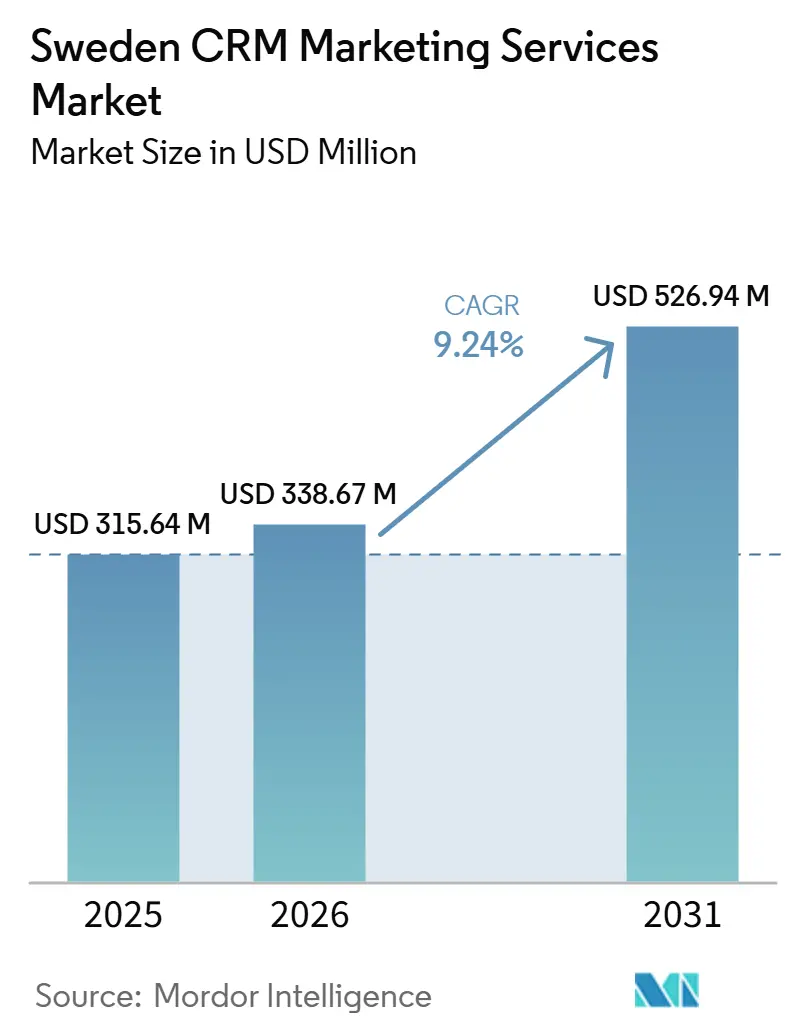
| Base Year Market Size (2025) | USD 315.64 Million |
| Market Size (2026) | USD 338.67 Million |
| Market Size (2031) | USD 526.94 Million |
| Growth Rate (2026 - 2031) | 9.24 % |
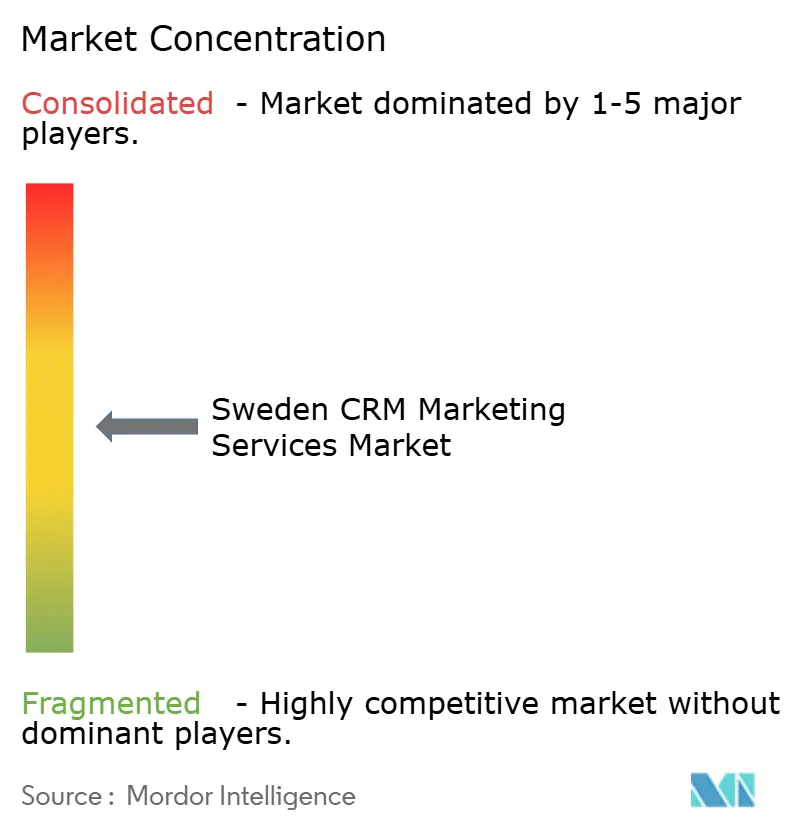
| Market Concentration | Medium |
Major Players *Disclaimer: Major Players sorted in no particular order Image © Mordor Intelligence. Reuse requires attribution under CC BY 4.0. | |
Sweden CRM Marketing Services Market Analysis by Mordor Intelligence
The Sweden CRM marketing services market size was valued at USD 315.64 million in 2025 and is forecast to reach USD 526.94 million by 2031, at a CAGR of 9.24% during 2026-2031. The Sweden CRM marketing services market is benefiting from a policy setting that gives AI, data, digital skills, public administration digitization, and connectivity a clear place in national priorities, which keeps enterprise software spending tied to broader modernization plans. This support is reinforced by public funding commitments and Sweden's strong ICT talent base, which together reduce adoption friction and make complex CRM programs more practical for both private and public organizations. The Sweden CRM marketing services market is also widening beyond core deployment work because AI transparency obligations and privacy-led data strategies are pushing companies to redesign consent processes, profiling controls, and first-party data models inside CRM environments. Industrial manufacturing remains a major anchor for demand because CRM upgrades often run alongside ERP modernization, which creates longer implementation cycles and larger service contracts than lighter SaaS-led projects. Competition in the Sweden CRM marketing services market remains strongest between global platform ecosystems at the large-enterprise end and Nordic specialists in the mid-market, while data residency demands and shortages of senior CRM architects continue to lift demand for managed services, compliance support, and integration expertise.
Key Report Takeaways
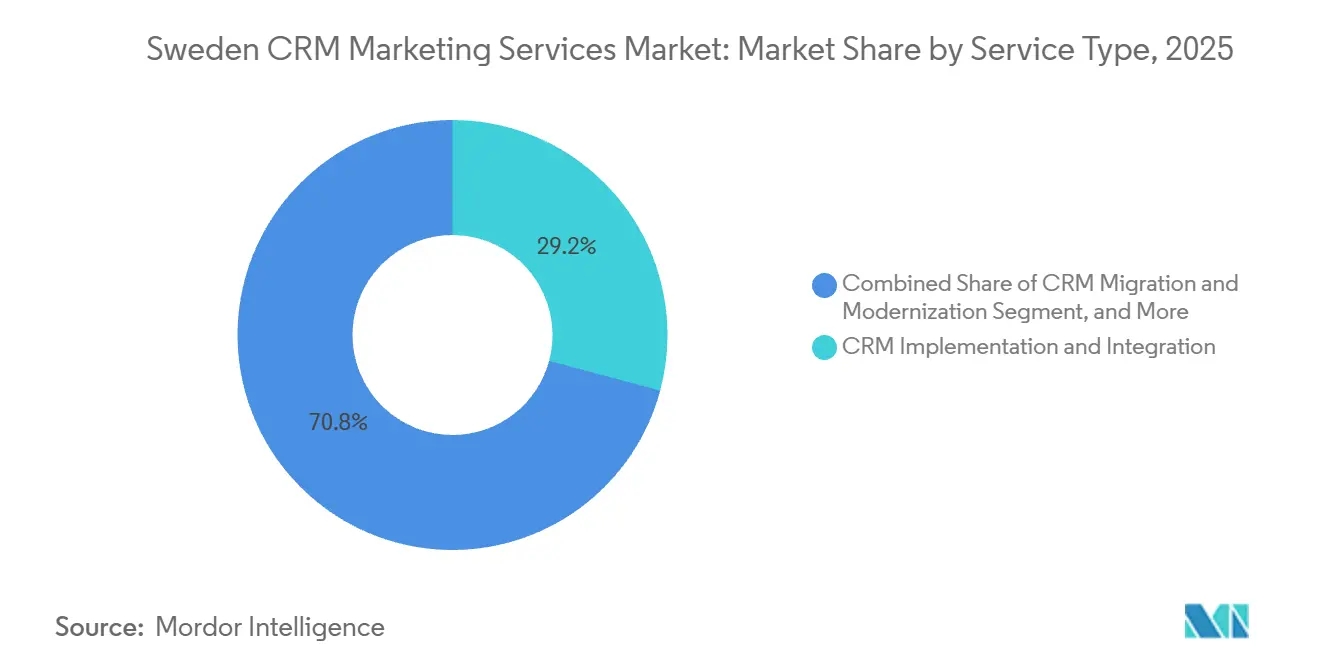
- By service type, CRM Implementation and Integration held 29.16% share in 2025, while CRM Managed Services is projected to expand at a 10.76% CAGR through 2031.
- By enterprise size, Large Enterprises held 68.34% share of the Sweden CRM marketing services market in 2025, while Small and Medium Enterprises are projected to record the fastest CAGR at 10.18% through 2031.
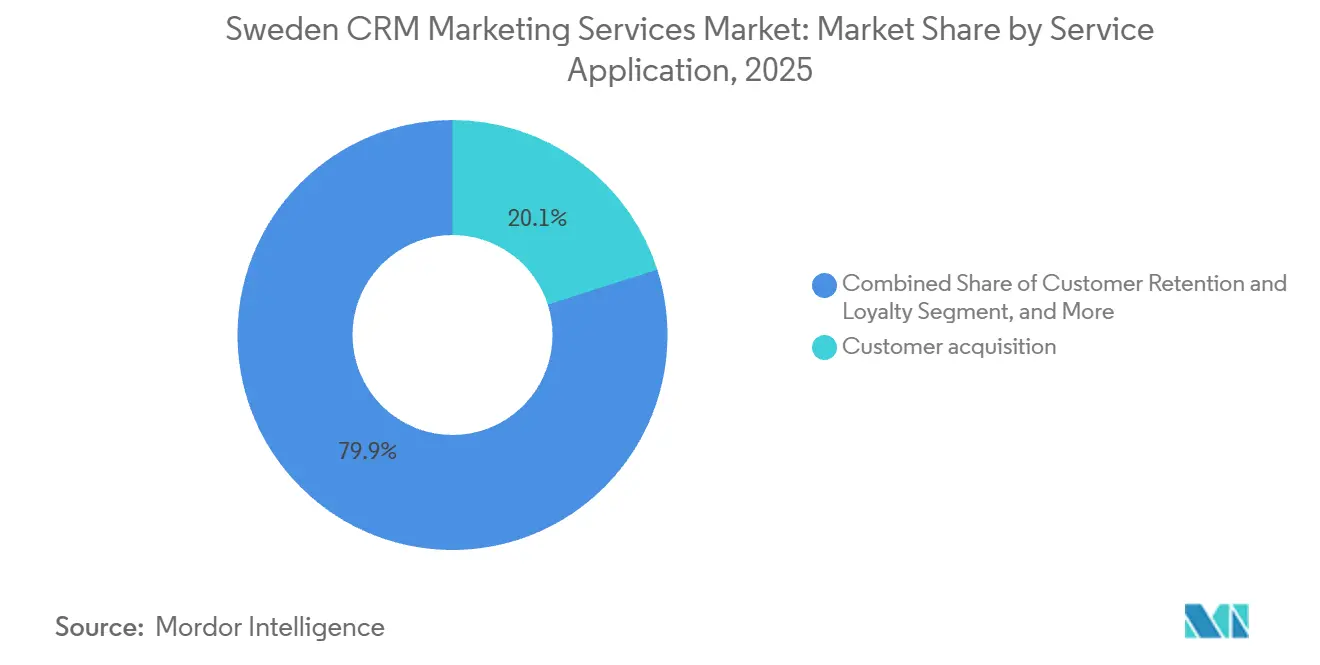
- By service application, Customer Acquisition accounted for 20.08% share of the Sweden CRM marketing services market in 2025, while Personalization Services is projected to advance at an 11.42% CAGR through 2031.
- By end-user industry, Industrial Manufacturing held 21.84% share in 2025, while Retail and E-commerce is projected to expand at a 10.94% CAGR through 2031.
Note: Market size and forecast figures in this report are generated using Mordor Intelligence’s proprietary estimation framework, updated with the latest available data and insights as of January 2026.
Sweden CRM Marketing Services Market Trends and Insights
Drivers Impact Analysis*
| Driver | (~) % Impact on CAGR Forecast | Geographic Relevance | Impact Timeline |
|---|---|---|---|
| Rising Demand for AI-Driven Customer Journey Orchestration | +2.5% | National, with high concentration in Stockholm and Gothenburg enterprise clusters | Short term (≤ 2 years) |
| Expansion of First-Party Data Activation in Privacy-Led Marketing | +1.8% | National, GDPR enforcement applies uniformly across Sweden, and IMY regulatory influence shapes compliance investment | Short term (≤ 2 years) |
| Growth of Revenue Operations Alignment Across Sales and Marketing | +1.3% | National, with early adoption concentrated among growth-stage SaaS companies in the Stockholm tech ecosystem | Medium term (2-4 years) |
| Wider Adoption of Embedded CRM in Mid-Market SaaS Stacks | +1.0% | National, strongest in technology-dense clusters in Stockholm, Gothenburg, and Malmö | Medium term (2-4 years) |
| Increasing Need for Verticalized Customer Engagement Workflows | +0.7% | National, with sector-specific concentration in industrial manufacturing clusters and BFSI hubs | Long term (≥ 4 years) |
| Demand for Real-Time Consent and Preference Management | +0.5% | National, ePrivacy Directive and GDPR compliance factors apply uniformly, and IMY enforcement drives urgency | Short term (≤ 2 years) |
| Source: Mordor Intelligence | |||
Rising Demand for AI-Driven Customer Journey Orchestration
AI-led journey orchestration has moved closer to a core delivery requirement in the Sweden CRM marketing services market, because buyers now expect CRM systems to connect lead capture, nurture, service response, and next-step recommendations in one operating flow. Sweden's 2025-2030 digitalization strategy placed AI and data across all 5 strategic focus areas, which gave enterprise buyers a stronger policy signal to fund applied AI projects inside customer engagement systems.[1] This shift is changing what implementation partners need to deliver, because clients increasingly require support with agent oversight, workflow logic, prompt controls, and real-time data movement rather than only front-end campaign setup. The skills needed for that work remain specialized, even in a digitally advanced country, which raises the value of providers that can support the full lifecycle after go-live. The EU AI Act is also making governance more visible in CRM-related buying decisions, especially where automated profiling and AI-assisted marketing actions must be documented and disclosed. As a result, the Sweden CRM marketing services market is seeing stronger demand for service firms that can combine orchestration work with operational governance and ongoing model supervision.
Expansion of First-Party Data Activation in Privacy-Led Marketing
Privacy-led marketing is turning first-party data activation into a system design issue rather than a campaign choice, which is widening the implementation scope inside the Sweden CRM marketing services market. Companies that once depended on lighter audience tools are now using CRM environments as the main place to organize consent records, segmentation rules, preference histories, and customer communication logic. That change matters because the value of the CRM build increasingly depends on whether data collection, retention, and activation can operate under stricter privacy controls without interrupting marketing execution. The legal environment continues to support this direction, because the Inteligo Media ruling reinforced that profiling and segmentation activities still require a proper legal basis under GDPR, even when soft opt-in arguments are raised for outbound email. The Sweden CRM marketing services market is therefore expanding into consent architecture, compliance-oriented data modeling, and CRM-native governance work that goes beyond traditional deployment tasks. This also explains why first-time CRM rollouts are becoming more strategic for mid-market firms that need their own compliant audience foundation as external data signals weaken.
Growth of Revenue Operations Alignment Across Sales and Marketing
Revenue operations is becoming a practical reason for CRM platform selection in Swedish B2B organizations, especially where management wants one operating view across marketing, sales, pipeline control, and customer success. A 2025 review of Nordic RevOps practices showed that CRM systems were already widely used as the central data layer, while sales engagement tools and advanced pipeline analytics were materially less mature. That gap is important for service providers because it turns CRM work into a broader integration project that links attribution, forecasting, handoff rules, and reporting across teams. As companies scale, disconnected tools become harder to manage, which makes shared definitions, data governance, and common workflow design more valuable than isolated feature additions. The Sweden CRM marketing services market is benefiting from that pattern because consulting and strategy work tends to grow before larger implementation and managed services projects begin. This creates a durable pipeline for providers that can align commercial processes across departments instead of treating CRM as only a marketing system.
Wider Adoption of Embedded CRM in Mid-Market SaaS Stacks
Mid-market buyers are increasingly adopting CRM capabilities as part of broader SaaS environments, which is changing how service demand is formed in the Sweden CRM marketing services market. These deployments are often smaller, quicker to configure, and more standardized than large-enterprise programs, but they still generate recurring demand for onboarding, customization, integration, and user support. Upsales reinforced this direction in May 2026 when it launched AI Workspace, which added AI-based deal recommendations, pipeline analytics, and company-level intelligence directly into CRM workflows for Nordic teams. The practical effect is that CRM adoption feels less disruptive for smaller firms, because core prospecting and revenue workflows can be activated inside tools that already fit their operating model. That lowers the historical cost and complexity barrier that kept many smaller companies outside the category for longer than large enterprises. The Sweden CRM marketing services market is therefore gaining breadth through repeatable mid-market delivery models rather than only through a small number of very large transformation programs.
Restraints Impact Analysis*
| Restraint | (~) % Impact on CAGR Forecast | Geographic Relevance | Impact Timeline |
|---|---|---|---|
| Data Residency Complexity Across Multicloud CRM Deployments | -1.6% | National, compounded in public sector, BFSI, and healthcare segments operating under stricter data localization requirements, and IMY oversight heightens scrutiny on subprocessors | Medium term (2-4 years) |
| Integration Friction with Legacy ERP and Commerce Systems | -1.2% | National, particularly acute in industrial manufacturing and government and public administration with large SAP ECC and legacy ERP installed bases | Medium term (2-4 years) |
| High Cost of Skilled CRM Consultants and Solution Architects | -0.8% | National, with the shortage most visible in the Stockholm metropolitan area where global technology firms compete for senior talent | Short term (≤ 2 years) |
| Model Governance Gaps in AI-Assisted Marketing Automation | -0.6% | National, EU AI Act compliance and GDPR profiling requirements apply uniformly across Sweden | Short term (≤ 2 years) |
| Source: Mordor Intelligence | |||
Data Residency Complexity Across Multicloud CRM Deployments
Data residency remains one of the clearest constraints on project speed in the Sweden CRM marketing services market, because modern CRM stacks rarely operate through a single vendor alone. A typical deployment can involve multiple connected tools for email delivery, enrichment, analytics, personalization, and identity handling, and each one adds another layer of contractual and audit review. Microsoft acknowledged the scale of this issue in February 2025 when it completed the EU Data Boundary for the Microsoft Cloud, allowing core Microsoft 365, Dynamics 365, Power Platform, and most Azure data to be stored and processed within EU and EFTA regions. Even with stronger first-party vendor commitments, Swedish buyers still need confidence across the full subprocessor chain, which adds time and cost to procurement and implementation. This is especially relevant in the public sector, BFSI, and healthcare, where a single weak compliance link can disrupt vendor selection or force redesign late in a project. The Sweden CRM marketing services market, therefore, sees slower conversion on some deals, even as the same issue creates follow-on demand for compliance consulting and managed oversight.
Integration Friction with Legacy ERP and Commerce Systems
Legacy ERP and commerce environments continue to slow CRM programs in Sweden, especially in sectors where installed systems were built for product control and transaction processing rather than modern customer engagement. IBM noted in 2025 that CRM and ERP integration frequently remains difficult because many enterprise systems still operate as isolated silos and require deliberate work to share data effectively.[2] In practice, that means implementation teams spend more time on middleware design, master data alignment, field mapping, and process exceptions than buyers expect at the start of a project. The issue is particularly visible in manufacturing and government environments, where legacy estates are broader and where replacement timelines do not always match CRM upgrade cycles. This creates commercial pressure for service providers, because fixed-fee work can drift into scope expansion when ERP complexity is underestimated. The Sweden CRM marketing services market therefore, carries a structural execution risk that favors firms with deeper enterprise integration experience and stronger pricing discipline.
*Our forecasts treat driver/restraint impacts as directional, not additive. The impact forecasts reflect baseline growth, mix effects, and variable interactions.
Segment Analysis
By Service Type: Implementation Anchors Revenue as Managed Services Accelerate
CRM Implementation and Integration held 29.16% of the Sweden CRM marketing services market size in 2025, which made it the largest revenue contributor within service type. That lead reflects the steady volume of greenfield deployments, platform migrations, and multi-system integration programs still running across Swedish organizations. The segment also acts as the first commercial entry point for service providers, because most downstream work depends on an effective initial design and deployment stage. In the Sweden CRM marketing services market, this keeps implementation work closely tied to longer client relationships rather than to one-off technical delivery. Migration and modernization are also gaining relevance as firms review older on-premises environments and prepare for cloud-native workflows, data restructuring, and broader automation.
CRM Managed Services is projected to grow at a 10.76% CAGR between 2026 and 2031, which shows the shift toward recurring operational support in the Sweden CRM marketing services market. Many Swedish buyers now prefer predictable operating expenditure over large internal service teams, especially when CRM environments include frequent releases, AI features, and connected data tools. Lime Technologies stated in its Q1 2026 interim report that its strategic mix is moving further toward annual recurring revenue from software and managed services, which it linked to stronger long-term profitability. That position matters because it reflects how providers are reshaping their revenue base around ongoing service relationships instead of project-heavy delivery. Lime also launched a Workflows module built on the European n8n automation platform, which is likely to increase demand for platform-specific training, customization, and post-deployment support among Swedish users.

By Enterprise Size: Large Enterprises Lead, but SME Momentum Builds on Structural Drivers
Large Enterprises held 68.34% of the Sweden CRM marketing services market share in 2025, which kept spending concentrated in organizations with broad commercial footprints and deeper implementation budgets. These buyers often run multi-department, multi-country, and multi-instance CRM environments that require external support across architecture, governance, integration, and managed operations. In manufacturing, financial services, and retail, many large Swedish organizations also work under platform standards set by global parent groups, which reinforces demand around Salesforce, Microsoft Dynamics 365, and SAP ecosystems. That structure supports longer contracts and a broader service mix than is typical in the smaller company segment. It also helps explain why the upper end of the Sweden CRM marketing services industry remains relatively concentrated around global platforms and their partner networks.
Small and Medium Enterprises are projected to grow at a 10.18% CAGR between 2026 and 2031, which makes them the fastest-moving enterprise cohort in the Sweden CRM marketing services market. The main driver is not only lower software cost, but also the spread of embedded CRM functions inside SaaS products that reduce setup friction for smaller teams. Upsales added AI Workspace in May 2026 with AI-powered deal recommendations, pipeline analytics, and company intelligence, which shows how local platforms are packaging advanced functionality into easier operating models for growing firms.[3] As these tools become easier to activate, service demand shifts toward repeatable onboarding, standard integrations, user training, and recurring support packages rather than large bespoke programs. This gives the Sweden CRM marketing services industry a broader growth base, because smaller companies can now enter the category earlier in their commercial maturity cycle.
By Service Application: Personalization Outpaces Acquisition as ROI Attribution Shifts
Customer Acquisition held 20.08% share in 2025, which kept it as the largest service application within the Sweden CRM marketing services market. That position reflects the long-standing role of CRM in lead generation, campaign execution, pipeline support, and prospect conversion. Many organizations still treat acquisition activity as the first justification for CRM spending, because it is easier to connect those programs to volume, response, and sales pipeline outcomes. The remaining application groups, including retention and loyalty, campaign management, marketing automation, analytics and insights, omnichannel engagement, and personalization, continue to serve different points in the customer lifecycle. This has created a balanced application structure, but one where growth momentum is now moving beyond pure prospecting use cases.
Personalization Services is projected to grow at an 11.42% CAGR between 2026 and 2031, which makes it the fastest-growing application area in the Sweden CRM marketing services market. Consumer-facing brands are increasing spending on one-to-one engagement because retention economics and customer lifetime value now carry more weight in CRM budget decisions. Swedish retail CRM providers have been building around that demand pattern, linking loyalty management, behavioral recommendations, and product discovery into the same service stack used by marketing teams. This reflects a wider shift in the Sweden CRM marketing services market, where buyers are placing more value on measurable improvement from existing customer relationships than on a pure expansion of acquisition volume. As that budget mix changes, providers with stronger personalization, retention, and orchestration capabilities are likely to capture a larger share of service demand.
By End-user Industry: Manufacturing Leads, while Retail and E-commerce Speeds Up
Industrial Manufacturing held 21.84% of the Sweden CRM marketing services market size in 2025, which made it the largest end-user segment in the report scope. This share reflects the country's strong industrial base and the commercial complexity that comes with distributor management, strategic accounts, long B2B sales cycles, and multi-country customer relationships. CRM work in this segment often overlaps with ERP modernization, which increases the value of integration and process design services. Other end-user groups, including BFSI, healthcare and life sciences, IT and telecom, government and public administration, and other industries, each bring distinct demand patterns shaped by compliance, service coordination, and recurring customer management needs. The public sector opportunity is also growing as Sweden's digitalization strategy pushes public bodies toward AI-enabled digital services and better data use in service delivery.
Retail and E-commerce is projected to expand at a 10.94% CAGR between 2026 and 2031, which makes it the fastest-growing end-user group in the Sweden CRM marketing services market. This momentum comes from stronger demand for loyalty programs, personalized communications, and omnichannel engagement as retail competition intensifies across Sweden and the broader Nordic region. The segment also benefits from a clearer line between CRM activity and measurable outcomes, because brands can see the effect of personalization and retention programs more directly than in many heavier industrial settings. That has encouraged providers to sharpen their product and service offers around customer data use, campaign timing, and behavioral response management. Within the Sweden CRM marketing services industry, this makes retail and e-commerce one of the clearest areas where AI-enabled engagement tools are translating into faster service demand growth.
Geography Analysis
The Sweden CRM marketing services market size stood at USD 315.64 million in 2025, and the national market is projected to grow at a 9.24% CAGR through 2031. Sweden's position is supported by a rare mix of institutional backing, digital infrastructure, and labor-market readiness that strengthens both software demand and service delivery capacity. The European Commission reported in 2025 that 85% of Swedish citizens believed the digitalization of public and private services was improving daily life, which signals a broad acceptance of digital service models across the country.[4] The same report showed that Sweden had the largest share of ICT graduates among EU member states and a high level of enterprise ICT training, which supports both adoption and implementation depth. Sweden's 2025-2030 digitalization strategy added further weight by making AI and data cross-cutting priorities in both private and public modernization agendas.
Within the Nordic region, Sweden functions as a practical center for CRM consulting, implementation, and managed service activity because it combines enterprise demand with a strong local provider base. Swedish-headquartered and Nordic-native firms continue to treat the home market as a proving ground for product updates, service models, and integration capabilities before expanding further across Europe. SuperOffice's Q1 2026 product update added Fortnox ERP synchronization for Swedish customers, which shows how vendors are tailoring capabilities to local operating needs rather than serving the market through generic regional templates. Lime Technologies has also been extending its footprint from Sweden into other European markets, which underlines the role of Sweden as both a demand center and an export base for CRM service expertise. This regional position gives the Sweden CRM marketing services market more weight than its population size alone would suggest.
Geographic demand inside Sweden is also shaped by procurement needs in regulated and enterprise-heavy sectors such as industrial manufacturing, BFSI, healthcare, and public administration. Data sovereignty requirements are especially important in these segments, and Microsoft addressed part of that concern through its EU Data Boundary for Microsoft Cloud services in 2025. That does not remove all friction, but it improves the attractiveness of providers that can show stronger control over hosting, processing, and subprocessor arrangements. As a result, the Sweden CRM marketing services market continues to reward vendors and partners that combine technical depth with local compliance credibility.
Competitive Landscape
The Sweden CRM marketing services market has a dual structure, with a more concentrated enterprise tier and a far more fragmented mid-market service layer. Global ecosystems such as Salesforce, Microsoft Dynamics 365, HubSpot, Oracle, SAP, and Adobe remain strong in large-account environments because they offer broader platform scope, established partner networks, and deeper international support coverage. At the same time, Nordic specialists compete by offering local-language support, closer alignment with EU data expectations, and stronger process depth in specific verticals. Lime Technologies has been explicit about this strategy, describing verticalization around sectors such as utilities, real estate, and membership organizations as a core way to defend margins and win mid-market contracts.[5] This means competition in the Sweden CRM marketing services market is not based only on software breadth, but also on who can translate platform capability into lower execution risk for buyers.
Several recent strategic moves show how providers are responding to that pressure. Microsoft completed the EU Data Boundary for its cloud services in 2025, which directly strengthened its position with buyers that place high weight on regional data handling and transparency. Upsales launched AI Workspace in May 2026, which signaled a push to make AI-driven deal support and prospect intelligence more accessible for Nordic growth companies. SuperOffice added Fortnox ERP synchronization for Swedish customers in Q1 2026, which reflects a practical strategy of improving local system fit rather than competing only on headline feature breadth. Lime also introduced its Workflows module on a European automation base, which supports a stronger value proposition around AI, automation, and data sovereignty for customers that prefer regional alternatives. Together, these moves show that the Sweden CRM marketing services market is being shaped by product adaptation, AI enablement, and compliance positioning at the same time.
A further competitive layer is now forming around AI governance, where buyers need help documenting automated marketing actions and profiling logic under the EU AI Act . No single provider appears to have scaled that capability into a clearly dominant standalone service line, which leaves room for specialists that can connect technical delivery with governance controls. The mid-market, therefore, remains open to selective competition, even though enterprise contracts are harder to win without platform ecosystem scale. Overall, the Sweden CRM marketing services market remains moderately concentrated at the top but still open enough in the service layer for local and regional firms to defend share through specialization, integrations, and compliance-led differentiation.
Sweden CRM Marketing Services Industry Leaders
-
Salesforce, Inc.
-
Microsoft Corporation
-
HubSpot, Inc.
-
Oracle Corporation
-
SAP SE
- *Disclaimer: Major Players sorted in no particular order
Recent Industry Developments
- June 2026: Oras Group, a Nordic multi-brand bathroom and plumbing supplier, launched a multi-year Group-wide CRM transformation in collaboration with digital consultancy NoA Ignite, deploying Salesforce Agentforce across sales, service, marketing, and field service functions. The program begins its rollout with Nordic markets, replacing a fragmented legacy CRM landscape with a unified Salesforce platform, before extending to Central European operations in subsequent phases.
- May 2026: Upsales, a Stockholm-based CRM platform engineered for SaaS and subscription businesses, launched AI Workspace on May 12, introducing AI-powered deal recommendations, pipeline analytics, and European company database access as core platform capabilities for Nordic sales and marketing teams.
- May 2026: SAP announced the rebranding and strategic repositioning of its Business Technology Platform, BTP, as the SAP Business AI Platform, SAP BAIP, at SAP Sapphire 2026, centralizing AI agents, Business Data Cloud, and an AI Agent Hub under a unified AI-first product architecture.
- November 2025: EuroForce, a Salesforce consulting firm with established Sweden operations, opened a new office in Helsinki, Finland, expanding its Nordic AI and Salesforce advisory reach. The Helsinki entity, EuroForce Finland Oy, serves Finnish and broader Nordic enterprises pursuing Salesforce-based AI agent and architecture projects.
Sweden CRM Marketing Services Market Report Scope
The Sweden CRM marketing services market comprises revenues generated from professional and managed services that support the planning, deployment, integration, modernization, optimization, operation, and maintenance of customer relationship management (CRM) and marketing technology environments. The market includes CRM strategy and consulting, CRM implementation and integration, CRM migration and modernization, CRM managed services, and CRM training and support delivered to organizations across Brazil.
The Sweden CRM Marketing Services Market Report is segmented by Service Type (CRM Strategy and Consulting, CRM Implementation and Integration, CRM Migration and Modernization, CRM Managed Services, and CRM Training and Support), Enterprise Size (Large Enterprises, and Small and Medium Enterprises), Service Application (Customer Acquisition, Customer Retention and Loyalty, Campaign Management Services, Marketing Automation Services, Customer Analytics and Insights, Omnichannel Customer Engagement, and Personalization Services), and End-user Industry (BFSI, Healthcare and Life Sciences, Information Technology and Telecom, Retail and E-Commerce, Industrial Manufacturing, Government and Public Administration, and Other End-user Industries). The Market Forecasts are Provided in Terms of Value (USD).
| CRM Strategy and Consulting |
| CRM Implementation and Integration |
| CRM Migration and Modernization |
| CRM Managed Services |
| CRM Training and Support |
| Large Enterprises |
| Small and Medium Enterprises |
| Customer Acquisition |
| Customer Retention and Loyalty |
| Campaign Management Services |
| Marketing Automation Services |
| Customer Analytics and Insights |
| Omnichannel Customer Engagement |
| Personalization Services |
| BFSI |
| Healthcare and Life Sciences |
| Information Technology and Telecom |
| Retail and E-commerce |
| Industrial Manufacturing |
| Government and Public Administration |
| Other End-user Industries |
| By Service Type | CRM Strategy and Consulting |
| CRM Implementation and Integration | |
| CRM Migration and Modernization | |
| CRM Managed Services | |
| CRM Training and Support | |
| By Enterprise Size | Large Enterprises |
| Small and Medium Enterprises | |
| By Service Application | Customer Acquisition |
| Customer Retention and Loyalty | |
| Campaign Management Services | |
| Marketing Automation Services | |
| Customer Analytics and Insights | |
| Omnichannel Customer Engagement | |
| Personalization Services | |
| By End-user Industry | BFSI |
| Healthcare and Life Sciences | |
| Information Technology and Telecom | |
| Retail and E-commerce | |
| Industrial Manufacturing | |
| Government and Public Administration | |
| Other End-user Industries |
Key Questions Answered in the Report
What is the size of the Sweden CRM marketing services market?
The Sweden CRM marketing services market was valued at USD 315.64 million in 2025 and is projected to reach USD 526.94 million by 2031, growing at a 9.24% CAGR during 2026-2031.
Which service type leads in Sweden CRM marketing services?
CRM Implementation and Integration led the market in 2025 with a 29.16% share, reflecting strong demand for deployments, migrations, and multi-system integration work.
Which enterprise group is expanding the fastest in Sweden?
Small and Medium Enterprises are projected to grow at a 10.18% CAGR through 2031, supported by embedded CRM functions and easier SaaS-based deployment models.
What is driving faster demand for personalization services in Sweden?
Personalization Services is projected to grow at an 11.42% CAGR, as brands place more emphasis on customer lifetime value, loyalty, and one-to-one engagement.
Which end-user segment contributes the most revenue today?
Industrial Manufacturing held the largest share at 21.84% in 2025, supported by long sales cycles, distributor management needs, and overlap with ERP modernization.
Why does data residency matter so much for CRM projects in Sweden?
Buyers in regulated sectors need stronger control over hosting, processing, and subprocessors, which can slow projects but also increase demand for compliance support and managed services.