
Nordic CRM Marketing Services Market Size and Share
Market Overview
| Study Period | 2020 - 2031 |
|---|---|
| Forecast Data Period | 2026 - 2031 |
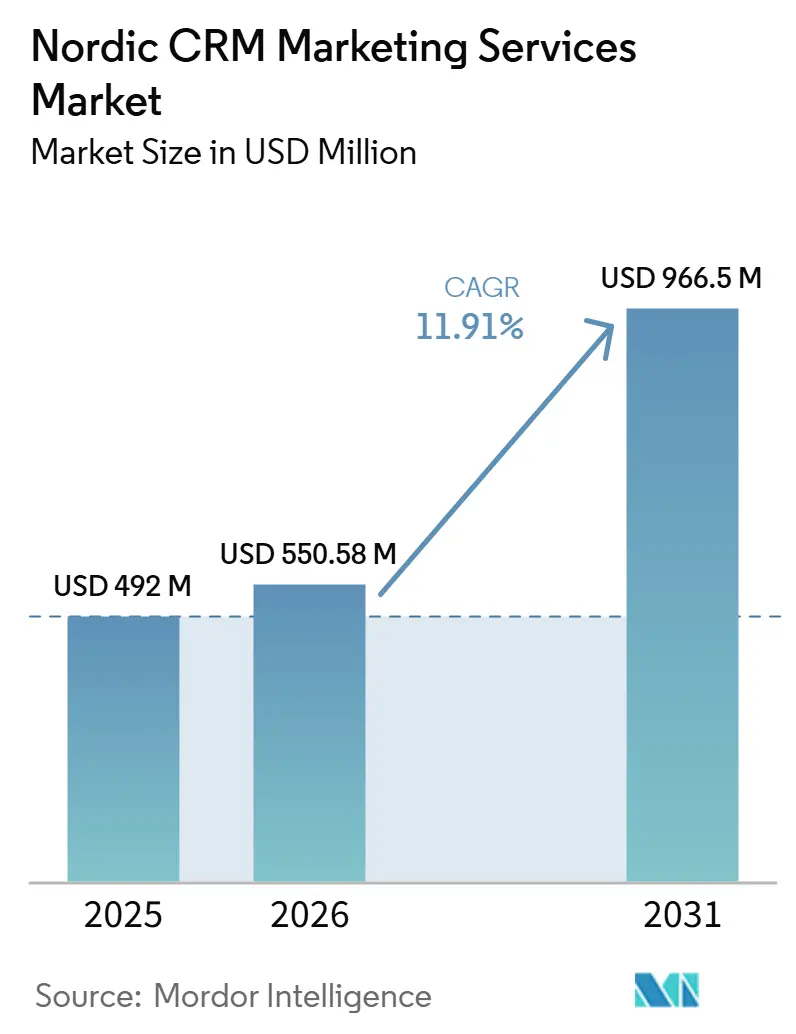
| Base Year Market Size (2025) | USD 492 Million |
| Market Size (2026) | USD 550.58 Million |
| Market Size (2031) | USD 966.5 Million |
| Growth Rate (2026 - 2031) | 11.91 % |
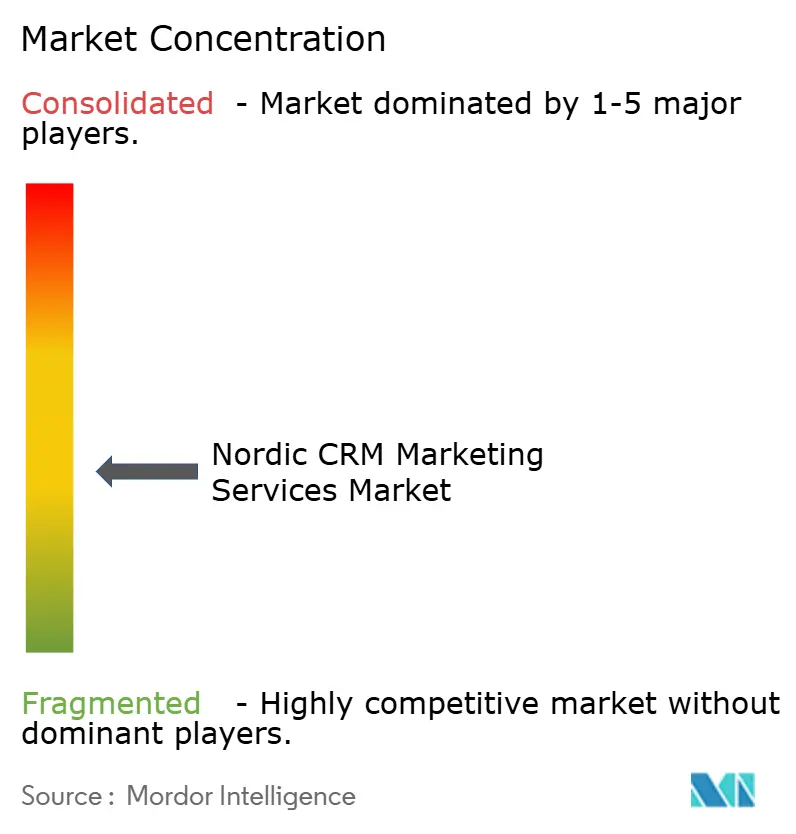
| Market Concentration | Medium |
Major Players *Disclaimer: Major Players sorted in no particular order Image © Mordor Intelligence. Reuse requires attribution under CC BY 4.0. | |
Nordic CRM Marketing Services Market Analysis by Mordor Intelligence
The Nordic CRM marketing services market size is projected to expand from USD 492.00 million in 2025 and USD 550.58 million in 2026 to USD 966.50 million by 2031, registering a CAGR of 11.91% between 2026 and 2031. The Nordic CRM marketing services market is growing on the back of stronger enterprise demand for AI-native customer engagement programs and the region’s long-standing preference for cloud-first technology setups. The service scope is also widening because companies are no longer limiting CRM work to implementation alone, and are adding workflow management, platform migration, data hygiene, consent architecture, and ongoing managed support to the same engagement. The addressable base remains broad because a large share of European companies still do not run a formal CRM system, which leaves room for first-time adoption as well as replacement demand. Compliance pressure is also increasing the value of service providers because consent design, documentation, and audit readiness are now part of commercial CRM decisions in the region. The Nordic CRM marketing services market, therefore, remains supported by both new adoption and platform modernization, while competitive advantage is moving toward firms that combine platform depth with localized compliance capability.
Key Report Takeaways
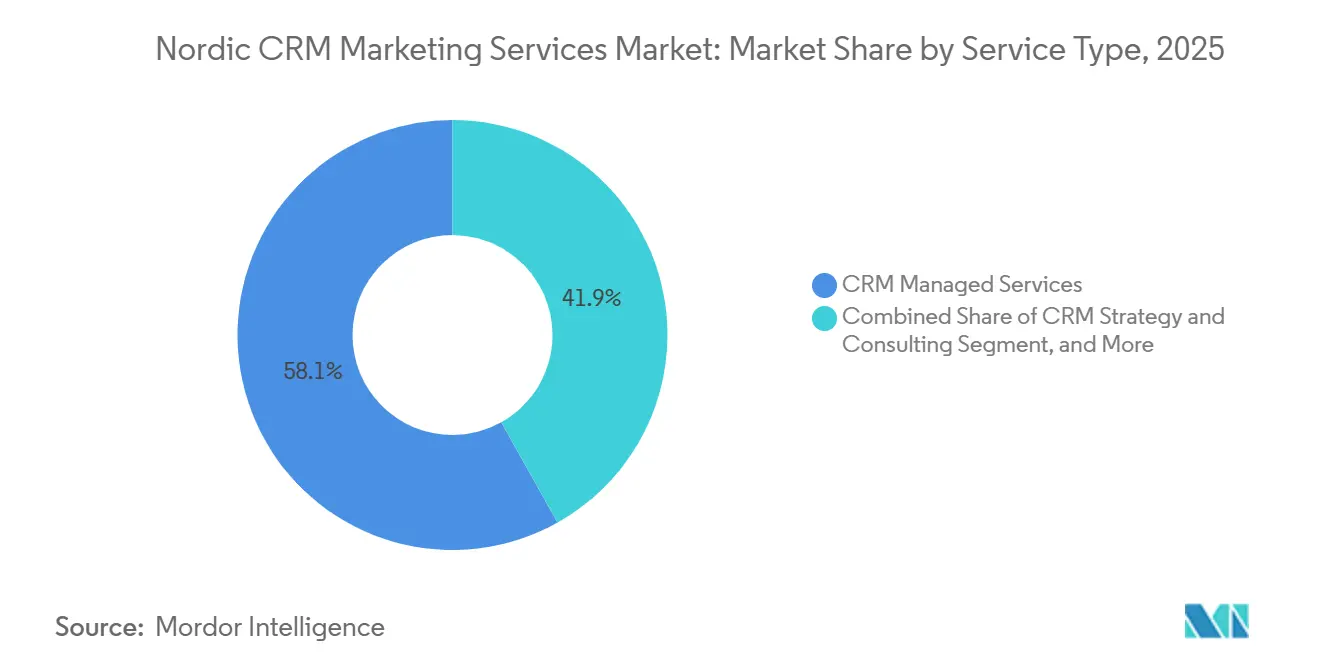
- By service type, CRM managed services held 58.12% of the Nordic CRM marketing services market revenue in 2025, while CRM migration and modernization is projected to expand at a 13.91% CAGR through 2031.
- By enterprise size, large enterprises accounted for 68.41% of the Nordic CRM marketing services market share in 2025, while small and medium enterprises are projected to record the highest CAGR at 14.72% through 2031.
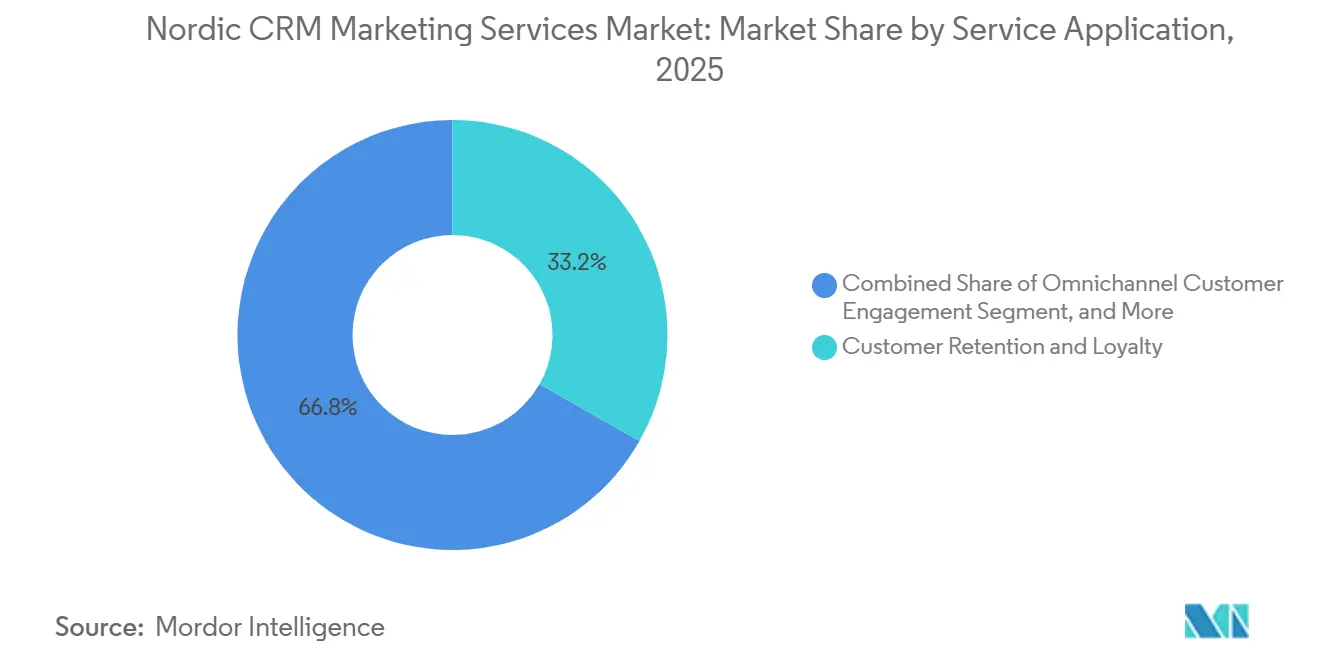
- By service application, customer retention and loyalty captured 33.21% of the Nordic CRM marketing services market share in 2025, while personalization services are expected to advance at a 13.56% CAGR through 2031.
- By end-user industry, BFSI held 35.67% share in 2025, while healthcare and life sciences are projected to grow at a 13.04% CAGR through 2031.
- By geography, Sweden led the Nordic CRM marketing services market with 55.37% market share in 2025, while Finland is projected to record the fastest CAGR of 14.38% through 2031.
Note: Market size and forecast figures in this report are generated using Mordor Intelligence’s proprietary estimation framework, updated with the latest available data and insights as of January 2026.
Market Trends and Insights
Drivers Impact Analysis of Nordic CRM Marketing Services Market*
| Driver | (~) % Impact on CAGR Forecast | Geographic Relevance | Impact Timeline |
|---|---|---|---|
| Increased Use of AI for Lead Scoring, Segmentation, and Next-Best-Action | +3.2% | Nordic-wide, strongest uptake in Sweden and Finland | Short term (≤ 2 years) |
| Demand for GDPR-First Personalization and Consent-Oriented Engagement | +2.4% | Nordic core, enforcement-led pull in Norway and Denmark | Medium term (2-4 years) |
| Rising CRM and Marketing Automation Adoption Across Nordic Enterprises | +2.0% | Nordic-wide, Sweden and Denmark as primary adopters | Medium term (2-4 years) |
| Rapid Shift from Point Solutions to Unified Customer Data Platforms | +1.8% | Nordic-wide, concentrated in Sweden and Denmark | Short term (≤ 2 years) |
| Legacy MarTech Stack Consolidation by Mid-Market Buyers | +1.4% | Sweden, Denmark, Norway | Medium term (2-4 years) |
| Expansion of Nordic B2B SaaS and Recurring-Revenue Go-To-Market Models | +0.9% | Sweden, Finland | Long term (≥ 4 years) |
| Source: Mordor Intelligence | |||
Increased Use of AI for Lead Scoring, Segmentation, and Next-Best-Action
AI is moving from a useful add-on to a core operating layer in the Nordic CRM marketing services market, especially in programs tied to lead scoring, account prioritization, audience segmentation, and next-best-action design. This shift is changing what buyers expect from service providers, as they now want model tuning, workflow orchestration, data quality controls, and measurement support, rather than just basic campaign execution. Goava promoted AI-powered prospecting tools for Nordic B2B sales teams in 2026, demonstrating how AI-based account discovery and signal detection are being embedded directly into CRM workflows across the region. Nordea also described a shared AI-driven digital backbone across four Nordic markets that supports more personalized customer nudges and lifecycle engagement, confirming that large regional enterprises are tying CRM improvements to AI-supported customer management at scale. In the Nordic CRM marketing services market, this underscores the need for ongoing external support, as AI outputs depend on stable customer data, governed consent flows, and coordinated channel execution. It also shifts commercial models toward longer service relationships, as buyers need repeated optimization after the initial deployment rather than a one-time implementation.
Demand for GDPR-First Personalization and Consent-Oriented Engagement
The Nordic CRM marketing services market is also supported by stricter consent-handling requirements, as personalization in this region must sit on a clear legal and operational foundation before a single campaign can move forward. The European Data Protection Board requires consent to be freely given, specific, informed, and unambiguous, which makes consent capture and proof management a direct part of CRM design rather than a separate legal review step.[1] Norway’s Datatilsynet imposed a NOK 20 million (USD 1.82 million) fine on Elkjøp in 2025 for bundled loyalty-club consent failures, underscoring how visible the commercial risk can become when consent architecture falls short. In the Nordic CRM marketing services market, this has made consent management platform integration, retroactive consent reviews, and record-keeping design part of the standard project scope for many retail and BFSI programs. Nordea’s 2025 investor material also linked improved CRM and case-handling tools with a shared digital backbone used across four Nordic markets, showing that compliant personalization is being treated as a scale capability rather than a narrow compliance fix. Providers that can combine campaign design with GDPR-ready architecture, therefore, hold a stronger position, as buyers want a single operating model that balances engagement growth and regulatory discipline.
Rising CRM and Marketing Automation Adoption Across Nordic Enterprises
The Nordic CRM marketing services market continues to benefit from broader CRM and marketing automation adoption as more organizations move beyond basic contact management into structured customer journey execution. This shift is not limited to large corporations, as SaaS delivery has lowered the entry barrier for smaller firms and made repeatable deployment models more viable across the region. Mordor Intelligence reported that small and medium enterprises accounted for 61.55% of the Nordic SaaS market in 2025 and are projected to expand at a 17.35% CAGR through 2031, supporting the view that the software base needed for CRM service adoption is becoming broader among smaller firms. SuperOffice reported 20% ARR growth in 2025 and tied that performance to stronger SMB demand across Nordic and European markets, pointing to steady buyer appetite for commercial software that can later support surrounding service revenue. BEC Financial Technologies also rebuilt Salesforce Marketing Cloud into a modular digital marketing engine for Danish banks, demonstrating how sector-specific implementations are becoming templates that can be reused across multiple institutions. As adoption spreads, the Nordic CRM marketing services market gains recurring work in administration, journey design, release management, integration support, and user enablement, expanding the service pool beyond the initial platform rollout.
Rapid Shift From Point Solutions to Unified Customer Data Platforms
A further support factor for the Nordic CRM marketing services market is the move away from fragmented point solutions toward unified customer data platforms that connect CRM, marketing automation, and analytics within a single, governed structure. This change matters because AI-led orchestration works better when customer identity, consent status, engagement history, and channel data are available in a single place rather than being split across separate tools. The marketing industry body MFO highlighted a Strawberry Hotels case in 2026 where the company moved from Salesforce Marketing Cloud to a stack built around Braze, mParticle, and Dynamic Yield, and the program generated NOK 60 million (USD 5.46 million) in incremental revenue in 6 months with zero downtime. That example shows why migration and modernization work is being framed less as a technical clean-up and more as a commercial redesign with measurable revenue expectations. In the Nordic CRM marketing services market, projects of this type usually require identity mapping, data cleansing, permission logic, workflow rebuilding, and post-migration optimization, which keeps provider involvement high across the full transition. It also explains why buyers are willing to fund larger transformation programs when they can connect platform consolidation with better personalization, cleaner reporting, and faster execution across channels.
Restraints Impact Analysis of Nordic CRM Marketing Services Market*
| Restraint | (~) % Impact on CAGR Forecast | Geographic Relevance | Impact Timeline |
|---|---|---|---|
| Fragmented Legacy ERP and CRM Integration Environments | -1.8% | Nordic-wide, concentrated in Sweden, Norway, Finland | Medium term (2-4 years) |
| High Cost of Localized Implementation, Training, and Change Management | -1.2% | Iceland, Finland, Norway | Medium term (2-4 years) |
| Tight Data Residency and Cross-Border Consent Complexity | -0.8% | Multinational Nordic enterprises operating across EU markets | Long term (≥ 4 years) |
| Limited In-House CRM Operations Talent in Smaller Nordic Markets | -0.6% | Iceland, Finland, Norway | Short term (≤ 2 years) |
| Source: Mordor Intelligence | |||
Fragmented Legacy ERP and CRM Integration Environments
The main operational brake on the Nordic CRM marketing services market remains the coexistence of older ERP and CRM environments that were not designed to exchange data cleanly across sales, service, marketing, and finance functions. Many organizations still run a mix of on-prem systems, older cloud deployments, and custom interfaces, which means CRM work often begins with integration repairs before any visible customer-facing improvements can be delivered. Oras Group’s June 2026 CRM transformation with NoA Ignite explicitly focused on replacing a fragmented legacy CRM landscape across the business, underscoring how common this issue remains even in established regional companies. In the Nordic CRM marketing services market, integration complexity slows sales cycles because buyers need architecture reviews, security checks, data mapping, and governance decisions before they can approve a wider migration or managed service contract. The challenge becomes greater in multi-country organizations because customer records, order systems, consent records, and service histories often reside in separate systems that follow different operating procedures. This does not remove demand from the Nordic CRM marketing services market, but it does delay revenue conversion and lengthen the path from project scoping to productive deployment.
High Cost of Localized Implementation, Training, and Change Management
The Nordic CRM marketing services market also faces cost constraints because localized implementation, workforce training, and change management often require more time and specialized labor than comparable projects in larger European markets. Buyers in smaller Nordic countries usually operate with thinner partner pools, multiple working languages, and dispersed teams, which can increase staffing pressure and slow the pace of adoption after go-live. SuperOffice released versions 11.1 through 11.13 between January and April 2026, adding improvements in marketing automation, lead distribution, AI-powered mobile functions, and ERP integrations, and that release cadence shows why user enablement cannot stop after launch. LeadDesk completed the acquisition of an AI-based translation solution from Fluentic Oy in February 2026, underscoring the practical importance of multilingual communication capabilities in customer-facing software environments across the region. In the Nordic CRM marketing services market, executive alignment is also important because a platform can be installed quickly, while process redesign, training routines, and daily usage discipline can take much longer to settle into normal operations. The result is that some smaller buyers delay projects or narrow the scope at the contracting stage, which softens near-term spending even when long-term demand remains healthy.
*Our forecasts treat driver/restraint impacts as directional, not additive. The impact forecasts reflect baseline growth, mix effects, and variable interactions.
Nordic CRM Marketing Services Market Segment Analysis
By Service Type:
Managed Services Lead, Modernization Expands FastestCRM managed services accounted for 58.12% of the Nordic CRM marketing services market share in 2025, making it the largest revenue pool within the service mix. That position reflects how many enterprises in the region prefer to outsource daily CRM administration, workflow maintenance, release management, and data hygiene rather than build those capabilities entirely in-house. In the Nordic CRM marketing services market, managed services also create a stable commercial base for providers because the work is recurring and usually sits close to the customer’s daily operating model. This segment is especially relevant in regulated sectors and in organizations with complex campaign calendars, where even minor platform errors can affect customer communication, reporting quality, or compliance records. It also gives providers a close view of account priorities, which can later support cross-selling into consulting, integration, training, and migration work.
CRM migration and modernization are projected to expand at a 13.91% CAGR through 2031, making it the fastest-growing service type in the Nordic CRM marketing services industry. Growth in this category reflects a clear shift in buyer behavior, as companies are no longer satisfied with patching old tools and can move toward cleaner customer data structures and more unified operating models. In the Nordic CRM marketing services market, these projects usually start when organizations want to retire overlapping marketing systems, improve data consistency, or bring consent logic into the main CRM workflow. Migration work also tends to be more valuable and more architecture-heavy than routine support contracts, underscoring the importance of planning, cleansing, identity resolution, and cutover management. Training and support remain important because every major platform update and every new AI-led workflow creates another round of user adoption work after the technical migration is complete.

By Enterprise Size:
Large Enterprises Dominate, SMEs Accelerate AdoptionLarge enterprises held 68.41% of the Nordic CRM marketing services market in 2025, reflecting their broader system footprints, higher integration needs, and larger multi-country customer programs. These organizations usually operate across several business units and markets, so their CRM requirements extend beyond marketing into service coordination, data governance, case management, and analytics alignment. In the Nordic CRM marketing services market, large enterprise accounts also tend to favor deeper vendor ecosystems because they need partners that can connect CRM with ERP, data warehouses, customer support tools, and external channels without disrupting existing operations. Their spending base remains high because transformation programs often span several phases and then move into long-term managed service relationships after go-live. That pattern keeps large enterprise demand central to revenue generation even as other customer groups widen the addressable market.
Small and medium enterprises are projected to grow at a 14.72% CAGR through 2031, which makes them the fastest-expanding buyer group in the Nordic CRM marketing services industry. SaaS maturity across the region is helping drive this shift, as smaller firms now have access to capable CRM platforms, automation tools, and partner-led deployment models that were once too costly or complex. Mordor Intelligence reported that SMEs held a 61.55% share of the Nordic SaaS market in 2025, which supports the view that digital software adoption is already well established among this buyer base, now moving further into CRM services. SuperOffice also reported 20% ARR growth for 2025, attributing it to stronger SMB demand, indicating that smaller businesses are continuing to invest in customer management systems across the region. In the Nordic CRM marketing services market, this changes delivery economics because SMEs respond better to templated onboarding, standard workflow packages, and subscription-based support rather than highly customized enterprise programs.
By Service Application:
Retention Leads, Personalization Gains SpeedCustomer retention and loyalty accounted for 33.21% of demand in 2025, placing it at the center of service application demand across the Nordic CRM marketing services market. That outcome aligns with the region's commercial logic because many companies operate in mature sectors where protecting existing relationships, improving repeat-purchase patterns, and elevating service quality can yield stronger returns than broad acquisition spending. In practice, retention programs keep CRM teams focused on customer records, offer timing, lifecycle messaging, loyalty structure, and complaint resolution, all of which require stable data handling and repeat campaign execution. This also explains why managed operations and platform support remain important, because retention work depends on reliable rules, consistent segmentation, and clean engagement histories over time. The Nordic CRM marketing services market, therefore, continues to generate routine service demand from retention-led programs even as broader transformation cycles slow.
Personalization services are projected to expand at a 13.56% CAGR through 2031, which makes them the fastest-growing application area. The pace of expansion stems from how AI-driven segmentation, real-time activation, and consent-aware targeting are converging across enterprise CRM programs. Nordea described AI-supported customer nudges and lifecycle engagement across four Nordic markets, demonstrating that large regional organizations are treating personalization as a structured operating capability rather than a limited campaign feature. Novo Nordisk’s International Operations unit committed to Veeva Vault CRM in January 2026, and that move shows how regulated sectors are also seeking platforms that can connect customer engagement with role-specific data and compliance requirements.[2] In the Nordic CRM marketing services market, demand for personalization tends to pull through adjacent services such as data activation, consent review, journey orchestration, and performance optimization, broadening the revenue impact beyond the application line alone.
By End-User Industry:
BFSI Leads Revenue, Healthcare Builds MomentumBFSI accounted for 35.67% share in 2025, making it the largest vertical in the Nordic CRM marketing services market. Banks and insurers have a strong need for auditable consent records, controlled communication flows, and more individualized engagement, which keeps CRM spending closely tied to both customer growth and regulatory discipline. In 2026, AI personalization, lifecycle management, and cross-channel orchestration ranked high on the AI investment agenda for Nordic banks, which supports the strong position of BFSI within the service mix. BEC Financial Technologies also rebuilt the Salesforce Marketing Cloud for Danish banks into a modular engine that supports automated and individualized digital communication, demonstrating how repeatable banking-focused CRM models are being established in the region. In the Nordic CRM marketing services market, BFSI clients often generate substantial downstream work in consent management, workflow documentation, message governance, analytics, and ongoing managed support, as these needs do not end once the platform is installed.
Healthcare and life sciences are projected to grow at a 13.04% CAGR through 2031, which makes it the fastest-growing end-user vertical. Growth in this segment is being supported by a shift away from broad, horizontal tools toward systems that better fit regulated commercial models, medical engagement requirements, and role-based data structures. Veeva announced in January 2026 that Novo Nordisk’s International Operations unit had committed to Veeva Vault CRM, signaling a rising appetite for purpose-built life sciences CRM systems in this region. In the Nordic CRM marketing services market, that shift creates new demand for specialized deployment, migration, training, and integration work, as healthcare organizations often need tighter links across sales, marketing, medical affairs, and compliance processes. Other verticals, such as IT and telecom, retail and e-commerce, industrial manufacturing, and government and public administration, remain active as well, but their buying pace continues to reflect their own digital maturity, budget cycles, and operating priorities.
Geography Analysis
Sweden CRM Marketing Services Market
Sweden held 55.37% of the Nordic CRM marketing services market share in 2025, which made it the clear regional leader by revenue. The country’s position reflects its concentration of enterprise headquarters, deep digital marketing spend, and strong B2B software base, all of which support sustained demand for implementation, migration, and managed services. The Nordic CRM marketing services market is particularly dense in Sweden, as platform vendors, consultancies, SaaS firms, and customer experience specialists operate in proximity and reinforce one another’s growth. SuperOffice’s acquisition of Swedish CRM consultancy i-Centrum in August 2025 expanded implementation capacity in the largest country market and showed that buyers still value local delivery reach alongside platform capability.[3] Sweden also serves as a reference point for the rest of the Nordic CRM marketing services market, as many service models, partner practices, and go-to-market strategies first scale there before expanding into neighboring countries.
Norway and Denmark CRM Marketing Services Market
Norway and Denmark contributed materially to regional demand through financial services, retail, and other regulated customer-facing sectors. In Norway, visible enforcement of customer consent requirements has raised the value of CRM work that includes legal process design, customer permission logic, and audit-ready recordkeeping. In Denmark, BEC Financial Technologies demonstrated how a modular Salesforce Marketing Cloud setup can be used across banks, pointing to a steady appetite for sector-specific deployment and managed support models. The Nordic CRM marketing services market, therefore, remains broad-based across the western Nordic economies, even though Sweden still carries the largest revenue base. Norway and Denmark matter because they create recurring demand in compliance-heavy and communications-intensive use cases that tend to support long service relationships.
Finland and Iceland CRM Marketing Services Market
Finland is projected to grow at a 14.38% CAGR through 2031, which makes it the fastest-growing country market in the region. SuperOffice’s acquisition of Finnish event management software company Lyyti in December 2025 expanded its Finnish footprint and added event data capability that can feed into broader customer journey management. Oras Group’s June 2026 Salesforce Agentforce program also highlighted how large Finnish manufacturers are investing in multi-year CRM transformation across sales, service, marketing, and field service functions. Iceland remained the smallest contributor by revenue, but it continued to show interest in cloud-based CRM as financial services and tourism operators modernized customer engagement practices. Across all 5 geographies, the Nordic CRM marketing services market is being shaped by a common pattern: a move from isolated campaign tools toward unified, consent-aware, service-led customer engagement platforms.
Competitive Landscape
The Nordic CRM marketing services market remained moderately fragmented, with global platforms such as Salesforce, Microsoft Dynamics 365, HubSpot, Adobe, and Oracle holding sway in larger enterprise environments, while regional vendors and specialist partners remained relevant in the SMB and mid-market. Competition is not driven only by software ownership because buyers also compare service depth, compliance fluency, country coverage, vertical specialization, and the ability to keep pace with frequent product updates. This has created a field where enterprise platform leaders remain strong, but a long tail of implementation and managed service firms still controls a meaningful share of delivery activity across the 5-country region. The Nordic CRM marketing services market also continues to reward providers that can move seamlessly between consulting, integration, migration, and managed support without forcing clients to coordinate several disconnected firms. That structure keeps competition active because no single provider has fully closed the space between global platform scale and country-level delivery specialization.
One visible strategic path has been a large transformation deployment tied to AI-led platform consolidation. Oras Group’s multi-year rollout of Salesforce Agentforce across sales, service, marketing, and field service functions showed how major accounts are using CRM transformation to replace fragmented legacy environments with a more unified operating stack. Another path has been expansion through acquisition, and SuperOffice followed that route by acquiring Swedish CRM consultancy i-Centrum in August 2025 and Finnish software company Lyyti in December 2025, while also securing EUR 266 million (USD 287.3 million) in continuation funding in June 2025 to support further European growth. A third path has been vertical specialization, where companies focus on regulated sectors that require tailored data structures and operating controls. Veeva’s January 2026 announcement on Novo Nordisk’s move to Vault CRM showed how life sciences-focused systems are winning business where horizontal CRM tools do not fully match regulatory or workflow needs.
The Nordic CRM marketing services market is also seeing tighter competition among regional champions, as scale now matters more across product breadth, partner capacity, and acquisition reach. SuperOffice nearly tripled cloud ARR since Axcel’s initial 2020 investment and used fresh 2025 funding support to keep expanding, which shows how European-owned players are trying to build enough depth to compete more directly with larger global vendors. At the same time, firms such as Goava are pushing AI-based prospecting into the CRM layer itself, which narrows the line between core CRM workflows and specialized revenue tools.[4] The result is a competitive field where platform ownership matters, but delivery capability, local trust, vertical fit, and adjacent product expansion still decide a large share of client selection in the Nordic CRM marketing services market.
Nordic CRM Marketing Services Industry Leaders
-
SAP SE
-
Oracle Corporation
-
Salesforce, Inc.
-
Adobe Inc.
-
Microsoft Corporation
- *Disclaimer: Major Players sorted in no particular order
Nordic CRM Marketing Services Market Companies Covered in this Report
- Salesforce, Inc.
- Microsoft Corporation
- HubSpot, Inc.
- Adobe Inc.
- Oracle Corporation
- SAP SE
- Zoho Corporation Pvt. Ltd.
- Freshworks Inc.
- Pipedrive OÜ
- SuperOffice AS
- Efficy SA
- Creatio
- ActiveCampaign, LLC
- Brevo SAS
- Zendesk, Inc.
- monday.com Ltd.
- Klaviyo, Inc.
- Visma Software AS
- webCRM A/S
- LeadDesk Oyj
Recent Industry Developments in Nordic CRM Marketing Services Market
- June 2026: Oras Group, a Finnish water solutions manufacturer, partnered with digital consultancy NoA Ignite on a multi-year CRM transformation deploying Salesforce Agentforce across sales, service, marketing, and field service teams. The program replaces a fragmented legacy CRM landscape with a unified AI-native platform, beginning in Nordic markets before extending to Central Europe.
- April 2026: SuperOffice released version 11 of its CRM platform, with versions 11.1 through 11.13 shipping January-April 2026, introducing improvements to marketing automation flows, lead distribution, AI-powered mobile capabilities, and ERP integrations via its ConnectERP module.
- February 2026: LeadDesk Oyj completed the acquisition of an AI-based translation solution from Finnish company Fluentic Oy, financing the acquisition with a EUR 300 thousand (USD 324 thousand) bank loan, adding multilingual AI capabilities to its cloud-based contact center platform.
- January 2026: Novo Nordisk's International Operations unit committed to Veeva Vault CRM, powered by Veeva's AI-driven agentic platform, to support commercial execution across personal and digital channels. The deal signals the life sciences industry's accelerating migration from horizontal CRM platforms to purpose-built systems that address country-specific regulatory and compliance requirements.
Nordic CRM Marketing Services Market Report Scope
The Nordic CRM Marketing Services Market comprises services that help organizations leverage customer relationship management (CRM) technologies for customer engagement, marketing automation, and data-driven relationship management across the Nordic countries. These services include customer analytics, loyalty program management, omnichannel campaign execution, and CRM integration and consulting. High digital maturity, strong adoption of cloud-based platforms, and a growing emphasis on customer-centric business strategies characterize the market. The market supports organizations in delivering personalized and compliant customer experiences while improving marketing efficiency.
The Nordic CRM Marketing Services Market Report is Segmented by Service Type (CRM Strategy and Consulting, CRM Implementation and Integration, CRM Migration and Modernization, CRM Managed Services, and CRM Training and Support), Enterprise Size (Large Enterprises, and Small and Medium Enterprises), Service Application (Customer Acquisition, Customer Retention and Loyalty, Campaign Management Services, Marketing Automation Services, Customer Analytics and Insights, Omnichannel Customer Engagement, and Personalization Services), End-user Industry (Banking, Financial Services, and Insurance (BFSI), Healthcare and Life Sciences, Information Technology and Telecom, Retail and E-commerce, Industrial Manufacturing, Government and Public Administration, and Other End-user Industries), and Geography (Sweden, Norway, Denmark, Finland, and Iceland). The Market Forecasts are Provided in Terms of Value (USD).
Segmentation Overview
| CRM Strategy and Consulting |
| CRM Implementation and Integration |
| CRM Migration and Modernization |
| CRM Managed Services |
| CRM Training and Support |
| Large Enterprises |
| Small and Medium Enterprises |
| Customer Acquisition |
| Customer Retention and Loyalty |
| Campaign Management Services |
| Marketing Automation Services |
| Customer Analytics and Insights |
| Omnichannel Customer Engagement |
| Personalization Services |
| Banking, Financial Services, and Insurance (BFSI) |
| Healthcare and Life Sciences |
| Information Technology and Telecom |
| Retail and E-commerce |
| Industrial Manufacturing |
| Government and Public Administration |
| Other End-user Industries |
| Sweden |
| Norway |
| Denmark |
| Finland |
| Iceland |
| By Service Type | CRM Strategy and Consulting |
| CRM Implementation and Integration | |
| CRM Migration and Modernization | |
| CRM Managed Services | |
| CRM Training and Support | |
| By Enterprise Size | Large Enterprises |
| Small and Medium Enterprises | |
| By Service Application | Customer Acquisition |
| Customer Retention and Loyalty | |
| Campaign Management Services | |
| Marketing Automation Services | |
| Customer Analytics and Insights | |
| Omnichannel Customer Engagement | |
| Personalization Services | |
| By End-user Industry | Banking, Financial Services, and Insurance (BFSI) |
| Healthcare and Life Sciences | |
| Information Technology and Telecom | |
| Retail and E-commerce | |
| Industrial Manufacturing | |
| Government and Public Administration | |
| Other End-user Industries | |
| By Geography | Sweden |
| Norway | |
| Denmark | |
| Finland | |
| Iceland |
Key Questions Answered in the Report
What is the 2026 size of the Nordic CRM marketing services space?
The Nordic CRM marketing services market stood at USD 550.58 million in 2026 and is projected to reach USD 966.50 million by 2031 at an 11.91% CAGR.
Which service type leads revenue in Nordic CRM marketing services?
CRM managed services led with 58.12% revenue share in 2025, reflecting strong demand for outsourced platform operations, workflow support, and data hygiene.
Which customer group is expanding fastest across the Nordics?
Small and medium enterprises are projected to grow at a 14.72% CAGR through 2031 as SaaS delivery makes CRM services more accessible and easier to deploy.
Why is personalization becoming more important in Nordic CRM programs?
Personalization services are expected to grow at a 13.56% CAGR through 2031 as AI-led segmentation, unified customer data, and consent-based targeting become more central to engagement design.
Which country leads regional demand and which grows fastest?
Sweden led with 55.37% share in 2025, while Finland is projected to post the fastest CAGR at 14.38% through 2031.
Which end-user vertical creates the largest revenue pool?
BFSI led with 35.67% share in 2025 because banks and insurers need auditable consent handling, individualized communication, and stronger lifecycle engagement tools.