
Italy CRM Marketing Services Market Size and Share
Market Overview
| Study Period | 2020 - 2031 |
|---|---|
| Forecast Data Period | 2026 - 2031 |
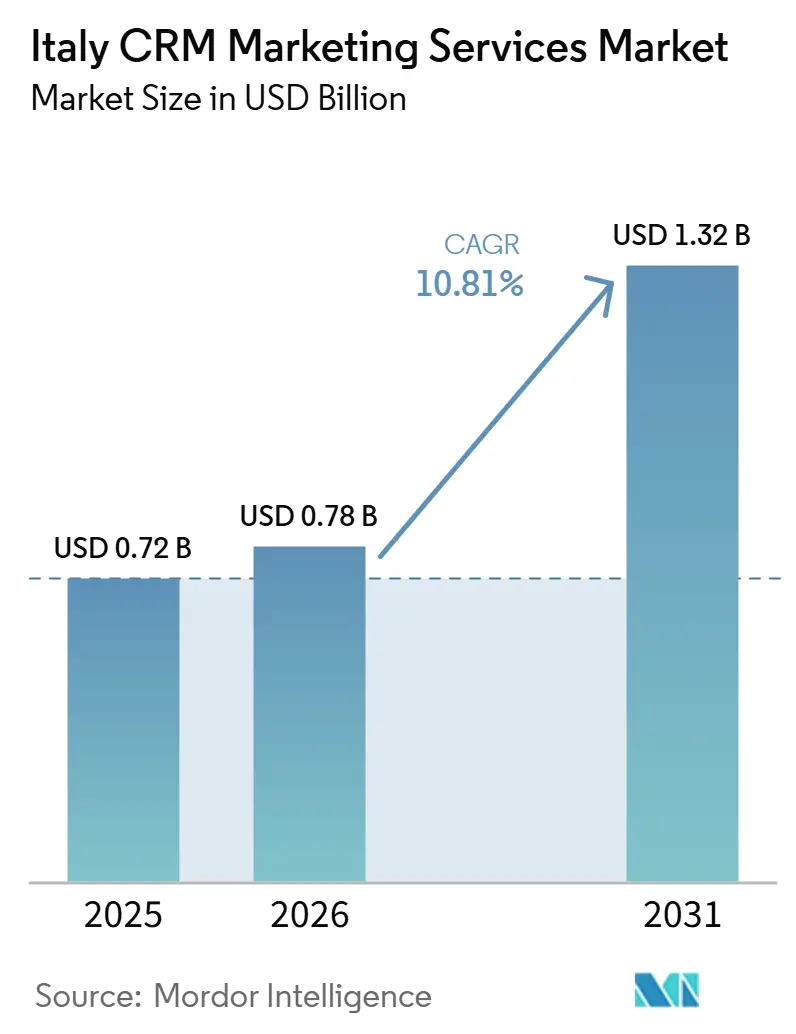
| Base Year Market Size (2025) | USD 0.72 Billion |
| Market Size (2026) | USD 0.78 Billion |
| Market Size (2031) | USD 1.32 Billion |
| Growth Rate (2026 - 2031) | 11.10 % |
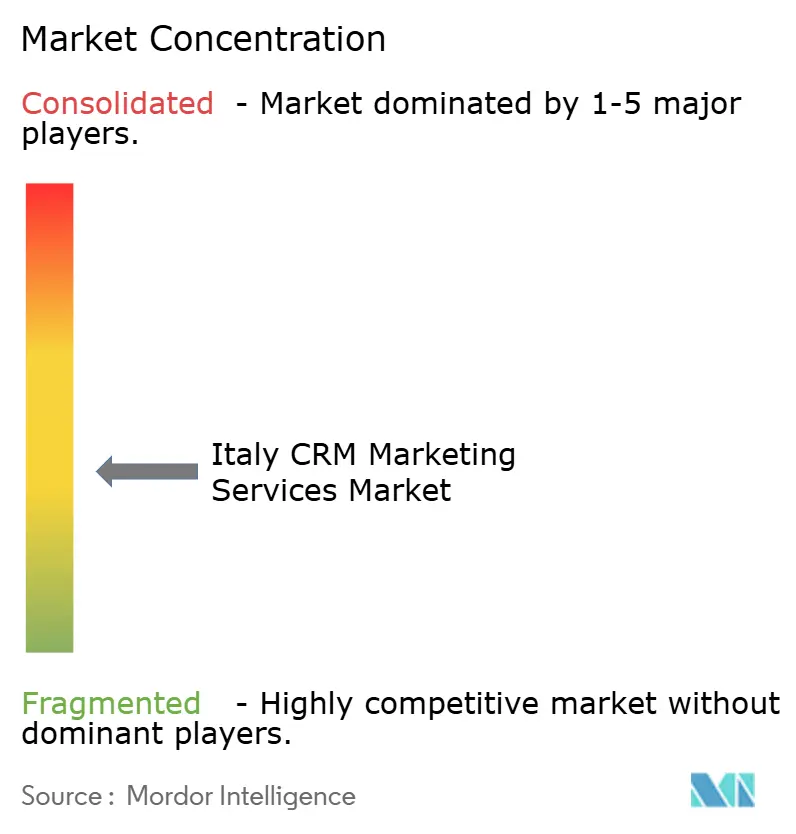
| Market Concentration | Medium |
Major Players *Disclaimer: Major Players sorted in no particular order Image © Mordor Intelligence. Reuse requires attribution under CC BY 4.0. | |
Italy CRM Marketing Services Market Analysis by Mordor Intelligence
The Italy CRM Marketing Services Market size is expected to increase from USD 0.72 billion in 2025 to USD 0.79 billion in 2026 and reach USD 1.32 billion by 2031, growing at a CAGR of 11.10% over 2026-2031. The Italy CRM Marketing Services Market continued to move beyond basic software deployment, as CRM became more closely tied to customer intelligence, campaign execution, and revenue planning across Italian enterprises. Demand also shifted toward deeper integration, as companies increasingly sought CRM systems to work in sync with marketing automation tools and broader digital customer workflows. Northern Italy remained the main demand center, supported by its dense base of large enterprises, financial institutions, and established technology delivery networks. The market also faced a persistent execution gap, because CRM adoption moved faster than data governance, user readiness, and operating discipline in many organizations. Even with those constraints, long-term momentum remained firm, supported by ongoing enterprise modernization, rising interest in AI-led customer engagement, and continued investment by global platform vendors in Italy.
Key Report Takeaways
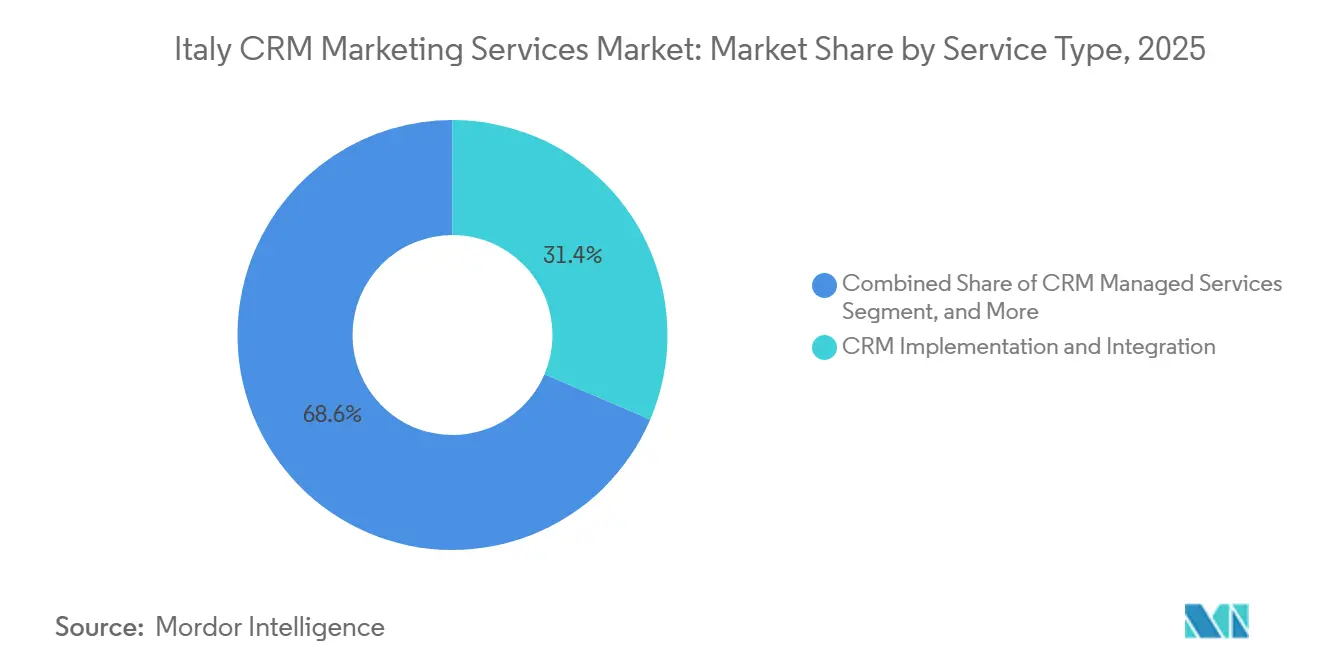
- By service type, CRM Implementation and Integration held 31.42% share in 2025, while CRM Managed Services is projected to expand at a 13.24% CAGR through 2031.
- By enterprise size, large enterprises held 64.81% of the Italy CRM Marketing Services Market share in 2025, while SMEs are projected to expand at a 13.69% CAGR through 2031.
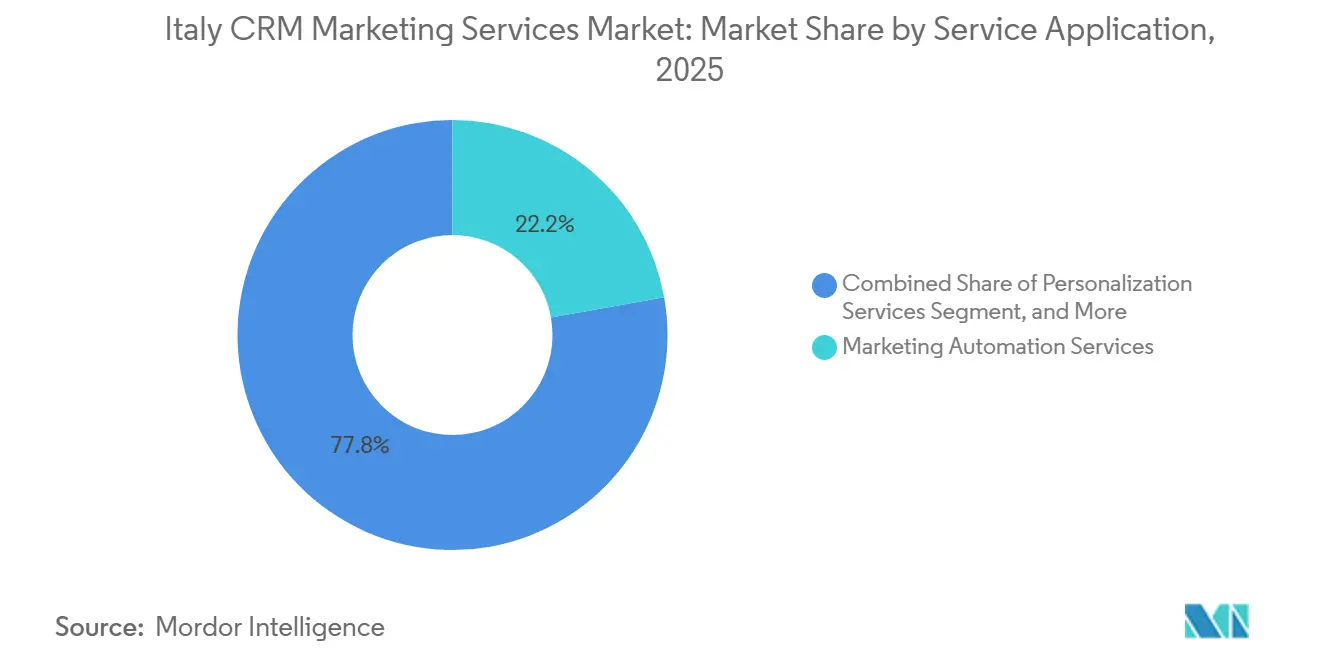
- By service application, Marketing Automation Services accounted for 22.19% share in 2025, while Personalization Services is projected to expand at a 14.83% CAGR through 2031.
- By end-user industry, BFSI accounted for 26.74% share of the Italy CRM Marketing Services Market size in 2025, while retail and e-commerce is projected to expand at a 12.92% CAGR through 2031.
Note: Market size and forecast figures in this report are generated using Mordor Intelligence’s proprietary estimation framework, updated with the latest available data and insights as of January 2026.
Italy CRM Marketing Services Market Trends and Insights
Drivers Impact Analysis*
| Driver | (~) % Impact on CAGR Forecast | Geographic Relevance | Impact Timeline |
|---|---|---|---|
| Rising Demand for Omnichannel Customer Engagement | +2.5% | National, concentrated in North Italy with spill-over to Central Italy, Rome and Florence | Medium term (2-4 years) |
| Increasing Need for CRM and Marketing Automation Integration | +2.1% | National, largest gains in Lombardy and Emilia-Romagna industrial belts | Medium term (2-4 years) |
| GDPR-Driven Demand for Compliant Customer Data Management | +1.8% | National, strongest in BFSI and retail sectors across all regions | Short term (≤ 2 years) |
| AI-Powered Lead Scoring and Journey Orchestration Adoption | +1.5% | North Italy, Milan hub, with early adoption in Rome and Bologna | Long term (≥ 4 years) |
| SME Digitalization and SaaS Adoption | +1.2% | National, with PNRR-supported uptake in South Italy | Medium term (2-4 years) |
| Sector-Specific CRM Workflows in Retail, B2B, and Services | +0.8% | National, with retail concentrated in the North and services in Rome and Milan | Long term (≥ 4 years) |
| Source: Mordor Intelligence | |||
Rising Demand for Omnichannel Customer Engagement
Omnichannel engagement remained the strongest commercial trigger for the Italy CRM Marketing Services Market, as companies increasingly needed a single operating layer across stores, websites, service desks, and digital campaigns. This need became more urgent as customer journeys grew less linear and as brands faced pressure to respond faster across multiple touchpoints. In Italy’s fashion and beauty segment, 70% of shoppers demonstrated omnichannel buying behavior in 2025, prompting brands to more closely integrate physical and digital engagement data.[1] That shift expanded the scope of CRM work from basic deployment toward identity stitching, campaign coordination, and real-time audience management. As a result, providers that could build unified customer views and support continuous optimization were better placed to capture longer and more recurring contracts in the ItalY CRM Marketing Services Market.
Increasing Need for CRM And Marketing Automation Integration
The Italy CRM Marketing Services Market also gained momentum from the rising need to connect CRM platforms with marketing automation systems, as companies moved away from isolated deployments and toward linked customer lifecycle management. The 10th Osservatorio CRM found that marketing automation ranked among the leading CRM investment priorities for Italian organizations in 2026, showing that the focus had shifted from first-time installation toward better orchestration of existing tools. This mattered to service providers because integration work usually required custom interfaces, data harmonization, workflow redesign, and broader business coordination than in standard implementation projects.[2] Capgemini’s April 2025 expansion of its Google Cloud partnership in Italy showed how leading firms were aligning customer experience work with AI-enabled integration models across telecommunications, retail, and financial services. Once CRM and marketing automation integration moved ahead of ERP linkage in enterprise priorities, the Italy CRM Marketing Services Market became more dependent on recurring technical support, system tuning, and data flow management than on one-time build projects.[3]
GDPR-Driven Demand for Compliant Customer Data Management
Compliance needs remained a clear growth driver for the Italy CRM Marketing Services Market, especially in sectors that relied heavily on profiling, segmentation, and targeted communications. Companies using CRM data for customer scoring and campaign execution faced rising pressure to document consent paths, control data use, and tighten governance around automated decision support. That pressure increased the value of advisory work on consent design, data governance rules, and CRM process review, particularly for banks, insurers, and retailers with large customer bases. It also pushed implementation projects beyond front-end campaign tools and deeper into record structure, retention logic, and internal approval flows. In practice, the compliance burden made CRM modernization more service-intensive, which supported demand for consulting, integration, and managed support work across the Italy CRM Marketing Services Market.
AI-Powered Lead Scoring and Journey Orchestration Adoption
AI adoption created a strong long-term opportunity for the Italy CRM Marketing Services Market, even though actual deployment remained limited in 2026. The 10th Osservatorio CRM reported that only 3% of Italian companies had fully integrated AI into CRM processes, while 27% had partial adoption and 71% had not yet integrated AI. The same gap appeared in operating readiness: SDA Bocconi found that only 16.7% of surveyed firms considered themselves AI-ready, and 57.4% cited weak underlying data as the main obstacle. Salesforce’s June 2026 investment plan for Italy, which included added roles in data science and agentic AI, showed that major platform vendors expected this gap to convert into sustained service demand rather than short-lived experimentation. As AI use moved from pilot activity toward production support, the Italy CRM Marketing Services Market was likely to see more demand for predictive scoring, journey orchestration, model supervision, and post-deployment managed services.
Restraints Impact Analysis*
| Restraint | (~) % Impact on CAGR Forecast | Geographic Relevance | Impact Timeline |
|---|---|---|---|
| Fragmented Buyer Maturity and Slow CRM Change Management | -0.8% | National, most acute among SMEs in Central and South Italy | Medium term (2-4 years) |
| Data Quality Gaps Across Legacy Customer Databases | -0.6% | National, concentrated in manufacturing and industrial sectors in North Italy | Short term (≤ 2 years) |
| Rising Integration Costs Across ERP, E-Commerce, and CDP Stacks | -0.5% | National, most pronounced for large enterprises with multi-stack environments | Medium term (2-4 years) |
| Shortage of Senior CRM Architects and Marketing Operations Talent | -0.4% | National, most acute in Milan, Rome, and Turin talent pools | Long term (≥ 4 years) |
| Source: Mordor Intelligence | |||
Fragmented Buyer Maturity and Slow CRM Change Management
Fragmented buyer maturity remained the most persistent operating restraint in the Italy CRM Marketing Services Market, as organizations adopted CRM at very different speeds and with varying levels of internal readiness. The 10th Osservatorio CRM reported that 78% of Italian companies used a CRM in 2026, yet user adoption had become the primary pain point for 30% of respondents, which showed that installation had often moved ahead of behavioral change. This issue was more visible among smaller companies, where leadership bandwidth, training resources, and process discipline were often weaker than in large enterprises. For service providers, that meant longer discovery phases, more training, and slower conversion of technical rollouts into measurable business use. The Italy CRM Marketing Services Market therefore faced a delivery drag that was not driven solely by technology, but by the uneven pace of organizational adaptation.
Data Quality Gaps Across Legacy Customer Databases
Data quality also imposed a clear ceiling on the Italy CRM Marketing Services Market, as poor data quality reduced the value of automation, personalization, and AI-led engagement programs. SDA Bocconi found in March 2026 that 47% of CRM data was still entered manually, 37.5% of companies had no data governance policy, and 65.5% of employees lost at least 1 hour per week searching for or correcting data. When buyer organizations saw that poor data limited campaign accuracy and customer insight, they often slowed broader CRM spending until clean-up work had started. This raised the cost and duration of projects, especially where legacy databases had been built across disconnected systems and informal processes. At the same time, it created a narrow opportunity for providers with structured remediation, governance, and data stewardship offerings inside the Italy CRM Marketing Services Market.
*Our forecasts treat driver/restraint impacts as directional, not additive. The impact forecasts reflect baseline growth, mix effects, and variable interactions.
Segment Analysis
By Service Type: Integration Projects Anchor Revenue As Managed Services Accelerate
CRM Implementation and Integration held 31.42% of the Italy CRM Marketing Services market share in 2025, making it the largest service type in the Italy CRM Marketing Services Market. This lead reflected the number of organizations that were still building or reconnecting their CRM environments across sales, marketing, service, and commerce systems. The market’s implementation backlog remained significant because project scopes had become broader and more technical than in earlier CRM rollouts. The shift toward connected marketing and customer data workflows made even routine deployments more demanding in terms of interfaces, data structure, and operating design.
The same transition also supported faster growth in CRM Managed Services, which is projected to expand at a 13.24% CAGR through 2031 in the Italy CRM Marketing Services Market. Many companies sought advanced CRM capabilities without building large internal marketing teams, especially as specialist talent costs rose. The 2026 Osservatorio CRM results showed that integration priorities had tilted toward marketing automation and continuous ecosystem alignment rather than stand-alone installation work. That pushed vendors to combine delivery, optimization, governance, and support into recurring service models rather than relying solely on one-off implementation fees.

By Enterprise Size: Large Enterprises Dominate As SMEs Reshape The Growth Curve
Large enterprises accounted for 64.81% of the Italy CRM Marketing Services Market in 2025, which showed how strongly spending was still tied to the country’s largest banks, industrial groups, and enterprise-scale service organizations. These buyers usually had larger budgets, stronger digital governance, and a greater ability to run multi-year transformation programs with global service partners. Their demand also covered a broader set of work, including architecture review, integration, migration, analytics enablement, and managed support. This kept large-enterprise contracts central to revenue concentration across the Italy CRM Marketing Services Market.
SMEs, however, are projected to expand at a 13.69% CAGR through 2031, making them the fastest-growing segment of the Italy CRM Marketing Services Market. The growth path began with a lower adoption base, but was supported by SaaS affordability, modular deployment models, and digital transition incentives that reduced entry barriers. Intesa Sanpaolo’s 2026-2029 business plan, with EUR 5.1 billion (USD 5.81 billion) in technology investment and explicit attention to advanced analytics and omnichannel enablement, also showed how the wider enterprise environment in Italy continued to normalize CRM-led transformation. Providers that could package consulting, rollout, and support in simpler and lower-risk formats were better positioned to turn SME adoption into scalable growth.
By Service Application: Automation Leads Revenue As Personalization Gains Pace
Marketing Automation Services held 22.19% share in 2025, making it the largest application area in the Italy CRM Marketing Services Market. This position reflected the practical need to reduce manual campaign work before companies moved toward more advanced uses of customer intelligence. Automation offered a clear first step by improving campaign consistency, scheduling, and lead handling without requiring the highest level of organizational maturity. It also fits well with the needs of retailers, banks, and service-led businesses that manage frequent customer communications across multiple channels.
Personalization Services is projected to expand at a 14.83% CAGR through 2031, indicating the next spending cycle in the Italy CRM Marketing Services Market. As customer engagement became more data-driven, companies increasingly wanted CRM programs that could adapt content, timing, and offers to individual behavior. SAP Emarsys deployments for Baldinini and Peg Perego in January 2026 showed how Italian brands were using segmentation, behavioral analytics, and multi-touchpoint communication to deepen customer relevance. That shift from broad campaign execution to tailored engagement expanded the role of service providers across analytics, orchestration, testing, and lifecycle design.[4]
By End-User Industry: BFSI Anchors Spending While Retail And E-Commerce Lead Growth
BFSI held 26.74% share in 2025, giving it the largest industry position in the Italy CRM Marketing Services Market. Banks and insurers remained heavy users of CRM services because they relied on data-led customer engagement and operated under tighter compliance and governance requirements than many other sectors. Their projects also tended to be larger, because they covered customer onboarding, relationship management, analytics, and controlled communication workflows at scale. This kept BFSI at the center of large-account demand across the Italy CRM Marketing Services Market.
Retail and e-commerce are projected to expand at a 12.92% CAGR through 2031, making it the fastest-growing end-user group. The growth was supported by stronger digital transaction volumes, broader use of customer data, and a growing need to align store, online, and post-purchase engagement. The ABI Lab 2026 report confirmed that CRM modernization remained a leading ICT priority in banking, while Bancomat’s July 2025 Salesforce adoption demonstrated that financial players were extending CRM beyond product administration into direct engagement. In retail, the wider shift toward personalized journeys and omnichannel coordination kept CRM marketing services closely tied to revenue generation rather than to support functions alone.
Geography Analysis
Northern Italy remained the leading geography in the Italy CRM Marketing Services Market, supported by the country’s largest cluster of enterprise headquarters, financial institutions, and specialized technology partners. Milan, Turin, Bologna, and nearby industrial corridors continued to anchor both customer demand and service delivery capacity. Salesforce opened its new office at Palazzo Missori in Milan in June 2026, which reinforced the city’s role as a key platform and talent hub for the market. Reply, headquartered in Turin, reported EUR 644.96 million (USD 735.03 million) in Q1 2026 revenue, which further reflected the concentration of advanced digital delivery capacity in the North.
Central Italy ranked second in the Italy CRM Marketing Services Market, with Rome shaping much of the region’s CRM activity through public administration, utilities, regulated services, and financial groups. Demand in this part of the country tended to be more policy-linked and institution-led than in the North, where private enterprise concentration was stronger. Healthcare and life sciences also contributed to the regional base, especially as patient engagement and lifecycle management platforms became more important. Capgemini’s expansion of its customer experience partnership with Google Cloud was highly relevant to Rome-based financial services and telecom accounts that required integrated, AI-enabled customer workflows.
Southern Italy and the Islands remained the smallest geography in the Italy CRM Marketing Services Market, but they also showed the strongest catch-up potential through 2031. Adoption in the South started from a lower digital base, which limited current market depth but created space for first-time CRM projects and cloud-led operating models. Academic research published by MDPI showed that regional digital and e-commerce development in Italy had historically been uneven, with slower starting conditions in Southern regions. Springer Nature research on Italian firms also showed that the corporate digital divide closely tracked economic disparities across regions, even as infrastructure quality had improved more broadly nationwide. In this setting, remote delivery, SaaS-first implementation, and managed support models were likely to shape how the Italy CRM Marketing Services Market expanded in the South.
Competitive Landscape
The Italy CRM Marketing Services Market was moderately fragmented at the upper end, because global consulting firms still controlled a large share of high-value enterprise mandates. Accenture, Capgemini, IBM, and Deloitte remained prominent in large-account work through their ties to major CRM and cloud ecosystems. Their scale gave them an advantage in multi-country delivery, platform depth, and complex transformation programs. At the same time, the broader market remained contested by platform-native integrators, domestic specialists, and digital agencies with narrower but often faster execution models.
Reply and other Italy-based specialists competed by offering closer sector alignment, local delivery familiarity, and more productized service assets inside the Italy CRM Marketing Services Market. Reply’s expanded Prebuilt AI Apps portfolio showed how domestic firms were moving beyond labor-led implementation and into reusable solution layers for banking, insurance, and manufacturing. Salesforce’s continued 41% platform penetration in Italy also kept the competitive field active across migration support, optimization work, and platform-agnostic advisory. This meant competition was no longer shaped only by platform selection, but also by the ability to improve customer journeys, data quality, and operating efficiency after deployment.
Several strategic moves showed how providers were repositioning around AI, vertical depth, and recurring services in the Italy CRM Marketing Services Market. Salesforce announced a USD 1 billion investment in Italy in June 2026, including a new Milan office and expanded AI upskilling, signaling a long-term commitment to local ecosystem growth. Capgemini expanded its Google Cloud partnership in Italy in April 2025 to develop sector-focused AI customer experience solutions. Bancomat adopted Salesforce in July 2025 to strengthen direct customer engagement, demonstrating that CRM use cases were broadening even in infrastructure-led financial organizations. BCC Iccrea Group also signed a partnership with Accenture in January 2025 for a major IT transformation program that included CRM modernization, which reinforced the importance of banking-led demand in competitive positioning. These moves showed that scale, AI capability, and sector credibility were becoming more important than basic implementation capacity alone.
Italy CRM Marketing Services Industry Leaders
-
Accenture PLC
-
Capgemini SE
-
Publicis Groupe S.A.
-
Deloitte Touche Tohmatsu Limited
-
Salesforce, Inc.
- *Disclaimer: Major Players sorted in no particular order
Recent Industry Developments
- June 2026: Salesforce, Inc. announced a USD 1 billion, 5-year investment in Italy, opening a new office at Palazzo Missori in Milan and expanding its Italian workforce across data science, agentic AI, and deployment engineering. The investment includes the Enterprise Architecture Academy, an AI upskilling program for enterprises and public administrations. Italy is identified as a strategic AI growth center within Western Europe, with existing deployments at Ferrari, Enel, UniCredit, Telepass, and Trenitalia.
- March 2026: The Italian Garante Privacy issued a EUR 17.6 million (USD 19.9 million) fine against Intesa Sanpaolo for unauthorized CRM profiling and consent violations in the Isybank migration case. The ruling established that CRM-based segmentation and automated marketing decisions require explicit, granular GDPR consent, a precedent with market-wide implications for data-driven CRM services.
- February 2026: Intesa Sanpaolo Group published its 2026-2029 business plan committing EUR 5.1 billion (USD 5.76 billion) to technology investment, specifying advanced-analytics CRM for private banking advisory, full omnichannel customer journey enablement, and a target of 100% cloud-based applications by 2029.
- January 2026: SAP SE's Emarsys omnichannel marketing platform was deployed by Italian fashion brand Baldinini and baby gear maker Peg Perego to enable advanced customer segmentation, behavioral analytics, and personalized multi-touchpoint marketing, accelerating mid-enterprise personalization project adoption in Italy's consumer goods and fashion sectors.
Italy CRM Marketing Services Market Report Scope
The Italian CRM (Customer Relationship Management) marketing services market encompasses the range of professional, managed, and support services provided to organizations in Italy to help them strategize, implement, optimize, and maintain CRM systems specifically for marketing functions. This market excludes the actual CRM software licenses or platform subscriptions (SaaS/on-premise), focusing entirely on the human expertise, consulting, and outsourced operations required to leverage these technologies effectively. The services covered include initial CRM strategy and consulting, system implementation and integration with existing marketing stacks, data migration and platform modernization, ongoing managed services, and user training and support. These services are used by businesses of varying sizes across multiple industries to execute specific marketing applications, including customer acquisition, retention, and loyalty programs; campaign management; marketing automation; customer analytics; omnichannel engagement; and hyper-personalization. The market value represents the revenue generated by service providers and agencies operating within Italy for these specific CRM-related marketing engagements.
The Italy CRM Marketing Services Market Report is Segmented by Service Type (CRM Strategy and Consulting, CRM Implementation and Integration, CRM Migration and Modernization, CRM Managed Services, and CRM Training and Support), Enterprise Size (Large Enterprises, and Small and Medium Enterprises), Service Application (Customer Acquisition, Customer Retention and Loyalty, Campaign Management Services, Marketing Automation Services, Customer Analytics and Insights, Omnichannel Customer Engagement, and Personalization Services), and End-user Industry (Banking, Financial Services, and Insurance (BFSI), Healthcare and Life Sciences, Information Technology and Telecom, Retail and E-commerce, Industrial Manufacturing, Government and Public Administration, and Other End-user Industries). The Market Forecasts are Provided in Terms of Value (USD).
| CRM Strategy and Consulting |
| CRM Implementation and Integration |
| CRM Migration and Modernization |
| CRM Managed Services |
| CRM Training and Support |
| Large Enterprises |
| Small and Medium Enterprises |
| Customer Acquisition |
| Customer Retention and Loyalty |
| Campaign Management Services |
| Marketing Automation Services |
| Customer Analytics and Insights |
| Omnichannel Customer Engagement |
| Personalization Services |
| Banking, Financial Services, and Insurance (BFSI) |
| Healthcare and Life Sciences |
| Information Technology and Telecom |
| Retail and E-commerce |
| Industrial Manufacturing |
| Government and Public Administration |
| Other End-user Industries |
| By Service Type | CRM Strategy and Consulting |
| CRM Implementation and Integration | |
| CRM Migration and Modernization | |
| CRM Managed Services | |
| CRM Training and Support | |
| By Enterprise Size | Large Enterprises |
| Small and Medium Enterprises | |
| By Service Application | Customer Acquisition |
| Customer Retention and Loyalty | |
| Campaign Management Services | |
| Marketing Automation Services | |
| Customer Analytics and Insights | |
| Omnichannel Customer Engagement | |
| Personalization Services | |
| By End-user Industry | Banking, Financial Services, and Insurance (BFSI) |
| Healthcare and Life Sciences | |
| Information Technology and Telecom | |
| Retail and E-commerce | |
| Industrial Manufacturing | |
| Government and Public Administration | |
| Other End-user Industries |
Key Questions Answered in the Report
What is the current and forecast size of the Italy CRM Marketing Services Market?
The Italy CRM Marketing Services Market was valued at USD 0.72 billion in 2025, is expected to reach USD 0.79 billion in 2026, and is forecast to reach USD 1.32 billion by 2031 at a 11.10% CAGR.
Which service type leads spending in Italy CRM marketing services?
CRM Implementation and Integration led spending with a 31.42% share in 2025, reflecting ongoing demand for deployment and multi-system connection work.
Which application area is growing the fastest in Italy?
Personalization Services is projected to post the fastest growth, with a 14.83% CAGR through 2031, as brands shift toward more tailored customer engagement.
Which business segment drives the largest demand?
BFSI held the largest end-user share at 26.74% in 2025, supported by strong demand for data-led engagement, governance, and customer lifecycle modernization.
Why are SMEs becoming more important in Italy CRM services?
SMEs are projected to expand at a 13.69% CAGR through 2031 because SaaS pricing, modular rollout models, and digital incentives are making CRM adoption more practical for smaller firms.
Which part of Italy is most important for CRM marketing services growth?
Northern Italy remains the main demand center because it has the highest concentration of large enterprises, financial institutions, and delivery capacity, while Southern Italy offers the strongest catch-up potential.