
South Asia CRM Marketing Services Market Size and Share
Market Overview
| Study Period | 2020 - 2031 |
|---|---|
| Forecast Data Period | 2026 - 2031 |
| Base Year Market Size (2025) | USD 1.7 Billion |
| Market Size (2026) | USD 1.89 Billion |
| Market Size (2031) | USD 3.52 Billion |
| Growth Rate (2026 - 2031) | 13.20 % |
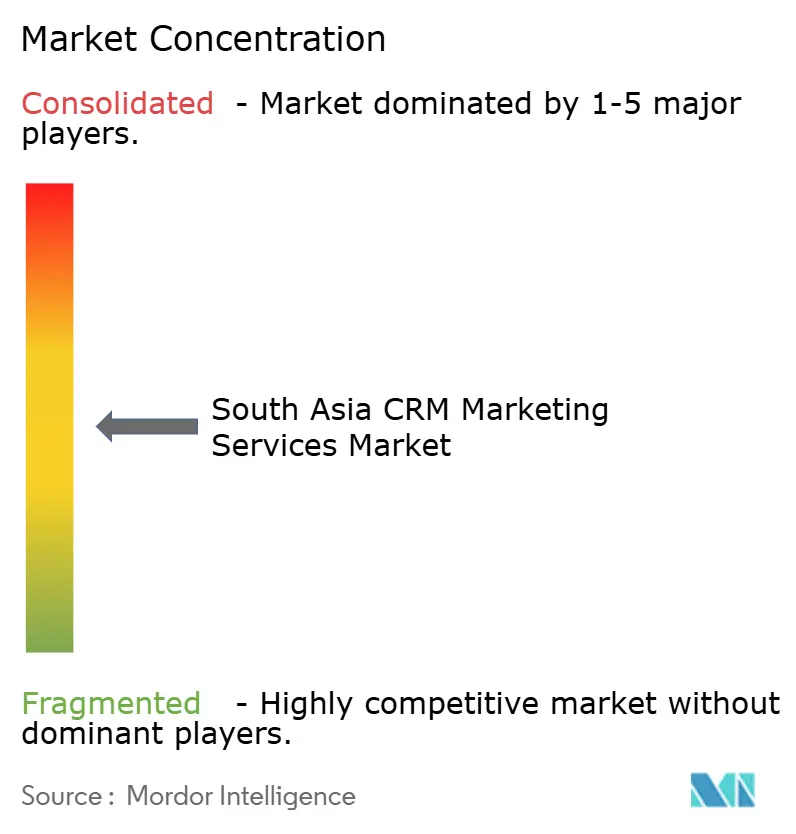
| Market Concentration | Medium |
Major Players *Disclaimer: Major Players sorted in no particular order Image © Mordor Intelligence. Reuse requires attribution under CC BY 4.0. | |
South Asia CRM Marketing Services Market Analysis by Mordor Intelligence
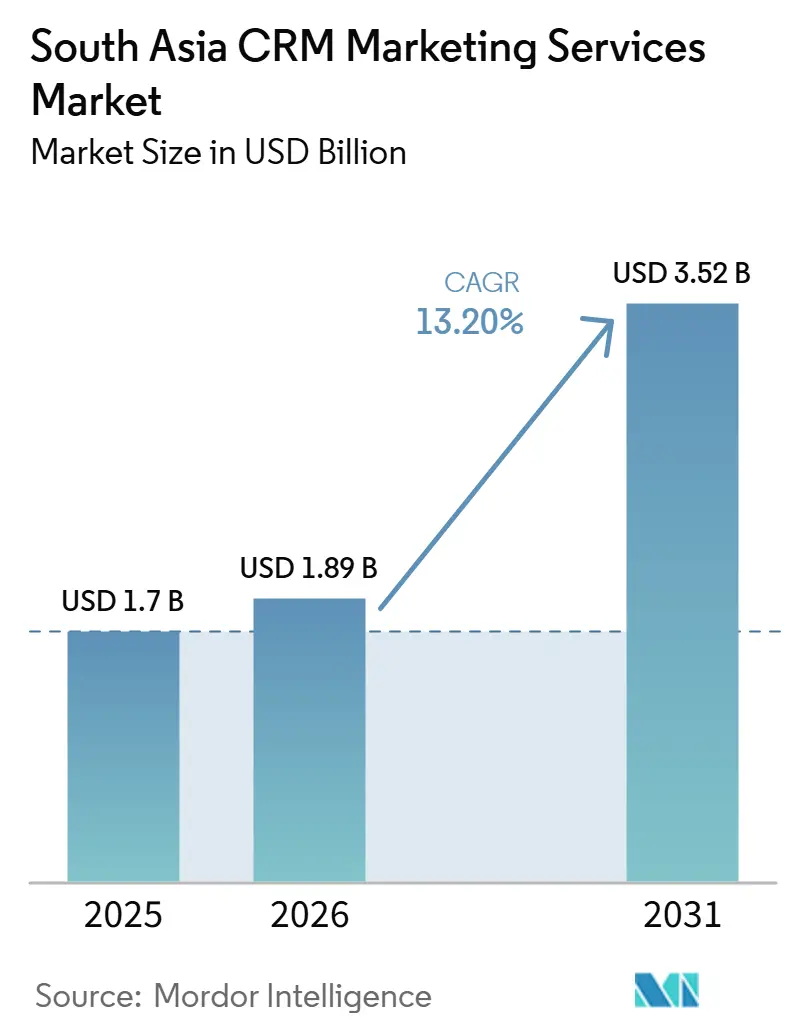
The South Asia CRM marketing services market size was valued at USD 1.70 billion in 2025 and estimated to grow from USD 1.89 billion in 2026 to reach USD 3.52 billion by 2031, at a CAGR of 13.20% during the forecast period (2026-2031). The South Asia CRM marketing services market is moving beyond routine digital promotion, as enterprises now connect campaign delivery with AI-led workflows, consent management, and control of first-party customer data. Growth is also tied to a broader reset in enterprise buying behavior, as brands increasingly want vendors that can implement, operate, and optimize platforms rather than just set strategy. Privacy rules are pushing companies to redesign how customer records are collected, stored, and used, creating sustained demand for managed delivery models with stronger governance controls. At the same time, buyers are becoming more selective about execution capability, because talent shortages in architecture, integration, and marketing automation can slow projects even when software budgets remain available. This combination of automation demand, regulatory pressure, and rising execution complexity is widening the opportunity for firms that can support large enterprises and also package lighter subscription-led services for smaller businesses.
Key Report Takeaways
- By service type, CRM Implementation and Integration held 54.21% of the South Asia CRM marketing services market share in 2025, while CRM Managed Services is projected to expand at a 15.46% CAGR through 2031.
- By enterprise size, large enterprises accounted for 70.44% of the South Asia CRM marketing services market share in 2025, while small and medium enterprises are projected to grow at a 16.22% CAGR through 2031.
- By service application, Customer Acquisition captured 34.28% of the South Asia CRM marketing services market share in 2025, while Marketing Automation Services is projected to expand at a 15.05% CAGR through 2031.
- By end-user industry, BFSI held 33.69% of the South Asia CRM marketing services market share in 2025, while Retail and E-commerce are projected to grow at a 14.67% CAGR through 2031.
- By geography, India held 57.29% of the South Asia CRM marketing services market share in 2025, while Bangladesh is projected to expand at a 15.89% CAGR through 2031.
Note: Market size and forecast figures in this report are generated using Mordor Intelligence’s proprietary estimation framework, updated with the latest available data and insights as of January 2026.
Market Trends and Insights
Drivers Impact Analysis of South Asia CRM Marketing Services Market*
| Driver | (~) % Impact on CAGR Forecast | Geographic Relevance | Impact Timeline |
|---|---|---|---|
| Rising Demand for Hyper-Personalized Customer Journeys | +2.8% | Global, with India and Bangladesh as leading adopters | Medium term (2-4 years) |
| Expansion of Digital Commerce and First-Party Data Strategies | +2.5% | India dominant, early-stage spillover to Pakistan and Sri Lanka | Medium term (2-4 years) |
| Enterprise Shift Toward AI-Assisted Campaign Orchestration | +2.3% | India dominant, emerging uptake in Pakistan and Bangladesh | Long term (≥ 4 years) |
| Growth of SME Subscription Adoption Across South Asia | +2.0% | APAC core, strong signal from India, Bangladesh, and Pakistan | Short term (≤ 2 years) |
| Cross-Border Customer Engagement Needs for Regional Brands | +1.2% | India, Bangladesh, Sri Lanka | Medium term (2-4 years) |
| Privacy-First Marketing Architecture Replacing Cookie Dependence | +1.0% | India primary, early spillover to Bangladesh | Medium term (2-4 years) |
| Source: Mordor Intelligence | |||
Rising Demand for Hyper-Personalized Customer Journeys
The South Asia CRM marketing services market is benefiting from a shift in customer expectations, as brands now need communication that reflects language, timing, channel preferences, and purchase context rather than generic outreach. In India and neighboring markets, this need is sharper because consumer bases are large, diverse, and spread across very different urban, semi-urban, and digital-first demand pools. A 2026 peer-reviewed study found that AI and machine learning within CRM can improve customer satisfaction through more tailored engagement, but it also noted that transparent data use remains essential for trust and effectiveness. That makes personalization in South Asia less about message frequency and more about whether campaigns are built around consent, relevance, and local language execution. Service providers that already package regional-language content support, WhatsApp-linked outreach, and event-based campaign design are better placed to win mid-market work in retail, FMCG, D2C, and financial services. As a result, the South Asia CRM marketing services market is seeing stronger demand for delivery models that combine marketing logic with operational execution rather than stand-alone software setups.
Expansion of Digital Commerce and First-Party Data Strategies
The South Asia CRM marketing services market is also being shaped by the move away from third-party cookies and toward first-party customer records that can be activated in compliance with applicable laws. In 2026, enterprises with digital storefronts are relying more heavily on CRM-managed data sets, opt-in communication preferences, and transactional histories to keep targeting and attribution workable. India’s Digital Personal Data Protection Rules, 2025, made this shift more urgent by formalizing consent-led operating requirements under the country’s privacy framework. That change is pushing many brands to prefer managed providers that already support auditable data pipelines, governance workflows, and clearer customer record controls. The commercial effect is strong because first-party data now serves two roles at once: it supports campaign performance and reduces compliance risk. This is giving the South Asia CRM marketing services market a more durable demand base than pure discretionary digital spending usually provides.
Enterprise Shift Toward AI-Assisted Campaign Orchestration
The South Asia CRM marketing services market is increasingly tied to enterprise movement from rule-based campaign scheduling to AI-assisted orchestration that adjusts audiences, timing, and content paths with less manual intervention. This change matters because large brands no longer want only dashboard visibility; they want systems that can interpret intent, trigger actions, and improve execution speed across channels. Oracle’s February 2026 launch of role-based AI agents within Oracle Fusion Cloud Applications, including a Program Orchestration Agent for marketing, showed how platform vendors are embedding this capability directly into enterprise workflow design. Once these capabilities are embedded in the core stack, the service requirement also changes, as enterprises need partners who can configure, govern, and refine agent-led activity rather than simply deploy static journeys. That shift is moving more advisory and integration value toward providers with orchestration skills and away from firms that focus only on strategy documents. It is therefore reinforcing the view that the South Asia CRM marketing services market will reward execution depth more than presentation-led consulting over the forecast period.
Growth of SME Subscription Adoption Across South Asia
The South Asia CRM marketing services market still has a large pool of underpenetrated smaller businesses, especially as cloud subscriptions have reduced the need for upfront infrastructure spending. Subscription-first pricing makes CRM adoption more practical for SMEs that want staged deployment and cash flow flexibility rather than a large, one-time technology commitment. This changes the service opportunity because many smaller firms do not need custom architecture first; they need onboarding, campaign setup, workflow tuning, and regular operating support after activation. The gap between having a CRM license and using it effectively remains wide, which creates recurring service demand rather than one-time software demand. That pattern aligns with the report’s 16.22% CAGR for SMEs and 15.46% CAGR for CRM Managed Services, suggesting a services-led route to SME expansion across the region. For that reason, the South Asia CRM marketing services market is broadening through lower-entry subscription models, while value creation is shifting toward post-deployment usage support.
Restraints Impact Analysis of South Asia CRM Marketing Services Market*
| Restraint | (~) % Impact on CAGR Forecast | Geographic Relevance | Impact Timeline |
|---|---|---|---|
| Fragmented Data Privacy Enforcement Across South Asia | -1.4% | Regional, most acute in Pakistan and Sri Lanka | Short term (≤ 2 years) |
| Limited CRM and Marketing Automation Implementation Talent | -1.1% | APAC core, across all South Asian markets | Short term (≤ 2 years) |
| Legacy ERP and Channel System Integration Complexity | -0.9% | India and Pakistan, large enterprise concentrations | Medium term (2-4 years) |
| Foreign Exchange Volatility Pressure on SaaS and Services Budgets | -0.7% | Pakistan, Bangladesh, Sri Lanka | Short term (≤ 2 years) |
| Source: Mordor Intelligence | |||
Fragmented Data Privacy Enforcement Across South Asia
The South Asia CRM marketing services market faces a practical constraint: privacy frameworks across the region are not advancing at the same pace or with the same level of enforcement. India has already operationalized the DPDP Rules, 2025, while other South Asian markets are at different legislative or review stages, complicating the design of multi-country customer engagement. Research released in 2025 by Genesys and Dun and Bradstreet found that 51% of Indian BFSI leaders viewed regulatory and data privacy constraints as a major barrier to customer experience modernization. That matters for regional brands because consent frameworks, data residency choices, and breach response practices may need to vary by country even when the campaign objective is shared. Service providers can charge for this complexity, but it also raises delivery costs and narrows margins when cross-border coordination becomes difficult. Until regional enforcement becomes more consistent, the South Asia CRM marketing services market will continue to see friction in fully integrated multi-country campaign management.
Limited CRM And Marketing Automation Implementation Talent
The South Asia CRM marketing services market is also constrained by a shortage of people who can connect platform knowledge with AI workflow design, data integration, and consent-aware execution. Basic administration capacity is expanding, but deeper implementation capability remains scarce relative to the pace of enterprise demand. Salesforce India’s June 2026 commitment to skill 1 million learners by 2030 showed that even a market leader sees talent depth as a strategic bottleneck for future scale.[1] This scarcity raises consultant costs, slows project timelines, and gives large integrators an advantage by allowing them to move experienced teams across client accounts more easily. Smaller regional providers can still compete in selected niches, but they face pressure when enterprise buyers demand orchestration, compliance, and integration skills within a single engagement. As a result, the South Asia CRM marketing services market remains growth-oriented, but not every vendor can capture that demand at the same pace.
*Our forecasts treat driver/restraint impacts as directional, not additive. The impact forecasts reflect baseline growth, mix effects, and variable interactions.
South Asia CRM Marketing Services Market Segment Analysis
By Service Type:
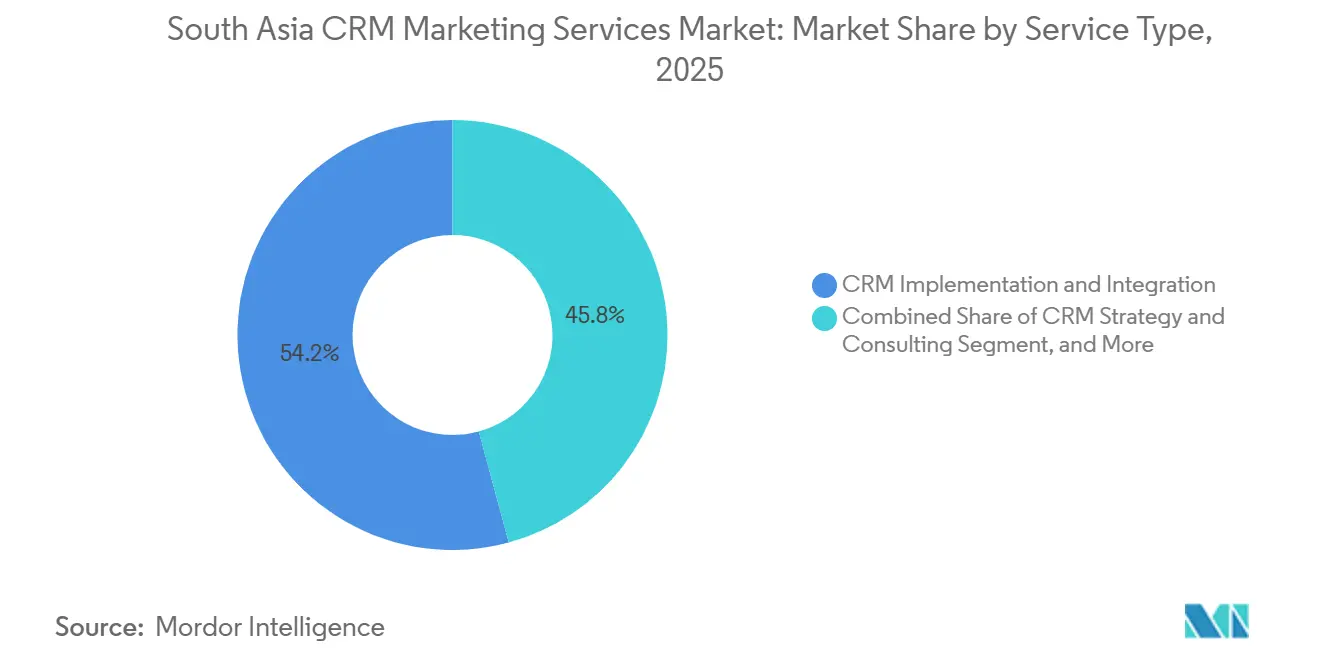
CRM Implementation and Integration Anchors Revenue While Managed Services Gains DepthCRM Implementation and Integration accounted for 54.21% of the South Asia CRM marketing services market in 2025, indicating that many buyers are still in the build-and-migration phase rather than the steady-state optimization phase. This concentration reflects ongoing movement away from older on-premises systems and toward cloud-native stacks that require system design, workflow rebuilding, data mapping, and channel integration before any marketing gains are visible. Much of this demand comes from regulated, process-heavy sectors where a simple software switch is not enough, because customer data, campaign controls, and reporting structures must also be rebuilt to align with new platform logic. Large enterprises in BFSI, telecom, manufacturing, and digital commerce have therefore continued to generate multi-year implementation mandates that support the revenue base of both global integrators and regional delivery partners. The dominance of this category also indicates that core modernization work is still far from complete across the South Asia CRM marketing services industry.
CRM Managed Services is projected to grow at a 15.46% CAGR through 2031, making it the fastest-growing service type, even though it starts from a smaller base. This growth is tied to buyers who completed foundational deployments and now prefer outside teams to handle journey management, campaign execution, AI workflow tuning, and ongoing governance support. Oracle’s 2026 rollout of embedded AI agents adds to that shift because agent-led workflow design raises the technical and operational bar for post-deployment management.[2] Strategy and consulting, migration and modernization, and training and support still matter, but they increasingly connect to broader delivery programs rather than stand alone as independent spending pools. The South Asia CRM marketing services market is therefore moving from installation-led value creation toward an operating model where managed services become central after the initial platform build is complete.

By Enterprise Size:
Large Enterprises Hold the Revenue Base While SMEs Shape the Faster Growth PathLarge enterprises accounted for 70.44% of the South Asia CRM marketing services market in 2025, reflecting the buying power of sectors with higher compliance requirements, wider customer bases, and more complex system estates. These organizations usually need deeper integration across sales, service, marketing, analytics, and internal controls, which pushes contract values up and extends engagement cycles. They also tend to stay with incumbent vendors longer because switching costs rise once workflows, consent rules, data layers, and reporting systems are embedded across the business. That makes large accounts stable revenue anchors for top platform vendors and major integrators, even when the pace of fresh vendor rotation remains limited. In practical terms, large enterprises continue to define the commercial center of the South Asia CRM marketing services market.
Small and medium enterprises are projected to expand at a 16.22% CAGR through 2031, making them the fastest-growing enterprise size segment in the report. Their momentum comes from lower-cost subscriptions, faster deployment cycles, and the ability to activate CRM without first building large internal technology teams. This growth is especially important because many SMEs do not only need software access, they need help converting that access into lead capture, repeat purchase programs, retention journeys, and day-to-day customer communication. Indian-origin vendors such as Zoho, Freshworks, and LeadSquared fit this pattern well in price-sensitive environments, since they can support staged adoption and lighter operating models more effectively than some enterprise-heavy global alternatives. The South Asia CRM marketing services industry is therefore becoming more balanced, with large firms still driving present revenue while SMEs increasingly shape where future volume growth comes from.
By Service Application:
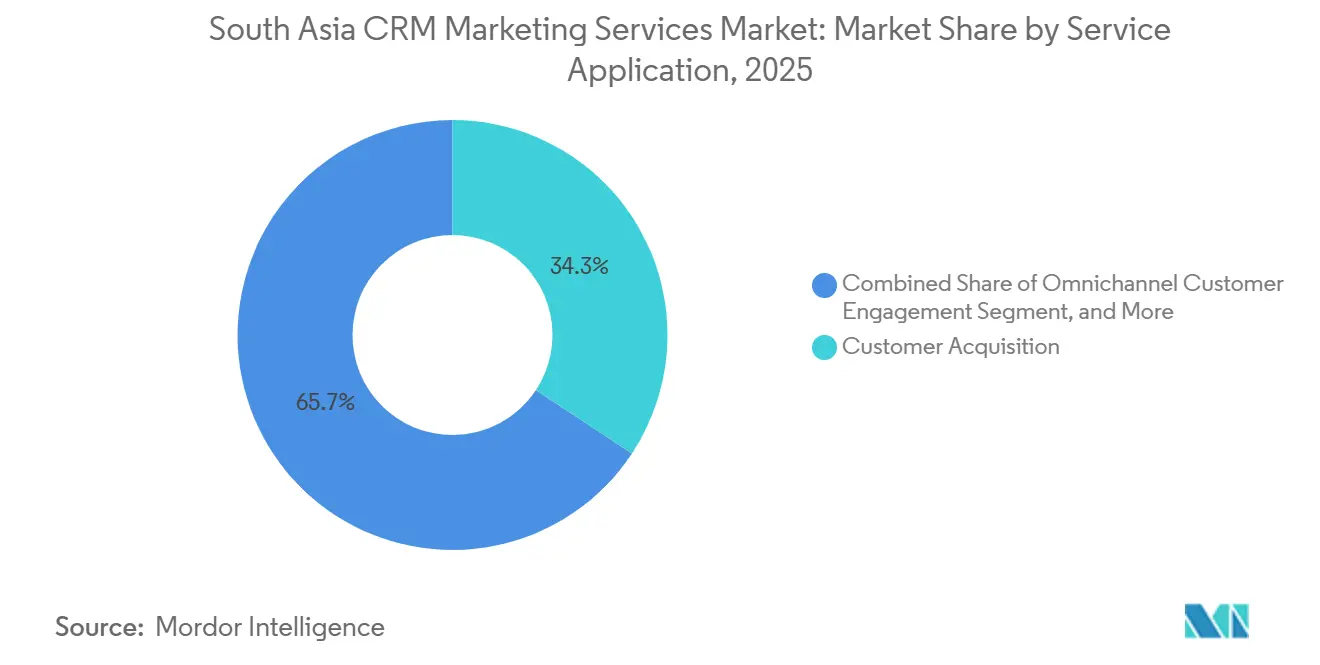
Customer Acquisition Leads Current Spend While Automation Changes Delivery EconomicsCustomer Acquisition held a 34.28% share in 2025, indicating that lead generation and prospect conversion still account for the largest share of service demand across the region. This is consistent with fast-growing consumer markets where brands remain focused on expanding reach, building active user pools, and improving response rates across digital channels. In sectors such as retail, BFSI, and e-commerce, acquisition programs are often the primary reason companies invest in CRM-managed campaigns, as the commercial link is easier to track than broader brand activity. That keeps acquisition at the center of current budgets, especially where consumer bases are expanding and competitive intensity is high. It also means the South Asia CRM marketing services market still rewards providers that can practically connect targeting, execution, and measurable conversion outcomes.
Marketing Automation Services is projected to grow at a 15.05% CAGR through 2031, indicating a shift from manually triggered communication to always-on journey management. As enterprise teams handle more channels and customer states, automated sequencing helps improve timeliness, consistency, and scale without increasing headcount at the same rate. Oracle’s customer experience AI rollouts and LTM’s BlueVerse M.A.X launch on Agentforce Marketing both show how automation is moving from a feature set to a managed execution model. Customer retention and loyalty, campaign management, analytics, omnichannel engagement, and personalization remain important adjacent areas, but their value is increasingly tied to how well automation binds them across the operating cycle. For that reason, the South Asia CRM marketing services market is seeing application-level spending shift toward systems that reduce reliance on manual campaigns and enable continuous optimization.
By End-User Industry:
BFSI Leads Present Demand While Retail and E-Commerce Builds the Faster Expansion TrackBFSI accounted for 33.69% of the end-user mix in 2025, making it the largest contributor to the South Asia CRM marketing services market. This leadership comes from a combination of scale, regulatory scrutiny, high-value customer relationships, and the need for more controlled communication across product lines. Banks, insurers, and lending institutions cannot rely on broad untargeted outreach when consent, suitability, and customer record quality increasingly shape both service outcomes and supervisory expectations. That keeps BFSI investment steady across implementation, data governance, orchestration, and managed customer engagement work, especially in India and other more structured services markets. The result is that BFSI remains the most established demand center in the South Asia CRM marketing services industry, even as newer use cases expand elsewhere.
Retail and e-commerce are projected to grow at a 14.67% CAGR through 2031, reflecting the need for repeat purchase management, regional-language promotion, loyalty flows, and faster engagement in high-frequency consumer categories. Quick commerce, D2C expansion, and mobile-led purchasing behavior are making CRM execution more central to how consumer brands acquire, retain, and reactivate buyers. That gives this vertical a different operating profile from BFSI, because success depends less on heavily governed workflow design and more on speed, channel coordination, and customer lifecycle management. Healthcare and life sciences, IT and telecom, industrial manufacturing, government and public administration, and other end-user industries also contribute to demand, with telecom and digital services showing stronger readiness for analytics-rich deployment. The South Asia CRM marketing services market is therefore broadening by vertical, but current revenue leadership and future acceleration are coming from different end-user groups.
Geography Analysis
India CRM Marketing Services Market
India held 57.29% of the South Asia CRM marketing services market share in 2025, underscoring that the region’s largest digital economy continues to drive most current demand. The country combines a broad enterprise base, a dense IT services capacity, and a deeper software ecosystem than other South Asian markets, which helps both domestic adoption and local delivery capability. Salesforce India reported revenue of INR 13,384.5 crore, equivalent to approximately USD 1.61 billion, for the financial year ended March 31, 2025, highlighting the scale of enterprise CRM demand already present in the country. Microsoft’s December 2025 commitment of USD 17.5 billion for India over 2026 to 2029 adds another layer of support because cloud and AI infrastructure depth strengthens the environment in which CRM automation workloads operate.[3] India also benefits from clearer momentum in privacy regulation, enterprise cloud migration, and AI-linked workflow adoption than most neighboring markets. These conditions keep the South Asia CRM marketing services market centered on India for both current spending and near-term platform evolution.
Bangladesh and Sri Lanka CRM Marketing Services Market
Bangladesh is projected to grow at a 15.89% CAGR through 2031, which makes it the fastest-growing country market in the report. Growth there is linked to expanding urban retail activity, stronger digital engagement among businesses, and the rising need for relationship management in export-oriented sectors. The opportunity is meaningful because Bangladesh is moving from basic digital presence toward more structured customer lifecycle tools, even though penetration remains behind India in platform depth and implementation capacity. Sri Lanka adds a different profile, with demand shaped more by services, telecom, and financial activity, while macroeconomic pressure continues to temper larger discretionary technology commitments. Together, these countries show that the South Asia CRM marketing services market is widening geographically, but not all markets are expanding from the same operating base.
Pakistan CRM Marketing Services Market
Pakistan remains an important but more constrained part of the regional picture, with demand tied closely to telecom, BFSI, and enterprise modernization priorities. FX exposure and budget sensitivity create additional friction in markets where subscriptions and services are often priced in foreign currency, slowing adoption among smaller buyers even when business interest is present. The Rest of South Asia segment remains modest in present value, but cloud-delivery models are reducing infrastructure barriers that once limited CRM adoption in smaller economies. Across the region, the pace of expansion depends heavily on whether service providers can match delivery depth with locally workable pricing, governance, and implementation support. That is why the South Asia CRM marketing services market is growing across multiple geographies, but India still sets the practical benchmark for scale, maturity, and execution capacity.
Competitive Landscape
The South Asia CRM marketing services market is moderately concentrated at the top end, with Salesforce, Microsoft, Oracle, and SAP holding a strong position in larger enterprise accounts. Their advantage comes from platform breadth, integration depth, brand trust in regulated sectors, and the ability to support large multi-function deployments across marketing, sales, and service. At the same time, the field becomes more fragmented below the top tier, where regional partners, specialized implementers, and managed-service firms compete for mid-market and SME work with narrower but often more adaptable service packages. This split structure means leadership is strongest in complex enterprise programs, while growth opportunities remain more open in operational delivery, localization, and ongoing account support. The South Asia CRM marketing services market, therefore, combines concentrated enterprise control with broad delivery fragmentation underneath.
Strategic positioning in 2026 shows that major vendors are trying to widen their advantage through infrastructure, orchestration, and compliance support rather than only through software features. Salesforce moved MuleSoft to Hyperforce in India in May 2026, giving customers a local data-residency path for integrations and AI-powered workflows within a governed environment. SAP opened a new Mumbai data center in June 2026, strengthening its local data handling capabilities for enterprises seeking cloud-based systems while staying aligned with Indian regulatory requirements.[4] Oracle then expanded the competitive bar further with Fusion Agentic Applications for Customer Experience, embedding coordinated AI agents across marketing, sales, and service workflows. These moves suggest that winning large accounts now depends as much on execution readiness and operating architecture as on brand recognition.
Below the enterprise tier, white space remains strongest in AI-native managed services and in support models built for smaller firms that cannot operate advanced stacks on their own. Providers that can simplify onboarding, keep compliance manageable, and connect automation with everyday campaign execution are in a stronger position to grow outside the largest accounts. LTM’s BlueVerse™ M.A.X launch, built on Agentforce Marketing, also reflects how ecosystem players are packaging orchestration and personalization into service-ready solutions rather than leaving customers to assemble the model themselves. Salesforce’s April 2026 collaboration with Dairy Day Ice Cream further shows that adoption is moving into consumer brands that want stronger front-end sales visibility and digitally managed customer engagement. The South Asia CRM marketing services market is therefore not defined only by who owns the platform; it is increasingly shaped by who can run the system well after go-live.
South Asia CRM Marketing Services Industry Leaders
-
Salesforce, Inc.
-
SAP SE
-
Adobe Inc.
-
Oracle Corporation
-
Microsoft Corporation
- *Disclaimer: Major Players sorted in no particular order
South Asia CRM Marketing Services Market Companies Covered in this Report
- Salesforce, Inc.
- Microsoft Corporation
- Oracle Corporation
- SAP SE
- Adobe Inc.
- HubSpot, Inc.
- Zoho Corporation Private Limited
- Freshworks Inc.
- Pegasystems Inc.
- Teradata Corporation
- SAS Institute Inc.
- Nice Ltd.
- Genesys Cloud Services, Inc.
- HCL Technologies Limited
- Tata Consultancy Services Limited
- Wipro Limited
- Accenture plc
- Capgemini SE
- Infosys Limited
- Cognizant Technology Solutions Corporation
Recent Industry Developments in South Asia CRM Marketing Services Market
- June 2026: SAP opened a new data center in Mumbai supporting SAP Business Network and SAP Business Technology Platform, with local data residency compliant with MeitY guidelines. The facility enables enterprises in BFSI, manufacturing, and government-adjacent sectors to deploy SAP's agentic AI and automation tools within Indian jurisdiction, removing the data sovereignty barrier that previously restricted regulated-sector cloud CRM migrations.
- June 2026: Salesforce India's Center of Excellence celebrated its 10th anniversary with a commitment to equip 1 million learners across India with AI-focused skills by 2030, partnering with AICTE, MeitY, IndiaAI, and its systems integrator partners, including TCS, Infosys, Accenture, and PwC, to build a structured AI talent pipeline directly aligned to Agentforce and Data Cloud platform roles.
- May 2026: Salesforce announced the upcoming availability of MuleSoft on Hyperforce in a dedicated India region, enabling organizations to deploy integrations and AI-powered workflows with local data residency and DPDP compliance. The MuleSoft Agent Fabric and Omni Gateway capabilities within the India Hyperforce environment provide governed, agentic integration infrastructure for enterprises operating across regulated sectors with complex multi-system CRM architectures.
- May 2026: LTM launched BlueVerse™ M.A.X, an end-to-end AI marketing orchestration solution built on Agentforce Marketing by Salesforce, designed to enable brands to deliver AI-powered personalized experiences across geographies. Arundhati Bhattacharya, CEO and President of Salesforce South Asia, described the offering as a next-generation Marketing-as-a-Service solution that combines Agentforce's orchestration capabilities with LTM's BlueVerse AI platform for personalization at scale and a measurably faster return on investment.
South Asia CRM Marketing Services Market Report Scope
The South Asia CRM Marketing Services Market comprises services that enable organizations to implement and optimize customer relationship management (CRM)-based marketing strategies across countries such as India, Bangladesh, Sri Lanka, Nepal, and Pakistan. These services include marketing automation, customer insight generation, campaign management, lead nurturing, and customer lifecycle engagement. Increasing internet penetration, rapid enterprise digitalization, and expanding adoption of cloud-based CRM solutions drive the market. The market helps organizations improve customer acquisition, engagement, and retention through data-driven marketing approaches.
The South Asia CRM Marketing Services Market Report is Segmented by Service Type (CRM Strategy and Consulting, CRM Implementation and Integration, CRM Migration and Modernization, CRM Managed Services, and CRM Training and Support), Enterprise Size (Large Enterprises, and Small and Medium Enterprises), Service Application (Customer Acquisition, Customer Retention and Loyalty, Campaign Management Services, Marketing Automation Services, Customer Analytics and Insights, Omnichannel Customer Engagement, and Personalization Services), End-user Industry (Banking, Financial Services, and Insurance (BFSI), Healthcare and Life Sciences, Information Technology and Telecom, Retail and E-commerce, Industrial Manufacturing, Government and Public Administration, and Other End-user Industries), and Geography (India, Pakistan, Bangladesh, Sri Lanka, and Rest of South Asia). The Market Forecasts are Provided in Terms of Value (USD).
Segmentation Overview
| CRM Strategy and Consulting |
| CRM Implementation and Integration |
| CRM Migration and Modernization |
| CRM Managed Services |
| CRM Training and Support |
| Large Enterprises |
| Small and Medium Enterprises |
| Customer Acquisition |
| Customer Retention and Loyalty |
| Campaign Management Services |
| Marketing Automation Services |
| Customer Analytics and Insights |
| Omnichannel Customer Engagement |
| Personalization Services |
| Banking, Financial Services, and Insurance (BFSI) |
| Healthcare and Life Sciences |
| Information Technology and Telecom |
| Retail and E-commerce |
| Industrial Manufacturing |
| Government and Public Administration |
| Other End-user Industries |
| India |
| Pakistan |
| Bangladesh |
| Sri Lanka |
| Rest of South Asia |
| By Service Type | CRM Strategy and Consulting |
| CRM Implementation and Integration | |
| CRM Migration and Modernization | |
| CRM Managed Services | |
| CRM Training and Support | |
| By Enterprise Size | Large Enterprises |
| Small and Medium Enterprises | |
| By Service Application | Customer Acquisition |
| Customer Retention and Loyalty | |
| Campaign Management Services | |
| Marketing Automation Services | |
| Customer Analytics and Insights | |
| Omnichannel Customer Engagement | |
| Personalization Services | |
| By End-user Industry | Banking, Financial Services, and Insurance (BFSI) |
| Healthcare and Life Sciences | |
| Information Technology and Telecom | |
| Retail and E-commerce | |
| Industrial Manufacturing | |
| Government and Public Administration | |
| Other End-user Industries | |
| By Geography | India |
| Pakistan | |
| Bangladesh | |
| Sri Lanka | |
| Rest of South Asia |
Key Questions Answered in the Report
What is the current size of the South Asia CRM marketing services market?
The South Asia CRM marketing services market was valued at USD 1.70 billion in 2025, is estimated at USD 1.89 billion in 2026, and is forecast to reach USD 3.52 billion by 2031 at a 13.20% CAGR.
Which country leads CRM marketing services demand in South Asia?
India led with 57.29% share in 2025, supported by stronger enterprise cloud adoption, deeper IT services capacity, and higher spending from regulated sectors.
Which service type brings in the most revenue?
CRM Implementation and Integration led with 54.21% share in 2025, showing that many enterprises are still modernizing core customer engagement systems.
Which customer group is expanding the fastest?
SMEs are projected to grow at a 16.22% CAGR through 2031, helped by subscription-led CRM adoption and rising demand for ongoing managed support.
Why is marketing automation gaining ground across South Asia?
Marketing Automation Services is projected to grow at a 15.05% CAGR, as enterprises shift from manually triggered outreach to AI-assisted and always-on customer journeys.
What is the main challenge slowing wider adoption?
Privacy fragmentation across countries and limited implementation talent are the main constraints, because they increase delivery complexity, cost, and rollout time.