
Netherlands CRM Marketing Services Market Size and Share
Market Overview
| Study Period | 2020 - 2031 |
|---|---|
| Forecast Data Period | 2026 - 2031 |
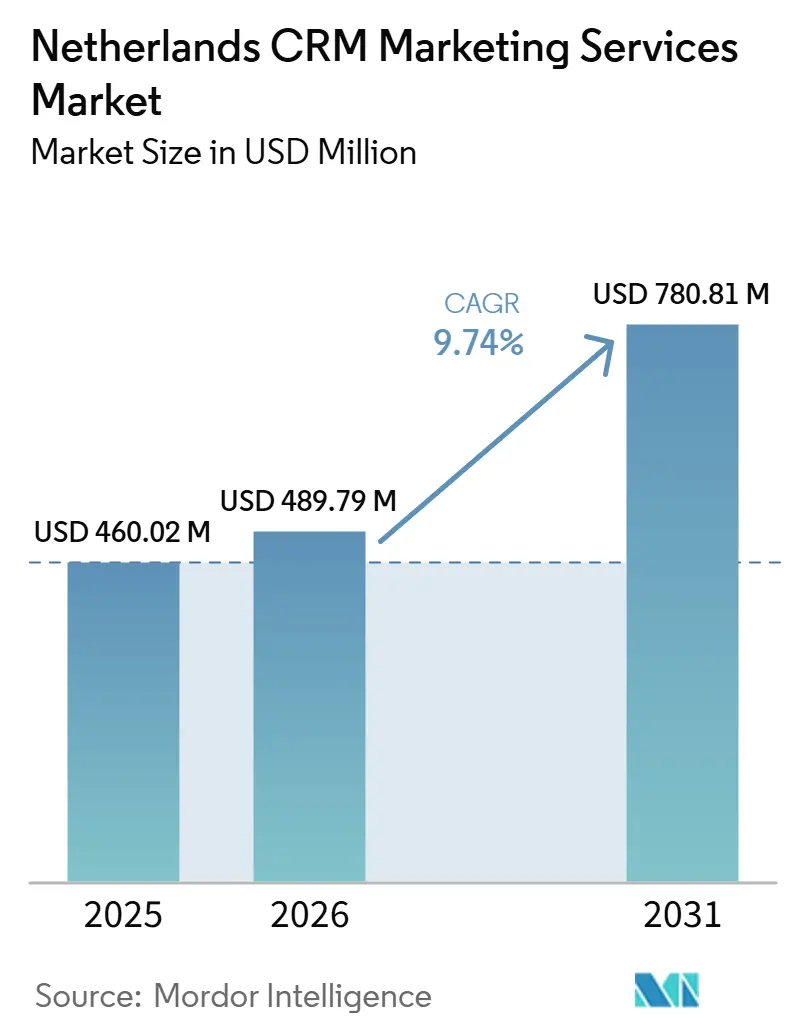
| Base Year Market Size (2025) | USD 460.02 Million |
| Market Size (2026) | USD 489.79 Million |
| Market Size (2031) | USD 780.81 Million |
| Growth Rate (2026 - 2031) | 9.74 % |
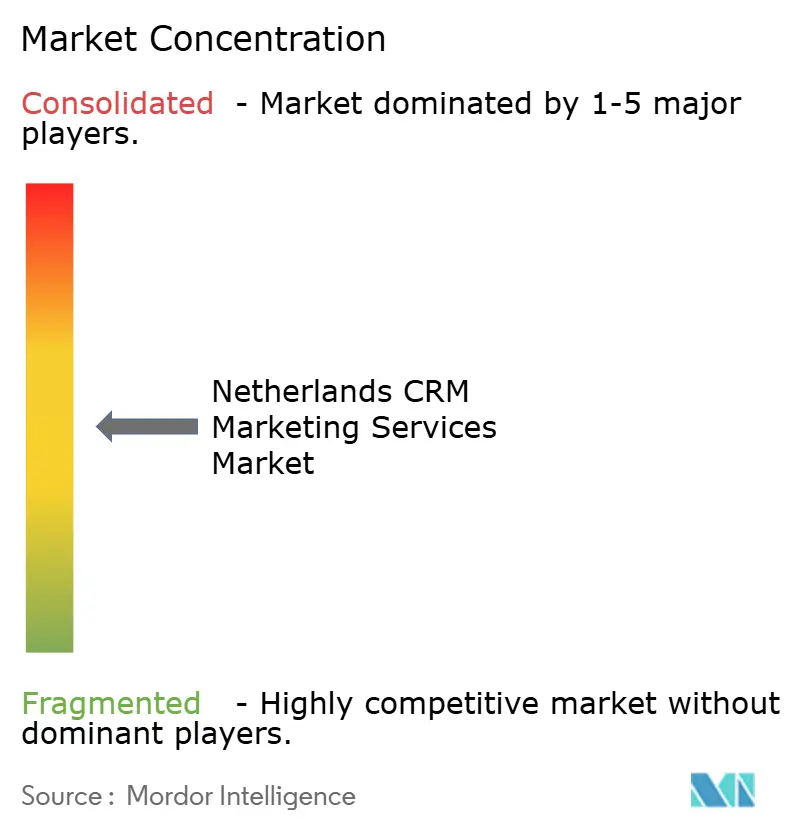
| Market Concentration | Medium |
Major Players *Disclaimer: Major Players sorted in no particular order Image © Mordor Intelligence. Reuse requires attribution under CC BY 4.0. | |
Netherlands CRM Marketing Services Market Analysis by Mordor Intelligence
The Netherlands CRM Marketing Services market size is projected to expand from USD 460.02 million in 2025 and USD 489.79 million in 2026 to USD 780.81 million by 2031, registering a CAGR of 9.74% between 2026 and 2031. The Netherlands CRM Marketing Services market is benefiting from a business base that is already comfortable with cloud deployment and is now moving more steadily into AI-led customer operations. Demand is also rising as Dutch companies seek CRM systems that support personalization, enhanced lead management, and tighter coordination among sales, marketing, and service teams. Privacy compliance remains a strong factor in purchase decisions, which is pushing buyers toward platforms and service partners that can support consent management, data governance, and auditable workflows. The Netherlands CRM Marketing Services market is also moving from one-time implementation work toward recurring support, optimization, and managed delivery as buyers look for quicker rollouts and steadier operating results. This is creating more room for firms that can combine platform expertise, local process knowledge, and ongoing service continuity into a single offering.
Key Report Takeaways
- By service type, CRM Implementation and Integration held 31.42% of the Netherlands CRM Marketing Services market share in 2025, while CRM Managed Services is projected to expand at an 11.83% CAGR through 2031.
- By enterprise size, Large Enterprises held a 64.81% share in 2025, while SMEs are projected to expand at a 12.19% CAGR through 2031.
- By application, Marketing Automation Services accounted for a 22.19% share of the Netherlands CRM Marketing Services market size in 2025, while Personalization Services is projected to advance at a 13.48% CAGR through 2031.
- By end-user industry, Banking, Financial Services, and Insurance accounted for 26.74% share in 2025, while Retail and E-commerce are projected to grow at an 11.62% CAGR through 2031.
Note: Market size and forecast figures in this report are generated using Mordor Intelligence’s proprietary estimation framework, updated with the latest available data and insights as of January 2026.
Netherlands CRM Marketing Services Market Trends and Insights
Drivers Impact Analysis*
| Driver | (~) % Impact on CAGR Forecast | Geographic Relevance | Impact Timeline |
|---|---|---|---|
| Rising Need for AI-Assisted Lead Prioritization and Personalization | +2.1% | National, with early concentration in Amsterdam, Rotterdam, and Utrecht tech hubs | Short term (≤ 2 years) |
| Accelerating SME Adoption of Integrated CRM and Marketing Workflows | +1.9% | National, with highest intensity in Randstad SME clusters | Medium term (2-4 years) |
| GDPR-Driven Demand for Consent-Safe Customer Data Operations | +1.4% | National, extending across EU-headquartered multinationals operating in the Netherlands | Short term (≤ 2 years) |
| Shift From Point Solutions to Unified Revenue Platforms | +1.1% | National, BFSI and large enterprise segments | Medium term (2-4 years) |
| Expansion of Subscription-Based and Managed CRM Marketing Services | +0.8% | National | Long term (≥ 4 years) |
| Cross-Channel Orchestration Requirements in a Fragmented Buyer Journey | +0.5% | National, highest in retail and e-commerce segments | Medium term (2-4 years) |
| Source: Mordor Intelligence | |||
Rising Need for AI-Assisted Lead Prioritization and Personalization
The Netherlands CRM Marketing Services market is seeing stronger demand for AI-enabled lead scoring and more individualized customer communication. Dutch SMEs are already operating on a strong digital foundation, with 81% in the cloud and 84% planning to increase AI investment over the next 3 years.[1] That readiness is changing what buyers expect from service providers because clients now want tools and workflows that can rank opportunities faster and tailor outreach with less manual effort. Platform vendors are also reinforcing that shift through broader AI rollouts, including HubSpot’s expansion of smart CRM and automation features in 2025. As a result, the Netherlands CRM Marketing Services market is moving toward services that combine implementation with model oversight, workflow tuning, and ongoing campaign refinement. Providers that cannot support those needs are becoming less relevant in shortlisting and renewal decisions.[2]
Accelerating SME Adoption of Integrated CRM and Marketing Workflows
The Netherlands CRM Marketing Services market is gaining momentum as smaller companies no longer wait for full-scale infrastructure upgrades before adopting modern CRM workflows. Wolters Kluwer reported that 81% of Dutch SMEs were already operating in cloud environments in 2026, meaning many can move to CRM and marketing tools without the delays that older on-premises systems often create. The same report showed that 84% of Dutch SMEs planned to increase AI investment over the next 3 years, indicating a broader willingness to integrate customer data, campaign activity, and sales follow-up into a single operating model. This matters because the Netherlands CRM Marketing Services market can serve SMEs with shorter deployment cycles and more standardized service bundles than those needed by large enterprises. It also supports recurring revenue opportunities for providers that can offer onboarding, training, optimization, and light-touch managed support under a single contract. The result is a wider, more durable client base for providers who understand SME buying patterns and local operating needs.
GDPR-Driven Demand for Consent-Safe Customer Data Operations
The Netherlands CRM Marketing Services market continues to benefit from compliance-led system upgrades. The Dutch data protection authority fined Clearview AI EUR 30,500,000 (USD 32.94 million) in September 2024 for processing personal data without a legal basis.[3] That action made it clear that data handling, profiling, and AI-supported processing are not separate from privacy enforcement. This is pushing organizations to review customer data flows, permissions, storage controls, and profiling logic before they scale marketing automation or personalization programs. In turn, the Netherlands CRM Marketing Services market is seeing more demand for service partners that can build consent-aware workflows and align them with operational use. Providers with stronger EU data governance capabilities are therefore better positioned to defend pricing and retain enterprise accounts.
Shift from Point Solutions to Unified Revenue Platforms
The Netherlands CRM Marketing Services market is also being shaped by buyers who want fewer disconnected systems. Microsoft reported that ABN AMRO reduced the total cost of ownership for its customer engagement platform by up to 40% after consolidating onto Dynamics 365 Customer Service and Sales, and the bank’s employee net promoter scores improved from 4.8 to 7.0.[4] That example shows why Dutch enterprises are moving away from isolated tools and toward broader revenue platforms that can connect customer records, service activity, and commercial workflows. The shift matters for the Netherlands CRM Marketing Services market because it increases the need for integration planning, data model alignment, governance, and post-deployment support. It also extends the value of service relationships beyond go-live, as buyers need continued oversight after consolidation is complete. Providers that can manage platform simplification and ongoing operations are therefore gaining a stronger position than firms that only sell project-based implementation work.
Restraints Impact Analysis*
| Restraint | (~) % Impact on CAGR Forecast | Geographic Relevance | Impact Timeline |
|---|---|---|---|
| High Cost of Localized Implementation and Ongoing Optimization | -1.8% | National, most acute in SME and mid-market segments | Short term (≤ 2 years) |
| Talent Shortage in CRM-Enabled Marketing Operations and MarTech Architecture | -1.4% | National, with pronounced ICT specialist deficit in non-Randstad provinces | Long term (≥ 4 years) |
| Data Quality Gaps Across Legacy Customer Systems | -0.9% | National, with high severity in BFSI and industrial manufacturing verticals | Medium term (2-4 years) |
| Integration Complexity Across European Privacy, Identity, and Consent Frameworks | -0.5% | EU-wide, primarily affecting Netherlands-headquartered multinationals | Medium term (2-4 years) |
| Source: Mordor Intelligence | |||
High Cost of Localized Implementation and Ongoing Optimization
The Netherlands CRM Marketing Services market still faces resistance from buyers who need local process alignment but lack the large transformation budgets needed to support it. Smaller firms may be cloud-ready, yet they still need help with setup, workflow design, user training, integration, and post-launch optimization. That makes the real cost of adoption broader than just software configuration. The issue is more visible when buyers need local accounting or ERP connectivity and when internal teams are too lean to maintain the system after deployment. The Netherlands CRM Marketing Services market, therefore, grows more slowly in parts of the SME and mid-market base where buyers delay projects or narrow service scope to control spending. Providers that package implementation and managed support together are better placed to reduce this restraint, but the affordability issue remains meaningful in the near term.
Talent Shortage in CRM-Enabled Marketing Operations and MarTech Architecture
The Netherlands CRM Marketing Services market is also limited by the shortage of skilled digital and ICT talent. The European Commission’s 2025 Digital Decade Country Report for the Netherlands noted persistent ICT specialist shortages, a declining share of women in ICT employment, and budget cuts to higher education that could weaken the future talent pipeline. Wolters Kluwer also found that 41% of Dutch SMEs cited hiring and retention as their top operational pressure point in 2026. This matters because CRM adoption depends on people who can manage data, configure automation, coordinate change, and maintain system quality over time. The Netherlands CRM Marketing Services market faces pressure on both delivery capacity and customer-side readiness, especially as projects move from installation to optimization. Service providers can offset part of the problem through automation and managed services, but the talent gap will remain a structural brake in the long term.
*Our forecasts treat driver/restraint impacts as directional, not additive. The impact forecasts reflect baseline growth, mix effects, and variable interactions.
Segment Analysis
By Service Type: Managed Services Outpace Implementation In Growth Trajectory
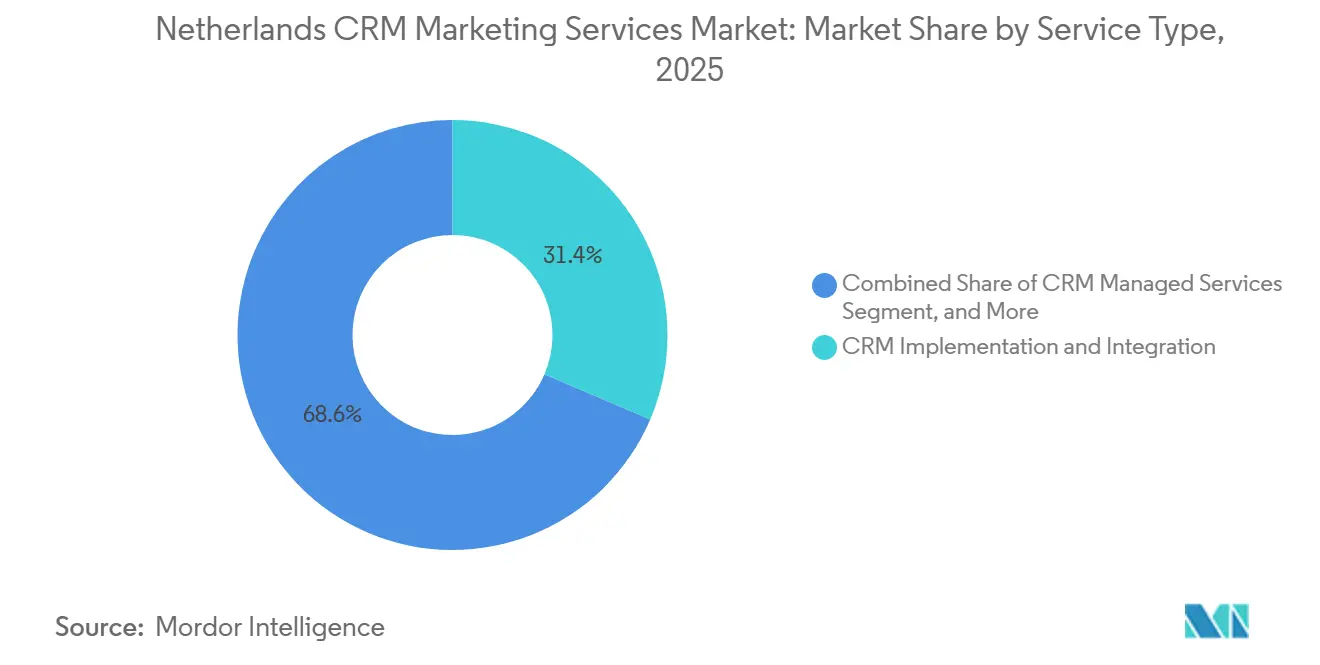
CRM Implementation and Integration accounted for 31.42% of the Netherlands CRM Marketing Services market in 2025, making it the largest service type. That position reflected the ongoing system replacement and architecture cleanup still underway across large Dutch organizations. Many buyers continued to upgrade because older CRM environments could not support current expectations around AI use, customer visibility, and workflow coordination. In practice, implementation work remained the first step for companies seeking to unify data sources and standardize operating processes. CRM Strategy and Consulting stayed relevant at the start of that cycle because buyers wanted clearer planning before committing to platform and partner choices. CRM Migration and Modernization also remained important, as legacy data structures and older workflows made platform changes more difficult.
Faster growth is now moving toward CRM Managed Services, which is projected to expand at a 11.83% CAGR from 2026 to 2031. This shows that the Netherlands CRM Marketing Services market is gradually placing more value on continuity after launch than on installation alone. Buyers increasingly want a single partner to monitor platform health, handle change requests, support users, and keep automation aligned with business goals. That preference becomes stronger when organizations run multiple customer-facing systems and do not want to expand their internal administrative teams. CRM Training and Support, therefore, remains tied to long-term performance rather than one-time user onboarding. Over time, this balance should shift a larger share of the Netherlands CRM Marketing Services market toward recurring contracts and away from project-by-project spending cycles.

By Enterprise Size: SMEs Accelerate, Large Enterprises Anchor Revenue
Large Enterprises held 64.81% of the Netherlands' CRM Marketing Services market share in 2025, reflecting their greater spending power and the broader scope of their CRM programs. Their projects often involve more business units, interfaces, and operating controls than those of smaller firms. That gives service providers higher revenue per account through implementation, integration, governance, and post-go-live support. The Netherlands CRM Marketing Services market also benefits from the reference value of large enterprise clients because successful programs at recognized institutions can support future sales. Microsoft’s case study on ABN AMRO illustrates how large Dutch organizations are using CRM consolidation to cut costs and improve operating efficiency.
At the same time, SMEs are projected to expand at a 12.19% CAGR from 2026 to 2031, making them the fastest-growing enterprise category. Wolters Kluwer reported that 81% of Dutch SMEs were already in cloud environments and 84% planned to increase AI investment over the next 3 years. Those conditions support faster deployment and make the Netherlands CRM Marketing Services market more accessible to smaller buyers than it was in earlier years. SMEs still face budget pressure and staffing constraints, but many can start with a narrower scope and add functions over time. That creates space for standardized packages, lighter integrations, and recurring support models tailored to growth stages. The result is a market where large enterprises still anchor revenue, while SMEs offer a stronger path for volume expansion.
By Service Application: AI Pushes Demand Toward Personalization
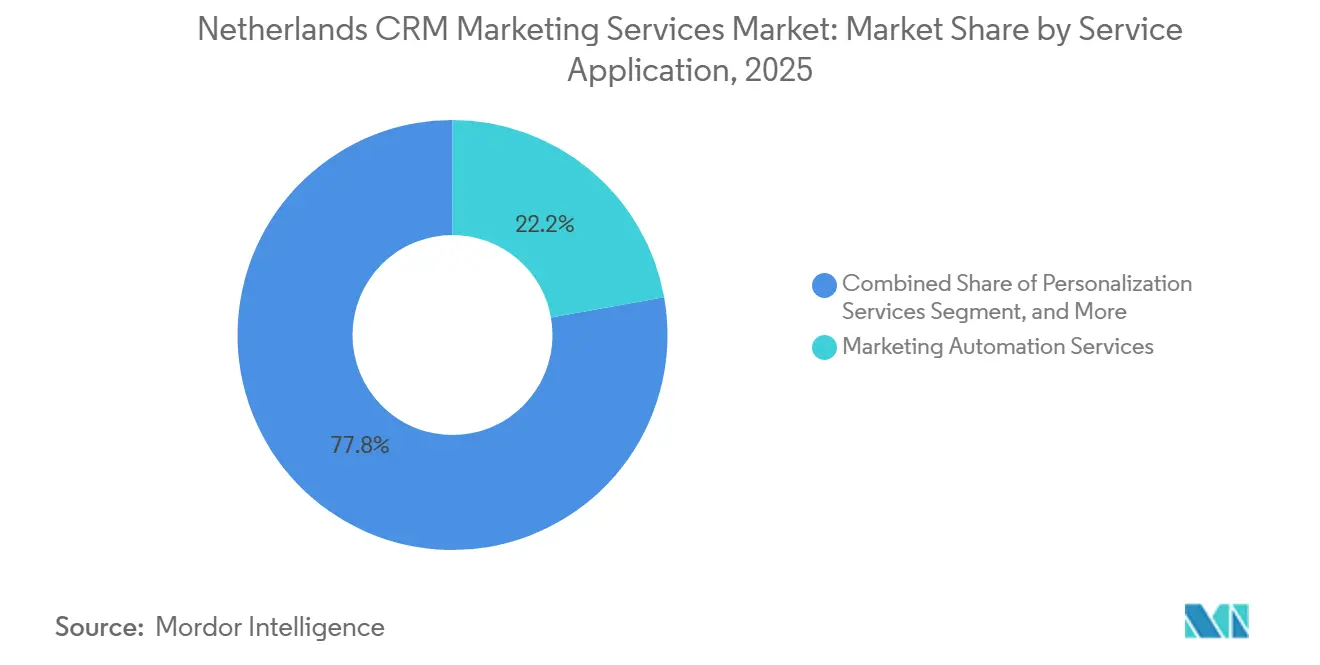
Marketing Automation Services held a 22.19% share of the Netherlands CRM Marketing Services market in 2025, making it the largest service application category. That result reflected the wide use of campaign workflows, email programs, and channel execution tools across Dutch organizations that had already moved beyond manual marketing operations. It also showed that many buyers still viewed automation as the operating core of customer engagement. Customer Acquisition, Customer Retention and Loyalty, Campaign Management Services, Customer Analytics and Insights, and Omnichannel Customer Engagement all remained relevant because they support different parts of the same commercial process. Together, these functions helped organizations manage outreach, coordinate campaigns, and turn customer data into actionable insights. The Netherlands CRM Marketing Services market still relies on automation as the practical foundation for broader customer management.
The strongest growth is moving into Personalization Services, which is projected to expand at a 13.48% CAGR from 2026 to 2031. This reflects a shift from standard campaign execution toward more context-based communication and better use of customer behavior signals. SAP’s February 2026 deployment for Studio Anneloes demonstrated how behavioral data-driven communication can replace manual scheduling with event-triggered customer messaging across channels. That type of use case matters because it requires stronger identity handling, data flow coordination, and ongoing content logic than basic automation alone. The Netherlands CRM Marketing Services market is therefore seeing more work that spans architecture, segmentation, and operational tuning within a single engagement. As this continues, providers that can connect analytics, consent control, and execution should capture a larger share of application-led spending.
By End-User Industry: BFSI Leads While Retail And E-Commerce Expands Faster
Banking, Financial Services, and Insurance accounted for 26.74% of the Netherlands CRM Marketing Services market share in 2025, which kept it as the leading end-user vertical. That leadership reflects the sector’s long-running focus on customer data modernization, service consistency, and governance-heavy operating environments. Large financial institutions also tend to run complex customer journeys across products and channels, which increases the need for structured CRM services. Microsoft’s ABN AMRO example showed how a major Dutch bank used platform consolidation to improve operating outcomes and lower ownership costs. In the Netherlands CRM Marketing Services market, BFSI therefore remains important not only for revenue scale but also for the depth of service work attached to each account.
Retail and E-commerce are projected to expand at a 11.62% CAGR from 2026 to 2031, making it the fastest-growing end-user segment. That pace is supported by strong digital buying behavior and the need for more tailored and responsive customer communication. SAP’s work with Studio Anneloes in 2026 and Versuni in 2025 showed how retail and commerce-related businesses are building more connected customer communication and self-service environments. Healthcare and Life Sciences, Information Technology and Telecom, Industrial Manufacturing, Government and Public Administration, and Other End-User Industries also remain part of the opportunity set, but their CRM maturity is less uniform across these industries. The Netherlands CRM Marketing Services market will continue to draw steady value from BFSI while gaining faster incremental growth from commerce-led and consumer-facing use cases.
Geography Analysis
The Netherlands CRM Marketing Services market reflects a national market with demand concentrated in the country’s main economic corridor. The strongest concentration remains in the Randstad region, including Amsterdam, Rotterdam, The Hague, and Utrecht. This area hosts a high share of financial institutions, multinational headquarters, digital businesses, and large commercial teams that need coordinated customer systems. That concentration supports a dense flow of implementation, integration, and managed service work across the Netherlands CRM Marketing Services market. It also helps explain why large enterprise mandates and advanced platform projects appear first in the western part of the country.
The Netherlands has a favorable digital backdrop for CRM service adoption. The European Commission reported in 2025 that 84% of Dutch citizens believed digitalization of public and private services made life easier. That wider acceptance of digital services supports faster organizational willingness to modernize customer engagement systems. Wolters Kluwer also reported that 81% of Dutch SMEs operated in cloud environments in 2026, which strengthens the deployment base for the Netherlands CRM Marketing Services market across both mature and emerging demand pockets.
Growth outside the Randstad is developing from a lower starting point, especially in provinces that are more tied to manufacturing, logistics, and regional business networks. The European Commission stated that the Netherlands’ Digital Decade roadmap carried a EUR 5.25 billion (USD 5.67 billion) program, and that EUR 1.2 billion (USD 1.37 billion) from the Recovery and Resilience Plan was set aside for digital transformation. That policy support should help narrow regional differences in adoption over time. For the Netherlands CRM Marketing Services market, this means future growth will not depend only on the largest urban centers but also on wider SME digitalization and more sector-specific CRM use in regions beyond the Randstad.
Competitive Landscape
The Netherlands CRM Marketing Services market is moderately consolidated at the platform level but remains fragmented across service delivery partners. Salesforce, HubSpot, SAP, and Microsoft continue to hold strong positions as the main technology anchors across enterprise and mid-market accounts. At the same time, a large base of Dutch and Benelux specialists competes in implementation, managed support, and vertical-specific delivery. This means no single provider controls the full service landscape, even when a few platforms dominate software choice. The Netherlands CRM Marketing Services market therefore operates through a two-layer structure in which platform leadership is relatively concentrated, while execution capacity is spread across many local and regional partners.
Competition is increasingly shaped by AI capability and the ability to turn it into operational outcomes. Salesforce announced in June 2026 that it had signed a definitive agreement to acquire Fin for approximately USD 3.6 billion, and Fin’s AI agents had autonomously resolved an average of 76% of customer support volume. HubSpot also expanded its AI position through Breeze AI and announced more than 200 product updates at INBOUND 2025. These moves matter in the Netherlands CRM Marketing Services market because they raise customer expectations for automation, smarter workflow support, and faster payback from CRM spending.
Platform strategy is not the only competitive factor. Compliance readiness and local delivery depth are also shaping account retention and new business wins. The Dutch data protection authority’s action against Clearview AI reinforced the importance of lawful data use and stronger controls around profiling and data processing. Microsoft’s ABN AMRO case and SAP’s work with Studio Anneloes and Versuni also show that large clients value providers that can support both platform modernization and operating continuity. In this setting, the Netherlands CRM Marketing Services market favors providers that can combine platform expertise, privacy discipline, and reliable post-launch support, rather than firms that compete solely on setup work.
Netherlands CRM Marketing Services Industry Leaders
-
Salesforce, Inc.
-
HubSpot, Inc.
-
Adobe Inc.
-
Microsoft Corporation
-
SAP SE
- *Disclaimer: Major Players sorted in no particular order
Recent Industry Developments
- June 2026: Salesforce signed a definitive agreement to acquire Fin (formerly Intercom) for approximately USD 3.6 billion. The deal integrates Fin's AI agents, which autonomously resolve an average of 76% of customer support volume, into the Agentforce platform, extending autonomous AI agent capabilities to enterprises and mid-market organizations globally. The transaction is expected to close in Q4 of Salesforce's fiscal year 2027.
- February 2026: Studio Anneloes, a Dutch fashion retailer, became one of the first brands in the Netherlands to implement SAP Engagement Cloud for customer lifecycle marketing. The deployment enabled automated, behavioral-data-driven communication across multiple channels, replacing manual campaign scheduling with event-triggered, purchase-history-based customer communication at scale.
- July 2025: Versuni, formerly Philips Domestic Appliances, implemented the full SAP CX Suite in 16 months, replacing a legacy ordering platform with an integrated B2B customer portal connecting SAP Commerce Cloud, SAP S/4HANA, and Customer Data Cloud, providing global clients with real-time access to order status and self-service functionality.
- July 2025: MAAS International deployed SAP Sales Cloud as a replacement for its legacy CRM system in a 3.5-month project. The implementation, executed with SAP partner The Value Chain, provides the commercial team with improved data quality, mobile functionality, and a foundation for broader ERP process automation.
Netherlands CRM Marketing Services Market Report Scope
The Netherlands CRM (Customer Relationship Management) marketing services market encompasses the range of professional, managed, and support services provided to organizations in the Netherlands to help them strategize, implement, optimize, and maintain CRM systems specifically for marketing functions. This market excludes the actual CRM software licenses or platform subscriptions (SaaS/on-premise), focusing entirely on the human expertise, consulting, and outsourced operations required to leverage these technologies effectively. The services covered include initial CRM strategy and consulting, system implementation and integration with existing marketing stacks, data migration and platform modernization, ongoing managed services, and user training and support. These services are used by businesses of varying sizes across multiple industries to execute specific marketing applications, including customer acquisition, retention, and loyalty programs; campaign management; marketing automation; customer analytics; omnichannel engagement; and hyper-personalization. The market value represents the revenue generated by service providers and agencies operating within the Netherlands for these specific CRM-related marketing engagements.
The Netherlands CRM Marketing Services Market Report is Segmented by Service Type (CRM Strategy and Consulting, CRM Implementation and Integration, CRM Migration and Modernization, CRM Managed Services, and CRM Training and Support), Enterprise Size (Large Enterprises, and Small and Medium Enterprises), Service Application (Customer Acquisition, Customer Retention and Loyalty, Campaign Management Services, Marketing Automation Services, Customer Analytics and Insights, Omnichannel Customer Engagement, and Personalization Services), and End-user Industry (Banking, Financial Services, and Insurance (BFSI), Healthcare and Life Sciences, Information Technology and Telecom, Retail and E-commerce, Industrial Manufacturing, Government and Public Administration, and Other End-user Industries). The Market Forecasts are Provided in Terms of Value (USD).
| CRM Strategy and Consulting |
| CRM Implementation and Integration |
| CRM Migration and Modernization |
| CRM Managed Services |
| CRM Training and Support |
| Large Enterprises |
| Small and Medium Enterprises |
| Customer Acquisition |
| Customer Retention and Loyalty |
| Campaign Management Services |
| Marketing Automation Services |
| Customer Analytics and Insights |
| Omnichannel Customer Engagement |
| Personalization Services |
| Banking, Financial Services, and Insurance (BFSI) |
| Healthcare and Life Sciences |
| Information Technology and Telecom |
| Retail and E-commerce |
| Industrial Manufacturing |
| Government and Public Administration |
| Other End-user Industries |
| By Service Type | CRM Strategy and Consulting |
| CRM Implementation and Integration | |
| CRM Migration and Modernization | |
| CRM Managed Services | |
| CRM Training and Support | |
| By Enterprise Size | Large Enterprises |
| Small and Medium Enterprises | |
| By Service Application | Customer Acquisition |
| Customer Retention and Loyalty | |
| Campaign Management Services | |
| Marketing Automation Services | |
| Customer Analytics and Insights | |
| Omnichannel Customer Engagement | |
| Personalization Services | |
| By End-user Industry | Banking, Financial Services, and Insurance (BFSI) |
| Healthcare and Life Sciences | |
| Information Technology and Telecom | |
| Retail and E-commerce | |
| Industrial Manufacturing | |
| Government and Public Administration | |
| Other End-user Industries |
Key Questions Answered in the Report
What is the size of the Netherlands CRM Marketing Services sector in 2026 and where will it reach by 2031?
The Netherlands CRM Marketing Services market stood at USD 490.79 million in 2026 and is projected to reach USD 780.81 million by 2031, growing at a 9.74% CAGR over 2026 to 2031.
Which service type leads revenue generation in the Netherlands CRM Marketing Services space?
CRM Implementation and Integration led with 31.42% share in 2025, showing that platform replacement and modernization still account for the largest part of spending.
Which customer group is growing faster in the Netherlands CRM Marketing Services field?
SMEs are growing faster, with a projected 12.19% CAGR through 2031, while Large Enterprises still held the bigger 64.81% share in 2025.
Why is personalization becoming more important in Dutch CRM services?
Personalization Services is projected to grow at a 13.48% CAGR through 2031 because buyers want more relevant and behavior-based customer communication across channels.
Which end-user sector creates the biggest demand in the Netherlands?
BFSI remained the largest end-user segment with 26.74% share in 2025, supported by large-scale customer data and platform modernization programs.
What is changing competition among CRM service providers in the Netherlands?
Competition is moving beyond implementation alone. Buyers now place more weight on AI capability, privacy compliance, integration depth, and long-term managed support.