
Enterprise Identity and Access Management (IAM) Market Size and Share
Market Overview
| Study Period | 2020 - 2031 |
|---|---|
| Market Size (2026) | USD 27.53 Billion |
| Market Size (2031) | USD 61.99 Billion |
| Growth Rate (2026 - 2031) | 17.63 % |
| Fastest Growing Market | Asia-Pacific |
| Largest Market | North America |
| Market Concentration | Medium |
Major Players *Disclaimer: Major Players sorted in no particular order Image © Mordor Intelligence. Reuse requires attribution under CC BY 4.0. | |
Enterprise Identity and Access Management (IAM) Market Analysis by Mordor Intelligence
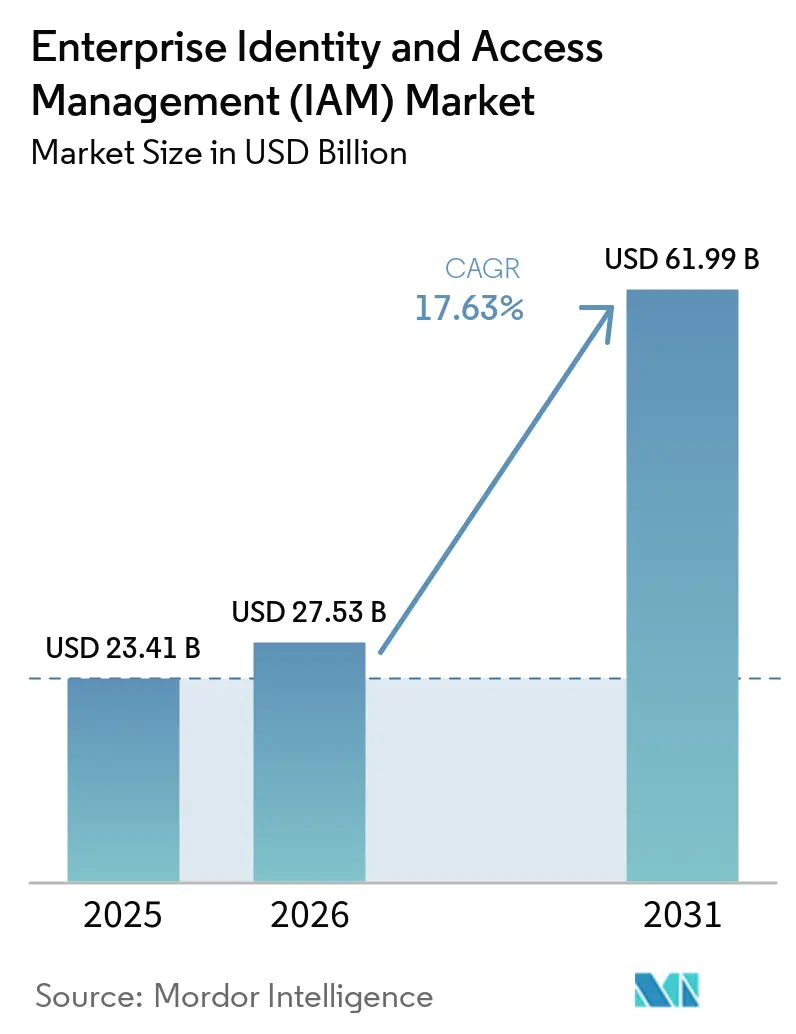
The enterprise identity and access management (IAM) market size is expected to increase from USD 23.41 billion in 2025 to USD 27.53 billion in 2026 and reach USD 61.99 billion by 2031, growing at a CAGR of 17.63% over 2026-2031. The enterprise identity and access management market is growing because identity has moved from a supporting control to the main decision point for access across cloud, hybrid, and on-premise environments. Demand is rising as enterprises manage a larger mix of human users, service accounts, APIs, bots, and AI agents, which expands governance scope and increases the need for stronger lifecycle controls. Regulatory timelines are also tightening, with zero trust programs and access governance obligations pushing enterprises to modernize faster and treat identity programs as part of core compliance spending. The SAP Identity Management retirement cycle, approaching 2027, is adding a forced migration layer for enterprises that kept identity governance close to ERP environments, which is opening room for both platform vendors and service providers. Competitive activity remains active because large enterprises are consolidating tools into broader platforms, while legacy directory complexity and operating skill gaps still slow deployment speed and keep a meaningful part of demand in the services pipeline.
Key Report Takeaways
- By component, solutions accounted for 71.35% share of the enterprise identity and access management (IAM) market in 2025, while services are projected to expand at a 19.53% CAGR through 2031.
- By technology, access management held 36.79% share of the enterprise identity and access management market in 2025, while non-human identity management is projected to grow at a 22.28% CAGR through 2031.
- By deployment mode, cloud-based deployment captured 56.23% share of the enterprise IAM market in 2025, while hybrid deployment is expected to expand at a 22.63% CAGR through 2031.
- By organization size, large enterprises accounted for 67.74% of the enterprise identity and access management market in 2025, while SMEs are projected to grow at a 21.37% CAGR through 2031.
- By end-use industry, BFSI held 24.31% of the enterprise identity and access management (IAM) market in 2025, while healthcare and life sciences are projected to expand at a 19.87% CAGR through 2031.
- By geography, North America accounted for 39.27% of the enterprise IAM market in 2025, while Asia-Pacific is projected to grow at a 23.61% CAGR through 2031.
Note: Market size and forecast figures in this report are generated using Mordor Intelligence’s proprietary estimation framework, updated with the latest available data and insights as of January 2026.
Global Enterprise Identity and Access Management (IAM) Market Trends and Insights
Drivers Impact Analysis*
| DRIVER | (~) % IMPACT ON CAGR FORECAST | GEOGRAPHIC RELEVANCE | IMPACT TIMELINE |
|---|---|---|---|
| Rising Identity Fraud and Account Takeover Attempts | +4.5% | Global | Short term (≤ 2 years) |
| Expansion of Zero Trust Access Architectures | +3.8% | North America, Europe, APAC | Medium term (2-4 years) |
| Cloud and SaaS Sprawl Across Hybrid Enterprises | +3.1% | Global | Short term (≤ 2 years) |
| Regulatory Pressure for Stronger Access Governance | +2.5% | Europe, North America | Medium term (2-4 years) |
| Non-Human Identity Growth From Machine-to-Machine Access | +2.1% | Global | Medium term (2-4 years) |
| Identity Security Convergence With Broader Cyber Platforms | +1.5% | North America, Europe | Long term (≥ 4 years) |
| Source: Mordor Intelligence | |||
Rising Identity Fraud and Account Takeover Attempts
Identity-based attacks have become one of the clearest buying triggers in the enterprise identity and access management (IAM) market because they affect customer channels, workforce access, and recovery workflows at the same time. The FBI Internet Crime Complaint Center recorded USD 359.7 million in account takeover losses from more than 4,700 complaints in 2025, while total cybercrime losses reached USD 20.9 billion in the same year.[1]SpyCloud, “FBI IC3 2025 Report: $20.9B in Cybercrime Losses, Key Takeaways for Security Teams,” SpyCloud, spycloud.com LexisNexis Risk Solutions reviewed more than 116 billion online transactions in 2025 and found an 8% rise in global fraud attack rates, with EMEA recording a 27% year-over-year increase. Microsoft also reported that password attacks exceeded 7,000 per second globally in 2025, which shows how inexpensive credential abuse has become for attackers. As transaction controls improve, attackers are moving earlier in the user journey and exploiting account creation, credential reset, and recovery steps that many enterprises still manage through inconsistent processes. That shift is pushing the enterprise IAM market toward stronger identity proofing, broader MFA, adaptive access policies, and tighter lifecycle governance rather than relying only on sign-in controls.
Expansion of Zero Trust Access Architectures
The enterprise identity and access management (IAM) market is also being lifted by the shift from perimeter controls to continuous verification models that rely on identity as the main policy engine. NIST published Special Publication 1800-35 in June 2025 and presented 19 practical zero trust architecture implementation builds validated with 24 industry collaborators.[2]National Institute of Standards and Technology, “NIST Offers 19 Ways to Build Zero Trust Architectures,” NIST, nist.gov The NSA released updated guidance in April 2026 that defined phase-based zero trust maturity expectations for the user pillar, which gives defense organizations a structured path for identity upgrades. These frameworks matter because they turn identity controls into measurable program requirements for agencies, contractors, and enterprises working in regulated supply chains. NIS2 and related sector rules are reinforcing the same direction in Europe, where access governance and privileged access control are now tied more directly to legal accountability and procurement standards. The result is that many organizations are not starting from scratch; they are rebuilding existing enterprise IAM estates into continuous trust models, which favors vendors already embedded in enterprise identity environments.
Cloud and SaaS Sprawl Across Hybrid Enterprises
The enterprise identity and access management (IAM) market continues to gain momentum as enterprises operate across multiple cloud identity providers, large SaaS portfolios, and long-standing on-premises directories simultaneously. This environment increases administrative overhead because each platform introduces separate user stores, policies, connectors, and certification steps that have to be aligned without breaking access. Many enterprises, therefore, spend a large part of their IAM budgets on integration, connector maintenance, and exception handling instead of on new control depth. The upcoming SAP Identity Management retirement cycle is intensifying that pressure for SAP-dependent organizations, as it forces a governance redesign rather than a simple version upgrade. Vendors that offer cloud-native platforms, broad connector libraries, and low-code onboarding workflows are therefore gaining ground as buyers look for faster migration paths and lower implementation friction. This dynamic is expanding the enterprise identity and access management market by making unified governance and cross-environment visibility more valuable than isolated authentication features.
Regulatory Pressure for Stronger Access Governance
Regulation is increasingly shaping the enterprise identity and access management (IAM) market because access governance is now tied to operational resilience, board accountability, and supervisory review. DORA took effect across the European Union in January 2025 and pushed financial institutions toward real-time access rights management and regular access reviews, which map directly to identity governance and privileged access programs. ENISA reported in 2025 that 34% of EU organizations had specific capability gaps in IAM operations, which shows that compliance pressure is rising faster than operational readiness.[3]European Union Agency for Cybersecurity, “Navigating Cybersecurity Investments in the Time of NIS 2,” ENISA, enisa.europa.eu France’s ANSSI also published the ReCyF technical framework in March 2026, which added more concrete identity and access expectations for essential and important entities under the national NIS2 path. These changes are shifting IAM from a post-audit remediation tool to a front-end procurement priority because organizations need durable evidence of access control, access review, and privileged entitlement governance. That is why the enterprise identity and access management market is seeing more demand for products that can show policy enforcement, certification records, and consistent control across workforce, partner, and machine identities.
Restraints Impact Analysis*
| RESTRAINT | (~) % IMPACT ON CAGR FORECAST | GEOGRAPHIC RELEVANCE | IMPACT TIMELINE |
|---|---|---|---|
| Integration Complexity With Legacy Directory Environments | -0.7% | North America, Europe, APAC | Medium term (2-4 years) |
| High Cost of Enterprise-Scale IAM Modernization | -0.5% | Global | Short term (≤ 2 years) |
| Identity Data Fragmentation Across Cloud Platforms | -0.4% | Global | Medium term (2-4 years) |
| Skilled Identity Governance Talent Shortage | -0.3% | Europe, North America, APAC | Long term (≥ 4 years) |
| Source: Mordor Intelligence | |||
Integration Complexity With Legacy Directory Environments
The enterprise identity and access management (IAM) market still faces friction from the depth of legacy directory environments that many enterprises built over 15 to 20 years. Active Directory estates often include custom group structures, one-off connectors, undocumented dependencies, and shadow integrations that are only discovered after migration planning begins. This makes program scoping difficult and stretches deployment timelines because each connected application can create a separate testing and entitlement challenge. Enterprises that proceed with modernization often run parallel identity systems for long transition windows, which increase support costs and create temporary policy gaps that require additional controls. The problem is most visible in industrial and mid-market environments where directory history is deep but dedicated IAM architecture capacity is limited. As a result, strong demand exists in the enterprise IAM market, but a part of it converts slowly into recognized revenue because modernization programs take longer to execute than initial buying plans suggest.
High Cost of Enterprise-Scale IAM Modernization
Cost is another important restraint in the enterprise identity and access management (IAM) market, especially when buyers move from product comparison into full implementation planning. License pricing matters, but the larger expense often sits in data cleanup, role design, approval workflow mapping, access model redesign, and integration with hundreds of target applications. Cloud deployment reduces infrastructure overhead, but it does not remove the effort needed to normalize entitlements and align reporting relationships across disconnected systems. This cost profile is easier for large enterprises to absorb because they increasingly treat identity modernization as part of compliance and cyber resilience budgets. Mid-market organizations face a harder decision because they may need enterprise-grade controls but lack the internal teams and budget structure to support multi-year transformation projects. That pressure keeps demand strong for SaaS IAM, subscription pricing, and managed identity services that lower the initial commitment even as the broader enterprise identity and access management market keeps expanding.
*Our forecasts treat driver/restraint impacts as directional, not additive. The impact forecasts reflect baseline growth, mix effects, and variable interactions.
Segment Analysis
By Component: Solutions Anchor The Platform, Services Reshape Delivery
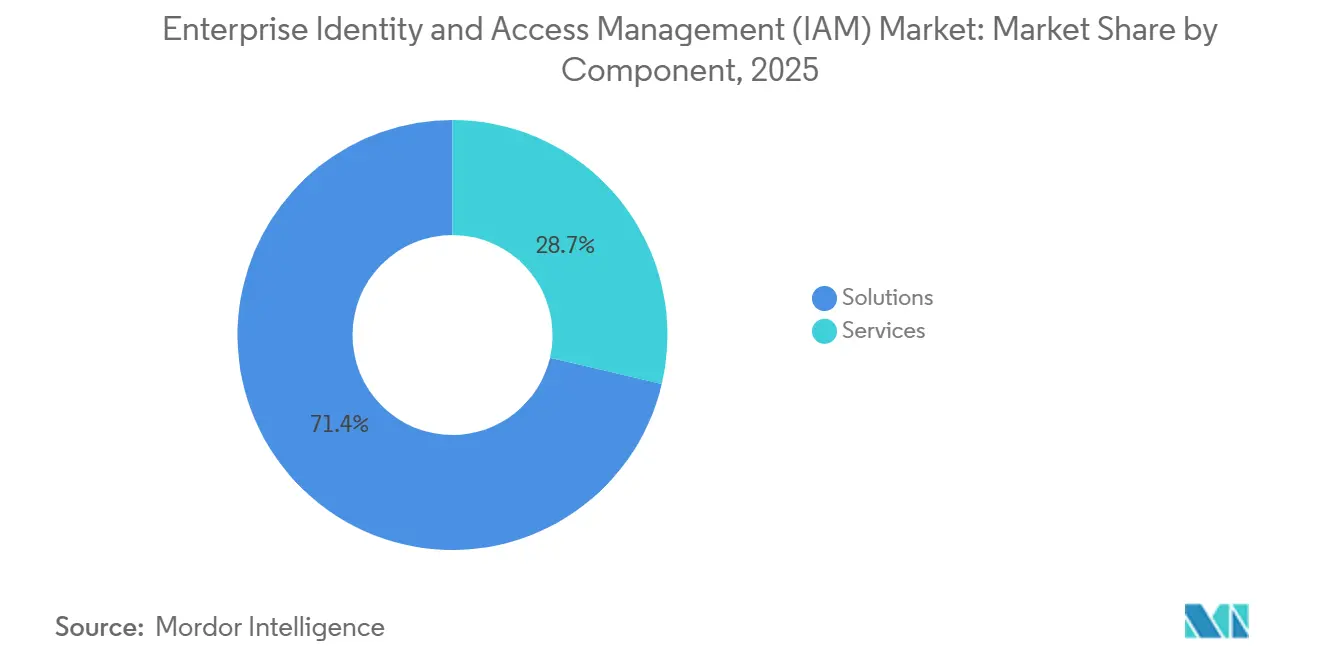
Solutions captured 71.35% of the enterprise identity and access management (IAM) market size in 2025, which shows how strongly enterprises still prioritize core platforms before expanding delivery support. This segment remained dominant because authentication, access control, identity lifecycle automation, privileged access management, and risk analytics form the foundation on which all later governance activity depends. Buyers usually need these software layers in place before they can standardize policy, automate certifications, or extend controls across new digital channels. The solutions base is also broad because both workforce identity and customer identity programs depend on common policy engines, credential controls, and administrative workflows. For that reason, the enterprise identity and access management market continues to anchor revenue in software even while deployment models and procurement preferences evolve.
Services are projected to grow at a 19.53% CAGR through 2031, which makes them the faster-moving part of the enterprise identity and access management (IAM) market over the forecast period. Demand is rising because many enterprises do not have deep IAM engineering teams and need outside support for migration planning, connector deployment, policy tuning, and ongoing governance operations. ENISA’s 2025 finding that 34% of EU organizations reported IAM capability gaps helps explain why managed service demand remains strong even when platform interest is already established. Managed services are advancing faster than traditional project work because hybrid environments require continuous monitoring, access review, and lifecycle administration rather than periodic implementation milestones. IBM’s AskIAM launch in May 2026 showed how service providers are repositioning delivery through agentic orchestration that works across IBM Verify, Microsoft Entra, Saviynt, CyberArk, and SailPoint environments.[4]IBM Verify Community, “IBM Verify News, A Technical Touchpoint May 2026,” IBM, community.ibm.com


By Technology: Access Management Leads, Non-Human Identity Redefines Governance Scope
Access management held 36.79% of technology revenue in 2025, which reflects its broad deployment base across workforce and customer-facing environments in the enterprise identity and access management (IAM) market. Single sign-on, adaptive MFA, session controls, and conditional access have become core operating requirements rather than optional upgrades for most enterprises. That scale supports the segment’s leading share because nearly every IAM program starts with access orchestration before it expands into deeper entitlement governance. Competitive separation in this segment now depends less on basic sign-in features and more on policy precision, identity orchestration, and the ability to align access signals across cloud and on-premises systems. This keeps access management at the center of the enterprise identity and access management (IAM) market even as buyers ask for wider governance capability.
Non-human identity management is projected to grow at a 22.28% CAGR through 2031, which makes it the fastest-growing technology segment in the enterprise IAM market. The category is widening because enterprises now manage service accounts, API keys, bots, containers, certificates, and AI agents alongside human identities, and each of those assets carries separate access and accountability needs. Privileged identity and third-party identity programs are growing in parallel because supplier access and machine access are now linked more closely to operational and supply chain risk. Okta made Okta for AI Agents generally available in April 2026, adding lifecycle management, short-lived token authentication, and revocation controls for AI agents inside Universal Directory. SailPoint followed with Agentic Fabric in March 2026, which reinforced the idea that AI agent identity governance is becoming a distinct control layer inside the enterprise identity and access management (IAM) market.[5]SailPoint, Inc., “SailPoint Redefines Identity Security With New Adaptive Identity Innovations,” SailPoint, sailpoint.com
By Deployment Mode: Cloud Leads, Hybrid Closes The Infrastructure Gap
Cloud-based deployment captured 56.23% of total revenue in 2025, giving it the leading position in the enterprise identity and access management (IAM) market size by deployment mode. This leadership reflects the appeal of vendor-managed upgrades, faster rollout cycles, elastic scaling, and easier remote administration across distributed user populations. Buyers also value the speed with which cloud platforms can roll out policy changes, authentication updates, and new integrations across large estates. At the same time, cloud leadership does not mean on-premise identity has disappeared, because government, defense, and parts of financial services still maintain local control requirements for sensitive environments. That balance explains why the enterprise IAM market continues to grow through a mix of cloud acceleration and selective on-premise persistence.
Hybrid deployment is projected to grow at a 22.63% CAGR through 2031, which shows how closely the enterprise identity and access management market is tied to mixed infrastructure realities rather than full cloud replacement. Most enterprises still run legacy directories, internal applications, and regulated workloads beside cloud services, so identity teams need a single governance model that can span all of them. Vendors that can manage Active Directory, cloud identity providers, and SaaS applications through one console are gaining preference because buyers want policy consistency without rebuilding every system at once. SAP’s Q1 2026 updates to SAP Cloud Identity Services added support for multiple corporate OpenID Connect identity providers with the same issuer URL and a new Authorization Management Service API, both of which support more flexible hybrid identity design. Hybrid, therefore, remains a strong growth lane inside the enterprise identity and access management (IAM) market because it matches the real pace of enterprise infrastructure change.
By Organization Size: Large Enterprises Anchor Revenue, SMEs Drive the Next Wave
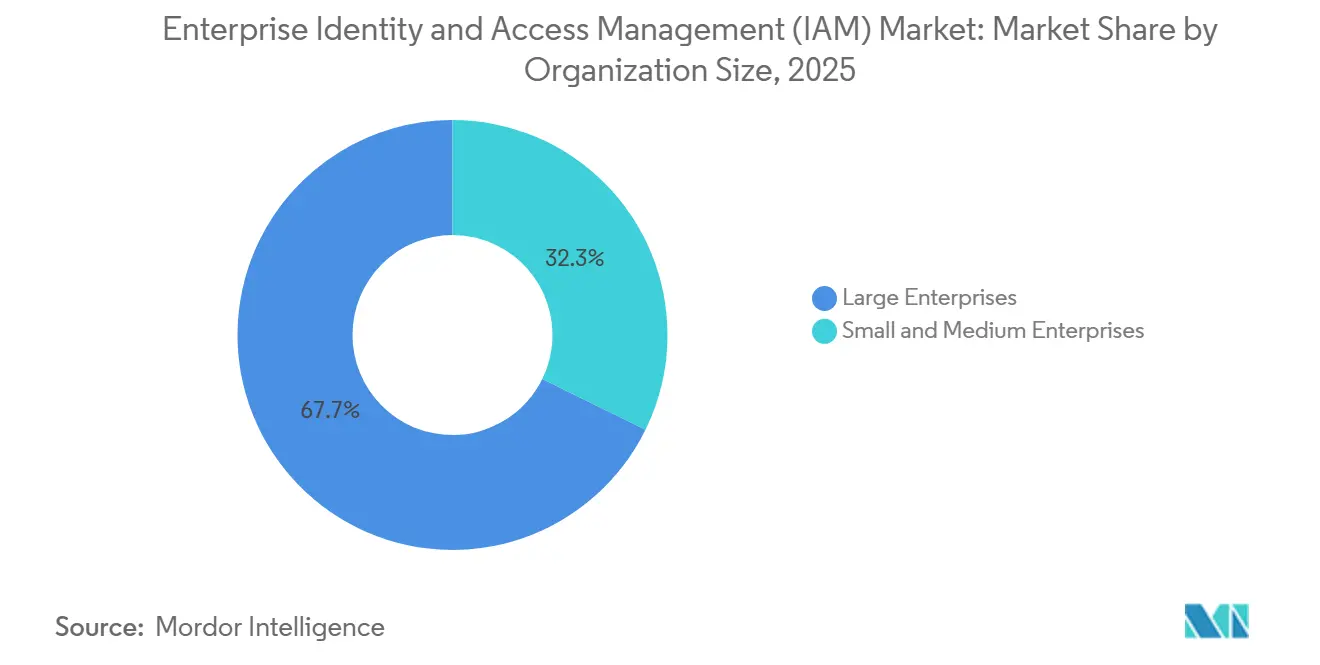
Large enterprises accounted for 67.74% of revenue in 2025, which made them the main revenue base of the enterprise identity and access management (IAM) market. Their leading share reflects higher per-seat spending, larger identity populations, heavier compliance requirements, and the complexity of managing access across many business units and geographies. These organizations also operate broader application portfolios, which increases demand for identity governance, privileged access control, and lifecycle automation at scale. Procurement cycles are longer in this segment, but budgets are usually larger, and platform standardization is often linked to enterprise-wide cyber programs. As a result, large organizations continue to shape vendor roadmaps and revenue concentration in the identity and access management market.
SMEs are projected to grow at a 21.37% CAGR through 2031, which gives them a faster expansion profile inside the enterprise identity and access management market. Growth is being supported by SaaS delivery, lighter implementation models, and subscription pricing that reduces the upfront barrier that once limited adoption. Managed services are especially important for this segment because smaller organizations often need stronger access controls but do not maintain dedicated identity teams. Consumption-based pricing is also a better fit for SMEs because it aligns spending with actual user counts and avoids large perpetual license commitments. This means the enterprise identity and access management (IAM) market is widening beyond large enterprise programs and moving into a broader installed base that values simplicity, faster setup, and ongoing operational support.
By End-Use Industry: BFSI Compliance Leads, Healthcare Security Stakes Accelerate
BFSI held 24.31% of the enterprise identity and access management (IAM) market share in 2025, which placed it at the front of end-use demand. The sector’s position is rooted in high exposure to fraud, strong dependence on privileged access control, and close regulatory oversight of authentication, authorization, and access review processes. Financial institutions also manage large customer identity flows and sensitive internal approval chains, which makes IAM a direct operational control rather than a supporting IT tool. DORA and related supervisory expectations have added urgency by pushing access rights management and periodic review deeper into resilience planning. These conditions keep BFSI central to the enterprise identity and access management market because spending is tied to both risk control and regulatory readiness.
Healthcare and life sciences is projected to grow at a 19.87% CAGR through 2031, making it the fastest-growing end-use segment in the enterprise identity and access management market. The U.S. Department of Health and Human Services proposed HIPAA Security Rule updates in January 2025 that are designed to align more closely with modern security practice, which raises the importance of structured identity controls in healthcare environments. Growth is also supported by complex EHR integration, partner access needs, and consolidation across health systems that must unify identities without interrupting care delivery. Thales’s OneWelcome Identity Platform selection by Availity in June 2026 illustrates how high-volume healthcare networks are moving toward centralized adaptive authentication and consent-aware identity infrastructure. Government and public administration, IT and telecom, retail and e-commerce, energy and utilities, and industrial manufacturing also remain important demand pools as the enterprise identity and access management (IAM) market extends into operational technology, public digital services, and regulated consumer platforms.
Geography Analysis
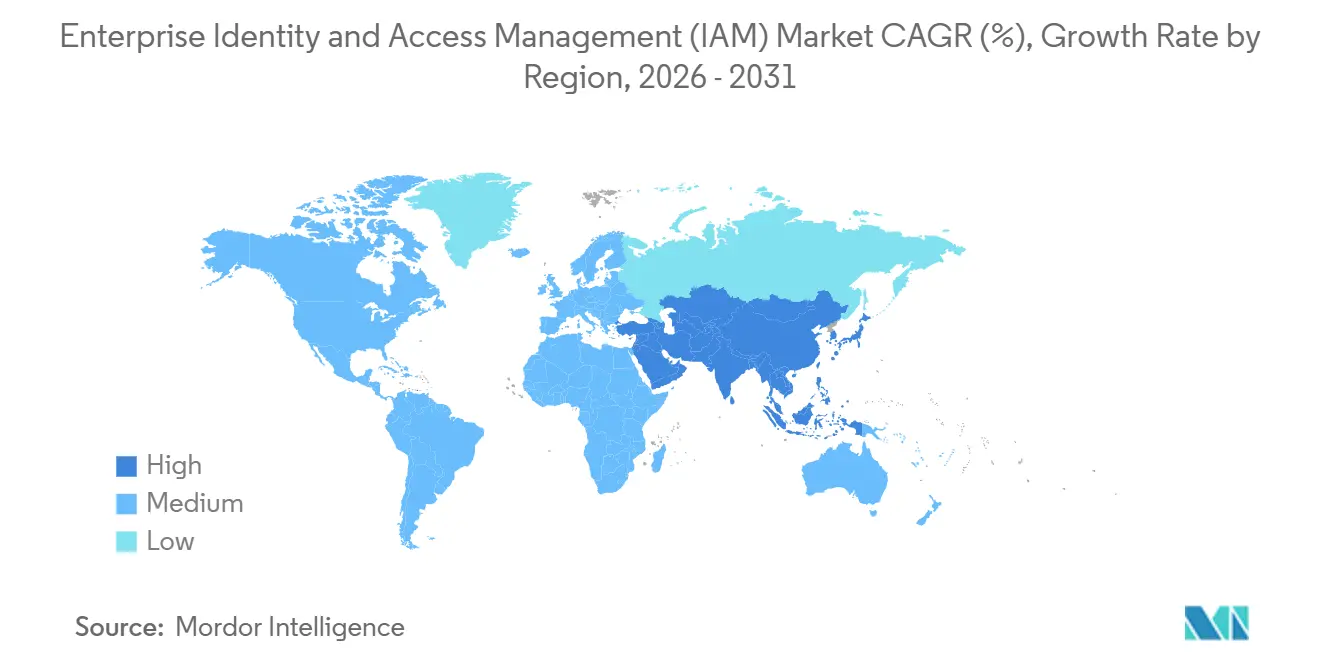
North America held 39.27% of the enterprise identity and access management (IAM) market share in 2025, which made it the leading regional contributor by revenue. The region benefits from the highest concentration of IAM vendors, deep enterprise software budgets, and a procurement environment where identity modernization is often tied directly to federal cybersecurity programs. The U.S. Department of Defense's zero trust strategy and maturity roadmap continue to shape expectations across the defense ecosystem, which strengthens demand for identity controls that support least privilege, continuous verification, and auditable access governance.[6]U.S. Department of Defense, “DoD Zero Trust Strategy,” Department of Defense, dodcio.defense.gov Canada is also advancing digital identity and cybersecurity programs, while U.S. financial services and fintech remain among the most active buyers in the region.
Asia-Pacific is projected to grow at a 23.61% CAGR from 2026 to 2031, which makes it the fastest-growing region in the enterprise identity and access management market. Growth is being driven by a mix of government digital identity programs, mobile-first service models, rising fraud exposure, and faster cloud adoption across major economies. India is seeing stronger IAM demand as digital payments, fintech expansion, and incident reporting expectations increase the need for real-time identity verification and access governance. China remains important because the size of its digital economy and industrial base creates large-scale workforce, machine, and application identity requirements. Japan, South Korea, and Southeast Asia are also adding momentum as enterprises broaden cloud usage and look for stronger controls over customer identity, workforce access, and non-human accounts.
Europe ranks behind North America in current scale, but its spending path in the enterprise identity and access management (IAM) market is being shaped strongly by NIS2 and DORA-related obligations. ENISA’s 2025 assessment that 34% of EU organizations reported IAM capability gaps shows that modernization demand is substantial and still under-served in many environments. South America is emerging as a meaningful growth area as open banking, digital payments, and BFSI digitization increase the value of stronger customer and workforce identity controls. The Middle East and Africa are also gaining momentum as Saudi Arabia and the UAE expand digital transformation programs and government-backed digital identity services.

Competitive Landscape
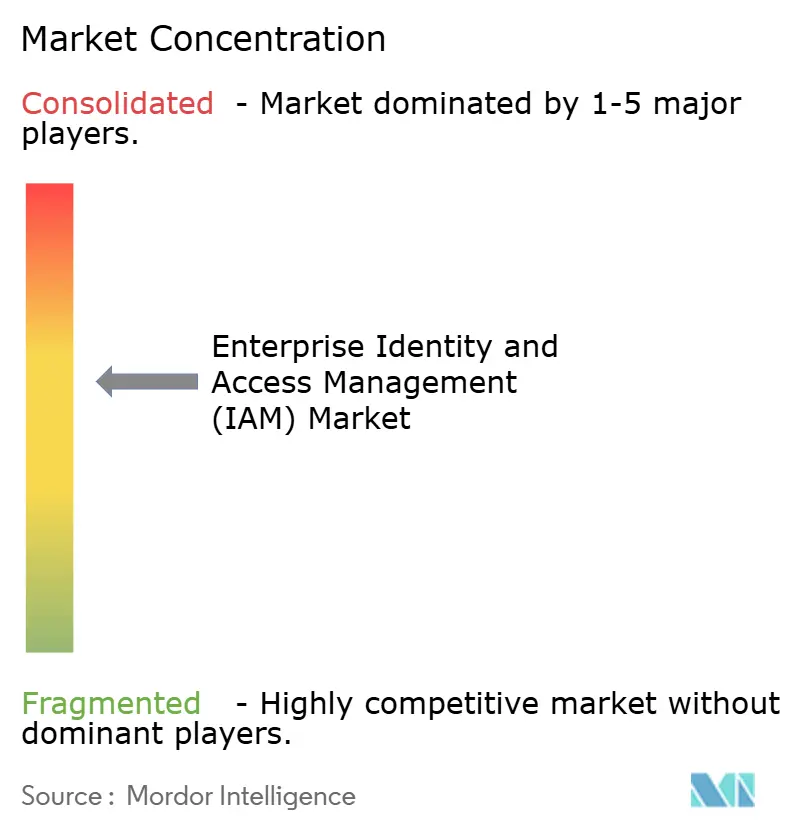
The enterprise identity and access management (IAM) market is moderately concentrated, with the top 5 vendors accounting for 40% of total revenue, while the remaining 95% is spread across a large field of specialized providers. Large platform vendors compete on depth across access management, identity governance, privileged access, and non-human identity, while smaller players often focus on sector specialization, regional compliance needs, or deployment simplicity. Competition is becoming more strategic because buyers increasingly prefer consolidated platforms that reduce connector sprawl and give security teams better visibility across the workforce, partners, and machine identities. This is keeping pricing pressure active in some segments while still leaving room for differentiated products in fast-moving control areas.
One of the most important strategic moves in the enterprise identity and access management market was Palo Alto Networks’ completion of the CyberArk acquisition in February 2026, which brought privileged access management and identity security deeper into a broader AI-focused security platform. CyberArk had already expanded earlier in the cycle through its February 2025 acquisition of Zilla Security, which added depth to its platform in identity governance and administration. Okta took a different path, making Okta for AI Agents generally available in April 2026 and focusing on registration, lifecycle governance, and revocation for agent identities. SailPoint reinforced its governance-led position with Agentic Fabric in March 2026 and then announced its intent to acquire Entro Security in June 2026 to strengthen coverage across non-human identity types and credential categories. These moves show that the enterprise identity and access management (IAM) market is no longer centered only on employee sign-in; it is now also a contest over who can govern AI agents, machine credentials, and cross-platform entitlements with the fewest operational gaps.
The enterprise IAM market still leaves room for challengers because no single vendor has established a dominant standard for AI agent identity governance or for hybrid governance across every major enterprise stack. BeyondTrust, One Identity, SecureAuth, Avatier, and ManageEngine continue to hold defensible positions by addressing specific vertical needs, regional compliance demands, or targeted customer segments. IBM is leaning on cross-platform delivery and service-led orchestration, as evidenced by its AskIAM approach and efforts to support mixed identity environments. Thales is also differentiating through trust infrastructure and healthcare-linked identity deployments, which strengthen its position in high-assurance use cases. Standards alignment now matters more in competitive evaluations, and participation in initiatives such as NIST SP 1800-35 can help build procurement confidence in regulated environments.
Enterprise Identity and Access Management (IAM) Industry Leaders
Microsoft Corporation
Okta, Inc.
IBM Corporation
Oracle Corporation
Ping Identity Corporation
- *Disclaimer: Major Players sorted in no particular order

Recent Industry Developments
- June 2026: SailPoint, Inc. announced its intent to acquire Entro Security Ltd. for approximately USD 200 million, accelerating its Agentic Fabric platform with coverage for over 1,000 non-human identity types and 1,200+ credential categories, including API keys, tokens, and certificates for AI agent governance. The transaction is expected to close in Q3 FY2027.
- June 2026: Thales's OneWelcome Identity Platform was selected by Availity, one of the largest real-time health information networks in the United States, to modernize identity infrastructure supporting billions of healthcare transactions and millions of provider, payer, and partner users, replacing fragmented systems with a centralized adaptive authentication and consent management architecture.
- May 2026: IBM Verify released April 2026 SaaS updates, including default-enabled faster authentication performance, enterprise-ready SAML flexibility with multi-environment support, and new real-time threat-based user-level enforcement during SSO sessions for improved operational security posture.
- April 2026: Okta made Okta for AI Agents generally available on April 30, 2026, providing AI agents with first-class identities in Universal Directory, short-lived token authentication, lifecycle management, governance workflows, and a kill-switch for rogue agent access revocation across any agent framework, cloud, or SaaS environment.
- March 2026: SailPoint announced Agentic Fabric, extending its AI-powered identity governance platform to cover AI agent identities with access certification, human accountability assignment, and an identity graph to secure modern enterprise AI-driven environments.


Global Enterprise Identity and Access Management (IAM) Market Report Scope
Enterprise identity and access management (IAM) refers to the technologies, solutions, and services that enable organizations to securely manage digital identities and control user access to systems, applications, and data. Enterprise IAM includes capabilities such as identity governance, access management, single sign-on, multi-factor authentication, and privileged access management. These solutions help enterprises strengthen security, meet compliance requirements, reduce access-related risks, and support zero-trust frameworks across cloud, on-premises, and hybrid environments.
The Enterprise Identity and Access Management (IAM) Market Report is Segmented by Component (Solutions [Identity Lifecycle Automation, Authentication and Access Control, Identity Governance and Administration, Privileged Access Management, Fraud and Risk Analytics, and Passwordless and Biometric Authentication], Services [Professional Services, Managed Services]), Technology (Workforce Identity, Customer Identity, Privileged Identity, Machine and Non-Human Identity, and Third-Party Identity) Deployment Mode (Cloud, On-Premises, and Hybrid), Organization Size (Large Enterprises, and Small and Medium Enterprises), End-Use Industry (Banking, Financial Services, and Insurance (BFSI), Government and Public Administration, Healthcare and Life Sciences, IT and Telecommunication, Retail and E-Commerce, Energy and Utilities, Industrial Manufacturing, Education and Research Institutions, Transportation and Logistics, and Other End-User Industries), and Geography (North America, South America, Europe, Asia-Pacific, Middle East, and Africa). The Market Forecasts are Provided in Terms of Value (USD).
| Solutions | Identity Lifecycle Automation |
| Authentication and Access Control | |
| Identity Governance and Administration | |
| Privileged Access Management | |
| Fraud and Risk Analytics | |
| Passwordless and Biometric Authentication | |
| Services | Professional Services |
| Managed Services |
| Workforce Identity |
| Customer Identity |
| Privileged Identity |
| Machine and Non-Human Identity |
| Third-Party Identity |
| Cloud |
| On-Premises |
| Hybrid |
| Large Enterprises |
| Small and Medium Enterprises |
| Banking, Financial Services, and Insurance (BFSI) |
| Government and Public Administration |
| Healthcare and Life Sciences |
| IT and Telecommunication |
| Retail and E-Commerce |
| Energy and Utilities |
| Industrial Manufacturing |
| Education and Research Institutions |
| Transportation and Logistics |
| Other End-User Industries |
| North America | United States |
| Canada | |
| Mexico | |
| South America | Brazil |
| Argentina | |
| Rest of South America | |
| Europe | Germany |
| United Kingdom | |
| France | |
| Italy | |
| Spain | |
| Russia | |
| Rest of Europe | |
| Asia-Pacific | China |
| India | |
| Japan | |
| South Korea | |
| Australia | |
| Rest of Asia-Pacific | |
| Middle East | Saudi Arabia |
| United Arab Emirates | |
| Turkey | |
| Rest of the Middle East | |
| Africa | South Africa |
| Nigeria | |
| Rest of Africa |
| By Component | Solutions | Identity Lifecycle Automation |
| Authentication and Access Control | ||
| Identity Governance and Administration | ||
| Privileged Access Management | ||
| Fraud and Risk Analytics | ||
| Passwordless and Biometric Authentication | ||
| Services | Professional Services | |
| Managed Services | ||
| By Technology | Workforce Identity | |
| Customer Identity | ||
| Privileged Identity | ||
| Machine and Non-Human Identity | ||
| Third-Party Identity | ||
| By Deployment Mode | Cloud | |
| On-Premises | ||
| Hybrid | ||
| By Organization Size | Large Enterprises | |
| Small and Medium Enterprises | ||
| By End-Use Industry | Banking, Financial Services, and Insurance (BFSI) | |
| Government and Public Administration | ||
| Healthcare and Life Sciences | ||
| IT and Telecommunication | ||
| Retail and E-Commerce | ||
| Energy and Utilities | ||
| Industrial Manufacturing | ||
| Education and Research Institutions | ||
| Transportation and Logistics | ||
| Other End-User Industries | ||
| By Geography | North America | United States |
| Canada | ||
| Mexico | ||
| South America | Brazil | |
| Argentina | ||
| Rest of South America | ||
| Europe | Germany | |
| United Kingdom | ||
| France | ||
| Italy | ||
| Spain | ||
| Russia | ||
| Rest of Europe | ||
| Asia-Pacific | China | |
| India | ||
| Japan | ||
| South Korea | ||
| Australia | ||
| Rest of Asia-Pacific | ||
| Middle East | Saudi Arabia | |
| United Arab Emirates | ||
| Turkey | ||
| Rest of the Middle East | ||
| Africa | South Africa | |
| Nigeria | ||
| Rest of Africa | ||


Key Questions Answered in the Report
What is the current and forecast value of the enterprise identity and access management (IAM) market?
The enterprise identity and access management (IAM) market was valued at USD 23.41 billion in 2025, stands at USD 27.53 billion in 2026, and is forecast to reach USD 61.99 billion by 2031 at a 17.63% CAGR.
Which deployment model leads today and which one is growing the fastest?
Cloud-based deployment led with 56.23% share in 2025, while hybrid deployment is projected to grow the fastest at a 22.63% CAGR through 2031.
Why are enterprises increasing spending on identity controls?
Spending is rising because fraud pressure, zero trust mandates, hybrid cloud complexity, and stricter access governance requirements are all increasing at the same time.
Which technology segment is expanding the fastest through 2031?
Non-human identity management is projected to grow at a 22.28% CAGR as enterprises need stronger control over service accounts, API keys, bots, certificates, and AI agents.
Which customer group is driving the next wave of adoption?
Large enterprises still anchor revenue with 67.74% share, but SMEs are growing faster at a 21.37% CAGR as SaaS delivery and managed services reduce adoption barriers.
Which regions offer the strongest growth prospects?
North America remained the largest region with 39.27% share in 2025, while Asia-Pacific offers the strongest growth outlook with a projected 23.61% CAGR through 2031.
Page last updated on:


 Your data is secure and never sold or shared.


