
Human Capital Management (HCM) Enterprise Resource Planning Market Size and Share
Market Overview
| Study Period | 2020 - 2031 |
|---|---|
| Market Size (2026) | USD 17.54 Billion |
| Market Size (2031) | USD 28.78 Billion |
| Growth Rate (2026 - 2031) | 10.42 % |
| Fastest Growing Market | Asia Pacific |
| Largest Market | North America |
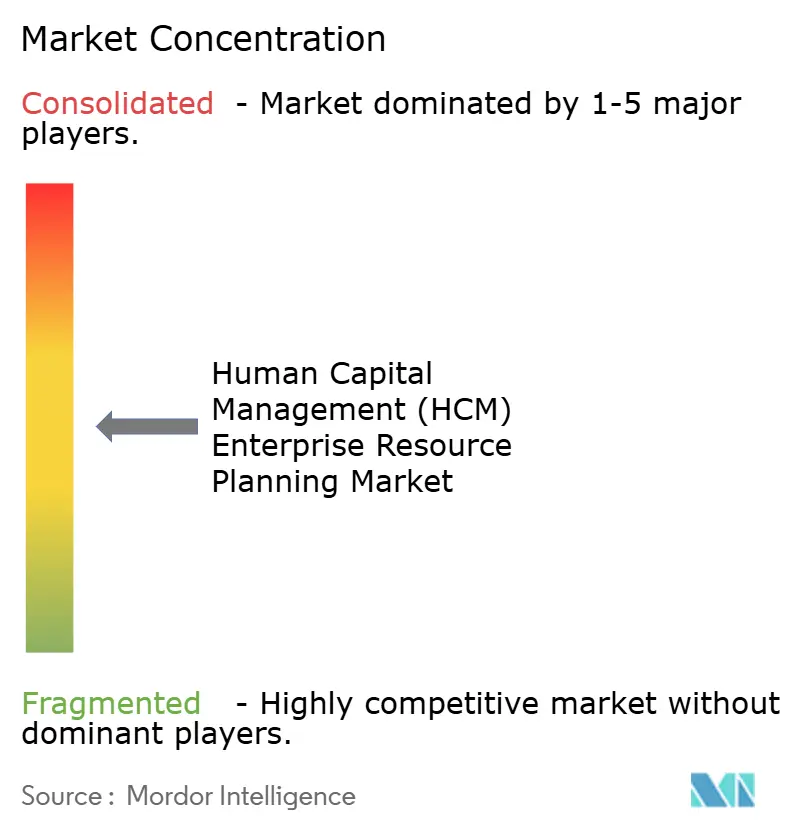
| Market Concentration | Medium |
Major Players *Disclaimer: Major Players sorted in no particular order Image © Mordor Intelligence. Reuse requires attribution under CC BY 4.0. | |
Human Capital Management (HCM) Enterprise Resource Planning Market Analysis by Mordor Intelligence
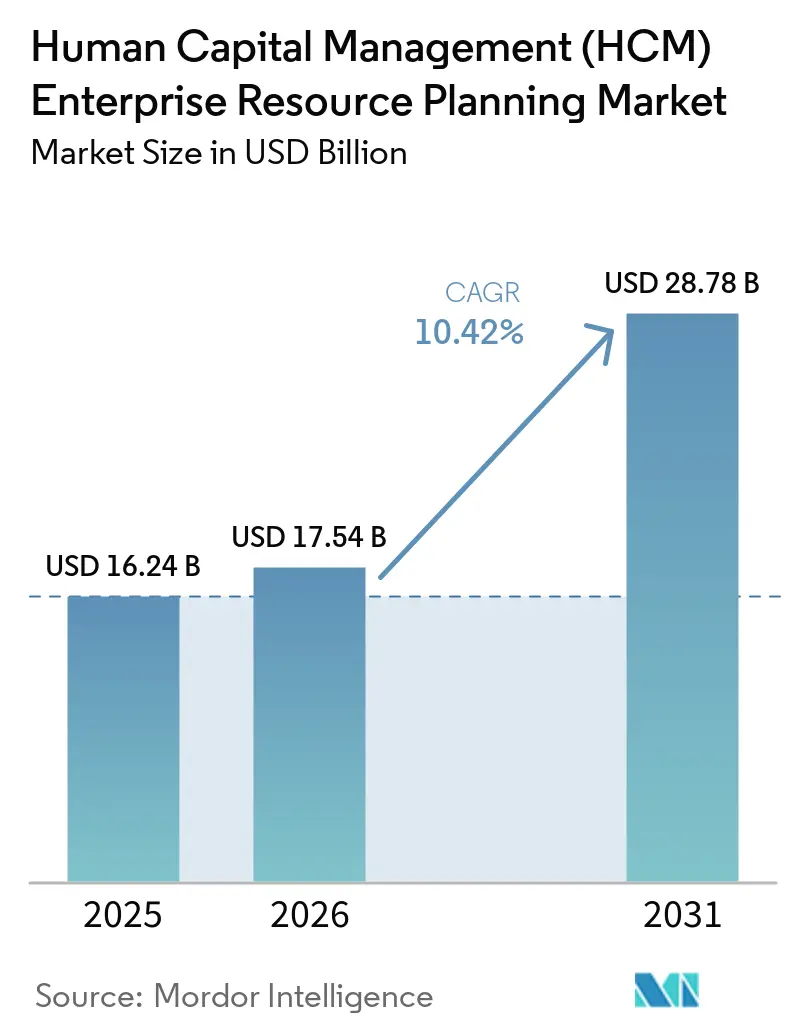
The Human Capital Management (HCM) Enterprise Resource Planning (ERP) market size is projected to expand from USD 17.54 billion in 2026 to USD 28.78 billion by 2031, registering a CAGR of 10.42% over 2026-2031. Cloud-native suites are replacing aging on-premise modules as enterprises seek unified payroll, talent, and analytics capabilities at lower infrastructure cost. Platform vendors are embedding generative AI for skills detection, reducing time-to-hire and improving retention. Compliance complexity in multi-country payroll is accelerating demand for integrated rule engines, while remote and hybrid work models push adoption of mobile self-service and geofencing features. Competitive intensity remains moderate, as the top five players control significant revenue, yet regional specialists thrive by tailoring data residency and vertical workflows.
Key Report Takeaways
- In the Human Capital Management ERP market, by deployment model, cloud captured 62.13% revenue in 2025 and is forecast to grow at a 15.12% CAGR through 2031.
- In the Human Capital Management ERP market, large enterprises commanded 57.23% of the market share in 2025, while small and medium enterprises are advancing at a 13.72% CAGR through 2031.
- In the Human Capital Management ERP market, by industry vertical, banking, financial services, and insurance led with 18.56% revenue share in 2025; healthcare is projected to post the fastest 13.24% CAGR through 2031.
- In the Human Capital Management ERP market, by component, core HR accounted for 23.76% of the market size in 2025, whereas talent management is expanding at a 15.79% CAGR through 2031.
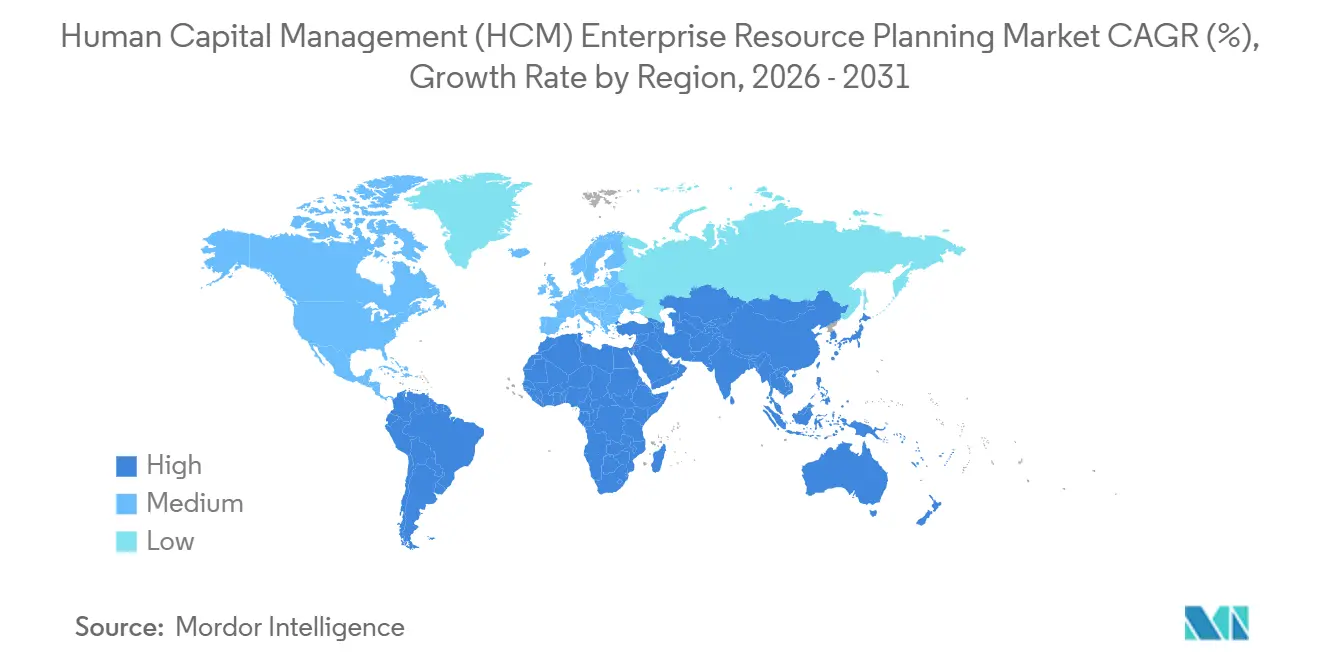
- In the Human Capital Management ERP market, Asia-Pacific is the fastest-growing geography at a projected 13.94% CAGR between 2026-2031.
Note: Market size and forecast figures in this report are generated using Mordor Intelligence’s proprietary estimation framework, updated with the latest available data and insights as of January 2026.
Market Trends and Insights
Drivers Impact Analysis of Human Capital Management (HCM) Enterprise Resource Planning Market*
| Driver | (~) % Impact on CAGR Forecast | Geographic Relevance | Impact Timeline |
|---|---|---|---|
| Accelerated Transition to Cloud-Native HR Suites | +3.2% | Global, highest in North America and Europe | Medium term (2-4 years) |
| Demand for Analytics-Driven Workforce Planning | +2.8% | Global, strong in Asia-Pacific and North America | Long term (≥4 years) |
| Compliance Complexity in Multi-Country Payroll | +2.1% | Europe, Asia-Pacific, global multinationals | Medium term (2-4 years) |
| Rise of Remote and Hybrid Work Models | +1.9% | Global, early in North America, Europe, urban Asia-Pacific | Short term (≤2 years) |
| AI-Powered Talent Acquisition and Retention Tools | +1.7% | North America, Europe, emerging Asia-Pacific | Medium term (2-4 years) |
| Integration of HCM with IoT-Enabled Workforce Safety Systems | +0.9% | Manufacturing regions in North America, Europe, China, India | Long term (≥4 years) |
| Source: Mordor Intelligence | |||
Accelerated Transition to Cloud-Native HR Suites
Organizations are migrating from on-premise ERP add-ons to cloud platforms that cut hardware expense and reduce upgrade pain. Oracle reported double-digit HCM Cloud customer growth in fiscal 2025, citing deployment cycles of 6-9 months compared with 18-24 months on legacy stacks.[1] Workday’s 2026R1 embedded AI agents that resolve routine queries, freeing HR staff for strategic planning.[2] Subscription pricing converts capital outlays into variable operating costs, aligning spend with headcount volatility. ADP’s Lyric unified data model reduces integration overhead and shortens implementation time. Still, data-cleansing challenges and workflow re-engineering slow heavily customized enterprises.
Demand for Analytics-Driven Workforce Planning
Predictive analytics help employers anticipate skills gaps, optimize labor budgets, and flag attrition risk. Workday users achieved 50% better nurse retention via AI-driven models. The U.S. Bureau of Labor Statistics projects a shortfall of 1.9 million registered nurses by 2031, intensifying demand for retention analytics.[3] Manufacturers deploy skills intelligence to retrain workers on robotics and additive manufacturing, lowering external hiring costs. Oracle’s Dynamic Skills surfaces internal candidates, cutting time-to-fill by about 30%. Regulators are watching algorithmic bias, and the EEOC has issued guidance on explainability.
Compliance Complexity in Multi-Country Payroll
Rule changes in taxation, social security, and posted-worker directives make manual payroll untenable. ADP clients using GlobalView reduced compliance errors by 40% through centralized rule engines. The EU’s Posted Workers Directive forces real-time wage adjustments when staff cross borders. The IRS lowered the W-2 e-filing threshold, nudging U.S. mid-sized firms toward cloud payroll IRS.GOV. Ceridian’s Dayforce maintains a single global employee record to prevent batch-file mismatches.
Rise of Remote and Hybrid Work Models
ManpowerGroup’s Q1 2026 survey showed a 31% net hiring outlook in Asia-Pacific, with many roles eligible for remote work. Workday’s virtual onboarding cuts time-to-productivity by 25%. UKG added geofencing for site-based staff to automate meal-break compliance. Mobile self-service reduces HR tickets by up to 40% as employees manage data, leave, and pay via apps. Payroll complexity rises when hybrid staff crosses tax jurisdictions, pushing demand for dynamic withholding engines.
Restraints Impact Analysis of Human Capital Management (HCM) Enterprise Resource Planning Market*
| Restraint | (~) % Impact on CAGR Forecast | Geographic Relevance | Impact Timeline |
|---|---|---|---|
| High Switching Costs from Legacy ERP | -1.8% | Global, acute in large customized enterprises | Short term (≤2 years) |
| Data Privacy and Sovereignty Concerns | -1.3% | Europe, Asia-Pacific, multinationals | Medium term (2-4 years) |
| Implementation Skill Shortage Among HR-IT Staff | -0.7% | Global, higher in emerging markets | Medium term (2-4 years) |
| Vendor Lock-In Fear in Mid-Market Enterprises | -0.5% | North America, Europe, Asia-Pacific mid-market | Long term (≥4 years) |
| Source: Mordor Intelligence | |||
High Switching Costs From Legacy ERP
Data migration can last 6-12 months and require costly consultants, reaching 15-20% of annual subscription fees. Enterprises must write off sunk licenses, pay overlapping subscriptions, and retrain users, deterring near-term moves. Customized union scheduling in manufacturing and healthcare raises re-engineering hurdles, stretching payback periods.
Data Privacy and Sovereignty Concerns
GDPR fines of up to 4% of global revenue pressure vendors to host EU data locally.[4] China’s PIPL and India’s draft bill impose similar mandates, fragmenting cloud architectures. Ceridian offers customer-defined data residency to navigate divergent rules. Cross-border M&A complicates record consolidation unless standard contractual clauses exist, adding integration risk.
*Our forecasts treat driver/restraint impacts as directional, not additive. The impact forecasts reflect baseline growth, mix effects, and variable interactions.
Human Capital Management (HCM) Enterprise Resource Planning Market Segment Analysis
By Deployment Model:
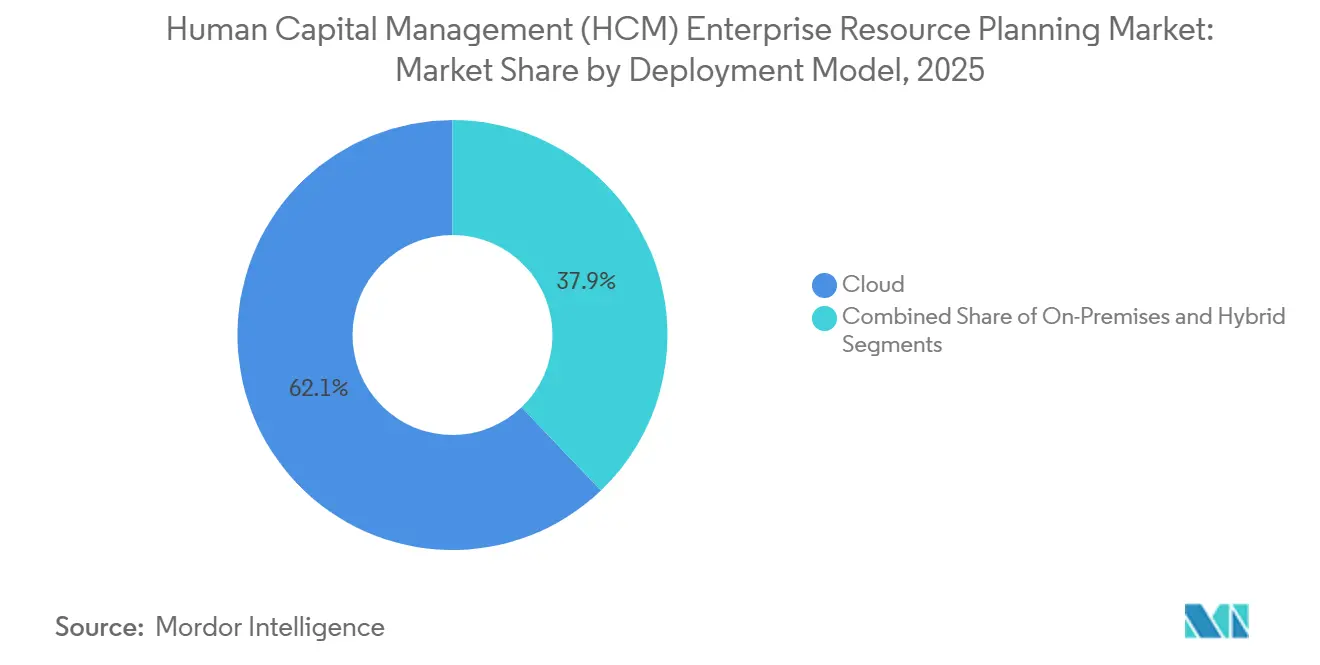
Cloud Subscriptions Outpace Hybrid BuildsCloud deployments accounted for 62.13% of the human capital management ERP market in 2025 and are expected to grow at a 15.12% CAGR through 2031. Pure cloud bookings represented 85% of Workday’s new deals, reflecting customer preference for continuous feature delivery. Hybrid strategies persist for governments and defense agencies that keep payroll engines on-premise to satisfy security mandates. However, maintaining dual stacks undercuts savings, and vendors are phasing out legacy versions.
The human capital management ERP market increasingly rewards platforms that align fees with active headcount, allowing firms to flex spend during cycles. Oracle HCM Cloud 25A pushed AI payroll reconciliation to subscribers months ahead of on-premise clients, underscoring the innovation gap. Data-residency rules may slow full-stack adoption in Europe and Asia-Pacific, but most multinationals prefer localized regions over hybrid builds.

By Organization Size:
Enterprises Still Dominate Value, Mid-Market Fuels VolumeLarge enterprises contributed 57.23% revenue in 2025 and require audit-ready controls, multi-ledger payroll, and deep integrations that lift average contract values. They also buy adjacent learning and analytics, widening the human capital management ERP market share gap versus smaller firms. Yet small and medium enterprises post the faster 13.72% CAGR as simplified onboarding trims IT overhead.
Gusto, BambooHR, and HiBob offer flat-rate bundles that complete go-lives in under 90 days. Workday launched a mid-market edition in 2024, entering the 500-2,500 employee band. SMEs value mobile apps, embedded payments, and hands-off compliance, though many skip succession and learning at first pass, leaving expansion potential. Vendors court this segment because low churn and upsell headroom lift lifetime value across the human capital management ERP market.
By Component Or Module:
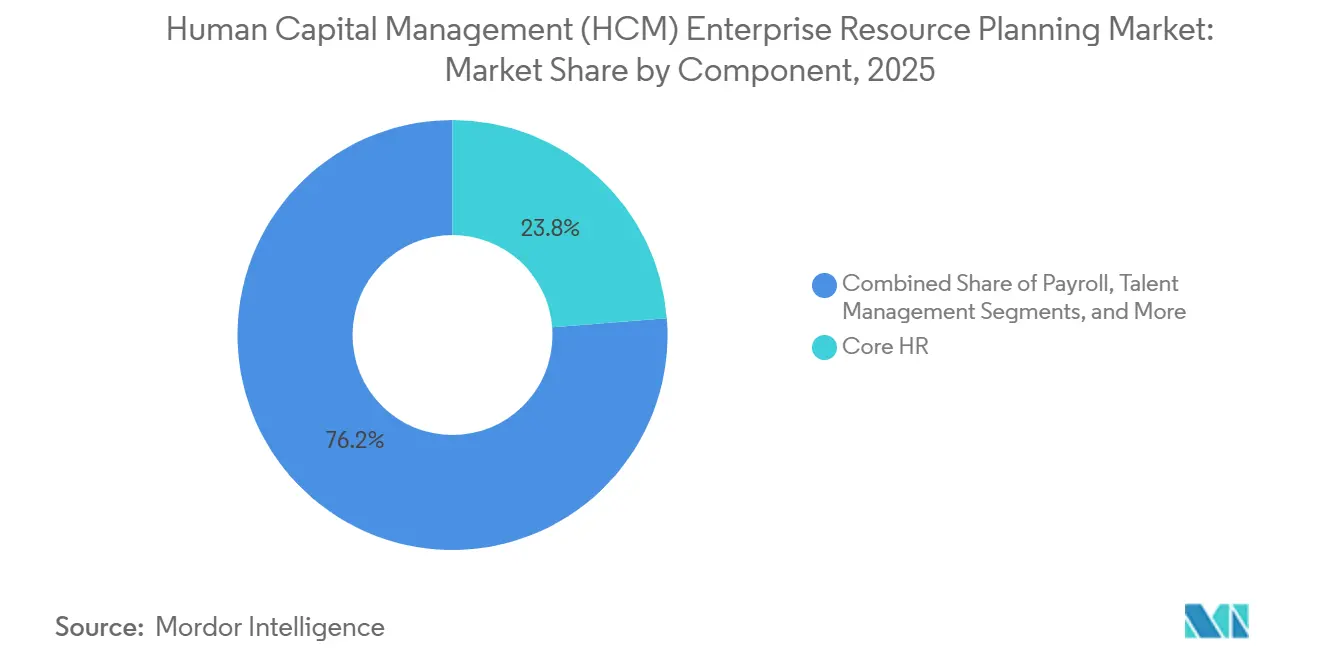
Talent Management And Workforce Analytics SurgeCore HR still underpins every deal at 23.76% of 2025 revenue, but talent management is surging at 15.79% CAGR. Skills ontologies and internal talent marketplaces reduce hiring costs while boosting engagement. Payroll remains non-negotiable, though the category is mature. Vendors differentiate with multi-country engines and AI reconciliation, ensuring compliance without costly year-end corrections.
Workforce management is growing rapidly as cities expand predictive-scheduling laws, making time-and-attendance automation urgent. Learning and development adoption rises as organizations embed LinkedIn Learning and Coursera catalogs, while engagement and compensation modules follow once data foundations stabilize. Continuous listening surveys and AI-based pulse analytics are now integrated into engagement suites, unlocking new upsell paths and expanding the human capital management ERP market.
By Industry Vertical:
BFSI Tops Spend, Healthcare Leads GrowthBFSI captured 18.56% of 2025 spend because anti-money-laundering training, mandatory license tracking, and pay-equity disclosure demand robust audit trails. Major banks deploy AI chatbots to handle policy queries, freeing up HR capacity. Healthcare is the fastest-growing sector, with a 13.24% CAGR, amid acute nurse shortages and strict credentialing requirements. Workday retention models halved attrition in pilot hospitals.
Manufacturing companies adopt workforce management to reduce overtime, with Align HCM citing 15-20% savings. Retail and e-commerce rely on predictive scheduling to satisfy city ordinances. IT and telecom emphasize internal mobility as skill half-lives shrink, while government entities keep hybrid or on-premise installs under procurement rules. Other verticals, such as hospitality, construction, and education, move at varied speeds, yet all feed rising demand in the broader human capital management ERP market.
Geography Analysis
North America Human Capital Management (HCM) Enterprise Resource Planning Market
North America contributed 34.97% of 2025 revenue, driven by strict multi-state payroll laws and early cloud adoption. The IRS cut the W-2 e-file threshold, accelerating migration among mid-sized employers. Growth is plateauing as most enterprises finish first-wave migrations and now purchase AI add-ons rather than full suites.
APAC Human Capital Management (HCM) Enterprise Resource Planning Market
Asia-Pacific is projected to be the fastest-growing region, with a compound annual growth rate (CAGR) of 13.94% during the forecast period. The implementation of in-country payroll engines has become crucial as Goods and Services Tax (GST) and social insurance reforms introduce additional layers of complexity into payroll management. Australia and New Zealand demonstrate high levels of cloud adoption, whereas Indonesia and Vietnam are experiencing slower progress due to persistent infrastructure challenges.
EMEA Human Capital Management (HCM) Enterprise Resource Planning Market
Europe’s trajectory is compliance-driven, as the GDPR requires local data processing and the Posted Workers Directive requires payroll recalculations. Vendors run regional data centers in Germany, the Netherlands, and Ireland. Eastern Europe benefits as shared-services hubs grow in Poland and Romania. The Middle East is expanding under Saudi Vision 2030 workforce reforms, whereas Africa remains nascent outside South Africa and Egypt.
Competitive Landscape
The human capital management ERP market is moderately concentrated, with the top five suppliers capturing a significant share of global revenue. Incumbents defend their share through annual AI feature drops, Workday’s 2026R1 virtual agent, and Oracle’s AI payroll reconciliation, among others. Challengers such as Gusto, HiBob, and BambooHR land mid-market deals with transparent SaaS pricing and quick go-lives.
Technology differentiation is widening. Vendors that embed generative AI for resume parsing, predictive attrition, and skills ontologies are winning competitive evaluations. Compliance capabilities remain pivotal in Europe and Asia-Pacific, where fines for payroll or data errors are severe. Switching costs give incumbents retention leverage, so growth strategies focus on cross-selling analytics and learning modules rather than pure new-logo pursuit.
M&A continues: suite providers absorb niche AI startups to fill capability gaps, while partnerships with Deloitte and Accenture supply global implementation scale. Emerging disruptors experiment with blockchain credentialing, yet enterprise readiness is limited, keeping adoption experimental.
Human Capital Management (HCM) Enterprise Resource Planning Industry Leaders
-
Workday Inc.
-
Ultimate Kronos Group, Inc.
-
Automatic Data Processing, Inc.
-
Paycom Software, Inc.
-
Paylocity Holding Corporation
- *Disclaimer: Major Players sorted in no particular order
Human Capital Management (HCM) Enterprise Resource Planning Market Companies Covered in this Report
- Workday Inc.
- Ultimate Kronos Group, Inc.
- Ceridian HCM Holding Inc.
- Automatic Data Processing, Inc.
- Paycom Software, Inc.
- Paylocity Holding Corporation
- Cornerstone OnDemand, Inc.
- Bamboo HR LLC
- Namely Inc.
- Zoho Corporation Pvt. Ltd.
- Ramco Systems Limited
- PeopleStrategy, Inc.
- Gusto, Inc.
- TriNet Zenefits LLC
- HiBob Ltd.
- The Sage Group plc
- Epicor Software Corporation
- Unit4 N.V.
- Infor (US), Inc.
- Softworks Workforce Management Ltd.
Recent Industry Developments in Human Capital Management (HCM) Enterprise Resource Planning Market
- March 2026: Ultimate Kronos Group added AI scheduling for manufacturing clients, predicting overtime costs and automating union rule compliance.
- January 2026: Workday rolled out 2026R1, introducing AI agents that cut HR ticket volume by 30% and enhancing skills mapping for internal mobility.
- November 2025: Ceridian launched Dayforce Wallet in Europe, allowing on-demand pay while maintaining GDPR compliance.
- August 2025: ADP expanded Lyric with embedded analytics dashboards tailored for 500-2,500 employee firms.
Global Human Capital Management (HCM) Enterprise Resource Planning Market Report Scope
The Human Capital Management ERP Market Report is Segmented by Deployment Model (Cloud, On-Premise, Hybrid), Organization Size (Small and Medium Enterprises, Large Enterprises), Industry Vertical (Manufacturing, BFSI, Healthcare, Retail and E-commerce, IT and Telecom, Government, Other Industry Verticals), Component or Module (Core HR, Payroll, Talent Management, Workforce Management, Learning and Development, Other Modules), and Geography (North America, South America, Europe, Asia-Pacific, Middle East, Africa).
Segmentation Overview
| Cloud |
| On-Premise |
| Hybrid |
| Small and Medium Enterprises |
| Large Enterprises |
| Manufacturing |
| BFSI |
| Healthcare |
| Retail and E-commerce |
| IT and Telecom |
| Government |
| Other Industry Verticals |
| Core HR |
| Payroll |
| Talent Management |
| Workforce Management |
| Learning and Development |
| Other Modules |
| North America | United States |
| Canada | |
| Mexico | |
| South America | Brazil |
| Argentina | |
| Rest of South America | |
| Europe | Germany |
| United Kingdom | |
| France | |
| Italy | |
| Spain | |
| Russia | |
| Rest of Europe | |
| Asia-Pacific | China |
| India | |
| Japan | |
| South Korea | |
| Australia and New Zealand | |
| Rest of Asia-Pacific | |
| Middle East | United Arab Emirates |
| Saudi Arabia | |
| Turkey | |
| Rest of Middle East | |
| Africa | South Africa |
| Egypt | |
| Rest of Africa |
| By Deployment Model | Cloud | |
| On-Premise | ||
| Hybrid | ||
| By Organization Size | Small and Medium Enterprises | |
| Large Enterprises | ||
| By Industry Vertical | Manufacturing | |
| BFSI | ||
| Healthcare | ||
| Retail and E-commerce | ||
| IT and Telecom | ||
| Government | ||
| Other Industry Verticals | ||
| By Component | Core HR | |
| Payroll | ||
| Talent Management | ||
| Workforce Management | ||
| Learning and Development | ||
| Other Modules | ||
| By Geography | North America | United States |
| Canada | ||
| Mexico | ||
| South America | Brazil | |
| Argentina | ||
| Rest of South America | ||
| Europe | Germany | |
| United Kingdom | ||
| France | ||
| Italy | ||
| Spain | ||
| Russia | ||
| Rest of Europe | ||
| Asia-Pacific | China | |
| India | ||
| Japan | ||
| South Korea | ||
| Australia and New Zealand | ||
| Rest of Asia-Pacific | ||
| Middle East | United Arab Emirates | |
| Saudi Arabia | ||
| Turkey | ||
| Rest of Middle East | ||
| Africa | South Africa | |
| Egypt | ||
| Rest of Africa | ||
Key Questions Answered in the Report
How large will the human capital management market be by 2031?
It is forecast to reach USD 28.78 billion by 2031, expanding at a 10.42% CAGR from 2026.
Which deployment model is growing fastest?
Cloud subscriptions, which held 62.13% revenue in 2025, are projected to grow at a 15.12% CAGR through 2031.
Why is Asia-Pacific the fastest-growing region?
Robust hiring outlooks, complex payroll reforms, and high mobile adoption drive a 13.94% regional CAGR.
What factors restrain rapid HCM adoption?
High switching costs from customized ERP systems and stringent data-sovereignty laws slow transitions.
Which module segment offers the strongest growth opportunity?
Talent management, expanding at 15.79% CAGR, as firms leverage AI skills ontologies for internal mobility.
How concentrated is vendor competition?
Moderate, with the top five providers holding around 40% of revenue but ample space for niche specialists.