
Eastern Europe Construction Market Size and Share
Market Overview
| Study Period | 2020 - 2031 |
|---|---|
| Forecast Data Period | 2026 - 2031 |
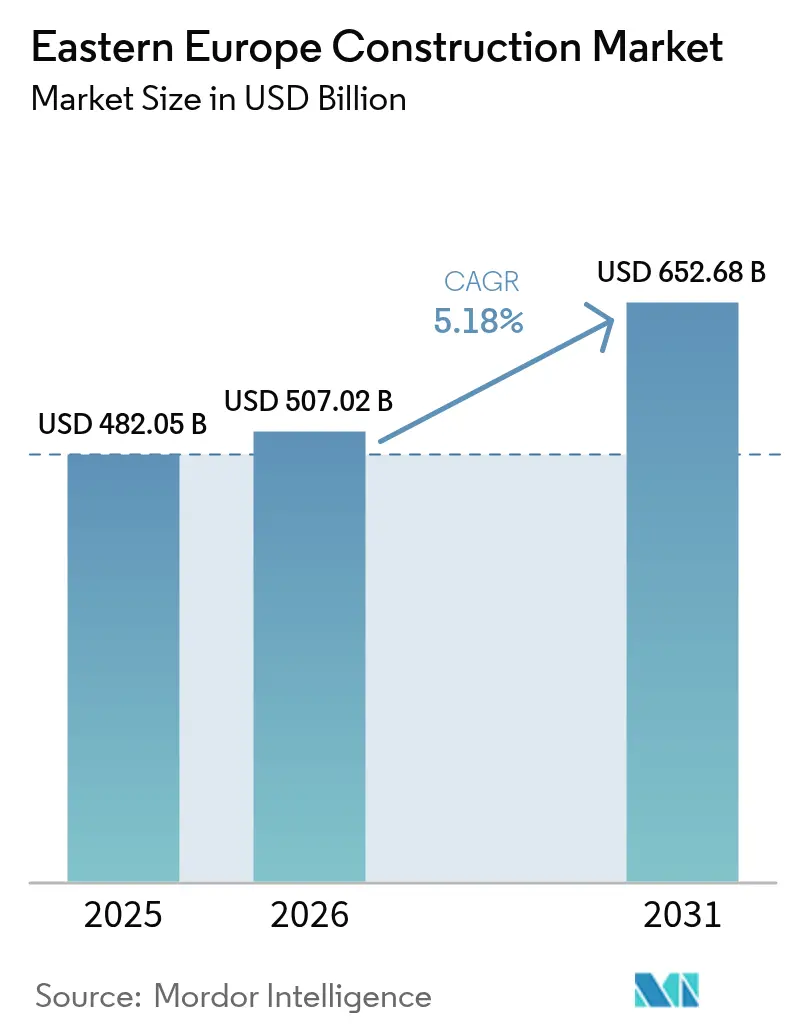
| Base Year Market Size (2025) | USD 482.05 Billion |
| Market Size (2026) | USD 507.02 Billion |
| Market Size (2031) | USD 652.68 Billion |
| Growth Rate (2026 - 2031) | 5.18 % |
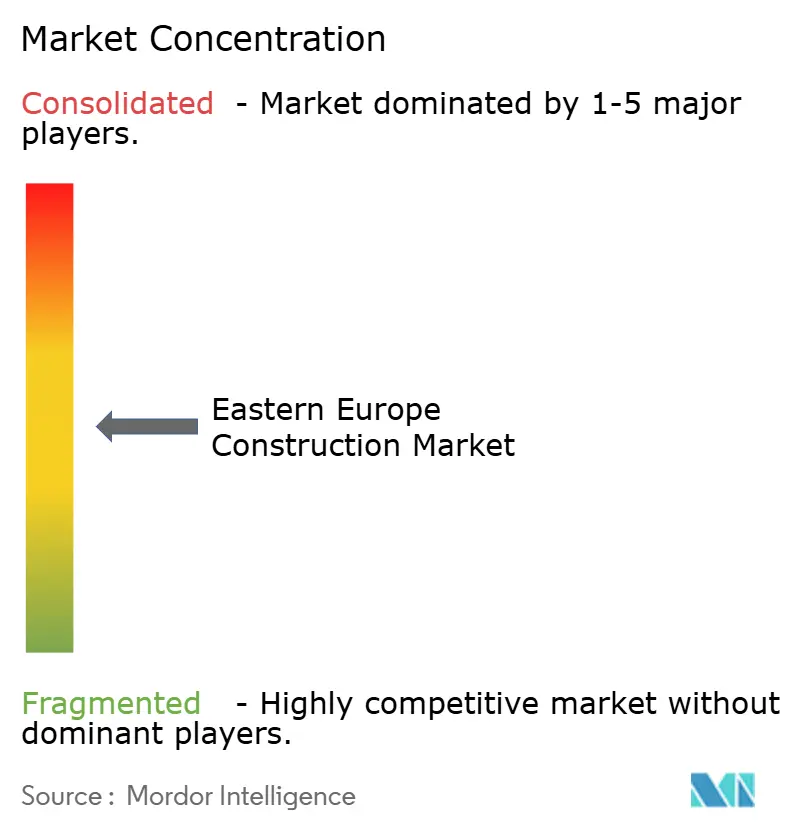
| Market Concentration | Medium |
Major Players *Disclaimer: Major Players sorted in no particular order Image © Mordor Intelligence. Reuse requires attribution under CC BY 4.0. | |
Eastern Europe Construction Market Analysis by Mordor Intelligence
The Eastern Europe Construction Market size is expected to grow from USD 482.05 billion in 2025 to USD 507.02 billion in 2026 and is forecast to reach USD 652.68 billion by 2031 at 5.18% CAGR over 2026-2031. Current growth reflects the convergence of post-war reconstruction, accelerated European Union infrastructure modernization, and a sweeping renewable-energy build-out that is diverting sizeable capital toward transport, energy, and digital networks. Infrastructure remains the anchor segment, public programs continue to dominate financing, and Ukraine’s rebuilding efforts are drawing unprecedented flows of foreign direct investment. Private capital is returning on the back of gradually improving interest-rate conditions, while supply-chain constraints in cement and steel are nudging the industry toward vertical integration. Modern construction methods are beginning to shake up on-site traditions, driven by labor scarcity, building information modeling (BIM) mandates, and stricter carbon-reduction rules.
Key Report Takeaways
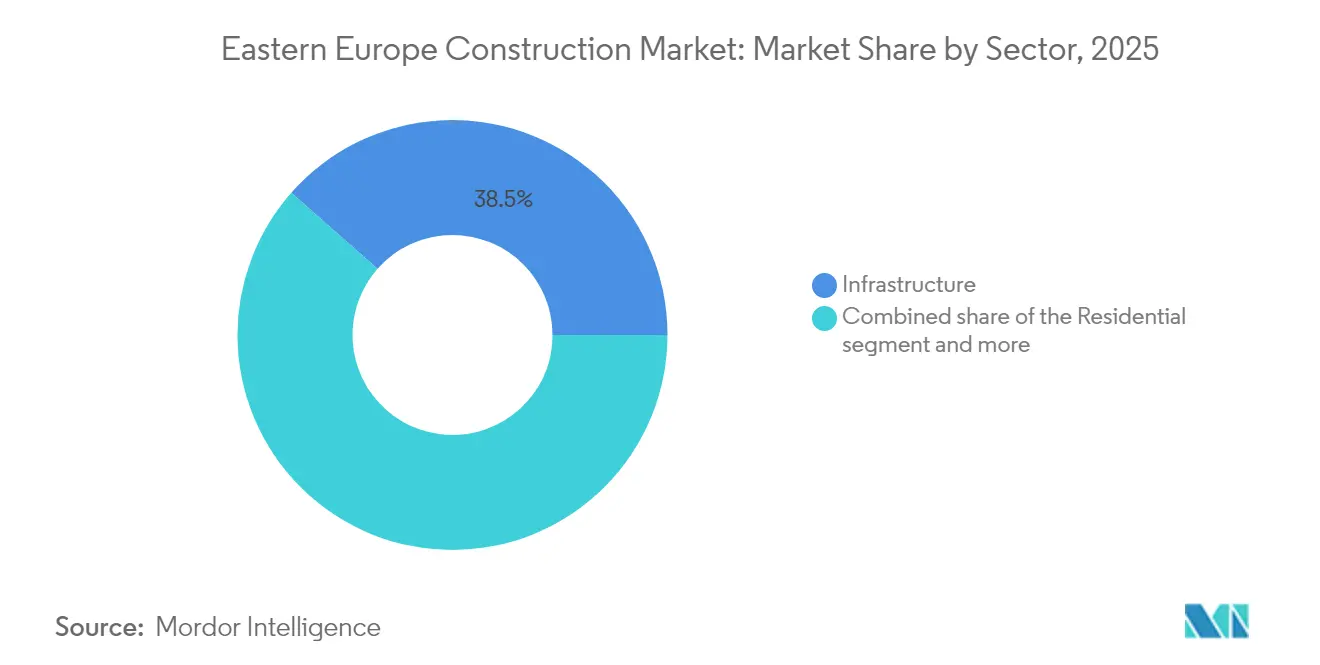
- By Sector, Infrastructure led with a 38.49% share of the Eastern Europe construction market in 2025, while the same segment is forecast to post the fastest 7.28% CAGR through 2031.
- By Construction type, New construction accounted for 60.85% of the Eastern Europe construction market size in 2025, whereas renovation activity is advancing at a 6.15% CAGR on aging asset upgrades.
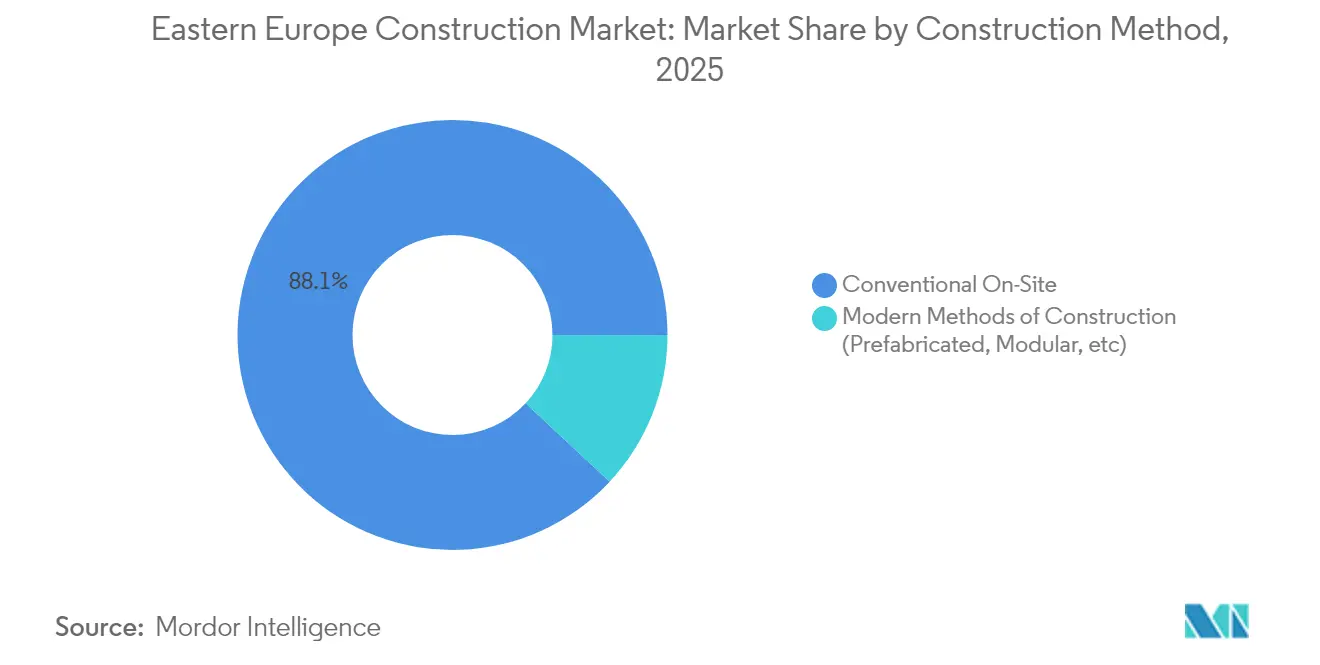
- By Construction Method, Conventional on-site building retained 88.05% of Eastern Europe construction market share in 2025; prefabricated and modular solutions are gaining momentum at a 8.65% CAGR to 2031.
- By Investment source, Public funding controlled 54.10% of 2025 spending, yet privately financed projects are pacing the field with a 7.45% CAGR through 2031 as investors re-enter reconstruction and renewables.
- By geography, Romania contributed 21.20% of 2025 regional revenue, whereas Ukraine is projected to log the quickest 6.78% CAGR on the back of multibillion-dollar recovery programs.
Note: Market size and forecast figures in this report are generated using Mordor Intelligence’s proprietary estimation framework, updated with the latest available data and insights as of 2026.
Market Trends and Insights
Drivers Impact Analysis of Eastern Europe Construction Market*
| Driver | (%) Impact on CAGR Forecast | Geographic Relevance | Impact Timeline |
|---|---|---|---|
| Surge in EU-funded infrastructure programs | +1.8% | EU cohesion economies | Medium term (2-4 years) |
| Rapid build-out of renewable-energy assets | +1.5% | Romania, Hungary, Poland | Medium term (2-4 years) |
| Return of foreign direct investment into post-war Ukraine reconstruction | +1.2% | Ukraine and neighbors | Long term (≥ 4 years) |
| Demand spike for affordable multifamily housing in urban corridors | +0.9% | Bucharest, Warsaw, Budapest, Prague | Short term (≤ 2 years) |
| Digital-twin & BIM mandates in public procurement | +0.6% | Latvia, Poland, Czech Republic | Medium term (2-4 years) |
| Pre-fabricated timber modules to meet green-build quotas | +0.5% | Germany, Poland, Czech Republic | Long term (≥ 4 years) |
| Source: Mordor Intelligence | |||
Surge in EU-Funded Infrastructure Programs
EU cohesion countries have been awarded EUR 25.8 billion (USD 28.1 billion) for 2021-2027 under the Connecting Europe Facility, unleashing large packages for rail, road, energy, and digital corridors. Hungary’s MAV rail upgrade alone combines EUR 1.0 billion (USD 1.1 billion) of European Investment Bank funding with national co-financing, underscoring the catalytic role of blended public capital. The 2024 CEF Transport call introduced an extra EUR 2.5 billion (USD 2.7 billion) and opened eligibility to Ukraine and Moldova, broadening the addressable project pipeline. Compliance with EU procurement law and environmental standards is incentivizing contractors to upgrade digital processes. Taken together, these measures anchor a multi-year backlog that is expected to keep civil-engineering order books full through the medium term[1].
Rapid Build-Out of Renewable-Energy Assets
Eastern Europe’s energy transition is catalyzing construction demand across generation, transmission, and storage. The Green Energy Corridor that links Azerbaijan, Georgia, Hungary, and Romania represents a EUR 10 billion (USD 10.9 billion) opportunity to build 1,100 km of high-capacity lines capable of carrying 4 GW of clean power. Hungary has earmarked EUR 52.5 million (USD 57.2 million) to upgrade its network so it can triple solar capacity by 2030, requiring new substations and automation. In Romania, a 400 MW wind farm at Peștera II attracted EUR 30 million (USD 32.7 million) of EIB money, while the USD 93 million Pecineaga project is under construction. Ukrainian-owned DTEK is rolling out a 5 GW portfolio across four EU markets, channeling nearly USD 163 million into early-stage wind and solar parks. These investments are fast-tracking grid reinforcement, foundation works, and component installation across the region[2].
Return of Foreign Direct Investment into Post-War Ukraine Reconstruction
The EU has endorsed EUR 50 billion (USD 54.4 billion) for Ukraine’s recovery, while total rebuilding needs are estimated at EUR 451 billion (USD 491.6 billion). Multinationals are positioning early: CRH has funneled USD 500 million into Ukraine since 1999, including USD 80 million after the 2022 invasion, and has taken over Dyckerhoff Cement Ukraine to secure cement supply. The Ukraine FIRST facility is offering technical aid for priority assets ranging from power grids to social housing. Domestic cement output stabilized at 7.97 million t in 2024, and exports multiplied to 1.7 million t, illustrating quick supply adaptation. FDI momentum is therefore lifting building-materials demand and bringing forward tender activity for critical infrastructure[3].
Demand Spike for Affordable Multifamily Housing in Urban Corridors
Household formation and shrinking unit sizes are pushing cities to accelerate apartment delivery. Cluj-Napoca’s housing stock expanded 12% from 2011-2018, with peri-urban districts absorbing the bulk of new supply as commuting infrastructure improved. Developers such as Kesz Group broke ground on the USD 54.5 million Corallis Apartments in Bucharest in 2024, a five-tower scheme scheduled for completion in 2027. Persistent affordability gaps and thin social-housing pipelines create a robust demand floor. Consequently, urban-residential work is likely to retain its share despite financing headwinds.
Restraints Impact Analysis of Eastern Europe Construction Market*
| Restraint | (%) Impact on CAGR Forecast | Geographic Relevance | Impact Timeline |
|---|---|---|---|
| High interest-rate environment squeezing developer liquidity | -1.1% | Region-wide | Short term (≤ 2 years) |
| Acute skilled-labor shortages driving wage inflation | -0.8% | Czech Republic, Moldova, Poland | Medium term (2-4 years) |
| Chronic permitting delays tied to anti-corruption reforms | -0.6% | Romania, Poland, Czech Republic | Medium term (2-4 years) |
| Cross-border supply-chain chokepoints for cement & rebar | -0.4% | Poland-Ukraine frontier | Short term (≤ 2 years) |
| Source: Mordor Intelligence | |||
High Interest-Rate Environment Squeezing Developer Liquidity
Policy rates have toggled between 4.5% and 8.1% since 2023, eroding debt-coverage ratios and scuttling some speculative schemes. The European Central Bank has since started trimming key rates, narrowing commercial-property yield spreads, and partially reviving deal flow. Private lenders have returned selectively to Central and Eastern Europe after a decade-long lull, but underwriting remains conservative. Developers, therefore, face a period of tight capital, likely to temper growth over the next two years.
Acute Skilled-Labor Shortages Driving Wage Inflation
Two-thirds of Czech construction firms reported unfilled positions in 2024, and Moldovan companies flagged shortages at 30%, up from 16% in 2021. Deloitte’s 2025 Central Europe real-estate survey ranks labor costs and availability ahead of financing as the sector’s most pressing challenge. Governments are tackling the gap through reskilling initiatives and relaxed visa regimes; Hungary and Greece have lightened entry rules for seasonal construction workers. Romania’s removal of wage tax breaks for site workers risks further cost escalation. Unless migration inflows offset domestic deficits, rising pay may compress contractor margins through the medium term.
*Our forecasts treat driver/restraint impacts as directional, not additive. The impact forecasts reflect baseline growth, mix effects, and variable interactions.
Eastern Europe Construction Market Segment Analysis
By Sector:
Infrastructure as Both Anchor and AcceleratorInfrastructure contributed 38.49% to 2025 revenue and is projected to rise at a 7.28% CAGR, the fastest among all sectors, thereby defining the growth vector of the Eastern Europe construction market size. Mega-rail projects such as Hungary’s EUR 2.162 billion (USD 2.4 billion) modernization and Romania’s cross-country motorway extensions are moving in lockstep with power-grid upgrades like the USD 10.9 billion Green Energy Corridor. Energy-infrastructure work is further supported by Hungary’s USD 57.2 million network upgrades aimed at tripling solar capacity by 2030.
Residential activity is mixed: urban apartment demand remains strong, as highlighted by Bucharest’s USD 54.5 million Corallis project, yet high rates and elevated land prices constrain mortgage affordability. Commercial work is pivoting toward low-carbon office retrofits, exemplified by Skanska’s timber-frame tower in Prague, while industrial and logistics builds benefit from near-shoring and e-commerce growth despite site-permitting frictions.

By Construction Type:
Renovation Accelerates Under Efficiency MandatesNew builds maintained 60.85% of 2025 revenue, cementing their role as the largest slice of the Eastern Europe construction market share. However, renovation works are gathering pace at a 6.15% CAGR as Soviet-era assets undergo energy-efficiency retrofits to meet European performance standards. Ukraine offers a unique blend, where demining and partial rebuilding of utilities are prerequisites for full-scale new construction.
EU funding increasingly rewards deep-renovation projects, easing the financing of façade insulation, HVAC upgrades, and smart-meter installation. Space scarcity in city cores and permitting complexities further tilt economics toward adaptive reuse, particularly among commercial landlords needing to hit carbon-budget checkpoints.
By Construction Method:
Prefabrication Edges Into the MainstreamConventional on-site techniques still controlled 88.05% of 2025 turnover, but modern methods are growing at a 8.65% CAGR, eroding the traditional dominance of the Eastern Europe construction market. Poland’s prefabricated share, at 6.5%, signals early traction compared with Germany’s 11%, while BIM mandates are compressing learning curves for modular workflows.
Latvia’s 2025 BIM requirement, combined with rising timber-module adoption, is expected to steer public tenders toward integrated off-site solutions. Prefabrication also mitigates skilled-labor shortages and accelerates deployment timelines, reinforcing its economic case across the region.
By Investment Source:
Public Funds Hold the Majority, but Private Capital Gains SteamPublic budgets delivered 54.10% of 2025 spend, courtesy of EU cohesion envelopes and multilateral loans. The Connecting Europe Facility’s EUR 25.8 billion (USD 28.1 billion) allocation and Ukraine’s EUR 50 billion (USD 54.4 billion) recovery package underline the scale of taxpayer-backed financing.
Private outlays are picking up at a 7.45% CAGR, buoyed by sector-specific plays such as DTEK’s 5 GW renewables rollout and CRH’s cement-plant acquisitions. European Central Bank rate cuts and tightening green-asset supply are further tipping investors toward development pipelines, signaling a more balanced funding mix by the decade’s end.
Geography Analysis
Romania Construction Market
Romania led regional revenue with a 21.20% share in 2025, leveraging its bridge position between Western Europe and the Black Sea. Ongoing works on the A3 motorway (USD 92.7 million) and the USD 93 million Pecineaga wind farm underscore the breadth of transport and energy pipelines. However, 2024 output dipped 4% after seven years of rapid gains as labor-tax relief expired and material inflation persisted.
Ukraine Construction Market
Ukraine is poised for the fastest 6.78% CAGR through 2031, anchored by multilateral packages and a domestic cement industry that stabilized at 7.97 million t in 2024. Two new kiln lines are planned in Kryvy Rih and Ivano-Frankivsk, and the Ukraine FIRST facility is marshaling technical assistance for roads, hospitals, and energy hubs.
Central and Eastern Europe Construction Market
Secondary markets such as Hungary, Croatia, and Bulgaria benefit from EU cohesion funds and cross-border interconnectors. Hungary’s USD 1.1 billion rail overhaul and USD 57.2 million grid upgrade illustrate a pipeline rich in both civil-engineering and power-system opportunities. The second 400 kV Greece-Bulgaria link is already under construction, and the Green Energy Corridor adds a further USD 10.9 billion of grid work. Poland is emerging as a digital-procurement frontrunner, with BIM tenders and modular demand showing above-average growth potential.
Regulatory Landscape
Eastern Europe construction activity is shaped by EU product compliance and country-level reforms aimed at faster permitting and more digital workflows. Regulation (EU) 2024/3110, the updated Construction Products Regulation, sets a unified technical language for product performance and introduces digital product passports, with application beginning on 8 January 2026. Supporting secondary rules also advanced in 2026, including Commission Implementing Regulation (EU) 2026/387 (adopted 23 February 2026), which sets the format for European technical assessments under the new CPR framework and tightens documentation and traceability requirements for building-material manufacturers supplying regional projects.
On project delivery, multiple jurisdictions have moved toward streamlined, more digitized administrative pathways. Poland enacted amendments to its Construction Law via the Act of 4 December 2025, with key provisions entering into force on 1 January 2026 and 7 January 2026, and additional provisions scheduled for 20 September 2026, affecting how works are documented and processed. Latvia implemented a unified construction registration process as of 6 January 2026 covering the lifecycle from project initiation through Land Register entry, while the Czech Republic continued implementing its updated Building Act (Act 283/2021 Coll.) into 2026 to centralize and simplify permitting, influencing lead times for public and private developments across the region.
Value Chain Analysis
The regional value chain runs from public and private project sponsors, including EU cohesion programs, multilateral lenders, and national budgets, through developers and general contractors, design and engineering firms, and building-material and equipment suppliers supporting on-site and off-site execution. Infrastructure dominates spend, with 38.49% share in 2025, pulling through demand for aggregates, cement, rebar, power equipment, and rail and road components. Energy and grid projects add more specialized requirements for substations, cabling, and foundations. Increasing BIM and digital procurement requirements in public tenders, notably in Latvia and Poland, are also shifting coordination upstream to design and engineering, strengthening demand for integrated design-build and supply-linked delivery models.
Execution risk and procurement strategy continue to be shaped by input and logistics constraints. Labor availability and labor cost pressures were flagged as the primary concern for Central European real-estate developers in 2025, and materials supply is sensitive to energy-intensive steel and cement production costs, plus higher logistics costs from longer shipping routes. Ukraine illustrates how supply chains are reconfigured under disruption, with reliance on imported materials rising from 12-14% in 2021 to 23% by 2023 amid shutdowns and logistics constraints, pushing contractors toward multi-sourcing, cross-border procurement, and materials pre-ordering. Building-material participants in Poland have also called for customs and trade reforms to address non-EU import competition, highlighting how border processes feed into price formation and availability for large public works.
Competitive Landscape
Eastern Europe’s construction arena is moderately fragmented, mixing global heavyweights with agile local specialists. Infrastructure megaprojects generally favor multinationals such as STRABAG, Skanska, and PORR, whose balance sheets and engineering depth satisfy complex-project criteria. Residential and commercial niches, by contrast, often award contracts to regional firms that can navigate municipal codes and client networks.
Strategic consolidation picked up in 2024 when Hungary’s Duna Aszfalt Zrt. Acquired 100% of Mota-Engil Central Europe, later re-branded Duna Polska, thereby enlarging its mining and road-building footprint. On the materials side, CRH’s purchase of Dyckerhoff Cement Ukraine secures local clinker supply and boosts vertical-integration leverage ahead of large-scale reconstruction.
Digital capabilities are emerging as a key differentiator. Contractors fluent in BIM and modular workflows tend to outscore rivals on public tender assessments in Latvia and Poland. Renewables represent a fresh battleground, with specialized EPC firms chasing DTEK’s 5 GW roll-out and grid-reinforcement contracts tied to the Green Energy Corridor. Supply-chain integration, particularly in cement and steel, offers scope for margin defense amid input-price volatility.
Eastern Europe Construction Industry Leaders
-
Strabag
-
Skanska
-
PORR
-
Budimex
-
Metinvest
- *Disclaimer: Major Players sorted in no particular order
Eastern Europe Construction Market Companies Covered in this Report
- Strabag
- Skanska
- PORR
- Budimex
- Metinvest
- Vinci
- Eurovia
- BESIX
- Bouygues
- Eiffage
- ACCIONA
- FCC Construcción
- Royal BAM Group
- Hochtief
- Astaldi
- Ferrovial
- Gülermak
- China Communications Construction Co. (CCCC)
- Impresa Pizzarotti
- Unibep
Market Opportunities and Future Outlook
Large, state-backed transport and logistics builds are creating visible whitespace for heavy civil works, marine construction, and hinterland connectivity packages. In Poland, construction commenced in July 2026 on the Cape Pomerania deepwater port and container terminal in Swinoujscie, a EUR 2.3 billion investment by the Szczecin and Swinoujscie Maritime Ports Authority, expanding demand for breakwaters, dredging, quay walls, storage yards, and road and rail tie-ins. Poland also presented the Integrated Railway Network (ZSK) plan in June 2026 covering 4,700 km of new rail lines across 19 corridors, reinforcing the medium-term pipeline for track works, bridges, signaling corridors, and station-area redevelopment, alongside modernization contracts on existing lines.
Energy networks and construction digitalization are opening opportunities across grid reinforcement, multi-utility corridors, and standardized delivery models. Lithuania transmission operators Litgrid and Amber Grid (EPSO-G group) submitted a joint 2026-2035 network development plan with EUR 2.5 billion for electricity grid upgrades, EUR 438.1 million for natural gas systems, and EUR 1.2 billion for hydrogen infrastructure, supporting packages for substations, pipelines, compressor and metering stations, and industrial connections. Separately, BIM mandates and pilots are moving from concept into procurement practice: Poland targets MacroBIM requirements for public projects exceeding EUR 10 million, Romania defined Q3 2024 to Q3 2026 for launching national-level BIM and pilots, and Bulgaria is implementing BIM pilots under its National Recovery and Resilience Plan, with public works thresholds referenced for 2027-2030. This combination supports demand for contractors and consultants that can execute BIM-enabled delivery, digital QA/QC, and repeatable modular or prefabricated approaches that reduce schedule risk under labor scarcity.
Recent Industry Developments in Eastern Europe Construction Market
- July 2026: STRABAG signed an agreement to acquire 100% of Iasi-based Romanian construction company DAROCONSTRUCT SRL. The deal expands STRABAG's delivery capacity and local footprint in Romania. It supports larger participation in transport and civil works tenders and reinforces its regional execution platform.
- June 2026: STRABAG signed a EUR 255 million contract with PKP Polskie Linie Kolejowe S.A. to modernise Section 2 of Railway Line No. 201 in Poland between Maksymilianowo and Wierzchucin, covering more than 31 km. The award adds to the multi-year rail backlog and strengthens competitive positioning in a segment anchored by publicly financed modernization programs.
- September 2024: CRH Ukraine BV finalized the acquisition of a 99.9775% stake in Dyckerhoff Cement Ukraine, adding two cement plants to its asset base. The transaction deepens vertical integration in a supply-constrained market and improves access to local clinker and cement supply needed for reconstruction and large infrastructure projects.
Eastern Europe Construction Market Report Scope and Research Methodology
Market Definition and Coverage
This market is measured as the value of construction activity delivered across Eastern Europe, covering new build and renovation work that is executed across major building and civil project categories.
Scope exclusions: It excludes upstream building-materials manufacturing and pure real estate transactions that do not reflect construction work performed.
Segments Covered in This Report
- By Sector
- Residential
- Apartments/Condominiums
- Villas/Landed Houses
- Commercial
- Office
- Retail
- Industrial and Logistics
- Others
- Infrastructure
- Transportation Infrastructure (Roadways, Railways, Airways, others)
- Energy & Utilities
- Others
- Residential
- By Construction Type
- New Construction
- Renovation
- By Construction Method
- Conventional On-Site
- Modern Methods of Construction (Prefabricated, Modular, etc)
- By Investment Source
- Public
- Private
- By Geography
- Romania
- Hungary
- Croatia
- Ukraine
- Bulgaria
- Rest of Eastern Europe
Data Sources, Market Sizing, and Validation
Desk Research
Desk work starts by building a fact base around construction output, permits, and macro drivers, because these signals anchor the demand pool to what is being built and paid for in Eastern Europe. Public sources such as Eurostat, national statistical offices in Eastern Europe, central bank releases, and ministries covering transport and housing were used to map the investment cycle and large project pipelines.
We also reviewed documents such as public procurement portals, OECD and World Bank dataset publications, and customs and trade statistics where equipment and input signals were relevant. Company filings, annual reports, and investor presentations were then used to sanity check revenue exposure and the timing of large awards. Paid subscriptions were used only where needed for company financials and intelligence, as well as for news and financials to confirm major contract events. These sources are illustrative only, and many other public references were also used for data collection, validation, and clarification.
Primary Interviews and Surveys
Interviews and surveys with CXOs, functional and unit leaders, managers, contractors, developers, and infrastructure specialists across Europe help clarify project timing, pricing movement, funding conditions, and country-level gaps. Respondent input is compared with official construction output, investment, and permit data to test secondary estimates before final analysis.
Distribution of primary research fieldwork respondents
| Company type | Respondent position |
|---|---|
| Top tier: 27% | CXOs: 22% |
| Mid tier: 48% | Functional/Unit leaders: 31% |
| Smaller Players: 25% | Managers: 47% |
Market-Sizing & Forecasting
Market sizing is built using a top-down approach where construction output and investment series are reconstructed by country and then translated into a consistent USD value for the region. The model is then corroborated with selective bottom-up approximations, such as sampled project counts and typical cost per square meter for buildings, along with channel checks on contractor backlogs and reported order intake, so totals can be adjusted when a country line looks overstated.
Key inputs used (illustrative) include construction output indices, public infrastructure budget allocations, building permits and housing starts where available, renovation share trends, and labor and materials cost inflation that affects realized project value. Forecasts were produced using scenario analysis around funding availability, interest-rate direction, and post-conflict rebuilding pace, and then aligned with what interviewees expect for award timing and execution delays. Where bottom-up signals are missing for smaller countries, we fill gaps by using proxy ratios from similar markets and then re-test the results against regional investment patterns.
Data Validation & Update Cycle
Outputs are checked through triangulation across independent metrics, including construction output movements, known large project awards, and country-level budget changes, before numbers are finalized for the Eastern Europe view. If a sharp variance shows up, we revisit assumptions, re-check currency conversion timing, and re-contact sources to confirm whether the change is a real cycle shift or a data artifact.
Each report goes through multi-step analyst review, where calculations, definitions, and country totals are re-verified before sign-off. The study is refreshed annually, and interim updates are triggered when major policy changes, funding announcements, or disruption events materially shift the construction pipeline in the region. Right before delivery, a final pass is completed so clients receive the latest view supported by the same repeatable steps.
Mordor Intelligence's Eastern Europe Construction Market Size Versus Other Published Estimates
Published market sizes for Eastern Europe construction can look far apart even when they talk about similar countries, because the underlying definition of construction value is not always consistent. Differences also come from how firms treat inflation, currency timing, and whether the estimate leans on reported output, project awards, or a modeled demand pool.
The main gap comes from country coverage and what is treated as construction value, where Mordor Intelligence counts Romania, Hungary, Croatia, Ukraine, Bulgaria, and the rest of Eastern Europe under delivered construction activity across new construction and renovation, instead of using a broader country list and a real output framing that can inflate the headline. When these scope choices shift, the same sector labels can still produce different totals, especially once USD conversion year and price escalation assumptions are changed.
Benchmark comparison
| Source | Market Size | Gaps in Research Methodology |
|---|---|---|
| Mordor Intelligence | USD 482.05 B (2025) | |
| Trade Publisher A | USD 809.20 B (2024) | Uses a wider country set and reports construction output values in real terms across many economies, which can expand the addressable pool versus a delivered-activity view and also shifts the year of USD conversion. |
| Global Consultancy B | USD 117.00 B (2024) | Likely applies a narrower monetization lens and may undercount infrastructure-heavy work or renovation value, which compresses totals when project value recognition and inflation pass-through are treated conservatively. |
The spread across the table mainly reflects differences in geography selection, the point at which project value is recognized, and how prices are normalized into USD for the chosen year. By keeping the scope tied to delivered construction activity and then re-checking it with project and backlog signals, our estimate stays traceable to clear inputs that can be repeated when assumptions are updated.
Key Questions Answered in the Report
What is the 2026 value of the Eastern Europe construction market?
The market was valued at USD 507.02 billion in 2026.
How fast is Eastern European construction expected to grow through 2031?
It is forecast to expand at a 5.18% CAGR, reaching USD 652.68 billion.
Which sector holds the biggest slice of regional spending?
Infrastructure leads with 38.49% of 2025 revenue.
Which country is growing the fastest?
Ukraine is projected to register a 6.78% CAGR through 2031.
What share does public funding hold in 2025?
Public sources accounted for 54.10% of spending.
How large is the prefabricated and modular opportunity?
Modern methods are expanding at a 8.65% CAGR, outpacing traditional on-site techniques.