
Market Overview
| Study Period | 2020 - 2031 |
|---|---|
| Forecast Data Period | 2026 - 2031 |
| Base Year Market Size (2025) | USD 15.47 Billion |
| Market Size (2026) | USD 16.28 Billion |
| Market Size (2031) | USD 21.48 Billion |
| Growth Rate (2026 - 2031) | 5.70 % |
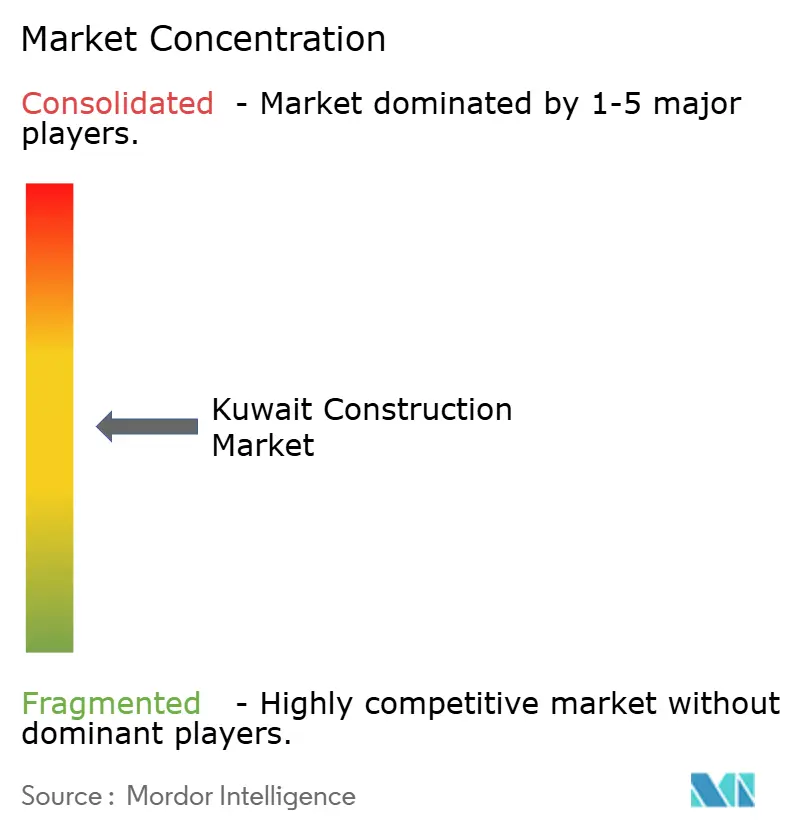
| Market Concentration | Medium |
Major Players *Disclaimer: Major Players sorted in no particular order Image © Mordor Intelligence. Reuse requires attribution under CC BY 4.0. | |
Kuwait Construction Market Analysis by Mordor Intelligence
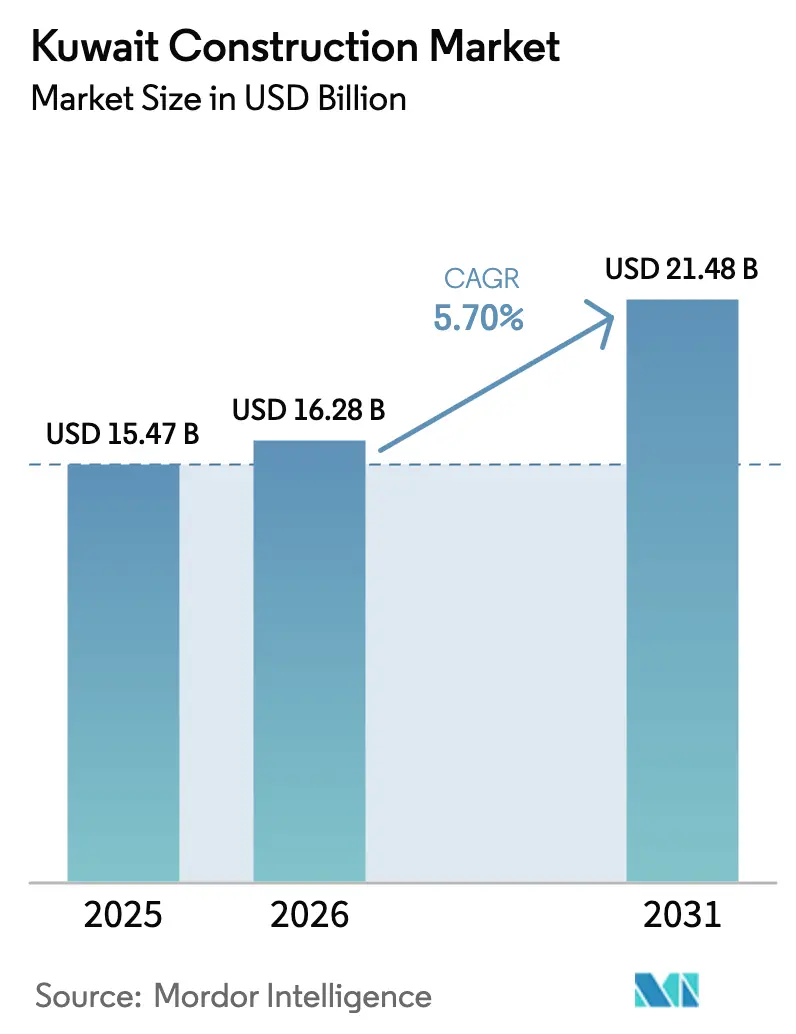
The Kuwait Construction Market size is projected to expand from USD 15.47 billion in 2025 and USD 16.28 billion in 2026 to USD 21.48 billion by 2031, registering a CAGR of 5.70% between 2026 to 2031.
Robust public spending on Vision 2035 flagships, rising foreign direct investment, and an accelerating shift toward modular building methods are sustaining momentum despite tighter fiscal ceilings. Parliamentary suspension in May 2024 unblocked contract awards worth USD 1.9 billion during 2025, quadrupling 2024 levels and signaling a decisive move from planning to execution[1]. Residential activity dominates as the social-housing backlog reached 105,000 applications in 2025, driving a 6.93% CAGR that outpaces all other segments and underpinning aggressive mandates for 30% modular or 3D-printed components in public-housing starts. Private participation is climbing at 6.73% CAGR on the back of Kuwait Investment Authority co-investment platforms that have attracted more than USD 10 billion for mixed-use megaprojects such as Silk City and South Saad Al-Abdullah. Even so, conventional on-site techniques remain prevalent, capturing 93.23% of 2025 spending, while modern methods expand briskly at 7.93% CAGR under Ministry of Public Works mandates for factory-assembled components.
Key Report Takeaways
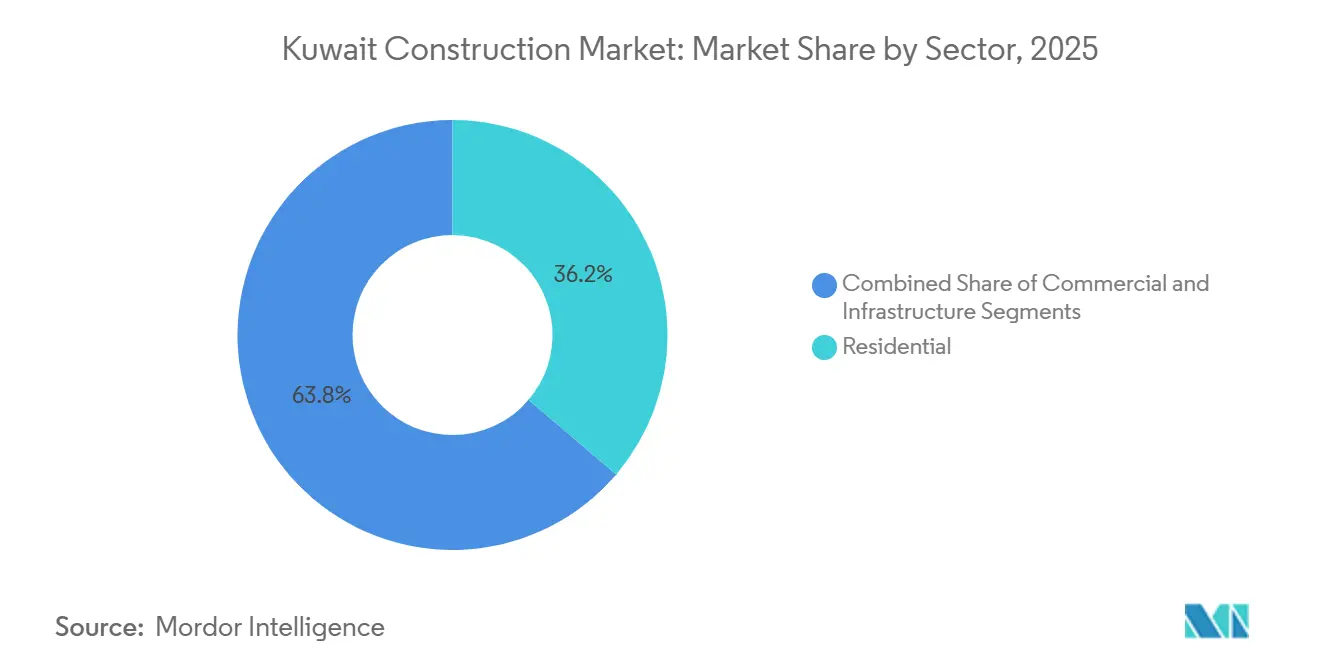
- By sector, residential led with 36.23% of the Kuwait construction market share in 2025 and is advancing at a 6.93% CAGR through 2031.
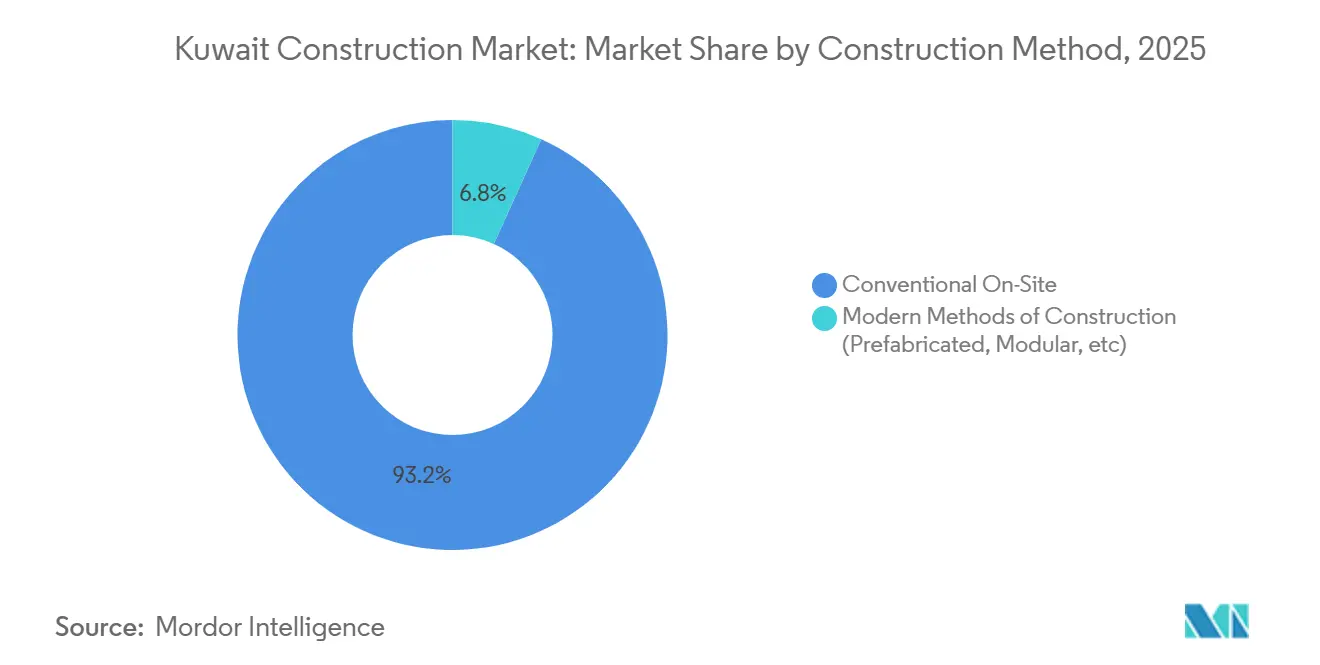
- By construction method, conventional on-site techniques held 93.23% of the Kuwait construction market size in 2025, while modular methods are expanding at a 7.93% CAGR through 2031.
- By investment source, public spending accounted for 72.23% of 2025 outlays, yet private investment is recording the highest projected 6.73% CAGR through 2031.
- By governorate, Kuwait City commanded 37.23% of the 2025 value, whereas the Rest of Kuwait is growing fastest at 7.13% CAGR to 2031.
- Combined Group Contracting, KCPC, MAK, Hyundai E&C, and JGC together controlled under 40% of 2025 contract values, underscoring a moderately concentrated landscape.
Note: Market size and forecast figures in this report are generated using Mordor Intelligence’s proprietary estimation framework, updated with the latest available data and insights as of January 2026.
Kuwait Construction Market Trends and Insights
Drivers Impact Analysis*
| Drivers | (~) % Impact on CAGR Forecast | Geographic Relevance | Impact Timeline |
|---|---|---|---|
| Vision 2035 megaprojects entering full construction phase | +1.8% | Kuwait City, Jahra, Al-Zour | Medium term (2-4 years) |
| Sovereign wealth fund co-investment unlocking >USD 10 billion FDI | +1.2% | Silk City, South Saad Al-Abdullah | Long term (≥ 4 years) |
| Modular & 3D-printed housing program acceleration | +1.1% | Jahra, Farwaniya, Mutlaa | Medium term (2–4 years) |
| 2025 Sustainable Building Code boosting retrofits | +0.9% | Kuwait City, Hawalli | Short term (≤ 2 years) |
| 5G-enabled smart-city mandates | +0.7% | Silk City, South Saad Al-Abdullah | Long term (≥ 4 years) |
| Blue/green hydrogen & CCUS scale-up in Al-Zour | +0.6% | Al Ahmadi | Long term (≥ 4 years) |
| Source: Mordor Intelligence | |||
Implementation of Kuwait Vision 2035 Megaprojects Entering Full Construction Phase
Vision 2035 moved decisively from blueprint to building after parliament’s May 2024 suspension lifted a 13-year legislative gridlock, triggering USD 1.9 billion in contract awards during 2025 and compressing procurement cycles for Silk City, South Saad Al-Abdullah and the Mubarak Al-Kabeer Port expansion. Oil revenue averaging USD 78 per barrel in early 2026 provides fiscal headroom, while 300 active projects worth USD 115 billion signal sustained opportunity even though fewer than 60% have reached financial close. Concentrated activity in Kuwait City, Jahra and Al-Zour is reshaping regional labor markets, pushing non-oil GDP growth to 3.3% in 2026. Contractors now face aggressive delivery windows that favor firms with robust project-management and cash-flow capacity.
Sovereign Wealth Fund–Backed Infrastructure Co-Investment Platform Unlocking Over USD 10 Billion FDI from 2025
Kuwait Investment Authority’s pivot toward domestic infrastructure co-investment channels foreign capital into joint ventures that grant 30%–40% equity in exchange for design and operational expertise. Phase 1 infrastructure in Silk City is already in service, and Phase 2 residential towers are breaking ground in late 2026. South Saad Al-Abdullah mirrors the model with China Gezhouba leading a USD 4 billion smart-city build. Performance-based contracts penalize schedule drift, a break from Kuwait’s traditional cost-plus norm, and real-estate sales surged 28% year-on-year in H1 2025 on confidence in megaproject timelines.
Acceleration of Modular & 3D-Printed Housing Programs to Clear 92,000-Unit Backlog
Social-housing applications could reach 197,000 by 2035, prompting mandates that at least 30% of units use modular or 3D-printed elements by 2028. The 3,345-unit Jahra pilot trims on-site labor by 40% and halves the build time to 18 months. With three more cities tendering 40,000 modular units, supply-chain investments in automated welding and local assembly plants are scaling rapidly.
Mandatory 2025 Update to Kuwait Sustainable Building Code Spurring Energy-Efficient Retrofits
The 2025 code revision forces every commercial building above 5,000 m² to slash energy intensity 25% by December 2027 or face escalating fines, instantly converting 18 million m² of legacy stock into retrofit targets[2]. Prescriptive measures such as double-glazed façades and solar-ready rooftops are favoring contractors with building-management and grid-integration skill sets, while quarterly inspections from January 2026 compress delivery schedules. Early compliant landlords are capturing 12%–18% rent premiums.
Restraints Impact Analysis*
| Restraints | (~) % Impact on CAGR Forecast | Geographic Relevance | Impact Timeline |
|---|---|---|---|
| Skilled-labor shortages under 2024 Kuwaitization quotas | −0.8% | Kuwait City, Al-Zour | Short term (≤ 2 years) |
| Volatile steel & cement costs amid EU CBAM/export levies | −0.6% | National | Medium term (2-4 years) |
| Fiscal-consolidation law capping capital spending | −0.5% | Public projects nationwide | Short term (≤ 2 years) |
| Water-scarcity compliance raising onsite costs | −0.4% | Greenfield sites | Medium term (2-4 years) |
| Source: Mordor Intelligence | |||
Persistent Skilled-Labor Shortages Intensified by Kuwaitization Quotas
Non-nationals still hold 78.7% of jobs, yet public contracts must now staff 70%–98% Kuwaiti nationals, shrinking the experienced workforce for site supervision, BIM coordination and CCUS engineering[3]. Wage inflation of 18%–25% since 2023 is eroding margins on fixed-price deals, while vocational programs lag industry needs by up to two years.
Volatile Steel & Cement Costs Amid EU CBAM and Regional Levies
EU CBAM surcharges and Saudi cement export duties lifted landed costs 12%–18% and cut inbound volumes 22% in H1 2025, straining contracts signed prior to policy shifts. Smaller firms face liquidity pressure as they renegotiate price-escalation clauses or absorb losses.
*Our forecasts treat driver/restraint impacts as directional, not additive. The impact forecasts reflect baseline growth, mix effects, and variable interactions.
Segment Analysis
By Sector: Residential Leads Kuwait’s Supply-Gap Agenda
Residential accounted for 36.23% of the Kuwait construction market size in 2025 and is growing at a 6.93% CAGR to 2031, propelled by an expanding social-housing queue and mandates for modular delivery that reduce build cycles to 18 months[4]. Apartments represent roughly 65% of unit starts, reflecting land scarcity and high urban plot prices, while villa construction concentrates in Jahra and South Sabah Al-Ahmad, where land grants lower entry costs. Early modular adopters, often joint ventures with foreign fabricators, are positioned to capture outsized Kuwait construction market share as tenders scale.
The commercial segment lags in both share and growth but underpins Vision 2035 diversification. Office buildings tilt toward energy-retrofit upgrades that satisfy the 2025 code, and industrial–logistics facilities flourish in Silk City’s free zone and Al-Zour’s petrochemical cluster. Retail footprints are downsizing amid e-commerce penetration above 30%, reallocating capital toward experiential formats.

By Construction Type: New Builds Dominate, Retrofits Rise
New construction claimed 80.23% of the 2025 value as Silk City, South Saad Al-Abdullah, and Mubarak Al-Kabeer Port entered heavy civil phases. Although front-loaded capital skews cash-flow profiles, elevated oil prices offer a cushion for accelerated tendering, supporting continued strength in the Kuwait construction market.
Retrofit spending, 19.77% in 2025, matches new-build growth at 6.93% CAGR thanks to the energy-certificate mandate. Around 18 million m² of legacy stock in Kuwait City and Hawalli must upgrade façades, HVAC, and controls to avoid escalating fines, creating steady workstreams and premium lease gains.
By Construction Method: Conventional Prevails, Modular Accelerates
Conventional on-site practices still hold 93.23% of 2025 spend, yet modular techniques expand at 7.93% CAGR under Ministry of Public Works targets for 30% prefabrication in social housing. The Kuwait construction market size attached to modular bids is poised to jump once ISO 19208-aligned standards debut in Q3 2026, streamlining approvals. Supply-chain investments, automated welding lines, and local assembly yards are narrowing tolerance gaps and boosting local content.
By Investment Source: Private Capital Accelerates
Public entities funded 72.23% of the 2025 value, but private capital is rising at a 6.73% CAGR as sovereign wealth co-investment mandates pull global developers into joint ventures. The Kuwait construction industry, meanwhile, adjusts to longer payment cycles and stricter debt ceilings that favor well-capitalized firms capable of bridging cash-flow gaps.
Geography Analysis
Kuwait City’s retrofit-led growth revolves around an 18 million m² backlog of aging stock now subject to 25% energy-reduction mandates. High-rise apartments dominate new urban supply as USD 3,250-per-m² land costs constrain villas. Silk City, while administratively within the capital, operates as a self-contained megaproject with a USD 130 billion envelope incorporating a 36-km causeway and five man-made islands.
Al Ahmadi’s industrial focus features ACWA Power’s USD 3.3 billion IWPP and blue/green hydrogen pilots that demand specialist EPC skills. Logistics bottlenecks water trucking at KD 8 per m³, and limited worker accommodation inflates costs 10%–15% over Kuwait City benchmarks. Hawalli supplies dense retrofit opportunities, whereas Farwaniya benefits from airport-adjacent logistics growth and mid-market housing spillover.
Rest-of-Kuwait governorates are decentralization winners. Jahra hosts the 3,345-unit modular pilot and tenders for 40,000 additional social-housing units. South Saad Al-Abdullah’s USD 4 billion smart-city plan, Mutlaa City’s USD 2 billion infrastructure, and a USD 1.2 billion Jahra wastewater upgrade will collectively reshape labor distribution and utilities demand through 2031.
Regulatory Landscape
Kuwait Municipality (Baladia) sits at the center of the permitting stack, covering building permits, zoning approvals, and safety licensing for residential and commercial buildings, with fire and life-safety requirements aligned to the Kuwait Fire Force Services Manual as part of the licensing process. For public works, the Ministry of Public Works (MPW) remains a key standards-setter through its construction contract documents and legacy engineering references used in official procedures, while MPW technical reviews also gatekeep approvals for road, drainage, rainwater, and sewage design submissions tied to utility connections.
Residential city delivery is being reshaped by the Public Authority for Housing Welfare (PAHW) through its developer and contractor qualification requirements, and by newer delivery models enabled under Law No. 118 of 2023 that open larger roles for specialized private developers in building and operating residential cities. This structure shifts compliance from a pure contractor execution model toward longer-term obligations (design, finance, build, operate, and maintain) under PAHW supervision, raising the importance of pre-qualification and technical specification adherence from bid stage onward.
Value Chain Analysis
Demand origination is still dominated by public-sector clients and state-linked programs, with procurement and governance flowing through entities such as the Central Agency for Public Tenders (CAPT) for larger awards, PAHW for social housing and residential cities, and MPW for infrastructure delivery and technical approvals. The upstream chain starts with master planning and design (architectural and engineering consultancies), then contractor classification and tendering, followed by EPC and general contracting execution across civil, building, MEP, and specialist packages; utility tie-ins and commissioning require coordination with agencies such as the Ministry of Electricity, Water and Renewable Energy (MEWRE) and other infrastructure authorities.
Downstream execution capacity is increasingly anchored by large, multi-year utility and public-infrastructure packages that pull in international EPC capability alongside local contractors and JVs. The 2025-2026 MPW plan (66 projects) and 2026 awards in sewage treatment and desalination illustrate how utilities packages (treatment plants, pipelines, and network upgrades) translate into sustained demand for equipment suppliers, specialist subcontractors, and O&M-ready delivery approaches. Materials and logistics constraints remain a practical pressure point given Kuwait’s reliance on imported inputs for many categories, while contractor registration and qualification requirements at PAHW and MPW influence who can access higher-value public scopes.
Competitive Landscape
The top five contractors secured below 40% of 2025 awards, confirming moderate concentration that leaves room for mid-tier specialists. Local firms dominate civil works but increasingly outsource digital and MEP scopes to global EPCs. Workforce Kuwaitization raises costs and spurs investment in training, yet graduation rates remain under 40%, prolonging skilled-labor gaps.
Modular construction and energy retrofits are emerging white spaces. Only 32% of surveyed contractors have completed modular pilots, yet mandates for 30% prefabrication in public housing will quickly scale demand. Early movers with ISO 19208-aligned processes and digital-twin capabilities are positioned to earn premium margins. Technology integration, 5G networks, BIM-driven sequencing, and carbon-capture readiness offer differentiation as smart-city and hydrogen clusters proliferate.
International majors such as ACWA Power, Technip Energies, JGC, and Fluor capture high-complexity EPC scopes. Joint ventures combining local client access with foreign engineering depth are now standard on megaproject pursuits, evidenced by the VINCI–Van Oord bid for Mubarak Al-Kabeer Port and KCPC’s partnership with China Gezhouba at South Saad Al-Abdullah.
Kuwait Construction Industry Leaders
-
Combined Group Contracting Co.
-
Kuwait Company for Process Plant Construction & Contracting (KCPC)
-
Mushrif Trading & Contracting Co.
-
Mohammed Abdulmohsin Al-Kharafi & Sons (MAK)
-
Hyundai Engineering & Construction Co. Ltd
- *Disclaimer: Major Players sorted in no particular order
Market Opportunities and Future Outlook
Private developer participation in large residential-city programs is a clear whitespace tied to PAHW’s shift toward developer-led models under Law No. 118 of 2023, which explicitly enables specialized companies to construct and develop residential cities. The May 2026 PAHW pre-qualification invitations for major residential packages (Al Mutlaa City (M-3), East Saad Al Abdullah City (ESA-1), and West Saad Al Abdullah (WSA-1)) underline an active funnel for developer, contractor, and supply-chain entrants that can meet PAHW qualification and long-horizon delivery requirements.
Utilities and infrastructure packages are another visible opportunity area, supported by announced public project-spending plans for the 2026-2027 fiscal cycle that target airport, water, and power infrastructure, and by ongoing award activity across sewage treatment, desalination, and power-network scopes. In parallel, the enforcement mechanics of the 2025 Kuwait Sustainable Building Code revision (quarterly inspections starting January 2026 and a December 2027 compliance deadline for large commercial buildings) expand addressable work in retrofits across facade, HVAC, and building controls, rewarding contractors and integrators that can deliver energy-performance upgrades and documentation in inspection-driven timelines.
Recent Industry Developments
- May 2026: Combined Group Contracting signed a KWD 77.34 million contract with Kuwait Oil Company to construct flowlines and associated works under Tender No. RFP-2141028, with a 60-month execution period. The award reinforces the multi-year backlog of energy-related civil and mechanical construction and supports sustained utilization for capable local contractors and their subcontractor ecosystems.
- December 2025: Bechtel won a USD 1.2 billion FEED and project-management services scope for a green-hydrogen plant in Al-Zour. The package highlights how early-phase engineering and program management is being allocated ahead of full EPC commitments in emerging energy-transition projects.
- May 2024: Kuwait’s parliamentary suspension removed a key bottleneck that had slowed approvals and procurement for major state projects. The improved award environment that followed helped move multiple Vision 2035 programs from planning into executable tender pipelines.
Research Methodology Framework and Report Scope
Market Definition and Coverage
For this study, the Kuwait construction market is defined as the annual value of construction activity across Kuwait, covering on-site work and the related materials and professional services used to build, expand, or refurbish buildings and civil infrastructure.
Scope exclusions: Offshore oil and gas platform construction, owner-built informal housing, and temporary site facilities are not counted.
Segmentation Overview
- By Sector
- Residential
- Apartments/Condominiums
- Villas/Landed Houses
- Commercial
- Office
- Retail
- Industrial and Logistics
- Others
- Infrastructure
- Transportation Infrastructure (Roadways, Railways, Airways, others)
- Energy & Utilities
- Others
- Residential
- By Construction Type
- New Construction
- Renovation
- By Construction Method
- Conventional On-Site
- Modern Methods of Construction (Prefabricated, Modular, etc.)
- By Investment Source
- Public
- Private
- By Governorate
- Kuwait City
- Al Ahmadi
- Hawalli
- Farwaniya
- Rest of Kuwait
Data Sources, Market Sizing, and Validation
Desk Research
Desk research started with mapping the demand pool using public datasets that indicate where construction spending is actually happening. We leaned on sources such as Kuwait Central Statistical Bureau publications, Ministry of Finance budget documents, Public Authority for Housing Welfare program updates, and Central Bank of Kuwait releases for macro and investment context.
To anchor the project pipeline and timing, additional checks were made using publicly available tender notices, authority and municipality project announcements, and press coverage from regional business publications. For company-level context, we referenced annual reports and investor presentations where available, and we also used a paid subscription for company financials and for shipment-level import data to sense material inflows that typically move with construction activity. This list is illustrative, and many other sources were referred to for data collection, validation, and clarification during the research work.
Primary Interviews and Surveys
Primary work focused on validating what is being awarded versus what is being executed, and how fast budgets are turning into site spending across key public and private buyers in Kuwait. We spoke with contractors, consultants, developers, and materials-linked stakeholders to confirm typical cost breakups, execution lags, and how price movements are being reflected in active contracts.
Feedback was balanced across major project centers in the country, and it was used to tighten assumptions where desk sources are slow to update, especially around start dates, re-phasing, and price escalation clauses.
Distribution of primary research fieldwork respondents
| Company type | Respondent position |
|---|---|
| Top tier: 31% | CXOs: 18% |
| Mid tier: 49% | Functional/Unit leaders: 23% |
| Smaller Players: 20% | Managers: 59% |
Market-Sizing & Forecasting
Market size was built using a top-down approach where public capital budgets, tendering signals, and active project pipelines are translated into likely annual execution, then reconciled to what can realistically be delivered on the ground. In practice, this meant aligning planned and awarded work to an execution curve, before converting it into yearly value using current price levels.
To keep the model tied to real activity, we tracked inputs such as government capex releases, housing award volumes, infrastructure program milestones, construction cost inflation, and imported building material trends that tend to move with site work. The totals were then pressure-tested using selective bottom-up approximations, including sampled project values by type, typical cost-per-square-meter ranges, and contractor revenue mix checks to see if the implied market pool is reasonable.
For forecasting, scenario analysis was used because Kuwait construction is sensitive to budget timing and project re-phasing. Base, faster, and slower execution paths were created from the same pipeline, and the final forecast was chosen after expert feedback on award conversion, labor availability, and expected cost escalation. Where project data was incomplete, we filled gaps using conservative start dates and benchmark execution rates, then revisited them during validation calls.
Data Validation & Update Cycle
Validation was done through multiple passes so that unusual jumps do not slip into the final outputs. We cross-checked results against independent signals like budget execution commentary, major award announcements, and construction cost movements, then reviewed any large variances at a project cluster level before sign-off.
If a key assumption moved, such as a large program being re-tendered or delayed, respondents were re-contacted to confirm the new timing and price implications. Reports are refreshed annually, with interim updates when material events change the near-term execution picture. Before delivery, an analyst runs a final check to ensure the latest publicly released data and market signals are reflected.
Mordor Intelligence's Kuwait Construction Market Estimate Compared With Other Published Estimates
Published market sizes for Kuwait construction can look different even when they use the same currency, because each publisher updates at different times and treats price escalation and execution timing in its own way. In our work, the key goal was to keep yearly value aligned with when spending actually hits the site, not just when projects are announced.
Key gap drivers are usually the exchange-rate timing used for conversion into USD, whether cost inflation is applied as a single annual factor or updated mid-year, and how paused or re-phased public projects are handled in the execution curve. A more frequent refresh of project status and price inputs reduces the chance of counting work too early or carrying outdated unit costs, which can shift a single-year value by a meaningful amount.
Benchmark comparison
| Source | Market Size | Gaps in Research Methodology |
|---|---|---|
| Mordor Intelligence | USD 15.47 B (2025) | |
| Syndicated Publisher A | USD 14.77 B (2025) | This estimate appears to apply a slightly tighter execution assumption for the same year, and it is not always clear how mid-year price escalation and project re-phasing are re-cut into the final USD total. |
| Industry Publisher B | USD 14.33 B (2025) | The lower value is consistent with a more conservative conversion of pipeline into executed spending, and the pricing basis and currency timing look less transparent, which can understate years with higher cost inflation. |
The spread in values is mainly explained by timing choices, including when exchange rates are sampled and how quickly unit-cost assumptions are refreshed against new cost signals, which is why the model updates and validation checks used by Mordor Intelligence matter most for the 2025 point estimate.
Key Questions Answered in the Report
What is the current value of the Kuwait construction market?
It is valued at USD 16.28 billion in 2026 with a forecast to reach USD 21.48 billion by 2031.
How fast is the sector expected to grow?
The market is projected to expand at a 5.7% CAGR between 2026 and 2031.
Which segment leads spending today?
Residential construction leads with 36.23% of 2025 value, fueled by social-housing demand.
Where is construction activity growing quickest geographically?
The Rest of Kuwait is advancing at a 7.13% CAGR through 2031, led by governorates outside Kuwait City such as Jahra.
How concentrated is contractor competition?
The top five players control under 40% of contract awards, indicating moderate concentration and room for new entrants.