
Earned Wage Access (EWA) Platform Market Size and Share
Market Overview
| Study Period | 2020 - 2031 |
|---|---|
| Market Size (2026) | USD 9.08 Billion |
| Market Size (2031) | USD 19.24 Billion |
| Growth Rate (2026 - 2031) | 16.20 % |
| Fastest Growing Market | Asia-Pacific |
| Largest Market | North America |
| Market Concentration | Medium |
Major Players *Disclaimer: Major Players sorted in no particular order Image © Mordor Intelligence. Reuse requires attribution under CC BY 4.0. | |
Earned Wage Access (EWA) Platform Market Analysis by Mordor Intelligence
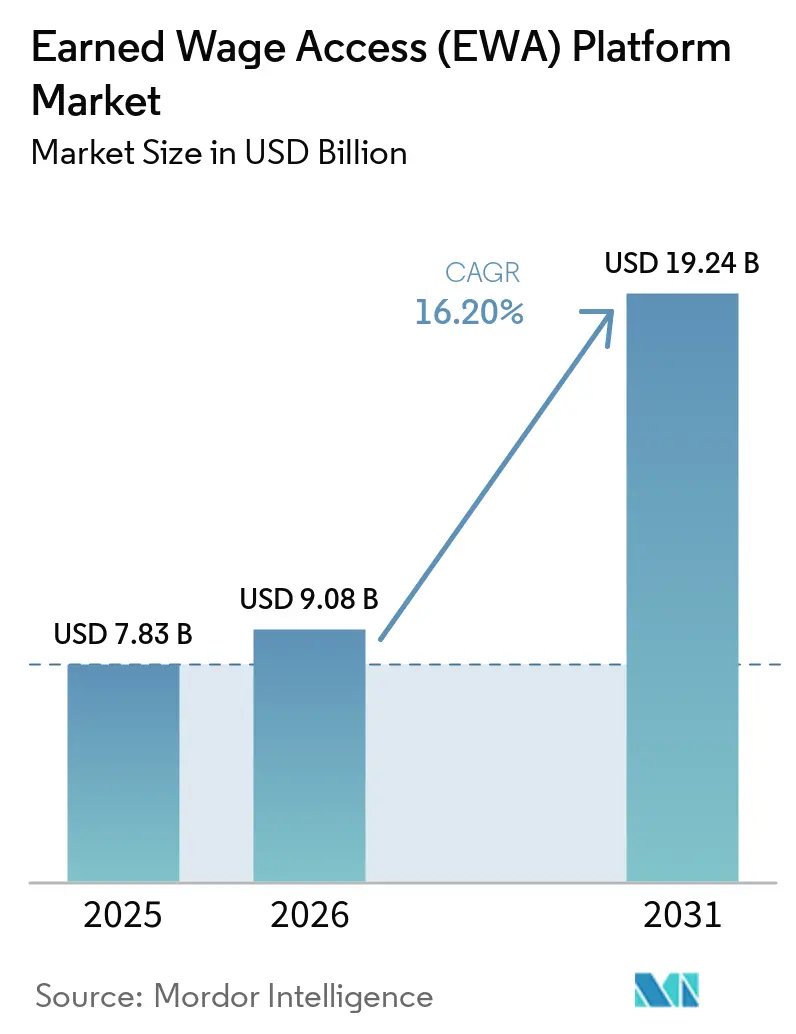
The Earned Wage Access (EWA) Platform market size is expected to be USD 7.83 billion in 2025, USD 9.08 billion in 2026, and reach USD 19.24 billion by 2031, growing at a CAGR of 16.2% from 2026 to 2031. Over the past year, large employers reframed on-demand pay as a retention lever rather than an experimental perk, linking it to measurable reductions in absenteeism, payday-loan dependency, and workforce churn. Federal clarification that zero-fee, employer-integrated earned wage access programs fall outside lending rules removed a critical adoption barrier, while the rapid scale-up of instant-payment networks trimmed settlement costs and liquidity risk. Vendors responded by embedding predictive cash-flow insights and savings nudges, turning basic wage advances into broader financial-wellness suites. Competitive intensity remains high because payroll software firms, neobanks, and embedded-finance specialists are all courting the same set of enterprise integrations.
Key Report Takeaways
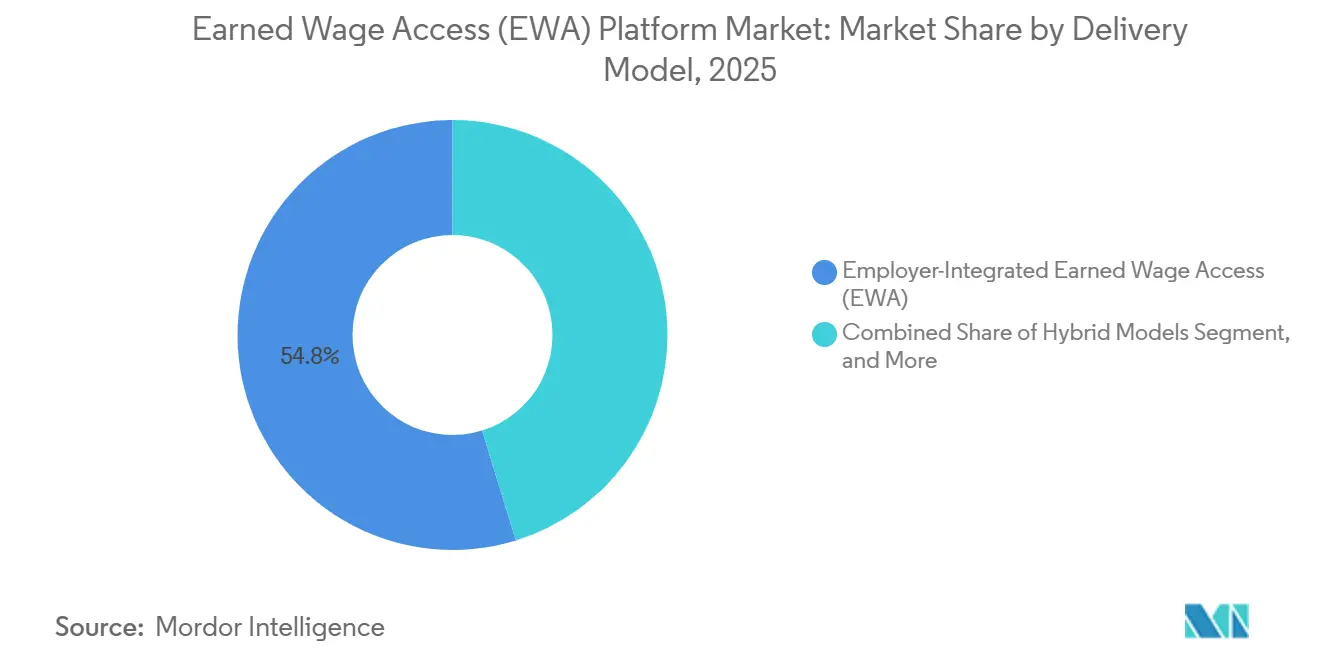
- By delivery model, employer-integrated platforms held 54.77% of Earned Wage Access (EWA) Platform market share in 2025, whereas hybrid architectures are advancing at an 18.34% CAGR through 2031.
- By deployment mode, on-premise systems led with 66.67% revenue share in 2025, while cloud-based offerings are projected to record an 18.71% CAGR between 2026 and 2031.
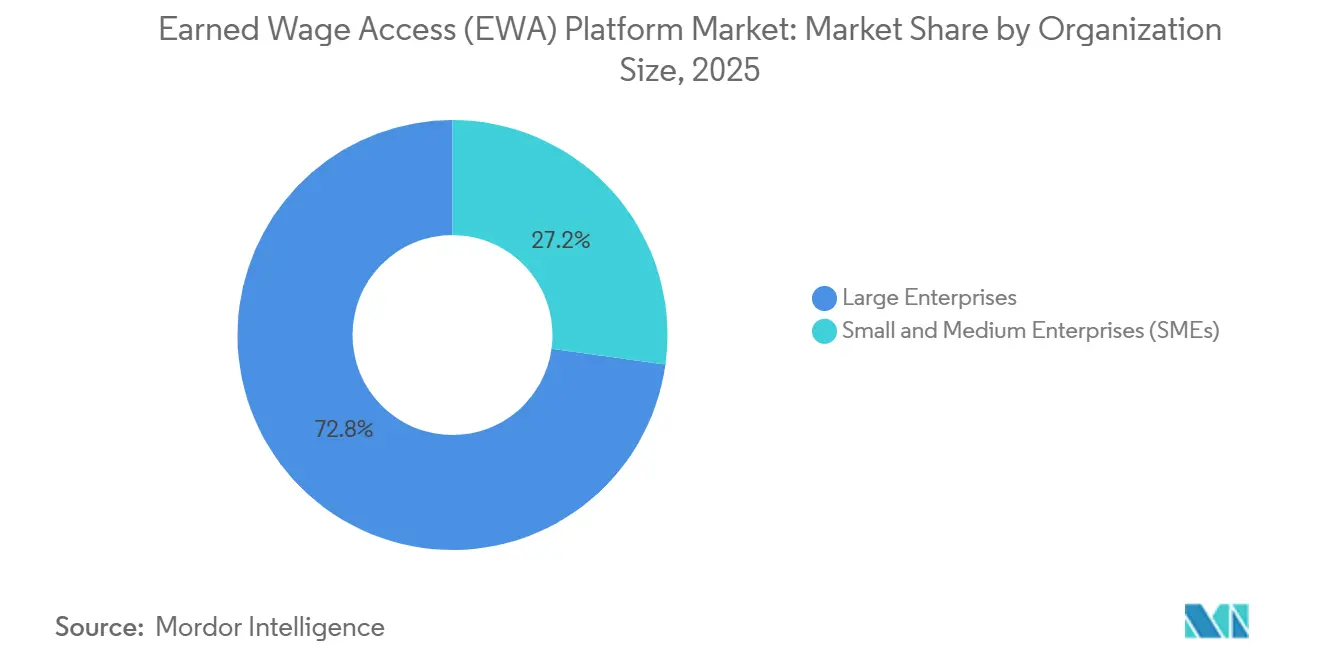
- By organization size, large enterprises captured 72.81% revenue in 2025, yet small and medium enterprises represent the fastest expansion at a 19.04% CAGR to 2031.
- By end-user industry, retail and e-commerce dominated with 23.41% revenue share in 2025, whereas healthcare is set to grow at a 17.45% CAGR through 2031.
- By geography, North America accounted for 36.54% revenue in 2025, but Asia-Pacific is forecast to rise at a 17.92% CAGR over 2026-2031.
Note: Market size and forecast figures in this report are generated using Mordor Intelligence’s proprietary estimation framework, updated with the latest available data and insights as of January 2026.
Market Trends and Insights
Drivers Impact Analysis of Earned Wage Access (EWA) Platform Market*
| Driver | (~) % Impact on CAGR Forecast | Geographic Relevance | Impact Timeline |
|---|---|---|---|
| Surging Adoption of Earned Wage Access as a Financial-Wellness Benefit | +4.2% | Global with North America and Europe leadership | Medium term (2-4 years) |
| Expansion of Real-Time Payments Infrastructure in Developed Markets | +3.8% | North America, Europe, Australia | Short term (≤ 2 years) |
| Increasing Gig-Economy Workforce Across Asia-Pacific | +3.1% | Asia-Pacific core, spill-over to Middle East and Africa | Long term (≥ 4 years) |
| Intensifying Competition for Hourly Talent in Retail and Hospitality | +2.6% | North America, Europe, select Asia-Pacific | Short term (≤ 2 years) |
| Growing Strategic Partnerships Between FinTechs and Traditional Payroll Vendors | +1.9% | Global, concentrated in North America and Europe | Medium term (2-4 years) |
| Emergence of Embedded-Finance APIs Enabling White-Label EWA | +1.5% | Global, early adoption in North America and South America | Long term (≥ 4 years) |
| Source: Mordor Intelligence | |||
Surging Adoption of Earned Wage Access as a Financial-Wellness Benefit
Employers have repositioned on-demand pay from a fringe perk to a central component of financial-wellness strategies, driven by survey evidence showing more than half of frontline healthcare staff link money stress to job performance. Lower voluntary turnover among nurses translated into five-figure savings per departure prevented, shifting evaluation of earned wage access from HR budgets to CFO-level cost-avoidance metrics. Hourly workers overwhelmingly state a preference for weekly or instant pay, yet employer adoption still lags, signaling significant headroom for growth. As audit standards such as SOC 2 and GDPR become baseline requirements, best-in-class vendors differentiate through transparent fee structures and immutable audit trails. Taken together, these factors anchor demand across both commercial and public-sector employers.
Expansion of Real-Time Payments Infrastructure in Developed Markets
Instant-settlement systems, FedNow in the United States, RTP in Europe, and the New Payments Platform in Australia, scaled dramatically during 2025, lifting transaction ceilings and widening financial-institution participation. Same-day clearing lowers or eliminates the pre-funding float previously carried by providers, making zero-fee wage advances economically sustainable. Higher transaction limits now cover mid-sized payroll batches, enabling employers to use a single rail for both advances and regular salary. In turn, vendors can promise workers immediate disbursement without relying on prepaid cards, addressing one of the largest pain points cited in user-experience surveys. The result is a structural improvement in unit economics that supports broader geographic rollouts.
Increasing Gig-Economy Workforce Across Asia-Pacific
Gig-worker totals in India, Indonesia, and the Philippines climbed sharply in 2025, outpacing traditional payroll employment and creating a pool of workers underserved by employer-integrated models. Local regulators classify most earned wage access providers as non-banking financial companies, unlocking debt financing for liquidity pools and giving platforms room to scale. Direct-to-consumer and hybrid delivery designs dominate this segment because platform workers frequently engage with multiple income sources, necessitating app-based, worker-centred solutions rather than single-employer integrations. Investment flows reflect the opportunity; multi-million-dollar funding rounds have pushed local champions into regional expansion. Over the forecast horizon, Asia-Pacific’s demographic tailwinds are expected to push the Earned Wage Access (EWA) Platform market into double-digit annual growth.
Intensifying Competition for Hourly Talent in Retail and Hospitality
United States retail and hospitality vacancies exceeded four million roles during 2025, while quit rates persistently doubled pre-pandemic norms.[1]Employers are leaning on earned wage access to lengthen average tenure without raising base wages, with real-world deployments demonstrating nearly one-third lower turnover. Quick-service restaurants illustrate the urgency; when tenure averages fewer than 90 days, extending stay by even two weeks yields meaningful savings in hiring and training spend. Logistics firms have copied the model, enabling drivers to collect earnings within hours of delivery completion, and reporting measurable retention benefits. Competitive differentiation is now fleeting, as rising baseline expectations mean late adopters risk reputational damage among prospective hires.
Restraints Impact Analysis of Earned Wage Access (EWA) Platform Market*
| Restraint | (~) % Impact on CAGR Forecast | Geographic Relevance | Impact Timeline |
|---|---|---|---|
| Regulatory Ambiguity Around Lending versus Non-Lending Classification | -2.8% | Global, acute in Asia-Pacific and Africa | Short term (≤ 2 years) |
| Data-Security and Privacy Concerns Among Large Enterprises | -1.9% | North America and Europe with GDPR and CCPA focus | Medium term (2-4 years) |
| Limited Financial Literacy Slowing User Uptake in Africa | -0.7% | Africa, concentrated in Nigeria, Kenya, and South Africa | Long term (≥ 4 years) |
| Interchange-Fee Compression Pressuring Unit Economics | -0.6% | North America, with Washington State as leading indicator | Medium term (2-4 years) |
| Source: Mordor Intelligence | |||
Regulatory Ambiguity Around Lending Versus Non-Lending Classification
Federal guidance in the United States excludes fee-free, employer-integrated earned wage access from lending statutes, yet each state, and many foreign jurisdictions, retains discretion to impose money-transmitter or small-loan licensing. California’s disclosure mandates and Connecticut’s registration thresholds raise compliance costs that weigh heaviest on emerging vendors. In Asia-Pacific, India offers clarity by treating providers as non-banking financial companies, whereas Indonesia and others still debate fee caps and license categories. The resulting patchwork forces platforms into either piecemeal licensing or lobbying for harmonized rules, slowing multi-state rollouts and inflating legal overhead. Because growth requires wide geographic reach, persistent ambiguity remains a significant drag on near-term expansion.
Data-Security and Privacy Concerns Among Large Enterprises
High-profile payroll data breaches crystallized buyer focus on zero-trust architectures, SOC 2 Type II attestations, and zero-knowledge encryption. For vendors, security evaluations now stretch sales cycles to nine-plus months, effectively increasing customer-acquisition cost. Compliance with GDPR and CCPA adds overlapping requirements for data minimization, explicit consent, and audit logging, further tightening technical specifications. Enterprises are also extending Department of Justice rules that target data brokers to all payroll-adjacent vendors, broadening the scope of due-diligence questionnaires. Vendors unable to illustrate airtight segmentation of earnings, identity, and behavioral data risk exclusion from procurement shortlists, particularly in healthcare and financial-services verticals.
*Our forecasts treat driver/restraint impacts as directional, not additive. The impact forecasts reflect baseline growth, mix effects, and variable interactions.
Earned Wage Access (EWA) Platform Market Segment Analysis
By Delivery Model:
Hybrid Architectures Become the Preferred OptionEmployer-integrated systems commanded the largest slice of the Earned Wage Access (EWA) Platform market with 54.77% in 2025, a reflection of large organizations prioritizing zero-fee benefits that sidestep lending compliance. The blend of both hybrid platforms is the fastest-growing segment, expanding at an 18.34% CAGR. Direct-to-consumer apps, however, remain essential for gig workers and employees at firms without sponsored programs. These solutions weave budgeting dashboards, savings nudges, and early-deposit features into one workflow, addressing worker demand for holistic money management. Recent white-label API launches let payroll vendors bolt such services onto existing suites, shortening deployment to weeks. This convergence points to a future where single-purpose advances fade, and bundled wellness suites dominate, reinforcing network effects that reward platforms with the broadest employer, payroll, and consumer touchpoints.
Hybrid models also temper regulatory risk because they collect employer payroll data yet settle funds directly to workers, allowing dynamic compliance configurations by jurisdiction. Major providers report that hybrid users engage with at least two ancillary services, budgeting or goal-based savings, within three months, improving stickiness and cross-sell revenue. The earned wage access market size allocated to hybrid platforms is on track to more than double by 2031 as enterprises seek configurable options that satisfy both compliance and worker preference.

By Deployment Mode:
Cloud Solutions Move Into the MajorityOn-premise installs represented 66.67% of revenue in 2025, yet cloud deployments advance at an 18.71% CAGR, as mid-market firms look for faster go-lives and lower capital expenditure. Workday’s strategic investment embedded DailyPay directly into its cloud HCM suite, eliminating middleware latency.[2] Cloud platforms push weekly feature updates, provide multi-region redundancy, and integrate with real-time payment rails in a fraction of the time required for on-prem installs. Strategic investments from leading HR software vendors baked cloud earned wage access directly into core human-capital suites, cementing these architectures as default for greenfield implementations.
While on-premise will persist in industries subject to stringent data-sovereignty rules, practically every new contract below the top-tier enterprise category now specifies cloud deployment. The earned wage access platform market experiences tangible efficiency gains because vendors can unify security upgrades across tenants, rather than delivering custom patches. Moreover, API-first cloud systems make it straightforward to open developer ecosystems, spawning add-ons such as earned-asset trading or automated savings that amplify the core proposition.
By Organization Size:
Embedded Finance Unlocks the SME OpportunityLarge enterprises generated 72.81% of 2025 spend, but SME adoption is growing at a 19.04% CAGR. Large organizations remain the revenue anchor due to volume discounts and sophisticated integration capacity. Payroll vendors now embed earned wage access in their dashboards through single-call APIs, removing the historical need for SMEs to contract with separate fintech providers. The price point, frequently under USD 5 per active user per month, lands within tight operating margins common in hospitality, construction, and small-format retail.
SMEs also value the morale uplift and lower turnover that earned wage access confers, an effect documented in partner case studies. For vendors, the economics of embedded distribution decouple user acquisition from costly direct sales, giving rise to a long-tail strategy that collectively rivals large-enterprise volumes. Over the forecast window, the earned wage access platform market size tied to SME consumption is expected to rise meaningfully as embedded payroll channels expand across North America and South America.
By End-User Industry:
Healthcare Surges on Escalating Nurse Turnover CostsRetail and e-commerce led revenue by 23.41% in 2025, but healthcare is the fastest climber at a 17.45% CAGR. Retail and e-commerce retained the largest slice of 2025 revenue as employers rushed to stem churn among cash-strapped hourly staff. Hospitals face five-figure replacement costs for each departing nurse, making even small retention lifts financially consequential. Earned wage access deployments have already halved voluntary quits in pilot programs, prompting accelerated rollouts across multisite health systems. Manufacturing occupies a rising middle ground as mobile-first interfaces enable floor workers to view earnings without desktop kiosks.
In logistics, instant cash advances triggered by delivery confirmation demonstrate the spread of the model beyond traditional payroll settings. Financial-services firms are also experimenting, especially where customer-facing staff experience commission volatility. Taken together, the diversity of vertical uptake underscores that the earned wage access platform market is no longer confined to hospitality and retail; it is becoming a cross-industry norm wherever cash-flow volatility collides with tight labor markets.
Geography Analysis
North America Earned Wage Access (EWA) Platform Market
North America held 36.54% revenue share in 2025, underpinned by a mature payroll-software ecosystem, well-capitalized providers, and the operational debut of the FedNow rail that processed 74 million transactions. Federal regulatory clarity further thawed enterprise hesitancy, accelerating adoption among Fortune 500 employers. Canada and Mexico show rising interest, driven by gig-economy platforms embedding direct-to-consumer models that bypass employer sponsorship.
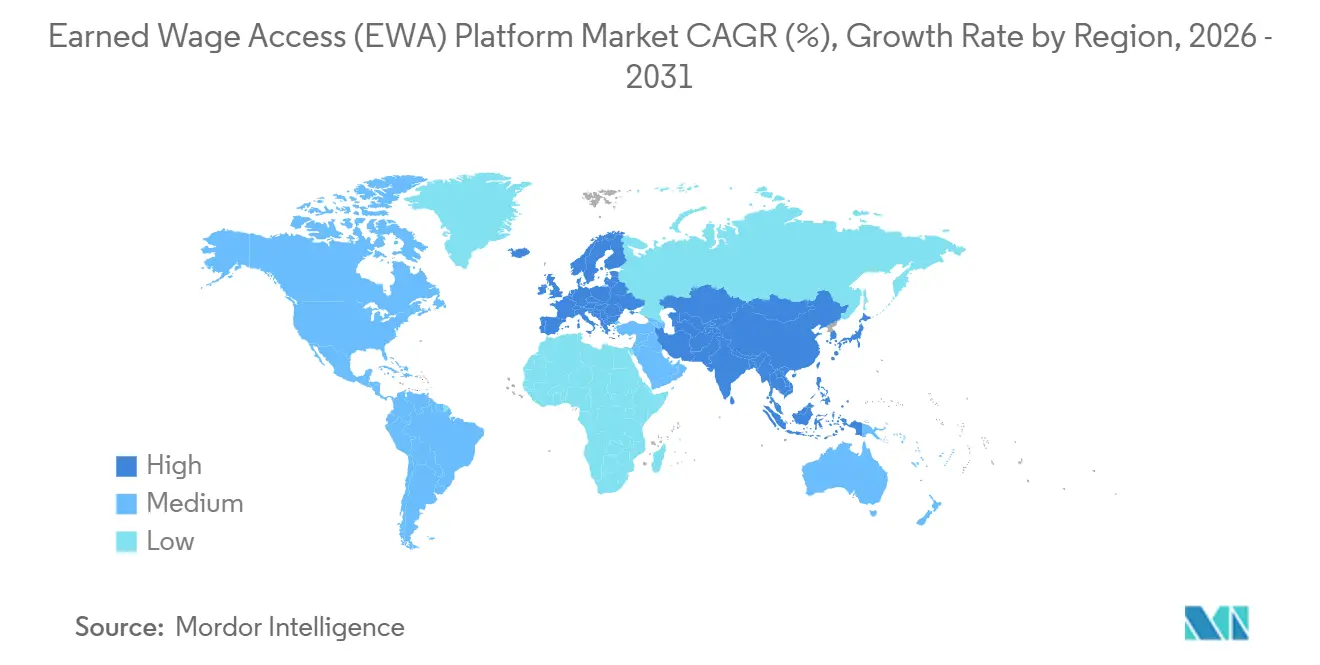
APAC Earned Wage Access (EWA) Platform Market
Asia-Pacific is the growth engine, advancing at a 17.92% CAGR through 2031. India’s classification of providers as non-banking financial companies unlocked debt funding pathways, while the gig workforce vaulted beyond 7.7 million. Regional players use this regulatory runway to scale pan-Asian footprints, leveraging real-time payment infrastructure such as Australia’s New Payments Platform and Singapore’s FAST system.[3] China, Japan, and South Korea report mid-tier uptake, anchored by the e-commerce and manufacturing sectors.
EMEA and South America Earned Wage Access (EWA) Platform Market
Europe maintains a steady trajectory as SEPA Instant participation becomes mandatory, standardizing immediate settlement across member states. GDPR compliance inflates upfront security costs, elongating procurement cycles, but once integrated, enterprises report fewer chargebacks and higher employee satisfaction. South America records solid momentum as regulatory discussions in Argentina about wallet-based payroll catalyze platform partnerships, while Brazil and Colombia start to craft open-finance guidelines conducive to earned wage access expansion. In the Middle East, large expatriate workforces underpin adoption, exemplified by eight-figure joint ventures, whereas Africa remains nascent due to patchy instant-payment rails and varying consumer financial literacy.
Competitive Landscape
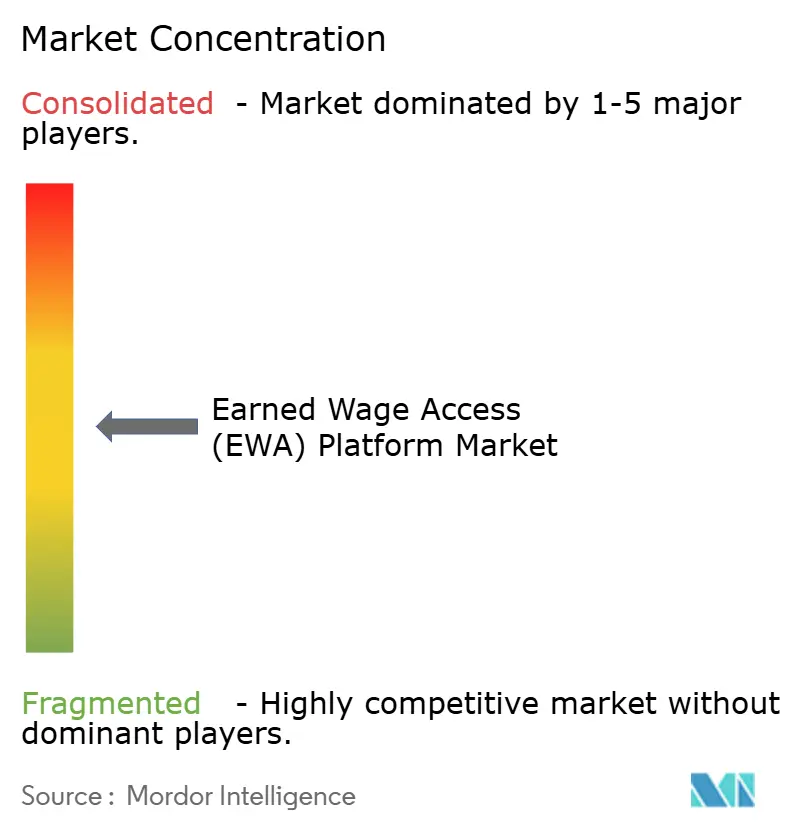
The earned wage access platform market remains moderately fragmented, with no vendor exceeding 15% share, yet rivalry intensifies as new entrants target every layer of the value chain. Incumbents such as DailyPay, Payactiv, and Wagestream lean on bank-grade compliance certifications, winning Fortune 500 contracts that demand multilayer security and auditability. Direct-to-consumer pioneers like Earnin and Branch cultivate viral app growth and bank-account linking to reach workers unaffiliated with employer programs, boosting share in the gig-economy cohort.
Strategic alliances reshape positioning: Workday’s investment in DailyPay embedded earned wage access directly into a top human-capital suite, tilting the playing field toward vertically integrated ecosystems. White-label APIs from Branch and Payactiv enable regional payroll processors to rebrand earned wage access, multiplying distribution nodes and further fragmenting market share.
Technology roadmaps now emphasize predictive insights that warn users of cash shortfalls, reducing advance frequency and improving margins. Outside North America and Europe, regional specialists, Refyne in India, NowPay in the Middle East, secure funding to localize compliance and language support, signaling that global winners will likely emerge through federated alliances rather than single-entity dominance.
Earned Wage Access (EWA) Platform Industry Leaders
-
Payactiv Inc.
-
DailyPay Inc.
-
Earnin, Inc.
-
Wagestream Holdings Limited
-
Instant Financial USA Inc.
- *Disclaimer: Major Players sorted in no particular order
Earned Wage Access (EWA) Platform Market Companies Covered in this Report
- Payactiv Inc.
- Earnin, Inc.
- DailyPay Inc.
- Wagestream Holdings Limited
- Instant Financial USA Inc.
- FlexWage Solutions LLC
- Even Responsible Finance, Inc.
- Branch Technologies Inc.
- Rain Technologies Inc.
- ZayZoon Inc.
- Clair Inc.
- Hastee Technologies Limited
- SalaryFinance Limited
- Refyne Tech Private Limited
- Tapcheck Inc.
- FinFit Ops LLC
- Immediate Solutions, Inc.
- Payflow S.L.
- Line Financial PBC
- Instapay Technologies Pty Ltd
Recent Industry Developments in Earned Wage Access (EWA) Platform Market
- March 2026: Argentina’s legislature debated labor reforms that would require salary deposits into digital wallets, paving the way for platforms such as Reba and Mercado Pago to embed earned wage access alongside payroll accounts.
- February 2026: ZayZoon integrated with Swipeclock, giving 15,000 SMEs a one-click path to on-demand pay without additional vendor contracts.
- February 2026: Rain Technologies plugged its platform into Microsoft Teams, letting 3.5 million covered employees request advances and receive financial-wellness alerts inside their collaboration hub.
- January 2026: NowPay and Tas'heel formed a USD 20 million joint venture to reach Saudi Arabia’s 18.1 million workforce, 79% of whom live paycheck-to-paycheck.
Global Earned Wage Access (EWA) Platform Market Report Scope
The Earned Wage Access (EWA) Platform Market empowers employees to tap into their earned wages ahead of the conventional payday. By seamlessly integrating with payroll, time-tracking, or HCM systems, these platforms offer real-time earnings visibility and facilitate on-demand disbursements. EWA solutions enhance cash-flow flexibility, aiming to lessen employees' dependence on overdrafts, credit cards, and payday loans. The market's expansion is fueled by employer wellness initiatives, the adoption of a mobile-first workforce, and escalating demands for instantaneous digital payments.
The Earned Wage Access Platform Market Report is Segmented by Delivery Model (Employer-Integrated Earned Wage Access [EWA], Direct-to-Consumer Earned Wage Access [EWA], and Hybrid Models), Deployment Mode (Cloud-Based, and On-Premise), Organization Size (Large Enterprises, and Small and Medium Enterprises [SMEs]), End-User Industry (Retail and E-Commerce, Healthcare, Manufacturing, Hospitality and Food Service, Transportation and Logistics, Banking, Financial Services and Insurance [BFSI], and Other End-User Industries), and Geography (North America, South America, Europe, Asia-Pacific, Middle East, and Africa). The Market Forecasts are Provided in Terms of Value (USD).
Segmentation Overview
| Employer-Integrated Earned Wage Access (EWA) |
| Direct-to-Consumer Earned Wage Access (EWA) |
| Hybrid Models |
| Cloud-Based |
| On-Premise |
| Large Enterprises |
| Small and Medium Enterprises (SMEs) |
| Retail and E-Commerce |
| Healthcare |
| Manufacturing |
| Hospitality and Food Service |
| Transportation and Logistics |
| Banking, Financial Services and Insurance (BFSI) |
| Other End-User Industries |
| North America | United States |
| Canada | |
| Mexico | |
| South America | Brazil |
| Argentina | |
| Rest of South America | |
| Europe | Germany |
| United Kingdom | |
| France | |
| Italy | |
| Spain | |
| Russia | |
| Rest of Europe | |
| Asia-Pacific | China |
| India | |
| Japan | |
| South Korea | |
| Australia | |
| Rest of Asia-Pacific | |
| Middle East | Saudi Arabia |
| United Arab Emirates | |
| Turkey | |
| Rest of Middle East | |
| Africa | South Africa |
| Nigeria | |
| Rest of Africa |
| By Delivery Model | Employer-Integrated Earned Wage Access (EWA) | |
| Direct-to-Consumer Earned Wage Access (EWA) | ||
| Hybrid Models | ||
| By Deployment Mode | Cloud-Based | |
| On-Premise | ||
| By Organization Size | Large Enterprises | |
| Small and Medium Enterprises (SMEs) | ||
| By End-User Industry | Retail and E-Commerce | |
| Healthcare | ||
| Manufacturing | ||
| Hospitality and Food Service | ||
| Transportation and Logistics | ||
| Banking, Financial Services and Insurance (BFSI) | ||
| Other End-User Industries | ||
| By Geography | North America | United States |
| Canada | ||
| Mexico | ||
| South America | Brazil | |
| Argentina | ||
| Rest of South America | ||
| Europe | Germany | |
| United Kingdom | ||
| France | ||
| Italy | ||
| Spain | ||
| Russia | ||
| Rest of Europe | ||
| Asia-Pacific | China | |
| India | ||
| Japan | ||
| South Korea | ||
| Australia | ||
| Rest of Asia-Pacific | ||
| Middle East | Saudi Arabia | |
| United Arab Emirates | ||
| Turkey | ||
| Rest of Middle East | ||
| Africa | South Africa | |
| Nigeria | ||
| Rest of Africa | ||
Key Questions Answered in the Report
What is the current Earned Wage Access (EWA) Platform market size and how fast is it growing?
The Earned Wage Access (EWA) Platform market size stands at USD 9.08 billion in 2026 and is projected to reach USD 19.24 billion by 2031, reflecting a 16.2% CAGR.
Which delivery model leads adoption across employers?
Employer-integrated systems held 54.77% market share in 2025, but hybrid architectures are expanding fastest at an 18.34% CAGR to 2031.
Why is healthcare the fastest-growing vertical for on-demand pay?
Nurse turnover costs exceeded USD 61,000 per departure in 2025, and hospitals using earned wage access cut voluntary quits by half, driving a 17.45% CAGR in healthcare uptake.
How are small and medium enterprises accessing earned wage access?
Embedded-finance APIs from payroll vendors now let SMEs activate on-demand pay through a single click, underpinning a 19.04% CAGR for the segment.
What role do instant-payment networks play in earned wage access adoption?
Systems such as FedNow, RTP, and SEPA Instant settle advances in seconds, removing pre-funding float and enabling zero-fee models that attract both employers and workers.