
ASEAN Digital Workplace Market Size and Share
Market Overview
| Study Period | 2020 - 2031 |
|---|---|
| Forecast Data Period | 2026 - 2031 |
| Base Year Market Size (2025) | USD 2.61 Billion |
| Market Size (2026) | USD 3.27 Billion |
| Market Size (2031) | USD 10.59 Billion |
| Growth Rate (2026 - 2031) | 26.49 % |
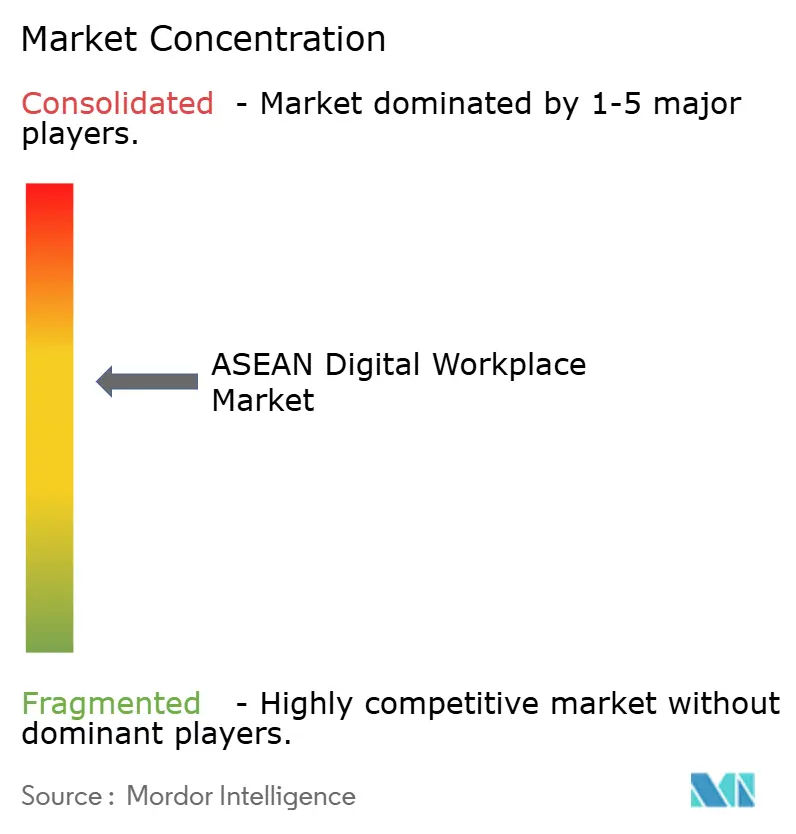
| Market Concentration | Medium |
Major Players *Disclaimer: Major Players sorted in no particular order Image © Mordor Intelligence. Reuse requires attribution under CC BY 4.0. | |
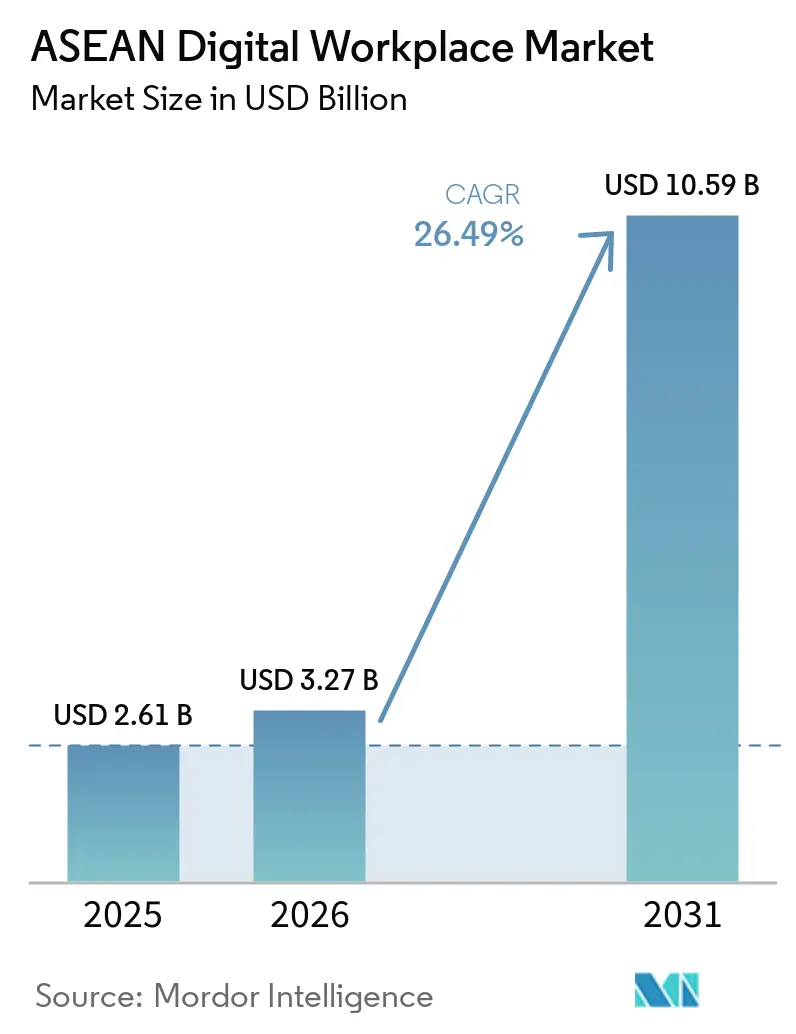
ASEAN Digital Workplace Market Analysis by Mordor Intelligence
The ASEAN digital workplace market size is expected to grow from USD 2.61 billion in 2025 to USD 3.27 billion in 2026, and is forecast to reach USD 10.59 billion by 2031, at a 26.49% CAGR over 2026-2031. The market has moved beyond pilot programs, and enterprises are now rolling out broader workplace platforms that combine communication, security, workflow management, and employee support into more unified operating environments. Public policy is also reinforcing this shift, as regional digital programs are giving companies clearer direction on cloud readiness, data infrastructure, and cross-border digital coordination. Demand is also rising as AI features are embedded in workplace software, making these platforms more central to daily operations rather than optional productivity tools. At the same time, vendors are competing through ecosystem partnerships, managed deployment models, and sector-focused offers that help clients move faster with fewer integration barriers. Growth opportunities remain strong, but execution still depends on how well enterprises handle data rules, legacy systems, and digital skills shortages across the region.
Key Report Takeaways
- By component, solutions held 68.32% share of the ASEAN digital workplace market in 2025, and solutions are projected to expand at a 26.89% CAGR through 2031.
- By deployment mode, cloud held 66.87% share of the ASEAN digital workplace market in 2025, and cloud is projected to expand at a 27.08% CAGR through 2031.
- By organization size, large enterprises held 63.19% share in 2025, while SMEs are projected to expand at a 26.77% CAGR through 2031.
- By end-user industry, manufacturing accounted for 24.51% share in 2025, while healthcare is projected to expand at a 28.36% CAGR through 2031.
- By geography, Singapore held 24.83% share in 2025, while Vietnam is projected to expand at a 27.88% CAGR through 2031.
Note: Market size and forecast figures in this report are generated using Mordor Intelligence’s proprietary estimation framework, updated with the latest available data and insights as of January 2026.
Market Trends and Insights
Drivers Impact Analysis of ASEAN Digital Workplace Market*
| Driver | (~) % Impact on CAGR Forecast | Geographic Relevance | Impact Timeline |
|---|---|---|---|
| Rising Shift To Hybrid and Remote Work Models | +5.8% | Global, concentrated in Singapore, Malaysia, Philippines | Short term (≤ 2 years) |
| Expanding Demand for Cloud-Based Collaboration Suites | +4.6% | Global, led by Singapore, Vietnam, Indonesia | Short term (≤ 2 years) |
| Fast Adoption of Employee Experience Platforms and Digital Adoption Tools | +3.9% | Singapore, Malaysia, Thailand | Medium term (2-4 years) |
| Increasing SME Digitization Across ASEAN | +3.5% | Vietnam, Indonesia, Philippines, Thailand | Medium term (2-4 years) |
| Growing Need for Zero Trust Workplace Security and Compliance Automation | +3.1% | Singapore, Malaysia, spill-over to Indonesia, Philippines | Medium term (2-4 years) |
| Rise of Super-App Style Workflows and Mobile-First Work Culture | +2.4% | Vietnam, Indonesia, Philippines | Long term (≥ 4 years) |
| Source: Mordor Intelligence | |||
Rising Shift To Hybrid and Remote Work Models
Hybrid work has become a normal operating model in major ASEAN business centers, and that change is keeping the ASEAN digital workplace market on a strong upward path because companies now need stable tools for distributed teams, secure access, and coordinated workflows across sites. The market is also benefiting because hybrid work has pushed companies to replace parallel remote access systems with more unified workplace stacks that are easier to manage and secure over time. The ASEAN Digital Masterplan 2030 also gave this shift greater institutional backing by calling for stronger digital competencies and change management capabilities in public administration by 2028, broadening the demand base beyond private enterprise alone. The same regional framework identified cloud and data centers as the top infrastructure priority for 61% of surveyed stakeholders, underscoring that hybrid work needs are now tied to broader digital infrastructure decisions across ASEAN.[1] This is making the ASEAN digital workplace market less dependent on temporary work policy changes and more tied to long-term redesign of how employees connect, collaborate, and access systems across countries and business units. It also raises the value of vendors that can combine collaboration, endpoint control, and access governance into a single offer, because buyers increasingly want fewer systems to manage as hybrid operations mature.
Expanding Demand for Cloud-Based Collaboration Suites
Cloud-based collaboration suites are now a core growth engine for the ASEAN digital workplace market, as they serve as the primary layer through which companies deploy communication, document management, workflow automation, and AI features at scale. Microsoft announced a USD 5.5 billion investment in cloud and AI infrastructure and operations in Singapore for 2025-2029, which reinforced Singapore’s role as a regional base for enterprise cloud adoption and ecosystem development. The rollout of Microsoft 365 Copilot to 743,000 Accenture employees in April 2026 also showed that AI is now being delivered through mainstream workplace suites rather than through separate experimental systems. In Indonesia, Microsoft-linked reporting showed that 59% of business leaders had already deployed AI agents in 2025 and that 95% planned to expand that capacity within 12-18 months, indicating that cloud suite demand is being driven by automation use cases, not just basic productivity needs. Malaysia followed a similar trajectory, with AI adoption rising to 21.8% in Q1 2026 from 19.7% in H2 2025, supporting further subscription growth for cloud-first workplace platforms. As a result, the ASEAN digital workplace market is increasingly shaped by platform ecosystems that bundle productivity, automation, governance, and AI into a single subscription.
Fast Adoption of Employee Experience Platforms and Digital Adoption Tools
Employee experience software is gaining ground in the ASEAN digital workplace market because employers are treating engagement and workflow usability as operating priorities rather than as narrow HR concerns. A 2025 Workvivo case study showed that Maybank’s deployment across 42,000 employees in 15 countries delivered 4x higher engagement during peak campaign periods, providing the market with a concrete example of how employee experience tools can support measurable workforce outcomes. The ASEAN digital workplace market is also benefiting from closer links between employee experience tools and digital adoption layers, since companies want workers to use new systems effectively after deployment rather than leave utilization gaps unresolved. ABeam Consulting partnered with WalkMe in April 2025 to embed guided digital adoption capabilities into enterprise management services in Southeast Asia, reflecting the need for stronger adoption support for new software environments. Singapore’s Enterprise Workforce Transformation Package also set aside support of up to SGD 90,000 (USD 70,200) per company for workforce analytics platforms and AI-infused HR technology, providing mid-market firms with a more realistic entry path to these tools. The PwC Global AI Jobs Barometer 2026 further showed that jobs requiring AI skills were growing at a rate around 8 times faster than overall job growth, which helps explain why organizations are investing in adoption support and workforce-facing digital tools rather than focusing solely on back-end systems.
Increasing SME Digitization Across ASEAN
SME digitization is widening the demand base for the ASEAN digital workplace market, as smaller firms are now being drawn into digital adoption through policy support and lower-cost software models. Vietnam’s government signed Decision 433/QD-TTg in March 2026 to support at least 300,000 SMEs with digital platforms and AI applications by 2030, which gives vendors a direct policy-led opportunity in one of the region’s fastest-growing demand pools. The Philippines also backed a regional AI-powered growth agenda for MSMEs at the 48th ASEAN Summit in May 2026, which added further momentum to cross-country efforts to digitalize small businesses. The addressable opportunity is large because MSMEs account for at least 97% of ASEAN businesses and 85% of employment, which means even gradual workplace software adoption across this base can translate into substantial incremental demand. The ASEAN digital workplace market is also seeing a split between more digitally advanced SMEs in Singapore, Malaysia, and Vietnam and earlier-stage firms in Indonesia and the Philippines, which is pushing suppliers to vary product packaging, onboarding support, and pricing across countries. This matters because the next wave of market expansion is likely to come less from large enterprise seat growth and more from smaller organizations moving from fragmented tools into structured workplace platforms.
Restraints Impact Analysis of ASEAN Digital Workplace Market*
| Restraint | (~) % Impact on CAGR Forecast | Geographic Relevance | Impact Timeline |
|---|---|---|---|
| Integration Complexity With Legacy Enterprise Systems | -3.2% | Indonesia, Thailand, Philippines, spill-over to Malaysia, Vietnam | Medium term (2-4 years) |
| Budget Constraints Among Small and Medium-Sized Enterprises | -2.8% | ASEAN-wide, concentrated in Vietnam, Indonesia, Cambodia | Short term (≤ 2 years) |
| Data Sovereignty, Privacy, and Cross-Border Compliance Constraints | -2.1% | Indonesia, Vietnam, Malaysia, Thailand | Medium term (2-4 years) |
| Skills Gaps in Digital Workplace Administration and Change Management | -1.8% | ASEAN-wide, most acute in Indonesia, Philippines, Vietnam | Long term (≥ 4 years) |
| Source: Mordor Intelligence | |||
Integration Complexity With Legacy Enterprise Systems
Legacy infrastructure continues to slow the ASEAN digital workplace market because many enterprises still operate older production, banking, or administrative systems that do not connect easily with newer workplace platforms. The Business Times reported in 2025 that ASEAN manufacturers were struggling to scale AI and advanced technology adoption because many facilities were over a decade old and relied on incompatible multi-vendor systems, a challenge similar to that for broader workplace transformation. This issue goes beyond software compatibility, because IT teams that spend time fixing integrations often have less capacity left for training, rollout governance, and process redesign. Indonesia’s Ministry of Industry tried to address the underlying skills gap through the PIDI 4.0 program, which trained 1,921 workers in digital competencies between 2022 and 2025, but the installed base of legacy systems still limits how quickly organizations can move from pilot activity to full deployment. The ASEAN digital workplace market, therefore, favors vendors that can offer connectors, phased migration plans, and layered deployment models rather than demanding the full replacement of existing infrastructure. Until those integration barriers ease, a meaningful share of enterprise demand will continue to move more slowly than budget plans suggest.
Budget Constraints Among Small and Medium-Sized Enterprises
Budget pressure remains a real restraint on the ASEAN digital workplace market, as many SMEs can fund initial software trials but struggle to cover the ongoing costs of implementation, admin work, training, and process change. The AIBP ASEAN Enterprise Innovation Survey 2024-2025 found that 50% of Malaysian enterprise leaders identified digital transformation as the top reason for technology investment, yet smaller firms still identified total cost of ownership as a major barrier, highlighting the gap between strategic intent and actual spending capacity. This creates a recurring pattern where companies start a deployment but do not commit enough resources to sustain adoption or realize the expected gains from new tools. Singapore addressed part of this problem in Budget 2026 by expanding the Productivity Solutions Grant and by committing more than SGD 400 million (USD 298 million)) to the Enterprise Workforce Transformation Package for business adoption support.[2] Malaysia also proposed an additional 50% tax deduction for MSME spending on AI and cybersecurity training under Budget 2026, indicating that governments recognize the financing gap in workforce technology adoption. Even with this support, the ASEAN digital workplace market will still depend on vendors offering simple subscription structures, limited upfront cost, and fast time-to-value for smaller buyers.
*Our forecasts treat driver/restraint impacts as directional, not additive. The impact forecasts reflect baseline growth, mix effects, and variable interactions.
ASEAN Digital Workplace Market Segment Analysis
By Component:
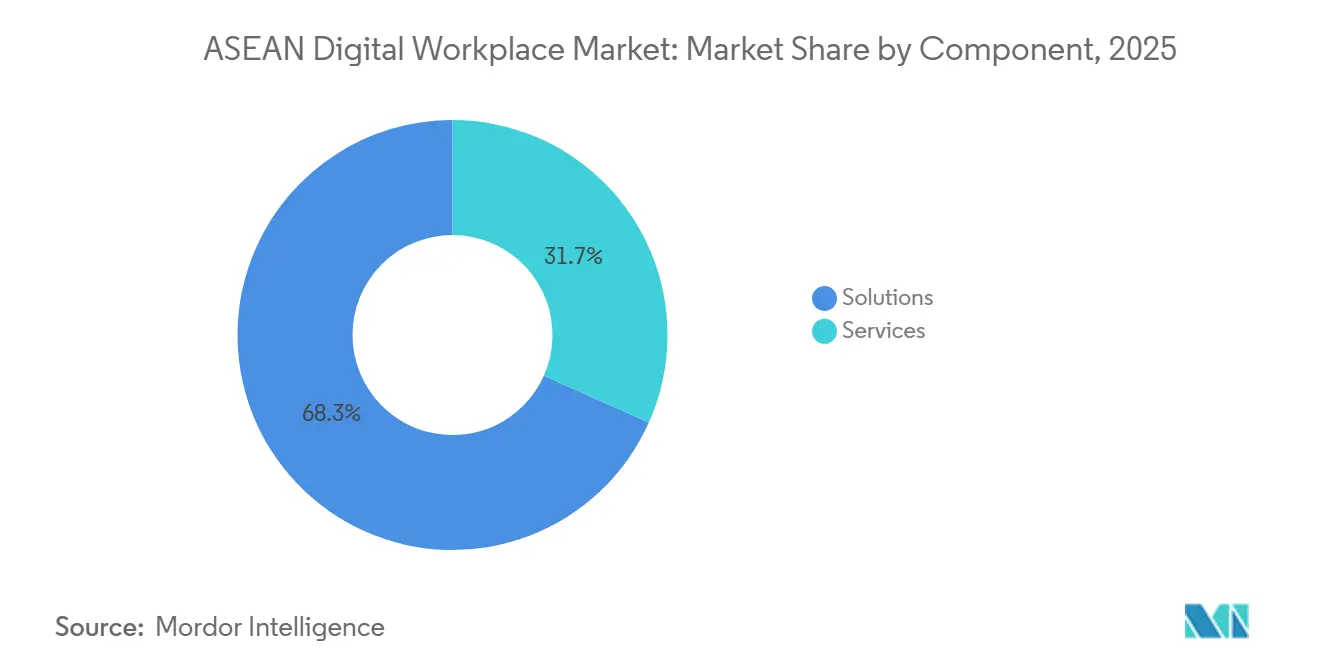
Integrated Solutions Hold the Largest PositionSolutions accounted for 68.32% of the market in 2025 and represented the largest revenue base in the ASEAN digital workplace market, as enterprises preferred software layers that directly support communication, workflow management, endpoint consistency, and employee-facing operations. Solutions also led because many buyers wanted to move away from fragmented point tools and toward broader platform environments that could support more of the digital employee lifecycle under fewer vendors. Unified communication and collaboration tools remained the most widely used part of this mix, followed by workflow automation, knowledge management, and employee experience systems, which reflects how the ASEAN digital workplace industry is consolidating around a smaller set of high-utility tools. Virtual desktop infrastructure and cloud PC tools also gained traction as organizations tried to secure hybrid access and standardize endpoint environments across dispersed teams. This positioning kept the ASEAN digital workplace market centered on product-led spending, even as services remained important for implementation support.
The services segment is expected to generate a CAGR of 26.89% over the forecast period, and it continued to expand as companies sought external support to address rollout complexity, integration work, and post-deployment management across countries and business functions. That demand is especially relevant in manufacturing and banking settings where legacy architecture slows adoption and raises the burden on internal IT teams. Accenture’s rollout of Microsoft 365 Copilot to 743,000 employees in April 2026 showed how large workplace programs are now being implemented at enterprise scale through solution-led transformation models rather than narrow software purchases. The same pattern was evident in the March 2026 launch of Accenture’s Microsoft forward-deployed engineering practice, built to move enterprise AI programs from concept to production within days, reinforcing the value of tightly linked software and services offerings in the ASEAN digital workplace market. Over time, this should favor providers that can combine native platform capability with implementation depth, because buyers are increasingly selecting partners that can reduce time to deployment without adding another layer of vendor complexity.
By Deployment Mode:
Cloud Becomes The Default FoundationCloud held 66.87% of the market in 2025 and posted the strongest disclosed growth rate at 27.08% through 2031, underscoring how firmly the ASEAN digital workplace market has shifted toward hosted and subscription-based delivery. Cloud won share because it matched the region’s need for faster rollout, easier scaling, and broader access across multi-site workforces without requiring the same level of internal infrastructure investment as on-premises systems. This shift also reflects how workplace software is now more closely tied to AI readiness, as many automation and assistant features are initially delivered through cloud ecosystems. Microsoft’s infrastructure commitment in Singapore supported that direction by strengthening regional capacity for cloud and AI workloads that feed enterprise workplace adoption. Malaysia’s AI adoption rate rose to 21.8% in Q1 2026 from 19.7% in H2 2025, following the expansion of local cloud capacity, suggesting a link between infrastructure availability and demand for modern workplace platforms.
On-premises systems remained relevant in regulated sectors such as financial services, healthcare, and government, where data residency rules and prior infrastructure investments continue to create strong inertia around deployment decisions. Hybrid models also continued to gain relevance because they gave organizations a practical way to balance public cloud scalability with tighter control over sensitive data and workload placement. The June 2026 conclusion of ASEAN DEFA negotiations should help reduce some cross-border data flow friction over time, thereby gradually strengthening the cloud case for multi-country deployments in the ASEAN digital workplace market. At the same time, compliance frameworks such as Singapore’s PDPA and the ASEAN Guide on AI Governance and Ethics will continue to shape how companies draw the boundary between public cloud and controlled environments, which means deployment choices will remain tied to regulatory interpretation as much as to technical preference.
By Organization Size:
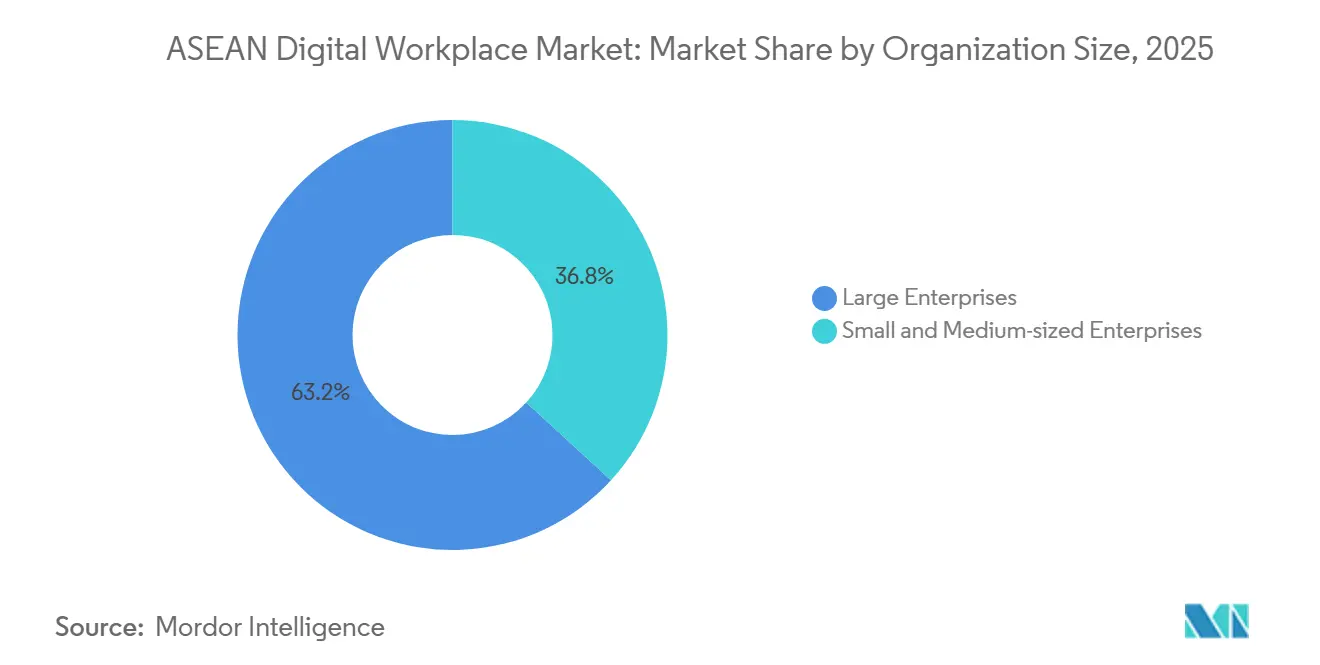
Large Enterprises Lead Spend While SMEs Drive ExpansionLarge enterprises accounted for 63.19% of the market in 2025, which reflects their stronger budgets, wider user bases, and greater need to coordinate communication, HR workflows, endpoint management, and analytics across multiple units. They remain central to the ASEAN digital workplace market because they are the main buyers of multi-module platforms and the main users of managed services tied to cloud and AI deployments. SMEs, however, are projected to expand at a 26.77% CAGR through 2031, which makes them the most important source of incremental volume as adoption spreads beyond top-tier corporate accounts. This shift matters because the ASEAN digital workplace industry is no longer defined only by enterprise transformation programs; it is also being shaped by the sheer number of smaller firms entering structured software environments for the first time. Budget support and easier software delivery models are making that transition more practical across several ASEAN countries.
Singapore reinforced this trend through the expansion of the Productivity Solutions Grant, which amounted to more than SGD 400 million (USD 298 million). Enterprise Workforce Transformation Package, designed to lower adoption barriers to business investment in digital and AI solutions. Vietnam’s Decision 433/QD-TTg added another direct demand signal by committing to support at least 300,000 SMEs through digital platforms and AI applications by 2030. The challenge is that ASEAN’s SME base is uneven, with more advanced firms in Singapore, Malaysia, and Vietnam already exploring AI-enabled collaboration, while many smaller firms in Indonesia and the Philippines are still in earlier stages of their cloud migration cycles. That divergence is pushing the ASEAN digital workplace market toward more flexible pricing, simpler onboarding, and lighter implementation models. Vendors that can show quick gains with limited reliance on internal IT are likely to gain share faster than those that depend on lengthy enterprise-style deployment processes.
By End-User Industry:
Manufacturing Holds Scale While Healthcare Moves FasterManufacturing accounted for 24.51% of the ASEAN digital workplace market in 2025, making it the largest end-user segment, as factories invest in workforce coordination, connected operations, and communication tools that support broader Industry 4.0 programs. Manufacturing demand also reflects the need to better link frontline and plant-level employees to enterprise systems more consistently and securely. Healthcare is projected to expand at a 28.36% CAGR through 2031, which makes it the fastest-growing vertical as hospital groups adopt cloud-based HR systems, unified endpoint management, and digitally enabled operational workflows. The growth case in healthcare is stronger because sector modernization is increasingly tied to both efficiency and compliance expectations around data handling and standardized processes. This combination is giving the ASEAN digital workplace market a more balanced end-user profile, with manufacturing providing scale and healthcare contributing growth momentum.
Healthcare demand has also been supported by visible enterprise activity in the region. PT Siloam International Hospitals completed the migration of critical operations across 41 facilities to cloud-based infrastructure in August 2025, standardizing processes, enabling real-time data sharing, and activating AI applications for medical records and inventory management. HMI Medical also became Workday’s first healthcare customer in Singapore in 2025, showing that healthcare groups are investing in more unified people and operations platforms as they expand across Southeast Asia. Retail, BFSI, IT and telecommunications, and government remain important segments for the ASEAN digital workplace market because they already operate at a higher level of digital maturity and have larger user bases. Government demand should continue to grow as the ASEAN Digital Masterplan 2030 pushes member states toward more interoperable, user-focused public service delivery models by 2028.
Geography Analysis
Singapore and Malaysia Digital Workplace Market
Singapore held 24.83% of the market in 2025, making it the largest contributor and the clearest anchor market for the ASEAN digital workplace market, as it combines enterprise demand, policy support, and regional ecosystem depth. Budget 2026 committed more than SGD 400 million (USD 232 million) to the Enterprise Workforce Transformation Package and included support of up to SGD 90,000 (USD 70,200) per company for workforce analytics platforms and AI-infused HR tools, which directly supported workplace technology adoption.[3] Microsoft also committed USD 5.5 billion to cloud and AI infrastructure and operations in Singapore across 2025-2029, which strengthened the supply side of the ASEAN digital workplace market in its most mature geography. OpenAI added more than USD 234 million to Singapore’s AI ecosystem in May 2026 and planned to expand its local technical teams to more than 200 roles, deepening the city-state’s role as a development and delivery center for AI-enabled enterprise tools. Malaysia remained one of the more mature secondary markets, supported by AI adoption of 21.8% in Q1 2026 and by Budget 2026 measures such as an additional 50% tax deduction for MSME spending on AI and cybersecurity training.
Vietnam and Thailand Digital Workplace Market
Vietnam is projected to expand at a 27.88% CAGR through 2031, making it the fastest-growing geography in the ASEAN digital workplace market, as policy, business sentiment, and AI readiness are moving in the same direction. The Microsoft Work Trend Index 2025 showed that 95% of Vietnamese business leaders trusted AI agents to improve productivity, and 91% were considering hiring for AI-related roles, which placed Vietnam at the top globally on that measure. Decision 433/QD-TTg, signed in March 2026, committed the government to supporting at least 300,000 SMEs with digital platforms and AI applications by 2030, providing the ASEAN digital workplace market with a strong policy-led growth channel in Vietnam. VnEconomy also reported in 2026 that 77% of Vietnamese CIOs had elevated data analytics and business intelligence to their top technology investment priority, displacing cybersecurity from the top slot held in 2025, which points to rising demand for workplace platforms with stronger data and workflow visibility. Thailand is also expanding through its smart manufacturing agenda and financial services digitization, which keeps it relevant as an upper-middle demand center for the ASEAN digital workplace market.
ASEAN Digital Workplace Market
Indonesia, the Philippines, and the Rest of ASEAN represent the next broad growth layer for the ASEAN digital workplace market because they combine large labor pools with uneven but rising digital adoption. Indonesia is particularly important because its scale gives vendors access to the region’s largest economy and one of its largest SME bases, even though data localization rules and integration complexity continue to slow some multinational rollouts. The PIDI 4.0 program trained 1,921 workers in digital competencies between 2022 and 2025, which helps build the workforce foundation needed for larger digital workplace deployments over time. The Philippines benefits from its large BPO footprint, where companies are increasingly interested in employee experience and workforce analytics tools as they respond to automation pressure and productivity demands, while Cambodia, Laos, and Myanmar remain earlier-stage opportunities where mobile-first software can lower infrastructure barriers and gradually widen access to the ASEAN digital workplace market.
Competitive Landscape
The ASEAN digital workplace market is moderately consolidated at the top, with global IT services providers and major platform companies winning a large share of large-enterprise transformation work while smaller regional vendors compete more actively in mid-market and frontline use cases. Accenture, Microsoft, IBM, Infosys, TCS, and HCL Technologies have strong positions because they can combine software ecosystems, cloud partnerships, and managed delivery models that large buyers often prefer for multi-country programs. This structure creates a two-speed competitive landscape in the ASEAN digital workplace market, with a concentrated upper tier for complex enterprise deals and a more open field for specialized solutions targeting smaller businesses or specific workforce problems. The market is also being shaped by the fact that buyers increasingly want fewer vendors, faster deployment, and stronger compliance support in one package. That trend has raised the value of partnerships that connect platform capability with implementation depth.
Accenture’s March 2026 launch of a forward-deployed engineering practice with Microsoft was a clear example of how leading firms are trying to reduce the time from AI concept to production and strengthen their position in large-scale workplace transformation.[4] The April 2026 rollout of Microsoft 365 Copilot to 743,000 Accenture employees gave that partnership added weight, as it served both as a major internal deployment and as a visible proof point for enterprise customers considering similar programs. IBM followed a similarly focused path through its June 2026 five-year collaboration with Krungsri to build IT, digital, and AI capabilities in Thailand, which showed how sector-specific managed transformation can strengthen vendor positions in financial services. IBM and StarHub also expanded their collaboration in May 2026 on quantum-safe security capabilities in Singapore, signaling that workplace security differentiation is moving into more advanced areas for regulated customers. These moves suggest that leadership in the ASEAN digital workplace market increasingly depends on how well firms combine cloud, AI, security, and industry delivery rather than on software breadth alone.
White-space opportunities still exist because many frontline workers and SME buyers remain underserved by desktop-centered enterprise platforms designed for larger, office-based organizations. This has created room for challengers such as Lark, Darwinbox, and BrioHR, which are building positions through mobile-first design, regional language support, and more localized compliance alignment in the ASEAN digital workplace market. Demand is especially strong for tools that combine communication, payroll, engagement, and compliance features in a single subscription, since smaller firms often want fewer systems and a lower admin burden. Product requirements are also becoming more shaped by regulation, including AI governance expectations and country-specific employment or data rules that can affect deployment choices across multiple markets. That keeps the ASEAN digital workplace market open to regional specialists even as large global providers continue to dominate the most complex enterprise contracts.
ASEAN Digital Workplace Industry Leaders
-
Microsoft Corporation
-
IBM Corporation
-
Accenture plc
-
Cognizant Technology Solutions Corporation
-
Tata Consultancy Services Limited
- *Disclaimer: Major Players sorted in no particular order
ASEAN Digital Workplace Market Companies Covered in this Report
- Accenture plc
- Atos SE
- Capgemini SE
- Citrix Systems, Inc.
- Cognizant Technology Solutions Corporation
- Cloud Software Group, Inc.
- DXC Technology Company
- Fujitsu Limited
- HCL Technologies Limited
- Hewlett Packard Enterprise Company
- HTC Global Services, Inc.
- IBM Corporation
- Infosys Limited
- Microland Limited
- Microsoft Corporation
- NEC Corporation
- NTT DATA Group Corporation
- RingCentral, Inc.
- Tata Consultancy Services Limited
- Unisys Corporation
- Wipro Limited
- Yonyou Network Technology Co., Ltd.
Recent Industry Developments in ASEAN Digital Workplace Market
- June 2026: Krungsri (Bank of Ayudhya PCL) and IBM Consulting announced a five-year collaboration to build IT, digital, and AI capabilities supporting the bank's AI-driven growth strategy in Thailand. The engagement positions IBM as the primary digital transformation and workforce capability partner for one of Thailand's largest commercial banks, signaling growing institutional appetite for long-cycle managed workplace transformation contracts across ASEAN financial services.
- June 2026: The ASEAN Senior Economic Officials confirmed the conclusion of negotiations on the ASEAN Digital Economy Framework Agreement (DEFA), creating a regional framework for digital trade, cross-border data flows, and digital identity systems across all 10 ASEAN member states. The agreement is expected to reduce data sovereignty fragmentation that has constrained multi-country cloud and digital workplace deployments, and is targeted for signing by end-2026.
- May 2026: IBM and StarHub expanded their collaboration in Singapore to advance quantum-safe security capabilities, deploying IBM Guardium Cryptography Manager and IBM Quantum Safe Explorer to future-proof enterprise cryptographic architectures against emerging quantum computing threats. This development signals that quantum-resilient workplace security is transitioning from research to active enterprise deployment in Southeast Asia's most regulated markets.
- April 2026: Microsoft and Accenture confirmed the rollout of Microsoft 365 Copilot to approximately 743,000 Accenture employees across more than 120 countries, the largest enterprise generative AI deployment on record. The deal substantially expands Microsoft's paying Copilot seat base and validates cloud collaboration suites as the primary vehicle for AI-at-scale delivery in large enterprises.
ASEAN Digital Workplace Market Report Scope
The ASEAN Digital Workplace Market comprises solutions and services that enable organizations to create connected, collaborative, and productive digital work environments across office-based, remote, and hybrid work settings. Digital workplace technologies facilitate seamless access to enterprise applications, communication tools, business processes, and organizational knowledge while supporting workforce mobility, employee engagement, operational efficiency, and secure collaboration. These offerings include collaboration and communication platforms, employee experience solutions, endpoint and device management systems, workflow automation and knowledge management tools, virtual desktop infrastructure, cloud-based workspaces, and managed workplace services.
The ASEAN Digital Workplace Market is Segmented by Component (Solutions, and Services), Deployment Mode (Cloud, On-Premises, and Hybrid), Organization Size (Large Enterprises, and Small and Medium-sized Enterprises), End-User Industry (IT and Telecommunications, BFSI, Healthcare, Manufacturing, Retail, Government and Public Sector, Education, Energy and Utilities, Legal and Professional Services, Other End-User Industries), and Geography (Singapore, Malaysia, Thailand, Indonesia, Philippines, Vietnam, and Rest of ASEAN). The Market Forecasts are Provided in Terms of Value (USD).
Segmentation Overview
| Solutions | Unified Communication and Collaboration |
| Unified Endpoint Management | |
| Enterprise Mobility and Management | |
| Employee Experience Platforms and Intranet | |
| Workflow Automation and Knowledge Management | |
| Virtual Desktop Infrastructure and Cloud PC | |
| Services |
| Cloud |
| On-Premises |
| Hybrid |
| Large Enterprises |
| Small and Medium-sized Enterprises |
| IT and Telecommunications |
| BFSI |
| Healthcare |
| Manufacturing |
| Retail |
| Government and Public Sector |
| Education |
| Energy and Utilities |
| Legal and Professional Services |
| Other End-User Industries |
| Singapore |
| Malaysia |
| Thailand |
| Indonesia |
| Philippines |
| Vietnam |
| Rest of ASEAN |
| By Component | Solutions | Unified Communication and Collaboration |
| Unified Endpoint Management | ||
| Enterprise Mobility and Management | ||
| Employee Experience Platforms and Intranet | ||
| Workflow Automation and Knowledge Management | ||
| Virtual Desktop Infrastructure and Cloud PC | ||
| Services | ||
| By Deployment Mode | Cloud | |
| On-Premises | ||
| Hybrid | ||
| By Organization Size | Large Enterprises | |
| Small and Medium-sized Enterprises | ||
| By End-User Industry | IT and Telecommunications | |
| BFSI | ||
| Healthcare | ||
| Manufacturing | ||
| Retail | ||
| Government and Public Sector | ||
| Education | ||
| Energy and Utilities | ||
| Legal and Professional Services | ||
| Other End-User Industries | ||
| By Geography | Singapore | |
| Malaysia | ||
| Thailand | ||
| Indonesia | ||
| Philippines | ||
| Vietnam | ||
| Rest of ASEAN |
Key Questions Answered in the Report
What is the size outlook for the ASEAN digital workplace market space?
The ASEAN digital workplace market size was USD 2.61 billion in 2025, reached USD 3.27 billion in 2026, and is forecast to reach USD 10.59 billion by 2031 at a 26.49% CAGR.
Which deployment approach is leading adoption across ASEAN?
Cloud led with 66.87% share in 2025 and is projected to expand at a 27.08% CAGR through 2031, showing that hosted and subscription-based delivery has become the default approach for many enterprises.
Which country currently leads regional demand?
Singapore led with 24.83% share in 2025, supported by strong policy funding, mature enterprise demand, and large cloud and AI infrastructure commitments.
Which country is expanding the fastest through 2031?
Vietnam is projected to grow at a 27.88% CAGR through 2031, supported by SME digitalization policy, stronger digital infrastructure, and rising enterprise adoption of AI-enabled tools.
Which end-user group offers the strongest growth opportunity?
Healthcare is projected to expand at a 28.36% CAGR through 2031 as hospital groups adopt cloud-based HR, endpoint management, and digitally connected operational workflows.
Are large enterprises or SMEs shaping the next phase of demand?
Large enterprises still held 63.19% share in 2025, but SMEs are projected to grow at a 26.77% CAGR, which makes them the main source of future volume expansion across the region.