
Asia-Pacific Digital Workplace Market Size and Share
Market Overview
| Study Period | 2020 - 2031 |
|---|---|
| Forecast Data Period | 2026 - 2031 |
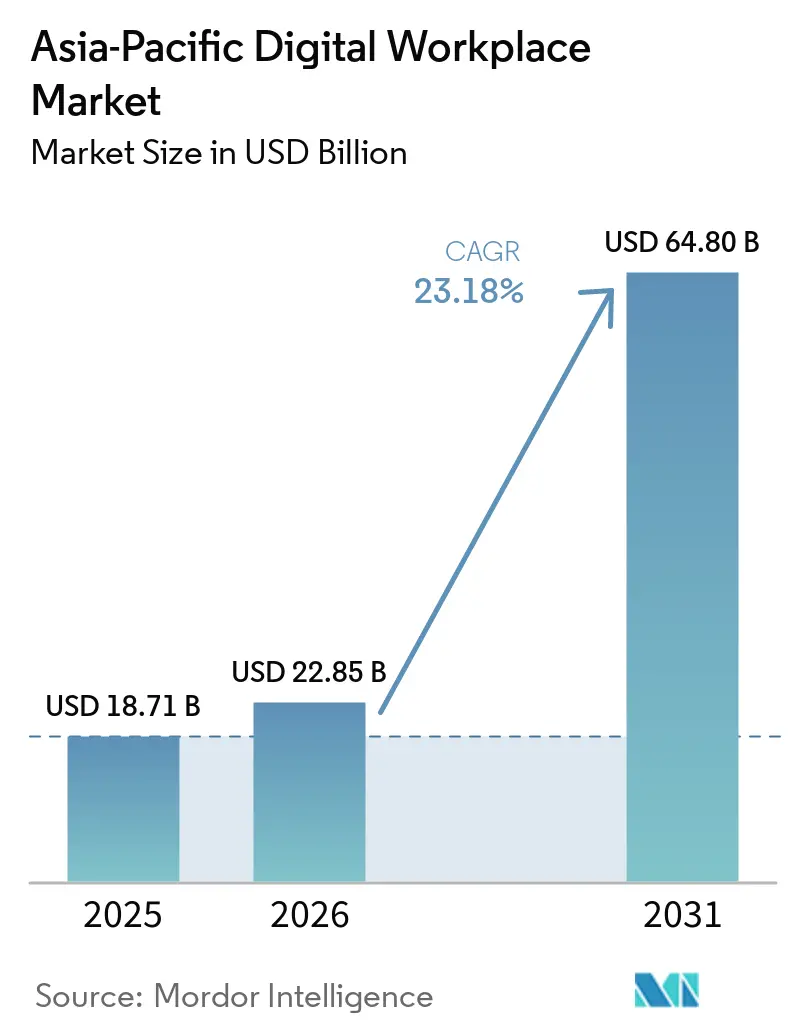
| Base Year Market Size (2025) | USD 18.71 Billion |
| Market Size (2026) | USD 22.85 Billion |
| Market Size (2031) | USD 64.80 Billion |
| Growth Rate (2026 - 2031) | 23.18 % |
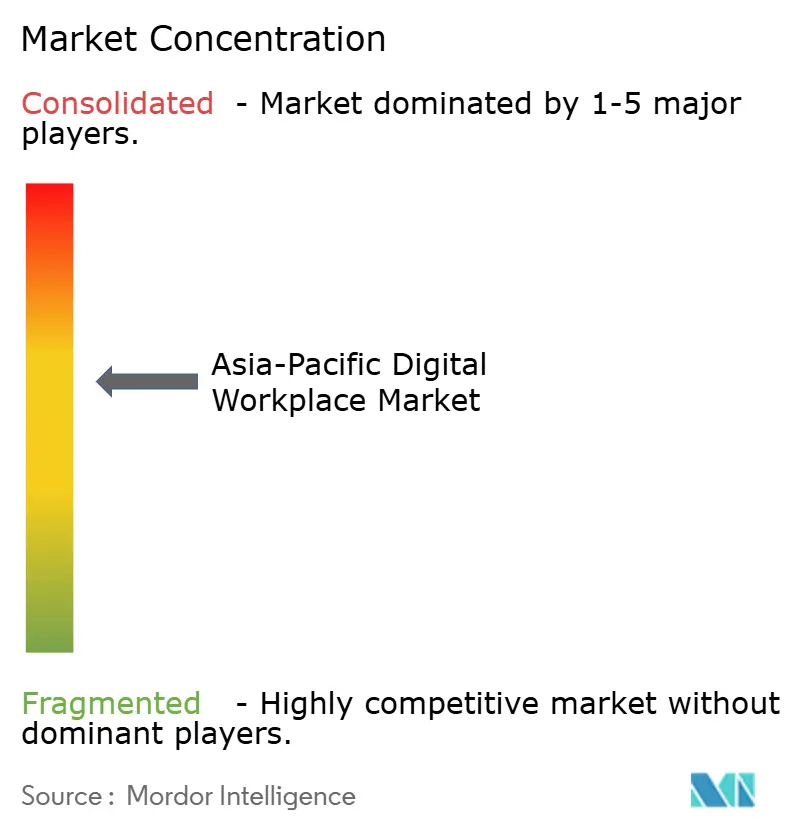
| Market Concentration | Medium |
Major Players *Disclaimer: Major Players sorted in no particular order Image © Mordor Intelligence. Reuse requires attribution under CC BY 4.0. | |
Asia-Pacific Digital Workplace Market Analysis by Mordor Intelligence
The Asia-Pacific digital workplace market size is expected to grow from USD 18.71 billion in 2025 to USD 22.85 billion in 2026 and is forecast to reach USD 64.8 billion by 2031 at 23.18% CAGR over 2026-2031. Growth in the Asia-Pacific digital workplace market is being shaped by the steady shift from isolated collaboration tools to connected workplace platforms that support communication, workflow execution, and employee support in a single environment. The APAC digital workplace market is also benefiting from wider cloud adoption, as enterprises want faster software updates, easier scaling, and better access to AI-enabled features without long upgrade cycles. Another important shift in the Asia-Pacific digital workplace market is the move toward workflow orchestration, where firms seek digital tools that can connect knowledge, service requests, and business systems rather than managing them separately. Competition in the APAC digital workplace market is developing along two tracks, large IT services firms pursuing managed workplace contracts, and platform vendors expanding their reach through AI-led product integration. The main constraint for the Asia-Pacific digital workplace market remains the gap between strong enterprise ambition and practical readiness, especially as legacy systems, skills shortages, and governance concerns slow deployment, while the SME segment continues to open the next layer of opportunity for lower-touch, cost-sensitive offerings.
Key Report Takeaways
- By component, Solutions held 68.26% of the Asia-Pacific digital workplace market in 2025, supported by demand for unified communications, workflow automation, and employee experience platforms.
- By deployment mode, Cloud accounted for 64.83% in 2025 and is projected to expand at a 23.72% CAGR through 2031.
- By organization size, Large Enterprises held 61.49% share of the APAC digital workplace market in 2025, while SMEs are projected to record the fastest growth at a 23.79% CAGR through 2031.
- By end-user industry, IT and Telecommunications accounted for 24.53% in 2025, while Healthcare is projected to expand at a 25.03% CAGR through 2031.
- By geography, China held 34.71% in 2025, while India is projected to record the highest regional CAGR at 24.58% through 2031.
Note: Market size and forecast figures in this report are generated using Mordor Intelligence’s proprietary estimation framework, updated with the latest available data and insights as of January 2026.
Market Trends and Insights
Drivers Impact Analysis of Asia-Pacific Digital Workplace Market*
| Driver | (~) % Impact on CAGR Forecast | Geographic Relevance | Impact Timeline |
|---|---|---|---|
| Hybrid Work Permanence Across Large Enterprises | +4.2% | Global, most pronounced in Australia and New Zealand, Singapore, and India | Short term (≤ 2 years) |
| Shift to Cloud-Hosted Employee Experience Stacks | +3.8% | Asia-Pacific-wide, with India and Southeast Asia leading cloud-first adoption | Medium term (2-4 years) |
| AI-Enabled Workflow Orchestration and Knowledge Access | +3.5% | Global, with Japan, South Korea, and India as early adopters | Medium term (2-4 years) |
| Security-First Workspace Consolidation | +2.9% | Asia-Pacific core, spill-over to Southeast Asia and South Korea | Short term (≤ 2 years) |
| Frontline Worker Digitization In Asset-Intensive Industries | +2.2% | China, India, Southeast Asia | Long term (≥ 4 years) |
| Outcome-Based Procurement for Digital Employee Experience | +1.6% | Australia and New Zealand, Singapore, Japan | Medium term (2-4 years) |
| Source: Mordor Intelligence | |||
Hybrid Work Permanence Across Large Enterprises
Hybrid work has moved beyond a temporary policy and now shapes long-term workplace design across large organizations in the region. This is keeping the Asia-Pacific digital workplace market active because enterprises need consistent collaboration, device management, workflow access, and employee support across office and remote settings. The demand pattern is no longer limited to video meetings or messaging, because companies increasingly want a connected layer that links knowledge, approvals, service requests, and team coordination. Microsoft stated in its 2026 Work Trend Index that firms are rebuilding their operating models around AI-enabled work, underscoring the need for digital tools that support coordination across distributed teams and workflows.[1] This trend is important for the Asia-Pacific digital workplace market because firms with fixed office attendance still need employees to move between physical and digital tasks without friction. As a result, spending remains focused on platforms that can support communication, knowledge access, and workflow continuity in a single operating environment.
Shift To Cloud-Hosted Employee Experience Stacks
Cloud deployment is gaining ground as enterprises increasingly seek digital workplace platforms that are continuously updated rather than delivered through periodic upgrade cycles. This is strengthening the Asia-Pacific digital workplace market because AI functionality, policy changes, and security controls are now delivered more efficiently through SaaS-native environments. Microsoft reported in June 2026 that Infosys, TCS, and Wipro together scaled Microsoft 365 Copilot to more than 300,000 employees in under six months, demonstrating how quickly large organizations are standardizing on cloud-based workplace software when the business case is clear. That pace of rollout matters because it reflects not only software adoption, but also confidence in cloud delivery for workplace productivity, governance, and AI access. The Asia-Pacific digital workplace market is also supported by the fact that many regulated buyers now see cloud as a practical route to faster deployment and simpler administration rather than a compromise on control. This makes cloud-hosted employee experience stacks central to platform selection across both large enterprises and emerging mid-market buyers.
Security-First Workspace Consolidation
Enterprises are increasingly treating security consolidation and workplace consolidation as linked decisions rather than separate projects. This supports the Asia-Pacific digital workplace market because fragmented identity tools, endpoint controls, and collaboration platforms create a poor base for scaled digital workplace deployment. HCLTech stated in January 2026 that Team Global Express selected it to consolidate a multi-vendor IT landscape into a single strategic managed services partnership covering digital workplace, cybersecurity, hybrid cloud, and AI-powered service transformation. That example shows how buyers are moving toward fewer providers and more unified operating models when workplace complexity becomes difficult to manage. IBM also said in June 2026 that its expanded collaboration with ServiceNow will address enterprise data governance, legacy application modernization, and autonomous IT operations, all of which are closely tied to secure workplace execution. The result is that vendors with both security relevance and workplace delivery capability are improving their position in enterprise buying cycles.
AI-Enabled Workflow Orchestration and Knowledge Access
AI is changing workplace buying priorities because enterprises now want tools that can coordinate tasks across systems rather than simply support isolated productivity features. This is important for the Asia-Pacific digital workplace market because workflow orchestration is becoming a core requirement for service management, employee support, and knowledge retrieval. Microsoft said in its 2026 Work Trend Index that firms are rebuilding how work is structured in the age of AI, which aligns with demand for digital workplace platforms that can connect people, content, and process more directly. ServiceNow also announced in June 2026 that it expanded its integration with Microsoft to extend AI agent governance across Microsoft environments, demonstrating how orchestration and governance are now being developed together. IBM described a similar direction in its expanded ServiceNow collaboration, where enterprise data access and AI execution are being tied more closely to workflow environments. As this pattern continues, the Asia-Pacific digital workplace market is shifting toward platforms that serve as the operating layer for AI-assisted work, rather than remaining only as communication or device management tools.
Restraints Impact Analysis of Asia-Pacific Digital Workplace Market*
| Restraint | (~) % Impact on CAGR Forecast | Geographic Relevance | Impact Timeline |
|---|---|---|---|
| Legacy Identity, Device, and Application Sprawl | -2.5% | Asia-Pacific-wide, most acute in Japan, Southeast Asia, and India | Long term (≥ 4 years) |
| Integration Debt Across Collaboration and Workflow Tools | -2.0% | Asia-Pacific-wide, particularly in BFSI and manufacturing sectors | Medium term (2-4 years) |
| Skills Gaps In DEX Administration and Adoption Governance | -1.4% | Asia-Pacific core, spill-over to Southeast Asia | Medium term (2-4 years) |
| Privacy, Sovereignty, and Cross-Border Data Concerns | -1.6% | China, India, Southeast Asia | Long term (≥ 4 years) |
| Source: Mordor Intelligence | |||
Legacy Identity, Device, and Application Sprawl
Legacy sprawl remains a major brake on workplace transformation because many enterprises still operate with disconnected identity, device, and application layers. This weakens the Asia-Pacific digital workplace market because buyers often need to address the underlying technology estate before they can fully realize the value of new workplace platforms. IBM said in June 2026 that its expanded work with ServiceNow is specifically targeting legacy application modernization and enterprise data readiness, indicating that foundational cleanup remains a real barrier to scaled AI and workplace deployment. The problem is not only technical, because sprawl also slows policy standardization, increases support effort, and makes user experience less consistent across teams and countries. HCLTech’s January 2026 engagement with Team Global Express also highlighted the need to consolidate a multi-vendor environment before broader service transformation could move ahead. Until more organizations reduce this complexity, the Asia-Pacific digital workplace market will continue to face slower implementation cycles and uneven adoption outcomes.
Integration Debt Across Collaboration and Workflow Tools
Integration debt is another clear restraint because workplace platforms depend on access to reliable data and connected business systems. Salesforce stated in February 2025 that 95% of Asia-Pacific IT leaders struggle to integrate data across systems, and that, on average, only 27% of applications within an organization are connected.[2] That matters for the Asia-Pacific digital workplace market because disconnected CRM, ERP, HCM, and service tools reduce the usefulness of AI assistants, self-service workflows, and knowledge search. Enterprises may buy strong front-end workplace tools, but value creation stays limited when approvals, records, and service data remain split across siloed systems. ServiceNow’s June 2026 expansion with Microsoft reflects how vendors are trying to reduce this issue through deeper interoperability and stronger governance across workplace and AI environments. Even so, integration debt will continue to delay deployment and reduce realized benefits until enterprise architecture becomes more connected.
*Our forecasts treat driver/restraint impacts as directional, not additive. The impact forecasts reflect baseline growth, mix effects, and variable interactions.
Asia-Pacific Digital Workplace Market Segment Analysis
By Component:
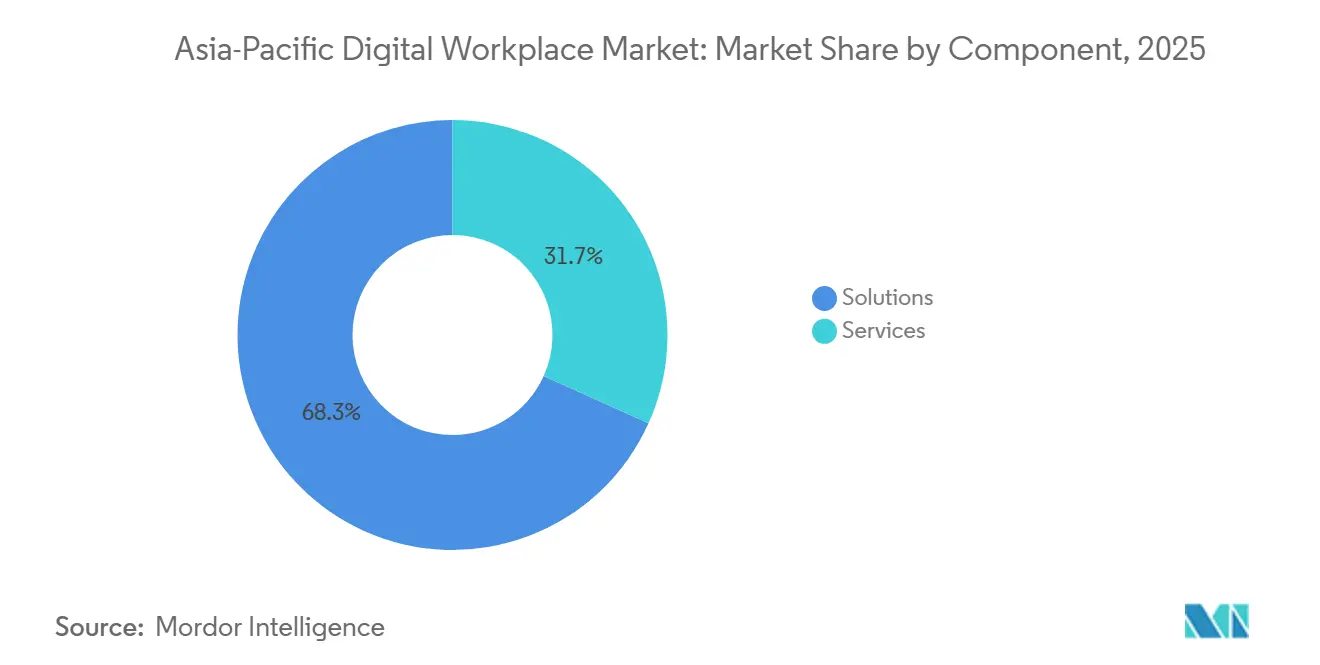
Solutions Remain The Core Spending CenterSolutions captured 68.26% of the Asia-Pacific digital workplace market in 2025, which shows that software platforms remain the primary layer through which buyers are modernizing workplace environments. This dominance reflects the enterprise's preference for integrated tools that manage communication, workflow automation, knowledge access, and employee support within a single architecture rather than through separate point products. In the Asia-Pacific digital workplace market, solution demand centers on unified communications, employee experience platforms, workflow automation, intranet capabilities, and knowledge management layers that support both daily productivity and structured service delivery. Buyers increasingly want these capabilities to work as a single, connected system because the value of a workplace platform rises when users can move between tasks without switching context. That is why the solutions category continues to hold the largest weight in the Asia-Pacific digital workplace market, especially in enterprises that are standardizing operating models across multiple business units and countries.
The solutions mix is also broadening, as digital workplace programs now touch endpoint control, workflow routing, and AI-assisted support. Virtual desktop infrastructure and cloud PC tools are drawing renewed attention where clients want secure access, policy consistency, and simpler management for distributed teams. Unified endpoint management is increasingly linked to collaboration and workflow platforms, as enterprises seek device, identity, and application controls to work together rather than in parallel silos. The services side of the Asia-Pacific digital workplace market remains smaller, but it remains important when deployment scale, integration needs, and change management requirements become too complex for internal teams to handle alone. HCLTech’s January 2026 engagement with Team Global Express shows how a single managed workplace scope can be used to consolidate vendors, simplify support, and create a more unified operating environment across a large organization
By Deployment Mode:
Cloud Sets The Standard Across New RolloutsCloud held 64.83% of the Asia-Pacific digital workplace market in 2025 and is projected to expand at a 23.72% CAGR through 2031, confirming that cloud has become the default route for most new workplace deployments. The main reason is that cloud environments allow enterprises to introduce AI features, policy changes, and collaboration improvements faster than on-premises models can typically support. In the Asia-Pacific digital workplace market, this matters because workplace tools must evolve continuously as user behavior, governance rules, and AI use cases change. Cloud deployment also gives vendors a more direct way to maintain product performance and deliver new functionality across large user bases without long local upgrade cycles. These advantages are especially relevant in regions where firms are trying to scale digital employee experience programs across multiple countries with different operational maturity levels.
The pace of cloud standardization is visible in enterprise behavior. Microsoft reported in June 2026 that Infosys, TCS, and Wipro together expanded Microsoft 365 Copilot to more than 300,000 employees in under six months, demonstrating how quickly cloud-based workplace tools can be rolled out when enterprise demand aligns with platform readiness. On-premises deployment still has relevance in parts of government and highly regulated industries where data-handling rules remain strict and internal control requirements are harder to change. Hybrid deployment, therefore, continues to function as a transition model in the Asia-Pacific digital workplace market, especially for large enterprises that are modernizing gradually while keeping some local workloads in place.
By Organization Size:
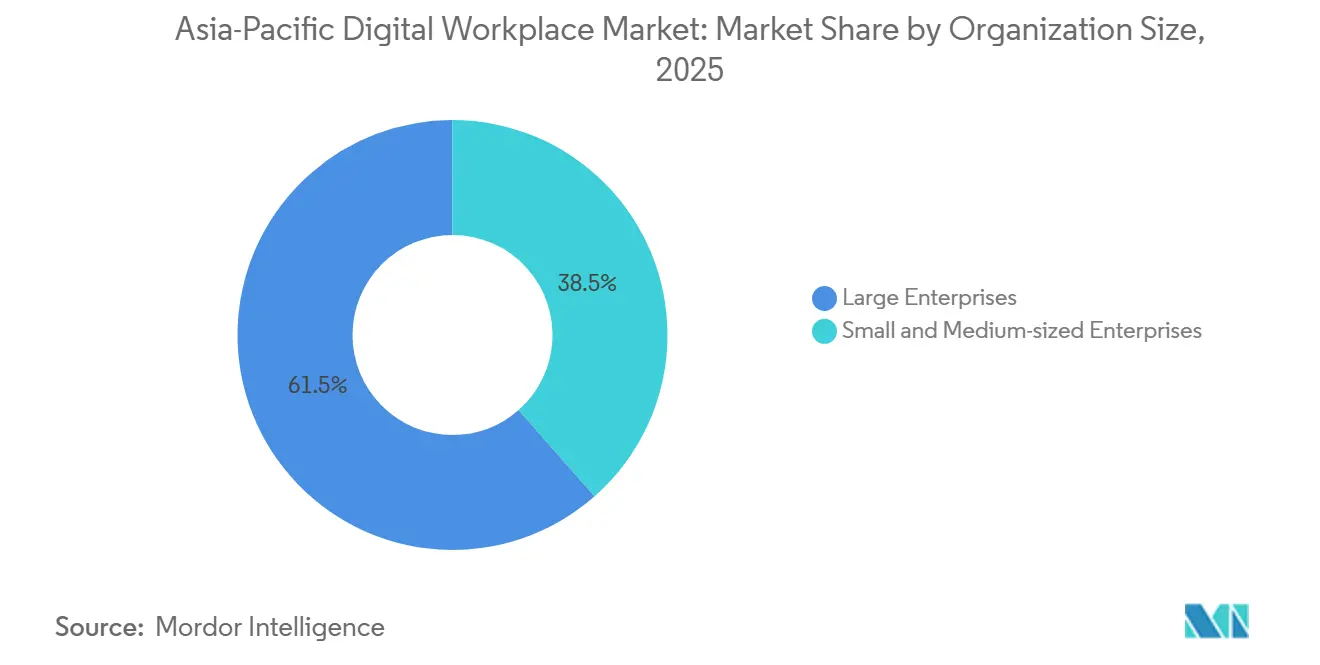
Large Enterprises Lead Spend While SMEs Expand the Addressable BaseLarge Enterprises held 61.49% of the Asia-Pacific digital workplace market share in 2025, reflecting their stronger budgets, wider user bases, and greater need for standardized operations across locations. These organizations are the main buyers of managed workplace contracts, integrated communications platforms, AI-enabled service management, and enterprise-grade governance tools. The Asia-Pacific digital workplace market has also been shaped by the fact that large enterprises typically maintain more complex technology estates, making unified workplace programs more valuable to them than to smaller firms. Their spending is often directed toward platform depth, integration capabilities, device lifecycle control, and employee experience measurement, as these areas influence both service quality and internal productivity. This explains why large enterprises still anchor the revenue structure of the Asia-Pacific digital workplace market even as new buyers emerge.
At the same time, SMEs are projected to expand at a 23.79% CAGR through 2031, indicating that the next growth phase will not rely solely on large-account spending. Lower entry costs, subscription pricing, and mobile-first delivery models are making workplace tools more accessible to smaller organizations that previously operated with limited formal infrastructure. The Asia-Pacific digital workplace industry is therefore widening beyond top-tier enterprise contracts and moving into a broader customer base where ease of use and low deployment effort matter more than extensive customization. Microsoft’s large-scale Copilot rollout across leading IT services firms also signals that supplier ecosystems are becoming more mature, which can eventually make advanced workplace capabilities easier for smaller firms to adopt through templates, partners, and packaged services. As a result, the Asia-Pacific digital workplace market is likely to see revenue concentration remain with large enterprises while user volume growth increasingly comes from SMEs.
By End-User Industry:
IT and Telecom Lead Current Demand While Healthcare Accelerates FastestIT and Telecommunications accounted for 24.53% of the Asia-Pacific digital workplace market in 2025, while Healthcare is projected to expand at a 25.03% CAGR through 2031. IT and telecom remain the largest end-user base because firms in this sector usually adopt workplace technologies earlier, operate distributed service teams, and require strong coordination across knowledge-intensive workflows. They also serve as reference users for the Asia-Pacific digital workplace market, as many of the region’s largest technology service firms run advanced workplace environments internally before offering similar models to clients. BFSI remains a major adopter because identity governance, secure communications, auditability, and controlled access are central to its operating model. Manufacturing is also rising in relevance as companies digitize plant, service, and frontline workflows that depend on better coordination between office teams and field personnel.
Rockwell Automation stated in 2026 that 95% of Asia Pacific manufacturers view digital transformation as essential to competitiveness, which supports the case for stronger workplace platforms in a sector where coordination, maintenance, and information access are increasingly digital. Healthcare is the fastest-growing end-user group because hospitals and health systems are moving beyond basic digitization and investing more in workflow support, knowledge access, and coordination between clinical and administrative teams. In the Asia-Pacific digital workplace market, that shift gives healthcare a stronger role, as workplace tools are increasingly tied to care support, scheduling, approvals, and internal service delivery rather than just office productivity. The Asia-Pacific digital workplace industry is therefore seeing a broader demand mix where technology-led sectors still lead today, but healthcare is becoming one of the clearest engines of forward expansion.
Geography Analysis
China Digital Workplace Market
China captured 34.71% of the Asia-Pacific digital workplace market share in 2025, making it the largest country in the region. This scale reflects the size of its enterprise base, the depth of local technology ecosystems, and the strong role of domestic platforms in workplace software decisions. The Asia-Pacific digital workplace market in China also benefits from the fact that large organizations are increasingly looking for tools that align with local operating needs, language requirements, and data control expectations. Japan remains important because large enterprises have the scale and process maturity to invest in workplace modernization, even where legacy infrastructure slows the pace of full transition. South Korea presents a different pattern, where dense office activity continues to support spending on communication, workflow, and productivity tools rather than diminishing the relevance of workplace technology.
India and Oceania Digital Workplace Market
India is projected to grow at a 24.58% CAGR through 2031, making it the fastest-growing country position in the Asia-Pacific digital workplace market. Microsoft reported in June 2026 that Infosys, TCS, and Wipro together scaled Microsoft 365 Copilot to more than 300,000 employees in under six months, highlighting the country’s ability to execute large-scale workplace AI rollouts at speed.[3] Australia and New Zealand remain one of the more mature parts of the Asia-Pacific digital workplace market because enterprise buyers there are active in managed services, cloud modernization, and AI-led operating model upgrades. HCLTech’s January 2026 Team Global Express engagement and Infosys’ 2025 Telstra joint venture both show that the market continues to attract strategic workplace and transformation programs from major providers.
ASEAN and Broader APAC Digital Workplace Market
Southeast Asia remains one of the most dynamic subregions in the Asia-Pacific digital workplace market because younger workforces, expanding digital infrastructure, and rising SME adoption are creating a larger pool of new buyers. The opportunity is especially notable as enterprises formalize workplace processes and move from basic collaboration tools to more structured workflow and employee support environments. The rest of Asia-Pacific, including smaller and earlier-stage markets, remains at a lower maturity level, but it represents a meaningful long-term expansion path as enterprise IT environments become more formal and cloud access improves. Taken together, these country patterns show that the Asia-Pacific digital workplace market is not moving at one uniform pace, but its regional growth base remains broad enough to support sustained expansion across both mature and emerging demand centers.
Competitive Landscape
The Asia-Pacific digital workplace market is moderately consolidated, with global IT services firms, large platform vendors, and regional specialists competing across different layers of the value chain. No single company defines the market on its own, because enterprise buyers often combine managed services, cloud software, workflow tools, and security capabilities from multiple providers. IBM, Accenture, TCS, HCL Technologies, and Wipro are prominent in large managed workplace and transformation contracts, while Microsoft, ServiceNow, Salesforce, and other platform vendors compete on product depth, integration quality, and AI readiness. This creates a two-track structure in the Asia-Pacific digital workplace market, where service-led delivery and platform-led control both shape buying outcomes. Competition is also intensifying because buyers increasingly prefer vendors that can link workplace functionality to governance, data readiness, and AI execution, rather than offering communication tools in isolation.
Several strategic moves show how fast the competitive model is evolving. IBM said in June 2026 that it expanded its collaboration with ServiceNow to combine watsonx capabilities with ServiceNow’s workflow and data fabric strengths, directly targeting enterprise barriers tied to legacy applications, governance, and AI scale.[4] ServiceNow also announced in June 2026 that it deepened its integration with Microsoft to extend AI agent governance across Microsoft environments, strengthening its position in enterprises seeking control and interoperability for AI-enabled workplace workflows. Microsoft’s June 2026 disclosure that Infosys, TCS, and Wipro scaled Copilot to more than 300,000 employees adds another signal that hyperscaler-aligned ecosystems are becoming a powerful route to scale in the Asia-Pacific digital workplace market.
The market still leaves room for specialists, but their strongest positions are usually tied to geography, vertical focus, or depth in managed delivery rather than broad regional dominance. HCLTech’s January 2026 Team Global Express engagement shows how vendor consolidation, workplace modernization, and AI-enabled service transformation are increasingly being sold as one integrated program. Wipro’s April 2026 update on its ABB relationship also showed continued emphasis on AI-first service desks, multilingual support, and proactive device management, which are practical differentiators in large global workplace accounts. In this setting, the Asia-Pacific digital workplace market rewards vendors that can demonstrate platform integration, operating scale, and execution reliability, while smaller players remain more exposed, as buyers want fewer vendors and tighter governance.
Asia-Pacific Digital Workplace Industry Leaders
-
IBM Corporation
-
Accenture PLC
-
Microsoft Corporation
-
Wipro Limited
-
Tata Consultancy Services Limited
- *Disclaimer: Major Players sorted in no particular order
Asia-Pacific Digital Workplace Market Companies Covered in this Report
- IBM Corporation
- Microsoft Corporation
- Accenture PLC
- Tata Consultancy Services Limited
- Wipro Limited
- Cognizant Technology Solutions Corporation
- HCL Technologies Limited
- NTT DATA Group Corporation
- Infosys Limited
- DXC Technology Company
- Fujitsu Limited
- Hewlett Packard Enterprise Company
- Capgemini SE
- Kyndryl Holdings, Inc.
- Unisys Corporation
- Citrix Systems, Inc.
- Atlassian Corporation
- Salesforce, Inc.
- ServiceNow, Inc.
- Kissflow Inc.
- Simpplr Inc.
Recent Industry Developments in Asia-Pacific Digital Workplace Market
- June 2026: IBM and ServiceNow expanded their commercial collaboration to address enterprise AI scaling barriers, combining IBM's watsonx AI platform and data capabilities with ServiceNow's AI Platform and Workflow Data Fabric. Joint solutions will target legacy application modernization, enterprise data governance, and autonomous IT operations, with availability expected in the second half of 2026.
- June 2026: Infosys, TCS, and Wipro collectively scaled Microsoft 365 Copilot licenses to over 300,000 employees, each company exceeding 100,000 seats, in under six months. Microsoft described this as one of the largest and fastest enterprise AI rollouts globally, marking a transition from pilot-level tool deployment to AI as an operating model across business-critical workflows.
- June 2026: ServiceNow expanded its strategic partnership with Microsoft, deepening integration between ServiceNow AI Control Tower and Microsoft Agent 365, extending governance across Azure-backed Microsoft Foundry and Copilot Studio ecosystems. ServiceNow AI specialists were also made available in the Microsoft Agent 365 Marketplace.
- January 2026: HCLTech was selected by Team Global Express, Australia and New Zealand's largest multimodal logistics organization, to consolidate its multi-vendor IT landscape into a single strategic managed services partnership. The engagement covers digital workplace, cybersecurity, hybrid cloud, and AI-powered service transformation using HCLTech's AI Force GenAI platform.
Asia-Pacific Digital Workplace Market Report Scope
The Asia-Pacific Digital Workplace Market comprises solutions and services that enable organizations to create integrated digital work environments that support communication, collaboration, productivity, and seamless access to enterprise applications and resources across distributed, hybrid, and office-based workforces. Digital workplace offerings include collaboration and communication platforms, virtual workspace solutions, employee experience technologies, workflow automation tools, endpoint and device management systems, identity and access management solutions, and managed workplace services.
The Asia-Pacific Digital Workplace Report is Segmented by Component (Solutions, and Services), Deployment Mode (Cloud, On-Premises, and Hybrid), Organization Size (Large Enterprises, and Small and Medium-sized Enterprises), End-User Industry (IT and Telecommunications, BFSI, Healthcare, Manufacturing, Retail, Government and Public Sector, Education, Energy and Utilities, Legal and Professional Services, Other End-User Industries), and Geography (China, Japan, India, South Korea, Australia and New Zealand, Southeast Asia, and Rest of Asia-Pacific). The Market Forecasts are Provided in Terms of Value (USD).
Segmentation Overview
| Solutions | Unified Communication and Collaboration |
| Unified Endpoint Management | |
| Enterprise Mobility and Management | |
| Employee Experience Platforms and Intranet | |
| Workflow Automation and Knowledge Management | |
| Virtual Desktop Infrastructure and Cloud PC | |
| Services |
| Cloud |
| On-Premises |
| Hybrid |
| Large Enterprises |
| Small and Medium-sized Enterprises |
| IT and Telecommunications |
| BFSI |
| Healthcare |
| Manufacturing |
| Retail |
| Government and Public Sector |
| Education |
| Energy and Utilities |
| Legal and Professional Services |
| Other End-User Industries |
| China |
| Japan |
| India |
| South Korea |
| Australia and New Zealand |
| Southeast Asia |
| Rest of Asia-Pacific |
| By Component | Solutions | Unified Communication and Collaboration |
| Unified Endpoint Management | ||
| Enterprise Mobility and Management | ||
| Employee Experience Platforms and Intranet | ||
| Workflow Automation and Knowledge Management | ||
| Virtual Desktop Infrastructure and Cloud PC | ||
| Services | ||
| By Deployment Mode | Cloud | |
| On-Premises | ||
| Hybrid | ||
| By Organization Size | Large Enterprises | |
| Small and Medium-sized Enterprises | ||
| By End-User Industry | IT and Telecommunications | |
| BFSI | ||
| Healthcare | ||
| Manufacturing | ||
| Retail | ||
| Government and Public Sector | ||
| Education | ||
| Energy and Utilities | ||
| Legal and Professional Services | ||
| Other End-User Industries | ||
| By Geography | China | |
| Japan | ||
| India | ||
| South Korea | ||
| Australia and New Zealand | ||
| Southeast Asia | ||
| Rest of Asia-Pacific |
Key Questions Answered in the Report
What is the current and future size of the Asia-Pacific digital workplace space?
The Asia-Pacific digital workplace market was valued at USD 18.71 billion in 2025, reached USD 22.85 billion in 2026, and is forecast to reach USD 64.8 billion by 2031 at a 23.18% CAGR.
Which deployment model leads regional demand?
Cloud leads demand with a 64.83% share in 2025 and is projected to grow at a 23.72% CAGR through 2031, reflecting preference for SaaS-native and AI-ready environments.
Which country contributes the most revenue today?
China held the largest regional share at 34.71% in 2025, supported by the scale of its enterprise base and strong local platform participation.
Which country is expanding the fastest through 2031?
India is projected to grow at a 24.58% CAGR through 2031, helped by hyperscaler expansion, strong enterprise IT capacity, and large-scale workplace AI rollouts.
Which end-user segment is growing the fastest?
Healthcare is the fastest-growing end-user industry with a 25.03% CAGR through 2031, driven by wider workflow digitization and stronger need for coordinated digital tools.
Who are the main competitors across the region?
The field includes global IT services firms such as IBM, TCS, HCL Technologies, and Wipro, along with platform vendors such as Microsoft, ServiceNow, and Salesforce.