
Employee Recognition And Rewards Platform Market Size and Share
Market Overview
| Study Period | 2020 - 2031 |
|---|---|
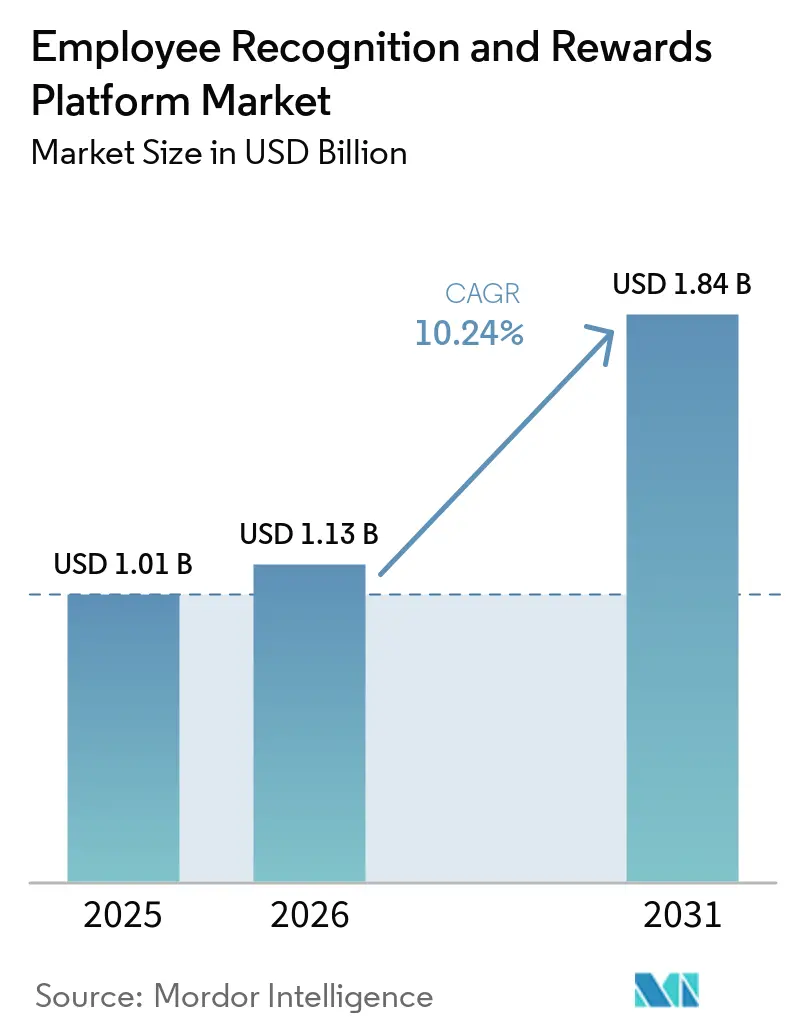
| Market Size (2026) | USD 1.13 Billion |
| Market Size (2031) | USD 1.84 Billion |
| Growth Rate (2026 - 2031) | 10.24 % |
| Fastest Growing Market | Asia-Pacific |
| Largest Market | North America |
| Market Concentration | Medium |
Major Players *Disclaimer: Major Players sorted in no particular order Image © Mordor Intelligence. Reuse requires attribution under CC BY 4.0. | |
Employee Recognition And Rewards Platform Market Analysis by Mordor Intelligence
The employee recognition and rewards platform market size is projected to be USD 1.01 billion in 2025, USD 1.13 billion in 2026, and reach USD 1.84 billion by 2031, growing at a CAGR of 10.24% from 2026 to 2031. Recognition software is no longer treated as discretionary HR spend because retention outcomes are increasingly linked to measurable financial value. Organizations are giving greater weight to recognition quality because employees who receive recognition aligned with multiple strategic pillars are far less likely to be actively seeking another job. The spread of hybrid work and large frontline populations has also increased the need for platforms that deliver frequent, visible recognition across dispersed teams. In the United States, elevated quit volumes continue to keep retention spending under pressure, which supports ongoing demand in the employee recognition and rewards platform market. Another layer of demand is coming from public companies that are starting to treat culture and workforce recognition records as part of broader human capital and ESG reporting practices.
Key Report Takeaways
- By component, software/platform held 69.42% of the employee recognition and rewards platform market in 2025, while services are projected to record the fastest growth at a 12.12% CAGR through 2031.
- By deployment mode, cloud-based deployment accounted for 71.18% of the employee recognition and rewards platform market in 2025, while hybrid deployment is forecast to expand fastest at a 13.42% CAGR through 2031.
- By enterprise size, large enterprises commanded 63.55% of the employee recognition and rewards platform market in 2025, while SMEs are projected to grow at the highest CAGR of 13.23% through 2031.
- By industry, information technology and telecom held 22.94% of the employee recognition and rewards platform market in 2025, while retail and e-commerce are expected to grow fastest at an 11.61% CAGR through 2031.
- By geography, North America held 38.77% of the employee recognition and rewards platform market in 2025, while Asia-Pacific is forecast to register the fastest CAGR of 14.31% through 2031.
Note: Market size and forecast figures in this report are generated using Mordor Intelligence’s proprietary estimation framework, updated with the latest available data and insights as of January 2026.
Market Trends and Insights
Drivers Impact Analysis of Employee Recognition And Rewards Platform Market*
| Driver | (~) % Impact on CAGR Forecast | Geographic Relevance | Impact Timeline |
|---|---|---|---|
| Rising Need to Reduce Voluntary Attrition and Burnout | +2.5% | Global, with concentrated early gains in North America and Northern Europe | Short term (= 2 years) |
| Expansion of Hybrid and Frontline Workforces | +2.0% | Global, APAC core, spill-over to MEA | Medium term (2-4 years) |
| Mainstreaming of Cloud-Native HR Technology Stacks | +1.5% | North America and EU, with accelerating APAC adoption | Medium term (2-4 years) |
| Deeper Integration With Collaboration and HRIS Workflows | +1.2% | North America and EU | Medium term (2-4 years) |
| Growing Use of Recognition Data in Human Capital Reporting | +0.8% | Global, led by EU and North America | Long term (= 4 years) |
| Expansion of Localized Global Reward Catalogs | +0.6% | APAC core, spill-over to MEA and South America | Long term (= 4 years) |
| Source: Mordor Intelligence | |||
Rising Need To Reduce Voluntary Attrition And Burnout
Employee turnover remains the clearest demand driver in the employee recognition and rewards platform market because organizations can now connect recognition quality more directly to retention outcomes. Gallup reported in September 2024 that employees who received recognition that met at least 4 of 5 strategic pillars were 65% less likely to be actively job hunting than those who received lower-quality recognition. Gallup and Workhuman also found that in a 10,000-person organization, doubling weekly recognition frequency can produce USD 16.1 million in annual turnover cost avoidance, USD 91.9 million in productivity gains, and USD 3.8 million in lower absenteeism.[1] The same research showed that adequately recognized employees were up to 90% less likely to report burnout, suggesting that recognition is relevant to both retention and workforce health. O.C. Tanner reported in March 2026 that employees receiving integrated recognition had 26 times the odds of planning to stay another year, providing HR teams with a stronger basis for ROI discussions with finance leaders. As a result, the employee recognition and rewards platform market is benefiting from a shift where recognition programs are being evaluated less as culture initiatives and more as retention infrastructure.
Expansion Of Hybrid And Frontline Workforces
Work patterns are now more fragmented, and that is changing how the employee recognition and rewards platform market is designed and sold. Gallup reported that in March 2025, 57% of exclusively remote workers and 57% of hybrid workers were actively watching for new jobs, compared with 45% of fully on-site employees. That gap has pushed employers to look for tools that make recognition more visible across distributed teams and less dependent on physical proximity. Vendors are responding with mobile-first product design, offline-friendly access, and simpler workflows for workers who do not spend the day inside desktop productivity tools. O.C. Tanner said its Q1 2026 Culture Cloud mobile app enhancements drove more than 200% growth in user engagement among client organizations in the airline, financial, and software sectors during January 2026.[2] This matters because the employee recognition and rewards platform market is increasingly shaped by whether platforms can reach frontline and shift-based workers with the same consistency as office staff.
Mainstreaming Of Cloud-Native HR Technology Stacks
The move to cloud HR systems is creating a steady pull for embedded recognition tools across the employee recognition and rewards platform market. Workday reported in 2025 that more than 65% of Fortune 500 companies use its platform and that it serves more than 11,500 organizations globally, which makes it a major route to enterprise distribution.[3] Achievers expanded its position inside that ecosystem when it launched Learn and Recognize Built on Workday in September 2025 and then joined Workday in April 2026 to launch Workday Recognition Provided by Achievers across 190 countries. The April 2026 launch matters because it places peer recognition and reward redemption directly inside the HCM environment, where managers and employees already complete everyday workflows. Workday also received ISO 42001 AI management system certification in fiscal 2025, which raises governance expectations for partner tools operating within certified HR environments. This is helping the employee recognition and rewards platform market move toward a model in which buyers favor vendors that fit cleanly into cloud HCM stacks without creating separate governance or security concerns.
Deeper Integration With Collaboration And HRIS Workflows
Recognition activity is moving into the applications where employees already spend their working hours, and this is becoming a core buying criterion in the employee recognition and rewards platform market. Achievers said its Microsoft Teams app added more than 100,000 monthly active users between 2023 and January 2025, showing that recognition adoption rises when r the daily collaboration flow. The company also announced a planned integration with Microsoft 365 Copilot, signaling that recognition activity is being tied more closely to content, meetings, and workflow context. In March 2026, Semos Cloud launched an AI intelligence layer certified as Built with SAP Business AI, allowing recognition data to be interpreted directly inside SAP SuccessFactors workflows without disrupting the clean-core strategy. Workhuman has also highlighted that its bi-directional SAP SuccessFactors integration can manage eligibility logic outside the SAP core while posting transactions back for payroll and tax processing, which shows how compliance requirements are now shaping integration design. Together, these shifts are reinforcing switching costs for incumbent vendors and strengthening certified integrations as a moat in the employee recognition and rewards platform market.
Restraints Impact Analysis of Employee Recognition And Rewards Platform Market*
| Restraint | (~) % Impact on CAGR Forecast | Geographic Relevance | Impact Timeline |
|---|---|---|---|
| Budget Scrutiny and ROI Attribution Pressure | -1.8% | Global, most acute in North America and EU | Short term (= 2 years) |
| Integration Complexity Across Legacy HR Systems | -1.5% | Global, most intense in large enterprises with multi-system environments | Medium term (2-4 years) |
| Cross-Border Tax and Reward Fulfillment Complexity | -0.9% | MEA, APAC, and South America | Long term (= 4 years) |
| Recognition Fatigue and AI Governance Risks | -0.7% | North America and EU | Medium term (2-4 years) |
| Source: Mordor Intelligence | |||
Budget Scrutiny And ROI Attribution Pressure
Budget approval remains one of the clearest barriers in the employee recognition and rewards platform market, as finance teams increasingly want proof that recognition spending drives changes in retention and productivity outcomes. HiBob said in May 2026 that 60% of surveyed people managers spent 3 or more hours gathering basic workforce data for a single decision, while only 2% had access to a unified HR and finance dashboard.[4] That gap matters because recognition programs often need 6 to 12 months before changes in retention or absenteeism become statistically credible, yet budget cycles usually require faster justification. When HR teams cannot demonstrate clear links between recognition spend and labor outcomes, recognition tools are more likely to be classified as optional rather than operational. Buyers are therefore leaning toward vendors that provide real-time dashboards, stronger measurement frameworks, and clearer outcome reporting. This pressure does not stop demand in the employee recognition and rewards platform market, but it does raise the standard for what vendors must prove during procurement and renewal.
Integration Complexity Across Legacy HR Systems
Integration complexity is still slowing adoption in the employee recognition and rewards platform market, especially in large enterprises with long-established payroll, HRIS, and collaboration environments. Recognition data often sits on different identifiers and access rules than core HR records, which creates friction during employee syncing, role mapping, and payroll reporting. Security review is another bottleneck because IT teams typically want encrypted APIs, access controls, auditability, and clear data minimization rules before a recognition platform moves into production. These steps become more difficult when global employers must connect modern recognition tools to legacy regional payroll systems or custom internal HR databases. Vendors with pre-certified integrations for Workday, SAP, Oracle, and UKG are therefore better positioned because they shorten approval cycles and reduce internal IT effort. The practical effect is that the employee recognition and rewards platform market grows faster where integration can be standardized, and slower where deployment requires heavy customization.
*Our forecasts treat driver/restraint impacts as directional, not additive. The impact forecasts reflect baseline growth, mix effects, and variable interactions.
Employee Recognition And Rewards Platform Market Segment Analysis
By Component:
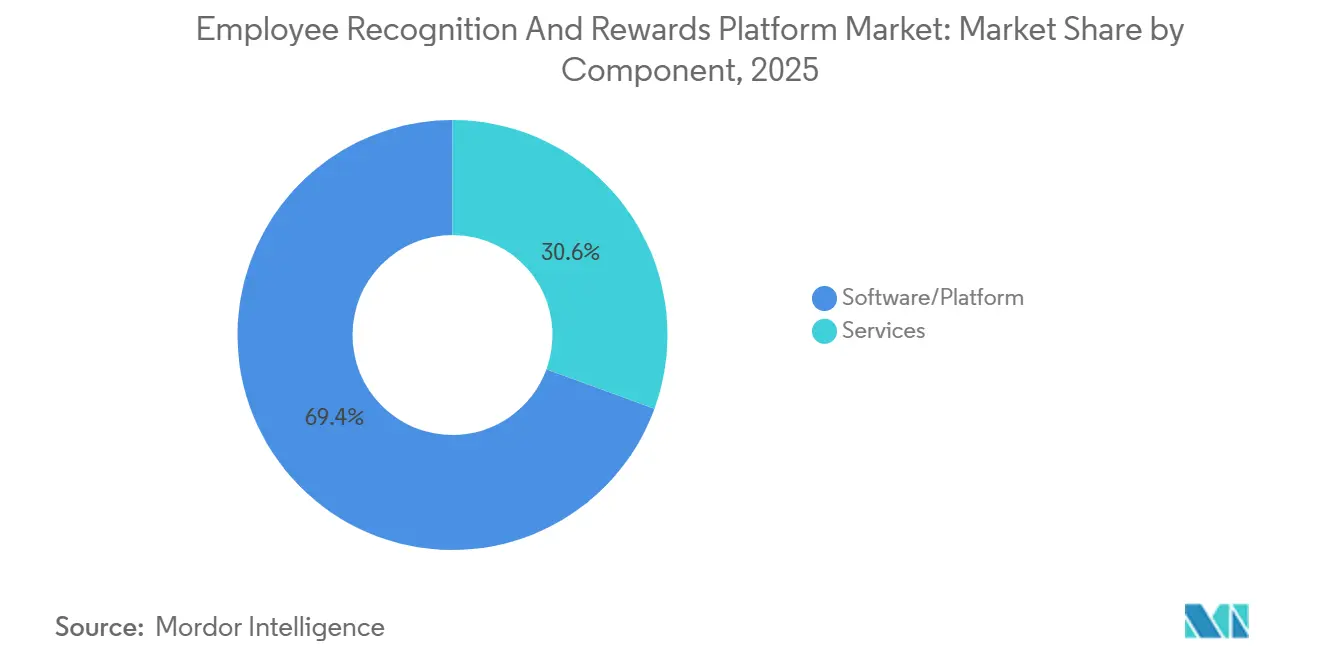
Software Leads While Services Grow On Delivery ComplexitySoftware/platform held 69.42% of the employee recognition and rewards platform market share in 2025, which confirms that recurring SaaS delivery remains the commercial core of the category. That leadership reflects enterprises' preference for a standardized platform layer that can scale recognition workflows, reporting, and reward administration across large employee populations. Awardco reinforced this model through its Awardco 2.0 redesign, which added modular employee listening, AI-based analytics, marketplace personalization, and broader workflow flexibility to the existing recognition engine. Moves like this show how vendors are protecting software revenue by widening the number of use cases served from a single platform seat. In the employee recognition and rewards platform industry, software remains the core product because it anchors recognition data, user access, and integration with the wider HR stack.
Services is the fastest-growing component, with the employee recognition and rewards platform market size for services projected to expand at a 12.12% CAGR through 2031. That growth is tied to a simple operational issue because many organizations can buy software quickly but still need help with rollout design, behavioral adoption, governance, and post-launch optimization. Managed implementation has become more valuable as programs move across multiple countries and must account for localized reward catalogs, tax rules, and payroll treatment. Services demand is also rising because buyers want help translating recognition activity into adoption plans that managers and employees will actually use after launch. As the employee recognition and rewards platform market expands, services are scaling with enterprise complexity rather than replacing the central role of software.
By Deployment Mode:
Cloud Retains The Lead While Hybrid Expands FastCloud-based deployment accounted for 71.18% of the employee recognition and rewards platform market in 2025, reflecting the broader shift toward SaaS delivery across enterprise HR applications. Cloud has a clear advantage because many recognition moments now happen inside tools like Microsoft Teams and Workday, both of which already operate as cloud-native environments. This model also supports faster product updates, easier remote access, and simpler rollout across dispersed workforces. On-premises deployment still matters in some government, defense, and financial environments where internal audit control or data sovereignty rules limit full cloud adoption. Even so, the employee recognition and rewards platform market continues to favor cloud-first solutions because they align with the operational patterns of modern HR software buyers.
Hybrid deployment is the fastest-growing mode, with a 13.42% CAGR through 2031, as large employers seek to connect cloud collaboration tools with on-premises HRIS and payroll systems. This is especially common in multinational enterprises where some jurisdictions still require local data handling or where legacy core systems have not yet moved fully to the cloud. Semos Cloud has outlined a multi-environment architecture that syncs only the required employee fields, uses TLS 1.2+ for transfers, AES-256 data encryption at rest, and OAuth 2.0 API authentication, reflecting how the hybrid design balances speed and control. In the employee recognition and rewards platform industry, hybrid growth is less a rejection of the cloud than a sign that enterprise architecture changes more slowly than recognition product innovation.
By End User Enterprise Size:
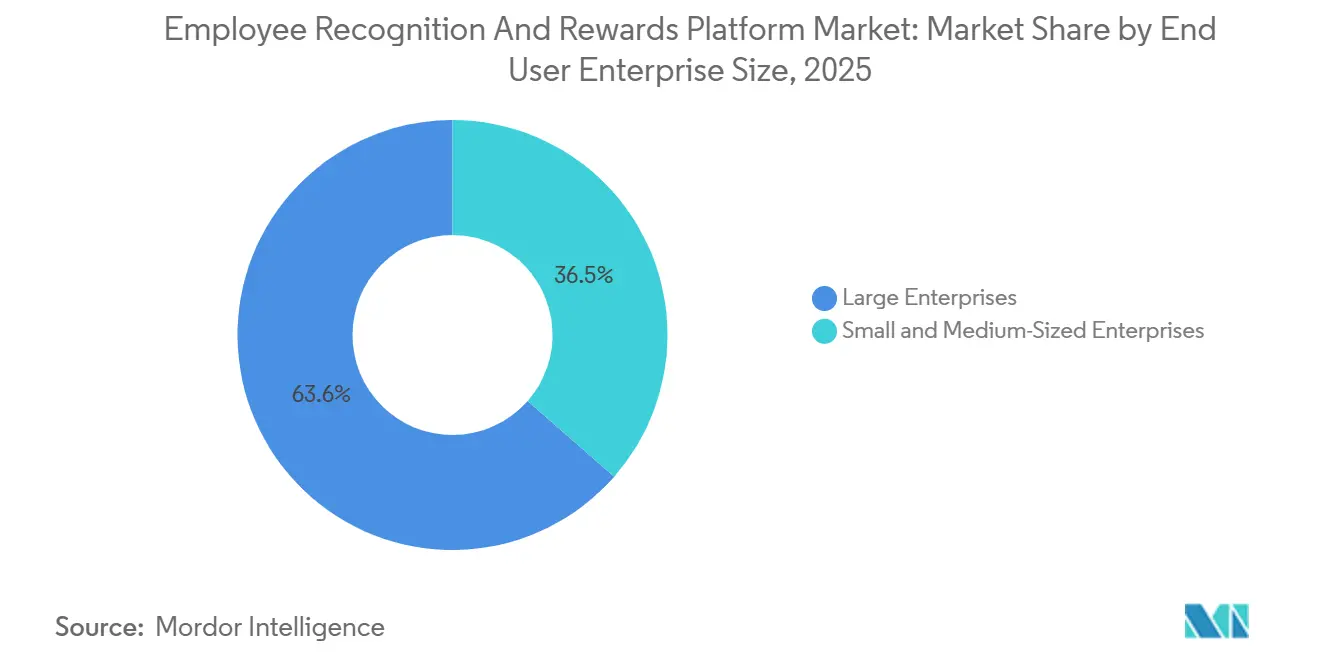
Large Enterprises Lead While SMEs Gain AccessibilityLarge enterprises commanded 63.55% of the employee recognition and rewards platform market share in 2025, showing that scale still favors organizations with large, distributed employee bases and formal HR operating models. Large employers have more to gain from recognition platforms because they face higher coordination costs, more frontline visibility issues, and a greater need for documented culture and performance programs. O.C. Tanner highlighted Capital One as a case where Culture Cloud was deployed to 51,000 associates across 145 business units, with 75% of employees receiving recognition and measurable gains in engagement, attrition, and Net Promoter Score. This kind of deployment illustrates why the employee recognition and rewards platform market has historically skewed toward very large organizations with the budget and process discipline to run recognition as an enterprise system. It also shows that large-enterprise demand is supported by the ability to connect recognition with a broader human capital measurement framework.
SMEs are the fastest-growing enterprise segment, with the employee recognition and rewards platform market size for SMEs projected to grow at a 13.23% CAGR through 2031. Growth at the smaller end of the market is driven by modular pricing, faster onboarding, and reduced reliance on deep HRIS synchronization. Slack-native and Microsoft Teams-native recognition features have reduced the need for separate portals, making adoption easier for smaller HR teams with limited system administration capacity. Platforms such as Nectar HR and Motivosity have also widened access by treating recognition as a manageable operating expense rather than a long implementation project. In the employee recognition and rewards platform industry, SME adoption is rising as affordability and simplicity are closing a gap once reserved for only global enterprises.
By End User Industry:
IT And Telecom Set The Base While Retail And E-commerce Grow FastInformation technology and telecom held 22.94% of the market in 2025, giving the segment the leading position across end-user industries in the employee recognition and rewards platform market. The sector has supported early demand because it already works inside digital collaboration systems and tends to treat recognition as part of performance signaling, learning, and retention. Achievers strengthened that link in September 2025 when it launched Learn and Recognize Built on Workday, allowing employers to award recognition points and achievements for completing Workday Learning courses. That move reflects a broader change in which recognition is linked to skills visibility and internal mobility rather than being limited to culture messaging alone. IT and telecom remain a natural anchor for the employee recognition and rewards platform market because they combine high digital readiness with persistent pressure to retain skilled labor.
Retail and e-commerce are the fastest-growing industry segments, with a 11.61% CAGR through 2031, driven by ongoing staffing pressures and the need to engage deskless employees at scale. O.C. Tanner reported in 2026 that 79% of retail employees experienced high burnout and that integrated recognition was associated with 4 times higher odds of workers planning to stay for 2 years or more. Healthcare and life sciences are another active growth area, supported by use cases that connect recognition with patient experience and care quality, including the Achievers and CipherHealth integration highlighted in June 2025. BFSI, industrial manufacturing, and government remain earlier adopters, but demand in those sectors is improving, with recognition records helping document performance culture, employee behavior, and operational consistency across regulated environments.
Geography Analysis
North America Employee Recognition and Rewards Platform Market
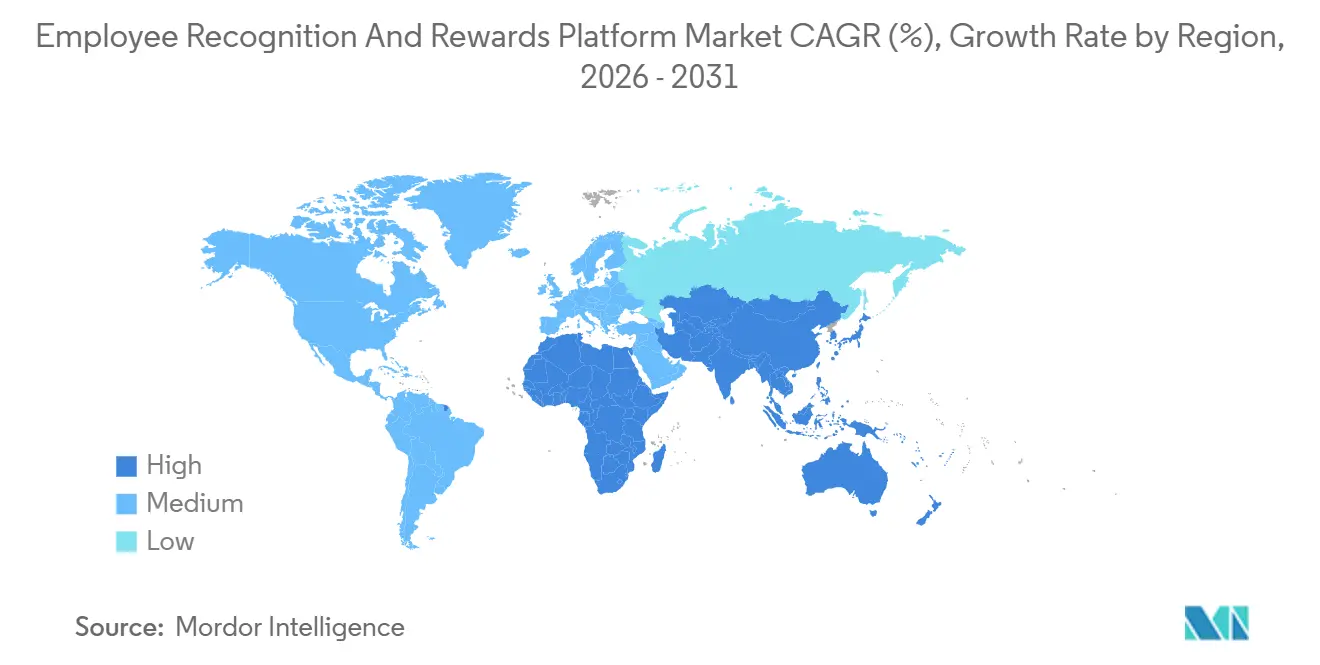
North America held 38.77% of the employee recognition and rewards platform market in 2025, making it the largest regional contributor to revenue. The region remains the center of demand because HR technology budgets are more mature, voluntary attrition is closely watched by leadership teams, and several of the category's best-known vendors are based there. The U.S. Bureau of Labor Statistics reported 3.0 million voluntary quits in February 2026, which kept retention costs visible and supported ongoing interest in recognition-linked employee programs. Canada is also contributing to growth, especially in retail and entertainment, where AI-supported recognition programs are being linked to customer experience improvement. Achievers noted that Cineplex used its platform to improve Net Promoter Scores at 45% of locations, which shows how recognition is being connected with front-line service outcomes in the region.
APAC Employee Recognition and Rewards Platform Market
Asia-Pacific is forecast to grow at the fastest CAGR of 14.31% through 2031 in the employee recognition and rewards platform market. Growth is being driven by enterprise digitalization, the size of frontline workforces, and rising employee expectations in large labor markets such as India, China, and Southeast Asia. India and South Korea are among the strongest volume opportunities because employers are adopting app-based recognition, collaboration-native tools, and localized reward options that fit large distributed teams. China remains attractive but more complex because data residency expectations and cross-border redemption rules can limit how global platforms operate or scale.
EMEA and South America Employee Recognition and Rewards Platform Market
Europe held the second-largest regional share in 2025, with Germany, the United Kingdom, and France representing the most established country markets in the employee recognition and rewards platform market. GDPR has had a stronger effect on platform design in Europe than in most other regions, which favors vendors that can offer clear consent trails, configurable data residency, and minimal employee data transfer. South America is still an earlier-stage market, but Brazil and Argentina are supporting adoption through large service-sector workforces and growing use of mobile-first tools where desktop access is uneven. The Middle East and Africa remains a smaller opportunity set today, although Saudi Arabia and the United Arab Emirates are showing stronger demand from public-sector bodies and hospitality employers that are formalizing workforce recognition programs.
Competitive Landscape
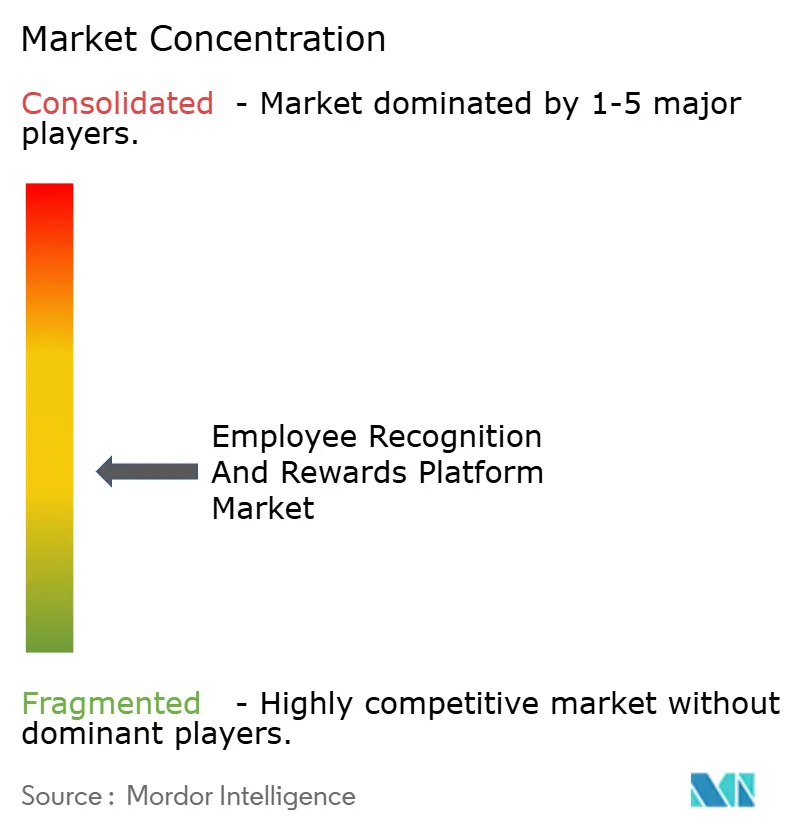
The employee recognition and rewards platform market is moderately fragmented, with a visible upper tier of global specialists and a broad mid-tier of vendors competing on integration depth, geography, and ease of deployment. Workhuman is one of the most established independent players, reporting 8 million users across 180 countries and more than a decade of consistent profitability. Awardco has also moved into the top tier after raising USD 165 million in Series B funding in May 2025, which pushed its valuation above USD 1 billion and gave it additional capital for AI, integration, and international expansion. O.C. Tanner and Achievers remain central competitors in the enterprise market because they have long-standing client relationships and deep integration capabilities across major HR systems. O.C. Tanner stated that it integrated with more than 75 HR information systems by Q3 2025 and received ISO/IEC 27001:2022 certification in Q1 2026, which reinforces its enterprise credibility in security-sensitive buying cycles.
Competition in the employee recognition and rewards platform market is increasingly shaped by three strategy paths: HRIS-native distribution, AI-driven behavioral intelligence, and broader global reward coverage. The April 2026 Workday and Achievers product launch created a significant distribution advantage because recognition and redemption were built directly into Workday HCM, a system already used by more than 65% of Fortune 500 companies. Awardco moved in a similar direction in May 2026, launching Awardco Intelligence on top of its Motivation Graph dataset, turning recognition data into a broader decision-support asset for HR teams. UKG also expanded its position in November 2025 by acquiring Mo and adding structured recognition capabilities to UKG Beacon for small and mid-sized businesses, indicating that adjacent HR software vendors are willing to buy recognition capabilities rather than build them from scratch.
White space remains meaningful in the employee recognition and rewards platform market, especially among deskless workforces and in regulated sectors where formal recognition adoption is still uneven. BFSI is one of the clearer expansion areas because recognition records can support broader documentation of performance culture and management behavior alongside more traditional HR metrics. Certified payroll and tax integrations also matter more over time because global employers want reward activity to move through compliant reporting structures without creating manual overhead. The vendors most likely to gain share are the ones that combine product usability with implementation support, governance credibility, and the ability to fit into large HR system environments without creating extra operational risk.
Employee Recognition And Rewards Platform Industry Leaders
-
Globoforce, Inc. d/b/a Workhuman
-
Awardco, Inc.
-
O.C. Tanner Company
-
Achievers Solutions Inc.
-
Reward Gateway UK Limited
- *Disclaimer: Major Players sorted in no particular order
Employee Recognition And Rewards Platform Market Companies Covered in this Report
- Globoforce, Inc. d/b/a Workhuman
- Awardco, Inc.
- O.C. Tanner Company
- Achievers Solutions Inc.
- Reward Gateway UK Limited
- Motivosity Inc.
- Kudos, Inc.
- Terryberry Company, LLC
- Smartly, Inc. d/b/a Bonusly
- PerkCity, Inc. d/b/a Nectar HR
- The Guusto Gifts Inc.
- Bucketlist Rewards Inc.
- Vantage Circle Technologies Pvt. Ltd
- Advantage Club Technologies Private Limited
- Workstars Global Ltd.
- Rewardian LLC
- Friendefi Inc. d/b/a Qarrot
- MatterApp, Inc.
- Engagedly Inc
- Emgage Private Limited
Recent Industry Developments in Employee Recognition And Rewards Platform Market
- May 2026: Awardco launched Awardco Intelligence, adding predictive attrition, sentiment analysis, AI Recognition Assistant, and MCP server for cross-platform recognition data queries.
- April 2026: Workday and Achievers introduced “Workday Recognition,” embedding peer recognition and rewards in Workday HCM across 190 countries, serving 11,500+ organizations with AI-driven insights.
- March 2026: Semos Cloud added an AI layer to SAP SuccessFactors, quantifying recognition impact, plus launched “Celebrate Inside Workday” integration for seamless recognition workflows.
- January 2026: Quantum Workplace acquired Assembly, integrating recognition and rewards data with engagement, performance, and retention signals into a unified talent management intelligence platform.
Global Employee Recognition And Rewards Platform Market Report Scope
The employee recognition and rewards platform market refers to digital solutions that enable organizations to acknowledge, reward, and motivate employees through structured programs. These platforms integrate recognition, rewards, analytics, and communication tools to strengthen workplace culture, improve engagement, and reduce attrition. Available via cloud, on-premises, or hybrid deployment models, they serve both large enterprises and SMEs across industries such as BFSI, healthcare, IT and telecom, retail, manufacturing, government, and others. Their core purpose is to connect recognition with measurable performance and human capital outcomes.
The employee recognition and rewards platform market report is segmented by Component (Software/Platform and Services), Deployment Mode (Cloud-Based, On-Premises, and Hybrid), Enterprise Size (Large Enterprises and Small and Medium-Sized Enterprises), End-user Industry (BFSI, Healthcare and Life Sciences, Information Technology and Telecom, Retail and E-commerce, Industrial Manufacturing, and Government and Public Sector,), and Geography (North America, South America, Europe, Asia-Pacific, Middle East, and Africa). The Market Forecasts are Provided in Terms of Value (USD).\
Segmentation Overview
| Software/Platform |
| Services |
| Cloud-Based |
| On-Premises |
| Hybrid |
| Large Enterprises |
| Small and Medium-Sized Enterprises |
| BFSI |
| Healthcare and Life Sciences |
| Information Technology and Telecom |
| Retail and E-commerce |
| Industrial Manufacturing |
| Government and Public Sector |
| North America | United States |
| Canada | |
| Mexico | |
| South America | Brazil |
| Argentina | |
| Rest of South America | |
| Europe | Germany |
| United Kingdom | |
| France | |
| Italy | |
| Spain | |
| Russia | |
| Netherlands | |
| Rest of Europe | |
| Asia-Pacific | China |
| Japan | |
| India | |
| South Korea | |
| Australia and New Zealand | |
| Rest of Asia-Pacific | |
| Middle East | Saudi Arabia |
| United Arab Emirates | |
| Rest of Middle East | |
| Africa | South Africa |
| Nigeria | |
| Rest of Africa |
| By Component | Software/Platform | |
| Services | ||
| By Deployment Mode | Cloud-Based | |
| On-Premises | ||
| Hybrid | ||
| By End User Enterprise Size | Large Enterprises | |
| Small and Medium-Sized Enterprises | ||
| By End User Industry | BFSI | |
| Healthcare and Life Sciences | ||
| Information Technology and Telecom | ||
| Retail and E-commerce | ||
| Industrial Manufacturing | ||
| Government and Public Sector | ||
| By Geography | North America | United States |
| Canada | ||
| Mexico | ||
| South America | Brazil | |
| Argentina | ||
| Rest of South America | ||
| Europe | Germany | |
| United Kingdom | ||
| France | ||
| Italy | ||
| Spain | ||
| Russia | ||
| Netherlands | ||
| Rest of Europe | ||
| Asia-Pacific | China | |
| Japan | ||
| India | ||
| South Korea | ||
| Australia and New Zealand | ||
| Rest of Asia-Pacific | ||
| Middle East | Saudi Arabia | |
| United Arab Emirates | ||
| Rest of Middle East | ||
| Africa | South Africa | |
| Nigeria | ||
| Rest of Africa | ||
Key Questions Answered in the Report
What is the current and projected size of the employee recognition and rewards platform market?
The employee recognition and rewards platform market was valued at USD 1.01 billion in 2025, stands at USD 1.13 billion in 2026, and is forecast to reach USD 1.84 billion by 2031 at a 10.24% CAGR.
Which deployment model is expanding fastest?
Hybrid deployment is growing fastest at a 13.42% CAGR through 2031, even though cloud-based deployment remained the largest model with a 71.18% share in 2025.
Why are companies increasing spending on recognition platforms?
Buyers are linking recognition more directly with retention, burnout reduction, and productivity, which makes the spend easier to justify as an operating tool rather than a culture perk.
Which customer group is driving the most demand?
Large enterprises still lead with 63.55% of 2025 demand, but SMEs are expanding faster at a 13.23% CAGR as simpler pricing and lower implementation barriers improve access.
Which end-user sector offers the strongest growth opportunity?
Retail and e-commerce is the fastest-growing vertical at an 11.61% CAGR through 2031, supported by frontline staffing pressure and high burnout levels.
Which region is growing the fastest?
Asia-Pacific is forecast to post the fastest regional expansion at a 14.31% CAGR through 2031, driven by enterprise digitalization and rising expectations from younger workforces.
What are the biggest barriers to adoption?
Budget scrutiny, ROI attribution pressure, and the difficulty of integrating recognition tools with legacy HRIS, payroll, and compliance systems remain the main hurdles.