
Dredging Equipment Market Size and Share
Market Overview
| Study Period | 2019 - 2031 |
|---|---|
| Market Size (2026) | USD 6.13 Billion |
| Market Size (2031) | USD 8.01 Billion |
| Growth Rate (2026 - 2031) | 5.51 % |
| Fastest Growing Market | Asia-Pacific |
| Largest Market | Asia-Pacific |
| Market Concentration | Medium |
Major Players *Disclaimer: Major Players sorted in no particular order Image © Mordor Intelligence. Reuse requires attribution under CC BY 4.0. | |
Dredging Equipment Market Analysis by Mordor Intelligence
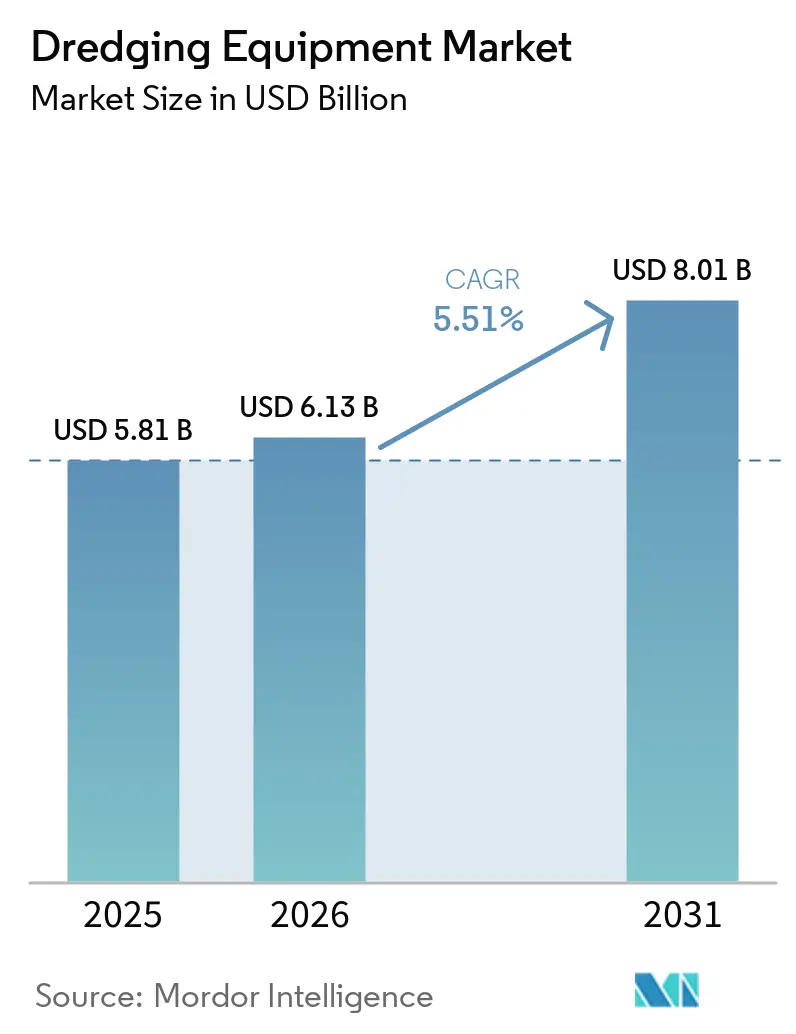
The Dredging Equipment Market was valued at USD 5.81 billion in 2025 and is expected to reach USD 6.13 billion in 2026. It is projected to reach USD 8.01 billion by 2031, registering a CAGR of 5.51% during the forecast period (2026–2031). Rising port-capacity projects, accelerating offshore wind build-outs, and government-funded inland waterway programs are translating into larger scopes of work for cutter-suction and trailing-suction hopper vessels. Contractors are modernizing fleets with dual-fuel engines and autonomous control suites to comply with tightening emissions rules and counter skilled-labor shortages. Rental and hybrid-annuity procurement formats are gaining traction, broadening access to equipment for municipal agencies and private port operators. Together, these forces are lifting day-rates, keeping utilization high, and underpinning a multi-year replacement cycle across the global dredging equipment market.
Key Report Takeaways
- By dredger type, hydraulic dredgers captured 41.27% of the dredging equipment market share in 2025, while mechanical dredgers are projected to expand at a 6.53% CAGR between 2026 and 2031.
- By application, navigational-channel maintenance accounted for 28.73% of the dredging equipment market share in 2025, whereas offshore renewable-energy construction is forecast to advance at a 6.55% CAGR through 2031.
- By end user, government agencies held 43.56% of the dredging equipment market share in 2025; private port operators are expected to grow at a 6.58% CAGR during 2026-2031.
- By ownership model, contractor-owned fleets accounted for 45.61% of the dredging equipment market share in 2025, while project-owned and public-private partnership arrangements are on track to grow at a 7.62% CAGR through 2031.
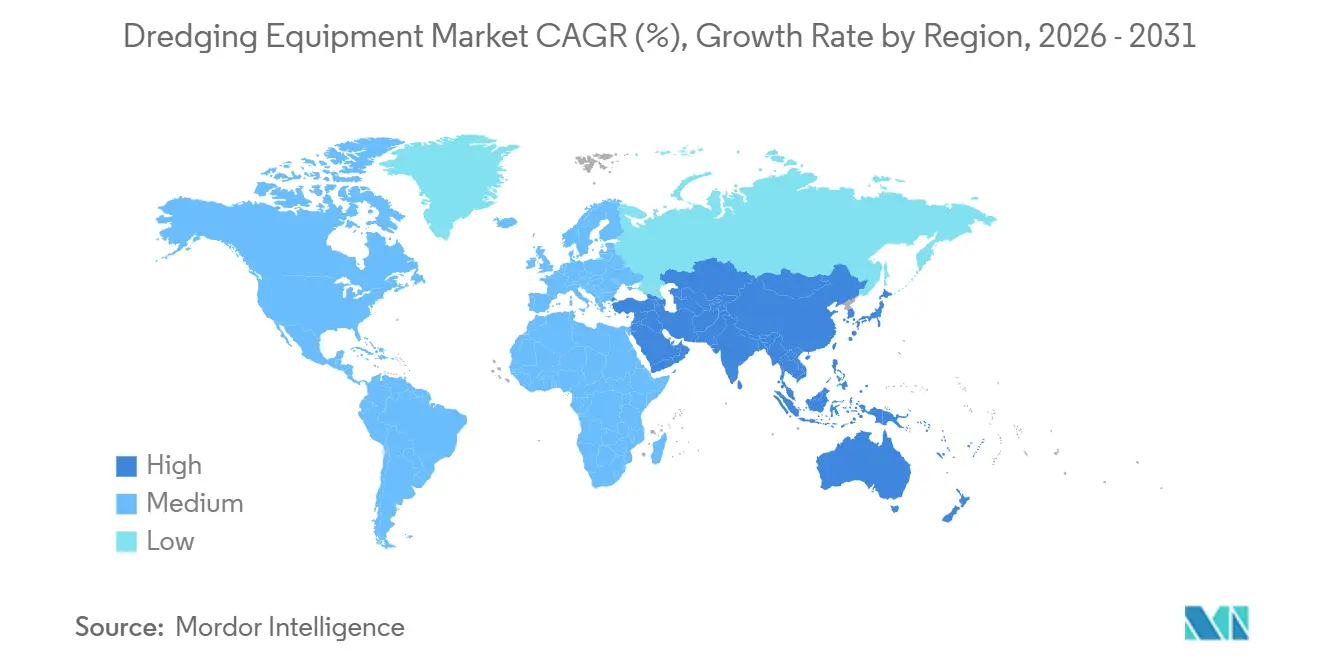
- By region, Asia-Pacific led with 37.63% of the dredging equipment market share in 2025 and is also the fastest-growing geography at a 7.64% CAGR over the forecast period.
Note: Market size and forecast figures in this report are generated using Mordor Intelligence’s proprietary estimation framework, updated with the latest available data and insights as of January 2026.
Market Trends and Insights
Drivers Impact Analysis of Dredging Equipment Market*
| Driver | (~) % Impact on CAGR Forecast | Geographic Relevance | Impact Timeline |
|---|---|---|---|
| Accelerated Port-Capacity Expansion | +1.2% | Global, with concentration in Asia-Pacific (China, India, Singapore) and Middle East (UAE, Saudi Arabia) | Medium term (2-4 years) |
| Offshore Wind and Subsea-Cable Build-Out | +1.0% | North America & Europe, spill-over to Asia-Pacific (Taiwan, Japan, South Korea) | Medium term (2-4 years) |
| Government Inland-Waterway Modernization | +0.8% | North America (USACE), Europe (Netherlands, Germany), South America (Brazil) | Long term (≥ 4 years) |
| AI-Enabled Autonomous Dredging Adoption | +0.6% | Europe (Netherlands, Belgium) early adopters, expanding to Asia-Pacific and North America | Long term (≥ 4 years) |
| Beneficial-Use Demand for Dredged Sediments | +0.5% | North America (USACE 70% goal), Europe (OSPAR), Asia-Pacific coastal restoration | Medium term (2-4 years) |
| Emergence of Circular-Economy Sand Substitutes | +0.4% | Global, with regulatory push in Europe and Asia-Pacific | Long term (≥ 4 years) |
| Source: Mordor Intelligence | |||
Accelerated Port-Capacity Expansion
As container throughput continues to rise, larger vessels are now demanding approach channels of significant depth. In recent years, Singapore has handled a substantial volume of TEUs, necessitating ongoing maintenance dredging at Tuas Megaport to accommodate some of the largest ships in operation [1]“Port Statistics 2025,” Maritime and Port Authority of Singapore, mpa.gov.sg . India, in a significant move, awarded a hybrid-annuity contract for a major port reclamation project – the region’s largest single tender – with phase-one delivery planned for the near future. Around the same period, Japan allocated a considerable budget for berth deepening projects at key ports, including Kashima, Kawasaki, and Yokohama. The UAE’s Saqr 2.0 upgrade, aiming for deeper drafts, has committed a significant investment in rock-cutting dredgers. These ambitious projects not only secure multiyear demand for vessels but also bolster a positive outlook for the dredging equipment market.
Offshore Wind and Subsea-Cable Build-Out
Foundation preparation and cable-trench excavation for Hornsea 3’s 231 turbines require precision dredging beyond the capabilities of a port-maintenance fleet [2]“Hornsea 3 Project Update 2026,” Ørsted A/S, orsted.com . Poland’s Baltica 2, now surveying glacial-till seabeds, specifies dynamic-positioned trailing suction hopper dredgers and fall-pipe vessels to protect marine habitats. ScottishPower’s East Anglia Three mandates water-injection dredgers to reach 1.5-meter burial depth in mixed substrates. Subsea-cable corridors like Dogger Bank South exceed 500 kilometers of trenching through 2027, sustaining specialty-equipment backlogs. Developers accept premium charter rates that compress project schedules, which directly enlarges revenue potential for the dredging equipment market.
Government Inland-Waterway Modernization
WRDA 2024 increased the federal harbor-depth limit to support greater beneficial use of dredged material and promote long-pipeline hydraulic dredging. In Europe, the Hoogwater Beschermings program has contracted Van Oord to strengthen Dutch dikes by relocating channel sediment, with completion targeted for the latter half of the decade. In Brazil, the Itajaí-Açu River contract has deployed water-injection dredging, substantially reducing disposal costs. Consistent appropriations provide fleet operators in the dredging equipment market with reliable project throughput.
AI-Enabled Autonomous Dredging Adoption
Royal IHC’s Mission Master enables a single operator to oversee multiple dredges from a shore-based control room, significantly reducing crew requirements during trials in the Netherlands. BMT’s ADAPT platform demonstrated notable fuel-consumption reductions during deployments in the North Sea. At Maasvlakte 2, the Smart Dredger consortium successfully conducted extended unmanned shifts, reducing labor costs while complying with ISO 14001 monitoring standards. Although the International Maritime Organization (IMO) has not yet finalized a code for autonomous vessels, early adopters in Europe and the Asia-Pacific (APAC) region are proactively budgeting for retrofits, anticipating a reasonable payback period. The dredging equipment market is undergoing a gradual yet significant shift toward automation, which is driving substantial cost savings and improving safety.
Restraints Impact Analysis of Dredging Equipment Market*
| Restraint | (~) % Impact on CAGR Forecast | Geographic Relevance | Impact Timeline |
|---|---|---|---|
| Tightening Environmental-Compliance Costs | -0.7% | Global, with strictest enforcement in Europe (EU ETS, FuelEU Maritime) and North America (EPA Tier 4) | Short term (≤ 2 years) |
| High Capex and Long ROI For Advanced Dredgers | -0.5% | Global, particularly impacting smaller contractors and emerging-market operators | Medium term (2-4 years) |
| Skilled-Labor Shortage for Autonomous Fleets | -0.3% | Europe (Denmark, Netherlands, Belgium), North America (Gulf Coast, Great Lakes) | Short term (≤ 2 years) |
| Volatility In Marine-Fuel Pricing & Availability | -0.2% | Global, with acute exposure in regions dependent on HFO and MGO (Middle East, Africa, South America) | Short term (≤ 2 years) |
| Source: Mordor Intelligence | |||
Tightening Environmental-Compliance Costs
By the end of the decade, the IMO Net-Zero Framework is expected to impose stringent well-to-wake emissions limits, steering fleets toward alternative fuels such as methanol, ammonia, and bio-LNG. For larger dredgers, the inclusion of maritime transport in the EU ETS is likely to significantly increase operating costs through carbon pricing. Meanwhile, FuelEU Maritime imposes substantial penalties on ships that fail to meet annual greenhouse gas intensity targets. In the mid-2020s, Boskalis introduced a large dual-fuel methanol hopper dredger, absorbing a considerable capital cost premium. However, smaller contractors without access to green financing face shrinking margins or may need to exit the market strategically, reducing spending in the dredging equipment market.
High Capex and Long ROI for Advanced Dredgers
Boskalis ordered the Seaway under a contract announced in October 2023. The vessel was launched in October 2025 and was delivered in mid-2026. It is a Trailing Suction Hopper Dredger (TSHD) equipped with diesel-electric propulsion and dual-fuel, methanol-ready systems, supporting operational flexibility and alignment with lower-emission fuel options. In contrast, Royal IHC's Beagle 8, including the vessel ordered by India's Vishwa Samudra Group in late 2025 for delivery in 2027, has an 8,000 m³ hopper capacity. The Beagle 8 belongs to a separate, smaller standardized TSHD series and should not be considered comparable to the larger Seaway vessel.
*Our forecasts treat driver/restraint impacts as directional, not additive. The impact forecasts reflect baseline growth, mix effects, and variable interactions.
Dredging Equipment Market Segment Analysis
By Dredger Type:
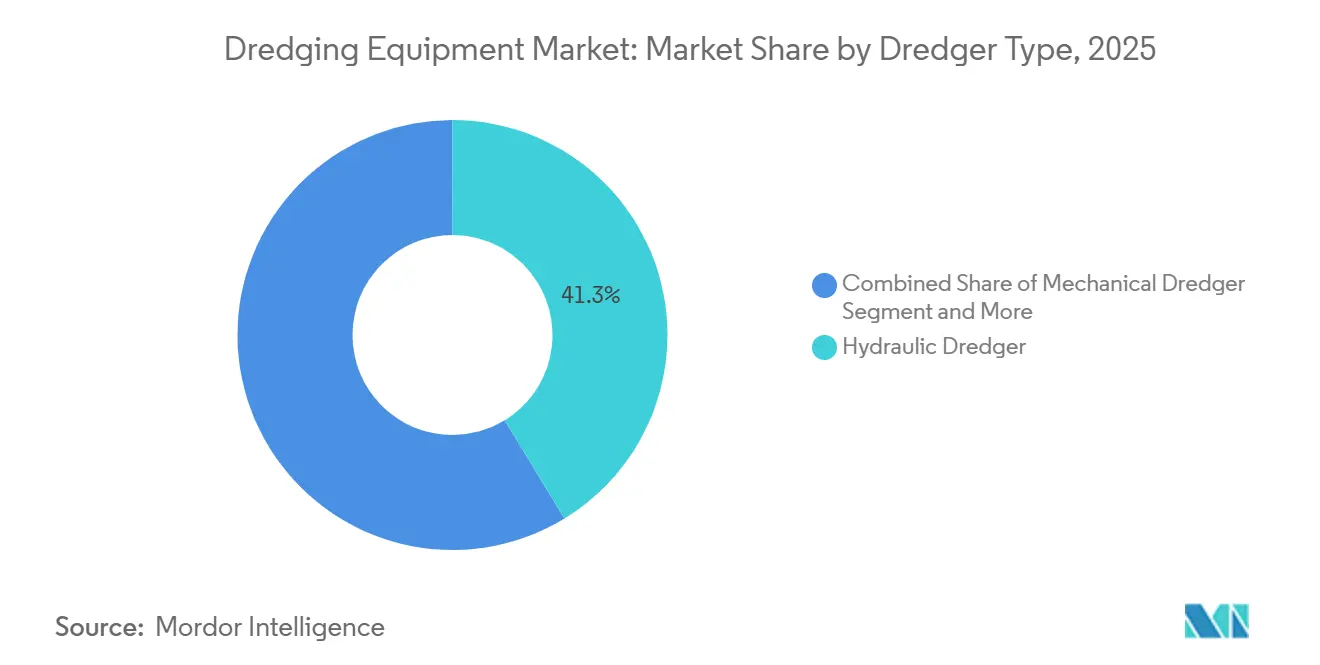
Hydraulic Productivity Sustains LeadershipHydraulic dredgers accounted for 41.27% of the dredging equipment market share in 2025, anchored by cutter suction and trailing suction hopper vessels that deliver nonstop slurry pumping over distances exceeding 5 km. The dredging equipment market size associated with hydraulic units is expected to expand at a steady pace as coastal megaprojects in Singapore, India, and the UAE maintain utilization near 80% of available days. Builders are fitting dual-fuel engines, abrasion-resistant suction pipes, and intelligent load controllers to lift cubic-meter productivity, enabling contractors to shave charter duration while staying within stricter turbidity limits.
Mechanical units excel in precision excavation that prevents over-digging inside wharfs, cofferdams, and lock systems, keeping disposal volumes down and monetizing the dredging equipment industry’s shift toward pay-by-cubic-meter contracts, which is driving growth at a CAGR of 6.53% through 2031. Backhoe barges secured niche roles in underwater archeology around Egypt’s Alexandria Harbor, where gentle bucket cycling protected heritage artifacts for hand recovery by divers.



By Application:
Offshore Renewables Accelerate Equipment TurnoverNavigational-channel maintenance remained the largest slice at 28.73% of the dredging equipment market share in 2025, yet offshore renewable-energy construction leads growth at a 6.55% CAGR through 2031. Ørsted’s Hornsea 3 seabed campaign specifies trailing suction hopper dredgers equipped with dynamic positioning that maintain ±5 cm tolerance, setting a new technical baseline for charters in the dredging equipment market. Poland’s Baltica 2 demands rock-dump fall-pipe vessels to armor turbine monopiles, prompting contractors to retrofit DP2 thrusters that stabilize during North Sea squalls.
Port and harbor expansion represents the second-largest application segment and includes Singapore’s Tuas Phase 2, which became fully operational in May 2026. Governments in India, Japan, and Saudi Arabia approved 2025-2026 budgets that fund new berth dredging plus reclamation acreage, sustaining baseline demand for conventional cutter suction fleets. Environmental remediation—though smaller in value—has strategic significance, as illustrated by Louisiana’s marsh-creation program, which moved 71 million yd³ of sediment in 2026. Hurricane recovery and flood-protection agendas add counter-cyclical resilience, helping insulate the dredging equipment market from shipping-cycle swings.
By End User:
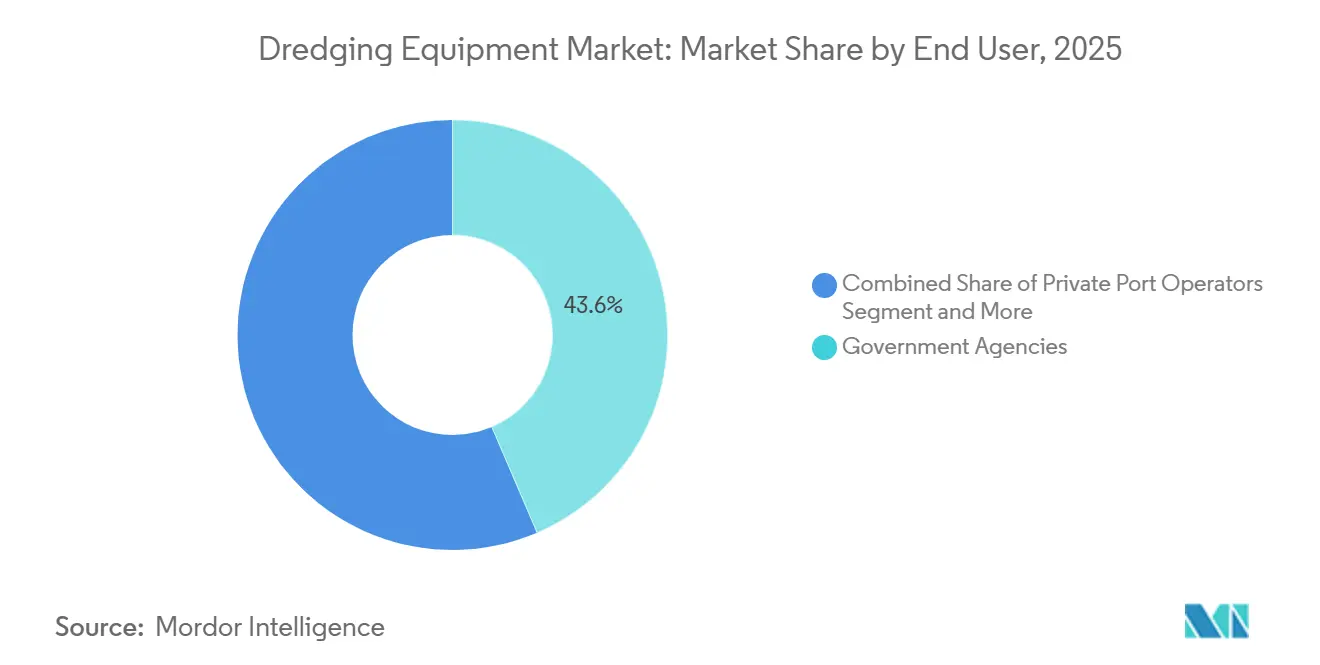
Private Port Operators Lift Future GrowthGovernment agencies contributed 43.56% of the dredging equipment market share in 2025, with the U.S. Army Corps of Engineers alone allocating a massive amount for dredging that year. National ministries in Japan and Brazil added combined outlays exceeding USD 600 million for berth deepening and river maintenance, keeping tenders flowing to the established contractor universe. Yet private port operators post the fastest 6.58% CAGR, spurred by concession terms that transfer draft-maintenance obligations while allowing tariff-based cost recovery.
Contract structure evolution favors equipment-as-a-service. Public-private partnerships under India’s hybrid-annuity model see government grants cover upfront dredger purchases. At the same time, operators collect annuities linked to berth availability—an approach that pulls deferred revenue forward for builders such as Royal IHC. EPC firms involved in LNG terminals and bridge foundations now rent booster pumps, HDPE pipelines, and 12-inch cutter-suction units from U.S. lessors, thereby redirecting capex toward their civil scope. This migration toward asset-light procurement enlarges the addressable pool of small-ticket rentals, reinforcing recurring revenue streams in the broader dredging equipment market.
By Ownership Model:
Rental and PPP Formats Widen AccessContractor-owned fleets still accounted for 45.61% of the dredging equipment market share in 2025, as majors like DEME, Boskalis, and Van Oord rely on proprietary hoppers to guarantee project delivery windows. In 2024, operators achieved significant hopper utilization for most of the year, validating investments such as Boskalis's large-capacity methanol hopper, which required a substantial financial commitment. However, project-owned and PPP structures are expanding at a 7.62% CAGR, raising the dredging equipment market size tied to long-term concessions where governments offload operational risk but retain sovereignty over navigational safety. India’s Vadhvan Port concession illustrates this: a Jan De Nul–DEME JV procures gear but receives milestone and maintenance annuities for 20 years.
Short-term rental has matured into a parallel channel. Cooper-Wilkins markets turnkey spreads, including an Ellicott 360 and 3,000 ft of pipe, at daily rates that bundle operators, fuel, and compliance paperwork—ideal for municipalities with seasonal silt clearing. These models compress mobilization lead times to under two weeks, increasing market liquidity and cushioning capex swings during freight downturns, thereby stabilizing demand across the dredging equipment market.
Geography Analysis
APAC Dredging Equipment Market
Asia-Pacific claimed 37.63% of the dredging equipment market share in 2025 and is set to compound at a 7.64% CAGR through 2031. This growth is fueled by container hubs in China, India, and Singapore, which are deepening channels and reclaiming land. Notably, India’s Vadhvan Port reclamation is moving a substantial volume of material, supporting significant charter pipelines for the yards of Jan De Nul, DEME, and Royal IHC. In 2025, Singapore processed a substantial volume of TEUs and continued its round-the-clock hopper campaigns at Tuas for several years. Japan allocated a significant budget for upgrades across multiple ports, including multi-year suction and grab scopes. Meanwhile, China’s Yangshan Phase IV is keeping basin hoppers busy, and Indonesia’s moratorium on seabed-sand exports is redirecting domestic dredger tonnage towards port expansions in Jakarta and Surabaya.
North America Dredging Equipment Market
North America, while trailing, is witnessing significant public funding. The U.S. dredging equipment market is expanding, especially after WRDA 2024 raised the depth ceiling and mandated a high percentage of beneficial use of sediments by the end of the decade. In Canada, the Port of Vancouver is clearing a significant volume annually to accommodate post-Panamax ships. Meanwhile, Mexico’s Veracruz expansion has reopened tenders for hopper charters, following weather-related delays.
EMEA Dredging Equipment Market
Europe is merging its offshore wind initiatives with flood-protection mandates. Projects like Hornsea 3, Dogger Bank South, and Baltica 2 are collectively booking extensive trenching work over the coming years, leading to a surge in specialty equipment day rates. The Netherlands’ Hoogwater Beschermings Program is set to recycle river sediment into embankment cores during its dike dredging projects. Compliance costs from EU ETS and FuelEU Maritime are accelerating fleet renewals, favoring early adopters of methanol or bio-LNG hoppers for project awards. In the Middle East and Africa, megaprojects like Ras Al Khaimah’s Saqr 2.0, Saudi Arabia’s NEOM Oxagon, and Egypt’s Dekheila Port, each valued significantly, are making deep-draft cuts in coral or rock beds.

Competitive Landscape
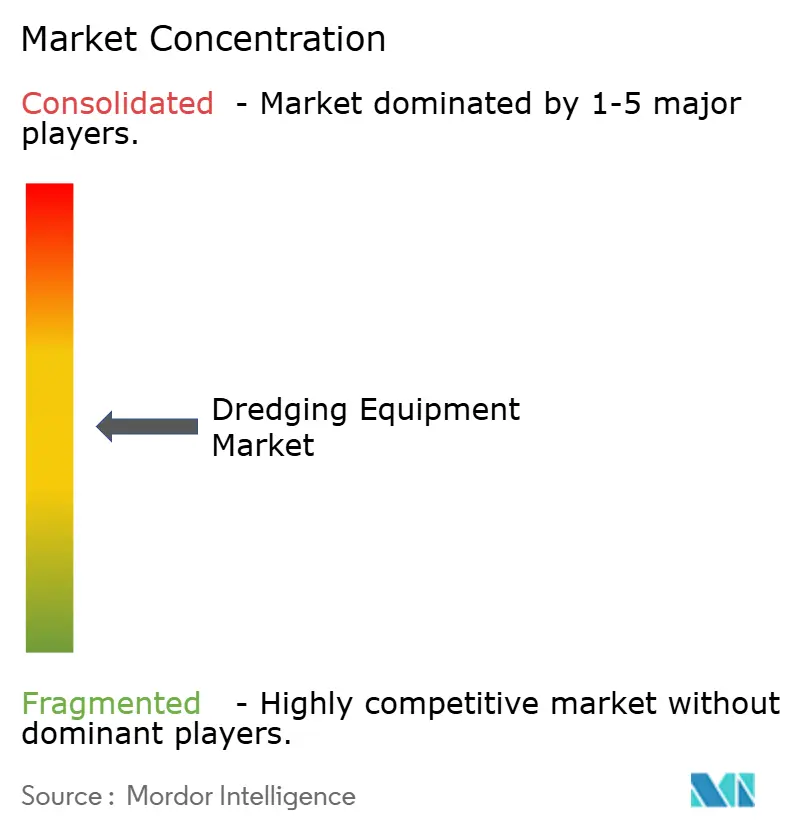
Royal IHC, DEME, Boskalis, Van Oord, and Jan De Nul—the five leading players—command a significant share of global fleet capacity, indicating moderate concentration in the dredging equipment market. During trials at Maasvlakte 2, Royal IHC’s Mission Main autonomous suite enabled a single shore-based operator to oversee multiple cutters, substantially reducing crew-related overhead and reinforcing the company’s position as a technology leader. DEME’s backlog recently reached a substantial value, supporting orders for dual-fuel hopper dredgers scheduled for future delivery. Boskalis also unveiled the largest methanol-ready dredger to date, targeting projects exposed to the EU Emissions Trading System (EU ETS) and dependent on the availability of green fuels.
Strategic initiatives increasingly focus on vertical integration and diversified rental offerings. Van Oord recently acquired a majority stake in a Dutch soil-washing company to capitalize on opportunities for sediment-to-aggregate conversion in inland projects. Jan De Nul launched a mobile dewatering facility in Texas that converts maintenance slurry into levee fill, creating an additional revenue stream beyond conventional charter services. Chinese competitor Shandong Haohai expanded its international deliveries, including a high-capacity bucket-wheel dredger dispatched to West Africa. However, the company continues to face buyer concerns regarding lifecycle support.
Environmental compliance has emerged as a key differentiator. Contractors with bio-LNG or methanol capabilities can secure preferred-bidder positions in North Sea and US Army Corps frameworks that prioritize carbon intensity. In contrast, smaller regional players without access to green financing may exit the market or become increasingly reliant on subcontracting. This trend could accelerate consolidation in the dredging equipment market over the coming years.
Dredging Equipment Industry Leaders
Damen Shipyards Group
Boskalis Westminster
DEME Group
Jan De Nul Group
Royal IHC (IHC Merwede Holding B.V. )
- *Disclaimer: Major Players sorted in no particular order
Dredging Equipment Market Companies Covered in this Report
- Royal IHC (IHC Merwede Holding B.V.)
- Damen Shipyards Group
- Jan De Nul Group
- DEME Group
- Boskalis Westminster
- Ellicott Dredges LLC
- DSC Dredge LLC
- American Marine Corporation
- Holland Dredge Design B.V.
- Liebherr-International AG
- Shandong Haohai Dredging Equipment Co., Ltd.
- Hyundai Heavy Industries Co. Ltd.
- SANY Group
- VOSTA LMG
- Caterpillar Inc.
- HJ Shipbuilding & Construction
- Keppel Offshore & Marine
- GeoForm International Inc.

Recent Industry Developments in Dredging Equipment Market
- April 2026: China launched its first ultra-large dredger equipped with a distributed in-hull mud pump, strengthening the country’s domestic dredging capabilities and supporting large-scale marine infrastructure and land reclamation projects.
- February 2026: Ellicott Dredge Enterprises launched its Generation IV Versi-Dredge product line. The system supports sand and sediment excavation using low-turbidity cutterheads and can accommodate a WeedMaster cutterhead for harvesting dense aquatic vegetation, with a pumping distance of up to 1 km.
- October 2025: Bird Construction completed the acquisition of Fraser River Pile & Dredge (FRPD), Canada’s largest marine infrastructure and dredging company, for USD 82.3 million. The acquisition accelerates Bird’s expansion into the heavy marine construction and foundation markets.
- September 2025: Antigua and Barbuda's Cabinet has approved the acquisition of specialized dredging equipment to address delays and restart stalled operations at St John's and Crabbs harbors. This decision aims to enhance the efficiency of harbor activities, ensure the timely completion of ongoing projects, and support the country's maritime infrastructure development.
- May 2025: Italdraghe, in partnership with a renowned Indian shipyard, has signed a significant contract to supply six SGT 450 (18”) cutter suction dredgers (CSD) to the Indian market. This agreement demonstrates Italdraghe's dedication to strengthening its regional presence and addressing the increasing demand for advanced dredging solutions. The collaboration with the Indian shipyard highlights the strategic importance of local partnerships in ensuring efficient production and timely delivery of these cutting-edge dredgers.


Global Dredging Equipment Market Report Scope
The scope of the report includes Dredger Type (Mechanical Dredger and More), Application (Navigational-Channel Maintenance and More), End User (Government Agencies and More), Ownership Model (Contractor-Owned and More), and Geography.
By Dredger Type, the market is segmented into mechanical, hydraulic, and other dredgers. By Application, the market is segmented into Navigational-channel maintenance, port & harbor expansion, land reclamation, offshore renewable-energy construction, environmental remediation, construction & mining (sand extraction), and disaster recovery & flood control. By End-User, the market is segmented into government agencies, private port operators, EPC contractors, and mining & energy companies. By ownership model, the market is segmented into contractor-owned, project-owned (Government/PPP), and rental/lease fleets. By Geography, the market is segmented into North America, South America, Europe, Asia-Pacific, and the Middle East and Africa. The Market Forecasts are Provided in Terms of Value (USD).
| Mechanical Dredger |
| Hydraulic Dredger |
| Others |
| Navigational-Channel Maintenance |
| Port & Harbor Expansion |
| Land Reclamation |
| Offshore Renewable-Energy Construction |
| Environmental Remediation |
| Construction & Mining (Sand Extraction) |
| Disaster Recovery & Flood Control |
| Government Agencies |
| Private Port Operators |
| EPC Contractors |
| Mining & Energy Companies |
| Contractor-Owned |
| Project-Owned (Government/PPP) |
| Rental / Lease Fleet |
| North America | United States |
| Canada | |
| Rest of North America | |
| South America | Brazil |
| Argentina | |
| Rest of South America | |
| Europe | United Kingdom |
| Germany | |
| Spain | |
| Italy | |
| France | |
| Russia | |
| Rest of Europe | |
| Asia-Pacific | India |
| China | |
| Japan | |
| Indonesia | |
| Malaysia | |
| Singapore | |
| Vietnam | |
| Philippines | |
| South Korea | |
| Rest of Asia-Pacific | |
| Middle East and Africa | United Arab Emirates |
| Saudi Arabia | |
| Turkey | |
| Egypt | |
| South Africa | |
| Rest of Middle East and Africa |
| By Dredger Type | Mechanical Dredger | |
| Hydraulic Dredger | ||
| Others | ||
| By Application | Navigational-Channel Maintenance | |
| Port & Harbor Expansion | ||
| Land Reclamation | ||
| Offshore Renewable-Energy Construction | ||
| Environmental Remediation | ||
| Construction & Mining (Sand Extraction) | ||
| Disaster Recovery & Flood Control | ||
| By End User | Government Agencies | |
| Private Port Operators | ||
| EPC Contractors | ||
| Mining & Energy Companies | ||
| By Ownership Model | Contractor-Owned | |
| Project-Owned (Government/PPP) | ||
| Rental / Lease Fleet | ||
| By Geography | North America | United States |
| Canada | ||
| Rest of North America | ||
| South America | Brazil | |
| Argentina | ||
| Rest of South America | ||
| Europe | United Kingdom | |
| Germany | ||
| Spain | ||
| Italy | ||
| France | ||
| Russia | ||
| Rest of Europe | ||
| Asia-Pacific | India | |
| China | ||
| Japan | ||
| Indonesia | ||
| Malaysia | ||
| Singapore | ||
| Vietnam | ||
| Philippines | ||
| South Korea | ||
| Rest of Asia-Pacific | ||
| Middle East and Africa | United Arab Emirates | |
| Saudi Arabia | ||
| Turkey | ||
| Egypt | ||
| South Africa | ||
| Rest of Middle East and Africa | ||


Key Questions Answered in the Report
What is the current value of the dredging equipment market?
The Dredging Equipment Market was valued at USD 5.81 billion in 2025 and is expected to reach USD 6.13 billion in 2026. It is projected to reach USD 8.01 billion by 2031, registering a CAGR of 5.51% during the forecast period (2026–2031).
Which dredger type dominates global revenue?
Hydraulic dredgers led with 41.27% of the dredging equipment market share in 2025, due to their continuous-pumping productivity in land reclamation and channel maintenance work.
Which application segment is expanding fastest?
Offshore renewable-energy construction posts the highest 6.55% CAGR through 2031 as developers prepare seabeds and cable corridors for large-scale wind arrays.
Which region will contribute most to future demand?
Asia-Pacific is set to remain the largest and fastest-growing region, advancing at a 7.64% CAGR as projects in China, India, and Singapore sustain high equipment utilization.
How are environmental rules affecting fleet investment?
EU ETS, FuelEU Maritime, and IMO emission caps are pushing contractors toward methanol and bio-LNG-ready vessels, raising capex but also improving tender eligibility on low-carbon projects.
Page last updated on:





