
United States Mining Equipment Market Size and Share
Market Overview
| Study Period | 2019 - 2031 |
|---|---|
| Forecast Data Period | 2026 - 2031 |
| Base Year Market Size (2025) | USD 13.34 Billion |
| Market Size (2026) | USD 13.93 Billion |
| Market Size (2031) | USD 17.32 Billion |
| Growth Rate (2026 - 2031) | 4.45 % |
| Market Concentration | Medium |
Major Players *Disclaimer: Major Players sorted in no particular order Image © Mordor Intelligence. Reuse requires attribution under CC BY 4.0. | |
United States Mining Equipment Market Analysis by Mordor Intelligence
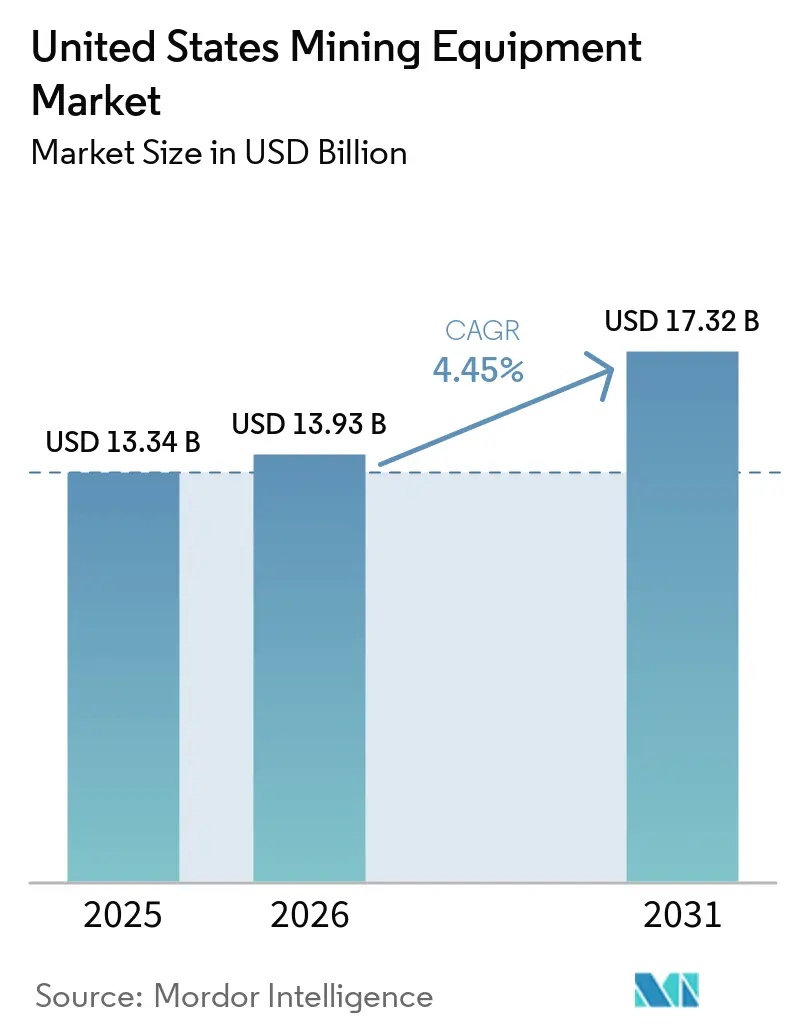
The United States mining equipment market size was valued at USD 13.34 billion in 2025, is estimated at USD 13.93 billion in 2026, and is projected to reach USD 17.32 billion by 2031 at a 4.45% CAGR over 2026-2031. Robust federal incentives, accelerated fleet‐replacement cycles, and the pivot to battery-electric mobile machinery are shortening procurement lead times and inflating order books. Section 45X production-tax credits now offset 10% of critical-mineral extraction costs, lowering effective purchase prices for specialized rigs and haul trucks. The Department of Energy’s USD 95 million Mine of the Future pilot is validating high-efficiency drills, loaders, and autonomous control suites, removing first-mover risk for operators. Operators are also responding to labor shortages by embedding automation modules that raise asset uptime and allow one technician to supervise multiple units. Equipment builders are countering metal-price volatility by rolling out power-agnostic platforms that accept diesel, battery, or dual-fuel packages, giving miners flexibility while protecting manufacturer margins.
Key Report Takeaways
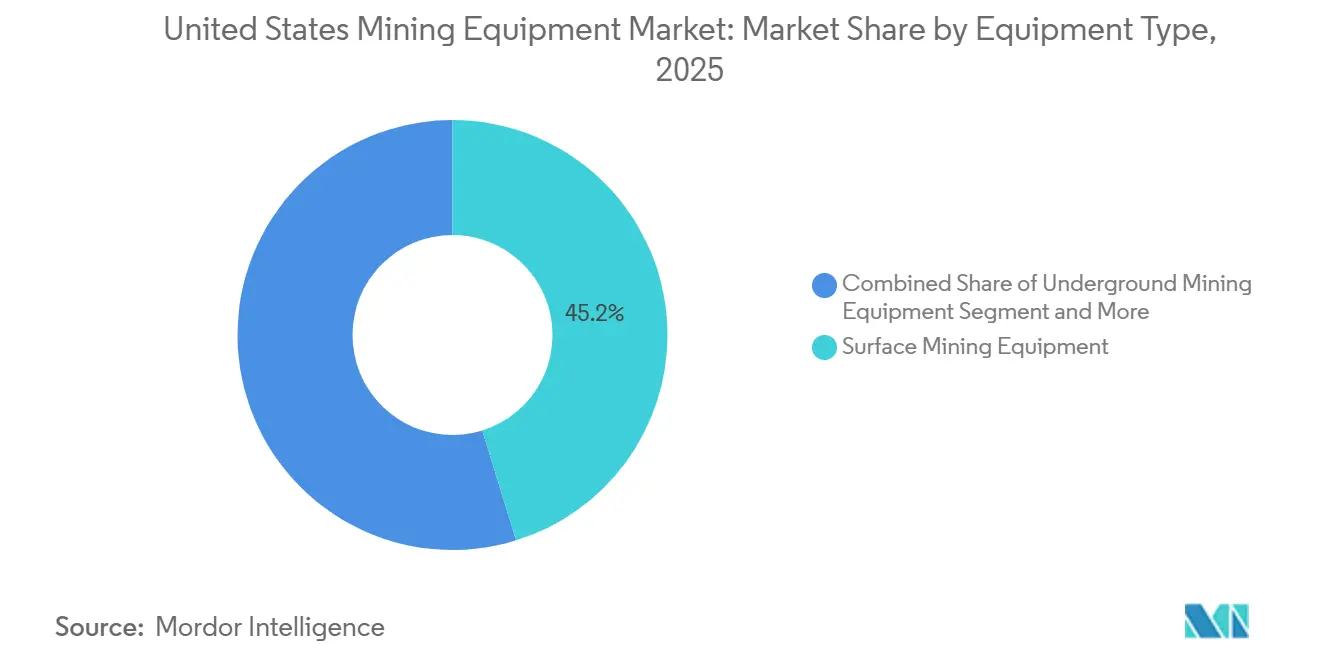
- By equipment type, surface mining held 45.23% of the United States mining equipment market share in 2025, while drills and breakers are forecast to expand at a 5.48% CAGR through 2031.
- By power source, internal combustion engine-powered units dominated with 67.71% revenue share in 2025, yet electric machines posted the fastest 5.47% CAGR to 2031.
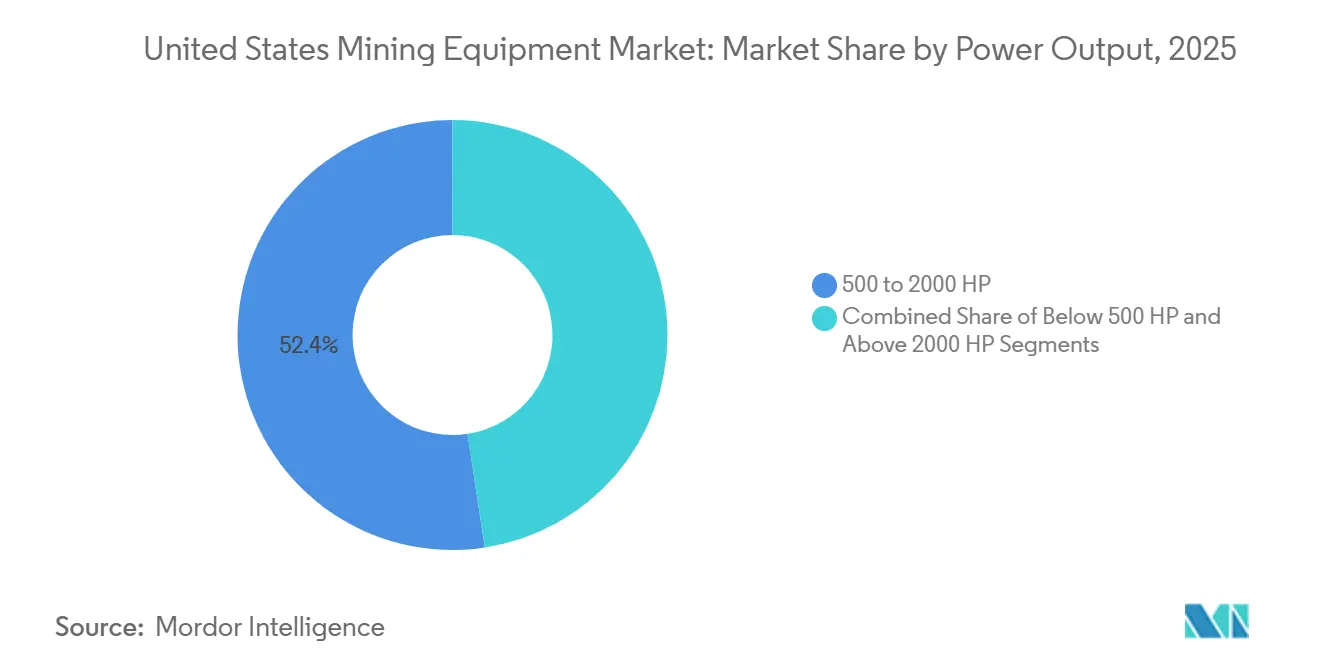
- By power output, the 500-to-2000 HP bracket captured 52.37% of the United States mining equipment market size in 2025; below-500 HP units record the highest 6.51% CAGR over the forecast.
- By application, metal mining led with a 45.34% share of the United States mining equipment market size in 2025 and is advancing at a 7.55% CAGR through 2031.
Note: Market size and forecast figures in this report are generated using Mordor Intelligence’s proprietary estimation framework, updated with the latest available data and insights as of January 2026.
Market Trends and Insights
Drivers Impact Analysis of United States Mining Equipment Market*
| Driver | (~) % Impact on CAGR Forecast | Geographic Relevance | Impact Timeline |
|---|---|---|---|
| Surge In Critical-Minerals Projects (Lithium, REE) | +1.1% | Nevada, North Carolina, Alaska, Arizona | Medium term (2-4 years) |
| Robust Replacement Cycle for Ageing Fleets | +0.9% | National, highest in Powder River Basin, Minnesota Iron Range | Short term (≤ 2 years) |
| Federal Infrastructure-Spending Boom | +0.8% | National, concentrated in Nevada, Arizona, North Carolina | Medium term (2-4 years) |
| Shift To Battery-Electric Mobile Equipment | +0.7% | National, early adoption in Nevada lithium belt, Arizona copper districts | Long term (≥ 4 years) |
| Automation Mandates at Deep-Underground Mines | +0.6% | National, priority in hard-rock gold/silver mines exceeding 1,500 meters depth | Long term (≥ 4 years) |
| New Tax Incentives for Low-Emission Machinery | +0.4% | National, amplified in states with complementary clean-energy credits | Medium term (2-4 years) |
| Source: Mordor Intelligence | |||
Surge in Critical-Minerals Projects
Over the next few years, significant equipment orders are anticipated from Lithium Americas’ Thacker Pass, Ioneer’s Rhyolite Ridge, and USA Rare Earth’s Round Top. With Nevada hosting the majority of advanced-stage lithium prospects, both Caterpillar and Komatsu have strategically stocked inventories in Elko and Reno. The DOE's substantial program, aimed at coal-waste recovery, backs mobile crushers and separators to enhance the value of low-grade feedstock. Sandvik's deployment of battery-electric drilling and haulage packages at South32 underscores a commitment to zero-emission blueprints for new shafts. While regional clustering challenges dealer capacity, it simultaneously boosts aftermarket revenue density for OEMs.
Robust Replacement Cycle for Aging Fleets
In 2025, the average age of surface trucks reached a significant milestone, pushing maintenance costs beyond their residual values. Coal operators in the Powder River Basin are replacing ultra-class trucks with smaller, fuel-efficient models to align with a dimmer volume forecast. In Arizona, metal miners are phasing out diesel excavators, opting instead for electric models that are eligible for Section 45X credits. Komatsu's D61PXi-25 dozer, set for release in 2026, boasts built-in grade control, ensuring significantly less re-work – a vital advantage amid a shortage of skilled operators. Orders that were deferred during the early 2020s have now culminated in substantial lump-sum purchases, resulting in a notable boost for the US mining equipment market.
Federal Infrastructure-Spending Boom
Federal infrastructure outlays in significant amounts bolster critical mineral supply chains, effectively lowering borrowing costs beneath commercial benchmarks [1]. The Mine of the Future, a proving ground, mitigates risks by rigorously testing cutting tools, digital twin software, and battery packs prior to their commercial debut. A substantial credit line from EXIM Bank reduces interest spreads considerably, thereby enhancing balance-sheet capacity for fleet upgrades[2]. Ioneer’s immediate order of Caterpillar 793 XE haul trucks following a DOE loan guarantee illustrates procurement acceleration. Shared validation facilities reduce first-mover penalties, hastening the adoption of autonomous and electrified rigs.
Shift to Battery-Electric Mobile Equipment
Ventilation, accounting for a significant portion of underground operating budgets, faces a transformative shift as the elimination of diesel particulates not only reduces airflow requirements but also lowers power bills. In the near future, Sandvik secured a substantial contract with South32, setting a new standard for zero-emission fleets in hard-rock headings. Epiroc’s ST10 G loader, with a quick recharge time, seamlessly integrates into three-shift rosters, eliminating the need for standby units. While upfront premiums remain high, federal incentives and state-level tax abatements provide notable discounts, significantly accelerating the payback period. Meanwhile, Komatsu-Innomotics' trolley assist achieves a considerable reduction in battery mass, striking a balance between capital expenditure and operational savings.
Restraints Impact Analysis of United States Mining Equipment Market*
| Restraint | (~) % Impact on CAGR Forecast | Geographic Relevance | Impact Timeline |
|---|---|---|---|
| Volatile Metal-Price Cycles | -0.5% | National, amplified in copper and gold districts | Short term (≤ 2 years) |
| Permitting Delays on Green-Field U.S. Mines | -0.4% | National, concentrated in Alaska, Nevada, Arizona | Long term (≥ 4 years) |
| High Upfront CAPEX For Electrified Equipment | -0.3% | National, most acute in underground hard-rock operations | Medium term (2-4 years) |
| Skilled-Labor Shortages for AHS And Digital Tech | -0.3% | National, highest in rural mining districts | Medium term (2-4 years) |
| Source: Mordor Intelligence | |||
Volatile Metal-Price Cycles
Despite the World Bank's forecast of a significant rise in industrial-metal prices by 2026, historical trends show that such fluctuations, especially within short-term windows, rarely lead to sustained fleet expansions. For instance, a substantial drop in copper prices can extend the amortization period of equipment loans, effectively halting discretionary orders. Meanwhile, smaller miners grappling with tight cash flows are delaying equipment replacements. This situation compels original equipment manufacturers (OEMs) to navigate the highs and lows of their inventory. While major players benefit from hedging programs that cushion the impact, junior explorers—who are pivotal in driving demand for compact rigs—find little relief. As a result, the United States mining equipment market exhibits a jagged, saw-tooth pattern instead of a smooth trajectory.
Permitting Delays on Green-Field Mines
In the United States, environmental reviews for SMEs typically take several years, while the complete cycle from discovery to production spans over a decade. Although FAST-41 has expedited only a limited number of mining projects, the majority remain ensnared in traditional processes. These prolonged timelines significantly reduce the window for equipment purchases shortly before extracting the first ore. This situation forces OEMs to either maintain speculative stock or face potential delays. While congressional proposals, such as the SPEED Act, seek to limit reviews to a shorter timeframe, their approval remains in question. As a result of these lengthy approvals, immediate equipment orders dwindle, even with a strong demand forecasted for the long term.
*Our forecasts treat driver/restraint impacts as directional, not additive. The impact forecasts reflect baseline growth, mix effects, and variable interactions.
United States Mining Equipment Market Segment Analysis
By Equipment Type:
Drills and Breakers Outpace Surface GrowthSurface rigs retained 45.23% of the United States mining equipment market share in 2025, underpinned by open-pit copper, gold, and coal fleets. Drills and Breakers, however, log a 5.48% CAGR to 2031, propelled by electric equipment units and autonomous drill rigs to ease ventilation loads. Sandvik’s SEK 750 million (USD 78.6 million) contract with South32 became the largest underground BEV deal in US history, signaling confidence in zero-emission payloads. Mobile crushers and screens that handle coal-waste reclamation attract DOE backing, adding niche upside.
OEMs see sustained demand for hybrid and ancillary assets. Komatsu’s D175AX-10 dozer bundles grade control to cut rework amid a tight labor pool. Hitachi’s EH4000AC-5 truck challenges Caterpillar’s 797 in ultra-class pits, compressing pricing but broadening choice. The United States mining equipment market, therefore, balances incumbency in surface fleets with breakout growth in equipment electrification.

By Power Source:
Electric Platforms Gain Despite Diesel DominanceInternal combustion engine-powered rigs still commanded 67.71% of 2025 revenues, reflecting entrenched diesel-hydraulic fleets and faster refuel cycles. Yet electric units expand at 5.47% CAGR, leveraging ventilation savings that offset premiums within five years. Epiroc’s ST10 G loader recharges in 3.5 hours, erasing the need for standby assets. Komatsu’s WX04B uses 10-minute swappable packs to quell range anxiety, while trolley assist pares battery mass by 40%.
Section 45X credits directly subsidize powertrain upgrades, giving electrics a statutory edge. Caterpillar’s 793 XE diesel-electric hybrid lowers fuel by 15-20%, bridging the gap where full battery adoption stalls. As Nevada and Arizona enforce tougher site emissions, mid-tier miners migrate to low-emission fleets, ensuring the United States mining equipment market benefits from a steady mix shift.
By Power Output:
Mid-Range Dominates, Compact Units Grow FastestMid-sized 500-to-2000 HP platforms covered 52.37% of the United States mining equipment market size in 2025, as haul roads and bench widths are optimized for this class. Compact sub-500 HP machines register the sharpest 6.51% CAGR through 2031, favored by rare-earth prospects and small-footprint lithium projects that cannot host ultra-class trucks. Above-2000 HP units remain vital in Powder River Basin coal but grow more slowly as operators downsize to curb fuel and maintenance.
The DOE is proving ground tests compact autonomous drill rigs, revealing productivity parity with larger machines when guided by real-time path planning. Sandvik’s DR410iE electric drills eliminate hydraulic hoses, trimming downtime by 30- 35%. Power-agnostic chassis, like Komatsu’s new dozer platform, let buyers defer propulsion choices, injecting flexibility into fleet strategies.
By Application:
Metal Mining Leads, Coal ContractsMetal operations absorbed 45.34% of 2025 orders and are on track for a 7.55% CAGR, reflecting lithium, copper, and rare-earth buildouts. Coal equipment declines as EPA Section 111 pressures output post-2032. Non-metal aggregates grow steadily but face import price competition.
Coal producers still renew select fleets, choosing mid-range diesels that right-size capacity. Metal miners embrace dual-fuel and electric drills to tap Section 45X credits and state abatements. Caterpillar’s LNG-diesel haul truck with Vale slashes CO₂ by 20-25%, offering a bridge solution ahead of full electrification. These dynamics reinforce metal mining’s pull on the United States mining equipment market while tempering coal demand.
Geography Analysis
In 2025, Nevada, Arizona, Alaska, and North Carolina together dominated the United States mining equipment market, accounting for a significant portion of its total. Nevada, with its numerous advanced-stage lithium projects, has become a hub, channeling orders for battery-electric haul trucks and compact drills to OEM centers in Elko and Reno. In Arizona's copper corridor, a similar trend is evident; notably, South32’s Hermosa mine stands out as the first United States greenfield mine tailored for an entirely electric underground fleet. Meanwhile, North Carolina’s Piedmont belt opts for smaller loaders to adhere to road limits, and Alaska's projects are in a holding pattern, navigating lengthy environmental reviews that tighten purchase timelines.
As coal output stabilizes in the Powder River Basin, demand begins to wane. Operators are downsizing their fleets, opting for mid-range trucks that align with the reduced tonnage. In Minnesota’s Iron Range, the approach is more about replacement than expansion, with new shovels being ordered only as older ones reach the end of their lifecycle. Consequently, OEMs are strategically managing their inventory, focusing on the burgeoning Southwest while keeping a minimal presence in traditional coal regions.
State-level incentives are creating disparities across the board. In Nevada, a sales-tax abatement offers a notable discount on lithium equipment, and when combined with federal credits, it can significantly reduce capital expenditures. Meanwhile, West Virginia’s Mine of the Future site is championing regional adoption, showcasing autonomous equipment for coal-waste reclamation in the Appalachians. Such policy landscapes are channeling investments into states that not only expedite approvals but also offer enticing tax benefits, thereby reshaping the United States mining equipment market's geographical dynamics.
Competitive Landscape
In the United States mining equipment market, Caterpillar, Komatsu, and Epiroc command a significant presence, collectively holding nearly half of the market share. In a strategic move, Caterpillar acquired RPMGlobal in recent years, integrating mine-planning software with its hardware. This not only enhances its offerings but also makes it harder for customers to switch to competitors. Meanwhile, Komatsu marked a milestone by delivering a substantial number of autonomous trolley-assist trucks, a testament to the advantages of a vast installed base and the company's commitment to data-driven uptime guarantees.
Leading the charge in underground battery electric vehicle (BEV) niches, Sandvik and Epiroc set the industry's pace. Sandvik clinched a record-breaking order from South32, while Epiroc introduced a quick-charge loader, establishing performance benchmarks for competitors. Chinese firms like SANY, XCMG, and Zoomlion are making waves by pricing their mid-range loaders significantly lower. However, they grapple with domestic-content challenges, limiting their market penetration. Meanwhile, niche players Astec and Terex are targeting coal-waste recovery, leveraging abrasion-resistant crushers and pursuing opportunities backed by the Department of Energy.
As technology converges, new partnerships emerge. Caterpillar's collaboration with NVIDIA in recent years aims to harness generative-AI diagnostics, potentially slashing downtime significantly. Komatsu's innovative power-agnostic chassis offers mines the flexibility to switch between diesel and battery power, adapting to changing economic landscapes. Sandvik's AutoMine promises to amplify operator productivity. These strategic maneuvers signal a shift in the industry's focus from mere horsepower to software sophistication, battery technology, and comprehensive service ecosystems, redefining competition in the United States mining equipment arena.
United States Mining Equipment Industry Leaders
-
Caterpillar Inc.
-
Komatsu Ltd.
-
Hitachi Construction Machinery
-
Sandvik AB
-
Epiroc AB
- *Disclaimer: Major Players sorted in no particular order
United States Mining Equipment Market Companies Covered in this Report
- Caterpillar Inc.
- Komatsu Ltd.
- Hitachi Construction Machinery Co. Ltd.
- CNH Industrial America LLC
- Deere and Company
- Doosan Corporation
- Hyundai Construction Equipment Co. Ltd.
- J C Bamford Excavators Ltd.
- KUBOTA Corporation
- LIEBHERR Corporation
- MANITOU Group
- SANY Group
- Terex Corporation
- AB Volvo
- Wacker Neuson SE
- XCMG Group
- Zoomlion Heavy Industry Science and Technology Co. Ltd.
- Epiroc AB
- Sandvik AB
- Astec Industries Inc.
- The Weir Group PLC
Recent Industry Developments in United States Mining Equipment Market
- March 2026: Sandvik rolled out new digital telemetry and analytics initiatives—such as My Sandvik Geo—and advanced automation suites like AutoMine to monitor rock conditions, track machine health, and keep operators away from hazardous underground zones.
- February 2026: Caterpillar completed the high-profile digital acquisition of RPMGlobal, a prominent mining software and technology firm. The transaction embeds RPMGlobal’s advanced scheduling, mine planning, and operational analytics straight into Caterpillar’s core asset management ecosystem.
- January 2026: Caterpillar introduced its native Cat AI Assistant to enhance real-time operator-to-equipment machine interactions. This was quickly followed by a May 2026 expansion of its next-generation battery-electric haul trucks and AI-enabled underground mining setups tailored for massive zero-emission sites.
United States Mining Equipment Market Report Scope
The scope of the report includes Equipment Type (Surface Mining Equipment, Crushing, Pulverizing and Screening Equipment, Drills and Breakers, and Others), Power Source (Internal Combustion Engine and Electric), Power Output (Below 500 HP and More), and Application (Metal Mining, Non-Metal Mining, and Coal Mining). The Market Forecasts are Provided in Terms of Value (USD) and Volume in Units.
Segmentation Overview
| Surface Mining Equipment |
| Crushing, Pulverizing and Screening Equipment |
| Drills and Breakers |
| Others |
| Internal Combustion Engine |
| Electric |
| Below 500 HP |
| 500 to 2000 HP |
| Above 2000 HP |
| Metal Mining |
| Non-metal Mining |
| Coal Mining |
| By Equipment Type | Surface Mining Equipment |
| Crushing, Pulverizing and Screening Equipment | |
| Drills and Breakers | |
| Others | |
| By Power Source | Internal Combustion Engine |
| Electric | |
| By Power Output | Below 500 HP |
| 500 to 2000 HP | |
| Above 2000 HP | |
| By Application | Metal Mining |
| Non-metal Mining | |
| Coal Mining |
Key Questions Answered in the Report
How large will the United States mining equipment market be by 2031?
It is forecast to reach USD 17.32 billion, advancing at a 4.45% CAGR between 2026 and 2031.
Which equipment segment is growing fastest?
Drills and Breakers post the quickest 5.48% CAGR, powered by deep-shaft lithium and rare-earth developments.
Are battery-electric trucks economical for US mines?
Yes, Section 45X credits and ventilation-power savings cut payback to roughly 3.5-5.5 years for underground sites.
What regions buy the most new equipment?
Nevada and Arizona together drive the majority, due to lithium and copper projects that favor electrified fleets.
How fragmented is supplier competition?
The three largest brands hold nearly half of share, so miners still have multiple sourcing options, especially for specialized processing gear.
What policies most influence future demand?
Federal infrastructure spending, Section 45X tax incentives, and upcoming MSHA automation rules are the primary growth catalysts.