
Dark Web Intelligence and Threat Monitoring Market Size and Share
Market Overview
| Study Period | 2020 - 2031 |
|---|---|
| Market Size (2026) | USD 2.73 Billion |
| Market Size (2031) | USD 5.5 Billion |
| Growth Rate (2026 - 2031) | 15.04 % |
| Fastest Growing Market | Asia-Pacific |
| Largest Market | North America |
| Market Concentration | Medium |
Major Players *Disclaimer: Major Players sorted in no particular order Image © Mordor Intelligence. Reuse requires attribution under CC BY 4.0. | |
Dark Web Intelligence and Threat Monitoring Market Analysis by Mordor Intelligence
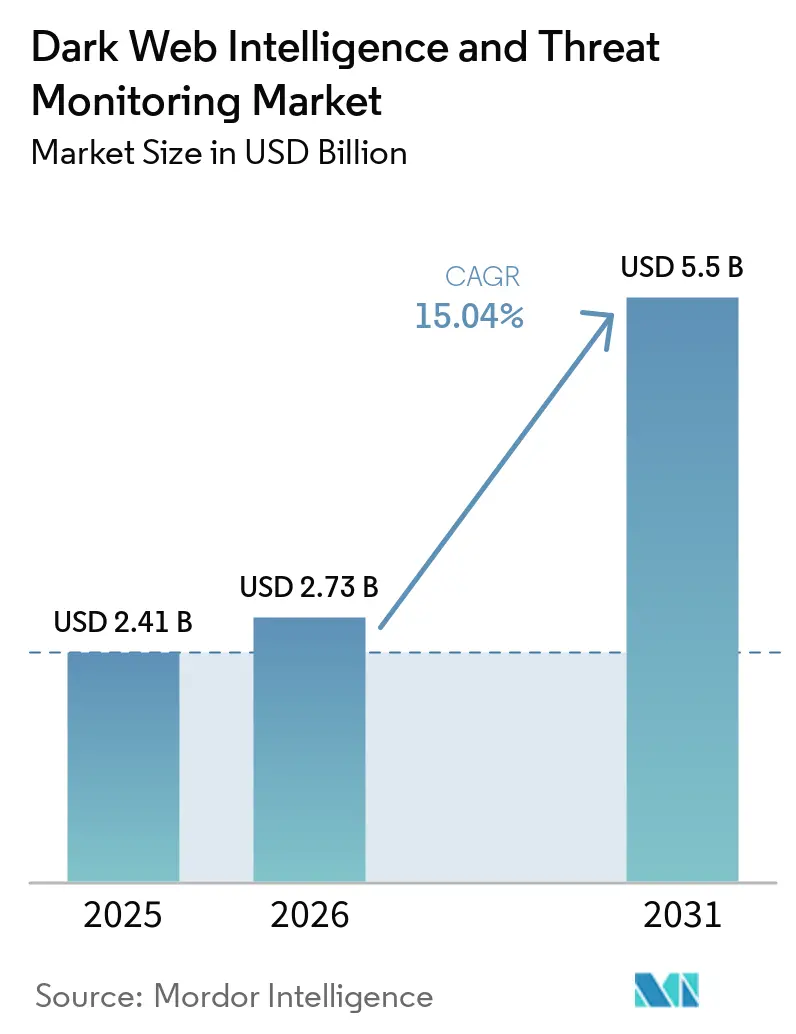
The dark web intelligence and threat monitoring market size is projected to be USD 2.41 billion in 2025, USD 2.73 billion in 2026, and reach USD 5.50 billion by 2031, growing at a CAGR of 15.04% from 2026 to 2031. Demand is rising as security teams move from breach response to continuous tracking of stolen data, compromised identities, and early attack signals. Threat actors now run credential theft, access brokerage, and ransomware operations as organized business lines, making periodic monitoring less effective. Identity exposure and cloud-focused intrusions have become central risk areas, so buyers are placing greater value on platforms that can surface threats before they are used in live attacks. Vendors are responding with broader intelligence suites, AI-assisted triage, and managed delivery models that reduce the burden on internal teams. Growth remains supported by this shift, although hiring limits for skilled analysts and legal uncertainty around collection methods still constrain how far some deployments can go.
Key Report Takeaways
- By component, software held 59.91% share of the dark web intelligence and threat monitoring market in 2025, while services are projected to expand at a 16.12% CAGR through 2031.
- By deployment, cloud accounted for 53.02% of the market in 2026, while hybrid is projected to record the highest CAGR at 16.23% through 2031.
- By intelligence type, dark web monitoring led with 27.19% share of the dark web intelligence and threat monitoring market in 2025, while credential intelligence is projected to grow fastest at a 16.45% CAGR through 2031.
- By end-user industry, BFSI accounted for 16.21% share of the dark web intelligence and threat monitoring market in 2025, while healthcare and life sciences are projected to expand at a 16.56% CAGR through 2031.
- By enterprise size, large enterprises captured 58.14% of the market in 2025, while small and medium enterprises are projected to grow at a 16.34% CAGR through 2031.
- By geography, North America held 31.18% share of the dark web intelligence and threat monitoring market in 2025, while Asia-Pacific is projected to post the highest regional CAGR at 16.67% through 2031.
Note: Market size and forecast figures in this report are generated using Mordor Intelligence’s proprietary estimation framework, updated with the latest available data and insights as of January 2026.
Market Trends and Insights
Drivers Impact Analysis of Dark Web Intelligence and Threat Monitoring Market*
| Driver | (~) % Impact on CAGR Forecast | Geographic Relevance | Impact Timeline |
|---|---|---|---|
| Rising Credential Theft and Account Takeover | +3.5% | Global, with the strongest exposure in North America and Europe | Short term (≤ 2 years) |
| Expansion Of Ransomware-As-A-Service and Access Broker Networks | +3.0% | Global, with notable exposure in North America, Europe, and Asia-Pacific | Medium term (2-4 years) |
| Regulatory Pressure for Breach Detection and Incident Readiness | +2.5% | Europe, North America, and Asia-Pacific | Medium term (2-4 years) |
| Growth f AI-Enabled Threat Hunting and Correlation Workflows | +2.0% | Global, with earlier adoption in North America and Western Europe | Long term (≥ 4 years) |
| Shadow Procurement of Stolen Data by Fraud and FinCrime Teams | +1.5% | North America and Europe, with spillover into Asia-Pacific and the Middle East | Medium term (2-4 years) |
| Demand From Critical Infrastructure and Defense Units | 1.0% | North America, Europe, and selected Asia-Pacific markets | Long term (≥ 4 years) |
| Source: Mordor Intelligence | |||
Rising Frequency of Credential Theft And Account Takeover
Credential theft has become the most consistent path into enterprise systems, and this shift is pushing the dark web intelligence and threat-monitoring market toward continuous monitoring rather than periodic review. KELA reported 2.86 billion compromised credentials in 2025, and business cloud and authentication services accounted for more than 30% of all exposed data, underscoring the centrality of identity to attack activity. The Identity Theft Resource Center reported that unauthorized device access overtook social engineering as the main compromise method for adults aged 35-64, which points to the growing role of infostealer-led credential exposure.[1] In practice, stolen credentials often appear in criminal channels before they are used, which creates a short but valuable response window for security teams. That window matters because defenders can reset credentials, revoke sessions, and tighten controls before an exposed account becomes an active intrusion path. As a result, the dark web intelligence and threat monitoring market is benefiting from a clear buyer preference for tools that turn credential exposure into early action.
Expansion of Ransomware-As-A-Service and Initial Access Broker Ecosystems
Ransomware groups now depend on a broader supply chain, making upstream monitoring more valuable in the dark web intelligence and threat monitoring market. Rapid7 observed that initial access brokers shifted toward higher-value enterprise targets and premium pricing in the second half of 2025, suggesting a more selective, profit-focused underground economy.[2] CrowdStrike reported that 42% of vulnerabilities were exploited before public disclosure, which means access brokers can act before many defenders even begin patch cycles. KELA also reported that ransomware incidents rose by more than 53% in 2025, reinforcing the link between stolen access, brokered entry, and later extortion activity. This matters because monitoring access listings gives defenders lead time that traditional incident response does not provide. That lead time is one of the clearest reasons enterprises continue to raise spending in the dark web intelligence and threat monitoring market.
Regulatory Pressure for Breach Detection and Incident Readiness
Compliance deadlines are turning dark web monitoring into routine control for regulated organizations, strengthening demand in the dark web intelligence and threat monitoring market. Sysdig noted that DORA entered into force on January 17, 2025, with no transition period, and the framework requires covered financial entities to provide rapid incident reporting once a major event is classified.[3] NIS2 extended similar expectations across critical sectors, and its 24-hour early-warning requirement leaves little room for passive or manual approaches. ISACA also noted that DORA requires continuous monitoring of ICT systems and regularly tested anomaly-detection mechanisms, which align closely with platform-based threat intelligence and alerting. The commercial effect is straightforward: tools that identify leaked credentials, exposed data, or active threat chatter can enable faster internal validation and reporting. This means the dark web intelligence and threat monitoring market is benefiting not only from security budgets but also from audit, resilience, and governance priorities.
Growth of AI-Enabled Threat Hunting and Correlation Workflows
AI-enabled analysis is changing how quickly large data volumes can be processed, raising expectations across the dark web intelligence and threat monitoring market. Google Cloud said its Gemini-powered capability brings dark web intelligence into AI-driven workflows and is designed to identify organization-specific threats at scale.[4] Team Cymru launched its Pure Signal MCP Server in April 2026 to let agentic AI systems query large threat intelligence datasets in real time, which points to faster machine-led investigation models. Dropzone AI stated that hunts that once consumed 40 analyst hours could be reduced to around 1 hour with AI-augmented execution, which shows the scale of possible efficiency gains. Faster triage changes operating rhythm because weekly hunts can become daily, and daily monitoring can move much closer to real time. This means the dark web intelligence and threat monitoring market is moving toward platforms that can correlate alerts, prioritize action, and reduce the time between detection and response.
Restraints Impact Analysis of Dark Web Intelligence and Threat Monitoring Market*
| Restraint | (~) % Impact on CAGR Forecast | Geographic Relevance | Impact Timeline |
|---|---|---|---|
| High False-Positive Rates In Open-Web And Dark-Web Correlation | -1.5% | Global, with the strongest effect in organizations with less mature intelligence programs | Medium term (2-4 years) |
| Operational Friction From Encrypted, Decentralized, And Ephemeral Sources | -1.2% | Global, with greater impact where non-English source coverage is weaker | Long term (≥ 4 years) |
| Shortage Of Skilled Analysts For Triage And Validation | -0.8% | Global, with more severe gaps in Asia-Pacific and the Middle East and Africa | Long term (≥ 4 years) |
| Legal And Ethical Constraints On Data Collection And Attribution | -0.6% | Europe, North America, and Asia-Pacific | Long term (≥ 4 years) |
| Source: Mordor Intelligence | |||
High False-Positive Rates in Open-Web and Dark-Web Correlation
False positives remain one of the most practical limits on value creation in the dark web intelligence and threat monitoring market. Teams that receive unverified alerts still need to compare them against internal identity records, access histories, and known breach timelines before they can act with confidence. The problem is structural because criminal forums carry recycled breach data, repackaged dumps, and misleading datasets that are hard to validate quickly. The Identity Theft Resource Center noted that attackers are using AI to repurpose old stolen records into more convincing threat packages, increasing noise and making correlation harder. This pushes many buyers toward managed services, where vendors assume a greater share of the validation burden before alerts reach the customer. It also means providers with better contextual graphing and stronger enrichment tend to stand out in the dark web intelligence and threat monitoring market.
Operational Friction From Encrypted, Decentralized, and Ephemeral Dark-Web Sources
Source visibility remains uneven, which continues to limit full coverage across the dark web intelligence and threat monitoring market. Threat actors move between rotating onion sites, private messaging groups, and invite-only communities that are designed to reduce outside observation. BSI reported an average of 119 new vulnerabilities per day in its 2025 IT security review, and broader pressure on external attack surfaces increases the value of timely intelligence while also making it harder to keep coverage current. Automated crawling alone is often not enough because private channels, non-English communities, and fast migrations can leave blind spots. This creates a clear gap between platforms that combine automation with human collection and those that rely only on indexed or easily reachable sources. As that gap remains, the dark web intelligence and threat monitoring market continues to reward vendors that can prove deeper source access rather than broad claims alone.
*Our forecasts treat driver/restraint impacts as directional, not additive. The impact forecasts reflect baseline growth, mix effects, and variable interactions.
Dark Web Intelligence and Threat Monitoring Market Segment Analysis
By Component:
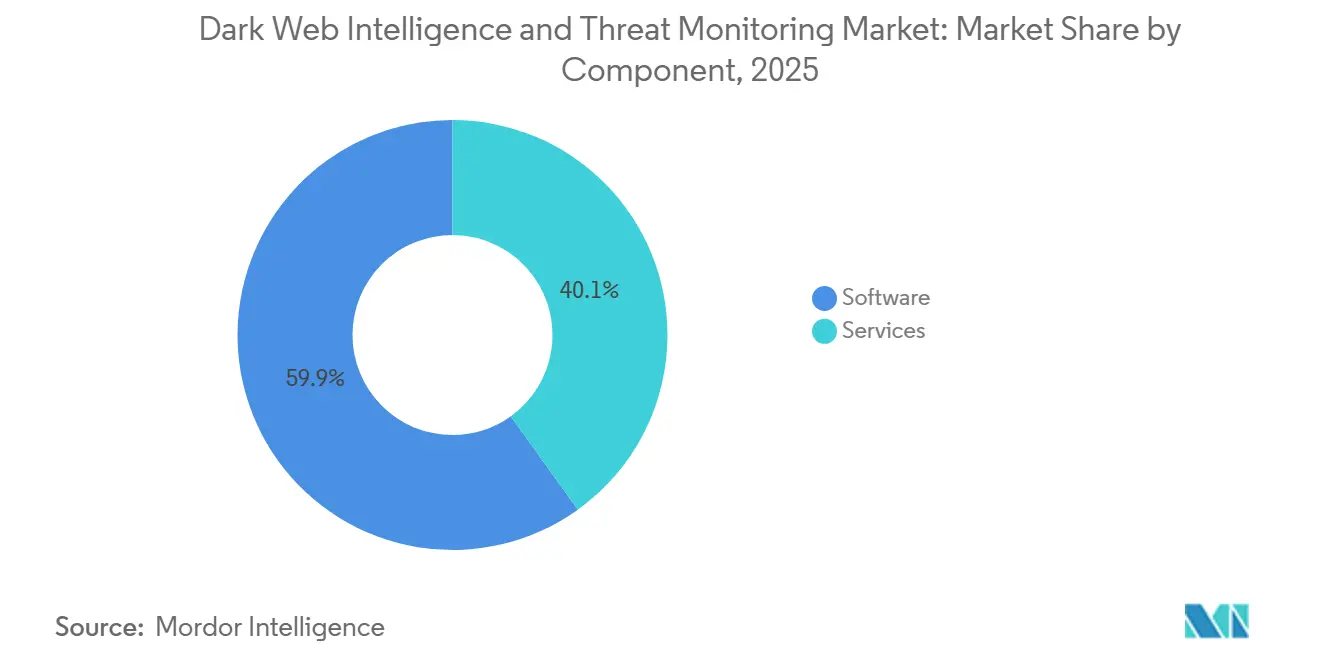
Services Growth Reshapes The Platform Procurement ModelSoftware retained 59.91% of the dark web intelligence and threat monitoring market share in 2025, which reflects the strong position of platform-based offerings in enterprise security programs. Buyers continue to favor software because it supports continuous updates, API-based integration, and a centralized workflow for alerting, investigation, and reporting. In many large deployments, the software layer is tied directly to SIEM and SOAR environments, so dark web findings can feed broader detection and response processes. This has helped software remain the default choice for organizations that already have internal analysts and established operating models.
The second part of the picture is changing faster, and that is why services are becoming more important in the dark web intelligence and threat monitoring market. Services are projected to grow at a 16.12% CAGR from 2026 to 2031, which is the fastest pace within this segmentation. Managed security providers are embedding dark web monitoring into wider detection and response bundles, which lowers adoption barriers for teams that lack dedicated intelligence staff. This matters most for mid-sized organizations that want coverage but do not want to build collection, validation, and escalation workflows on their own. AI-assisted triage is also helping providers reduce manual effort in alert handling, which improves the economics of managed delivery. The result is not a decline in software demand, but a clearer split between buyers that want platform control and buyers that want operational support. That shift keeps both revenue pools relevant inside the dark web intelligence and threat monitoring market, while tilting incremental growth toward service-led models. It also broadens the addressable base because more organizations can now purchase outcomes instead of building full internal capability.
By Deployment:
Hybrid Architectures Emerge As The Governance-Conscious ChoiceCloud deployment held 53.02% of the market in 2026, underscoring how strongly buyers value scale, update speed, and lower infrastructure overhead in the dark web intelligence and threat monitoring market. Cloud platforms can ingest new source data quickly, support multi-tenant delivery, and roll out model or workflow improvements without lengthy customer-side deployment cycles. This is especially attractive for organizations with lean security engineering teams, since they can access current intelligence without maintaining large local environments. Cloud also fits well with the growing use of subscription-based delivery, which has widened access beyond large enterprise accounts.
Hybrid deployment is projected to post the highest growth at a 16.23% CAGR through 2031, and that performance reflects a governance compromise rather than a rejection of cloud. In this part of the dark web intelligence and threat monitoring market, hybrid models are gaining traction because they allow organizations to keep sensitive workflows or internal mappings in controlled environments while still receiving broad external intelligence. Financial institutions, defense contractors, and public sector buyers often need that split because some data, users, or response processes cannot leave tightly governed environments. The wider regulatory focus on resilience and continuous monitoring is reinforcing this approach, especially where reporting obligations are strict. On-premises deployment still has relevance, but vendors are investing most of their innovation in cloud-native roadmaps, which can leave local installations behind in terms of feature depth over time. Hybrid benefits from that gap because it attracts buyers who want modern intelligence breadth without moving all activity into public cloud environments. This positions hybrid as the most practical bridge between compliance needs and platform modernization in the dark web intelligence and threat monitoring market. It also suggests future wins will depend less on pure hosting location and more on how well vendors separate collection, analysis, and sensitive internal action.
By Enterprise Size:
SME Procurement Unlocks The Market's Largest Untapped SegmentLarge enterprises accounted for 58.14% of revenue in 2025, reflecting their established security operations, broader attack surfaces, and larger budgets in the dark web intelligence and threat monitoring market. These organizations are more likely to run multi-module deployments that cover leaked credentials, brand abuse, third-party exposure, and threat actor tracking in a single program. They also have stronger integration capacity, which means alerts can trigger automated credential resets, access reviews, or broader incident workflows. That operating maturity helps explain why large enterprises continue to anchor present demand.
Growth is shifting toward smaller buyers, and small and medium enterprises are projected to expand at a 16.34% CAGR through 2031. Affordable SaaS delivery has made the dark web intelligence and threat monitoring market more reachable for firms that previously lacked the budget or staff to buy dedicated intelligence tools. Managed security service providers are the main route into this customer group because they package monitoring with broader support and simpler commercial terms. This matters because SMEs often need usable alerts more than full investigative depth, and bundled services meet that need better than complex platform ownership. Cyber insurance requirements and rising concern over credential exposure are also making continuous monitoring easier to justify at the smaller company level. The result is a broad greenfield opportunity for vendors that can keep pricing simple, maintain high alert quality, and keep onboarding light. This is why the dark web intelligence and threat-monitoring market is no longer tied solely to large enterprise security teams. It is also becoming a service-led product category for organizations that want basic visibility without a large internal intelligence function.
By Intelligence Type:
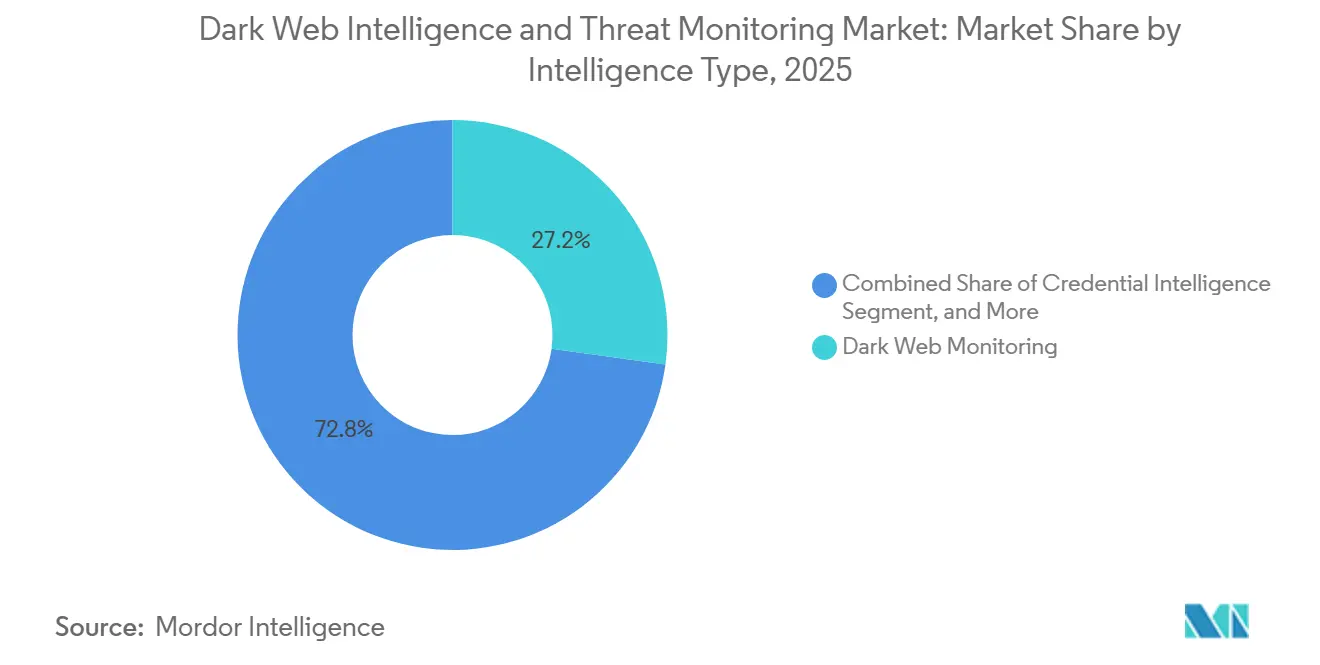
Credential Intelligence's Ascent Signals A Shift From Visibility To PreemptionDark web monitoring held a 27.19% share in 2025, maintaining its leading position among intelligence types in the dark web intelligence and threat monitoring market. That leadership reflects long-standing demand for visibility into hidden forums, marketplaces, and channels where stolen data, leaked records, and threat actor discussions appear. Deep web monitoring remains relevant for restricted or login-protected spaces, while surface web intelligence extends coverage to open but contextually important locations such as paste sites, repositories, and public communication channels. Brand and identity intelligence also remains important because impersonation, executive targeting, and fraudulent domain use continue to rise as AI-generated content spreads.
The growth center is now moving toward more specific identity exposure workflows, and credential intelligence is projected to grow at a 16.45% CAGR through 2031. In this area of the dark web intelligence and threat monitoring market, buyers are paying for specialized parsing, deduplication, and attribution that generic monitoring tools often lack. Infostealer logs now include session cookies and other access artifacts, in addition to passwords, making raw collection less useful unless it is linked to organizational context. That has changed the nature of value in the dark web intelligence and threat monitoring market, as buyers now want actionable user-device-domain mapping rather than broad mention tracking alone. Credential intelligence supports targeted remediation, which is usually faster and less disruptive than wide password reset programs across entire organizations. Vendors that can process stolen log data at scale are gaining an advantage over older monitoring-only products. The shift does not reduce the need for dark web visibility, but it does raise the bar for what constitutes useful visibility. Over time, the strongest platforms will be those that can connect forum chatter, stolen logs, and internal action paths into one response chain.

By End-User Industry:
Healthcare Overtakes Financial Services As The Most Vulnerable Growth MarketBFSI retained the largest end-user share at 16.21% in 2025, reflecting the direct monetary value of compromised credentials and fraud-linked data in the dark web intelligence and threat monitoring market. Financial institutions have treated external threat intelligence as a core control for longer than most sectors, because exposed access can quickly lead to fraud, account abuse, and downstream losses. CrowdStrike reported a 27% increase in the number of financial services victims named on dark web leak sites from April 2025 to March 2026, indicating that high spending has not reduced attackers' interest. INTERPOL also noted that dark web marketplaces now offer AI-enabled fraud tools such as voice cloning and automated fraud support, which adds another layer of intelligence that banks and payment firms need.
Healthcare and life sciences are projected to record the fastest CAGR of 16.56% through 2031, driven by a clear exposure gap rather than simple digitization. Many healthcare organizations still lack mature monitoring for leaked credentials, even though stolen access can sit in criminal channels before it is used in live intrusions. The Change Healthcare breach was confirmed to affect 190 million individuals in January 2025, and the incident was linked to stolen credentials used against a Citrix portal without multi-factor authentication. That case matters because it shows how earlier visibility into exposed credentials could support targeted prevention before an intrusion expands. IT and telecom, retail and e-commerce, industrial manufacturing, and government and public sector all maintain meaningful demand in the dark web intelligence and threat monitoring industry because each faces a different mix of fraud, espionage, and operational disruption risk. Industrial manufacturing and government are also seeing stronger procurement momentum as concern grows around operational technology and critical infrastructure exposure. This keeps the dark web intelligence and threat monitoring market broad, but it also makes healthcare the clearest growth story at the sector level. In practical terms, the fastest-expanding verticals are the ones where identity exposure, delayed detection, and business impact now intersect most directly.
Geography Analysis
North America Dark Web Intelligence and Threat Monitoring Market
North America held 31.18% of the dark web intelligence and threat monitoring market share in 2025, maintaining its leading regional position. The region benefits from deep security spending, a concentrated vendor base, and broad familiarity with breach disclosure and proactive monitoring. The New Jersey Cybersecurity and Communications Integration Cell noted that more than 15 billion credential sets are accessible on the internet, and that credential-based attacks remain the top threat vector for public and private organizations. Canada reinforced this direction, stating in its National Cyber Threat Assessment for 2025-2026 that state-sponsored cyber activity is expected to remain a top threat. The United States remains the primary revenue center in the dark web intelligence and threat monitoring market, as large enterprises, financial institutions, and public sector operators drive recurring demand.
Europe Dark Web Intelligence and Threat Monitoring Market
Europe remained the second-largest regional market, and its momentum is closely tied to formal resilience and reporting requirements. ISACA highlighted that DORA and NIS2 require continuous monitoring and rapid reporting, which support procurement across financial services and other critical sectors. Germany sends a clear signal: BSI recorded an average of 119 new vulnerabilities per day in its 2025 review, while the BKA reported more than 36,000 DDoS attacks on Deutsche Telekom infrastructure, up 25% from 2024. The United Kingdom, France, and the Benelux cluster continue to drive enterprise demand, while Southern and Eastern Europe remain earlier-stage opportunities for service-led expansion.
APAC, MEA and South America Dark Web Intelligence and Threat Monitoring Market
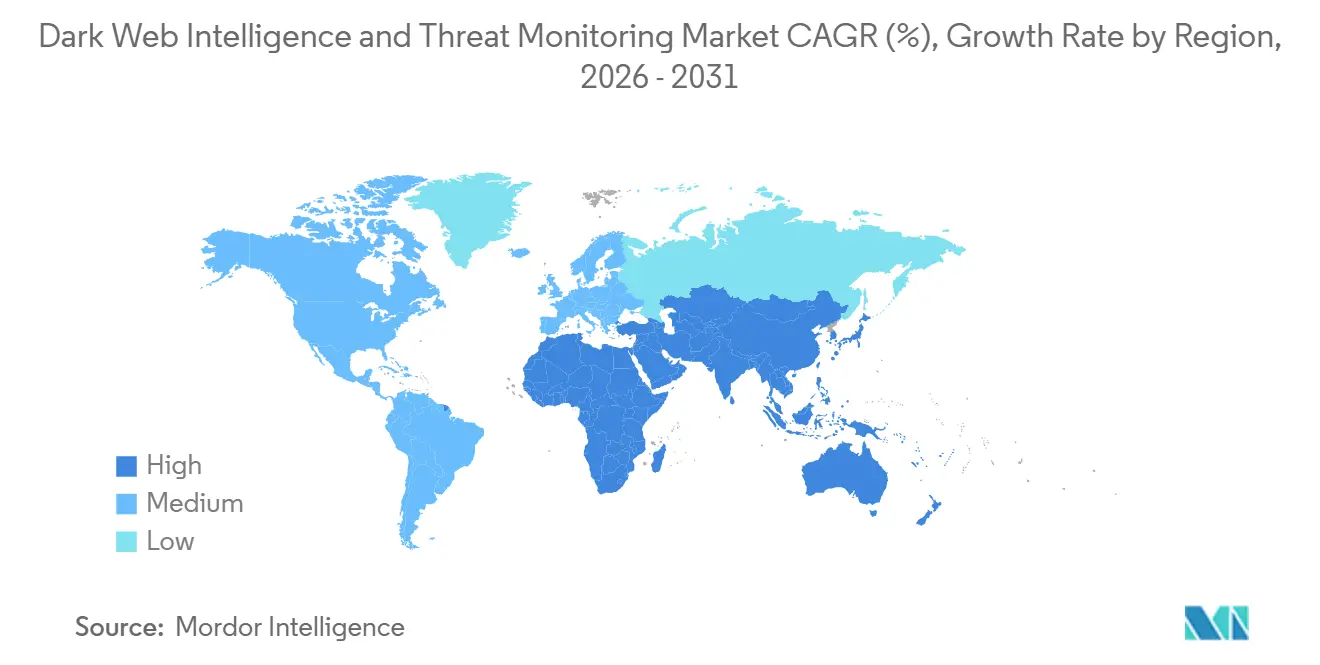
Asia-Pacific is projected to post the highest regional CAGR of 16.67% through 2031, making it the fastest-growing geography in the dark web intelligence and threat monitoring market. Growth is being supported by expanding digital payments, rising cybercrime exposure, and a more demanding compliance environment across large economies. Australia is an important example because the Cyber Security Act 2024 and the Notifiable Data Breaches scheme have increased the practical value of continuous monitoring for organizations handling sensitive data. China, Japan, South Korea, and parts of Southeast Asia are also expanding demand, with SMEs showing growing interest in cloud-delivered services. South America remains an emerging opportunity led by Brazil and Argentina, especially in financial services and government use cases tied to credential theft and digital banking risk. The Middle East and Africa are also seeing stronger interest, particularly in Gulf financial institutions and in South Africa and Nigeria, where telecommunications and banking infrastructure are attracting increased attention. Taken together, these patterns show that the dark web intelligence and threat monitoring market is no longer centered solely on mature Western buyers, but is expanding into fast-digitizing regions with rising exposure.
Competitive Landscape
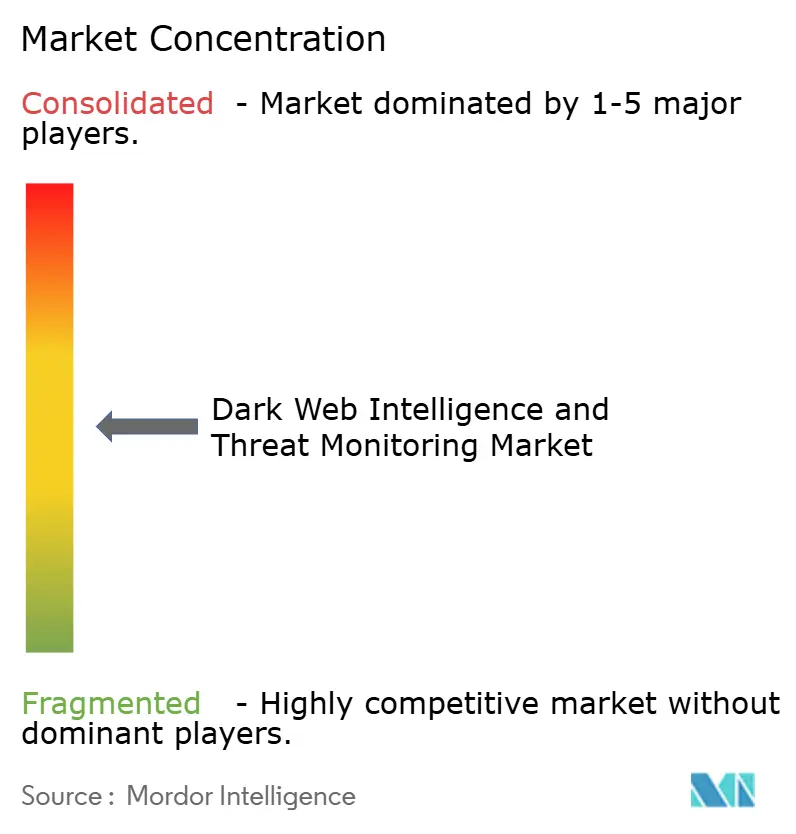
The dark web intelligence and threat monitoring market remains moderately fragmented, with a small group of scaled vendors leading a wider field of specialists. ZeroFox stated that Gartner recognized ZeroFox, Recorded Future, CrowdStrike, and Group-IB as Leaders in cyberthreat intelligence technologies in 2026, which reflects the strength of platform-based suites that combine monitoring, brand protection, and attribution. Mastercard strengthened that platform trend by completing its USD 2.65 billion acquisition of Recorded Future in December 2024, which linked payment fraud telemetry with broader intelligence workflows. Mastercard later expanded the strategic logic by introducing a threat intelligence solution for payment fraud and by partnering with Cloudflare in February 2026 to extend attack surface monitoring and remediation support. These moves show that leadership in the dark web intelligence and threat monitoring market is increasingly tied to ecosystem reach rather than raw collection depth.
Specialist vendors still matter because they compete on narrower but important strengths inside the dark web intelligence and threat monitoring market. Bitsight integrated Cybersixgill into its broader exposure management proposition, connecting external attack surface visibility with dark web intelligence in a single commercial story. Flashpoint followed a similar path in May 2026, launching its External Attack Surface Management module and expanding operational workflows to address priority intelligence requirements and managed attribution. These examples matter because buyers increasingly want joined-up workflows, where external exposure, underground activity, and internal action are linked instead of purchased as separate tools. That preference is changing how competition works in the dark web intelligence and threat monitoring market, especially for providers that once sold point capabilities.
Another pressure point is coming from hyperscale and AI-led workflows, which are raising the baseline for speed and automation in the dark web intelligence and threat monitoring market. Google Cloud positioned its Gemini-powered capability as a way to process dark web intelligence at scale and surface organization-specific threats more efficiently. Team Cymru also signaled a move toward machine-driven investigation by enabling agentic AI access to large threat datasets in real time. This creates room for vendors that can serve SMEs through managed models, and it also creates pressure on mid-tier firms that cannot match either source depth or AI-led efficiency. In that setting, the dark web intelligence and threat monitoring market is likely to reward vendors that combine trusted collection, clear action paths, and scalable automation rather than any single feature alone.
Dark Web Intelligence and Threat Monitoring Industry Leaders
-
Recorded Future, Inc.
-
CrowdStrike, Inc.
-
ZeroFox Holdings, Inc.
-
DarkOwl, LLC
-
Flashpoint, Inc.
- *Disclaimer: Major Players sorted in no particular order
Dark Web Intelligence and Threat Monitoring Market Companies Covered in this Report
- Recorded Future, Inc.
- CrowdStrike, Inc.
- ZeroFox Holdings, Inc.
- DarkOwl, LLC
- Flashpoint, Inc.
- KELA Group Ltd.
- Cybersixgill Ltd.
- Rapid7, Inc
- ReliaQuest, LLC
- Searchlight Cyber Ltd.
- SpyCloud, Inc.
- OneAvenue Ltd.
- EclecticIQ B.V.
- ThreatConnect, Inc.
- BitSight Technologies, Inc.
- Cyberint Ltd
- Google LLC
- Microsoft Corporation
- IBM Corporation
- Palo Alto Networks, Inc.
Recent Industry Developments in Dark Web Intelligence and Threat Monitoring Market
- June 2026: ZeroFox launched ZeroFox AI Analytics, a new in-platform capability enabling security teams real-time visibility into alert trends, disruption outcomes, and external threat signals through interactive dashboards and a Scout AI Assistant. The launch extends ZeroFox's platform beyond passive monitoring toward analytics-driven strategic intelligence reporting for enterprise security leadership.
- June 2026: CrowdStrike released the 2026 Technology Threat Landscape Report, revealing that China-nexus adversaries drove more than 58% of state-sponsored targeted intrusions against the technology sector, with AI intellectual property the primary target. The report is derived from Counter Adversary Operations tracking more than 280 named adversaries and directly informs CrowdStrike's dark web and deep web monitoring roadmap priorities.
- May 2026: ZeroFox was named a Leader in the Gartner Magic Quadrant for Cyberthreat Intelligence Technologies, reflecting its platform capabilities in external threat discovery, active disruption, and dark web monitoring. The recognition positions ZeroFox alongside CrowdStrike, Recorded Future, and Group-IB as a tier-1 intelligence platform.
- May 2026: ZeroFox was named a Leader in the Gartner Magic Quadrant for Cyberthreat Intelligence Technologies, reflecting its platform capabilities in external threat discovery, active disruption, and dark web monitoring. The recognition positions ZeroFox alongside CrowdStrike, Recorded Future, and Group-IB as a tier-1 intelligence platform.
Global Dark Web Intelligence and Threat Monitoring Market Report Scope
The Dark Web Intelligence and Threat Monitoring market refers to solutions and services that provide organizations with visibility into malicious activities across the dark web, deep web, and surface web to detect threats such as credential leaks, brand impersonation, identity theft, and illicit data trading. These platforms leverage advanced monitoring, analytics, and intelligence-sharing capabilities to proactively identify risks, safeguard sensitive information, and strengthen cyber defense strategies. Driven by the rise in cybercrime marketplaces, increasing data breaches, and regulatory compliance requirements, industries including BFSI, healthcare, IT, manufacturing, retail, and government are adopting these solutions to mitigate risks and enhance resilience. The primary objective of this market is to deliver actionable intelligence that enables organizations to anticipate, prevent, and respond effectively to emerging cyber threats originating from hidden online ecosystems.
The Dark Web Intelligence and Threat Monitoring market report is segmented by Component (Software and Services), Deployment (Cloud, On-Premises, and Hybrid), Enterprise Size (Large Enterprises and Small and Medium Enterprises), Intelligence Type (Dark Web Monitoring, Deep Web Monitoring, Surface Web Intelligence, Credential Intelligence, Brand and Identity Intelligence), End-user Industry (BFSI, Healthcare and Life Sciences, Information Technology and Telecom, Retail and E-commerce, Industrial Manufacturing, Government and Public Sector, and Other End-user Industries), and Geography (North America, South America, Europe, Asia-Pacific, Middle East, and Africa). The Market Forecasts are Provided in Terms of Value (USD).
Segmentation Overview
| Software |
| Services |
| Cloud |
| On-Premises |
| Hybrid |
| Large Enterprises |
| Small and Medium Enterprises |
| Dark Web Monitoring |
| Deep Web Monitoring |
| Surface Web Intelligence |
| Credential Intelligence |
| Brand and Identity Intelligence |
| BFSI |
| Healthcare and Life Sciences |
| Information Technology and Telecom |
| Retail and E-commerce |
| Industrial Manufacturing |
| Government and Public Sector |
| Other End-user Industries |
| North America | United States | |
| Canada | ||
| Mexico | ||
| South America | Brazil | |
| Argentina | ||
| Rest of South America | ||
| Europe | Germany | |
| United Kingdom | ||
| France | ||
| Italy | ||
| Spain | ||
| Russia | ||
| Rest of Europe | ||
| Asia-Pacific | China | |
| India | ||
| Japan | ||
| South Korea | ||
| Australia | ||
| Rest of Asia-Pacific | ||
| Middle East and Africa | Middle East | Saudi Arabia |
| United Arab Emirates | ||
| Rest of Middle East | ||
| Africa | South Africa | |
| Nigeria | ||
| Rest of Africa | ||
| By Component | Software | ||
| Services | |||
| By Deployment | Cloud | ||
| On-Premises | |||
| Hybrid | |||
| By Enterprise Size | Large Enterprises | ||
| Small and Medium Enterprises | |||
| By Intelligence Type | Dark Web Monitoring | ||
| Deep Web Monitoring | |||
| Surface Web Intelligence | |||
| Credential Intelligence | |||
| Brand and Identity Intelligence | |||
| By End-user Industry | BFSI | ||
| Healthcare and Life Sciences | |||
| Information Technology and Telecom | |||
| Retail and E-commerce | |||
| Industrial Manufacturing | |||
| Government and Public Sector | |||
| Other End-user Industries | |||
| By Geography | North America | United States | |
| Canada | |||
| Mexico | |||
| South America | Brazil | ||
| Argentina | |||
| Rest of South America | |||
| Europe | Germany | ||
| United Kingdom | |||
| France | |||
| Italy | |||
| Spain | |||
| Russia | |||
| Rest of Europe | |||
| Asia-Pacific | China | ||
| India | |||
| Japan | |||
| South Korea | |||
| Australia | |||
| Rest of Asia-Pacific | |||
| Middle East and Africa | Middle East | Saudi Arabia | |
| United Arab Emirates | |||
| Rest of Middle East | |||
| Africa | South Africa | ||
| Nigeria | |||
| Rest of Africa | |||
Key Questions Answered in the Report
How large is the dark web intelligence and threat monitoring space in 2026?
The dark web intelligence and threat monitoring market was estimated at USD 2.73 billion in 2026 and is projected to reach USD 5.50 billion by 2031 at a 15.04% CAGR.
Which segment leads by component?
Software led by component with 59.91% share in 2025, while services is expected to grow faster through 2031 as managed delivery becomes more common.
Why is credential intelligence gaining momentum?
Credential intelligence is projected to grow at a 16.45% CAGR because buyers want earlier action on stolen credentials, session artifacts, and infostealer data rather than broad visibility alone.
Which end-user group is growing fastest?
Healthcare and life sciences is projected to record the fastest CAGR at 16.56% through 2031 because exposed credentials can remain undetected before they are used in intrusions.
Which region is expanding the fastest?
Asia-Pacific is expected to post the highest regional CAGR at 16.67% through 2031, supported by digital payments growth, higher cybercrime exposure, and stronger compliance activity.
What is shaping competition among vendors?
Competition is shifting toward broader platforms, AI-led triage, and integrated workflows that link external exposure, underground activity, and response actions in one environment.