
Cybersecurity Mesh Architecture (CSMA) Market Size and Share
Market Overview
| Study Period | 2020 - 2031 |
|---|---|
| Market Size (2026) | USD 3.37 Billion |
| Market Size (2031) | USD 8.69 Billion |
| Growth Rate (2026 - 2031) | 20.86 % |
| Fastest Growing Market | Asia-Pacific |
| Largest Market | North America |
| Market Concentration | Medium |
Major Players *Disclaimer: Major Players sorted in no particular order Image © Mordor Intelligence. Reuse requires attribution under CC BY 4.0. | |
Cybersecurity Mesh Architecture (CSMA) Market Analysis by Mordor Intelligence
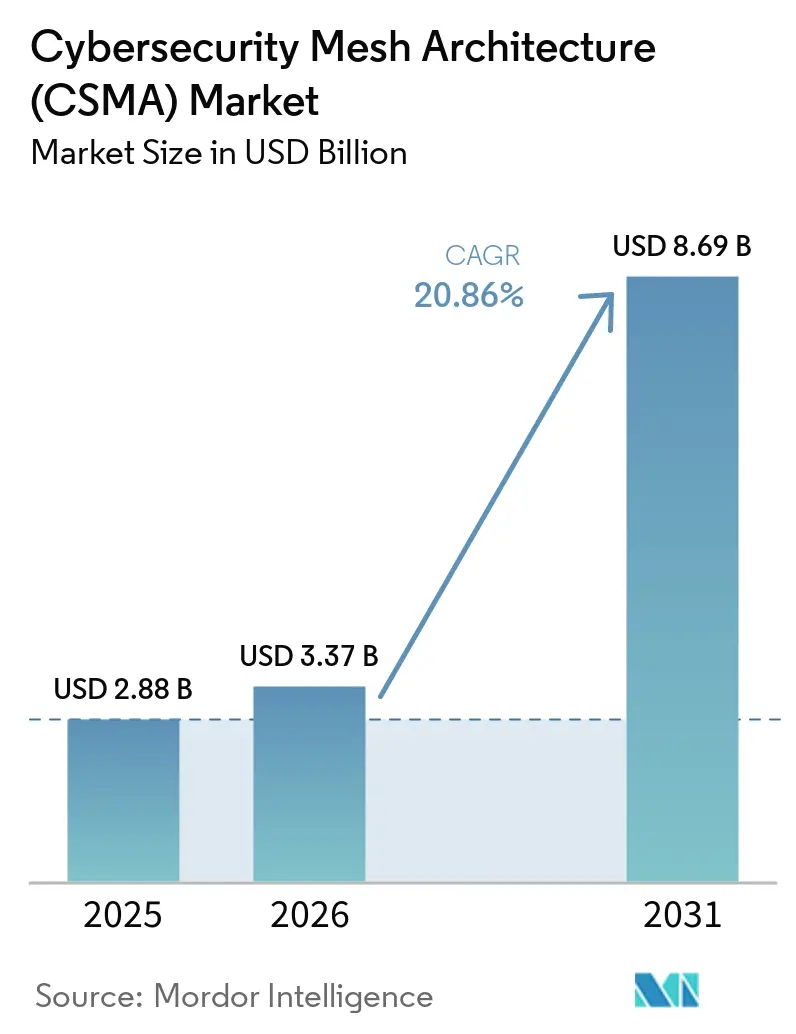
The Cybersecurity mesh architecture (CSMA) market size is projected to be USD 2.88 billion in 2025, USD 3.37 billion in 2026, and reach USD 8.69 billion by 2031, growing at a CAGR of 20.86% from 2026 to 2031. The main force behind this expansion is the breakdown of the traditional enterprise perimeter as remote work, multi-cloud environments, and connected devices continue to spread across business operations. Security teams now need a policy model that follows users, applications, and assets across multiple environments rather than relying on a single fixed network boundary. Regulatory pressure is also making it harder to defer this spending because organizations must continuously monitor access, identities, and third-party exposure. The same investments that support compliance are also helping enterprises prepare for machine identities and AI agents, which broadens the long-term role of the Cybersecurity mesh architecture (CSMA) market. Competition remains intense because buyers want unified platforms, but integration complexity and limited specialist talent still slow full-scale deployment in many organizations.
Key Report Takeaways
- By component, software held 60.91% share of Cybersecurity mesh architecture (CSMA) market in 2025, while services are projected to expand at a 22.94% CAGR through 2031.
- By deployment, cloud accounted for 53.87% of revenue in 2025, while hybrid is expected to record the fastest growth at a 23.05% CAGR through 2031.
- By enterprise size, large enterprises accounted for 59.16% of revenue in 2025, while SMEs are projected to grow at a 23.16% CAGR through 2031.
- By end-user industry, BFSI held 16.18% of revenue in 2025, while healthcare and life sciences are expected to post the fastest growth at a 23.27% CAGR through 2031.
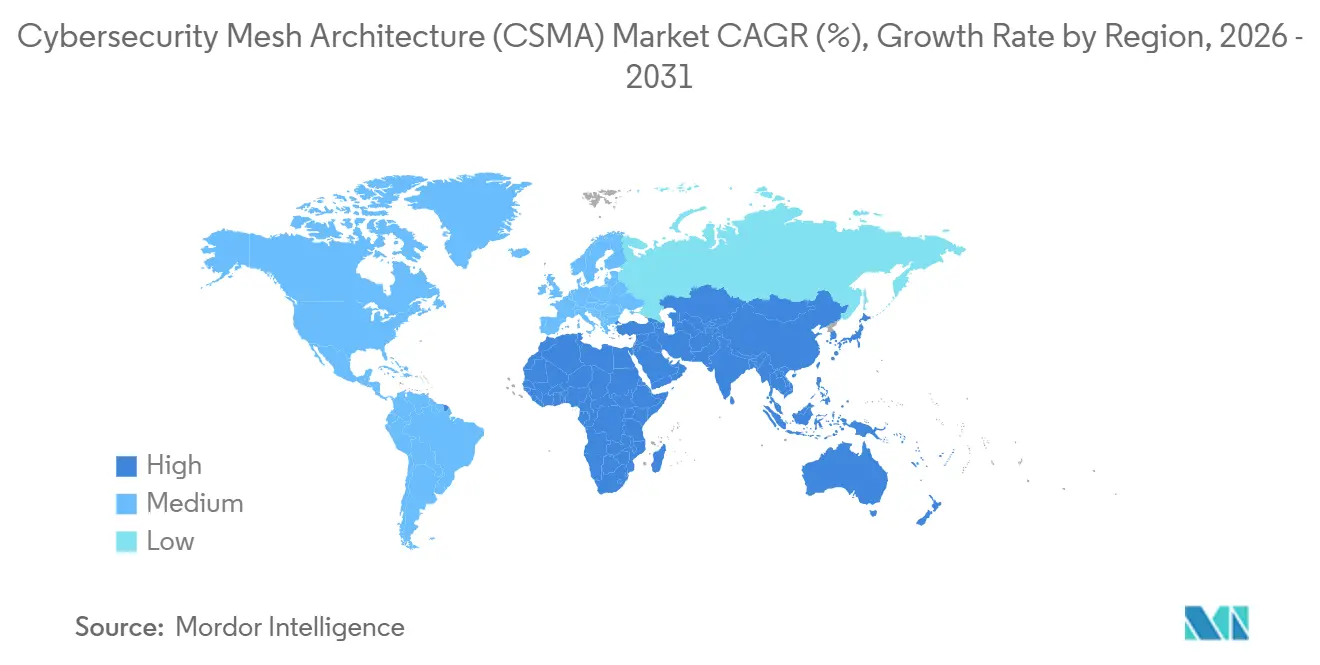
- By geography, North America held 32.12% of the Cybersecurity mesh architecture (CSMA) market share in 2025, while Asia-Pacific is projected to expand at a 23.38% CAGR through 2031.
Note: Market size and forecast figures in this report are generated using Mordor Intelligence’s proprietary estimation framework, updated with the latest available data and insights as of January 2026.
Market Trends and Insights
Drivers Impact Analysis of Cybersecurity Mesh Architecture (CSMA) Market*
| Driver | (~) % Impact on CAGR Forecast | Geographic Relevance | Impact Timeline |
|---|---|---|---|
| Rapid Shift To Distributed and Hybrid IT Environments | +4.2% | Global | Short term (≤ 2 years) |
| Zero Trust Program Expansion Across Enterprises | +3.8% | Global, concentrated in North America and EU | Medium term (2-4 years) |
| Rising Identity-Centric Security Orchestration Needs | +3.0% | Global | Medium term (2-4 years) |
| Tool Sprawl Forcing Cross-Platform Security Coordination | +2.5% | Global | Short term (≤ 2 years) |
| Compliance Pressure Around Continuous Access Verification | +2.1% | North America and EU | Medium term (2-4 years) |
| Security Teams Seeking Lower Mean Time to Contain Incidents | +1.5% | Global | Short term (≤ 2 years) |
| Source: Mordor Intelligence | |||
Rapid Shift to Distributed And Hybrid IT Environments
The move to distributed and hybrid IT remains the strongest driver of demand for the Cybersecurity mesh architecture (CSMA) market. Distributed IT environments are also driving demand in the cybersecurity mesh market. Enterprises now run workloads across on-premises sites, public clouds, private clouds, and edge locations simultaneously, weakening single-perimeter defense models. NIST Special Publication 800-207 states that modern enterprise networks no longer have a clearly defined perimeter, which supports the need for distributed security controls.[1] This operating model is no longer temporary for most organizations, especially in financial services and manufacturing, where operational and information technology are now more closely connected. Cisco’s 2025 AI Workforce Consortium report also identified service mesh and zero-trust architecture as high-severity skill gaps across G7 economies, underscoring how quickly hybrid IT is advancing relative to available expertise.[2]
Zero Trust Program Expansion Across Enterprises
Zero-trust programs are moving from pilot projects into broader production use, which is supporting the Cybersecurity mesh architecture (CSMA) market. Organizations that adopted zero trust with separate identity, endpoint, and network tools often found that these controls led to fragmented enforcement across distributed environments. A mesh-based design helps connect those controls so that verification, segmentation, and policy decisions work together more consistently. NIST’s Cybersecurity Framework 2.0 release reinforces this direction by linking governance and protection outcomes in a way that aligns well with composable security controls. This makes the Cybersecurity mesh architecture (CSMA) market more resilient than purely discretionary security spending because these programs are increasingly tied to formal operating and compliance requirements.
Rising Identity-Centric Security Orchestration Needs
Identity orchestration is becoming more central because non-human identities, service accounts, tokens, and AI agents are now a much larger part of enterprise environments. Traditional identity programs were built mainly around human users, but the Cybersecurity mesh architecture (CSMA) market is now expanding into machine identity governance as well. Cisco’s announced acquisition of Astrix Security in 2026 was aimed at improving the discovery and control of non-human identities across production environments, underscoring how quickly this area is moving into core platform strategy. CrowdStrike also introduced Continuous Identity for AI Agents in June 2026, replacing static privilege models with real-time, risk-aware authorization for agentic identities. As a result, the identity layer is widening the scope of the Cybersecurity mesh architecture (CSMA) market beyond workforce access into automated systems and AI-driven workflows.[3]
Tool Sprawl Forcing Cross-Platform Security Coordination
Tool sprawl is pushing many organizations toward an interoperability layer instead of another isolated point solution. Large enterprises often operate dozens of security tools from multiple vendors, creating visibility gaps and slowing response times when signals do not align. That makes the Cybersecurity mesh architecture (CSMA) market easier to justify, as mesh models can connect existing tools rather than forcing immediate replacement. IBM, Red Hat, and Palo Alto Networks expanded Project Lightwell in June 2026 to combine virtual patching with software remediation across open-source, commercial, operational technology, and healthcare environments, reflecting the same cross-platform coordination need seen in CSMA deployments. As AI workloads add more telemetry streams and access models, the value of a unifying control layer in the Cybersecurity mesh architecture (CSMA) market becomes stronger.[4]
Restraints Impact Analysis of Cybersecurity Mesh Architecture (CSMA) Market*
| Restraint | (~) % Impact on CAGR Forecast | Geographic Relevance | Impact Timeline |
|---|---|---|---|
| Integration Complexity Across Legacy And Modern Security Stacks | -2.8% | Global | Long term (≥ 4 years) |
| Shortage Of Mesh-Literate Security Talent | -2.2% | Global | Medium term (2-4 years) |
| Vendor Lock-In Concerns In Multi-Vendor Security Meshes | -1.8% | Global | Medium term (2-4 years) |
| Limited Budget Prioritization Versus Immediate Compliance Spend | -1.4% | Global | Short term (≤ 2 years) |
| Source: Mordor Intelligence | |||
Integration Complexity Across Legacy and Modern Security Stacks
Integration remains the main restraint because many legacy security tools do not expose the APIs, telemetry formats, or policy structures that mesh architectures need. Buyers with the most fragmented estates often have the strongest business case for CSMA, but they also face the longest implementation path. The Cybersecurity mesh architecture (CSMA) market, therefore, grows more slowly in organizations that must add middleware, external services, or staged migrations before policy orchestration can work at scale. IBM’s February 2025 acquisition of HashiCorp shows how much investment is required, even for a major vendor, to integrate secrets management, infrastructure provisioning, and hybrid cloud security into a single stack. This is why many mid-sized projects stay in pilot mode longer than planned, even when the strategic need is clear.
Shortage of Mesh-Literate Security Talent
Talent constraints continue to slow deployment because CSMA programs require skills that cross identity, policy orchestration, telemetry, and distributed infrastructure. Many security teams can manage point products, but fewer can redesign controls to operate consistently across cloud, on-premises, and edge environments. Cisco’s 2025 AI Workforce Consortium report identified both service mesh and zero trust architecture as high-severity skill gaps, which supports the view that adoption is moving faster than specialist capability. This shortage affects the Cybersecurity mesh architecture (CSMA) market most when organizations lack internal architects who can translate vendor platforms into production policy models. Automation and guided onboarding help, but they do not fully remove the need for experienced teams during large rollouts.
*Our forecasts treat driver/restraint impacts as directional, not additive. The impact forecasts reflect baseline growth, mix effects, and variable interactions.
Cybersecurity Mesh Architecture (CSMA) Market Segment Analysis
By Component:
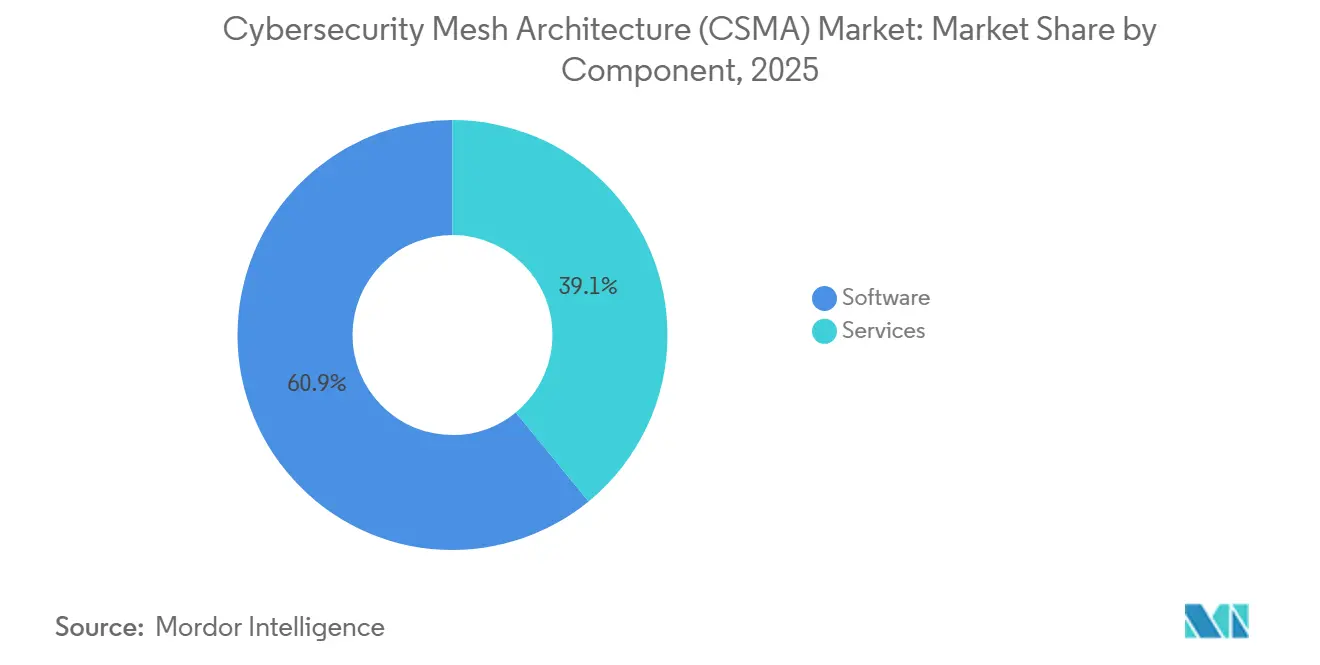
Services Gain Speed While Software Holds The Core Revenue BaseSoftware accounted for 60.91% of component revenue in 2025, making it the largest component of the Cybersecurity mesh architecture (CSMA) market. Buyers initially allocated their spending to policy management, security analytics, and identity orchestration because those layers form the foundation for a mesh model. This pattern shows that many early deployments start with architecture and visibility before moving into broader operating support. It also reflects the buying behavior of large enterprises that already have structured security roadmaps and want to consolidate policy logic first.
Services are projected to grow at a 22.94% CAGR from 2026 to 2031, which makes them the fastest-growing component category. That pace shows that software alone cannot resolve the integration work between older security stacks and newer orchestration layers. Advisory support, managed detection and response, and implementation services are taking a larger role as buyers move from pilot programs into scaled deployments. The line between software and services is also becoming less clear because many vendors now bundle platform subscriptions with onboarding, policy tuning, and managed operations. This keeps services on a faster path, even while software remains the revenue anchor in the Cybersecurity mesh architecture (CSMA) market.
By Deployment:
Hybrid Moves Fast as Cloud Remains the Largest BaseCloud deployment accounted for 53.87% of revenue in 2025, giving it the leading position in the Cybersecurity mesh architecture (CSMA) market share by deployment model. Cloud gained early traction because it allows faster provisioning, lower infrastructure overhead, and easier access to vendor-managed security services. This model has been especially useful for organizations with limited in-house architecture capacity because much of the platform management shifts to the provider. It also supported faster entry for smaller firms that wanted enterprise-grade controls without large upfront investments.
Hybrid deployment is projected to expand at a 23.05% CAGR through 2031, which makes it the fastest-growing deployment option. Large organizations still operate critical on-premises systems for sovereignty, latency, and regulatory reasons, so a full migration to cloud-only security is often impractical. The hybrid model lets these organizations apply a single policy across older infrastructure and newer digital environments without redesigning security each time a new workload moves. On-premises environments also remain relevant in classified, industrial, and air-gapped settings, which strengthens the long-term case for hybrid architectures. This keeps hybrid on a stronger growth path inside the Cybersecurity mesh architecture (CSMA) market.
By Enterprise Size:
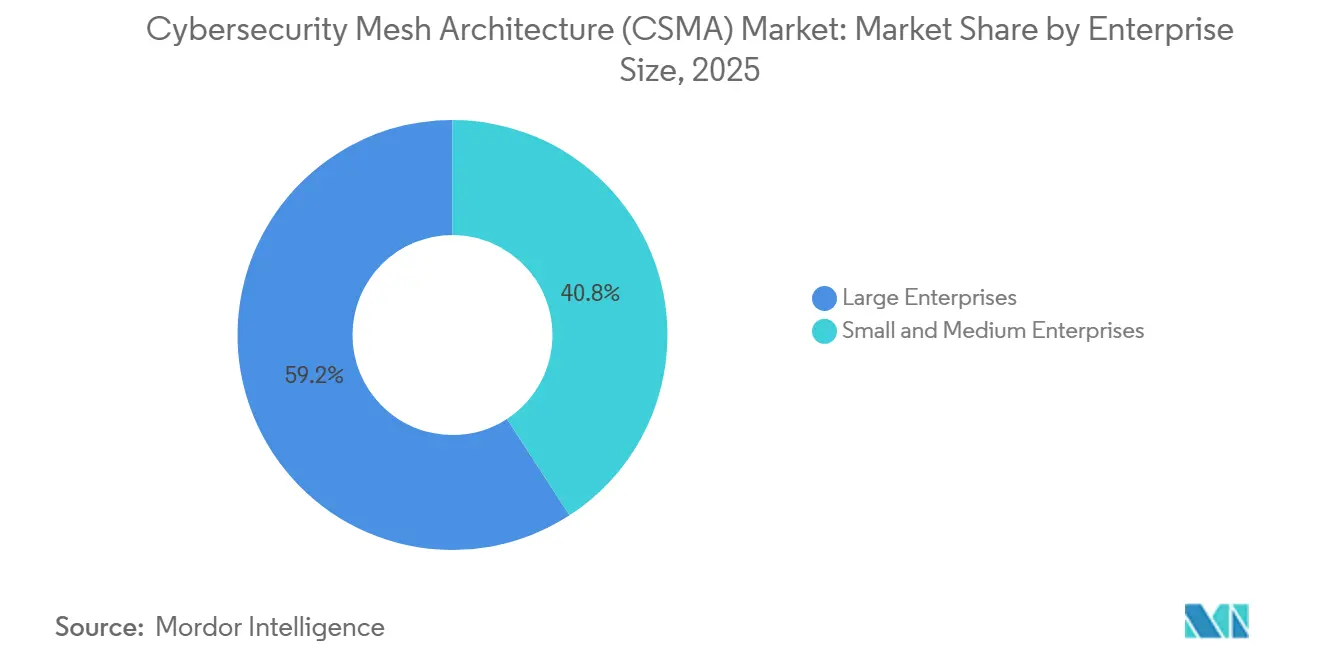
Large Enterprises Lead Revenue While SMEs Scale FasterLarge enterprises accounted for 59.16% of revenue in 2025, giving them the largest share in the Cybersecurity mesh architecture (CSMA) market by enterprise size. Their lead reflects larger security budgets, broader cloud estates, and greater exposure to formal compliance obligations. These organizations also tend to buy CSMA as part of multi-year transformation programs rather than single-product deals, creating deeper platform relationships for vendors. Large enterprises often need to coordinate security across many business units, geographies, and infrastructure types, which raises the value of unified policy and identity layers.
SMEs are projected to grow at a 23.16% CAGR through 2031, making them the fastest-expanding enterprise cohort. SaaS-delivered mesh stacks and managed services reduce the need for large internal architecture teams, which lowers the barrier to entry for smaller organizations. This growth pattern suggests that the market is moving from early enterprise concentration into a broader scaling phase. Managed security service providers are also helping by presenting mesh capabilities through a simpler operating model for smaller firms. Vendors that offer guided setup, pre-built policies, and simpler administration are likely to have an advantage in this part of the Cybersecurity mesh architecture (CSMA) market.
By End-user Industry:
BFSI Leads Current Revenue While Healthcare and Life Sciences Grow FastestBFSI accounted for 16.18% of end-user revenue in 2025, making it the largest vertical within the Cybersecurity mesh architecture (CSMA) market by end-user industry. Financial institutions face constant pressure to protect distributed digital channels, reduce fraud exposure, and maintain continuous monitoring across complex partner ecosystems. That makes identity control, segmentation, and coordinated telemetry especially important in banking and financial services settings. The sector also tends to adopt structured security models earlier because regulatory alignment directly affects daily operations. For that reason, BFSI has remained the clearest revenue anchor for the Cybersecurity mesh architecture (CSMA) market.
Healthcare and life sciences are projected to grow at a 23.27% CAGR through 2031, putting them ahead of other end-user groups in terms of expansion speed. Growth is being supported by connected medical devices, distributed electronic health record environments, and a broader need to secure third-party clinical systems without replacing expensive legacy assets. These conditions make mesh-style control attractive because organizations can extend policy and visibility across existing infrastructure instead of rebuilding everything at once. Other important end-user areas include information technology and telecom, retail and e-commerce, industrial manufacturing, and government and public sector, each shaped by a different mix of cloud use, connected infrastructure, and sector-specific threat exposure. Together, these verticals broaden the end-user base beyond its early dependence on financial services.
Geography Analysis
North America Cybersecurity Mesh Architecture (CSMA) Market
North America accounted for 32.12% of global revenue in 2025, making it the leading regional market for Cybersecurity mesh architecture (CSMA). The region benefits from dense financial services infrastructure, a strong concentration of specialist vendors, and a policy environment that treats zero trust as a baseline requirement in many public sector settings. Federal guidance and sector-specific security obligations have made continuous verification and identity-centric controls more urgent for large U.S. organizations, thereby shortening decision cycles compared with regions where the regulatory and vendor ecosystems are still less mature. Canada and Mexico added support through digital infrastructure growth and cross-border security requirements that increasingly depend on coordinated control models.
Europe and South America Cybersecurity Mesh Architecture (CSMA) Market
Europe remained a major demand center because several regulatory changes took effect within a short period, prompting organizations to adopt more structured security architectures. That pressure has been especially visible in regulated industries that need stronger oversight of access, third-party exposure, and operational resilience. European buyers have also shown a stronger preference for hybrid and sovereign deployment patterns than in some other regions. Deutsche Telekom and Palo Alto Networks addressed that need through Sovereign Cortex with T Security, which keeps telemetry within European borders while still using advanced managed security capabilities. South America saw steady progress as financial digitization and public-sector modernization created a more favorable environment for CSMA pilots and phased deployments.
APAC and MEA Cybersecurity Mesh Architecture (CSMA) Market
Asia-Pacific is projected to grow at a 23.38% CAGR through 2031, making it the fastest-growing region in the Cybersecurity mesh architecture (CSMA) market. The region is being supported by high digitization speed, expanding 5G infrastructure, and stronger national cybersecurity frameworks. India, Japan, South Korea, and Australia are all contributing through different paths, but each shows a rising need for distributed identity and access controls across modern infrastructure. The region also contains many organizations building cloud-native systems at scale, which aligns well with a mesh-oriented security design. In China, national approaches to identity and access management across cloud and on-premises environments add another layer of relevance for coordinated security models. The Middle East and Africa remain earlier in deployment maturity, but Saudi Arabia and the UAE are pushing adoption through digital government and critical infrastructure programs. Over time, that regional mix should keep Asia-Pacific and selected Middle East markets important growth engines for the Cybersecurity mesh architecture (CSMA) market.
Competitive Landscape
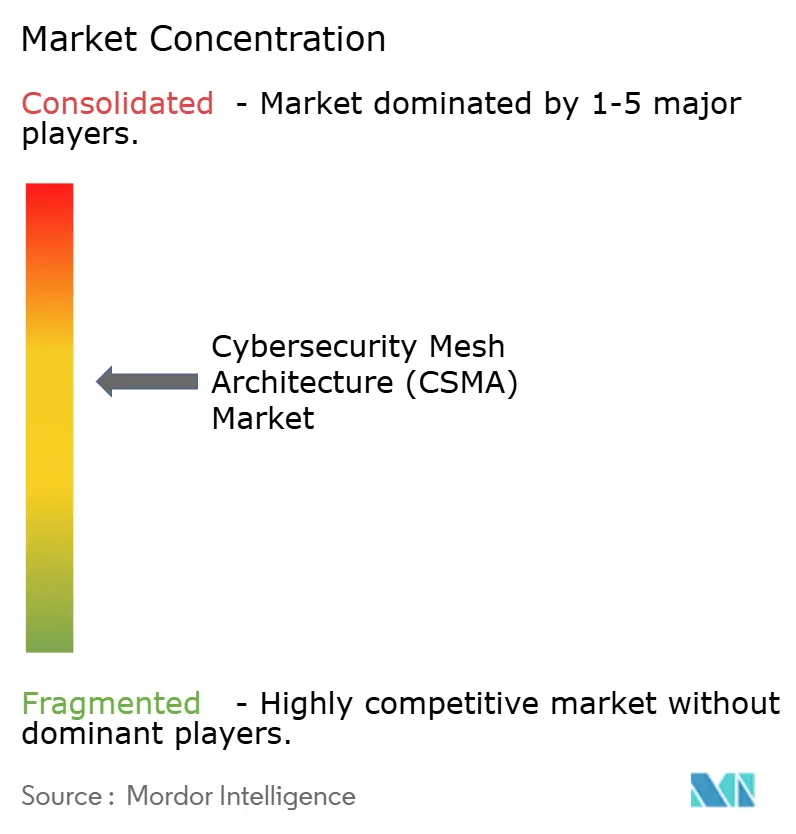
The Cybersecurity mesh architecture (CSMA) market shows moderate concentration at the platform level and broader fragmentation at the component level. Large players such as IBM, Palo Alto Networks, Cisco, Microsoft, CrowdStrike, Zscaler, Fortinet, and Check Point compete by expanding platform breadth and improving orchestration across identities, endpoints, applications, and networks. Buyers increasingly favor vendors that can integrate multiple security layers into a single operating model rather than add another isolated point tool. This has pushed competition toward consolidation, ecosystem building, and identity-centric expansion instead of narrow feature competition. The result is a market where broad platform direction matters as much as product performance in any single control layer.
Cisco’s planned 2026 acquisition of Astrix Security highlighted the importance of non-human identity governance in the Cybersecurity mesh architecture (CSMA) market. That move was followed by further identity-focused expansion into agentic security operations, indicating that major vendors are filling mesh gaps through targeted inorganic activity. CrowdStrike and Zscaler also expanded their partnership in August 2025 to more closely link the Zero Trust Exchange and Falcon platform, demonstrating how alliance models can address the same need without a full acquisition. CrowdStrike then launched the Charlotte AI AgentWorks ecosystem in March 2026 with several technology partners, extending CSMA-related controls to secure AI agent development and deployment. These examples show that the competitive landscape is shifting toward platforms that can govern both human and machine activity under a single, coordinated policy framework.
Smaller challengers still have room to compete by simplifying deployment or tailoring offerings for specific industries and organization sizes. Identity-governance specialists also hold a strong strategic position because the identity fabric often becomes the first layer through which buyers enter a broader mesh program. Public sector initiatives may further widen this opening, especially where sovereign or critical infrastructure requirements shape procurement. The European Commission’s ResilMesh project is developing an AI-driven SOAR platform for CSMA-aligned coordination across dispersed, heterogeneous cyber systems, signaling a growing policy-backed market for orchestrated security models. That supports a competitive landscape where leading vendors remain powerful, but specialized players can still win by solving deployment complexity, sovereignty needs, or industry-specific compliance demands.
Cybersecurity Mesh Architecture (CSMA) Industry Leaders
-
IBM Corporation
-
Palo Alto Networks, Inc.
-
Cisco Systems, Inc.
-
Fortinet, Inc.
-
Check Point Software Technologies Ltd.
- *Disclaimer: Major Players sorted in no particular order
Cybersecurity Mesh Architecture (CSMA) Market Companies Covered in this Report
- IBM Corporation
- Palo Alto Networks, Inc.
- Cisco Systems, Inc.
- Fortinet, Inc.
- Check Point Software Technologies Ltd.
- Microsoft Corporation
- CrowdStrike Holdings, Inc.
- Zscaler, Inc.
- Cloudflare, Inc.
- Akamai Technologies, Inc.
- Trend Micro Incorporated
- Forcepoint LLC
- F5, Inc.
- Ivanti, Inc.
- SonicWall Inc.
- Cato Networks Ltd.
- Appgate, Inc.
- SailPoint Technologies Holdings, Inc.
- CyberArk Software Ltd.
- Okta, Inc.
Recent Industry Developments in Cybersecurity Mesh Architecture (CSMA) Market
- June 2026: IBM, Red Hat, and Palo Alto Networks expanded Project Lightwell to integrate virtual patching with software remediation across open source, commercial, OT, and healthcare technologies, enabling organizations to deploy network-level protections before official software patches are available and reducing exposure windows for AI-accelerated exploitation.
- June 2026: Cisco announced its intent to acquire WideField Security Inc., a modern identity lifecycle security company, to accelerate Splunk's Agentic SOC capabilities by expanding threat investigation with identity, credentials, sessions, and blast-radius context, directly strengthening Cisco's CSMA-aligned identity fabric layer.
- June 2026: CrowdStrike unveiled Continuous Identity for AI Agents at Identiverse 2026, introducing real-time, risk-aware authorization for agentic identities using the SPIFFE standard and zero-standing-privilege principles, powered by its acquisition of SGNL.
- June 2026: Deutsche Telekom and Palo Alto Networks launched "Sovereign Cortex with T Security," a data-sovereign, AI-driven, managed security service that stores all telemetry exclusively within European borders, targeting healthcare, public sector, and critical infrastructure operators subject to DORA and NIS2 compliance mandates.
Global Cybersecurity Mesh Architecture (CSMA) Market Report Scope
The Cybersecurity Mesh Architecture (CSMA) market comprises solutions and services that deliver a distributed, modular, and integrated security framework to protect digital assets across highly interconnected, hybrid enterprise environments. CSMA enables organizations to unify disparate security tools, enforce consistent policies, and provide adaptive protection by leveraging identity, context, and intelligence-driven controls. It enhances resilience by ensuring secure access, threat detection, and governance across cloud, on-premises, and hybrid infrastructures. Driven by the rise of cloud adoption, remote work, IoT expansion, and increasingly sophisticated cyberattacks, industries such as BFSI, healthcare, IT, manufacturing, retail, and government are adopting CSMA to strengthen security posture, reduce risk exposure, and ensure compliance. The primary objective of this market is to create a scalable, flexible, and collaborative cybersecurity ecosystem that improves visibility, accelerates response, and safeguards critical digital operations in complex enterprise environments.
The Cybersecurity Mesh Architecture (CSMA) market report is segmented by Component (Software, and Services), Deployment (Cloud, On-Premises, and Hybrid), Enterprise Size (Large Enterprises, and Small and Medium Enterprises), End-user Industry (BFSI, Healthcare and Life Sciences, Information Technology and Telecom, Retail and E-commerce, Industrial Manufacturing, Government and Public Sector, and Other End-user Industries), and Geography (North America, South America, Europe, Asia-Pacific, Middle East, and Africa). The Market Forecasts are Provided in Terms of Value (USD).
Segmentation Overview
| Software |
| Services |
| Cloud |
| On-Premises |
| Hybrid |
| Large Enterprises |
| Small and Medium Enterprises |
| BFSI |
| Healthcare and Life Sciences |
| Information Technology and Telecom |
| Retail and E-commerce |
| Industrial Manufacturing |
| Government and Public Sector |
| Other End-user Industries |
| North America | United States | |
| Canada | ||
| Mexico | ||
| South America | Brazil | |
| Argentina | ||
| Rest of South America | ||
| Europe | Germany | |
| United Kingdom | ||
| France | ||
| Italy | ||
| Spain | ||
| Russia | ||
| Rest of Europe | ||
| Asia-Pacific | China | |
| India | ||
| Japan | ||
| South Korea | ||
| Australia | ||
| Rest of Asia-Pacific | ||
| Middle East and Africa | Middle East | Saudi Arabia |
| United Arab Emirates | ||
| Rest of Middle East | ||
| Africa | South Africa | |
| Nigeria | ||
| Rest of Africa | ||
| By Component | Software | ||
| Services | |||
| By Deployment | Cloud | ||
| On-Premises | |||
| Hybrid | |||
| By Enterprise Size | Large Enterprises | ||
| Small and Medium Enterprises | |||
| By End-user Industry | BFSI | ||
| Healthcare and Life Sciences | |||
| Information Technology and Telecom | |||
| Retail and E-commerce | |||
| Industrial Manufacturing | |||
| Government and Public Sector | |||
| Other End-user Industries | |||
| By Geography | North America | United States | |
| Canada | |||
| Mexico | |||
| South America | Brazil | ||
| Argentina | |||
| Rest of South America | |||
| Europe | Germany | ||
| United Kingdom | |||
| France | |||
| Italy | |||
| Spain | |||
| Russia | |||
| Rest of Europe | |||
| Asia-Pacific | China | ||
| India | |||
| Japan | |||
| South Korea | |||
| Australia | |||
| Rest of Asia-Pacific | |||
| Middle East and Africa | Middle East | Saudi Arabia | |
| United Arab Emirates | |||
| Rest of Middle East | |||
| Africa | South Africa | ||
| Nigeria | |||
| Rest of Africa | |||
Key Questions Answered in the Report
What is the current size of the cybersecurity mesh architecture (CSMA) market?
The Cybersecurity mesh architecture (CSMA) market size was USD 2.88 billion in 2025, reached USD 3.37 billion in 2026, and is forecast to reach USD 8.69 billion by 2031 at a 20.86% CAGR.
Which deployment model is growing fastest in cybersecurity mesh architecture (CSMA)?
Hybrid deployment is projected to grow fastest at a 23.05% CAGR through 2031, while cloud remained the largest deployment model with a 53.87% revenue share in 2025.
Which end-user group leads current demand for cybersecurity mesh architecture (CSMA)?
BFSI led end-user demand with a 16.18% revenue share in 2025 because of strong regulatory exposure, fraud prevention needs, and complex digital access environments.
Why are SMEs becoming more important in cybersecurity mesh architecture (CSMA)?
SMEs are projected to grow at a 23.16% CAGR through 2031 because SaaS-delivered platforms and managed services reduce the need for large in-house security architecture teams.
Which region offers the strongest growth outlook for cybersecurity mesh architecture (CSMA)?
Asia-Pacific has the strongest regional growth outlook with a 23.38% CAGR through 2031, supported by fast digitization, 5G buildout, and tightening cybersecurity frameworks.
What is driving vendor strategy in cybersecurity mesh architecture (CSMA)?
Vendors are focusing on platform consolidation, identity-centric expansion, and AI agent governance, with examples including Ciscos Astrix move, CrowdStrikes AI identity launch, and sovereign security services in Europe.