
Cyber Risk Quantification and Governance Platforms Market Size and Share
Market Overview
| Study Period | 2020 - 2031 |
|---|---|
| Market Size (2026) | USD 2.04 Billion |
| Market Size (2031) | USD 5.25 Billion |
| Growth Rate (2026 - 2031) | 20.81 % |
| Fastest Growing Market | Asia-Pacific |
| Largest Market | North America |
| Market Concentration | Medium |
Major Players *Disclaimer: Major Players sorted in no particular order Image © Mordor Intelligence. Reuse requires attribution under CC BY 4.0. | |
Cyber Risk Quantification and Governance Platforms Market Analysis by Mordor Intelligence
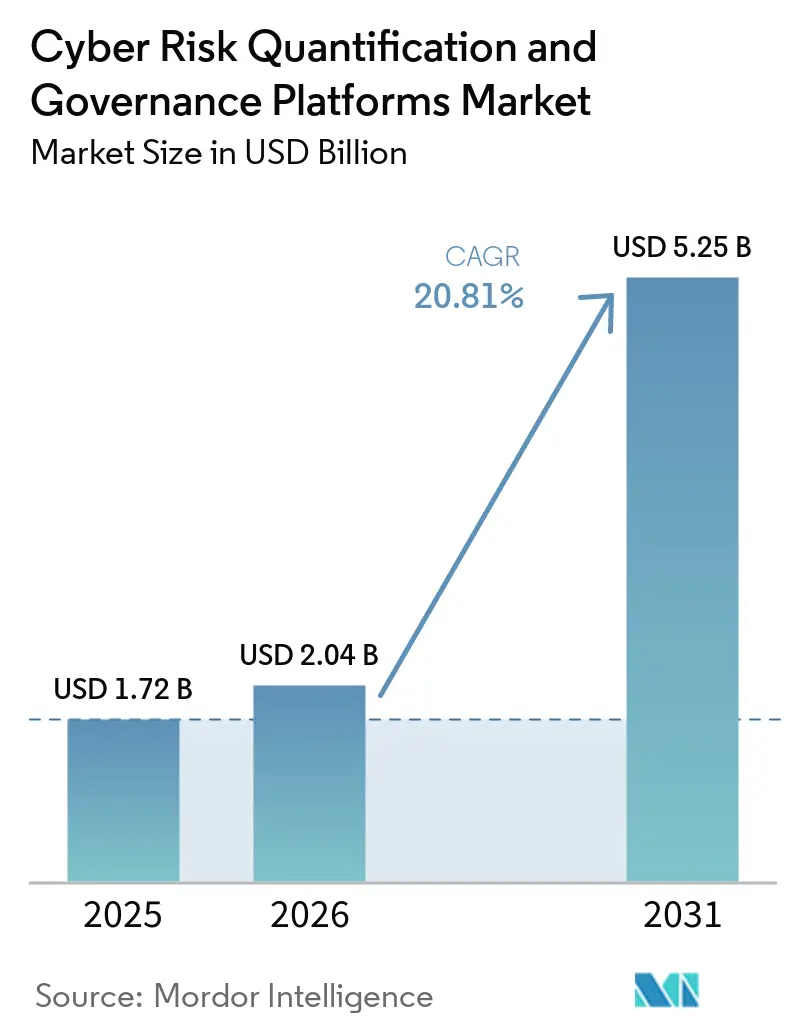
The Cyber risk quantification and governance platforms market size is projected to be USD 1.72 billion in 2025, USD 2.04 billion in 2026, and reach USD 5.25 billion by 2031, growing at a CAGR of 20.81% from 2026 to 2031. Growth is being supported by a clear move away from qualitative cyber reporting toward monetary loss models that boards, regulators, insurers, and finance teams can use in the same decision process. Compliance obligations are making this shift harder to delay, especially where companies now need to explain incident materiality, governance readiness, and operational resilience in financial terms. The market is also benefiting from wider enterprise adoption of exposure management, third-party monitoring, and governance tools that can feed quantified risk outputs into one reporting workflow. Vendor competition is increasingly centered on platform breadth, data quality, and the ability to connect cyber operations with board reporting and insurance discussions. The opportunity remains strongest where organizations need a repeatable way to justify cyber spending, prioritize remediation, and defend risk decisions under closer scrutiny.
Key Report Takeaways
- By component, platforms led with a 72.14% share in the Cyber risk quantification and governance platforms market in 2025, while services are projected to expand at a 22.94% CAGR through 2031.
- By deployment, cloud held a 53.09% share in 2025, while hybrid is projected to record the fastest CAGR at 23.05% through 2031.
- By enterprise size, large enterprises accounted for 59.12% of the Cyber risk quantification and governance platforms market size in 2025, while SMEs are expected to expand at a 23.16% CAGR through 2031.
- By end-user industry, BFSI held 16.17% of the Cyber risk quantification and governance platforms market share in 2025, while healthcare and life sciences are projected to grow at a 23.27% CAGR through 2031.
- By geography, North America captured 32.15% share in 2025, while Asia-Pacific is expected to advance at a 23.38% CAGR through 2031.
Note: Market size and forecast figures in this report are generated using Mordor Intelligence’s proprietary estimation framework, updated with the latest available data and insights as of January 2026.
Market Trends and Insights
Drivers Impact Analysis of Cyber Risk Quantification and Governance Platforms Market*
| Driver | (~) % Impact on CAGR Forecast | Geographic Relevance | Impact Timeline |
|---|---|---|---|
| Regulatory Disclosure Mandates for Quantified Cyber Risk | +5.5% | Global, led by North America and Europe | Short term (≤ 2 years) |
| Board-Level Demand for Monetary Risk Visibility | +4.8% | Global | Medium term (2-4 years) |
| Rising Cyber Insurance Underwriting Requirements | +3.9% | North America and Europe | Short term (≤ 2 years) |
| Supply Chain Attack Exposure Requiring External Risk Scoring | +3.2% | Global, with spillover across Asia-Pacific | Medium term (2-4 years) |
| AI-Enabled Real-Time Loss Forecasting | +2.5% | North America and Asia-Pacific | Medium term (2-4 years) |
| Tokenization of Cyber Risk for Capital Allocation Use Cases | +1.8% | North America, with early traction in European financial centers | Long term (≥ 4 years) |
| Source: Mordor Intelligence | |||
Regulatory Disclosure Mandates for Quantified Cyber Risk
The Cyber risk quantification and governance platforms market is receiving direct support from regulation, as incident materiality and resilience oversight are now discussed in financial terms rather than through simple heat maps. In the United States, the SEC requires public companies to disclose material cybersecurity incidents, and the XBRL tagging requirement has added more structure and audit visibility to those disclosures.[1] In Europe, DORA has been fully applicable since January 2025, raising the standard for ICT risk management and documentation across financial entities. The Cyber risk quantification and governance platforms market is benefiting from the need for organizations to have a defensible way to determine when an event becomes financially material and how to document that conclusion for boards and supervisors. This makes platform adoption part of legal and governance preparation, not only part of security modernization. It also shortens the gap between regulatory demand and budget approval because quantified outputs are easier to carry into audit, compliance, and board reporting.[2]
Board-Level Demand for Monetary Risk Visibility
The Cyber risk quantification and governance platforms market is also expanding because directors are asking for cyber exposure in dollar terms rather than in technical language. The NACD 2026 cyber oversight handbook calls on boards to ask management to model the financial implications of cyber incidents, including direct losses and broader business effects.[3] The FAIR Institute reported in 2025 that nearly 70% of organizations still do not quantify cyber risk in monetary terms, underscoring the significant white space in the Cyber risk quantification and governance platforms market. Once boards receive quantified scenarios, those numbers become easier to compare with insurance costs, cyber controls, and business interruption exposure. That shifts cyber discussions from abstract ratings to capital-allocation choices. It also increases demand for platforms that can continuously update scenarios rather than rely on one-time assessment cycles.
Rising Cyber Insurance Underwriting Requirements
The Cyber risk quantification and governance platforms market is benefiting from changes in cyber insurance underwriting that now place greater weight on evidence-based risk submissions. The IAIS noted in June 2026 that cyber insurance underwriting has become more specialized, with insurers aligning questionnaires with security frameworks and using catastrophe-style modeling to estimate loss frequency and severity.[4] This shift creates another demand channel for the Cyber risk quantification and governance platforms market, as enterprises increasingly need quantified documentation to support coverage discussions. Quantified loss scenarios also make it easier for finance teams to compare retention levels, premium changes, and control investments on one scale. SMEs are especially affected because even a modest pricing difference can matter when security budgets are tight. Over time, insurance-linked workflows should continue to pull more buyers toward recurring platform subscriptions and managed quantification support.
Supply Chain Attack Exposure Requiring External Risk Scoring
The rising cost and frequency of third-party cyber incidents are also supporting the Cyber risk quantification and governance platforms market. As a result, the cyber risk quantification and scoring platforms market benefits from insurer-driven pull as well as enterprise push. SecurityScorecard reported in 2025 that more than 70% of organizations experienced at least 1 material third-party cybersecurity incident in the prior year. That pushes buyers to connect external vendor scoring with internal loss modeling instead of managing those processes separately. Black Kite strengthened this direction in 2026 by using Open FAIR concepts in vendor assessment workflows, helping translate supplier cyber posture into a probable financial impact. The Cyber risk quantification and governance platforms market is therefore moving toward a model in which vendor risk, breach exposure, and board reporting are housed in a single shared system. Vendors that only provide letter grades or point-in-time questionnaires face greater pressure as customers demand financial prioritization and continuous monitoring within the same workflow.
Restraints Impact Analysis of Cyber Risk Quantification and Governance Platforms Market*
| Restraint | (~) % Impact on CAGR Forecast | Geographic Relevance | Impact Timeline |
|---|---|---|---|
| Lack of Agreed Quantification Standards | -2.1% | Global | Medium term (2-4 years) |
| Limited High-Quality Incident Loss Data | -1.9% | Global, most acute in Asia-Pacific and South America | Medium term (2-4 years) |
| Privacy Constraints on Cross-Enterprise Data Sharing | -1.3% | Europe and Asia-Pacific | Long term (≥ 4 years) |
| Scarcity of FAIR-Certified Quant Talent | -0.8% | Global, most severe in Asia-Pacific and Middle East and Africa | Short term (≤ 2 years) |
| Source: Mordor Intelligence | |||
Lack of Agreed Quantification Standards
The Cyber risk quantification and governance platforms market still faces friction because buyers do not work with 1 universally mandated quantification framework. FAIR v3.0 remains the most mature open standard in this area, but the FAIR Institute found in 2025 that only 24% of organizations currently use it, and another 22% plan to adopt it. Many enterprises still need to align FAIR outputs with NIST, ISO, and regulatory expectations, which slows implementation and makes vendor comparisons more difficult. The Cyber risk quantification and governance platforms market is affected because procurement teams often struggle to judge whether 2 platforms produce genuinely comparable loss estimates. This raises vendor education costs and lengthens sales cycles for buyers seeking strong governance defensibility. Until standards converge more clearly, adoption will continue to depend heavily on internal champions who can explain methodology choices to boards and auditors.
Limited High-Quality Incident Loss Data
The Cyber risk quantification and governance platforms market also faces a practical limit: effective financial loss models depend on large, trustworthy incident datasets. A 2026 survey in the International Journal of Information Security identified the scarcity of high-quality cyber loss data as a major barrier to accurate probabilistic modeling. IBM's 2025 breach report remains a widely used benchmark, but it does not solve the need for deep incident-level calibration across every industry and region. The Federal Reserve Bank of New York also found significant coverage gaps when modeling cyber vulnerabilities in the U.S. financial system, especially for smaller entities and indirect losses. The Cyber risk quantification and governance platforms market, therefore, gives vendors with proprietary claims data, consortium datasets, or long operating histories an advantage. Newer entrants can still compete on usability and workflow design, but data depth remains a major factor when large enterprises compare model credibility.
*Our forecasts treat driver/restraint impacts as directional, not additive. The impact forecasts reflect baseline growth, mix effects, and variable interactions.
Cyber Risk Quantification and Governance Platforms Market Segment Analysis
By Component:
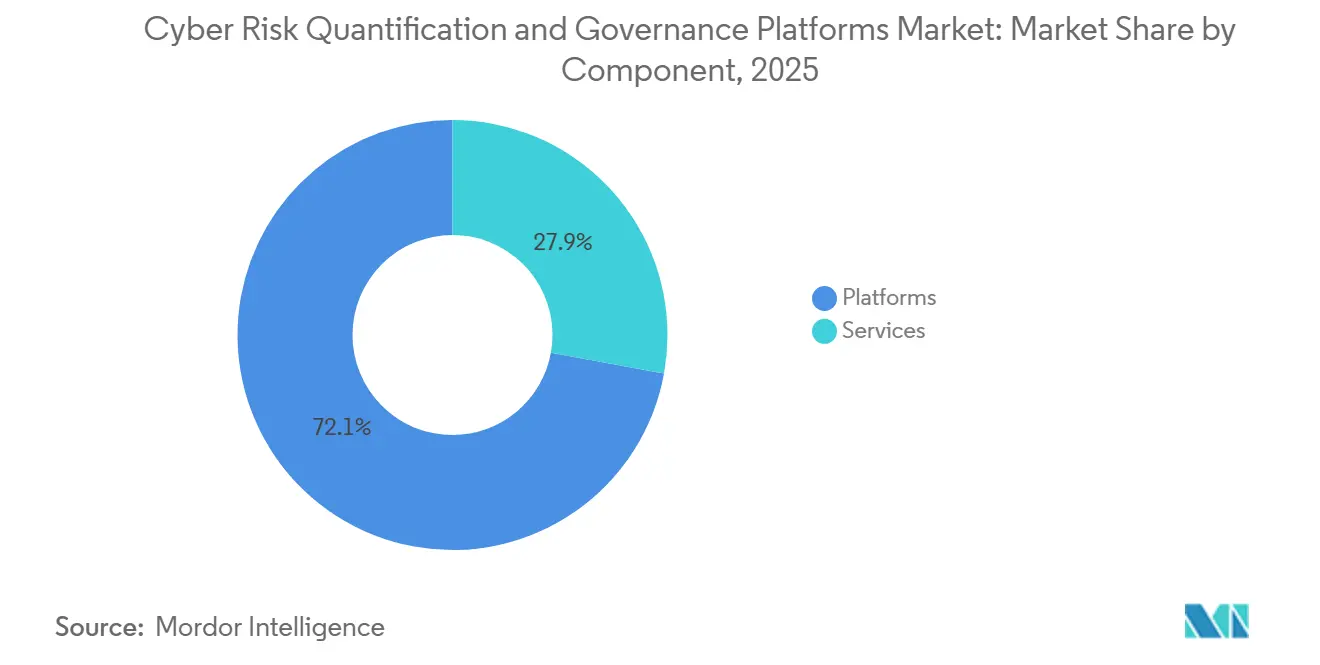
Platforms Keep the Revenue Base Broad While Services Deepen AdoptionPlatforms accounted for 72.14% of the Cyber risk quantification and governance market in 2025, indicating that buyers still prefer recurring software infrastructure over occasional outside assessment work. This base includes platforms for cyber risk quantification, cyber governance, third-party risk management, and cyber exposure management. Each category serves a different layer of the operating model, but buyers increasingly want them connected into a single workflow. That preference supports vendors that can combine risk quantification, board reporting, vendor monitoring, and exposure visibility without forcing clients to manage disconnected tools.
The services segment is projected to grow at a 22.94% CAGR through 2031, reflecting the work required to align cyber, finance, legal, and insurance teams around a single risk language. The FAIR Institute found that organizations with higher cyber risk management maturity, which often includes structured program support and implementation services, achieved 54% greater risk reduction than the overall respondent base. In practice, services do more than configure dashboards or scenarios. They help enterprises build operating routines, agree on model assumptions, and connect outputs to governance calendars. That also creates stickier customer relationships because vendor-specific scenario libraries and calibration choices become part of the client’s internal risk process.
By Deployment:
Cloud Leads Today While Hybrid Expands on Sovereignty NeedsCloud accounted for 53.09% of the Cyber risk quantification and governance platforms market in 2025, supported by easier subscription models, faster deployment, and continuous data ingestion from external threat and attack surface feeds. Cloud-native providers built an advantage around real-time updates, internet-facing data collection, and simpler expansion across distributed business units. That model fits organizations that want faster time-to-value and lower initial setup friction. It also aligns well with SMEs and mid-market buyers that do not want heavy infrastructure commitments before they validate the program internally.
Hybrid is projected to grow at a 23.05% CAGR from 2026 to 2031, as regulated buyers still need local control over sensitive data even when they want cloud-based intelligence feeds. The European Banking Authority's DORA technical standards reinforced the need for strong ICT risk management, which supports hybrid deployment where sensitive internal data and broader external signals must operate together. Tenable's open connector release in 2025 also showed how vendors are designing architectures that combine internal risk data with broader external context in a flexible way. Hybrid is therefore not a temporary compromise. It is becoming a practical, long-term solution for buyers who need both compliance controls and continuous external visibility in the Cyber risk quantification and governance platforms market.
By Enterprise Size:
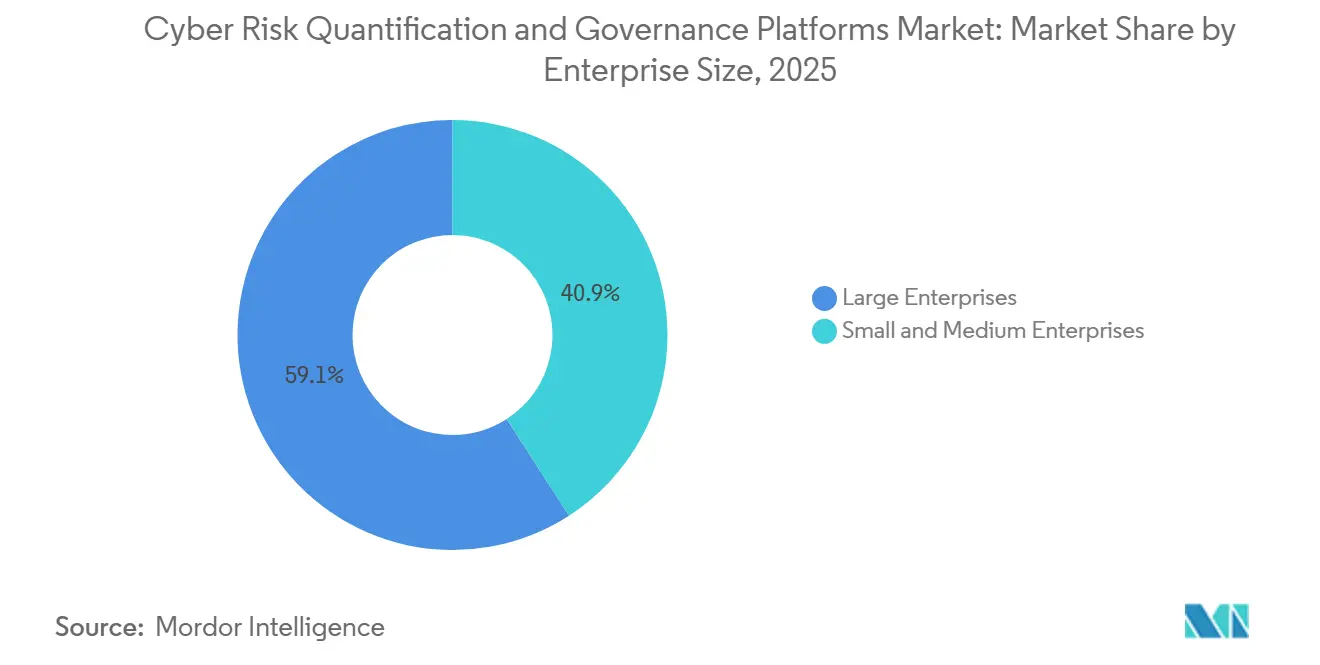
Large Enterprises Still Dominate While SME Demand Builds FastLarge enterprises held 59.12% share in 2025, reflecting their earlier investment in FAIR-based programs, deeper analyst teams, and broader access to internal data needed for mature scenario modeling. These organizations are also more likely to run multiple platform types simultaneously, including quantification, governance, third-party risk, and exposure management tools. That makes them important customers for vendors with broader product stacks and stronger integration capabilities. It also explains why enterprise deals often revolve around workflow depth, audit readiness, and reporting consistency rather than on a single technical feature.
SMEs are expected to expand at a 23.16% CAGR through 2031 as SaaS pricing, lighter implementation models, and more standardized workflows reduce the barriers that kept smaller buyers out of the market. The Cyber risk quantification and governance platforms market is becoming more accessible to SMEs because they increasingly need board-ready financial scenarios without building a large specialist team. Insurance pressure also matters here because smaller firms often feel premiums and coverage changes more directly than larger peers. As simplified onboarding improves, many SMEs are likely to adopt a platform before they build a formal internal quantification function. That shifts the segment from a niche opportunity toward a durable growth engine for vendors that can deliver useful outputs with limited client inputs.
By End-User Industry:
BFSI Sets the Adoption Base While Healthcare and Life Sciences Raises the Growth PaceBFSI held 16.17% of the Cyber risk quantification and governance platforms market share in 2025, reflecting the sector’s early engagement with regulatory reporting, operational resilience, and cyber insurance workflows. Financial institutions usually face mature governance expectations and complex third-party exposure, which makes quantified cyber reporting easier to justify across risk, finance, and board committees. In this vertical, platform demand is driven by the need to connect cyber controls with business continuity, vendor oversight, and capital planning in a single risk view. That is why BFSI remains the density leader even as other sectors accelerate.
The healthcare and life sciences sector is projected to record the fastest CAGR of 23.27% through 2031, as the financial consequences of cyber incidents are particularly evident in this vertical. IBM reported that the average global healthcare breach cost reached USD 7.42 million in 2025, the highest among industries for the 14th straight year. That cost profile makes board-level justification for quantification platforms more direct than in many other sectors. IT and telecom, retail and e-commerce, and manufacturing also remain important because software supply chain risk, payment ecosystem exposure, and operational disruption each require a more financial view of cyber consequences. Black Kite added weight to the manufacturing case in 2025 by reporting that 75% of manufacturing companies carried critical vulnerabilities with a CVSS score of 8 or higher and that ransomware activity against the sector had risen 9% year over year.
Geography Analysis
The Americas Cyber Risk Quantification and Governance Platforms Market
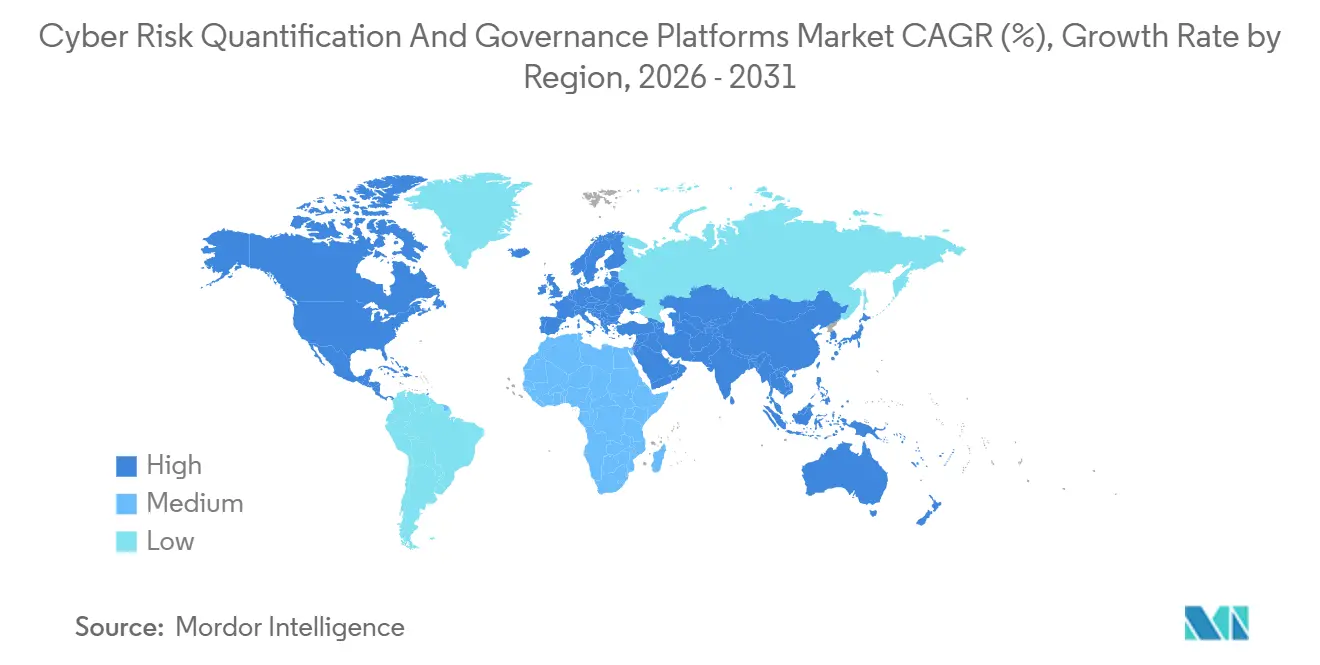
North America held 32.15% of the Cyber risk quantification and governance platforms market share in 2025, keeping the region in the lead in revenue and enterprise maturity. The SEC disclosure regime has pushed public companies toward a more formal view of material cyber impact, which directly supports demand for board-ready quantification outputs. The region also benefits from a strong cyber insurance ecosystem, which gives buyers another reason to express exposure in financial terms. Canada follows a similar path in terms of governance maturity, while the United States remains the center of adoption due to scale, board scrutiny, and practitioner depth. South America is still earlier in adoption, but enforcement around data governance and the growth of digital financial services are creating clearer entry points for the Cyber risk quantification and governance platforms market.
Europe Cyber Risk Quantification and Governance Platforms Market
Europe remains the second-largest regional cluster, and demand there is strongly tied to compliance execution. DORA has been fully applicable since January 2025, which has increased attention on ICT risk management, resilience planning, and supporting documentation across financial entities. Germany, the United Kingdom, and France form the core of current adoption because they combine large regulated enterprise bases with deeper governance spending. Italy and Spain are also moving faster as organizations prepare for tighter accountability and more structured cyber oversight. Russia remains outside much of the addressable space for Western vendors because sanctions and domestic technology requirements limit cross-border platform participation.
APAC and MEA Cyber Risk Quantification and Governance Platforms Market
Asia-Pacific is expected to grow at a 23.38% CAGR through 2031, giving it the fastest regional pace in the Cyber risk quantification and governance platforms market. Japan has strengthened this direction through updated critical infrastructure risk management guidance that includes more structured scenario-based thinking. Across Southeast Asia, many SMEs are moving directly to cloud-native tools rather than relying on older qualitative assessment methods. The Middle East and Africa remain smaller in overall size, but Gulf markets are generating institutional demand as digital economy programs and financial regulation expand. South Africa and Nigeria stand out as the more established African adoption markets, while the broader regional opportunity should improve as platform cost, workflow complexity, and local talent constraints become easier to manage.
Competitive Landscape
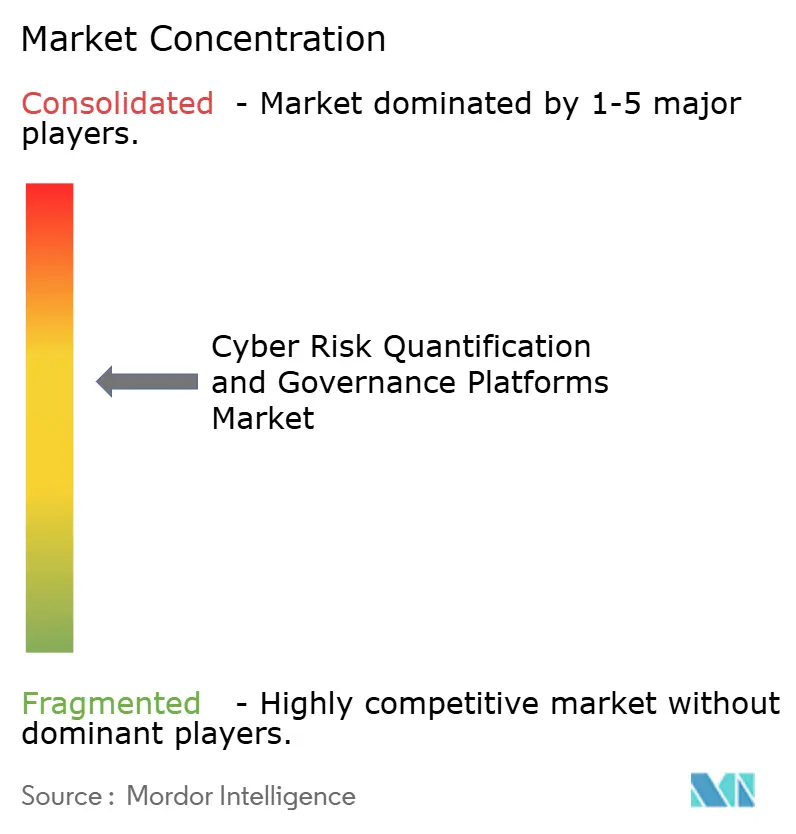
The Cyber risk quantification and governance platforms market is moderately concentrated, with competition split among pure-play quantification specialists, governance and risk incumbents, and third-party risk vendors adding financial modeling features. No single provider controls the core categories simultaneously, which keeps the field active and leaves room for both specialists and broader platform vendors. Pure-play names compete on model depth, audit-ready scenarios, and methodological transparency, while larger governance platforms compete on workflow breadth and enterprise integration. RapidRatings remains outside this addressable set because it focuses on financial health and counterparty credit risk rather than on cyber risk quantification or cyber governance capabilities.
Strategic moves over the last 2 years show that vendors are trying to combine financial quantification with continuous external visibility. SecurityScorecard completed the acquisition of Driftnet in May 2026 to add high-fidelity internet scanning and strengthen real-time third-party risk monitoring. Tenable launched Tenable One AI Exposure in January 2026, extending its exposure management platform into AI-related attack surfaces and governance needs. In 2025, Tenable also introduced its open connector to support broader data ingestion and more flexible cyber risk decisions across enterprise environments. In its November 2024 agreement to acquire Cybersixgill, Bitsight added threat intelligence and dark web visibility to its broader attack surface and vendor risk offering.
These moves point to a common strategy in the Cyber risk quantification and governance platforms market, where vendors are expanding both upward into board reporting and downward into operational data collection. Buyers increasingly want a platform that can show likely financial losses, identify the drivers behind those losses, and support remediation choices within the same environment. White space remains strongest in simplified SME offerings, OT and ICS-specific loss models, and broker-facing quantification services that do not require a full enterprise deployment. Services are also becoming a competitive lever because implementation support helps vendors embed scenario logic and reporting routines more deeply into client operations. That should keep the Cyber risk quantification and governance platforms market competitive even as consolidation continues across adjacent categories such as exposure management, third-party risk, and cyber governance.
Cyber Risk Quantification and Governance Platforms Industry Leaders
-
Bitsight Technologies Inc.
-
SecurityScorecard, Inc.
-
RiskLens, Inc.
-
Safe Security, Inc.
-
CyberCube Analytics, Inc.
- *Disclaimer: Major Players sorted in no particular order
Cyber Risk Quantification and Governance Platforms Market Companies Covered in this Report
- Bitsight Technologies Inc.
- SecurityScorecard, Inc.
- Safe Security, Inc.
- RiskLens, Inc.
- CyberCube Analytics, Inc.
- Kovrr Ltd.
- Axio Global, LLC
- Balbix, Inc.
- UpGuard Pty Ltd
- Panorays Ltd.
- Black Kite, Inc.
- C-Risk SAS
- Derive Security, Inc.
- OneTrust, LLC
- MetricStream, Inc.
- Venminder, Inc.
- Prevalent, Inc.
- RapidRatings International, Inc.
- Armis, Inc.
- Tenable Holdings, Inc.
Recent Industry Developments in Cyber Risk Quantification and Governance Platforms Market
- May 2026: SecurityScorecard completed the acquisition of Driftnet, a UK-based internet scanning and threat intelligence startup, integrating high-fidelity global internet discovery into its TPRM platform to enable real-time, threat-informed vendor risk monitoring for enterprise customers.
- January 2026: Tenable launched general availability of Tenable One AI Exposure, extending its exposure management platform to cover AI attack surfaces including SaaS platforms, cloud services, APIs, and AI agents, enabling organizations to govern AI-related cyber exposure within their broader enterprise risk programs, Tenable was also named a Leader in the inaugural 2025 Gartner Magic Quadrant for Exposure Assessment Platforms.
- October 2025: Safe Security and SecurityScorecard resolved a legal dispute and announced a research collaboration, a development that signals growing market preference for platform interoperability as the boundaries between cyber risk quantification and third-party risk scoring continue to converge.
- October 2025: SecurityScorecard acquired HyperComply, a vendor security review automation company, adding AI-driven assessment automation to its TPRM platform and reducing the manual effort historically associated with questionnaire-based vendor evaluation at scale.
Global Cyber Risk Quantification and Governance Platforms Market Report Scope
The Cyber Risk Quantification and Governance Platforms market refers to solutions and services that help organizations measure, manage, and govern cyber risks through data-driven quantification, exposure analysis, and compliance frameworks. These platforms enable enterprises to assess financial and operational impacts of cyber threats, prioritize risk mitigation strategies, manage third-party risks, and ensure governance alignment with regulatory standards. Driven by the increasing complexity of cyberattacks, the need for measurable risk insights, and growing regulatory requirements, industries such as BFSI, healthcare, IT, manufacturing, retail, and government are adopting these platforms to strengthen resilience, optimize security investments, and maintain trust. The primary objective of this market is to provide organizations with actionable intelligence and governance tools that enhance decision-making, reduce risk exposure, and ensure sustainable cyber resilience.
The Cyber Risk Quantification and Governance Platforms market report is segmented by Component (Platforms [Cyber Risk Quantification Platforms, Cyber Governance Platforms, Third-Party Risk Management Platforms, Cyber Exposure Management Platforms] and Services), Deployment (Cloud, On-Premises, and Hybrid), Enterprise Size (Large Enterprises, and Small and Medium Enterprises), End-user Industry (BFSI, Healthcare and Life Sciences, Information Technology and Telecom, Retail and E-commerce, Industrial Manufacturing, Government and Public Sector, and Other End-user Industries), and Geography (North America, South America, Europe, Asia-Pacific, Middle East, and Africa). The Market Forecasts are Provided in Terms of Value (USD).
Segmentation Overview
| Platforms | Cyber Risk Quantification Platforms |
| Cyber Governance Platforms | |
| Third-Party Risk Management Platforms | |
| Cyber Exposure Management Platforms | |
| Services |
| Cloud |
| On-Premises |
| Hybrid |
| Large Enterprises |
| Small and Medium Enterprises |
| BFSI |
| Healthcare and Life Sciences |
| Information Technology and Telecom |
| Retail and E-commerce |
| Industrial Manufacturing |
| Government and Public Sector |
| Other End-user Industries |
| North America | United States | |
| Canada | ||
| Mexico | ||
| South America | Brazil | |
| Argentina | ||
| Rest of South America | ||
| Europe | Germany | |
| United Kingdom | ||
| France | ||
| Italy | ||
| Spain | ||
| Russia | ||
| Rest of Europe | ||
| Asia-Pacific | China | |
| India | ||
| Japan | ||
| South Korea | ||
| Australia | ||
| Rest of Asia-Pacific | ||
| Middle East and Africa | Middle East | Saudi Arabia |
| United Arab Emirates | ||
| Rest of Middle East | ||
| Africa | South Africa | |
| Nigeria | ||
| Rest of Africa | ||
| By Component | Platforms | Cyber Risk Quantification Platforms | |
| Cyber Governance Platforms | |||
| Third-Party Risk Management Platforms | |||
| Cyber Exposure Management Platforms | |||
| Services | |||
| By Deployment | Cloud | ||
| On-Premises | |||
| Hybrid | |||
| By Enterprise Size | Large Enterprises | ||
| Small and Medium Enterprises | |||
| By End-user Industry | BFSI | ||
| Healthcare and Life Sciences | |||
| Information Technology and Telecom | |||
| Retail and E-commerce | |||
| Industrial Manufacturing | |||
| Government and Public Sector | |||
| Other End-user Industries | |||
| By Geography | North America | United States | |
| Canada | |||
| Mexico | |||
| South America | Brazil | ||
| Argentina | |||
| Rest of South America | |||
| Europe | Germany | ||
| United Kingdom | |||
| France | |||
| Italy | |||
| Spain | |||
| Russia | |||
| Rest of Europe | |||
| Asia-Pacific | China | ||
| India | |||
| Japan | |||
| South Korea | |||
| Australia | |||
| Rest of Asia-Pacific | |||
| Middle East and Africa | Middle East | Saudi Arabia | |
| United Arab Emirates | |||
| Rest of Middle East | |||
| Africa | South Africa | ||
| Nigeria | |||
| Rest of Africa | |||
Key Questions Answered in the Report
What is the size of the cyber risk quantification and governance platforms market in 2026?
The cyber risk quantification and governance platforms market is estimated at USD 2.04 billion in 2026 and is forecast to reach USD 5.25 billion by 2031 at a 20.81% CAGR.
What is driving adoption of cyber risk quantification platforms?
The biggest drivers are regulatory disclosure rules, stronger board demand for dollar-based cyber reporting, tighter cyber insurance underwriting, and the need to assess third-party cyber exposure in financial terms.
Which component leads revenue in this space?
Platforms led the revenue base with a 72.14% share in 2025, showing that buyers prefer continuous in-house software capability over periodic outside assessments.
Which deployment model is growing the fastest?
Hybrid deployment is projected to grow the fastest at a 23.05% CAGR through 2031 because regulated buyers want cloud intelligence with stronger control over sensitive internal data.
Which end-user vertical is expanding the fastest?
Healthcare and life sciences is projected to grow at a 23.27% CAGR, supported by very high breach costs and rising pressure to justify cyber spending with clearer financial models.
Which region is creating the strongest near-term opportunity?
North America remains the largest revenue base with 32.15% share in 2025, while Asia-Pacific is the fastest-growing region with a 23.38% CAGR through 2031.