
Market Overview
| Study Period | 2020 - 2031 |
|---|---|
| Forecast Data Period | 2026 - 2031 |
| Base Year Market Size (2025) | USD 171.0 Million |
| Market Size (2026) | USD 185.3 Million |
| Market Size (2031) | USD 276.83 Million |
| Growth Rate (2026 - 2031) | 8.36 % |
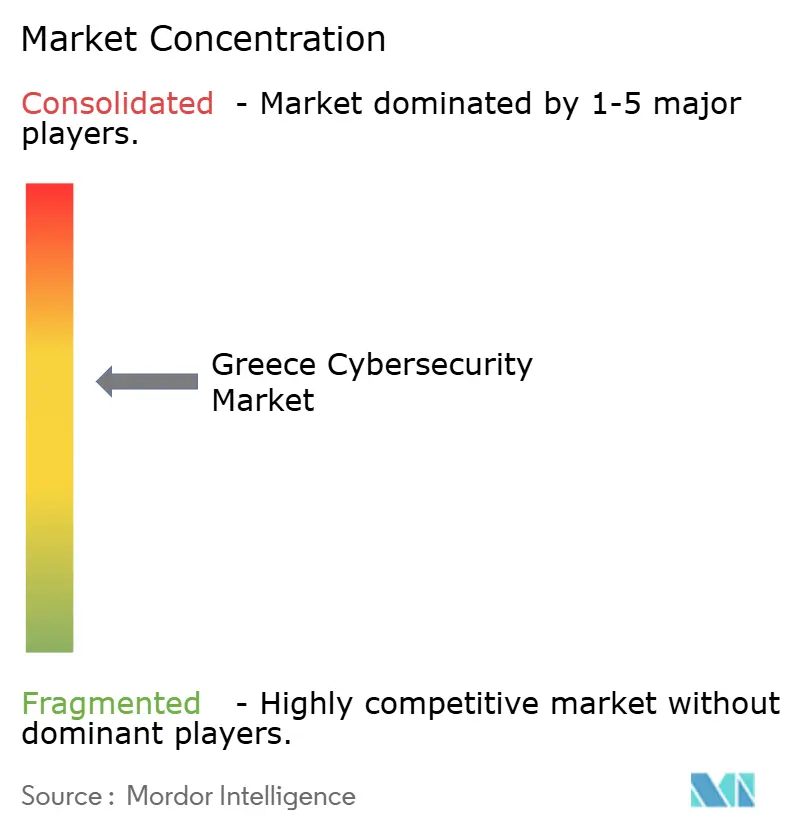
| Market Concentration | Medium |
Major Players *Disclaimer: Major Players sorted in no particular order Image © Mordor Intelligence. Reuse requires attribution under CC BY 4.0. | |
Greece Cybersecurity Market Analysis by Mordor Intelligence
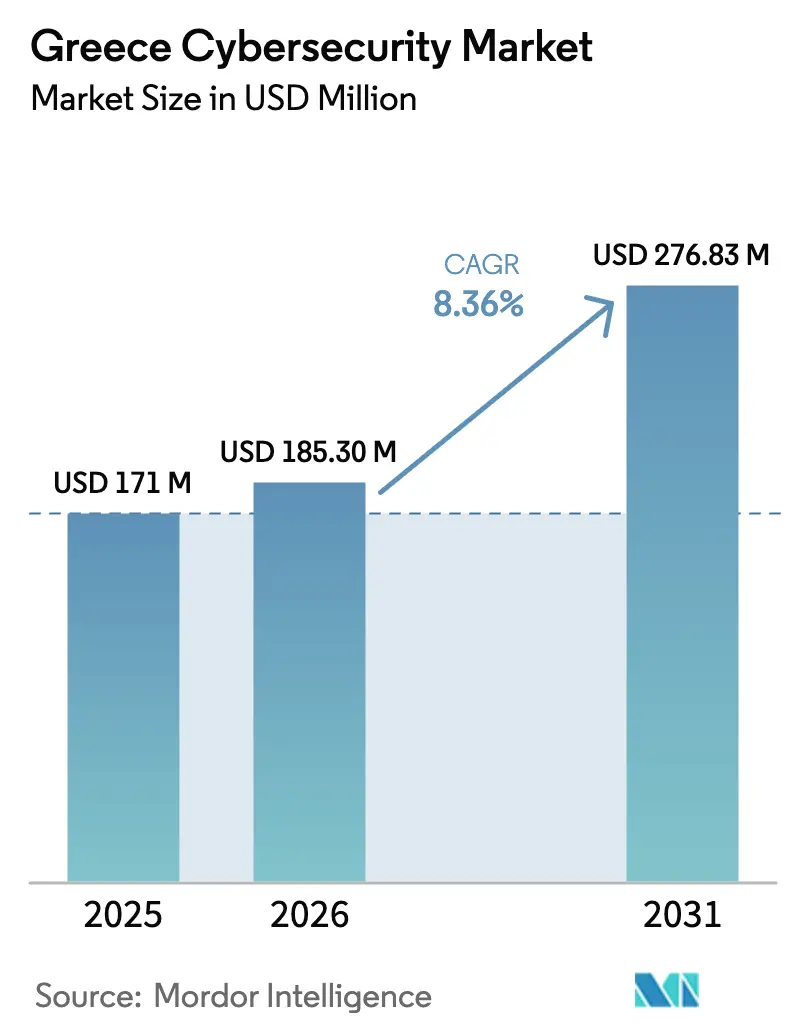
The Greece cybersecurity market size was valued at USD 171.0 million in 2025 and estimated to grow from USD 185.3 million in 2026 to reach USD 276.83 million by 2031, at a CAGR of 8.36% during the forecast period (2026-2031). Rising investment from the EU Recovery and Resilience Facility, mandatory alignment with the NIS2 Directive under Greek Law 5160/2024, and Microsoft’s USD 1.0 billion hyperscale datacenter region underpin sustained demand. Organizations now channel 9% of overall IT budgets toward security as weekly incidents against maritime, energy and telecom targets climb, while a 900% attack surge in shipping since 2017 recalibrates risk appetites. Expansion of submarine cable corridors linking Egypt, Cyprus and mainland Greece promotes network-security spending, and the talent deficit propels managed security services as a default procurement route for mid-market firms.
Key Report Takeaways
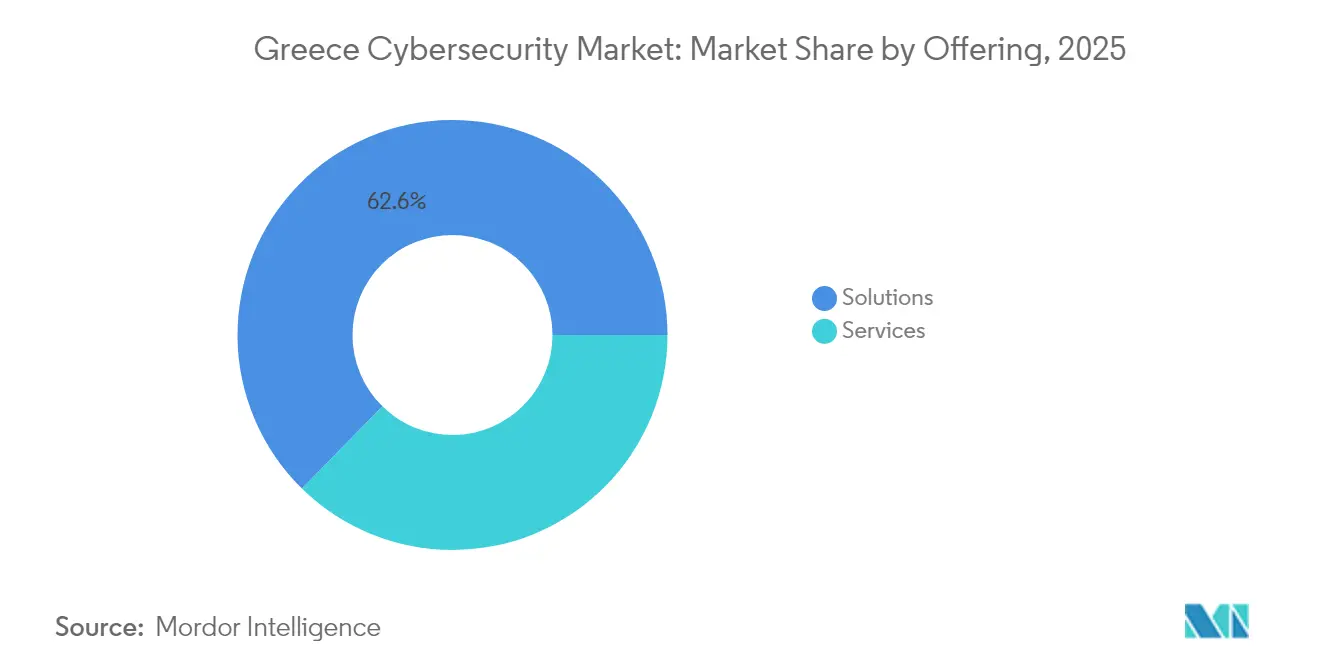
- By offering, solutions held 62.65% of the Greece cybersecurity market share in 2025; services are forecast to grow at a 12.35% CAGR to 2031.
- By deployment mode, cloud captured 56.85% of revenue in 2025, while on-premise trails; cloud is advancing at an 11.05% CAGR through 2031.
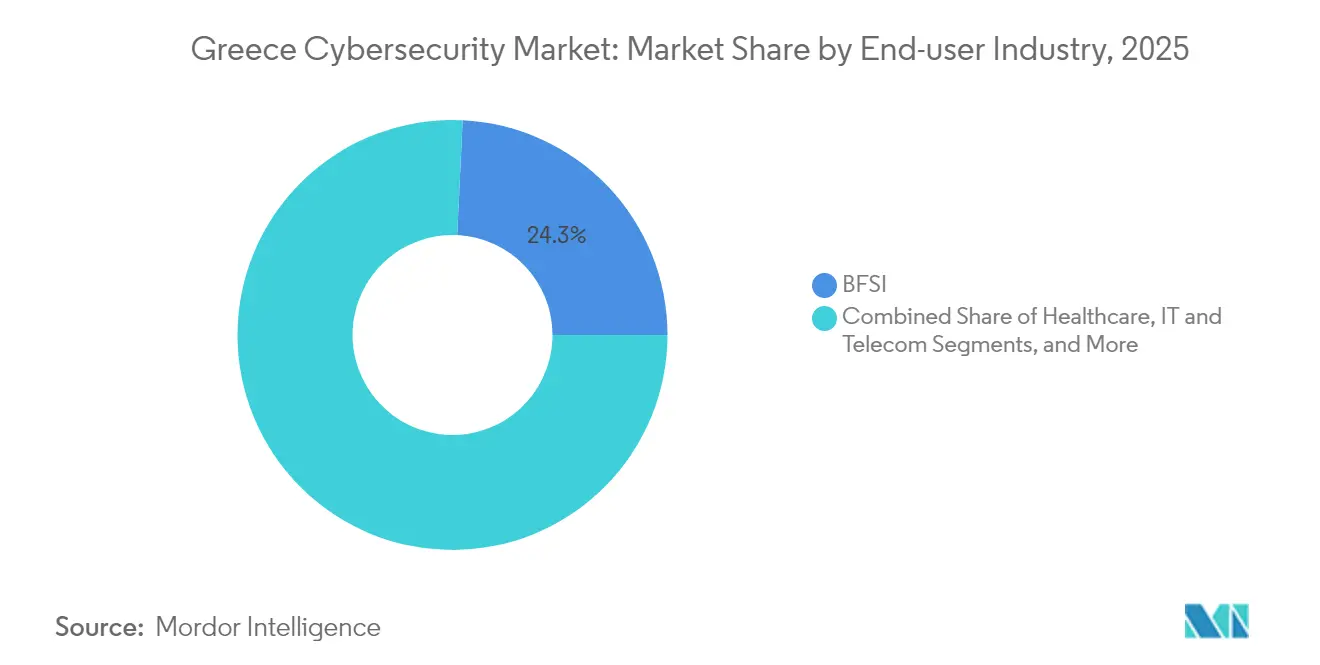
- By end-user industry, BFSI led with 24.25% revenue share in 2025, whereas healthcare is projected to expand at a 13.05% CAGR to 2031.
- By end-user enterprise size, large enterprises commanded 71.05% of the Greece cybersecurity market size in 2025, yet SMEs post the top-line growth at 13.55% CAGR through 2031.
Note: Market size and forecast figures in this report are generated using Mordor Intelligence’s proprietary estimation framework, updated with the latest available data and insights as of 2026.
Greece Cybersecurity Market Trends and Insights
Drivers Impact Analysis*
| Driver | (~) % Impact on CAGR Forecast | Geographic Relevance | Impact Timeline |
|---|---|---|---|
| Mandatory compliance with NIS2 and Greek Law 5160/2024 | +2.1% | Nationwide, 2,000+ entities | Medium term (2–4 years) |
| Surge in sophisticated attacks on critical infrastructure | +1.8% | Ports of Piraeus, Thessaloniki | Short term (≤ 2 years) |
| Accelerated cloud migration under “Greece 2.0” plan | +1.5% | Attica datacenter cluster | Medium term (2–4 years) |
| EU Recovery-fund fuelled security spend in BFSI and public sector | +1.3% | Countrywide | Short term (≤ 2 years) |
| Growth of hyperscale datacentres | +1.0% | Spata, Koropi, Heraklion | Long term (≥ 4 years) |
| Emergence as SE-Europe telecom-cable hub | +0.8% | Crete landing stations | Long term (≥ 4 years) |
| Source: Mordor Intelligence | |||
Mandatory compliance with NIS2 and Greek Law 5160/2024
Greek Law 5160/2024, effective November 2024, broadens liability from 400 critical operators to more than 2,000 essential and important entities, enforces 24-hour incident notifications and levies fines up to USD 10 million for non-compliance. Board-level accountability and compulsory supply-chain risk assessments push enterprises to adopt integrated detection and response platforms, automated reporting tools and cyber-governance consulting. Demand strengthens for threat-hunting and vulnerability-management services able to prove resilience audits to the National Cybersecurity Authority.
Surge in sophisticated cyber-attacks on critical infrastructure
State-sponsored activity now targets energy micro-grids, maritime control networks and cable landing stations, with large Greek organizations reporting 10–20% upticks in attack frequency and average breach costs of USD 504,000 [1]. The 900% escalation in maritime incidents since 2017 forces ship-operators to overhaul vessel OT monitoring, while shared threat-intelligence exchanges linking shipping, power and telecom operators emerge as risk-mitigation norms.
Accelerated cloud migration under “Greece 2.0” digital plan
USD 7.7 billion earmarked for Greece 2.0 accelerates 450 public-sector workloads toward cloud datacentres operated by Microsoft, Amazon Web Services and Google, fuelling identity-access, encryption and posture-management uptake. SME vouchers subsidise secure SaaS adoption for 100,000 companies, expanding mass-market demand for cloud-native security frameworks.
EU Recovery-fund fuelled security spend in BFSI and public sector
Greek transposition of the Digital Operational Resilience Act (DORA) via Law 5193/2025 imposes mandatory penetration tests, third-party risk assessments and continuous monitoring on banks and insurers supervised by the Bank of Greece. Parallel public-hospital imaging projects covering 2 million annual exams necessitate data-protection controls, stimulating cross-sector procurement of unified governance, risk and compliance (GRC) suites.
Restraints Impact Analysis*
| Restraint | (~) % Impact on CAGR Forecast | Geographic Relevance | Impact Timeline |
|---|---|---|---|
| Acute cybersecurity talent shortage | –1.4% | Athens, Thessaloniki tech hubs | Medium term (2–4 years) |
| SME cost-sensitivity toward advanced tools | –0.9% | Nationwide, 99% of firms | Short term (≤ 2 years) |
| Regulatory overlap causing fatigue | –0.6% | Multi-sector entities | Medium term (2–4 years) |
| Legacy OT in shipping and energy | –0.7% | Piraeus, Thessaloniki ports | Long term (≥ 4 years) |
| Source: Mordor Intelligence | |||
Acute cybersecurity talent shortage
Greece will require up to 400,000 additional technology workers by 2030, with 32% of firms failing to fill security roles as wage inflation outstrips budgets [2]. MSSPs raise retainers, and universities race to harmonise curricula, but the supply–demand gap persists, curbing in-house SOC expansion.
SME cost-sensitivity toward advanced security tools
Eighteen percent of Greek SMEs lack any cybersecurity controls and 44% rely solely on antivirus suites, citing funding and expertise gaps. Although the EU voucher scheme offsets procurement costs, unfamiliar tender rules and limited technical staff restrict uptake, lengthening sales cycles for enterprise-grade solutions.
*Our forecasts treat driver/restraint impacts as directional, not additive. The impact forecasts reflect baseline growth, mix effects, and variable interactions.
Segment Analysis
By Offering: Services Acceleration Outpaces Solutions Maturity
Solutions contributed 62.65% of revenue in 2025 as firms established baseline controls for NIS2 alignment. Services, though smaller, are scaling at a 12.35% CAGR, reflecting reliance on external specialists to bridge the talent deficit. Application- and cloud-security suites command adoption in newly built Attica datacentres, while identity-access tools gain traction among remote workforces.
Professional and managed services growth is underpinned by architecture reviews, incident-response retainers and regulatory-gap assessments. Providers such as KPMG Greece bundle NIS2, DORA and ISO-27001 readiness within fixed-fee engagements, positioning services as the fastest-rising revenue stream within the Greece cybersecurity market.

By Deployment Mode: Cloud Dominance Accelerates Infrastructure Transformation
Cloud held a 56.85% stake in 2025 and extends at an 11.05% CAGR to 2031, mirroring USD 5.0 billion in hyperscale facility investments by Microsoft, Digital Realty and AWS. Hybrid models capture utilities and BFSI entities that must keep legacy mainframes on-premise yet modularise new workloads in the cloud.
Greek Law 5069/2023 simplifies zoning for datacentres above 10 MW, sparking a cluster near Spata. Edge-compute nodes along submarine-cable landing sites create micro-segmented security perimeters. On-premise deployments remain essential for air-gapped maritime and energy OT, but the direction of travel favours SaaS and infrastructure-as-code security disciplines that underpin the Greece cybersecurity market.
By End-user Industry: Healthcare Surge Challenges BFSI Leadership
BFSI controlled 24.25% revenue in 2025, anchored in card-fraud analytics and core-banking modernisation. DORA makes continuous penetration testing and supply-chain audits mandatory, sustaining expenditure. Healthcare, boosted by AGFA HealthCare’s imaging rollout at 37 hospitals, logs the swiftest 13.05% CAGR, as patient-data confidentiality rules drive encryption and IAM projects.
Energy operators invest to neutralise rooftop solar vulnerabilities, while the maritime community introduces vessel-communications firewalls ahead of IMO cyber-deadlines. Retail and manufacturing activity is modest yet accelerating as SMEs utilise voucher funding, further broadening demand profiles inside the Greece cybersecurity market.
By End-user Enterprise Size: SME Growth Potential Exceeds Large-Enterprise Stability
Large enterprises accounted for 71.05% of 2025 spending, leveraging deeper budgets and mature governance structures. However, SMEs will outpace them at a 13.55% CAGR, catalysed by simplified security-as-a-service bundles and subsidised cloud migrations.
The talent crunch is acute for smaller firms lacking full-time CISOs, prompting MSSP partnerships for 24×7 monitoring. Government-supported dashboards such as SMESEC deliver unified risk views, instilling best-practice baselines and widening the customer funnel for the Greece cybersecurity market.
Geography Analysis
Attica anchors the domestic market as Microsoft, AWS and Digital Realty establish multi-availability-zone campuses near Spata and Koropi, igniting a local ecosystem of SOC providers, compliance consultants and start-ups. The National Cybersecurity Authority and leading integrators Space Hellas and Uni Systems operate their headquarters in Athens, securing public-sector NIS2 roll-outs .
Crete’s Heraklion campus and the Egyptian land-link via Port Said elevate the island as a Mediterranean cable crossroads, necessitating layered network-security gateways and sovereign data-governance controls. Thessaloniki hosts a secondary innovation pole tied to rooftop-solar R&D, where demonstrations of remote PV hijacking spark grid-protection pilots across mainland energy zones.
Regional export potential grows as Balkan neighbours seek EU-aligned frameworks. The Pharos AI supercomputing program and DAEDALUS initiative position Greece as a regional R&D nucleus, beckoning cross-border ventures and reinforcing the Greece cybersecurity market as a Southeast European security hub.
Regulatory Landscape
Greece supervises cybersecurity primarily through the National Cybersecurity Authority (NCSA), established as the central supervisory body under Law 5086/2024 and operating under the Ministry of Digital Governance. The NCSA functions as the national CSIRT and the single point of contact for the EU NIS2 framework, coordinating incident handling and supervisory engagement for in-scope entities.
NIS2 (Directive (EU) 2022/2555) has been transposed through Greek Law 5160/2024 (effective November 2024), expanding obligations from a narrower set of critical operators to more than 2,000 essential and important entities. The framework requires mandatory registration with the NCSA and ongoing compliance oversight, including desk-based reviews and audits. It also raises incident-reporting timelines and governance expectations, which sustains demand for compliance tooling, incident-response readiness, and supply-chain risk assessment services.
Value Chain Analysis
The Greece cybersecurity value chain begins with global technology OEMs supplying core platforms across endpoint, network, cloud, and identity, followed by local distribution and integration layers that localize licensing, deployment, and support. International vendor alliances (for example, IBM and Fortinet partnering on solutions) feed into Greek enterprise and public-sector deployments, where hybrid cloud, SOC tooling, and secure connectivity are procured as integrated stacks.
Downstream, local ICT distributors and channel partners (for example, GCC Hellas for Fortinet) extend coverage across Athens and regional accounts. Managed service providers such as Vodafone Business package secure networking, monitoring, and operations into recurring services that suit a talent-constrained buyer base. Training and awareness, along with ecosystem-building activities, including local industry events focused on OT and industrial infrastructure security, help align operational teams, integrators, and vendors around common deployment patterns and the standards required by regulated sectors.
Competitive Landscape
Global vendors—IBM, Cisco, Microsoft, Fortinet and Palo Alto Networks—serve large enterprises with full-stack platforms, combining XDR, SASE and zero-trust toolkits. Their scale advantages include global threat-intelligence feeds and local PoP coverage inside Athens datacentres.
Domestic integrators such as Space Hellas (USD 78.9 million H1 2024 revenue) and Uni Systems leverage native language support, EU-fund bid experience and entrenched public-sector ties to secure NIS2 and DORA compliance projects. Hybrid alliances form: Space Hellas resells Cisco SecureX, while Uni Systems integrates Microsoft Sentinel for managed detection.
Service-centred firms—EY, KPMG, Accenture—differentiate via governance consulting as the talent drought intensifies, pricing retainer contracts at premium rates. Maritime-focused start-ups emerge, including Optima Cyber, addressing operational-technology niches. The moderate blend of local and global providers keeps the Greece cybersecurity market moderately concentrated yet competitive.
Greece Cybersecurity Industry Leaders
-
IBM Corporation
-
Fortinet Inc.
-
Cisco Systems, Inc.
-
Check Point Software Technologies Ltd.
-
Palo Alto Networks, Inc.
- *Disclaimer: Major Players sorted in no particular order
Market Opportunities and Future Outlook
National programs are creating clear whitespace around structured cyber-resilience projects and skills mobilization. The National Cybersecurity Strategy 2026-2030, adopted via Ministerial Decision 2563/16-12-2025, explicitly targets NIS2 implementation and critical-infrastructure protection. It also introduces mechanisms such as a National Register of Greek Cybersecurity Researchers and Experts and a National Cybersecurity Reserve to financially support public and private resilience initiatives. These instruments tend to favor vendors and service providers that can package governance, risk, compliance, and operational delivery into repeatable programs aligned to NCSA supervision.
Secure connectivity and OT protection form another opportunity cluster as cloud migration and distributed infrastructure broaden the attack surface. Vodafone Business launching SASE and SD-WAN solutions in Greece in partnership with Fortinet (July 2026) points to market pull for SASE-style architectures delivered through local operators and managed services, especially for mid-market firms without in-house SOC capacity. In parallel, critical infrastructure modernization efforts, such as IPTO deploying an AI-enabled asset performance management system with IBM and NOVA ICT (March 2026), reinforce security controls that integrate with operational systems in energy, ports, and telecom environments.
Recent Industry Developments
- July 2026: Vodafone Business (Greece) launched new SASE and SD-WAN solutions in Greece, developed in partnership with Fortinet. The rollout expands secure connectivity offerings for enterprises and strengthens the combined Vodafone Fortinet footprint in the market.
- June 2026: IDEAL Technology designated as a SASE Specialized Distributor for Fortinet in Greece and Cyprus. This formal channel expansion supports SASE adoption among Greek and Cypriot customers and improves local distribution capability.
- March 2026: IBM Corporation (IPTO program collaboration via NOVA ICT) implemented an AI-powered Asset Performance Management System to protect electricity transmission infrastructure. This demonstrates active modernization of public-sector and critical national infrastructure cybersecurity and suggests potential demand for embedded security solutions.
Research Methodology Framework and Report Scope
Market Definition and Coverage
This market covers spending in Greece on cybersecurity software and related services that help organizations prevent, detect, and respond to digital threats across users, devices, networks, cloud, and data environments.
Scope exclusions: It excludes general IT hardware refresh, basic connectivity services, and non-security IT consulting that is not directly tied to security outcomes.
Segmentation Overview
- By Offering
- Solutions
- Application Security
- Cloud Security
- Data Security
- Identity and Access Management
- Infrastructure Protection
- Integrated Risk Management
- Network Security
- End-point Security
- Services
- Professional Services
- Managed Services
- Solutions
- By Deployment Mode
- Cloud
- On-Premise
- By End-user Industry
- BFSI
- Healthcare
- IT and Telecom
- Industrial and Defense
- Retail and E-commerce
- Energy and Utilities
- Manufacturing
- Others
- By End-user Enterprise Size
- Large Enterprises
- Small and Medium Enterprises (SMEs)
Data Sources, Market Sizing, and Validation
Desk Research
Desk work starts by mapping Greece-specific demand signals and policy triggers that usually shape security budgets. We reference public sources such as ENISA publications, European Commission materials and EU law trackers (including NIS2), Eurostat digital economy statistics, OECD ICT indicators, and reports from Greece-focused public bodies that discuss cyber readiness and reported incidents.
To make the market model practical, we also review company annual reports, investor presentations, audited financial statements, and reputable press coverage on large projects, cloud buildouts, and public tenders. Where it helps with cross-checking, we use paid subscriptions focused on company financials and intelligence, contract and tender tracking, and patent databases to confirm what providers build and what buyers procure. These examples are not exhaustive, and many other sources were also used for data collection, validation, and clarification.
Primary Interviews and Surveys
We conduct expert interviews and surveys with cybersecurity suppliers, distributors, service providers, technology leaders, and purchasing managers in Greece. Their input checks adoption, renewal timing, average selling prices, managed service demand, and the effect of NIS2 and Law 5160/2024. Open gaps are rechecked against secondary evidence before assumptions and final results are aligned.
Distribution of primary research fieldwork respondents
| Company type | Respondent position |
|---|---|
| Top tier: 27% | CXOs: 20% |
| Mid tier: 49% | Functional/Unit leaders: 30% |
| Smaller Players: 24% | Managers: 50% |
Market-Sizing & Forecasting
Sizing begins with a top-down build where national IT and digital spending signals are filtered into a Greece-only cybersecurity demand pool, and then allocated across software and services based on adoption and compliance intensity. The totals are checked with selective bottom-up approximations, including sampled revenue rollups from providers active in Greece, channel feedback on deal sizes, and price-per-user or price-per-device ranges multiplied by realistic volumes, which helps correct over-counting.
Inputs that matter in this market include enterprise security budget shares, regulatory compliance timelines (particularly NIS2 readiness work), cloud migration pace, managed security service take-up among mid-sized firms, incident frequency and severity trends, and the shifting split between recurring subscriptions and project-based services. Forecasting uses scenario analysis supported by a simple multivariate regression view, where the main drivers (digitalization spend, regulatory deadlines, and threat pressure) are stress-tested and then aligned to what primary respondents expect for price progression and renewal behavior. When a segment lacks clean public data, we apply conservative penetration curves and keep assumptions traceable to interview feedback and observable procurement activity.
Data Validation & Update Cycle
Validation is done through step-by-step checks that compare outputs against independent signals such as ICT spend direction, public tender flows, and the implied spend per enterprise cohort, and then outliers are reviewed before sign-off. If a number looks stretched, we recheck currency conversion timing, subscription duration assumptions, and whether a service line was counted twice across delivery layers.
Reports are refreshed annually, and interim updates are made when material events shift demand, including major regulation changes, large public programs, or sharp shifts in threat patterns. Before delivery, an analyst performs a fresh pass on key inputs and re-contacts experts when new data creates a meaningful variance, so clients receive the latest updated view.
Mordor Intelligence's Greece Cybersecurity Market Size Compared Against Other Published Estimates
Published cybersecurity market figures for Greece can differ widely because the boundaries are not always the same, and timing assumptions behind pricing and currency can move the number more than many readers expect. Differences also come from whether an estimate leans toward product-only views, services-heavy views, or a mixed view that reflects how organizations procure security.
Refresh timing and conversion choices are a frequent gap driver for this country market, because multi-year contracts and subscriptions are often priced in euros while many summaries are presented in USD. By anchoring conversion to the base year and rechecking subscription ASP progression during the annual refresh, the model used by Mordor Intelligence avoids overstating growth when list prices rise but renewals and bundles soften realized pricing.
Benchmark comparison
| Source | Market Size | Gaps in Research Methodology |
|---|---|---|
| Mordor Intelligence | USD 171.00 M (2025) | |
| Trade Journal A | USD 551.00 M (2028) | Target is stated in euros and tied to a 2024-2028 outlook, and it is unclear if it includes broader digital risk programs and adjacent IT spend. A USD figure can shift materially depending on the conversion year, and the scope may extend beyond core security tools and services. |
| Industry Association B | USD 160.00 M (2025) | Often reflects conservative member-reported revenues and can undercount indirect channels and bundled managed services. The approach may also apply flat ASP assumptions that miss mix-shift toward higher-value managed offerings. |
Across the three views, the spread mainly comes from year alignment, currency handling, and whether services and bundled delivery are counted consistently. Keeping assumptions tied to observable procurement signals and re-validating price and renewal logic each cycle helps produce a number that is easier to replicate and track over time.
Key Questions Answered in the Report
What is the current size of the Greece cybersecurity market and how fast is it growing?
The market is valued at USD 185.3 million in 2026 and is forecast to reach USD 276.83 million by 2031, registering an 8.36% CAGR.
Which segment is expanding faster—solutions or services?
Services are the fastest-growing segment at a 12.35% CAGR through 2031, outpacing the solutions segment that currently holds the larger revenue share.
Why is cloud deployment gaining momentum in Greece?
USD 5.0 billion in hyperscale datacenter investments from Microsoft, Digital Realty and AWS, coupled with the Greece 2.0 digital-transformation program, is driving an 11.05% CAGR for cloud-based security.
How does NIS2 compliance impact Greek organizations?
Greek Law 5160/2024 extends cybersecurity obligations to more than 2,000 entities, imposes 24-hour breach-notification rules and fines up to USD 10 million, accelerating demand for automated detection and response tools.