
Cruise Tourism Market Size and Share
Market Overview
| Study Period | 2020 - 2031 |
|---|---|
| Market Size (2026) | USD 203.79 Billion |
| Market Size (2031) | USD 279.76 Billion |
| Growth Rate (2026 - 2031) | 6.55 % |
| Fastest Growing Market | Asia Pacific |
| Largest Market | North America |
| Market Concentration | High |
Major Players *Disclaimer: Major Players sorted in no particular order Image © Mordor Intelligence. Reuse requires attribution under CC BY 4.0. | |
Cruise Tourism Market Analysis by Mordor Intelligence
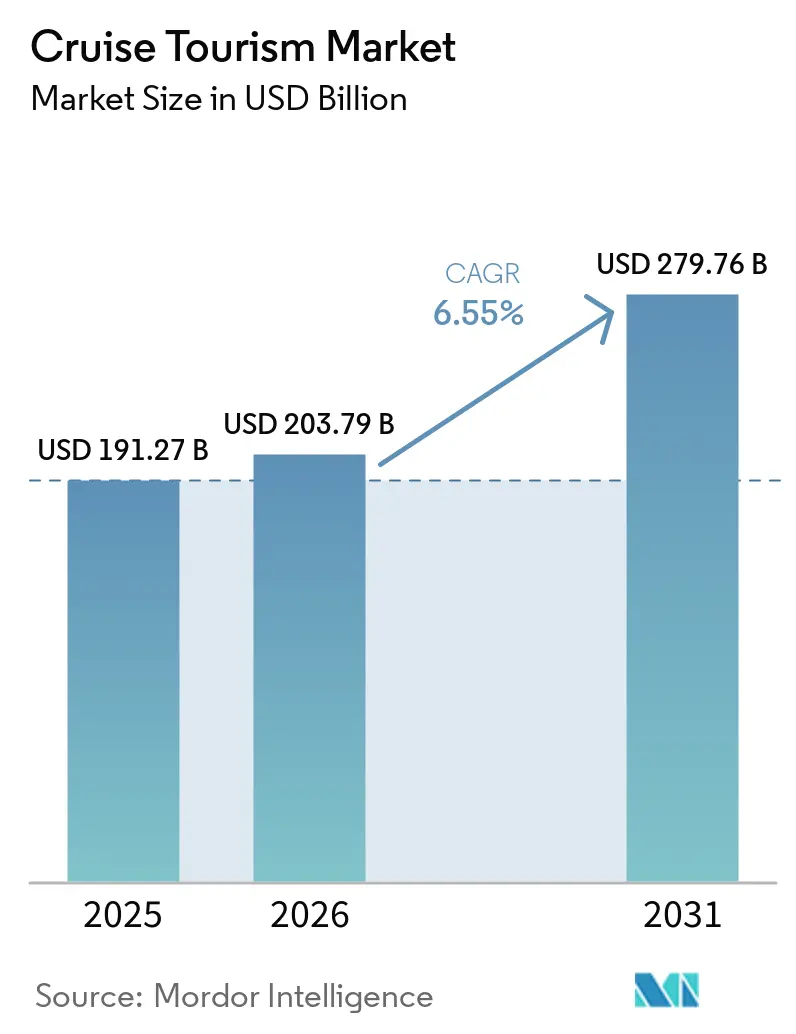
The cruise tourism market size is expected to grow from USD 191.27 billion in 2025 to USD 203.79 billion in 2026 and is forecast to reach USD 279.76 billion by 2031 at 6.55% CAGR over 2026-2031. Buoyed by post-pandemic travel resurgence, the market benefits from pent-up demand, mega-ship deployments, and rapid expansion into emerging regions. Operators leverage larger vessels to lower per-berth costs while channeling savings into digital guest-experience upgrades. Expedition itineraries outperform mainstream segments as climate-induced polar route access widens and affluent adventure travelers willingly pay premium fares. Meanwhile, environmental regulations and macroeconomic uncertainty temper profit margins, forcing fleets to accelerate efficiency investments and diversify itinerary portfolios.
Key Report Takeaways
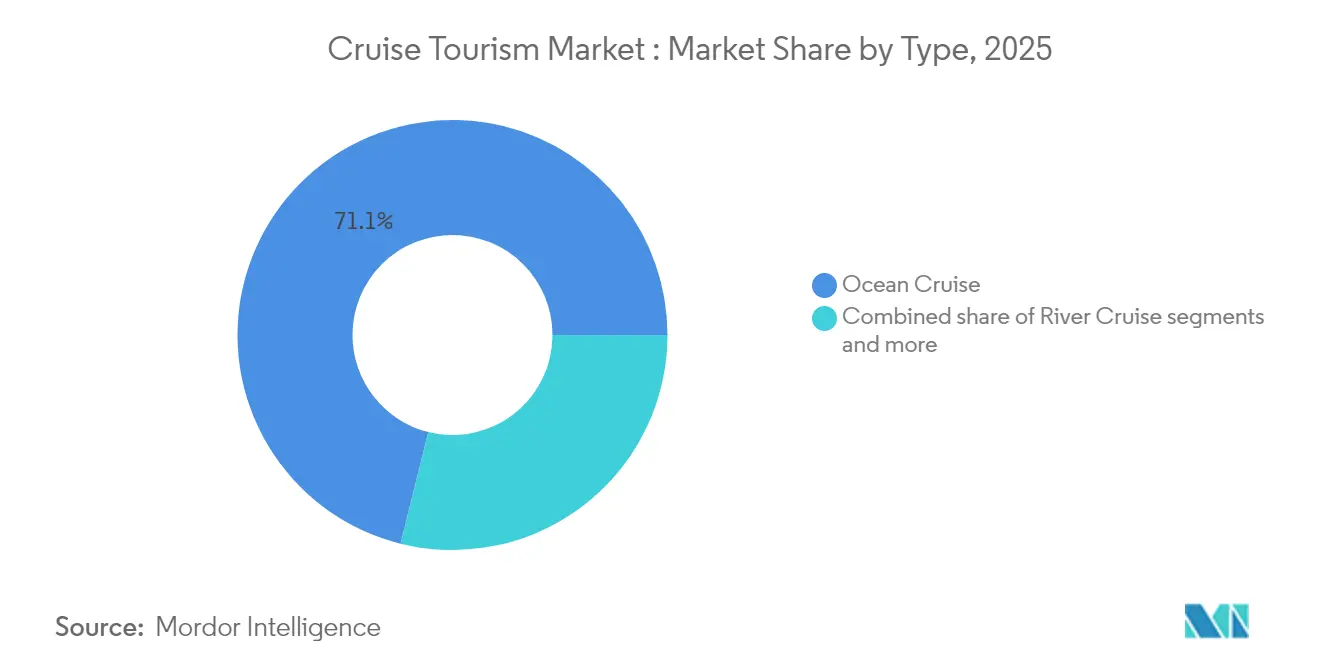
- By type, ocean cruises led with 71.12% of the cruise tourism market share in 2025; expedition cruises are forecast to expand at a 10.12% CAGR through 2031.
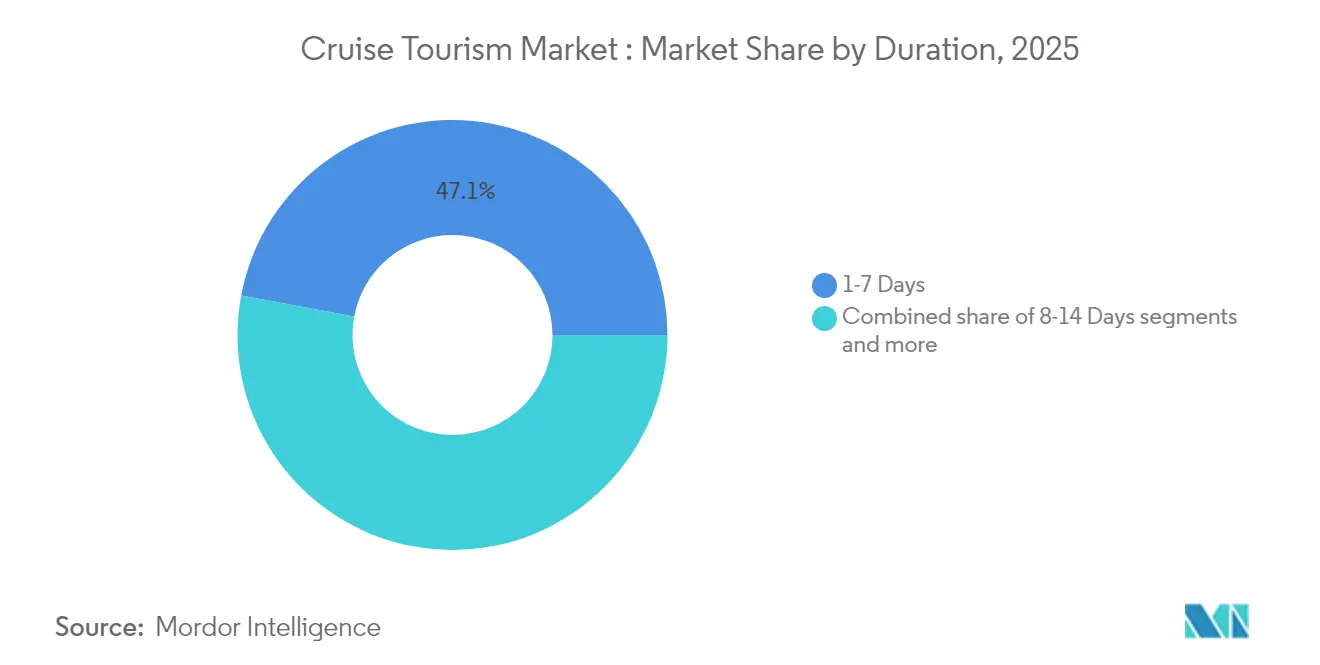
- By duration, 1-7 day voyages accounted for 47.05% of the cruise tourism market share in 2025, while 8-14 day cruises are poised to grow at an 8.05% CAGR to 2031.
- By passenger age, the 40-59 segment held 39.15% share of the cruise tourism market size in 2025, whereas the 20-39 cohort is advancing at a 9.52% CAGR.
- By geography, North America commanded 52.20% of the cruise tourism market share in 2025, but Asia-Pacific is projected to post an 10.78% CAGR through 2031.
Note: Market size and forecast figures in this report are generated using Mordor Intelligence’s proprietary estimation framework, updated with the latest available data and insights as of 2026.
Market Trends and Insights
Drivers Impact Analysis of Cruise Tourism Market *
| Driver | (~) % Impact on CAGR Forecast | Geographic Relevance | Impact Timeline |
|---|---|---|---|
| Growing middle-class disposable income in emerging markets | 1.8% | APAC core, spill-over to MEA and South America | Medium term (2-4 years) |
| Rapid expansion of new-build ocean vessels & mega-ships | 1.2% | Global, with concentration in North America & Europe | Long term (≥ 4 years) |
| Strong post-COVID pent-up demand for experiential travel | 0.9% | Global, strongest in North America & Europe | Short term (≤ 2 years) |
| Surge in retiree wealth fueling longer cruise vacations | 0.7% | North America & Europe primarily | Medium term (2-4 years) |
| Opening of previously restricted polar waterways | 0.3% | Arctic/Antarctic routes, benefiting global operators | Long term (≥ 4 years) |
| Government-backed port infrastructure upgrades | 0.4% | APAC, MEA, and South America emerging markets | Medium term (2-4 years) |
| Source: Mordor Intelligence | |||
Growing Middle-Class Income Expansion Reshapes Passenger Demographics
Emerging market prosperity fundamentally alters cruise accessibility, with China's middle-class households earning above USD 10,000 annually projected to reach 550 million by 2030. This demographic expansion drives first-time cruiser adoption rates exceeding 15% annually across ASEAN markets, where multi-generational family bookings now represent 35% of regional demand. The shift enables operators to deploy larger vessels on Asia-Pacific itineraries, with average ship capacity increasing 23% since 2024 as lines chase economies of scale. Pricing strategies adapt accordingly, with premium operators launching mid-market brands specifically targeting emerging market consumers who prioritize value over luxury amenities.
Mega-Ship Economics Transform Capacity Deployment Strategies
Twenty-five ships ordered in 2024 add 6,000-plus berths each and cut per-capita operating expenses by up to 22% thanks to fuel-efficient hulls [1]. Larger vessels enable older tonnage redeployment into secondary markets without diluting premium route pricing. Balance-sheet risk rises, however, if demand misaligns with supply in mature corridors. Operators mitigate exposure by aligning delivery schedules with forward bookings and by forging favorable long-term financing at today’s relatively low borrowing costs. Airports and ports race to expand infrastructure that accommodates ships exceeding 250,000 gross tons.
Post-Pandemic Experiential Travel Demand Sustains Premium Pricing
Global cruise bookings in 2024 eclipsed 2019 levels by 12% even as average fares rose 8-15% [2]. Consumers prioritize unique experiences such as Antarctic landings, leading to expedition booking surges of 71%. Lines redesign stateroom-mix strategies, swapping low-yield inside cabins for balcony and suite categories that capture higher onboard spend averaging USD 65-80 daily. While revenge-travel momentum is strongest in North America and Europe, emerging markets display parallel enthusiasm, signaling a durable pivot from possession-based to experience-based discretionary spending.
Retiree Wealth Concentration Drives Extended Voyage Demand
Affluent retirees propel demand for itineraries surpassing 21 days that command USD 400-600 daily rates [3]. Operators retrofit ships with residential-style suites and expanded medical centers to support long-haul comfort. High onboard revenue capture offsets elongated voyage duration by reducing port fees as a share of total costs. Luxury lines reap disproportionate gains because service quality and destination enrichment products resonate with this demographic. Continued growth hinges on financial-market stability that safeguards seniors’ investment income streams.
Restraints Impact Analysis of Cruise Tourism Market *
| Restraint | (~) % Impact on CAGR Forecast | Geographic Relevance | Impact Timeline |
|---|---|---|---|
| Macroeconomic shocks elevating travel-cost sensitivity | 0.8% | Global, strongest impact in emerging markets | Short term (≤ 2 years) |
| Environmental regulations raising operating costs | 0.6% | Global, with EU leading regulatory implementation | Medium term (2-4 years) |
| Limited berth capacity at marquee ports | 0.4% | Caribbean, Mediterranean, Alaska primary routes | Medium term (2-4 years) |
| Rising geopolitical instability along key corridors | 0.3% | Middle East, Eastern Mediterranean, Arctic routes | Short term (≤ 2 years) |
| Source: Mordor Intelligence | |||
Economic Volatility Pressures Discretionary Travel Budgets
Inflationary pressures and recession fears create headwinds for cruise demand, particularly among price-sensitive emerging market consumers who represent the industry's primary growth engine. Central bank monetary tightening cycles reduce household disposable income, with cruise bookings showing a 0.7-0.9 correlation to consumer confidence indices across major source markets. Operators respond through dynamic pricing strategies and flexible payment plans, yet sustained economic weakness could force capacity reductions or aggressive discounting that erodes profitability. The challenge intensifies in markets like China and India, where nascent cruise cultures lack the loyalty patterns that sustain demand during downturns.
Environmental Compliance Costs Strain Operating Margins
IMO 2030 emission reduction targets and expanding the EU Emissions Trading System coverage impose significant retrofit and operational costs across global fleets. Compliance investments average USD 15-25 million per vessel for scrubber installations and fuel system modifications, while alternative fuel premiums add USD 50-80 per passenger to voyage costs. FuelEU Maritime regulations further complicate operations by mandating renewable fuel blending quotas that exceed current supply capacity. These regulatory pressures disproportionately impact older vessels, accelerating fleet renewal cycles and creating competitive advantages for operators with newer, more efficient ships.
*Our forecasts treat driver/restraint impacts as directional, not additive. The impact forecasts reflect baseline growth, mix effects, and variable interactions.
Cruise Tourism Market Segment Analysis
By Type:
Expedition Cruises Capitalize on Climate-Driven Route AccessExpedition vessels generate a 10.12% CAGR, even though ocean cruises retain 71.12 of % 2025 revenue dominance. The cruise tourism market size for expedition itineraries is set to climb from USD 7.9 billion in 2025 to USD 14.1 billion by 2031, benefiting from per-passenger yields exceeding USD 1,000 daily. Operators invest in ice-class hulls, zodiac fleets, and science partnerships to differentiate, yet must balance growth against fragile polar ecosystems. River cruises, theme voyages, and adventure sailings broaden customer choice but face port-infrastructure and seasonality constraints that slow expansion.
Passengers' appetite for authenticity drives niche-segment proliferation. Smaller ships access restricted bays and remote villages, fostering cultural exchange and sustainable tourism narratives. However, polar-region restrictions could cap capacity if environmental thresholds tighten further. High ticket prices insulate margins but expose demand to macroeconomic swings. Strategic collaboration with local authorities ensures controlled visitor volumes while preserving itinerary appeal.

By Duration:
Mid-Length Voyages Gain Traction Among Working ProfessionalsThe 8-14 day bracket grows 8.05% annually as remote-work flexibility enables travelers to merge vacation and telecommuting. The cruise Tourism market share held by short cruises drops gradually as consumers seek multi-country routes without exceeding two-week leave entitlements. Mid-length voyages optimize port costs across itinerary chains and unlock incremental onboard spend opportunities.
Lines tailors entertainment schedules and connectivity packages to lure professionals who demand stable broadband. Longer 15-20 day trips cater mainly to affluent retirees, while world cruises remain niche yet profitable. By designing voyages that start on weekends, operators minimize vacation-day usage, further boosting appeal to time-constrained travelers.
By Passenger Age:
Younger Demographics Drive Digital Innovation AdoptionThe 20-39 cohort is projected to expand at 9.52% CAGR, lifting its revenue slice from 29.00% in 2025 to 34.20% by 2031. That growth elevates the cruise Tourism market size for the age group to USD 95.7 billion by 2031 . Millennials and Gen Z exhibit onboard spend of USD 85-110 daily, materially higher than older guests. Operators introduce contactless payments, mobile ordering, and social-media-optimized spaces to meet expectations.
Marketing pivots toward influencer partnerships and gamified loyalty apps that convert first-time cruisers into repeat customers. Yet price sensitivity remains acute, demanding value-oriented fare tiers and flexible cancellation policies. For the 13-19 bracket, school calendars restrict travel windows, compelling lines to stage youth-centric programming during holiday peaks.
Geography Analysis
North America Cruise Tourism Market
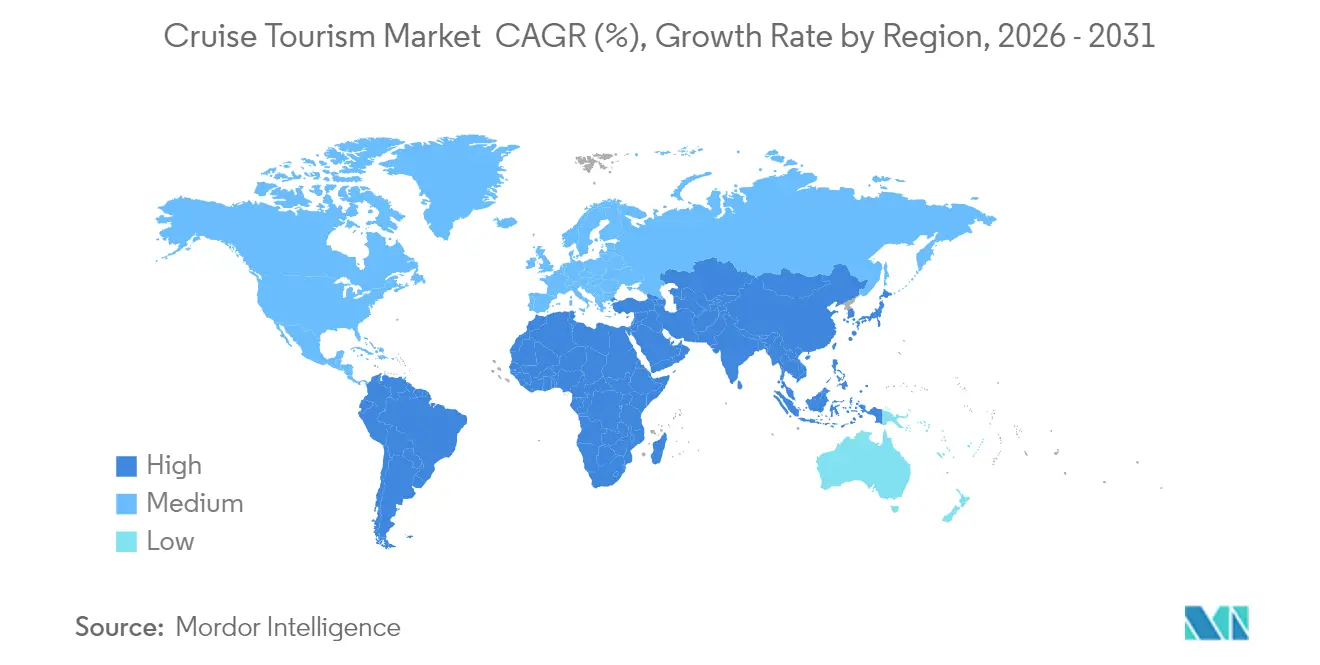
North America retains 52.20% revenue share, anchored by Caribbean and Alaska routes supported by extensive port networks and favorable regulatory frameworks. Environmental restrictions in Alaska tighten itinerary windows, but Canada’s Arctic infrastructure upgrades unlock new summer options. Mexico’s Caribbean investments expand embarkation alternatives, reducing reliance on U.S. ports.
APAC Cruise Tourism Market
Asia-Pacific’s 10.78% CAGR crowns it the fastest-growing region. Governments allocate more than USD 15 billion to port facilities, customs modernization, and cruise-specific marketing. China’s state-backed shipbuilding accelerates domestic capacity, and Singapore leverages Changi Airport connectivity to capture fly-cruise traffic. Australia benefits from southern-hemisphere seasonality that fills berths during the Northern Hemisphere winter.
Europe Cruise Tourism Market
Europe enjoys mature but modest growth as Mediterranean and Baltic voyages capitalize on UNESCO-rich ports. However, the EU ETS raises operating expenses and may redirect older tonnage to less-regulated waters. Eastern European terminals emerge as cost-efficient alternatives, while Brexit complicates itinerary planning between the UK and continental ports.
Regulatory Landscape
Cruise tourism regulation is anchored in International Maritime Organization (IMO) safety and environmental conventions, implemented through flag-state oversight and port-state control regimes such as the Paris MOU and Tokyo MOU. Compliance requirements are tightening further through region-specific rules that shape itinerary planning and onboard and port waste handling, including Norway's zero-emission requirements in World Heritage fjords from January 1, 2026 for passenger ships under 10,000 gross tonnage and Transport Canada's Interim Order No. 4, effective June 11, 2026, governing sewage and greywater discharge by cruise ships in Canadian waters.
In Europe, destination-level frameworks are also tightening. The Sustainable Cruise Charter (2026-2030) in the Mediterranean, overseen by DIRM Mediterranee and the Principality of Monaco, raises expectations on environmental performance and port-call practices, reinforcing the role of ports and local authorities in monitoring. In the United States, cruise-specific passenger protection proposals such as S. 2640 (2025) indicate continued scrutiny of security, safety, and reporting, adding another compliance layer for operators calling at US ports.
Value Chain Analysis
The cruise tourism value chain begins upstream with vessel design, marine engineering, and specialized shipbuilding. This remains a high value-added segment concentrated among a limited set of advanced yards and tier suppliers, notably in Europe. As environmental retrofit cycles and newbuild pipelines overlap, the upstream concentration can increase dependency and delivery-risk exposure.
Midstream, major cruise operators (Carnival Corporation & plc, Royal Caribbean Group, Norwegian Cruise Line Holdings, MSC Cruises, and Disney Cruise Line) manage itinerary design, hotel operations at sea, distribution, and revenue management across ticketing and onboard spend. Downstream execution depends on port call logistics, passenger processing, shore-excursion operators, and local destination services, while ship provisioning and turnaround are constrained by narrow port windows, often 4-8 hours. These time-bound interfaces place reliability of port infrastructure, ground handling, and local supplier coordination at the center of both service quality and cost control.
Competitive Landscape
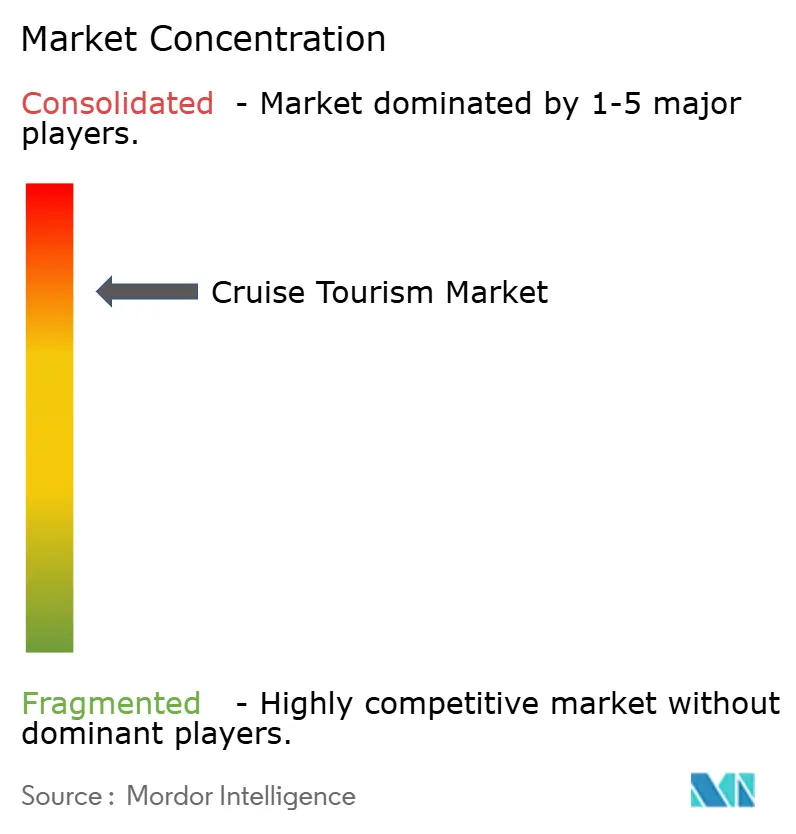
The cruise industry is dominated by a small number of major operators, with the top five companies holding the majority of global passenger capacity. This concentration creates high barriers to entry, enabling major players to exercise pricing discipline and coordinate capacity deployment effectively. Strategic partnerships and shared technology initiatives are common, exemplified by Royal Caribbean’s use of AI to boost guest engagement by 35%, and Princess Cruises’ comprehensive digital transformation programs. Rather than competing solely on capacity, cruise lines are increasingly differentiating through unique onboard experiences, exclusive destination access, and strong sustainability credentials. The industry avoids destructive price wars, recognizing the high capital intensity and long-term risks associated with such competition.
Technology adoption has emerged as a key differentiator, with top operators investing between USD 200–500 million annually in digital infrastructure. These investments support AI-driven guest services, IoT-enabled ship operations, and automation to enhance both operational efficiency and customer satisfaction. Enhancing the passenger experience through personalized services and seamless connectivity has become a strategic priority. At the same time, technology helps reduce operating costs and supports compliance with growing environmental regulations. As a result, innovation remains central to maintaining competitiveness and brand loyalty in the sector.
New market entrants tend to focus on niche segments such as ultra-luxury travel or expedition cruising, while established players reinforce their dominance through brand portfolio expansion and strategic acquisitions. Opportunities still exist in underserved geographic markets and underrepresented demographics, but the high capital requirements and regulatory complexities present significant obstacles. Consolidation remains a defining trend as smaller operators struggle to keep pace with environmental mandates and capacity competition from larger vessels. Mega-ship deployments by major brands further pressure independent cruise lines, accelerating industry concentration.
Cruise Tourism Industry Leaders
-
Carnival Corporation & plc
-
Royal Caribbean Group
-
Norwegian Cruise Line Holdings
-
MSC Cruises
-
Disney Cruise Line
- *Disclaimer: Major Players sorted in no particular order
Cruise Tourism Market Companies Covered in this Report
- Carnival Corporation & plc
- Royal Caribbean Group
- Norwegian Cruise Line Holdings Ltd.
- MSC Cruises S.A.
- Disney Cruise Line
- Viking Cruises Ltd.
- Genting Hong Kong Ltd. (Dream Cruises)
- Silversea Cruises
- Ponant
- Lindblad Expeditions
- Hurtigruten Group
- Scenic Luxury Cruises & Tours
- Oceania Cruises
- Regent Seven Seas Cruises
- Crystal Cruises
- Azamara
- Seabourn Cruise Line
- Holland America Line
- Celebrity Cruises
- Princess Cruises
Market Opportunities and Future Outlook
Regulation-led decarbonization is opening near-term areas for investable solutions that lower in-port emissions and support environmental compliance at destination hotspots. Norway's zero-emission requirements in World Heritage fjords (effective January 1, 2026 for passenger ships under 10,000 gross tonnage) increase the value of compliant tonnage and alternative operating concepts in sensitive areas, supporting opportunities for smaller-ship expedition and premium itineraries that can meet stricter local thresholds. At the same time, the Mediterranean Sustainable Cruise Charter (2026-2030), overseen by DIRM Mediterranee and the Principality of Monaco, elevates environmental commitments and links ports into charter networks, which reinforces demand for shore-power connections and port-side energy services at high-traffic calls.
Infrastructure-led expansion in emerging regions is another opportunity set, especially where governments and port authorities are modernizing cruise facilities and customs processes to support higher passenger throughput and more reliable turnarounds. The report context highlights more than USD 15 billion allocated in Asia-Pacific to port facilities, customs modernization, and cruise marketing, which supports fly-cruise and homeport development strategies. Operators and destinations also gain monetization headroom from proprietary destination assets and higher-control port calls, supported by private-destination pier expansions designed to handle multiple ships simultaneously and stabilize scheduling.
Recent Industry Developments in Cruise Tourism Market
- July 2026: The steel-cutting ceremony signals fleet expansion with a new Ace-Class vessel. The action strengthens Carnival’s capacity growth and long-term competitive positioning through flagship-class ships.
- June 2026: Carnival Corporation collaborated with partners to introduce LNG bunkering to Roatan, Honduras, at Isla Tropicale, using mobile fueling for Carnival Jubilee. The initiative enhances fuel flexibility and regulatory compliance, while supporting lower operating costs and emissions goals.
- June 2026: Carnival Corporation completed a two-berth extension at Celebration Key in The Bahamas, adding two berths to accommodate up to four ships simultaneously. The expansion increases throughput and scheduling resilience, enabling larger itineraries and higher guest intake.
Cruise Tourism Market Report Scope and Research Methodology
Market Definition and Coverage
For this study, the cruise tourism market is measured as the value generated from leisure travel taken on cruise ships. It is counted through passenger ticketing and onboard spending tied to cruise itineraries across major cruise regions.
Scope exclusions: We exclude the broader economic ripple effects of cruising, such as induced and indirect impacts, and most onshore-only tourism spend that is not directly linked to a cruise trip.
Segments Covered in This Report
- By Type
- River Cruise
- Ocean Cruise
- Expedition Cruise
- Theme Cruise
- Adventure Cruise
- Others
- By Duration
- 1-7 Days
- 8-14 Days
- 15-20 Days
- More than 21 Days
- By Passenger Age
- Less than 12 Years
- 13-19 Years
- 20-39 Years
- 40-59 Years
- Above 60 Years
- By Geography
- North America
- Canada
- United States
- Mexico
- South America
- Brazil
- Peru
- Chile
- Argentina
- Rest of South America
- Europe
- United Kingdom
- Germany
- France
- Spain
- Italy
- BENELUX (Belgium, Netherlands, and Luxembourg)
- NORDICS (Denmark, Finland, Iceland, Norway, and Sweden)
- Rest of Europe
- Asia-Pacific
- India
- China
- Japan
- Australia
- South Korea
- South East Asia (Singapore, Malaysia, Thailand, Indonesia, Vietnam, and Philippines)
- Rest of Asia-Pacific
- Middle East and Africa
- United Arab Emirates
- Saudi Arabia
- South Africa
- Nigeria
- Rest of Middle East and Africa
- North America
Data Sources, Market Sizing, and Validation
Desk Research
Desk research was used to set the demand and capacity context and to avoid building the model from assumptions alone. We referenced public cruise passenger trend and outlook publications from industry bodies such as Cruise Lines International Association, along with tourism statistics releases from agencies such as the UN World Tourism Organization and national tourism ministries.
To keep inputs grounded, supporting series were also reviewed from sources such as the World Bank (macro indicators), port authority disclosures (port calls and infrastructure updates), and regulatory bodies (environment and safety rules that affect deployment). Company filings, investor presentations, and reputable business press helped validate fleet additions, itinerary shifts, and pricing commentary. For company financials, news and financials, patent lookups, and selective import or export checks linked to shipbuilding and refurbishment cycles, we also used internal paid database subscriptions. This list of desk research sources is illustrative and not exhaustive, and many other sources were used for collection, cross-checking, and clarification.
Primary Interviews and Surveys
Primary interviews and surveys were used to pressure-test what the desk research could not fully explain, particularly around selling prices, occupancy patterns, and changes in itinerary mix. We spoke with a mix of cruise operators, travel intermediaries, port-side stakeholders, and sector specialists across the Americas, EMEA, and APAC, so regional recovery signals and seasonality could be reflected consistently.
Distribution of primary research fieldwork respondents
| Company type | Respondent position | Region |
|---|---|---|
| Top tier: 27% | CXOs: 12% | APAC: 41% |
| Mid tier: 59% | Functional/Unit leaders: 41% | EMEA: 32% |
| Smaller Players: 14% | Managers: 47% | Americas: 27% |
Market-Sizing & Forecasting
Sizing starts with a top-down demand pool build-up where passenger volumes and cruise capacity are reconstructed by region, and then converted into value using price and onboard spend assumptions. To keep totals realistic, we corroborate results with selective bottom-up checks, such as sampled ticket price ranges by itinerary type, observed occupancy bands, and sanity checks based on operator revenue disclosures.
Key model inputs include passenger counts, berth capacity and deployment (including new ship deliveries and retirements), occupancy and load factors, itinerary mix (short versus longer sailings), and average ticket price and onboard spend per passenger. Inflation, fuel-related surcharges, and currency conversion timing are handled carefully because they can change reported value even when passenger volumes appear stable.
For forecasting, scenario analysis is used to translate the capacity pipeline and booking sentiment into three demand paths, which are then aligned to consensus signals shared by industry experts. Where bottom-up detail is missing for smaller routes or niche cruise types, gaps are handled through proxy averages based on comparable itineraries and adjusted after interview validation.
Data Validation & Update Cycle
Validation is done through multiple checks so the final numbers do not rely on a single dataset. We compare model outputs against independent signals such as reported passenger growth, fleet capacity changes, and broad cruise revenue disclosures, and then re-check outliers that sit outside expected seasonality patterns.
Before sign-off, the work is reviewed in steps by another analyst, followed by a final consistency pass across regions, assumptions, and conversions. Reports are refreshed annually, and interim updates are made when material events occur, such as major capacity changes, regulatory shifts, or demand shocks. Before delivery, a fresh update pass is completed so clients receive the most current view possible.
Mordor Intelligence's Cruise Tourism Market Estimate Compared With Other Published Estimates
Published cruise tourism market values can look far apart because the underlying number is not always measuring the same thing. The biggest differences usually come from what is counted as cruise-related value, which year is treated as the base, and whether the figure mixes direct cruise revenues with wider economic impacts.
Some external estimates expand the scope to economic output and multiplier effects in destinations, while others narrow it to cruise line revenues only. In Mordor Intelligence modeling, the market is counted as cruise tourism value tied to passenger ticketing and onboard spend, and indirect and induced impacts are kept outside the total so the number stays traceable to travel demand and pricing inputs.
Benchmark comparison
| Source | Market Size | Gaps in Research Methodology |
|---|---|---|
| Mordor Intelligence | USD 203.79 B (2026) | |
| Industry Association A | USD 198.80 B (2024) | This figure is framed as total economic output supported by cruising and typically includes direct, indirect, and induced effects, which makes it broader than a cruise tourism value total anchored to passenger spend categories. |
| Travel Research Outlet B | USD 78.00 B (2026) | This estimate focuses on cruise industry revenues and may apply a tighter definition of revenue lines and cruise types, which can understate the wider passenger spending captured when onboard and ticket components are modeled together. |
The spread across publishers mainly reflects scope choices and how revenue or impact components are grouped, and it is also amplified by base-year selection and price assumptions. By keeping inputs tied to passenger volumes, capacity deployment, and spend per traveler, our approach stays repeatable and easier to reconcile against observable cruise demand signals.
Key Questions Answered in the Report
How large is the Cruise Tourism market in 2026?
It is valued at USD 203.79 billion in 2026, with a forecast to reach USD 279.76 billion by 2031.
What is the expected growth rate for cruise tourism through 2031?
The market is projected to expand at a 6.55% CAGR from 2026 to 2031.
Which cruise segment is growing the fastest?
Expedition cruises are forecast to grow at a 10.12% CAGR, making them the fastest-expanding segment.
Why is Asia-Pacific important for cruise operators?
Asia-Pacific is projected to post an 10.78% CAGR due to middle-class expansion and large-scale port investments, making it the primary growth engine.
How are environmental regulations affecting cruise lines?
IMO 2030 and EU ETS rules are adding retrofit costs of USD 15-25 million per ship and raising fuel expenses, pressuring operating margins.
What technological trends are shaping passenger experience?
Investments in AI-enhanced services, wearable devices, and high-speed Wi-Fi are elevating personalization and onboard spending.